
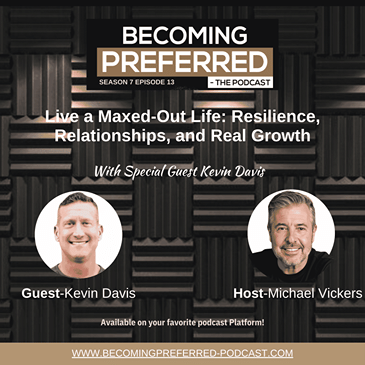
SEASON: 7 EPISODE: 13
Episode Overview:
Welcome back to the Becoming Preferred Podcast. In this episode, we’re exploring what it truly takes to optimize performance without sacrificing the things that matter most.
Our guest today is Kevin Davis. Entrepreneur, speaker, and founder of Maxed Out Life. Kevin’s built and scaled businesses across tech, fitness, automotive, and coaching, but his approach isn't about working yourself into burnout. It’s about operational discipline, resilience under fire, and radical clarity.
Whether he’s breaking down how to turn personal setbacks into strategic strengths, or how to maintain full presence at home while running high-stakes operations, Kevin brings a practical, zero-BS framework for leading a high-impact life.
If you’re looking to scale your business, sharpen your leadership, and maximize your potential across career and life, you’re in the right place. Please join me for my conversation with Kevin Davis.
Guest Bio:
Kevin is a 53-year-old Christ-follower, lifelong entrepreneur, father of two daughters, and husband to Michelle...his first and only love.
Early in their marriage, Kevin nearly lost it all. Chasing career success, he buried himself in work while his wife and newborn daughter waited for a husband and father who wasn't really there. It took a single ultimatum from Michelle to wake him up.
"I married the love of my life, Michelle. An incredible woman who’s as strong and beautiful inside as she is out. We had big dreams, young energy, and a life of adventure ahead of us. But like a lot of men, I almost threw it all away."
He chose his marriage. He chose his family. Since that day, Kevin has built a marriage stronger than anything he dreamed of... full of passion, partnership, and purpose. Now he helps other men do the same.
Resource Links:
- Website: https://maxedoutlifebook.com/
- Product Link: www.maxedoutlifebook.com
Insight Gold Timestamps:
01:52 You've got an interesting title of the book that I believe came out this summer and is now live: How I Lost My Left Nut and Other Life Lessons: How to Live a Maxed Out Life
02:44 I basically started raising myself at 7
03:57 I couldn't drive yet, and so I hired high school kids that had licenses to work for me
04:55 I actually have two degrees, I have one in business and one in exercise physiology
07:54 You're always looking for opportunities to turn whatever's happening into a positive
09:28 I think work life balance is a myth
10:03 I use this thing called the threshold method for myself
12:07 In the book, I tell this story, and it's it's not a happy story for me to tell, except it's got a happy ending
13:23 My wife, she was like, Hey, I've got my stuff packed, would you like to continue to be married?
15:33 If you can no longer see your feet whenever you stand up to go pee, then that's a problem
17:24 Extending grace rather than keeping score
20:06 My intention is to be a servant to you as a person and see how I can help you do more in what you're doing and have a greater impact
23:09 This is an unpopular opinion...
27:32 Would your wife marry you again if you acted the way that you do
29:41 Fix it, be miserable, or end it
33:24 I say just do something until it becomes a habit and then do more
37:43 Let's look at your calendar for the last two weeks and see if that's true
38:40 I have this thing called the Activated Marriage Toolkit
40:38 You can't be pissed off and be grateful at the same time
43:14 We have a new coaching program called The Husband She Wants
43:56 The website is maxedoutlifebook.com
Connect Socially:
LinkedIn: https://www.linkedin.com/in/kevinbryandavis/
Facebook: https://www.facebook.com/maxedoutman
TikTok: https://www.tiktok.com/@kd_maxedoutman
Instagram: https://www.instagram.com/maxedoutkevin/
Maxed Out Man Podcast: www.maxedoutman.com/podcast
Email: kevin@maxedoutman.com
Sponsors:
Rainmaker LeadGen Platform Demo: https://calendar.summit-learning.com/widget/booking/JKItVP7WErmCBjU2cCIx
Rainmaker Digital Solutions: https://www.rainmakerdigitalsolutions.com/
In 3, 2, 1.
Speaker BWelcome back to the Becoming Preferred podcast.
Speaker BIn this episode, we're exploring what it truly takes to optimize performance without sacrificing the things that matter most.
Speaker BOur guest today is Kevin Davis, entrepreneur, speaker and founder of Maxed Out Life.
Speaker BKevin's built and scaled businesses across tech, fitness, automotive and coaching.
Speaker BBut his approach isn't about working yourself into burnout.
Speaker BIs about operational discipline, resilience under fire, and radical clarity.
Speaker BWhether he's breaking down, how to turn personal setbacks into strategic strengths, or how to maintain full presence at home while running high stakes operations, Kevin brings a practical 0Bs framework for leading a high impact life.
Speaker BIf you're looking to scale your business, sharpen your leadership and maximize your potential across career and life, you're in the right place.
Speaker BPlease join me for my conversation with Kevin Davis.
Speaker CWell, hi Kevin.
Speaker BWelcome to the program.
Speaker CWe're delighted to have you.
Speaker AThank you so much.
Speaker AMan, I cannot wait for this episode.
Speaker CNow, where are we speaking to you from?
Speaker CWhere's home?
Speaker AI'm here in Bozeman, Montana, outside of Bozeman.
Speaker AYou know, home of the Yellowstone show.
Speaker AAnd I joke and say we don't kill nearly the many people that they do on the show.
Speaker CBut you don't go to the train station.
Speaker ANo, we do not.
Speaker ANot in that way.
Speaker AAlthough my wife does watch a lot of true crime.
Speaker ASo my friends have to do wellness checks on me all the.
Speaker CSo my wife does too.
Speaker CI think we have a lot.
Speaker CYour wife, Michelle.
Speaker CMy wife Beth, she loves the true crime things.
Speaker CI think she's getting ideas and inspiration sometimes 100% and she knows how to dispose of the body.
Speaker CBut hey, we don't know what happened to him.
Speaker AYeah, just he's gone.
Speaker AI don't know.
Speaker AHe, he went on, he took on his motorcycle out and he never came back.
Speaker ADon't know.
Speaker CThat's right.
Speaker CWell, I'm excited about talking about your, your book.
Speaker CYou've got an interesting title of the book I believe came out this summer and is now live How I Lost My Left Nut and Other Life Lessons and How to Live a Max out Life.
Speaker CAnd it sounds kind of worse than it is.
Speaker CAnd we're going to get into all of that.
Speaker CBut before we go there, our listeners always like to know how you got to be where you are.
Speaker CSo let's go back to high school.
Speaker CYou're in high school, you know, you're a sport, you're a normal kid.
Speaker CWell, you probably weren't a normal kid because I know you started your first business at entrepreneur at 15.
Speaker CBut let's go back to where maybe that dream, what started that process, what made you think, hey, I got to start my own business.
Speaker CAnd because I'm interested in the mindset that you had at that time and.
Speaker CAnd then going through school, some of your choices to get Kevin where he is today.
Speaker AWell, we could probably take a step back and go four or five years back.
Speaker AI actually have won a very dysfunctional, like, trailer trash, you know, drug addicted mother, all that stuff.
Speaker AAnd so I basically started raising myself at seven.
Speaker AAnd a lot of people say that, but like, I literally.
Speaker AShe would disappear for 10 to 14 days at a time.
Speaker ASo I went to school on my own, found my own.
Speaker ABut I'm like, Kevin, the other Kevin from Christmas or from the, you know, Christmas vacate.
Speaker AWhat was it?
Speaker CYeah, Home alone.
Speaker AYeah.
Speaker ASo from Home Alone, he's going grocery shopping is all that stuff.
Speaker AAnd so that was kind of.
Speaker DYeah.
Speaker AMacaulay Culkin.
Speaker ASo that was kind of me whenever I was in that seven, eight years old range.
Speaker AAnd.
Speaker AAnd so I almost call it the entrepreneurial approach to survival or to life.
Speaker ABecause you're dealing with failure, you're solving problems, you're figuring out what to do, and you're just g S D. Right.
Speaker AGetting crap done.
Speaker AAnd so that kind of became my life.
Speaker AAnd eventually I ended up.
Speaker AI could choose where I wanted to live.
Speaker AIn Texas at that time, where we lived, you could literally, like, the mom always got custody, but then at 12, you get to go and choose.
Speaker ASo I went, went to live with my dad and stepmother, which was like the best of two bad worlds, but started working.
Speaker AI did my first application when I was 14, and when I'm 15, I said, Hey, I could make more money in the summertime.
Speaker ASo I started a landscaping business.
Speaker AI couldn't drive yet, and so I hired high school kids that had licenses.
Speaker CTo work for me.
Speaker AAnd so that began my kind of entrepreneurial journey.
Speaker AAnd it also created a little bit of issues which are part of my story also, which is too much work and workaholism and escapism.
Speaker CWell, that's.
Speaker CWell, I think we had a similar foundation.
Speaker CI remember renting a rototiller when I was about 12 for 50 bucks a week.
Speaker CThen going around to all the neighbors and rototillering their gardens for 10 bucks.
Speaker ANice.
Speaker CAnd I could make 50 bucks a day and then turn back the equipment again.
Speaker CSo I never had any capital to put out in the equipment.
Speaker CBut I totally get it.
Speaker CSo that makes it.
Speaker CWell, that's interesting.
Speaker CSo now you're going to university.
Speaker CWhat was the dream?
Speaker AYeah, so we were fortunate.
Speaker AI lived in Stillwater, which is where Oklahoma State is, and we got to do concurrent enrollment.
Speaker ASo I actually took one class my senior year of high school in high school and I took 17 hours in college.
Speaker ASo I took a full load in college.
Speaker AI was able to kind of go down that road.
Speaker AI'm always been interested in fitness.
Speaker ASo I actually have two degrees.
Speaker AI have one in business and one in exercise physiology.
Speaker AAnd then after college began my career and ran health clubs.
Speaker AI was a personal trainer and got my first club at 21, which was a 51,000 square feet, $10 million health club.
Speaker ASo they gave this kid, you know, I was the operations manager.
Speaker ASo I ran the whole club.
Speaker AAnd so that was an interesting kind of point in my life.
Speaker AAnd, and if anybody knows anything about the fitness industry, your Life is basically 5am to 9am, 11 to 1 and 5pm to 9pm, which does not work.
Speaker AYou know, to try to raise a family.
Speaker AWe started having our first kid and I went to work for a dot com company in the fitness industry and software.
Speaker CWow.
Speaker CWell, that's.
Speaker CWell, you've been doing it for, like I say, over 30 years.
Speaker CSo let's kind of get into it.
Speaker CThe title of your book is really interesting.
Speaker CIt's How I My Left Nut and other Life Lessons.
Speaker CHow to Live a Maxed Out Life.
Speaker CLet's talk about the left Nut because I think it's in your book Life Lessons.
Speaker CYou candidly write about surviving a major motorcycle accident and turning the experience into a lesson in resilience.
Speaker CI want to hear about that.
Speaker CBut how can high performing leaders apply that mindset when an unexpected business crisis threatens to derail them?
Speaker AWell, I mean, I think that it's funny, you know, this is my personality.
Speaker AThe title of the book is My Personality.
Speaker AI'm always looking to have fun.
Speaker AI do keynotes about life is supposed to be fun.
Speaker AWe can talk more about that.
Speaker ABut for me, anything that has happened, and the book is really 17 crazy stories about what has happened in our life out of probably thousands.
Speaker ALike just the craziest stuff happens to us, good and bad.
Speaker AAnd I always look for the opportunity to have fun and see whether or not I can make, you know, the whole cliche, which is lemons out of.
Speaker AOr lemonade out of lemons.
Speaker ARight.
Speaker AAnd, and that's kind of my attitude.
Speaker AI'm just so adaptive and I think part of it is my upbringing or black thereof.
Speaker ABut taking something like the motorcycle accident, one of the funniest parts of that story is, and I don't even know that I wrote about it, but it is that it's a very rare injury.
Speaker ASo to have.
Speaker AI fractured my left testicle, if, you know, spoil, spoiler, spoiler alert.
Speaker ABut I did leave a dent in the gas tank.
Speaker ASo explain the physics of that.
Speaker AYeah, but it's a rare injury, so all of the interns and the new doctors and all that wanted to see this injury.
Speaker ASo, you know, and so like my wife was like, would you please stop showing people your private parts?
Speaker ABecause I would just be like, hey, can we see this?
Speaker AThere's like 15, 20 year old and, you know, 25 year old interns and I'm lifting up my gown and the workaholic aspect comes in because I actually went to work like three days later, I had a ice pack diaper on, and I was sitting in my office.
Speaker ABut the whole thing is, it was, it was such a crazy experience.
Speaker ABut my next thought was, okay, well, I wrecked my motorcycle.
Speaker AWhat parts do I need to rebuild it?
Speaker ASo I bought all the parts I needed, I rebuild it, I sold it for a profit.
Speaker AAnd so that to me is a big part of that resilience that you're always looking for.
Speaker AOpportunities to turn whatever's happening into a positive.
Speaker CYeah, well, like you said, it's making lemonade out of lemons.
Speaker CAnd when we look at things in their moment, what we're lacking, I think, is perspective, don't you think?
Speaker CLike, we need time and distance to know whether this was a good thing or whether this was a bad thing.
Speaker CIn the moments we look at it go, this is terrible.
Speaker CBut then had that not happened, this, you know, the pandemic comes to mind.
Speaker CI remember As a speaker, 2020, everything canceled, right?
Speaker CEverything canceled.
Speaker CWe lost our other people.
Speaker CIt was great for them.
Speaker CFor speakers, it was terrible.
Speaker CAnd I was recession proof as a speaker because I focus on generating revenue.
Speaker CThat's what our whole revenue enablement and becoming preferred.
Speaker CBut I wasn't, I wasn't pandemic proof.
Speaker CAnd all of a sudden we had to look at solutions again in which we could rebuild our business and take from what.
Speaker CSo we started teaching people how to do zoom meetings, how to, and it created presentation skills, then it created and it went on from there to create software.
Speaker CSo I agree with you.
Speaker CIt's.
Speaker CI think it's that mindset where other people, maybe that's the end of the road for them.
Speaker CThey find a bottle somewhere or, hey, their careers are over.
Speaker CAnd that's how they identify.
Speaker CSo I think that makes good sense.
Speaker COn the mindset part, let's talk about the mechanics of what you call active presence and engagement.
Speaker CAnd so in you, you talk about the danger of being physically present but mentally checked out.
Speaker CSo training real connection for workplace productivity.
Speaker CSo for driven executives, what practical habits ensure that they remain engaged at home but without sacrificing their professional momentum?
Speaker AWell, and part of that for me is that I think work life balance is a myth.
Speaker AIt's just shifting.
Speaker AIt's just shifting of priorities.
Speaker ARight.
Speaker AAnd it's one of the problems that we have, and myself included, back early in my career, is it's hard to have those priorities set straight.
Speaker AAnd I think one of the things about making sure that you stay is just being very mindful about what role you're in at any given time.
Speaker AYou know, you want to be the best husband and father that you can be at home.
Speaker AYou want to be the best executive entrepreneur, whatever, when you're at work.
Speaker AAnd those things in many ways need a separation and sometimes even mental separation.
Speaker AAnd I use this thing called the threshold method for myself.
Speaker AAnd I also teach my coaching clients the same thing.
Speaker AWhen you get to that threshold of your door going from the garage or from outside going into your home, take 30 seconds, actually mentally or physically change your hat if you wear hats.
Speaker ABut you're now shifting from the role of, I've been at work all day, I'm talking about KPIs and all that kind of stuff.
Speaker AAnd now I'm going to be husband and father.
Speaker AAnd that's a different kind of thing.
Speaker AI don't use the phrase, hey, honey, what's the KPI on raising our kids?
Speaker ALike, I don't do that.
Speaker ASo, like, you have to turn that language.
Speaker AYour language is different.
Speaker AYour accountant is different, Your mentality is different.
Speaker AAnd I think that's just as an example, one of the ways that we can stay fully engaged.
Speaker AI mean, keep your phone either in the car or somewhere.
Speaker AYou don't need it.
Speaker AAlmost never is there something happening at 7pm you know, caveats included that can't wait till tomorrow morning.
Speaker AYou know, I just, I've got four businesses, I have eight brands.
Speaker AI run consulting and coaching.
Speaker AAnd, you know, all of the stuff that I do, and I find that over 30 years, I can, I can turn those things on.
Speaker CNo, I admire that.
Speaker CThat's something I need to read about.
Speaker CIt's having those, those boundaries and creating those boundaries for yourself, I think, and I, and I agree with you on the work life balance.
Speaker CIt's a.
Speaker CIt's funny you use the term hats.
Speaker CI always say there's three hats we wear.
Speaker CThere's our boyfriend, girlfriend hat, which was.
Speaker CMy wife and I, that was our first relationship, was boyfriend, girlfriend.
Speaker CThen it was husband and wife hat.
Speaker CWe have that hat on.
Speaker CAnd then the third hat is mom and dad hat.
Speaker CAnd now we probably added a fourth hat, which is nana and papa hat.
Speaker CAnd now the grandbabies are coming, and so I have to shift gears.
Speaker CAnd for me, it isn't mentally shifting gears.
Speaker CI have to actually, where am I at, what I'm doing?
Speaker CWhat's my role?
Speaker CWhat should I be doing now?
Speaker CWhat were the.
Speaker CSome of the symptoms?
Speaker CBecause you weren't always this way.
Speaker CYou had the motorcycle event, of course that happened.
Speaker CYou're newly married, where there's some symptoms, some warning signs, some fear of God coming from Michelle that, hey, I know you can fix motorcycles now.
Speaker CYou need to revive this as well.
Speaker AYeah, Yeah.
Speaker AI mean, really, like in.
Speaker AIn the book, I tell this story, and it's.
Speaker AIt's not a happy story for me to tell, except for it's got a happy ending that continues to be happy.
Speaker ABut when I went to work for the dot com company and I helped grow it from 18 to over 300 employees, the money was flowing like milk and honey.
Speaker AYou know, that whole time period was.
Speaker AWas crazy.
Speaker ABut I was responsible for.
Speaker AI did corporate training at the time and some operations stuff.
Speaker CAnd.
Speaker AAnd at the time, I was responsible.
Speaker AAnd this was in Connecticut, but I was responsible for everything west of the Mississippi, which is a lot of territory.
Speaker AI used to wake up back in the day when they had yellow pages in the hotel room.
Speaker AIt's like, all right, what town am I in?
Speaker ALike, I don't even know where I'm at.
Speaker ASo six days a week travel, and I just kind of abandoned my family.
Speaker ABut the.
Speaker AThe hardest part of that story for me to tell is that I was really good at my job, but had no idea how to be a dad or a husband.
Speaker AAnd so Tony Robbins talks about leaving, you know, seeking pleasure and.
Speaker AAnd avoiding pain.
Speaker AAnd that's essentially what I think, many of us, myself included, which is I had the pain and struggle and frustration of being a new dad and new husband, but I was really freaking good at my job, and everybody told me how good I was at my job.
Speaker ASo it was success and dopamine.
Speaker AAnd we weren't talking about dopamine back in the 90s, but that was essentially what happened.
Speaker AAnd so my wife, she was like, hey, I'VE got my stuff packed.
Speaker AWould you like to continue to be married?
Speaker AAnd.
Speaker AAnd it was crazy.
Speaker AAnd for me, it was a God given epiphany moment where I was, I.
Speaker AThey talk about turning a 180 and I don't know anyone that has had that experience as strongly as I did.
Speaker ALike, I instantly, it's like my whole life flashed before my eyes and I saw my failures and I.
Speaker ABut as an entrepreneur, I'm like, all right, find the problem, fix the problem.
Speaker AAnd I did.
Speaker AAnd honestly, it's a crazy story because I ended up getting everything I wanted.
Speaker AI got my cake and got to eat it too, which is my wife and family.
Speaker ABut then I got a promotion at work and got to have more responsibility with no travel.
Speaker AIt's a crazy story, but that essentially is my story.
Speaker AIt's like, all right, well, now how do I teach men of all ages, even younger guys especially, like, how do you go through things like that and how do you set those priorities?
Speaker AYou mentioned before that you got married at 22 with your first marriage.
Speaker AAnd we got married at 21 and 22.
Speaker AAnd we've grown up together.
Speaker CYeah.
Speaker ASo, you know, there was a certain time when we crossed that threshold where we've been together longer than we were apart in our lives.
Speaker ABut it took work, right?
Speaker AIt's been constant work over the years.
Speaker CYeah, I think it does work, and it's because you're both evolving.
Speaker CAnd what's interesting is you've, you've been evolving.
Speaker CAnd I see women evolving.
Speaker CThey're.
Speaker CThey're always trying to make themselves better.
Speaker CAnd I don't see that with men so much.
Speaker CI see certain men doing it.
Speaker CYou know, they're growing and that.
Speaker CBut why are they doing that?
Speaker CWhy are they evolving and other people that don't?
Speaker CSo when it comes to workplace pressure and burnout, what were some of the warning signs or what are some of the warning signs that indicate whether an executive may be overextending and how they should navigate that conversation with their partners?
Speaker AWell, to me, I think it's easy as long as you're self aware in terms of yourself.
Speaker ALike, you know, you're 30.
Speaker AThe way we say it is you're crushing it at work.
Speaker ARight.
Speaker AYour business is going well, everything's going good.
Speaker AYou sleep like crap, you eat like crap, you look like crap, you feel like crap.
Speaker ARight.
Speaker ALike, take any of those or all of those and put them together and then you like that is a sense if you can no longer of your feet whenever you stand up to Go pee.
Speaker AThen that's a problem.
Speaker ARight.
Speaker ALike this.
Speaker ALet.
Speaker AYeah, let's.
Speaker AAnd in Oklahoma, we use other language for that, but we'll just use.
Speaker AWe'll just use feet.
Speaker AAnd so, you know, if you really just sit and think about whether or not you're living your optimized or maxed out life, as we call it, you know that that's true.
Speaker AAnd you're just unwilling to admit it usually.
Speaker AAnd then.
Speaker ABecause that requires change.
Speaker CYeah.
Speaker AAnd I look at both our, our lives, our health, our fitness, our mindset, all of those things are.
Speaker AIf we treated those the same way we treat our business, we'd be fully optimized.
Speaker AMarriage is the same way in terms of like, all right, if there's a problem, we work through it, we figure out a solution to make it better.
Speaker AAnd you know, at home, the conversations are really easy.
Speaker AIt's quiet at dinner, you're on your phone, she's on her phone, the kids are on their phones.
Speaker AShe's more irritated with you or you're more irritated with her.
Speaker AYou're not growing.
Speaker AYou don't have date nights, you don't have intimacy, you haven't had sex in three months or your sex life is, you know, terrible or ho hum or whatever.
Speaker ALike it's all these symptoms, you know, if I said, well, what's it like to have cancer?
Speaker AAnd you could list all the symptoms.
Speaker BRight.
Speaker AYour life, burnout and being out of priority is a big one.
Speaker CYeah.
Speaker CI think the best version of you ought to show up.
Speaker CIf the best version of you is showing up at any given time, then that synergy that comes from those relationships, I think are powerful.
Speaker CWell, and you talk about applying grace and partnership in professional relationships.
Speaker CSo a key pillar of your work with couples is the concept of sending grace rather than keeping score.
Speaker CI want to unpack that because I think there's some insights that would be useful.
Speaker CHow can entrepreneurs and business leaders apply the same principle as well to build stronger, more resilient workplace relationships?
Speaker CSo let's start on the personal side and unpack that.
Speaker CSending grace rather than keeping score.
Speaker CAnd then how do we apply that in the workforce?
Speaker AWell, I think really on both of them, it's having a servant, servant leadership, heart, which is a lot what we.
Speaker ATrue.
Speaker ABecause if I'm serving other people, there is no quid pro quo.
Speaker AAnd so in your relationship, I mean, unless you're only married for a couple of years as you go along, if you're keeping score, that score gets crazy over time.
Speaker AI mean, I've been married for 31 years.
Speaker AI've been together with my wife for 33.
Speaker AAnd the scorecard would be immeasurable.
Speaker ALike, of all if, if we kept all the stupid, I mean, just my side, all the stupid crap that I say on a regular basis or dumb things that I do or, you know, half hearted comments or just not being engaged or all of those things, the scorecard gets out of, out of control really quickly.
Speaker AWhereas if I then look at the positives and I look at things like how can I serve my wife in the best way possible?
Speaker AI use this phrase called getting your PhD and it works for husbands or wives, but it's pursuing her or pursuing his desires.
Speaker AAnd what I mean by it's getting your doctorate, right?
Speaker ALike, it's, it's the maximum education that you can get.
Speaker ABut it really is a matter of how do I know her almost better than she knows herself.
Speaker ABecause then if I know her, I'm not keeping score.
Speaker AI'm constantly learning about her.
Speaker AAnd you mentioned, you mentioned basically, you know, men not really trying to grow themselves over time and how women typically do more.
Speaker AMy wife is a welder, she's a boxer, she builds race cars, she does, you know, all this different stuff.
Speaker AAnd she was talking yesterday about, I just have too many things I want to learn.
Speaker AI feel like I'm kind of racing, racing to learn all these things at one time.
Speaker ABut I think it's the same way whenever you look at business and entrepreneurship and work relationships.
Speaker AI teach about networking events.
Speaker AAnd so if you go to a networking event, most of us do this thing where it's like, hey, Mike, nice to meet you.
Speaker ATell me what you do.
Speaker AAnd then while you're telling me all I'm doing is trying to figure out a way that I can tell you what I am and what I do and how cool I am.
Speaker ARight.
Speaker ALike, try to get that angle.
Speaker ABecause we're narcissists at the core.
Speaker AWe're all narcissists.
Speaker AWe're all ego driven, you know, yeah, it's all about me.
Speaker ABut if I say, okay, how can I possibly serve Mike and Michael in this, in this conversation?
Speaker AAnd I look for those opportunities, if you're saying, hey, I do this, I do public, I do keynote speak, hey, I, I know a couple of guys that help companies find speakers for their events.
Speaker ALike, how can I connect you?
Speaker AHow can I hook you up?
Speaker ASo that changes the dynamic and it changes the whole vibe because there's no quid pro quo.
Speaker ALike, you may ask me what I'm doing and you may reciprocate, but the intention.
Speaker AThat's not my intention.
Speaker AMy intention is to be a servant to you as a person and see how I can help you do more in what you're doing and have a greater.
Speaker CNo, that's, that's powerful and it's coming from contribution, what you're saying versus what's in it for me?
Speaker CWhat can I take out of this?
Speaker CWhere most people go in there and go from a self serving perspective.
Speaker CYou know, it's interesting you say it that way.
Speaker CI have a mantra I use when I'm speaking to get me into the same space and it's six words.
Speaker CHeal the space, heal the room.
Speaker CAnd the space is around me.
Speaker CIt's with you and me right now.
Speaker CAnd then the room is the room but without attachment.
Speaker CThat the room or the space needs healing.
Speaker CBut what it does is it puts me into a servitude mode to where I'm going.
Speaker CYou know what, there's people in this audience tonight that are.
Speaker CI've lost someone this week.
Speaker CThere's people in this audience that are going through a tough time.
Speaker CThey're in a bad marriage, their work, they're worried, they're scared if there's something I can do to reach out to them and it puts me into hey, I'm not the best thing since sliced bread mode, into more of a servitude mode and to give to it.
Speaker CSo I take that same approach and it changes the vibe and the receiving end of it is good.
Speaker CThe connections with the audiences are better, the authenticity is better, the flow is better.
Speaker CAnd I think that's what you're saying is when we go into situation and even as a leadership role we should be going into it from how can I help serve my employee?
Speaker CHow can I serve my team?
Speaker CHow can I?
Speaker CAnd I think it's a nice approach or even serving our partner and our children.
Speaker CSo terrific, terrific insight.
Speaker DAre you tired of chasing leads and ready to start effortlessly attracting more high value clients in life?
Speaker DYour introducing Rainmaker Lead Gen, the ultimate sales, engagement and client acquisition platform that takes the stress out of outreach.
Speaker DWith Rainmaker Lead Gen, you can easily identify, engage, educate and convert your ideal prospects into loyal clients.
Speaker DOur industry leading automation and email sequencing empowers you to reach more ideal clients, accelerate the sales cycle and close more business business.
Speaker DImagine authentically engaging with your prospects while the platform handles the heavy lifting.
Speaker DSay goodbye to the endless hustle and embrace a more efficient, effective approach to business development.
Speaker DReady to witness the magic.
Speaker DBook a 20 minute demo today and See how Rainmaker Lead Gen can revolutionize and level up your client acquisition game.
Speaker DThere's nothing to lose and everything to gain.
Speaker DDon't miss out on this opportunity to supercharge your client acquisition process.
Speaker DVisit rainmakerdigitalsolutions.com or check out the link in the show notes to book your demo.
Speaker DRainmaker Lead Gen.
Speaker DSpend less time hunting for your ideal clients and more time having high value sales conversations with your ideal clients.
Speaker BAnd now back to my conversation with Kevin Davis.
Speaker CSo let's talk about building intentionality for the next generation.
Speaker CSo in your book How I Lost my Left Nut, you detailed your commitment to creating stability and presence for your daughters.
Speaker CHow can busy working parents balance high stake careers with building a lasting family legacy?
Speaker AWell, this is an unpopular opinion.
Speaker AYou know, you see those on Instagram And Facebook and TikTok, you know the unpopular opinion and it'll give you the thing which is make your marriage a higher priority than anything else.
Speaker AAnd people don't like that a lot of times, especially women.
Speaker AMoms typically don't like to hear that.
Speaker ABut I, I have anecdotal and proof for my own life and proof that I've of a lot of people that I've worked with and a lot of people I've talked to that have successful relationships, especially if you make the kids the priority.
Speaker AThey're gone at 17 or 18 years and then what are you left with?
Speaker AYou haven't, you haven't built a marriage.
Speaker AYou're not really, you know, you spend too much time thinking about them and, and all that.
Speaker AAnd it's happening right now.
Speaker ASo we're in, you know, in mid September.
Speaker ARight.
Speaker AAnd so all you see on social media, all these people lamenting about how their kids have left home and are going to college.
Speaker AI don't know how I'm going to do it.
Speaker AAnd we've dealt with a lot of couples in that, in that time frame.
Speaker AAnd it's usually that's when a lot of divorces happen.
Speaker AEven statistically that 18 to 20, 22 years because they look at their spouse and they're like, I don't know what we do.
Speaker ALike, can we talk about the kids now and what they're doing in college and university.
Speaker AFor Michelle and I, dude, it's empty.
Speaker ANesting is the most awesome thing ever.
Speaker CI hear you.
Speaker AI joke and say I hardly wear pants now.
Speaker ALike it's, you know, I mean, but, but it really.
Speaker ABecause we had spent all those years.
Speaker CYeah.
Speaker ADeveloping our one to one relationship and I used to joke with my Girls and say, I'll make two more that look just like you.
Speaker AYou don't mess with your.
Speaker ADon't mess with my wife.
Speaker AAnd I want to make that distinction because I never use that phrase.
Speaker AI almost accidentally did, but I never used the phrase, don't talk to your mother that way.
Speaker AIt's.
Speaker AYou don't talk to my wife that way.
Speaker AWhich.
Speaker AWhich changes that dynamic between the two, because I will absolutely go off on you if you.
Speaker AAnd this is my kids or anybody else in the world.
Speaker ABut I have in the book, there's a copy of a text that my youngest sent me, and she was probably in her early 20s at the.
Speaker ABut she essentially said, I loved and felt so much peace and comfort knowing that we weren't number one, that mom was more important, because unlike so many of our friends, we knew 100% that that was solid.
Speaker CYeah.
Speaker ASo it has this.
Speaker AAnd this is what people don't understand is, like, you provide this foundation where the kids.
Speaker AThe world does not revolve around your children.
Speaker AYou know, and we can.
Speaker AWe could talk about narcissism and kids and, you know, like, you know, all that stuff too.
Speaker ABut that's.
Speaker AThat' definitely a big one.
Speaker CI understand the mother's instincts and the kids.
Speaker CSo it's.
Speaker CThey always have to balance everything.
Speaker CAnd, you know, I'm reminded of that saying that, you know, they were interviewing Ginger Rogers.
Speaker CWhat's it like being one of the greatest dancers of all time?
Speaker CAnd.
Speaker CAnd she says to the person interviewing her, and she says, well, I have to do everything he does, but backwards and in heels.
Speaker AAnd so I love that.
Speaker CSo it's.
Speaker CIt's kind of.
Speaker CThey're juggling all these balls.
Speaker CThey're exhausted.
Speaker CThey've had kids all day, you know, dealing with lunches, maybe little toddlers.
Speaker CAnd then all of a sudden, in walks, boy has different expectations or whatever, and she's exhausted.
Speaker CSo I think it requires communication, but to your point, by making time, helping out with the chores, doing those things, not waiting for her to do everything, take care of it, make some space and create some space for dialogue, communication, and sometimes just connecting.
Speaker CI think that can go a long way, don't you?
Speaker AYeah, for sure.
Speaker AI actually refer to my wife as my bride, typically, or hot wife, smoke show, which is her name, name in my phone.
Speaker ABut I also do something interesting.
Speaker AYou know, if I look over to my right in office here, there's a picture of my wife, my bride, when she was about 8 years old, and she's holding this little fish, and she's innocent and all that.
Speaker AAnd so I actually put that up there because I need to remember that there's a little girl inside of her.
Speaker CThat's right.
Speaker AAnd would I talk to that little girl in a mean way, or would I do everything I can to care for her and to make sure her needs are met?
Speaker AAnd so that's, for me, it's a.
Speaker AIt's a mental and visual reminder.
Speaker ABut I think I love the girlfriend boyfriend thing because we date.
Speaker AWe're supposed to date.
Speaker AAnd.
Speaker AAnd why do men or women.
Speaker ABoth.
Speaker AWhy do you stop doing the things that you did in order to woo that person?
Speaker AAnd I. I asked the question.
Speaker AI'm usually, I'm kind of a stab you in your face kind of coach, but I'm like, would your wife marry you again if you acted the way that you do right now?
Speaker AAnd most of the time it's no.
Speaker AAnd so.
Speaker AAll right, well, let's change those actions.
Speaker ALet's do something different.
Speaker CWell, let's talk about doing something different.
Speaker CLet's say we've got listeners both sides of the fence.
Speaker CWe've got mal.
Speaker CFemales.
Speaker CWe got couples and people in relationships, and they're going, hey, we're stuck.
Speaker CWe maybe need some help or what can we do?
Speaker CWhat should be some of the first steps that maybe he can take and what sort of some of the things that maybe she could take?
Speaker AYou know, I use this in a lot of different ways, but we all come to these points in our lives and sometimes multiple lives.
Speaker AI use it in context of fitness a lot of times, but it works in marriage as well, which is that's enough of this shit moments, right?
Speaker ALike, you just are like, all right, you have to decide that this, what we call is a mediocre marriage.
Speaker ALike, you're just tired of having mediocrity or marginal marriage or whatever you want to call it.
Speaker AAnd so you have to then, especially business people, whether your wife, you know, or a husband, you have to take steps and take deliberate action to fix the things.
Speaker AAnd a lot of times it's the first step.
Speaker AAnd some of the hardest steps that we take are just having the hard conversations, you know, And.
Speaker AAnd, you know, we use it in with sexual relationships a lot.
Speaker AIt's like, all right, well, your wife hates having sex with you and she's hated it for 20 years, and you have no idea why.
Speaker AAnd you think you're great.
Speaker AYou're probably not.
Speaker ASo find out.
Speaker ALike, I did a video that said you're not as good as a lover as you think you Are.
Speaker AAnd it's true for all of us, which is like, how can I serve you better in that way?
Speaker ABut then, how can I serve you better in our every day?
Speaker AAnd Dan Martell talks about this a lot with his wife Renee.
Speaker AHe will ask her once a week, how can I show up better for you as a husband.
Speaker AHusband and vice versa.
Speaker AHow can I show up better for you as a wife this week based on what I did last week?
Speaker AAnd really, it's like, all right, well, these are some struggles I had with you last week.
Speaker AAnd I think if you worked through some of those things and we could do that.
Speaker ABut it really is.
Speaker AIt's so easy just to exist for a long, long time before at the end of the day, you say, that's.
Speaker AYou can say, that's enough of this crap and take two choices.
Speaker ARight.
Speaker AYou got two paths.
Speaker CYeah.
Speaker AFix it.
Speaker AWell, three.
Speaker AFix it, be miserable, or end it.
Speaker CEnd it.
Speaker AAnd I like the first one.
Speaker AThat's my favorite.
Speaker CAbsolutely.
Speaker CWell, 50% of the time, the first one fails.
Speaker CSecond marriages fail 70% of the time.
Speaker CAnd the third one's actually, it's 30% success rate.
Speaker COr I think everyone's just so broke, they're just.
Speaker CThey're going to stick it out.
Speaker CRight, Right.
Speaker ABroke or broken?
Speaker AProbably both.
Speaker CYeah, exactly.
Speaker CAnd I think you're right.
Speaker CAnd it's being able to talk and be vulnerable and being open and.
Speaker CAnd you know what?
Speaker CI think communication, like my wife says it best.
Speaker CShe goes, you know, we're a team.
Speaker CWe're business partners.
Speaker CThere's times I want to, you know, I know my teammate wants to Batman punch me and just, you know, and bite your tongue.
Speaker CAnd there's times I'm angry or mad as well.
Speaker CBut we have our roles.
Speaker CWe have our departments.
Speaker CWe've worked together for 30 years, and people say, how do you make that one work?
Speaker CWell, we have our departments.
Speaker CSo, like, for instance, grocery shopping and cooking.
Speaker CThat's one of my roles.
Speaker CThat's a role.
Speaker CShe doesn't like doing it.
Speaker CI love doing it, so it's good.
Speaker CShe loves fixing, repairing things.
Speaker CShe's, you know, bought her a big, beautiful workbench one year for Christmas with all the tools.
Speaker CAnd it's not uncommon for me to go out into the garage and go, honey, come on, let's go.
Speaker CDinner, five minutes, please.
Speaker CYou know, and so we got a bit of a reversal, but she.
Speaker CShe loves that kind of thing.
Speaker CAnd, you know, we show appreciation, and then we try and do things for each other.
Speaker CSo for as long as we've been together, just simple little things, even if we're kind of bugged.
Speaker CAnd I, you know, I learned this and I'll just tell you.
Speaker CWhen I was in.
Speaker CI was living in the.
Speaker CIn the barrier.
Speaker CI had a roommate and this guy, I didn't pick him, but he was my roommate living in Northern California.
Speaker CAnd he was the most annoying guy ever.
Speaker CHe was just.
Speaker CHe was just so annoying.
Speaker CAnd I just wanted to punch him.
Speaker CEvery time I saw him, just looking at him, I wanted to punch him.
Speaker CAnd I didn't, but it's.
Speaker CAnd then one day I thought, yeah, you know what?
Speaker CAnd I went into his closet, this is to your point, And I took out his shoes and I shined all his shoes for him.
Speaker CWell, the next day, mine were all done and he did mine and just that simple act.
Speaker CWe actually became friends almost instantly.
Speaker CIt was almost like all the nonsense went away and boom.
Speaker CAnd it just worked that way.
Speaker CSo like with my wife, I might be annoyed or bugged or she might be annoyed or bugged with me or part somebody work or dealing with an issue or whatever it is, but I always put toothpaste on her toothbrush every night.
Speaker ANice.
Speaker CAnd you know, those types of things, just those little things that, hey, I'm thinking of you, or she loves chocolate.
Speaker CI think that's how I got her in the first place.
Speaker CSo, you know, I wore with chocolate, really good chocolate.
Speaker CAnd that's.
Speaker CGive her her fix and she's smiling, happy.
Speaker CYou know, we always have a nice piece of chocolate.
Speaker CChocolate.
Speaker CBut I think it's doing something and it's giving of yourself, even when you don't feel like it.
Speaker CAnd I think that's the hard part.
Speaker CI think that's the part you're talking about with Grace.
Speaker CSo I think like you said, communication.
Speaker CLet's talk about the role of fitness in there.
Speaker CBecause this.
Speaker CI was in that trap where, like, I'm in my.
Speaker CWell into my 60s now, but I work out five, six times a week.
Speaker CI work on strength, I do work on my heart, but I didn't always.
Speaker CMatter of fact, when I was 50, that's kind of when, oh, you know, my blood pressure is getting high.
Speaker CI'm getting that.
Speaker CThat what you were talking about, you know, got that little dad bod going.
Speaker CAnd I thought, okay, I gotta get hold of this and get a grip of this.
Speaker CSo I started working out and building the habit.
Speaker CI walked for 14 months.
Speaker CI walked five miles a day.
Speaker CNever missed a day, right?
Speaker CAnd today I still, I've already walked this morning.
Speaker C5:15.
Speaker CI do three miles every day and then I'll do spin class.
Speaker CWhat do you recommend for somebody who's feeling stuck?
Speaker CMaybe what's a good place to start?
Speaker CYou know, hey, I can start doing this, start building habits.
Speaker CBecause it's really about.
Speaker CAbout.
Speaker CI don't even think it's about discipline.
Speaker CI think it's about habits and building some proper habits.
Speaker CWhat should someone start today to and how does that impact that spiritual, mental, you know, well, being as well?
Speaker AWell, I, you know, one of my buddies says it takes 66 days to build a new habit.
Speaker ARight.
Speaker AThat's what they say, you know, and, and there's always been this thing and I get a little bit unpopular, but it's like, just do something and do that for your rest of your life.
Speaker AI say just do something until it becomes a habit and then do more, you know, because being fit, especially as you get older, is hard.
Speaker AAnd I think that we have this little bit of a lie to where tell people, like, if you just get up and walk, you know, 10 minutes a day, you're going to be health, you know, you'll be healthier than you would if you didn't.
Speaker ABut you need to get in the weight room.
Speaker AYou need to actually do cardio.
Speaker AYou need to actually have flexibility.
Speaker ALike it's, you know, I spend, Michelle and I, we block out our calendar till 9am every day.
Speaker AAnd so we work out every single day and we do weights four days a week.
Speaker CWeek.
Speaker AI'm a, I love lifting heavy things.
Speaker AAnd if you're a woman listening to this, I don't care what age you are, get in the weight room.
Speaker ADo not listen to anyone that tells you that cardio is fine.
Speaker AMy wife is right in that perimenopause stage and she lifts.
Speaker AShe's got more muscle now than she's had in her whole life.
Speaker AAnd that's the secret to longevity.
Speaker ABut if you're a person that's like, I just feel like crap, I don't know what to do.
Speaker AStart with small changes.
Speaker AFirst of all, good sleep habits are good.
Speaker AThere's a, you know, know, don't eat within a couple hours of going to bed.
Speaker ATurn off anything that uses your brain within about an hour and then use blue, blah, you know, no phones, blue blockers, those kind of things to kind of help with those and set good hygiene.
Speaker AAnd so that's one getting whatever.
Speaker ASo for me, for my wife, it's nine to 10 hours.
Speaker AShe.
Speaker AWomen typically need more sleep than men.
Speaker CYeah, my wife's in that Camp too.
Speaker AYeah, And I'm usually, I do really well at like seven and a half, but typically get around seven.
Speaker ASo I work really hard to get that, that.
Speaker ABut it just makes a huge difference.
Speaker AAnd then, you know, again, going after walks, one really easy thing to do is do a 10 minute walk after every meal.
Speaker AIt helps with glycogen use and insulin sensitivity and digestion and, and it just helps you feel better and it kind of re.
Speaker AEnergizes you and then begin to increase it.
Speaker AGet in the weight room, get.
Speaker AIf you have no idea what you're doing, just get a trainer.
Speaker AAnd you don't have to have a trainer for the rest of your life.
Speaker AInvest in a trainer.
Speaker AOne of the ways that I used to do it as a trainer is I would come in, set up your new program for you, we'd meet for a couple of weeks and then you go do your thing.
Speaker AAnd 12 to 16 weeks later, blather, rinse, repeat, like, let's see where you are.
Speaker AI can answer questions in between.
Speaker AGetting a trainer is really important if you don't know what you're doing.
Speaker ALike if you, if you've been, if you were a high school athlete, kind of unlearn some of those things, but you can get in and you know the basics about it.
Speaker ABut weight training is a big one.
Speaker ABut start somewhere and you don't have to do everything at once.
Speaker AYou don't have to go run a mile, do weight training, do cold plunge, do sauna, do all the things that people do.
Speaker AIt's just a matter of starting and doing something.
Speaker AA buddy of mine talks about, like if you're a guy that eats McDonald's five days a week, you don't have to stop eating McDonald's like for the next two weeks, just eat four days a week and then two days a week and then one day and then yeah, occasionally.
Speaker AAnd that's just a really extreme example.
Speaker ABut, but that's, that's.
Speaker COh, it's good.
Speaker CExamples that we used to, you know, years ago, we'd kill a bottle of wine.
Speaker CWe're up in the Canadian office and it gets cold in the winter.
Speaker CWe kill a bottle of wine every night, Just sit down, relax, have a bottle of wine.
Speaker CAnd so the one day we went sugar, we thought, let's go sugar free for 30 days.
Speaker CWhich meant no wine.
Speaker ANo wine.
Speaker AYeah.
Speaker CWell, I, without changing a thing a lot, 12 pounds came up.
Speaker CBoth we just went, whoa.
Speaker CAnd so that changed that dynamic right away.
Speaker CAnd we just, we never got, got, went back to that so we might, on a Friday or Saturday night, if we're out for dinner, might have a glass of wine or something and enjoy that.
Speaker CAnd we enjoy it, but it's not a daily occurrence anymore.
Speaker CAnd so to your point.
Speaker BYeah.
Speaker CTo do that, let's.
Speaker CLet's kind of just kind of wrap around building that foundation and why they all work together.
Speaker CSo you've got the.
Speaker CAs business owners, as entrepreneurs, as business executives.
Speaker CLike you said, there's no real balance to it.
Speaker CSo it's like if you're feeling like you're in a broken place or things just aren't right, or you're just.
Speaker CYou're just not happy because we ought to be happy.
Speaker CYou know, you want that rudder on your boat.
Speaker CWhat's a good place to start?
Speaker CWhat's.
Speaker CIs there, hey, do this first and then the rest.
Speaker CCome on.
Speaker CIs there one of those dynamics that's more important than others?
Speaker AI think one of them is just that self awareness.
Speaker AAnd, you know, back in the day, we used to say, if you want to know where you spend your money or, you know, all that, look at your checkbook.
Speaker AAnd now we.
Speaker ANow we don't use checkbooks.
Speaker ABut I use that in terms of time spent.
Speaker ASo if I ask most men, what are your top three priorities?
Speaker AThey'll say, you know, my wife, my family, God, my business.
Speaker AI'm like, all right, cool.
Speaker AWell, let's look at your calendar for the last two weeks and see if that's true.
Speaker AAnd you can do this on your own.
Speaker AAnd you have to take the no BS approach.
Speaker ARight.
Speaker AYou do not justify it.
Speaker AJust look at your calendar and tell me or tell yourself, are the priorities that I say or should be there?
Speaker AAre they there?
Speaker AAnd you're like, well, I haven't had a date night with my wife in six months or my husband in six months.
Speaker AI've been working till 8 or 9pm every night.
Speaker AI'm on my phone at midnight.
Speaker AYou know, all of those things, right.
Speaker AYou can.
Speaker AYou can take that.
Speaker AAnd so that's the first thing.
Speaker AAnd most of us, like, I don't think anyone listening to this would be like, oh, yeah, I'm totally in line and everything is great.
Speaker AI mean, even.
Speaker AEven someone that takes a lot of deliberate action, There are times in my calendar right now that I can say, okay, I need.
Speaker AI need to work through that and make that better.
Speaker AAnd then it's a matter of like, okay, well, whatever the biggest priority is and what I'm supposed to be doing, let's take and put those in action.
Speaker AAnd for most of us husbands and wives, it's just a date night.
Speaker ADo a date night once a week at least.
Speaker AAnd it's easy.
Speaker AIn the show notes we can.
Speaker AI have this thing called the activated marriage toolkit.
Speaker ASo we'll give it.
Speaker AAnd it actually has 101 date night ideas and 101 conversation starters for free.
Speaker ASo you guys can use those and no excuses, right?
Speaker AJust make one.
Speaker AMake a date night for that.
Speaker AThe other big thing that I do is I do and you know, it's a little woo.
Speaker ABut these gratitude journals.
Speaker CYeah, no.
Speaker AAnd so I literally every morning just get up for 10 minutes and do a gratitude journal journal.
Speaker AAnd it's literally just.
Speaker AI'm grateful for this.
Speaker AI'm grateful for this.
Speaker AI'm grateful for this.
Speaker AA trick that my buddy taught me is being grateful for things that haven't happened yet.
Speaker AIn other words, I have, I have a vision to where I want to officiate my daughter's wedding.
Speaker AI've done some officiating in the past and so actually say, okay, I'm, I'm grateful to be standing at the altar with my daughter, marrying her to this, you know, this man.
Speaker AAnd she has a, A kind of a pseudo fiance now.
Speaker AThey aren't fully engaged yet.
Speaker AAnd so like that's one thing I have revenue goals that I write.
Speaker AOkay, thank you.
Speaker AFor my first, you know, seven plus figure year.
Speaker AWhat, whatever these numbers are.
Speaker AAnd you know, do the same thing for your wife, but then.
Speaker AOr your relationship.
Speaker AAnd for me, what I will do is sometimes I'll just take a full day and I write usually two pages and in a little moleskin or whatever.
Speaker CYep, yep.
Speaker AAnd I'll just do it fully about one topic.
Speaker ALike for my spouse, you know, I'll write all these things.
Speaker AI'm grateful for her, but I actually did that one year.
Speaker AAnd this is a cool trick trick for either of you.
Speaker AI used to take 3 by 5.
Speaker AI took a year of 3 by 5 notebook card or note cards and I wrote something I love about her on those.
Speaker AAnd then I actually taped them around her vanity in her.
Speaker AWe have a big master bathroom, but around that and at the end of the year, so imagine she walks in, it's just all these cards, 300 plus cards that, that say how much like things that I specifically love her about.
Speaker AAnd then I put it in the book at the end of the year for Christmas, one of those like Shutter, Shutterfly or something like that.
Speaker ASo I designed the book and put that out there.
Speaker ABut that gratitude aspect, you can't be pissed off and be grateful at the same time.
Speaker AIt's just mentally impossible.
Speaker ASo that's a, that's a big thing is starting that gratitude.
Speaker APart of it is.
Speaker CWell, it's the two brains, right?
Speaker CYour amygdala is that fight or flight.
Speaker CYou're pissed off, you're angry, you're fighting.
Speaker CAnd the, your prefrontal cortex, you're thinking, you're reasoning and you're showing appreciation.
Speaker CYou actually have to ask yourself that question.
Speaker CYou know, I totally get the.
Speaker CWhat makes me laugh is some of the similarities are the journey we go through.
Speaker CI have a habit sometimes of not closing all the drawers in our bedroom like I do that.
Speaker CAnd my wife will say to me, she'll go hey, you're going to the gym today.
Speaker CAnd she asked work on that exercise worth your index finger there, that one, that muscle where you can, if you, if you don't mind.
Speaker CAnd so we laugh.
Speaker CWell, one day I was going out of town for about five days and while she was gone, I opened up all these drawers, all the cupboards, all in the.
Speaker CI don't.
Speaker CAll at different levels but I put a post it note on each one with a message about her, something about her and appreciate.
Speaker CSo to your point of the, you know, hundreds of them and I had all these.
Speaker CSo you walked into the bedroom and the post it notes everywhere.
Speaker CShe survived four days like that.
Speaker CShe said it was the hardest thing ever, but she loved it and she kept the notes.
Speaker ASo that's awesome.
Speaker CBut you know what?
Speaker CIt's remembering to play you're gonna do this anyway.
Speaker CAnd you know, I, I.
Speaker CEveryone has their own beliefs and their personal faith and their beliefs and I do know for sure that we have this period of time where on.
Speaker COn the planet.
Speaker CRight.
Speaker CAnd whatever comes next, great.
Speaker CIf there's something more fantastic.
Speaker CAnd I, you know, and I hope it's with her and my family but I do know I have some control over right now and in today's environment.
Speaker CSo it's what can I do today?
Speaker CWhat can I tell my kids?
Speaker CAnd one of the best things that you know, I, I saw this recently is you know, four or five times a day, even with colleagues, workers, family members, send them a quick little note, a text, no agenda attached.
Speaker CSo like a five by five, five days a week, five messages to some of your friends, reach out your business relationships, people in your network to your point and just say hey, just thinking about you.
Speaker CI really appreciate the fact that you do this.
Speaker CYou've inspired me on this or I love that post you had on this, something to give that appreciation because it tends to spiral us up when we're showing gratitude and to your point, which then it kind of is a vibe that just exudes.
Speaker CAnd most importantly, I think it's contagious, I. E. The stories that we, you know, we've talked about.
Speaker CNo, so, so great insights.
Speaker CWhat's next for you?
Speaker CYou're working on the book.
Speaker CYou've got.
Speaker CI know you got lots of different businesses for you.
Speaker CWhat do you want to be when you grow up?
Speaker AI haven't figured out what I want to be.
Speaker AI just know I'm not going to retire.
Speaker AMy wife asked me that and I'm like, I don't understand.
Speaker AI don't understand that word.
Speaker AWhat are you talking about?
Speaker AWe'll just do.
Speaker AWe'll just do more.
Speaker AYou know, I've been retired since I started working for myself, for the most part.
Speaker CYeah, exactly.
Speaker ABut for me, it's continuing to kind of get the message out about the book.
Speaker AWe have a new coaching program called the Husband She Wants, which we coach men.
Speaker ASo it's about becoming the.
Speaker ABecoming the man that she wants, which is, you know, safety, security, passion, all of the things that she wants from a husband, like, how do we help you be that?
Speaker AAnd so that's a.
Speaker AThat's a big thing for us.
Speaker AAnd then just continuing to try to be the best husband, father, and, you know, community person that I can honestly.
Speaker CWell, it's constant work, right?
Speaker CIt's constant work and it's setting those priorities and it's making those times and building them into your systems and building systems to support.
Speaker CYou do figure it out eventually, but it's, hey, why not figure it out now?
Speaker CAnd with the partner that you made that commitment to.
Speaker CKevin, this was great.
Speaker CKevin Davis, the book is called and the website is maxed out.
Speaker CLifebook.com.
Speaker CWe'll have everything in the show notes.
Speaker CThanks for your insights.
Speaker CSo much.
Speaker CWe can relate to and make us better human beings and better couples and better marriages.
Speaker CSo appreciate the work that you're doing.
Speaker CThanks for being our guest today, Kevin.
Speaker AThank you so much.
Speaker AThis was amazing.
Speaker AI appreciate it.
Speaker CIt.
Speaker BAs you are listening to this episode, what is one idea that you've heard that's caught your attention and why does it matter so much to you and who is one person who you can share that with, either sharing this episode or just sharing that insight that occurred to you while you were listening?
Speaker BPerhaps it is to shift your mindset from keeping score in your relationships to adopting a servant.
Speaker BHeart and focusing on how you can contribute to others.
Speaker BOr maybe it is building a lasting health routine that doesn't require an overnight overhaul.
Speaker BIt starts with small, consistent habits that compound over time.
Speaker BThank you for listening, for learning, and for investing in yourself so that you can become the best version of you.
Speaker BIf you found value in this episode, please write a review on Apple Podcasts.
Speaker BIf you haven't subscribed yet, please do so so you can get a new episode and start your week off right every Monday.
Speaker BUntil next time.
Speaker CThis podcast is created and associated with Summit Media.
Speaker CMy Executive producer is Beth Smith and Director of Research, Tori Smith.
Speaker CThe fee for the show is that you share it with friends when you find something useful or interesting.
Speaker CThis podcast is subject to copyright by Summit Media.
Speaker AGoodbye.