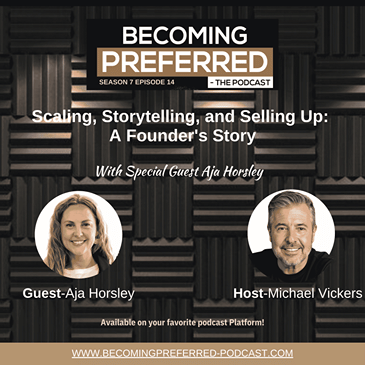
SEASON: 7 EPISODE: 14
Episode Overview:
Welcome back to Becoming Preferred, the podcast to level up your game and become the best version of you. Today, we’re exploring what it takes to turn scientific expertise into a market-disrupting consumer brand. And scale it all the way to a major acquisition.
Our guest today is Aja Horsley, an environmental scientist turned founder, who took a passion for pollinators and natural foods and built Drizzle Honey into an award-winning Consumer Packaged Goods brand across North America before being acquired by Wisdom Natural Brands.
Aja transformed a sleepy, commodity category into an innovative, functional, and purpose-driven brand. Today, she continues to lead Drizzle’s North American expansion, specializing in brand strategy, retail expansion, and Consumer Packaged Goods innovation.
Whether you’re looking to disrupt a traditional market, navigate national retail growth, or build a company with an exit in mind, Aja’s story offers an incredible playbook for building a brand customers truly love. Join me for my conversation with Aja Horsley.
Guest Bio:
Aja Horsley is the Founder of Drizzle Honey, a Canadian premium honey brand launched in 2016 with a mission to make raw honey more accessible, innovative, and sustainable. An Environmental Scientist by training, she transformed a passion for pollinators and natural foods into an award-winning consumer brand that expanded across Canada before being acquired by US based Wisdom Natural Brands.
Today, Aja leads the continued North American growth of the Drizzle brand, specializing in brand strategy, retail sales expansion, product innovation, and scaling purpose-driven consumer packaged goods.
Resource Links:
- Website: www.drizzlehoney.com
- Product Link: https://drizzlehoney.com/products/drizzle-turmeric-gold-honey?_pos=1&_sid=6176170cf&_ss=r
Insight Gold Timestamps:
02:43 I got my environmental science degree and just really fell in love with protecting the environment
06:09 There's a reason why they're called worker bees, is they work from sunup to sundown
07:59 I'm gonna tell you a story about why you should pay more for this
09:24 It has to be authentic
11:45 Building a cohort of other people, I think that's something that everybody needs to have
15:04 We really looked at who's our consumer
21:17 Build the business with the exit in mind
27:11 I do think there's a really beautiful place at the end of the acquisition where you can enjoy all that you've worked for
32:45 What role does social proof and digital storytelling play in driving velocity for a brand that is ultimately purchased at a physical level?
33:27 They say when you see a brand, you need to see it 7 times before you're going to purchase it
35:43 Become the preferred person yourself as much as the brand
Connect Socially:
LinkedIn: https://www.linkedin.com/in/aja-horsley-0044791a/
Facebook: https://www.facebook.com/drizzlehoneyproducts
Instagram: https://www.instagram.com/drizzle_honey
TikTok: https://www.tiktok.com/@drizzle_honey_
Email: ahorsley@wisdomnaturalbrands.com
Sponsors:
Rainmaker LeadGen Platform Demo: https://calendar.summit-learning.com/widget/booking/JKItVP7WErmCBjU2cCIx
Rainmaker Digital Solutions: https://www.rainmakerdigitalsolutions.com/
In 3, 2, 1.
Speaker BWelcome back to Becoming Preferred, the podcast to help you level up your game and become the best version of you.
Speaker BToday we're exploring what it takes to turn scientific expertise into a market disrupting consumer brand and scale it all the way to a major acquisition.
Speaker BOur guest today is Asia Horsley, an environmental scientist turned founder who took a passion for pollinators and natural foods and built Drizzle Honey into an award winning consumer packaged goods brand across North America.
Speaker BBefore being acquired by Wisdom Natural Brands, Asia transformed a sleepy commodity category into an innovative, functional and purpose driven brand.
Speaker BToday, she continues to lead Drizzle's North American expansion, specializing in brand strategy, retail expansion and consumer packaged goods innovation.
Speaker BWhether you're looking to disrupt a traditional market, navigate national retail growth, or build a company with an exit in mind, Asia's story offers an incredible playbook for building a brand customers truly love.
Speaker BJoin me now for my conversation with Asia Horsley.
Speaker CWell, hi Asia, welcome to the program.
Speaker BWe're delighted to have you.
Speaker AThanks for having me, Michael.
Speaker AExcited to be here.
Speaker CWell, I'm excited about this topic.
Speaker CI love talking to entrepreneurs.
Speaker CI love talking to people who have started businesses from scratch, built them up, scaled them.
Speaker CAnd because a lot of our listeners are trying to do that, they're busy professionals, they're entrepreneurs, they have their own companies, they work for organizations and companies.
Speaker CSo we, we're looking forward to your insights and how they might be able to apply them to their day to day lives as well.
Speaker CBut before we get started now, where are we speaking to you from?
Speaker ACalgary, Alberta, Canada.
Speaker CWell, that's my hometown.
Speaker CI'm in the studio.
Speaker AThat's right.
Speaker CYeah, I'm in this born and raised.
Speaker CWell, excellent.
Speaker CAnother Alberta girls.
Speaker CGood for you.
Speaker CWell, our podcast goes everywhere, but our studio is actually in Calgary.
Speaker CWe're not in studio, but we are online.
Speaker CSo nice to meet you.
Speaker CNow, before we get started, I always like to get a little background.
Speaker CYou're a CEO and queen bee of the organization.
Speaker CBasically you're the senior brand manager for Drizzle Honey.
Speaker CBut we're going to talk about that story.
Speaker CBut let's go, let's go back to high school first of all.
Speaker CSo you're in high school, you're in Alberta, you're deciding what you want to be when you grow up.
Speaker CTake us there.
Speaker CAnd how did you get into this?
Speaker CWhat brought you on this path to start your own business and become an entrepreneur?
Speaker AYeah.
Speaker AOkay.
Speaker AGoing back all the way to high school, that's.
Speaker AI was interested in science, always.
Speaker AI'VE always had a strong background in science, but like any good Alberta girl, I was looking at oil and gas for a career path and got into summer student work doing that.
Speaker AAnd just really, it didn't resonate with who I was.
Speaker AIt didn't excite me.
Speaker AI'm.
Speaker AI'm much more creative than that.
Speaker AAnd I did go through university after high school and I got my environmental science degree and just really fell in love with protecting the environment.
Speaker ABut also I had sort of a knack for business.
Speaker AAt the same time, in high school, I sold Avon.
Speaker AI used to always try and sell.
Speaker AI ran like nail salons on my front lawn and just, you know, was always hustling things.
Speaker ASo I think I had that in my background and ended up going through oil and gas a couple different companies and then decided to quit.
Speaker AI needed a break.
Speaker AI started up a gardening company and then went through the summer, that summer and got offered a job at sait just here in Calgary.
Speaker AAnd they had an applied research department and they were starting up at that time some urban agriculture research, which is really about growing food in cities and how that relates to, to research and business.
Speaker AAnd I got put into a bunch of projects there, including one that was for rooftop beekeeping and how we integrate honey into the culinary school, but also looking at rooftop beekeeping as an enterprise.
Speaker AAnd then that's kind of where the whole story begins of drizzle.
Speaker CWell, you started as an environmental scientist working with urban agriculture and pollinators, I believe.
Speaker CAnd many entrepreneurs start with technical expertise, and you had that too.
Speaker CBut they struggle to turn it into a commercial product.
Speaker CSo what was that exact moment or insight that made you realize, hey, this isn't just a passion project for me, there's actually a scalable brand here.
Speaker AYeah, well, there was a lot going on at that time with bees.
Speaker ASo everybody loves bees, they love honey.
Speaker AAnd I, I just saw this opportunity to put something onto the shelf that really resonated with millennials.
Speaker AAnd at the time it was really just squeeze bear honey.
Speaker AThere wasn't any interesting flavors on shelf.
Speaker AThe packaging was not good.
Speaker AIt was usually just tubs of honey.
Speaker AOften it was just the farmers putting product out, even if it was at mass commercial scale.
Speaker ABut there wasn't anyone millennial aged doing things on Shopify with honey, doing sexy packaging, doing different interesting superfood flavors.
Speaker AAnd at the same time, I also saw a way to promote bee health, which was a huge topic then as, and it is still very relevant right now, and how we could work with beekeepers in A sustainable way and talk about that with what we were doing.
Speaker ASo it was really a twofold thing where I wanted to support Canadian beekeepers and sustainable beekeepers support what they were doing.
Speaker AAlso getting a high quality honey product out of it and then finding a way to package it that was going to speak to people and make people want to eat more of that type of product.
Speaker CWell, you took, you went away from those plastic bear bottles, I know we see those.
Speaker CAnd you went to, I believe glass jars.
Speaker CAnd obviously we know about plastics and microplastics and things affecting it that way.
Speaker CAs far as the actual process for has it changed much how hives.
Speaker CI've been watching some TV programs on how it works and how they get the queen bee and she can last a long time.
Speaker CFrom what I understand, a bee lasts about a month, is about their lifespan and they're gone.
Speaker CBut she can last a year or two, so she's in charge.
Speaker CAnd then that process to collecting the honey, has that process evolved at all or are we still doing it the way it was when it was, you know, same with the little smoke canisters and they're going in and taking care of.
Speaker CAre those still the processes today?
Speaker AThat's it.
Speaker AIt's a pretty ancient industry there.
Speaker AI mean there's some supplements you can give the bees now and there's ways of getting higher production and there's regions that are higher producers.
Speaker ASo northern Alberta would be one because really long daylight hours.
Speaker AThe bees, they work.
Speaker ASo those worker bees, there's a reason why they're called worker bees is they work from sun up to sundown.
Speaker AAnd in northern Canada you have a really long day.
Speaker ASo it's an 18 hour day sometimes.
Speaker AAnd so they will just keep working bringing honey in.
Speaker ASo most of the hives are up there, but.
Speaker ABut the technique is the same.
Speaker ALike it's really.
Speaker AYou go out there with your smoker.
Speaker AI mean the guys that are doing it commercially are much quicker.
Speaker AThey're maybe covered in stings already, are just so used to it that they're not as careful as, you know, someone with something in their backyard with their little smoker and they're well covered.
Speaker ABut yeah, beyond that, it's pretty much the same process.
Speaker CWell, I think it's having that eye for that like you saw, you spotted an opportunity in a sleepy market.
Speaker CRight.
Speaker CLike honey is.
Speaker CIt's been around forever.
Speaker CWe've always had honey.
Speaker CIt's been used for literally centuries.
Speaker CI know the Egyptians used it preservatives, a lot of the mummies it's great.
Speaker CSo how do you take something that.
Speaker CAnd disrupt it in the way that you did and elevated the branding of it so it became more than just a commodity product.
Speaker CSo I think that's probably the first insight is a, that you saw that or you had the sight to see that.
Speaker CLet's talk about category creation versus premiumization.
Speaker CHoney is historically viewed as a basic commodity on grocery shelves.
Speaker CHow did you approach pricing, packaging and brand positioning to convince the retailers and consumers to pay a premium price for raw, functional honey?
Speaker AI didn't give it that much thought.
Speaker AI didn't have a business background.
Speaker AI just said, wow, this product came off of a rooftop at the time.
Speaker AOr I spent all these hours taking this product out of the hive.
Speaker AIt's so beautiful.
Speaker AEach bee only makes five or, sorry, one teaspoon of honey.
Speaker ASo 5 milliliters of of honey in their lifetime.
Speaker AAnd it was this gorgeous Canadian, raw, pristine honey.
Speaker AAnd I just thought people should be paying for this.
Speaker AThere's no reason why, like, I just was like, why is everything else so cheap on shelf?
Speaker ASo I said, here's this beautiful product.
Speaker AI'm going to tell you a story about why you should pay more for this.
Speaker AI'm going to tell you where it came from.
Speaker AI'm going to tell you about the bees and their little lives that they live and in turn talk about the farmers and support supporting the farmers and like how your dollars are going to, to a good thing and then come up with trendy products that do command a bit more money because some of the ones that we came out with are on the superfood side of things.
Speaker ASo people are just willing to pay more.
Speaker AAnd I positioned it more as a health food product.
Speaker AAnd in that sense too, people will pay more for a health food product as well.
Speaker ASo at the time, I didn't know what I was doing.
Speaker AI just had.
Speaker AI was so enamored with honey and bees and I just.
Speaker AAnd now I look back and of course I did the, all those P's, the pricing, positioning, all that, but I didn't even know what that was at the time.
Speaker CWell, I think you hit the nail on the head with the story.
Speaker CIt's the story that romanticizes it.
Speaker CSo if you think of all your commodities, like think sugar, take another product, a sweetener.
Speaker CSugar.
Speaker CSugar, right.
Speaker CBut what would be the story?
Speaker CWell, maybe, hey, it came from canes that were done in a sustainable thing with the way we harvest it, the money goes back to the villages.
Speaker CPeople want to know about that story.
Speaker CAnd that's purposeful and your generation is excellent for that.
Speaker CMine, you know, we're baby boomers.
Speaker CWe just let's produce the stuff, sell it, get the commodity out there.
Speaker CRight.
Speaker CSo the power of story.
Speaker CAnd I think you stumbled on it, but I think you discovered something that's really valuable because that's what romanticizes it.
Speaker CThat's what people go and they connect with that.
Speaker CAnd it has to be authentic.
Speaker CYou have to tell this story.
Speaker CBut I think by not having business training because there's business schools don't always teach this, you kind of found it out the hard way, but it worked out for you.
Speaker CSo congrats on that.
Speaker CLet's talk about scaling retail distribution, though.
Speaker CYou started in Canada, getting onto retail shelves in Canada is notoriously tough for any brand.
Speaker CSo looking back at your early retail expansion, what was your strategy for pitching major distributors and retail buyers when you were still just a small team?
Speaker AYeah, I again made sure that everything was looked really nice.
Speaker AI was very professional with everything I did.
Speaker AI think one thing I did have as an entrepreneur was a bit of a professional background because I had had.
Speaker AI wasn't just in my early 20s, which a lot of entrepreneurs in the food business seem to be when they're launching products.
Speaker ASo I just made sure everything looked good before I put it out.
Speaker AI made sure I had the website and all that.
Speaker ABut a big key piece of it, which I do need to give a lot of praise to, was being part of a business accelerator that Arlene Dickinson from Dragons Den had here in Calgary.
Speaker AAnd that did really help me accelerate into distribution and into retail and help just professionalize what I was presenting and gave me those connections that I needed to have that were just so much faster going through the accelerator.
Speaker AAnd when you can say, and I did get an investment from her, and when you can say you have an investment from someone like that, it also a lot easier.
Speaker CYeah, yeah, no kidding.
Speaker CHaving those investors good.
Speaker CSo you obviously had a good product, somebody to help you.
Speaker CSo what were the key elements you learned from that accelerator?
Speaker CWhat were the things that were in your mind were must dos.
Speaker CIf somebody entrepreneurs are listening that maybe can't get on to a program like that or get into an accelerator.
Speaker CWhat would be two or three things that you learned or gleaned from that experience that hey, you know, find an investor, do this.
Speaker CI don't want to put words in your mouth, but what would you recommend?
Speaker AAnd looking at your margins right away was a huge piece of it.
Speaker AAnd just understanding your cost of goods.
Speaker AAnd then what it takes to be on shelf, what margin you need when it all comes back to you.
Speaker ASo your distributor is going to take 20%, the retail store is going to take, you know, 35 to 45%.
Speaker AThen you're going to have to pay your brokers then your cost of goods and what are you really left with?
Speaker AHow can you run a business on that?
Speaker AAnd they say margins for food products really can't be below 45%.
Speaker AOtherwise you're just not going to be able to withstand going through the tough business of grocery also building a cohort of other people.
Speaker AI think that's something that everybody needs to have and that that program really did give to me and they did say that's going to be the biggest thing you get out of it.
Speaker AAnd I couldn't believe it at the beginning.
Speaker ABut having that cohort of other entrepreneurs that you're just in there grinding it out with and having the support from was super important to me.
Speaker AAnd I'm still friends with a lot of them.
Speaker ALike you're eight years later the ones that have made it through.
Speaker AI mean not everybody did, but you know, the 10, 15% that actually did make it through, still see them and still talk to them.
Speaker AOh, what else?
Speaker AYeah, margin is huge.
Speaker AJust knowing your, your numbers, your finances, being able to understand the accounting and your P and, and your balance sheet, super important.
Speaker AAnd if you don't have a business background, you need to learn that.
Speaker AAnd now thankfully we have AI and I just cannot believe how easy it would be now for someone to start up a business.
Speaker CI say the same thing, there's no excuse anymore, is there?
Speaker AThere's no excuse.
Speaker AAnd I, I was reading textbook when I started 2026.
Speaker AYeah, it was 10 years ago, I bought from Amazon business textbooks and now I could just go on AI and it would walk me through everything and teach me all, all that I need to know.
Speaker ASo it's a very different landscape really having AI in mind.
Speaker AWhat you can glean from that, it really is the relationships thing that would be the biggest thing is, is make a network of other people around you.
Speaker CNo, I think you're bang on.
Speaker CI think so the must haves are you got to have margin, you got to know what your business is set up, you got to set it up properly, make sure you've got some profitability or at least moving towards profitability.
Speaker CYou need to know your acquisition costs.
Speaker CHow much does it cost you to get a new customer?
Speaker CI'm assuming you got a lot of repeat business with your product.
Speaker CSo you're getting turned.
Speaker AYeah, we do.
Speaker AYeah.
Speaker AFor sure.
Speaker AYeah.
Speaker CWhen we become for honey, I'm imagining it's probably four or five turns a year maybe.
Speaker CI don't know.
Speaker CAre people buying it every month?
Speaker CBut we buy it.
Speaker CBut I don't buy it every month.
Speaker CI buy it.
Speaker CIt sits on the shelf for a few months and.
Speaker CBut always use it.
Speaker CAnd it, it's a natural preservative, so it lasts forever anyway.
Speaker AYeah.
Speaker AA lot of seasonality.
Speaker ASo cold weather, of course, makes honey sales.
Speaker ASo we go quiet in the summer.
Speaker AA lot of the time we're quiet in the summer.
Speaker ASummer, I think that's twofold.
Speaker AIt's just not hot drink season.
Speaker ABut also I think people buy from the farmers market, to be completely honest.
Speaker ASo they're just not buying in their traditional grocery avenue.
Speaker CYeah.
Speaker CNow are the, the bees hibernating in the winter time?
Speaker CSo because it's seasonal, are they?
Speaker AYeah, it has nothing to do with.
Speaker AYeah, so that's, that's an interesting point because all of the honey gets harvested now.
Speaker ASo basically we say in Calgary stampede week is when honey harvest starts.
Speaker ASo that's beginning of, well, mid July.
Speaker AHeavy harvesting right now.
Speaker AWe might get another bit of a crop in the beginning of September and then we take that year's harvest and then use it for the whole next year.
Speaker ASo it's not like sales of honey are seasonal in nature.
Speaker AWe sell most of it from September until February, March.
Speaker ABut we're using that harvest from right now for the entire year.
Speaker ASo we do have to forecast appropriately to make sure that we have enough.
Speaker AYeah.
Speaker CLet's talk about product innovation.
Speaker COne of the signature moves that you introduced was functionally was infused honeys like turmeric gold or turmeric gold, I guess you would say it when introducing line extensions or novel concepts.
Speaker CHow do you balance innovation and keeping the core brand heritage clear?
Speaker AWe really looked at who's our consumer.
Speaker AThat was the biggest piece of it.
Speaker AAnd because we were talking to health based, health conscious people, we knew that they would fall in love with what was trending still.
Speaker AAnd at the time was these functional products.
Speaker ASo the superfood trend started as superfoods and now it's sort of turned into wellness and now it's turned into functionality and, and it's all spun off of these different ingredient types.
Speaker AAnd now it's moving into the longevity trend.
Speaker ABut it all is kind of the same thing.
Speaker AWe just keep calling it something different.
Speaker ASo we looked at just what are our customers interested in?
Speaker AAnd it made that decision Fairly easy to come up with flavored products that they would resonate with.
Speaker CI just, I know they got ginger and it's a cacao or cocoa.
Speaker CIt's cacao.
Speaker ARaw cacao in that one.
Speaker AYeah.
Speaker AAnd then we've got a hot honey too, a spicy hot honey, which is.
Speaker CI bought it, my daughter turned me onto it and she actually turned us on to you and how we found you for this.
Speaker CAnd I actually went and bought my own and I drizzle it on pizza and it's amazing when I eat pizza it's like, wow, this is fantastic.
Speaker CSo no, it's good.
Speaker CAnd so it's finding that niche in those verticals and then in today's world you can scale to that accordingly.
Speaker CSo I think that is an important element to it.
Speaker CSo speaking of scaling and building a purpose driven brand like you have that scales, you maintained a strong commitment to sustainability, supporting B health local sourcing.
Speaker CMany founders worry that saying too true to eco conscious values ease into profit margins as they scale.
Speaker CSo how did you maintain your mission without sacrificing operational efficiency?
Speaker AWell, we're lucky in terms of calling something local and sustainable.
Speaker AWe have that product really readily available here.
Speaker AI could see how it would be hard for somebody that's sourcing all of their product from China, for example, to have it not eat into their profits.
Speaker ABut for us, this was the real opportunity was to use the Canadian product.
Speaker AWe could have mixed honey from Brazil and we could have mixed honey from Thailand and it would be a completely different product at that point.
Speaker AAnd we just didn't feel like we could talk about the product the same way if it wasn't a pure product.
Speaker ASo for us, keeping in with the sustainability, it's really key to the business.
Speaker AWe're a certified B Corp. We meet the highest social and environmental transparency certification in the world.
Speaker AAnd that does again speak to what our customers are willing to pay for.
Speaker ASo we know on that piece that it's not going to eat in necessarily to our sales, it's going to enhance our sales.
Speaker ASo it's really balancing that is what are people willing to pay for?
Speaker AAnd at the same time, where are you sourcing things and can you still get them at a price that's going to give you the margin that you need?
Speaker ASo it is, it is a fine balance and it's something we're always working on.
Speaker ABut for us, we have just found that to be able to charge the premium that we're charging, we need to have that story.
Speaker AAnd so that story comes at a premium cost to us, but then also premium cost to the customer.
Speaker CHow about the actual honey itself?
Speaker CIs there are some who say honey is honey.
Speaker CIn other words comes from this beer or that beer.
Speaker CYou said Brazilian or from Thailand or different.
Speaker CIs honey honey or do they mix it with other things?
Speaker CThey cut it with different things.
Speaker CIt diluted different things.
Speaker CAbsolutely.
Speaker CExplain that.
Speaker CI'd be curious myself.
Speaker AAbsolutely.
Speaker AIt is cut with things and you do need to be wary where you get it from.
Speaker AIf you have a pure Canadian product, of course you know it's going to come from hives that are here in Canada and there's certain standards and responsible ethics that we work on here.
Speaker AWe do have a huge honey fraud issue in North America.
Speaker AThe largest food fraud that was ever committed in North American history was on honey and that was about 10 years ago.
Speaker AIt was honey coming into the US and it was not real.
Speaker ASo barrel like truckloads and truckloads of honey, semi trucks came in on a ship.
Speaker AIt was not real honey.
Speaker ASo it goes so far as them cutting honey with chemicals that mimic the chemistry of honey when it's really just a water, sugar or water corn syrup, maybe a bit of honey in there.
Speaker AReal true honey.
Speaker ABut a lot of the time on the shelf.
Speaker AIf you're not getting a product that is true sourced, you need to be careful where it comes from and that goes for a lot of food.
Speaker ABut honey is absolutely in that high.
Speaker CI wouldn't have guessed that.
Speaker CSo thanks for clearing that insight.
Speaker CI think that's an important thing.
Speaker CIt's pure ingredient.
Speaker CDon't don't chintz on your honey.
Speaker CIt lasts a long time anyway so it's never going to go spoil on you.
Speaker CI might get hard but heated up and is still good to go.
Speaker DAre you tired of chasing leads and ready to start effortlessly attracting more high value clients?
Speaker DIntroducing Rainmaker Lead Gen, the ultimate sales, engagement and client acquisition platform that takes the stress out of outreach.
Speaker DWith Rainmaker Lead Gen, you can easily identify, engage, educate and convert your ideal prospects into loyal clients.
Speaker DOur industry leading automation and and email sequencing empowers you to reach more ideal clients, accelerate the sales cycle and close more business.
Speaker DImagine authentically engaging with your prospects while the platform handles the heavy lifting.
Speaker DSay goodbye to the endless hustle and embrace a more efficient, effective approach to business development.
Speaker DReady to witness the magic?
Speaker DBook a 20 minute demo today and see how Rainmaker Lead Gen can revolutionize and level up your client acquisition game.
Speaker DThere's nothing to lose and everything to gain.
Speaker DDon't miss out on this opportunity to supercharge your client acquisition process, visit rainmakerdigitalsolutions.com or check out the link in the show Notes to book your demo.
Speaker DRainmaker Lead Gen.
Speaker DSpend less time hunting for your ideal clients and more time having high value sales conversations with your ideal clients.
Speaker BAnd now back to my conversation with Asia Horsley.
Speaker CWell, you built a business and what a lot of our entrepreneurs and business professionals look at is, hey, I want to exit that business one day.
Speaker CI want to build something that I can exit and go do other things.
Speaker CYou had that went through that process.
Speaker CSo you navigated the whole merger and acquisition process.
Speaker CSo Drizzle Honey was acquired, but I believe by US Based Wisdom Natural Foods.
Speaker CSo in the health product section, for the founders listening who built with an accident, you know, build their business with an exit in mind.
Speaker CWhat were the most critical steps that you took to years before the acquisition to make Drizzle an attractive M and A candidate?
Speaker ASo you just said it.
Speaker ABuild the business with the exit in mind.
Speaker ABecause there's a lot of founders that do not build the business with the exit in mind.
Speaker AI don't think they ever have that goal set for themselves.
Speaker AWhereas right from the beginning I told myself the day that we started the business that I was going to sell the business and I gave myself five years.
Speaker AIt did not take five years, it took eight and a half years.
Speaker ANonetheless, we did go through Covid.
Speaker AI have two pregnancies, two babies.
Speaker AI all sorts of personal things that happened in between.
Speaker AAnd I do feel like eight and a half was a good time to sell.
Speaker AYou do need to sort of time your sale there.
Speaker ASo that's the biggest thing is, is have that exit in mind when you're growing the business.
Speaker ASo everything from the systems that you have in place, meaning that there are systems in place and it's not just relying on you.
Speaker AAnd I was able to test that when I went on maternity leave.
Speaker AAnd I think this is something one of those mom superpowers that a lot of business owners don't get to have is that you leave the business.
Speaker AYou literally leave your business for.
Speaker AI mean, I didn't get a traditional maternity leave of 12 to 18 months like most these great maternity leaves other Canadian women get.
Speaker ABut nonetheless, I did leave and I was gone for weeks and sometimes months at a time with once in a while checking in on emails.
Speaker AAnd so I had that able to work for me when I went to sell the business.
Speaker AThat was, I think, very attractive pitch to both the brokers to ask them to Sell my business for me, because that's.
Speaker AStep one is trying to find a broker that thinks their business is worthy of their time.
Speaker AAnd then step two is finding someone to actually buy your business in an extremely competitive environment.
Speaker AAnd so just having it not reliant on me was a really big piece of it.
Speaker AHaving my margins right was a big piece of it.
Speaker AHaving revenue growth showing was a big piece of it.
Speaker AI do think that having the previous investors as part of the business is a great piece of the story that just shows, you know, someone else.
Speaker AIt's a trustworthiness.
Speaker ASomeone else saw something in it as well.
Speaker AYeah, it's really just about.
Speaker AAbout the numbers and I think the way it's structured and having even within the company programs in place.
Speaker ALike we had an inventory management system running.
Speaker ASo again, it's not based on our wacky spreadsheets that only are in our heads.
Speaker AIt's run through an inventory management system.
Speaker AEverything was kind of there so that it could be passed off really easily.
Speaker CWell, you made some interesting points.
Speaker CAnd their buyers are looking for clean financials, protected ip, strong brand voice, all the things you've identified, repeatable customer acquisition channels, operational systems that can run without your involvement.
Speaker CAnd that's probably a hard part, was stepping out from that.
Speaker CAnd I'd be curious about where that was.
Speaker CThe other point I want to make here is, you know, we're in the United States and cabaret all over the world, but in Canada, women get 12 months to 18 months for maternity leave, and in the U.S. you don't.
Speaker CYou might get a month if you're lucky, if your employee is lucky.
Speaker CAnd my American friend and say, oh, well, you guys are a socialist guy.
Speaker CI'm going.
Speaker CHere we have a story of a capitalist starting a business, entrepreneur building a business, building an exit strategy and selling to an American company and still entitled to those benefits.
Speaker CBut because you work for yourself, there's no 18 months into it.
Speaker CSo I get that, I understand it.
Speaker CBut it does exist.
Speaker CAnd so the two can coexist.
Speaker CWe want to label systems all the time, but really we're in a great foundation, I think North America, we're in a great place to start a business.
Speaker CSo it doesn't matter where you started as long as that you do.
Speaker CBut I think what you said, having the systems in place, was it tough delegating off and letting go of certain things?
Speaker AYeah, of course.
Speaker AOf course it was.
Speaker AYeah.
Speaker ABut it was.
Speaker AThere's preparation for it.
Speaker AYou have nine months, you know, when you're pregnant, and so you do have nine months.
Speaker AIt's not all of a sudden.
Speaker AOne of my kids did come early, so that was a shock.
Speaker AMy first came a month early and so I really was relying on that last month to make the official pass off.
Speaker ABut you do get people ready.
Speaker APeople will step up for you.
Speaker AYou have to give your staff more credit a lot of the time.
Speaker AAnd if you're already a manager, that's not micromanaging, which I wasn't.
Speaker AWell, I don't think I was.
Speaker AMaybe my staff would say something else.
Speaker AThey're empowered already before you've even left.
Speaker AAnd so when you do leave, and especially we did have a team of other women, they really do step up to allow you to have that time with the baby.
Speaker ABecause I think everybody knows how important that is.
Speaker AAnd it's not like I was completely gone.
Speaker AIf they needed something, send me a text.
Speaker AI'm not dead, right?
Speaker ALike I'm just at home.
Speaker AAnd I was lucky enough my partner took some time off in there too and I would jump on it in evenings and it was enough to keep the business running.
Speaker CWell, you women are amazing.
Speaker CI have several daughters that have their own businesses.
Speaker CThey're also moms and new moms and they're juggling all of those things and issues and wearing all the hats that women do.
Speaker CSo I think that works.
Speaker CLet's talk about transitioning from founder CEO to brand leader post acquisition.
Speaker CSo after an acquisition, most founders or many founders struggle with the shift from owning 100% of the decision making to leading brand growth with under a parent company.
Speaker CHow have you navigated Leading North America's strategy for Drizzle within the Wisdom Natural brands?
Speaker CHow's that work for you?
Speaker AWell, to be honest, I really like being an employee.
Speaker AIt is a lot of pressure off of me at this stage of my life.
Speaker CYeah, no, I hear you.
Speaker BI have the.
Speaker CI have that fantasy once in a while.
Speaker AYeah, right.
Speaker AYeah, for sure.
Speaker AIt's.
Speaker ANo, it's coming true for me right now and I'm enjoying it because I know it's, you know, maybe not forever and I do know what it was like during those times.
Speaker ASo it's interesting.
Speaker AI was just talking to my operations manager about this this morning about working for somebody else and how there's.
Speaker ANow you don't make those decisions and you need to ask them for permission to do certain things.
Speaker AAnd you know, things get pushed back because they're not thinking about the same way as you are and their deadlines are not the same as yours.
Speaker AWhereas before I just would make A decision and go for it.
Speaker AAnd it's sometimes frustrating, but sometimes also just very nice to have the support of the.
Speaker AThat is a big reason why I pushed for the acquisition was to have other resources and also to take things off my plate that I didn't enjoy doing, which was accounting.
Speaker ANot that I didn't enjoy doing it, I just wasn't an expert.
Speaker AI'm not a cpa.
Speaker ASo asking me to do some of that, I didn't feel like it was always a good use of my time.
Speaker AAnd so I think yeah, from what the listeners could learn is I do think there's a really beautiful place at the end of the acquisition where you can enjoy all the that you've worked for.
Speaker AAnd I still have earnouts tied with my acquisition.
Speaker AI up until the end of 2027, I still have a reason to be there which is sort of these bonuses called earnouts that come with three years of targets.
Speaker AI still feel very driven to.
Speaker ATo hit those revenue targets, but also very supported at the same time.
Speaker AAnd I think it's a really nice thing to be able to sell your business.
Speaker AI feel very lucky.
Speaker CAbsolutely.
Speaker CRon.
Speaker CYou get different choices.
Speaker CWell, the luck was there because you built something that made you lucky at the end of the day, I mean luck does come into it a little bit.
Speaker CWe'd be.
Speaker CIf we were honest with ourselves.
Speaker CI've been lucky.
Speaker CTiming can be everything.
Speaker CAll that.
Speaker CI wasn't as fortunate.
Speaker CI built some businesses in the 80s and waited too long for the acquisition, ended up selling out.
Speaker CBut it was too long.
Speaker CHad I sold out a year earlier, we might not even be talking.
Speaker CBut that's how much a difference a year can make.
Speaker CRight.
Speaker CLet's talk about cracking different markets, particularly with the US market expansion.
Speaker CSo expanding from the Canadian market into the US It's a major milestone and vice versa.
Speaker CBut it represents unique supply chain issues, regulatory marketing challenges.
Speaker CWhat's been the biggest strategic shift in scaling drizzle across North America post acquisition?
Speaker AI would say just entering a country where it is a different consumer.
Speaker ASo our demographic is actually quite different in Canada than it is in the U.S. how so?
Speaker ANot completely, but the type of person they're used to a different type of honey.
Speaker AIn the US a really liquidy product versus ours is not.
Speaker AAnd so it's a different form of customer education.
Speaker AAnd so we're just finding it's taking more education with this demographic than it is in Canada.
Speaker AAnd so it's just people that are more invested in their health, like even more so.
Speaker AWhereas in Canada we could.
Speaker AOur demographic was a bit wider.
Speaker AIt seems to be a bit narrower in the US I would say also strategically, we just need to really think about our cost of goods coming over into the US we do get that bump from the exchange rate.
Speaker ASo it's a Canadian entity still.
Speaker ASo we do get that even though it's owned by a parent company.
Speaker ASo it all gets mishmashed in the end.
Speaker AThere's that and then.
Speaker ABut we also need to think about things like tariffs, which is something that has been up and down and up and down this whole last year.
Speaker AWe've been threatened, I think now three or four times.
Speaker AAnd now officially, just recently, they did go in place.
Speaker ASo strategically, that's not something we had to think about in Canada when it was just, we're launching the product here in Canada.
Speaker AOur consumer base knows what they're getting.
Speaker AIt's really easy to tell our story here because Canadians like to hear from other Canadians to then flipping over into the US and having to deal with anything from importing and exporting and duties and taxes and tariffs and new customer demographics and this huge market, like it's 10 times the market.
Speaker ASo you just really need to be careful that the territories that you enter, that's a huge piece of it.
Speaker CWell, Canada's 5%.
Speaker CIt's about 5% of that total U.S. market.
Speaker CIt's like a state.
Speaker CIt's like having a different state of California.
Speaker CYou're just out of another California.
Speaker CThat's kind of like.
Speaker CActually, you raised an interesting issue.
Speaker CAnd so for people who are listening, I think this is an important distinction.
Speaker CWe see the tariffs.
Speaker CTariffs have impact all of us.
Speaker CSo as a manufacturer, the product you work with an American company that purchased the brand, they sell in America, they sell in Canada, they distribute right across the country.
Speaker CThey're importing their raw ingredients, those ingredients into the country and they're being impacted by.
Speaker CWith those tariffs, and you've already got tight margins on there.
Speaker CSo when they import that I'm assuming according to leadership out there, and I don't want to get too political about it, but does the.
Speaker CThe brand.
Speaker CDoes Wisdom Natural Foods just absorb all of the costs of those tariffs we've just seen, or does that get passed on through the food chain?
Speaker CBecause it has to.
Speaker AWe don't know yet because these just went through.
Speaker ASo we have not done our first shipment into the US yet with these tariffs in place.
Speaker AWhat I'm thinking.
Speaker ASo I speak briefly.
Speaker AYeah, I did speak with the CEO and the cfo.
Speaker AWe'll probably, for the first little bit here, do it as normal and we'll absorb those costs.
Speaker AWe're also hoping our manufacturing facility who we co pack the product so they help us with the supply chain and getting it all in and then we pay this fee.
Speaker AWe hope that maybe they'll help a little bit with buffering that a little bit for us and then yeah, the rust is going to be absorbed for us.
Speaker AWe do not have room on the shelf price to increase the price at this point in time.
Speaker ASo we're already a premium high priced product on shelf and I do not believe the consumers especially as a brand new brand.
Speaker AYeah, I really don't think we have room because the rest of the honey on shelf is, is mostly American honey for the most part and would probably not increase in price.
Speaker ASo we can't just have a new brand all sudden increasing the price when.
Speaker CBut it impacts the American ownership, doesn't it?
Speaker CIn other words those costs have to be absorbed and eventually from a sustainability if on forever and we don't expect it.
Speaker CWell they're on again, off again, on again, off again.
Speaker CIt must cost something just to do that.
Speaker CYou're gonna that cost get absorbed through distribution, through retail, normally through the food chain.
Speaker CSo the consumer ends up paying more for.
Speaker CBecause your inputs are higher.
Speaker CRight.
Speaker CYour input costs are higher.
Speaker CSo you're eating it for a while until you can't and then it's, it's the business sustainability really.
Speaker CBut I, I think it's going to be short lived like everything else has been.
Speaker CSo we hope for the best.
Speaker AI hope so.
Speaker AI hope so because yeah, you're right, it's not sustainable long term like I said.
Speaker AWell for this first a couple shipments we'll maybe absorb it and after that we're going to have to go back to the drawing board because you cannot shrink your margin that much and still stay in business.
Speaker CLet's talk about mastering marketing across digital channels.
Speaker CDrizzle's built a beautiful cohesive community across Instagram, TikTok direct to consumer digital channels.
Speaker CWhat role does social proof and digital storytelling play in driving velocity for a brand that is ultimately purchased at a physical level?
Speaker AMm.
Speaker AVery important to have that social proof.
Speaker AAnd that's something right at the beginning that I really took seriously and luckily was at the beginning of a lot of content creation and influencers.
Speaker AThose were just people coming on board in 2016, 2017.
Speaker AThat industry has exploded and is rapidly changing still and even I would say some pieces of it are decreasing in popularity at this time.
Speaker ABut we were right there to, to ride that wave and be able to use that content and that social proof like the proof metric on it.
Speaker AThey say when you, you see a brand you need to see it seven times before you're going to purchase it.
Speaker ASo we used, you know in store you're going to see it but you might also see it at a consumer event, you might also see it at a trade show, you might also see it online through ads, through the different social media platforms, through an influencer.
Speaker ASo we just tried to use all of those touches points to build the brand equity behind it and hope that people would recognize the brand so that when they did finally go to make that purchase they felt like they could trust it.
Speaker CMakes sense.
Speaker CHow has your role changed then that you've handed off to a bigger company.
Speaker CYou're now the senior brand manager for this particular product and products.
Speaker CSo you're kind of like that ambassador out there.
Speaker CIs better role for you enjoy that role.
Speaker CAnd is that something that most founders ought to try and evolve to and let the day to day operations take care of themselves by people looking after those things?
Speaker AYeah, I think it's a good spot to be in.
Speaker AI get to represent the brand now and I'm really focused on sales.
Speaker ASo I'm naturally just good at selling and good at those relationships and getting in with the buyers and being able to convince people in a large scale to bring the product into their store.
Speaker ASo I gravitated to that but also because it helps me get my earn out bonuses.
Speaker ASo of course I want to hit the sales as much as I can.
Speaker ASo I've enjoyed that transition and I think there's a lot of opportunities for post exit founders.
Speaker ASo if you can get to that, that place.
Speaker AI feel like so many doors have been opened up to me now and I've had so many opportunities come to me.
Speaker AI hope my CEO doesn't listen to this podcast.
Speaker AJust the amount of jobs and consulting and advisory and all these things.
Speaker ASure to me nothing wrong with that.
Speaker BWe want.
Speaker CYou want your people as a founder.
Speaker CI want my people to be, you know, come and be interested in.
Speaker CThe worst part is when nobody wants your people.
Speaker CAnd so I'd rather have corporate, you know, be worried that's that's a better place to be.
Speaker CSo it's a good point.
Speaker CBut, but I understand.
Speaker CLast question for you.
Speaker COur show is all about becoming the preferred choice, the emotional favorite in your marketplace.
Speaker CAnd you've given some great insights on how entrepreneurs and business professionals could do that in a crowded environment where consumers have Endless options.
Speaker CWhat is the single most important advice that you have for entrepreneurs?
Speaker CTrying to build a brand that customers genuinely love and will stay loyal to.
Speaker AAt this point in time, looking back on it, become the preferred person yourself as much as the brand.
Speaker ASo it's really.
Speaker AWhich is not everybody's comfort zone.
Speaker ARight.
Speaker ANobody necessarily wants to be out there on LinkedIn or even be the face of the brand.
Speaker ABut I do feel like that was a big piece of this whole brand that I didn't really talk about earlier in the podcast, was sharing my story.
Speaker AWho am I?
Speaker AI'm an environmental scientist.
Speaker AAnd those are the reasons why you can trust me when I'm selling this product.
Speaker AAnd this is why I'm in love with the product and why I feel like you should be as well.
Speaker AAnd I always presented myself really well.
Speaker AI'd get dressed up for trade shows, and I just wanted everybody to fall in love with the product as much as fall in love with me.
Speaker AAnd it's kind of a ick thing to say, but at the same time, it's what helped promote the whole brand and everything along the way.
Speaker AAnd it's being vulnerable and putting your story out there.
Speaker AAnd I am More active on LinkedIn now, and I am allowing people to see part of this journey that I went through.
Speaker AAnd I did that throughout.
Speaker AI was on Instagram and I was on Facebook talking about this is what we're doing behind the scenes.
Speaker AAnd.
Speaker AAnd people fall in love with that as much as they fall in love with the brand because they want to see what we're doing.
Speaker AThey want to see what the girls that work with me are doing as well and help envision themselves in.
Speaker AIn that role, and it helps them connect with the brand.
Speaker CWell, it's like you're saying you got to be a product of the product, be good as an ambassador.
Speaker CYou got to love it, live it.
Speaker CIf you don't go find something you can get excited about, if you can't get excited about it, why bother going to sell it?
Speaker CSo, lots of.
Speaker CLots of good insights and advice there.
Speaker CLots of good opportunities.
Speaker CYou probably see them all the time.
Speaker CAnd it's a matter of where the time and energy.
Speaker CWhere do you want to put your time and energy into it?
Speaker CSo, Asia, thank you so much for being our guest today.
Speaker CLots of good insights.
Speaker CIf you had a superpower, because we know what you talk about from your background.
Speaker CIf you had a superpower, something, then you can brag here that, hey, I think we got it already, but something maybe our listeners don't Know that you're, you can brag here for a minute and go, hey, I'm really good at this.
Speaker CWhat would you tell us it is?
Speaker AI'm really good at closing a deal.
Speaker AI'd say that I'm really good at closing a deal and I feel like I shine in that like last, that really tough part of conversations where people sometimes back off or get a too nervous or they feel like what they're offering is not worthy of the price they're selling at.
Speaker AI would say I'm good at that piece of it and I'm proud of that.
Speaker CExcellent.
Speaker CIf you had kryptonite or a weak point, what would that be?
Speaker CFor me, it's detail.
Speaker CI have to have people around me who are excellent at diesel and organization.
Speaker CThat's what keeps me organized.
Speaker CSo I have systems and I have people.
Speaker CThat's because otherwise it's, you know, a more 30,000 foot perspective.
Speaker CWhat would be Asia's Kryptonite?
Speaker AMy distraction.
Speaker AI get distracted super easy.
Speaker ASo it is.
Speaker AAnd it's probably just.
Speaker CYeah, exactly.
Speaker AVery much so.
Speaker AI'm always like ping ponging around with so many things and I've never been diagnosed with ADHD and I don't care to go through that process.
Speaker AI've reigned it in and I think it's a superpower.
Speaker ABut that was my, my biggest thing is staying focused on what needs to be done and you know, like really honing down on what's going to be good.
Speaker CI had a guest in last season and she speaks on neurodivergency.
Speaker CAnd there's a spectrum like any spectrum.
Speaker CAnd I think a lot of entrepreneurs are on that spectrum, me included.
Speaker AOh yeah.
Speaker CI get you chasing shiny objects and it's like you got to stay focused on task, I think.
Speaker CSo that's important too.
Speaker CAnd it's not a bad or good thing.
Speaker CIt's.
Speaker CIt gives you a superpower because you look at things differently.
Speaker CRight.
Speaker CAnd matter of fact, in my latest book, I actually detail case studies with neurodivergent people.
Speaker CPeople are worried, how am I going to survive in the age of AI?
Speaker CAnd you know, Microsoft has whole programs where they hire neurodivergent people because they see the world differently and it creates uniqueness.
Speaker CAnd so I think those are all important things.
Speaker CBut hey, lots of good insights.
Speaker CLots of things you showed first.
Speaker CWhen people want to get hold of you, we'll have all, everything in the show notes.
Speaker CBut if they want to talk to you from an engagement point of view or consultant point of view, I'M sure they can get hold of you or advice or you can at least point them in the right direction.
Speaker CSo thank you so much for being our guest today.
Speaker AThank you for having me.
Speaker AI enjoyed it.
Speaker BAs you are listening to this episode, what is one idea that you've heard that's caught your attention and why does it matter so much to you?
Speaker BAnd who is one person who you can share that with, either sharing this episode or just sharing that insight that occurred to you while you were listening?
Speaker BPerhaps it is to build your company with an exit in mind and design your systems and margins from day one so the business can run in the sell without you.
Speaker BOr maybe it's the reminder to be the brand's face and how sharing your authentic personal story builds the emotional connection that drives true customer loyalty.
Speaker BThank you for listening, for learning, and for investing in yourself so that you can become the best version of you.
Speaker BIf you found value in this episode, please write a review on Apple Podcasts.
Speaker BIf you haven't subscribed yet, please do so so you can get a new episode and start your week off right every Monday.
Speaker BUntil next time.
Speaker BThis podcast is created and associated with Summit Media.
Speaker BMy Executive Producer is Beth Smith and.
Speaker CDirector of Research Tori Smith.
Speaker BThe fee for the show is that.
Speaker CYou share it with friends when you find something useful or interesting.
Speaker CThis podcast is subject to copyright by Summit Media.
Speaker AGoodbye.