
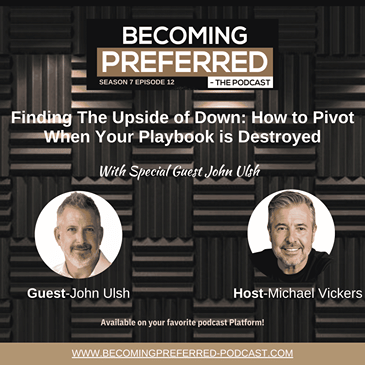
SEASON: 7 EPISODE: 12
Episode Overview:
Welcome back to Becoming Preferred, the podcast where we equip entrepreneurs and business leaders with the mindsets, strategies, and edge to level up their game and become the best version of you.
Now, when a business or a career hits an unexpected crisis, most leaders talk about 'bouncing back.' But what if the playbook is destroyed and there is no version of 'back' to return to?
My guest today knows what it means to rebuild from total scratch. In 2007, John D. Ulsh survived a catastrophic head-on collision and was given less than a three percent chance of survival. After more than 45 surgeries and years of recovery, he didn't just survive. He transformed his mindset, became a USA Today bestselling author of The Upside of Down, and now leads a top-performing real estate team.
Today, John shares how to lead under pressure, make high-stakes decisions when there is zero clarity, and embrace the process when the only way forward is through. Please join me for my conversation with John Ulsh.
Guest Bio:
John D. Ulsh is a resilience speaker and USA Today bestselling author of The Upside of Down.
In 2007, he survived a catastrophic head-on collision and was given less than a 3% chance of survival. What followed was nothing short of extraordinary. More than 45 surgeries and years of recovery, but the real challenge wasn’t physical. It was learning how to move forward when there was no roadmap, no timeline, and no version of “back.”
That experience reshaped how he approaches adversity, decision-making, and forward progress. Today, it drives his work with leaders and teams operating under pressure, making decisions without certainty, and continuing to move when clarity isn’t there. His philosophy is simple: resilience isn’t about bouncing back. It’s about being in the now and learning to embrace the process.
In parallel, John leads a top-performing real estate team in Central Pennsylvania; a real-time proving ground where mindset, discipline, and execution directly impact results.
Because when everything changes, the only way forward is through.
Resource Links:
- Website: https://johnulsh.com/
- Product Link: https://johnulsh.com/the-upside-of-down/
Insight Gold Timestamps:
05:34 I got accepted to law school and then ended up not going
10:20 My spleen had ruptured, my diaphragm ruptured, my appendix ruptured, my left lung completely had collapsed when my when my diaphragm ruptured, my right lung partially collapsed
11:15 I was given less than a three percent chance to survive
14:45 I got moved into a nursing home at 37 years of age
16:31 One of the decisions I made early on was that if I was goint to be paralyzed from the waist down, that my kids weren't gonna push me around in a wheelchair
20:11 What happened to me was not the airbags or the steering wheel, it was actually the recussive vibration from a hundred and twenty five mile impact speed
23:50 For me, the only thing I could control was showing up every day, trying to work on getting better every single day
25:41 He said, you know, you're allowed to be pissed off and still be positive
30:12 I would rather have somebody be purposeful than perfect every time
31:38 A lot of people say they don't have time, right, but the reality is they're really bad at time blocking
35:20 Most people who take on really big challenges, when they achieve them are anti climatic
39:42 Let's talk about the role of discipline when motivation fades
44:20 It all came out of this decision to want to control things that I could control
46:44 What's the very first step to finding the upside of down?
48:51 Aaron Volpatti episode reference
49:45 The book is called The Upside of Down, available wherever you get books
Connect Socially:
LinkedIn: https://www.linkedin.com/in/johnulsh/
Facebook: https://www.facebook.com/johnulsh/
YouTube: https://www.youtube.com/channel/UCm8nqBx5VWb5kjZSUwARECA
Instagram: https://www.instagram.com/johnulsh/?hl=en
TikTok: https://www.tiktok.com/@jdulsh
Email: john@johnulsh.team
Sponsors:
Rainmaker LeadGen Platform Demo: https://calendar.summit-learning.com/widget/booking/JKItVP7WErmCBjU2cCIx
Rainmaker Digital Solutions: https://www.rainmakerdigitalsolutions.com/
In 3, 2, 1.
Speaker BWelcome back to Becoming Preferred, the podcast where we equip entrepreneurs and business leaders with the mindset, strategies and edge to level up their game and become the best version of themselves.
Speaker BNow, when a business or a career hits an unexpected crisis, most leaders talk about bouncing back.
Speaker BBut what if the playbook is destroyed and there is no version of Back to return?
Speaker C2.
Speaker BMy guest today knows what it means to rebuild from scratch.
Speaker BIn 2007, John D. Alch survived a catastrophic head on collision and was given less than a 3% chance of survival after more than 45 surgeries and years of recovery.
Speaker BHe didn't just survive, he transformed his mindset, became a USA Today best selling author of the Upside of Down and now leads a top performing real estate team.
Speaker BToday, John shares how to lead under pressure, make high stakes decisions when there is zero clarity and embrace the process when the owner the only way forward is through.
Speaker BPlease join me for my conversation with John Alsch.
Speaker CWell, hi John, welcome to the program.
Speaker CWe're delighted to have you.
Speaker AThank you Michael for having me.
Speaker AI'm excited to be here.
Speaker CNow where are we speaking to you from today?
Speaker CJohn?
Speaker AI am in Philadelphia, Pennsylvania.
Speaker ASo I'm originally from Central Pennsylvania, Harrisburg, but I'm down in Philly right now.
Speaker CI know where Harrisburg is and a great sports town.
Speaker CYou got such great sports teams there.
Speaker CSo Phil and I know you're getting LeBron now for this coming up NBA season.
Speaker CI don't know, maybe we have a championship on the way.
Speaker AWell, I think that's the only reason LeBron showing up and I think that's what we all believe.
Speaker ABut you know, as we're also home of Villanova basketball and my son just graduated from there and those programs were built off of kids putting four or five years together.
Speaker AAnd so yeah, I don't know how the, I don't know how the sports basketball particularly does when you bring all the superstars together who they'll have to take, take a role play and I don't know how that's going to go, but we'll see.
Speaker AWe're excited.
Speaker CI work with sales teams and Phoenix Suns are one of our clients and I work with their sales teams and when LeBron went to Miami, they fired and laid off the entire salesforce.
Speaker CThey sold everything, sold out instantly done.
Speaker CThey didn't need it.
Speaker CThere was nothing to sell.
Speaker AThere was nothing to sell.
Speaker CSpaces all there was nothing to sell.
Speaker CThey everyone bought everything instantly and they literally.
Speaker CSo that's kind of impact he has and of course we know he's a.
Speaker CHe's an impact player.
Speaker CWell, thanks for doing this.
Speaker CI'm really excited about this.
Speaker CIt was interesting.
Speaker CI had a chance to peek at your book and talk about your story.
Speaker CYou have got a great story.
Speaker CBut before we kind of get into it, let's go back, first of all, to high school.
Speaker CYou're back in high school.
Speaker CMaybe you're living in Pennsylvania.
Speaker CYou're deciding what you want to be when you grow up.
Speaker CStart there.
Speaker CAnd what were you thinking?
Speaker CWhat was your journey like?
Speaker CWhere were you headed to?
Speaker CBecause life stuff, you know, events got in the way.
Speaker CStart there first, if you wouldn't mind.
Speaker CGive us a little back.
Speaker ASo I grew up in a little town north of Harrisburg.
Speaker ASo Harrisburg is divided by the Susquehanna river, largest tributary into the Chesapeake Bay.
Speaker ASo the river is over a mile wide, but you could, in the summer, you could walk across it and not get your shorts wet.
Speaker ASo, big open river.
Speaker ABut I grew up in the small town called Millersburg, north of Harrisburg.
Speaker AAnd we graduated an average 60 to 68 kids a class.
Speaker CWow.
Speaker AVery small, very rural.
Speaker AI was a high school athlete.
Speaker AIn our town, you played three sports because you otherwise didn't have enough kids.
Speaker ASo I played football, basketball, and ran track.
Speaker AI excelled at track.
Speaker ATrack was immediately easy for me.
Speaker AI was a really good hurdler, and so ended up growing into a sprinter as well, and then ultimately a jumper as well.
Speaker AAnd so I left little Millersburg and had an opportunity to run track at some big universities on the East coast, like, had an opportunity to go to Syracuse, Rutgers, visited those campuses in the winter of my senior year.
Speaker AAnd this is before you ever committed a year in advance and was way like a, you know, a small fish in a huge pond.
Speaker AAnd I'm like, yeah, this is like, I would have been like, probably the eighth fastest sprinter on the Syracuse tee, but I was the fastest kid in districts and, you know, state champion in hurdles.
Speaker ASo I was like, this is not where I want to be.
Speaker ASo I ended up going to a Division 3 program where I got to be MVP as all four years of my collegiate track career ended up doing decathlon, which allowed me to do all the events.
Speaker AAnd so built that, you know, running foundation, you know, early on.
Speaker ABut it was more of the, okay, well, running hurdles is fun.
Speaker AI was a big skateboarder growing up.
Speaker AI was of that.
Speaker AOf that late 80s, early 90s skateboard era.
Speaker AAnd so we had half pipes in our backyard and.
Speaker AAnd so hurdles was just, you know, another fun way to run without having to just run straight line like you had to jump over something.
Speaker ARight.
Speaker CSo.
Speaker CWell, how you could even do that?
Speaker CI get on a skateboard.
Speaker CI can't get off of one.
Speaker CI need help.
Speaker CI can get on it, but I can't do anything when I'm on it.
Speaker CAnd it's.
Speaker CI can't even get off it without falling on my butt.
Speaker CSo I was never, I never had that.
Speaker CI wish I did.
Speaker CI could play baseball and golf, but I was never your last guy picked.
Speaker CI was always your second last guy picked and saw your bonus player and you can have Vickers.
Speaker CSo I had to put my pursuits elsewhere.
Speaker CBut, hey, we all have those talents.
Speaker CAll right, so you're a poli sci guy, too.
Speaker CIn college, were you going to be a lawyer at one time?
Speaker CWas that.
Speaker AYeah.
Speaker ASo my father's an attorney.
Speaker AWell, he's 80 years, about to be 80 years old in two weeks and still says he's an attorney, still practices a little bit.
Speaker ASo it was in my, in my blood.
Speaker AMy grandfather was a banker.
Speaker ASo, you know, my thoughts were professional.
Speaker AGo to law school or go work in banking.
Speaker ASo I did both.
Speaker AI got accepted to law school.
Speaker CYeah.
Speaker AAnd then ended up not going and went to work for a bank and did that for a little over a year.
Speaker AYear before I was brought in to my, my wife's business, you know, so.
Speaker CYeah.
Speaker AWhich was the jewelry industry.
Speaker AAnd I spent 12 or 13 years there before I decided to go into real estate.
Speaker ASeparating ourselves.
Speaker AWe ended up being separated as a couple as well, but ultimately just not being in the same industry.
Speaker AAnd so that's what, you know, as we get to my accident, that's what I was, I had, I had just started in March of 2007, and the accident happened December.
Speaker AAnd we all know what happened in 2008, which was the start of the housing crash and the stock market crash.
Speaker AAnd I jokingly said you could write a book.
Speaker CYou could write, you could write a book on all those nasty events and how they impacted your life.
Speaker CRight.
Speaker CWell, let's talk about.
Speaker CBecause I know you were in real estate.
Speaker CI think you were for one of Warren Buffett's real estate company for a little bit.
Speaker AWilliams, before that was a Berkshire.
Speaker CYeah, yeah.
Speaker CSo.
Speaker CAll right, so let's go, if you don't mind, let's go to.
Speaker CLet's tell our audience what happened.
Speaker ASo December 1st of 2007 was a Saturday, and it was the Saturday right after Thanksgiving.
Speaker ASo Thanksgiving was real late that year.
Speaker ARight.
Speaker AAnd so we had Thanksgiving, had a bunch of family spend the night in the Friday Saturday morning, my 8 year old daughter Katie had a swim meet.
Speaker AAnd the swim meet was about an hour south of Harrisburg, Carlisle down 81, almost in Maryland for those who know the area.
Speaker AAnd so we had a real early morning to be at the pool.
Speaker AI think she had to be at the pool at 8am and as I said, I was been a runner my whole life, so I was running marathons at that point.
Speaker AAnd so I clearly remember like, you know, Saturday morning, getting up at like 6 in the morning, it's dark, I go outside and there's you know, an inch of snow on the ground, which in Pennsylvania, December 1st is real early, you know, to have some snow on the ground.
Speaker AAnd I remember because it was, you know, sort of a pain to run.
Speaker AI ran 13 miles that morning before mostly because again, combination of needing to get the miles in, but also just finish Thanksgiving and running was also a great stress breaker for me.
Speaker ASo we get early in the car, like 7am and we get down to the swim meet and we, we have a four year old son, James, and so basically we bribe him and say, look, if you can behave yourself in this indoor swim meet, which if you've ever been inside an indoor swimming pool, it's sort of like a Russian sauna in there.
Speaker AIt's just generally sweaty and hot and smells like chlorine.
Speaker AAnd so, so he's like, you know, we'll go get a Christmas tree when we're done if you can, you know, get through this swim meet.
Speaker ASo we leave the swim meet and it's about noon, so, you know, it's already just lunchtime.
Speaker AAnd we're pulling out of this high school where the, where the meet was held.
Speaker AAnd instead of turning left and going exactly the direction that we came from, we decided to take the more scenic route.
Speaker ATurn right out of the school, get up to Interstate 81 from a different exit, very rural area of Pennsylvania.
Speaker AAnd we're driving on a 55 mile undivided road.
Speaker AAnd a car coming the other direction at the last second crossed the center line.
Speaker AWe went driver to driver, no skid marks on the road.
Speaker ASo the police report would estimate the impact speed at 125 miles an hour.
Speaker CJeez.
Speaker AOther driver did not have a seatbelt on, died instantly.
Speaker ANo drugs, no alcohol.
Speaker AHe was actually on a, on a cell phone talking to his fiance.
Speaker AWe only know this because obviously after the fact, the police investigation.
Speaker CDistracted.
Speaker AYeah, that she was.
Speaker AAnd so something distracted right at the last second, whether it fell off at sea, you know, we've all been In a car, you know?
Speaker AYeah, especially if we travel for work where something falls or the coffee spills out of the thing.
Speaker ASomething happened last second.
Speaker ASo my whole family's in the car.
Speaker ASo my wife is in the front passenger seat.
Speaker AShe's unconscious.
Speaker ABroken hand, broken ribs, broken foot, laceration from the, from the lap belt.
Speaker AMy son James, the 4 year old, in a booster seat behind me.
Speaker AAnd so my chair comes back into him and snaps his fibia tibia in his left leg.
Speaker AAnd then the lap belt ended up severing a small intestine, but it never cut his skin.
Speaker ASo he was already admitted into the hospital before they even realized he was going septic because he didn't see a cut on his skin.
Speaker ASo my daughter Katie, the one who had the swim meet, was in the back passenger seat.
Speaker AShe was the only one who stayed conscious.
Speaker AAnd so when first responders actually arrived, they found her crawling between the seats crying, daddy, don't die.
Speaker AAnd so I took the blunt of it again.
Speaker AImpact speed.
Speaker AI'm six two.
Speaker AThe engine block did what it was supposed to.
Speaker AIt collapsed, but shattered my left foot.
Speaker AThe energy came up my left leg, split my pelvis 7 inches apart in the front, snapping the back of it.
Speaker AAnd then my tailbone split long way, and then L1 through L4.
Speaker ASo my four lower vertebrae all fractured into each other.
Speaker AThat orthopedic stuff wasn't even.
Speaker AThat wasn't even their concern.
Speaker AMy spleen had ruptured, my diaphragm ruptured, my appendix ruptured, my left lung completely collapsed.
Speaker AWhen my.
Speaker AWhen my diaphragm diaphragm ruptured, my right lung partially collapsed.
Speaker AAnd so we were closer to Hagerstown, Maryland than we were Harrisburg or any other major city.
Speaker AAnd University of Maryland's trauma center was actually the closest trauma center, but Penn State Medical center, which is Penn State University, the hospital itself is located in Hershey, Pennsylvania, so right outside of Harrisburg, where Hershey Chocolate's manufactured.
Speaker AYou know, the university is in the middle of the state, but the hospital is, the teaching hospital is in Harrisburg.
Speaker ASo they kept two of these helicopters.
Speaker AThey're called Life lion because Penn State is the Nitley Lion.
Speaker ASo they keep one at Hershey and they kept one in Carlisle, the town I was living in.
Speaker AAnd that transport saved my life.
Speaker AMy son and I were transported there.
Speaker AMy daughter and my wife were taken into Hagerstown and later transferred that afternoon in an ambulance, you know, two hours up to Hershey because I was going to die.
Speaker AI was given less than a 3% chance to survive.
Speaker AI took 38 units of blood in the first 12 hours, which is, you know, guys, our size, we hold about eight.
Speaker AYeah, that's how much I was bleeding out.
Speaker AThat was what was going to kill me.
Speaker AYou know, I survived for over 45 minutes with a collapsed, completely collapsed left lung and a partially collapsed right lung.
Speaker AAnd you know, part of the reason I tell that story about running 13 miles that morning is, you know, my physical condition saved my life.
Speaker CYeah, no kidding.
Speaker AI was also under 10.
Speaker AI was 185 pounds, was under 10 body fat.
Speaker ASo when they cut me from sternum to pelvis to open me to try to stop the internal bleeding, they also didn't have all this visceral fat that they had to work around.
Speaker CYeah.
Speaker ASo I would spend 18 days in a coma.
Speaker AMy son spent the second longest amount of time in the hospital and he was there 15 days.
Speaker ASo by the time I, you know, came off a ventilator, came out of a coma, my family was home recovering.
Speaker ASo, you know, one of my very first questions was, where's my family?
Speaker AHow's my family?
Speaker AAnd you know, for me, you know, I got it.
Speaker AYou know, I knew they were home, I knew they were injured, but I also knew they weren't still in hospital.
Speaker AThey were alive.
Speaker AYou know, my second question, was it my fault?
Speaker AAnd by 18 days the police report was there and you know, they had the impact speed and the fact that the driver, driver came across the line and there was no drugs or alcohol.
Speaker ALike, you know, he had a, he had a three month old baby boy to his fiance who he was on the phone with.
Speaker AAnd so, you know, this year when we have the 20th anniversary of our car accident, there'll also be a 20 year old young man who's never known his dad.
Speaker CYeah.
Speaker CWow.
Speaker CHave you ever reached out, have you ever connected with that side of the family at all?
Speaker AWe had some very minor connections.
Speaker AThat fiance wasn't interested at all.
Speaker AI mean, honestly, you know, I think she was, you know, I mean, Pennsylvania minimum coverage is $30,000 for liability for car.
Speaker AIt cost $30,000 for that helicopter to fly.
Speaker AMy son and I. Yeah, you know, whatever he had from his employer, we didn't try to go after.
Speaker AYeah, you know, we, you know, she was going to have to deal with her son by herself.
Speaker AAnd so whatever, you know, this is before the Internet as well, you know, so we tried to make some connections and ultimately got to her and she wasn't interested in talking.
Speaker CYeah, yeah, well, that's true, but, well, it's such a tragic, tragic thing.
Speaker CSo 07 hits, 08 hits.
Speaker CAnd of course we know the financials.
Speaker CSo you go from one crisis on a physical level to a mental one right where we're a job.
Speaker CSo the real estate's down.
Speaker CThat's for your training.
Speaker CSo obviously financially it was very difficult.
Speaker CAnd so I mean it doesn't get any worse really.
Speaker CIf you were going to paint, let's draw out something that's really worse.
Speaker CLet's talk about how because you started to evolve from there.
Speaker CSo after the 7 08, how did you start your work career?
Speaker CWhat were you doing to earn Ensby?
Speaker ASo when I came out of my coma I was, you know, I was so swollen.
Speaker AThey left me open for three days to try to repair these internal injuries, stop the bleeding and eventually they had to close me because of infection risks.
Speaker AThey couldn't pull my abdominal muscles so they just pulled the fascia skin and stitched together and said if this guy lives, we're gonna have to fix this later.
Speaker ASo when I came out of my coma it was, you know, 18 days.
Speaker AIt was 18th of December.
Speaker ABy the Christmas Eve I was transported out of the hospital and I thought I was going to rehab.
Speaker APhysical therapy inpatient to I was paralyzed from the waist down.
Speaker AI could not move either of my legs.
Speaker AI thought I was going to physical therapy because of my back and my pelvis.
Speaker AI was non weight bearing for eight more weeks.
Speaker ASo I got moved into a nursing home at 37 years of age to spend eight weeks the day before Christmas laying flat on my back.
Speaker ASo I tell that story because while I was in the nursing home I sold three homes.
Speaker ATwo to nurse aides and one to a nurse.
Speaker CThat's awesome.
Speaker AI had people from.
Speaker CThere's a closer for you.
Speaker AYeah, people from my office.
Speaker AShow it back then we were still using four part forms while laying flat on my back wrote those contracts.
Speaker AI am 100% sure that my partners took those contracts and rebid them afterwards.
Speaker AI'm also very sure that I got paid on transactions I wasn't involved in.
Speaker AThat was just the group of people that I was working with.
Speaker CLovely people.
Speaker CYeah.
Speaker AAnd so yes, so I was in real estate continued while I was recovering to, you know, sell where I could.
Speaker AAnd again, I had great support, I had great, great assistant.
Speaker AI had people who could cover for me.
Speaker AMy wife was working for her family's business.
Speaker ASo they covered because this is Christmas and they were in the retail jewelry business.
Speaker ASo this is the time of year.
Speaker CYeah, exactly.
Speaker AIt also was A realization that maybe even CEOs and upper, you know, leadership isn't as important as we think we are because things still happened and people still stepped up even though, you know, your number two person wasn't there, which was, you know.
Speaker AYeah.
Speaker APositive and on the fact that the team could do it.
Speaker ABut also, you know, sort of a realization that maybe we overemphasize how much, how many 80 hour days we have to put in or 80 hour weeks we have to put in at Christmas, you know what I mean?
Speaker ALike so.
Speaker ABut yeah, so I left rehab and went to physical therapy and they thought I would be there for a month.
Speaker AI was there for eight days.
Speaker AOne of the decisions I made early on was that if I was going to be paralyzed from the waist down that my kids weren't going to push me around in a wheelchair.
Speaker AAnd so with by New Year's I had stretchy bands tied to the rails of my bed.
Speaker AAnd you know, again I was 185 pound marathon runner.
Speaker ASo under 10% body fat.
Speaker AI was 155 pounds by J.
Speaker ASmall.
Speaker AYeah, yeah.
Speaker ASo I was just losing muscle.
Speaker AIt was a lot of body fat to lose, right?
Speaker AYeah, yeah.
Speaker ASo using those stretchy bands became this thing that I would do constantly while laying in this bed in tremendous amount of pain because now I'm taking oral narcotics versus IV and you know, every four hours I could have more narcotics.
Speaker AThey lasted about three hours if you know, so it was always this like, okay, I'm just waiting for the next chance to have some pain relief and so I just pull in these stretchy bands.
Speaker ASo when I got to physical therapy, even though I was 150 some pounds I could hold myself between two parallel bars.
Speaker AHad no use whatsoever of my left leg at that point.
Speaker AAfter, you know, now it's, now it's 13 weeks since the accident.
Speaker AI could use my right leg a little bit.
Speaker ATo this day I don't have any feeling in my left leg, but I feel my big toe which is the only reason again your listeners can't tell.
Speaker ABut I'm because I'm sitting, but I can walk.
Speaker AI'm not in a wheelchair right now.
Speaker AAnd that's simply for the miracle that I can.
Speaker AThe damage that was done through my to my nerves didn't affect my big toe.
Speaker CSo are you limping or you just.
Speaker CCan we tell that you've had.
Speaker AYeah, I mean not a lot anymore.
Speaker CYeah, I'm good.
Speaker AVery strong now.
Speaker AYeah, so what I've lack in, you know, balance and core balance because again, half of my abdominal muscles are still missing.
Speaker AThey were only able to reattach half of them when I finally was able to do it.
Speaker AMy balance is really held together by the fact that I'm very strong around my core now, but I can't close my eyes and stand on one foot.
Speaker AI'd fall right over.
Speaker CI probably in the same way I've seen your on stage photos and you look so good for you.
Speaker CLike, wow, that's just, that's not.
Speaker CAnd how's the rest of the family do?
Speaker CHow did they recover from all of that?
Speaker ASo, yeah.
Speaker ASo everybody.
Speaker ASo my son again with the legs being snapped as fibia tibia, being four years old, he just graduated college, he's six foot four.
Speaker ASo I did grow, right.
Speaker AHe did stop his growth.
Speaker CIt didn't.
Speaker CNo.
Speaker AYeah.
Speaker AAnd, and so later my wife's bowel would end up rupturing and they said it was damaged from the seat belt.
Speaker AThat was pretty scary for her because she ended up being septic and ended up in the hospital for a while.
Speaker ABut again later after the accident, just associated with that.
Speaker AAnd you know, my daughter who's, you know, now 26 years old, you know, even as, as a kid struggled to see car accidents again, dealing with the fact that, so, you know, my kids being 8 and 4 when the accident happened, they don't have a lot of memory of my life, particular my 4 year old son before the accident.
Speaker ASo I've had 45 surgeries to date related to the accident.
Speaker BWow.
Speaker AThe last 16 of them have been related to complications because I didn't die.
Speaker ASo I can't really be upset about it.
Speaker ABut like literally a lot of them have been to save my left leg from being amputated.
Speaker CYeah.
Speaker ADealing with the damage to my heart that would they later find that was at the time the only person they knew in the country with a traumatic vsd.
Speaker AA hole between the right left ventricle that opened up from trauma.
Speaker AAnd the argument would be you should have died from six other things.
Speaker ASo the fact that four to six months later a hole opened in your heart after the accident, you know, they don't have, they didn't know anybody back then.
Speaker AUnfortunately we do now because soldiers, you know, being in the area of explosives would experience, you know, similar injuries and they would later determine that really what happened to me was not the airbags or the steering wheel.
Speaker AIt was actually the recursive vibration from 125 mile impact speed.
Speaker CWow.
Speaker CWhat kind of car, what kind of vehicle were you driving?
Speaker AACURA rdx.
Speaker ASo this small car.
Speaker CYeah, yeah.
Speaker ABuilt off the Honda CRV platform.
Speaker CYeah, it's like a luxurious Honda.
Speaker CYeah, exactly.
Speaker CWow.
Speaker AAnd we ended up buying three.
Speaker ATwo more after that one because.
Speaker CYeah, well, they're collapsing cages.
Speaker CI mean, they've got some great design to those things as well.
Speaker CWow.
Speaker CWell, you've.
Speaker COne of the things you talk about is.
Speaker CAnd you've certainly have come back and obviously a great example of that.
Speaker CAnd most of us will never have to go through things like, I've had my setbacks have just kind of gone by the wayside as I'm listening to you.
Speaker CAnd, you know, for me, when I look back at a setback, I'm going, you know, I'm a speaker, 2020 hits.
Speaker CAll my speaking contracts collapsed and 60% of my stock portfolio tanked.
Speaker CBut I'm sitting here going, no, poor me.
Speaker CRight.
Speaker CAnd yet we're healthy, and our family's healthy and our kids are healthy.
Speaker CBut let's talk about the comeback and the resilience, because you've got the eight pillars of an unbreakable comeback in lessons, which you talk, which I think is really interesting.
Speaker CAnd then I want to talk about your ready framework, but let's talk about reframing, bouncing back in general.
Speaker CSo, John, most of people view resilience, which you've done, as bouncing back to where they came from before the crisis.
Speaker CBut in your work, you argue there's no version of back.
Speaker CSo how should entrepreneurs reframe adversity when there's a market shift or business failure completely destroys the original playbook.
Speaker AYeah.
Speaker ASo again, when you're thinking about adversity or setbacks, the first reframing, which is sometimes the hardest, is there's so much opportunity to learn not only about yourself or your business or your industry, with inside that setback.
Speaker CRight.
Speaker AYou know, we were talking about professional athletes a second ago.
Speaker AYou know, professional athletes, or college athletes, for that matter, are very unique individual in the sense that they don't reach the level where they are without actually falling in love with the process.
Speaker ARight.
Speaker ATaking the injuries, the setbacks that you didn't get picked, you didn't get this school that wants you like, they're.
Speaker AThey don't play for championships.
Speaker ANow, we just made a discussion that LeBron may be showing up just to win a championship, but he didn't get to where his level is by not wanting to go to practice.
Speaker AYou know, So I feel like for a lot of people, the goal, the finish line becomes this thing that you focus on.
Speaker AAnd if you talk to entrepreneurs, you talk to athletes, you talk to people who have dealt with adversity.
Speaker AThey'll all tell you that everything that they've learned, all the beauty, lies in the process and not the outcome.
Speaker ARight?
Speaker ASo I. I'd like people to think is, okay, fine, we are in this adversity, we're in the setback, but at this point, we don't have any control over that.
Speaker ALike, my accent's a perfect example.
Speaker AI always say, like, I'm not a first responder.
Speaker AI'm not a soldier.
Speaker AI say I was.
Speaker AI'm not even a motocross racer.
Speaker AI was doing nothing but leaving a swim meet with my family and a call across the center line, like, no control whatsoever.
Speaker APeople would later give me like, oh, here's an award for survival.
Speaker AAnd I would be like, the only reason I survived is because God insurgents.
Speaker ALike, I had nothing to do with my survival from the day I came out of a coma till today.
Speaker AI can take credit for my journey, but the reality is there's so much built into a plan or built into, you know, your goals that are way out of your control.
Speaker ACollapse of.
Speaker AOf a real.
Speaker ALike, you had a speaking keynote, and then all of a sudden, Covid happens.
Speaker AYeah, you couldn't have figure that out, like, no way.
Speaker ABut so.
Speaker ASo just like that, what you built was turned upside down.
Speaker ASo you can only control what you can control.
Speaker AAnd so, you know, for me, the only thing I could control was showing up every day, trying to work on getting better every single day.
Speaker CYou know, that's good minds.
Speaker CThat's good mindset, though.
Speaker CAnd you mentioned faith or God in your world, and you actually have a talk on faith in the fire, finding clarity, grace, and strength in the most painful chapters of your life.
Speaker CAnd we have people who aren't believers and people are believer.
Speaker CWe have everybody, every walk of life that listen to the show.
Speaker CWhat was the role of that for you?
Speaker CWere you into, you know, spiritual things ahead of time for you?
Speaker CChurch going and then that helped you?
Speaker CBecause there's a lot of variables, but what was the role for that for you?
Speaker AYeah, so I.
Speaker ASo I grew up with Christianity in my life.
Speaker AYou know, I grew up in, like I said, a small town.
Speaker AWe went to church on Sunday.
Speaker AEverybody.
Speaker AWe kind of had that same balance with my children.
Speaker AAnd so it.
Speaker AIt did in the sense, like, early on particularly, there was some of this that, you know, why did this happen to me?
Speaker AMentality.
Speaker ARight?
Speaker AYeah.
Speaker AWell, the other part for me was I struggled with survival's remorse, particularly in the first two years, like, really, why did I survive and the other person didn't?
Speaker ABecause.
Speaker AAnd so, you know, I talked to priests and pastors and therapists and psychologists, and nobody really gave me anything I could wrap my head around.
Speaker ANot from, like, okay, you should write a book and become a keynote speaker and try to help other people.
Speaker ABut a friend who was a Presbyterian pastor who.
Speaker AWho had played a role even from the first day when I showed up in the nursing home and told me that day on Christmas Eve, when no one else was in the room and watched my family interact with me for the first time since my kids only got to see me the very first time.
Speaker AThe day I moved into the nursing home, they never saw me in the hospital.
Speaker AIt was just decided to see me all hooked up to all that stuff was going to be too traumatic for them.
Speaker CPretty traumatic.
Speaker ASo he watched me interact, and then when my family left, he was still there.
Speaker AAnd he said, you know, you're allowed to be pissed off and still be positive.
Speaker AAnd I was like, you're right, because I'm in my room.
Speaker CThat's interesting.
Speaker CThat's good insight.
Speaker AYeah, yeah, yeah.
Speaker AAnd I'm watching this, like, Scrooge in the Christmas story.
Speaker ALike, everything's going on around me in the room.
Speaker APeople are coming to see me, friends are coming to see, because I just got in a nursing home, and I'm in so much pain and so drugged.
Speaker AIt's just like looking through foggy piece of glass through a window.
Speaker ALike, I'm not there, but I'm there.
Speaker CRight.
Speaker AAnd for.
Speaker AAnd, you know, I'm just trying to be a positive person for everybody else.
Speaker CYeah.
Speaker AAnd he said, you know what?
Speaker AIt's okay to be pissed off about it later.
Speaker AYou know, about two years after the accident, his wife worked for me, and I was sitting in his kitchen getting some paperwork, and he asked me how things were going, and I told him how the struggle of survival.
Speaker AAnd he said, maybe just survive so your kids would have a dad.
Speaker AWhy you make it more complicated than that?
Speaker AAnd so that was also, like, something that I held on to and.
Speaker AAnd started to say, like, okay, well, that's sort of my role.
Speaker ASo maybe I was working too much or going out and playing golf with my buddies and not being there for, you know, soccer matches and swim meets and all these things.
Speaker CWe've all done that.
Speaker CYeah.
Speaker ASo I've all.
Speaker ASo that was.
Speaker ACame a huge shift in my why.
Speaker AAnd my real estate career gave me the flexibility of saying, you know what?
Speaker AI can't meet you from 5 to 6:30 today because I have something else on my calendar which happened to be a soccer match but I'm available at 6:30 or 7 and I don't mind working until midnight so I'll just make it all kind of work.
Speaker AAnd so that became sort of this mantra of mine that I wasn't going to miss kids activities because something else was taking me away from it.
Speaker CYeah, your values probably got focused and you got clarity around that so that matters.
Speaker DAre you tired of chasing leads and ready to start effortlessly attracting more high value clients?
Speaker DIntroducing Rainmaker Lead Gen the ultimate sales, engagement and client acquisition platform that takes the stress out of outreach?
Speaker DWith Rainmaker Lead Gen, you can easily identify, engage, educate and convert your ideal prospects into loyal clients.
Speaker DOur industry leading automation and email sequencing empowers you to reach more ideal clients, accelerate the sales cycle and close more business.
Speaker DImagine authentically engaging with your prospects while the platform handles the heavy lifting.
Speaker DSay goodbye to the endless hustle and embrace a more efficient, effective approach to business development.
Speaker DReady to witness the magic?
Speaker DBook a 20 minute demo today and see how Rainmaker Rainmaker Lead Gen can revolutionize and level up your client acquisition game.
Speaker DThere's nothing to lose and everything to gain.
Speaker DDon't miss out on this opportunity to supercharge your client acquisition process.
Speaker DVisit rainmakerdigitalsolutions.com or check out the link in the show Notes to book your demo.
Speaker DRainmaker Lead Gen Spend less time hunting for your ideal clients and more time having high value sales conversations with your ideal clients.
Speaker BAnd now back to my conversation with John Ulsch.
Speaker CLet's talk about decision making without a roadmap because after surviving a 3% survival rate and enduring 45 surgeries, you faced years of recovery with zero guarantee of the outcome.
Speaker CIt probably affected your revenue as well.
Speaker CHow do you coach leaders though to make high stake business decisions when there is no roadmap, there is no certainty.
Speaker AWell, so my first, you know, framework or my first pillar is commitment.
Speaker AAnd I think a lot of people want a perfect plan or the perfect opportunity or the perfect system in place or the perfect people around them before they commit.
Speaker ARight?
Speaker AAnd I think leaders know that doesn't work that way, that you commit first and then you take the step and then you start to kind of have to figure things out.
Speaker ASo there's that leap of faith that's built into every commitment and you can be as prepared as you can be.
Speaker ABut if you're going to wait to be 100%, you'll just keep waiting forever Right.
Speaker CYeah.
Speaker ASo there is this commitment factor, and I like to separate motivation from commitment.
Speaker AA lot of people will say, I'm motivated, and motivation will get you started, but most always it kind of comes and goes.
Speaker CRight.
Speaker CBut commitment for the car, it's cast for the car.
Speaker CAnd then if you can make it to your purpose, that's purpose will give you the motivation you need if you're.
Speaker AYeah.
Speaker AAnd so.
Speaker AYeah, yeah, yeah.
Speaker AWell, purpose again.
Speaker AI would rather have somebody be purposeful than perfect every time.
Speaker AI'm sure you coach the same.
Speaker ALike, you can't be perfect.
Speaker ASo let's be really purposeful with our time and our energy.
Speaker AAnd so I also think that when it comes to commitment, a lot of people want to say, I'm motivated to make this change in my life or make these adjustments, and that's great.
Speaker AThat'll get a meeting with you or a meeting with me or get us in group coaching.
Speaker ABut it's not going to get you where you want to go.
Speaker AThat's commitment.
Speaker AAnd commitment is really just getting a plan.
Speaker CYeah.
Speaker AAnd then kind of executing from the plan.
Speaker ASo when you don't have motivation, you literally have commitment to lean against.
Speaker AAnd some days that's showing up and being at 100%.
Speaker AAnd some days it's showing up at 10%.
Speaker AEither way, it's showing up.
Speaker CYeah.
Speaker CShowing up.
Speaker CNo, it's.
Speaker CLet's talk about the trap of why me versus what now?
Speaker CSo when disaster hits, whether it's a severe injury or a loss of a major client, it's natural to fall into the why me?
Speaker CYou know, when did this happen?
Speaker CWhat practical mental exercises do you use to shift a team or yourself into what now Mode?
Speaker ASo I think the first thing is to understand the why part of it.
Speaker AYou look at that and you're like, oh, here's the team comes together, and here's seven different things that we should have done better or we did wrong or this is why it happened.
Speaker ARight.
Speaker AReality is there's probably one of those things that if you fix that one thing, a lot of other disappear.
Speaker ARight.
Speaker ASo I use the perfect example for a lot of individuals.
Speaker AA lot of people say they don't have time.
Speaker ARight.
Speaker ABut the reality is they're really bad at time blocking.
Speaker AAnd so when you look at the why me or why now Situation, we're back to this commitment thing.
Speaker ALike, we have no control at this point.
Speaker AThis is where we are now.
Speaker AOur choices are all based off of where we are right now.
Speaker ARight.
Speaker ASo we either.
Speaker AWe either stop.
Speaker AWe either evaluate and go forward or we just sit in this place until we're ready to make one of those two decisions.
Speaker ALike that's also the other part of commitment is there's a, there's a part of this to let yourself be in that moment.
Speaker AAnd if you're not ready to make commitment out of that moment right now, you know, you shouldn't be, you know, you shouldn't be hard because you're not going to get there anyway.
Speaker CYeah, no, that's right.
Speaker ASo just, you might as well stop and take some more time to evaluate and determine if, you know, if you're not committed to go forward, is it because you're still hurt, you know, either physically or mentally hurt, or are you financially in a place that you know requires you to stop for a minute?
Speaker ABut I always say there's a difference between grace and a pause and quitting.
Speaker AYou know, I would say, you know, through my journey I've had lots of setbacks that if you looked at it from a mile high, looks like a vertical climb the whole way.
Speaker AIf you looked at, on any given six month period of time, lots of times where I was in a worse place than I was six months earlier.
Speaker CYeah.
Speaker AThe difference was I just didn't quit.
Speaker AAnd to me saying I didn't quit was enough.
Speaker ALike I would just say I'm taking a break.
Speaker CYeah, mindset's everything.
Speaker CIt's that programming.
Speaker CSo you obviously had that.
Speaker CAnd I think maybe your athleticism and that just determination worked with it.
Speaker CAnd you actually talked on it earlier in our conversation.
Speaker CEmbracing the process over the outcome.
Speaker CSo in the upside of down, you talk about learning to embrace the process rather than hyper fixating on the end goal, which I believe it, I believe it's all process.
Speaker CDon't worry about the money, worry about building something that's excellent, that process.
Speaker CIt's the journey, not just the climbing.
Speaker CYou know, quick story comes to mind.
Speaker COne of my friends climbed Everest.
Speaker CThree times they climbed Everest and first time they fell 150 meters short of the top.
Speaker CSecond time, 300 meters short of the top, third time they actually summited.
Speaker CPeople died on the expeditions.
Speaker C60% Of the people die on the way down.
Speaker CAnd I mean they're just committed.
Speaker CSeven year journey, millions of dollars of investment.
Speaker CSo I said to him, his name is Al Hobson and Jamie Clark, the two mountain climbers.
Speaker CAnd I said, Al, what was it like?
Speaker CI was speaking with him two weeks after an event and he was, he was keynoting as well.
Speaker CAnd I said, what was it like when you finally got to the top and seven years of journey, millions of dollars, people, teammates died and stuff.
Speaker CAnd he goes, you know what?
Speaker CIt was anticlimactic.
Speaker CI go, what are you talking about?
Speaker CAnd he goes, when I got to the top, he goes, I realize that it wasn't about the summiting.
Speaker CThat was the thing.
Speaker CIt was the journey, it was the process, it was the getting there where all the action was.
Speaker CAnd he goes, to me, he goes, I'm tired of being a human doing, doing this, do this to get to the outcome.
Speaker CI just want to go home and be a human being and I'm going to be this and be that.
Speaker CSo I thought, great insight.
Speaker CAnd you've kind of said the same thing.
Speaker CSo how does an ambitious entrepreneur become or balance high growth goals and stay present in the grind?
Speaker AWell, again, I think it's based off a lot of what your, what your friend said.
Speaker AAnd I, I've got a good friend, Stephen Pivnick, who never got the summit and he's done the other peaks and he's not going back.
Speaker CYeah, I don't blame him, you know, and two and all the big ones and he's done.
Speaker AHe's finally got to do the Ironman Kona.
Speaker ABut he did it by never qualifying.
Speaker AHe did it by doing 20 full Ironmans.
Speaker AIf you do 20, you automatically get a bid into Hawaii.
Speaker ARight?
Speaker CYeah.
Speaker ASo, so he, again, perfect example.
Speaker ALike, all right, he never was fast.
Speaker AAnd so it's the same thing.
Speaker ALike most people who take on really big challenges when they achieve them are anti.
Speaker AAnticlimactic.
Speaker ARight.
Speaker CYeah.
Speaker ABecause.
Speaker ABecause all of the beauty lies in the grind anyway.
Speaker ARight.
Speaker CI 100%, I know, I'm with you.
Speaker AI think even then it's like, can we, you know, in my world, the finish line just keeps going further away.
Speaker AThe goalposts just keep moving away so that I don't ever get to the finish line.
Speaker CThat's right.
Speaker AAnd even if you look at, you know, super successful entrepreneurs, Billion and billionaires.
Speaker ARight.
Speaker AIt's not the money any longer.
Speaker AThe money is nothing more than a way to measure.
Speaker CYeah.
Speaker AWhat you're doing.
Speaker ARight.
Speaker ASo, you know, executives and entrepreneurs are just, it's just another way to measure success.
Speaker AThey don't get to that point and go, I'm done.
Speaker CYeah.
Speaker ASo I think that's the key.
Speaker AThe key is that you ultimately love the process and what you do so much that you don't want the finish line and you don't want the, you know, the peak, if you will.
Speaker AAnd so bigger challenge then Is how do I keep myself in the game?
Speaker CYeah, well, balance.
Speaker AThat's back to being balanced.
Speaker AFamily balance, life balance, exercise.
Speaker AYou know, if you do all these things and at the end you die of a massive heart attack.
Speaker CYeah, that.
Speaker CWhich is quick way to go, you know.
Speaker CWell, it's like I say, the process, you know, I call it.
Speaker CWe get glimpses of peace once in a while, but they're glimpses.
Speaker CAnd you know, I'm fortunate to work for some of Warren Buffett's companies and he has a great line speaking line because food always tastes best when you're hungry.
Speaker CAnd he's not giving his grandkids, you know, all the millions.
Speaker CHis kids get some, but they get four year college.
Speaker CRight.
Speaker CFull ride scholarship, that's it.
Speaker CYou could give them 100 million each and not.
Speaker CHe's given it 99% of it away to charity because he doesn't want to rob them from the process.
Speaker CAnd is the process you're talking about?
Speaker CLet's talk about your executive coaching program through some of your programs.
Speaker CWhat is the single biggest misconception that high performing leaders have about their own limitations?
Speaker AI think that the biggest one is this idea that there's a temple or church at the top of the mountain that they're going towards.
Speaker AI think so many leaders are driven by this nirvana at the top.
Speaker CRight, right.
Speaker ANever really realizing that it's just one step in front of you.
Speaker ASo after the accident, when I could finally walk again and I could move, I kind of made it a thing that I wanted to see the world.
Speaker AI wasn't going to wait till I was 50 some years old to travel.
Speaker ASo I was fortunate to go to the Holy Lands and I went to Greece on two trips and went to Italy and I went to Hong Kong and China.
Speaker AAnd every single one of these places there was a temple or a church on the top of a mountain that would be anywhere from 800 to 3,000 years old.
Speaker AAnd every single one of them had 800 to 3,000 year old set of steps that went up.
Speaker ARight.
Speaker AAnd I'm a guy, I told you earlier, I don't feel my left foot.
Speaker ASo I can walk.
Speaker ABut I can tell you that I could start at the bottom in Hong Kong at this mountain and look up and see this temple and just look at these stairs.
Speaker AAnd there was only one way I was going to get there and that was looking at that one stair in front of me and then stepping on that one.
Speaker AAnd then, and then if I had walked staring up at the horizon or at the top of this mountain, I would have fallen over and over and over again because I needed to look down in front of me.
Speaker AAnd I use that example a lot with we've all seen a giant set of stairs, and we all want to get to the top, even Philadelphia, you want to go see the rocky statue at Franklin, you got to go climb the stairs.
Speaker ASo the only way you're going to get there is one step at a time.
Speaker AAnd the only opportunity to hurt yourself or fall is to spend way too much time looking up at the top.
Speaker CYeah.
Speaker AAnd the other part of it is, you know, you get halfway up there and, you know, and you're like, all right, well, I'm halfway.
Speaker AYou look behind you and you're like, I've come a long way.
Speaker ABut you didn't.
Speaker AYou know, every step, if you look backwards after every step, you'd be like, I got a long way.
Speaker AI didn't go very far, and I have a long way to go.
Speaker CYeah.
Speaker AAnd so I think that, you know, the goal itself, when it becomes that thing on top of the mountain that the false God that you want to worship, then you're going to end up not getting there, because the only way to get there is to take that next rickety old step and stop and take another one.
Speaker ALike, it's just first steps over and over.
Speaker CWell, in your discipline, and you've had a career and a lifelong discipline just through your athleticism.
Speaker CSo let's talk about the role of discipline when motivation fades.
Speaker CSo it's easy.
Speaker CWhen business is booming, things are great.
Speaker CBut what daily disciplines or non negotiables kept you moving forward on days when you physically or mentally just didn't even want to get out of bed?
Speaker AA written plan.
Speaker AI, to this day, particularly as my recovery from my physical recovery, I keep journals, like my workout journals.
Speaker AAnd I could have used it even back 10, 15 years ago, you could use an app on my phone.
Speaker ABut I chose to keep these written books.
Speaker AAnd so there are times where I'll just take one and I'll look at it from, you know, 2013 or 14 and see where I was.
Speaker ARight.
Speaker AAnd a lot of times I'll see the things that I also stopped doing that seemed really important, but I don't do them anymore.
Speaker AAnd why?
Speaker AWhat made me get away from that reoccurring activity, particularly if it was revenue driven.
Speaker ARight.
Speaker AOr recovery driven.
Speaker AAnd so I, again, I am a big scorekeeper.
Speaker AEven though I'm not so much about achieving the goal, I am about keeping score.
Speaker ABecause I grew up as an athlete.
Speaker AAnd how do you know if you're winning if you're not keeping score?
Speaker CRight.
Speaker ASo I do think that, you know, keeping accurate record, whether it's a journal, whether it's your P. Ls, like, whatever it is, it needs to be tracked and because again, a big part of my recovery is dealing with the setbacks.
Speaker CYeah.
Speaker AAnd when the setbacks come, all you can do is reevaluate and then adjust your plan appropriately.
Speaker CYeah, no, it makes sense.
Speaker CI love to measure everything.
Speaker CYou know, I use a Apple, watch the loaded up one, and I track everything.
Speaker CI track my sleep, I track my macros, I track my heart rates.
Speaker CAnd I've actually lowered my physiological life by just over seven years, seven and a half years.
Speaker CAnd you know, I'm coming up on 67, but it's showing.
Speaker CI'm 59 with all the measure.
Speaker CThank you too.
Speaker CAnd.
Speaker CBut I wasn't.
Speaker CI'm healthier now, And I was seven, eight, 10 years ago.
Speaker CAnd it's those little steps, it's that daily thing.
Speaker CBut.
Speaker CAnd I look at that.
Speaker CHabits versus discipline.
Speaker CAnd I have mixed feelings about this because I think habits are important.
Speaker CWe have to have some good habits.
Speaker CYou know, this morning I'm in gym 5 15.
Speaker CI'm already heading out the door.
Speaker CRight.
Speaker CI don't always feel like it, particularly on Monday mornings, but I have that habit and I have that discipline.
Speaker CAnd I said it.
Speaker CAnd what I do is I will actually book it in and calendar it and book it with the instructors so that I'm showing up or I'm getting charged.
Speaker CAnd just that alone is my trigger to going, no, I'm not giving that up.
Speaker CI just don't want it.
Speaker CAnd then I'm always glad I did it when I did it, but not in the moment.
Speaker CIt just doesn't, you know, so it's a relative.
Speaker CThe discipline's the anchor, I guess.
Speaker CAnd you got those daily non negotiables, you know, that keeps you going.
Speaker CBecause I'm sure you had days where you're just feeling awful.
Speaker CYou're really terrible.
Speaker CYou didn't feel like working, you just.
Speaker CBut you got up and just did it anyway.
Speaker COr even a half day.
Speaker AWell, and so, first of all, one of my biggest challenges, like, again, part of my story is two years after the accident, my daughter's now 10, is out there juggling a soccer ball in the front yard.
Speaker AAnd I'm working in a home office.
Speaker AI'm on a walker at this point.
Speaker AAnd she comes in the office crying and I thought she hurt herself, Right.
Speaker AAnd she hits me with, I miss my old daddy, the one who will come out and train with me.
Speaker CYeah.
Speaker AAnd of all the things I had been through at that point, at 20, some surgeries at least, I was like, well, that's the worst thing anyone's ever said to me.
Speaker CYeah.
Speaker ASo, like, I, again, I thought I was here for living so that my daughter would have a daughter.
Speaker ASo the next day I literally went to my physical therapist and quit and said, I can do this on my own harder than you're going to push me.
Speaker ARight.
Speaker AAnd so I go to my local YMCA at 10am and there just happens to be a program there through United Cerebral Palsy with teenagers with down syndrome.
Speaker CWow.
Speaker AAnd if you've spent any time around people with down syndrome, the most positive human beings that you know.
Speaker AAnd so I literally walked into something that became a foundation of my ability to recover because I put myself around positive human beings who weren't there for any outcome other than the love of just going to the gym and working out.
Speaker AAnd I worked out this kid Danny, who by the way, was 17 years old, strong as a bull, significantly stronger than me when we first met each other.
Speaker ABut he was always just positive and pushing me and like, come on, you can do like, let's just go, let's just go.
Speaker AAnd that's the opposite of the world in my business world, Right.
Speaker AWhere everything was goal oriented.
Speaker AAnd so the lesson there was, okay, well, just show up.
Speaker CYeah.
Speaker ABut showing up was hard because I.
Speaker AChronic pain and a lot of pain and.
Speaker ABut what I started to understand was if I went to the gym and pushed myself really hard, I was going to be really sore.
Speaker ABut this was pain.
Speaker AI could control things that were within my control.
Speaker AAnd the chronic pain that I dealt with was completely out of my control.
Speaker ARight.
Speaker ASo it, you know, I got really strong and ultimately I was able to learn to walk without a walker, without a cane then.
Speaker ABut it all came out of this decision to want to control things that I could control and let the things that were out of my control, out of my control because you let it go.
Speaker AThe chronic pain was there, but I could control, push myself.
Speaker AAnd I knew this as a, as a marathon runner, as a college athlete, that there was a point in which you're now pushing your limit again.
Speaker CYeah.
Speaker AAnd, and that felt really good to me because I could control limits.
Speaker ASo I would say this, you know, I say the same to executives, like, look there, it's stuff that's out of your control.
Speaker ABut if you push your comfort level just a little bit each time, then you're going to make the progress that you want and you're going to own the progress because you pushed yourself out of your comfort level.
Speaker CYeah.
Speaker CWe're always capable of more like amazingly and obviously.
Speaker CAnd you're probably still in pain.
Speaker CYou probably still have the owies.
Speaker CYou probably got arthritis and half your body.
Speaker AI don't have my left leg because of the nerve damage.
Speaker AFeels like your leg when it's a fault, when it's asleep.
Speaker ASo, you know, your leg falls asleep, you got to stand up and you almost fall over.
Speaker CYou get those pins and needles, you can't feel it.
Speaker ALike it's not there.
Speaker AAgain, all I can feel is my big toe.
Speaker ASo I live with that.
Speaker ASo I had to even learn that, like, reading comprehension was a huge problem.
Speaker AYou ever try to read something when your hands asleep?
Speaker AIt's like, all I can think about is your hands asleep.
Speaker ARight.
Speaker CYeah.
Speaker AAnd so, you know, I've had years to get better at it.
Speaker CYeah.
Speaker ABut like, again, talking about this, you having to pay a trainer.
Speaker ARight.
Speaker AOr people paying us the coach.
Speaker CYeah.
Speaker AIs that, is that little bit of a commitment that comes from a financial cost?
Speaker CRight.
Speaker CYep.
Speaker AFor me, for the first, you know, the first six months of when I started working out the why with Danny and these other special need kids, I slept on my workout clothing decision.
Speaker AFatigue is a huge problem for everybody.
Speaker BRight.
Speaker ASo I took away one thing.
Speaker AAnd when I got up at six in the morning to get a workout and be, you know.
Speaker CYeah.
Speaker AI would sleep in workout clothing just simply because I didn't have to figure out what I was going to put on.
Speaker CYeah.
Speaker CYeah.
Speaker AYou know, I kept a pair of Crocs beside me and that it would slide on.
Speaker AAnd because I couldn't tie shoes, got my feet in them and a hoodie if it was, you know, cold.
Speaker AAnd that's.
Speaker AI never, once I got in the car, I never didn't go.
Speaker CYeah.
Speaker AI just had to get there.
Speaker ANo one ever feels bad afterwards, right?
Speaker CNo, Exactly.
Speaker CWell, listen, last question for your time flying.
Speaker CThis has been awesome.
Speaker CTurning downside into the ultimate advantage of an entrepreneur.
Speaker CListening right now.
Speaker COr business executive professional.
Speaker CKind of feels like they've hit rock bottom in their company or their career.
Speaker CI suggest they listen to this whole episode again.
Speaker CBut what's the very first step to finding the upside of down?
Speaker AIt's.
Speaker AI think it's, stop, give yourself grace for a minute and breathe.
Speaker AUnderstand where you are.
Speaker AI talk a lot about this ready framework and Reflection is the first R. And it's really.
Speaker AIt's really like, okay, where am I right now?
Speaker ALike, not where do I want to be.
Speaker ANot where I think I should be.
Speaker ALike, real.
Speaker AWhere am I?
Speaker AThere's, you know, next is like evaluating a situation, not how you want it to be, not how you know, you're really like, this is.
Speaker AThis is where I am.
Speaker AYou don't have to want to be there to be.
Speaker AOkay, saying, this is where I am.
Speaker ALike, there's a huge.
Speaker ALike, there's a piece of honesty that comes that if I don't have to say it to you, Michael.
Speaker ABut I gotta be able say it to myself.
Speaker CYeah.
Speaker AAnd for some of us, including myself, saying it to ourselves is sometimes harder than throwing it out to the general public.
Speaker ASo you really do need to stop and evaluate and understand this is where I am.
Speaker AYou know?
Speaker AYou know, this is not where I want to be.
Speaker ABut.
Speaker AAnd by admitting it, doesn't say that you're okay with it.
Speaker CRight.
Speaker CNo.
Speaker AAnd then.
Speaker CRight.
Speaker AAnd then I think you just.
Speaker AAgain, a lot of times people struggle with the fact that there's this.
Speaker AYou need to yield to things that are out of your control.
Speaker AAnd we talked a little bit earlier, like, there's just stuff that you're not going to be able to control, like the economy or, you know, a pandemic.
Speaker AThe weather, Right.
Speaker AYeah, the weather.
Speaker ASo you there, you just have to yield most things.
Speaker AYeah.
Speaker AAnd understand that.
Speaker AThat you just.
Speaker AYou yield and change.
Speaker ABecause, you know, I look at my journey as an example of somebody who I had all the best intentions to keep pushing.
Speaker AAnd then they'd say, okay, you're going to have another surgery.
Speaker AAnd when they're done, we're going to put Gore Tex in you, and we're not going to let you.
Speaker ALet you lift more than ten pounds, you know, for the next ten weeks again.
Speaker AAnd I know what's going to happen in this 10 weeks when I don't lift more than 10 pounds, I'm going to go so far backwards.
Speaker AWhat?
Speaker AThere's nothing I can do about it.
Speaker AI'm laying in a nursing home bed thinking, if I recover, my body heals faster.
Speaker AMy orthopedics are going to let me go to physical therapy.
Speaker AAnd they would tell me, you are not leaving this bed for eight weeks.
Speaker AWe don't care what the X ray show.
Speaker ALike, you're going to spend eight weeks here.
Speaker CYeah.
Speaker ASo just deal with it.
Speaker CYeah, we've seen it.
Speaker CWe had a NHL hockey player who was badly burned, but 70% of his body.
Speaker CAnd doctors told him two years, it was in the spring.
Speaker CAnd he goes, I've got, I'm drafted by university.
Speaker CI got to be in camp in the fall, four months.
Speaker CThey go, oh son, you're not getting there.
Speaker CThere's no way he not only did that, he made it there into the NHL.
Speaker CTotal visualization, total manifestation for him.
Speaker CTotal just grinding it and working on the habits and just he was trained athlete and through his own fault, he set himself on fire by an accident.
Speaker CBut Valparia put that information in the show notes.
Speaker CBut great episode.
Speaker CSame kind of.
Speaker CHe says the same thing.
Speaker CAnd that's the one thing I've seen with people who've gone through tragic, horrific things.
Speaker CThere's what can I control in here and control that?
Speaker CAnd you know, I love reading the Stoics because they talk about that.
Speaker CIt's my hero.
Speaker CAnd it's good wisdom.
Speaker CSo no, lots of great stuff.
Speaker CHey, great insights.
Speaker CThe book is called the Upside of Down, available where you get books.
Speaker CJohnalch.com, we'll have all that in the show notes.
Speaker CJohn, John, there's lots of great insights.
Speaker CAppreciate you sharing these with our audience and if they're interested in executive coaching, then go to your website.
Speaker CGot lots of good detailed resources there and formulas.
Speaker CWhether it's speaking at an event, whether it's working with the team and going, overcoming and building, that strength and resiliency can reach out to you.
Speaker CJohn, thank you so much for being our guest today.
Speaker AMichael, thanks for having me.
Speaker AIt was a great interview.
Speaker AAppreciate it.
Speaker BAs you were listening to this episode, what is one idea that you've heard that's caught your attention and why does it matter so much to you?
Speaker BAnd who is one person you can share that with?
Speaker BEither sharing this episode or just sharing that insight that occurred to you while you were listening?
Speaker BPerhaps it is that true resilience isn't about hyper fixating on the end goal, but about falling in love with the daily process and controlling what you can control.
Speaker BOr maybe it's that real commitment means showing up and taking action every single day, even on the days when motivation completely fades.
Speaker BThank you for listening, for learning, and for investing in yourself so that you can become the best version of you.
Speaker BIf you found value in this episode, please write a review on Apple Podcasts.
Speaker BIf you haven't subscribed yet, please do so so you can get a new episode and start your week off right every Monday.
Speaker BUntil next time.
Speaker BThis podcast is created and associated with Summit Media.
Speaker BMy executive producer is Beth Smith and Director of Research, Tori Smith.
Speaker BThe fee for the show is that you share it with friends when you find something useful or interesting.
Speaker BThis podcast is subject to copyright by Summit Media.
Speaker AGoodbye.