
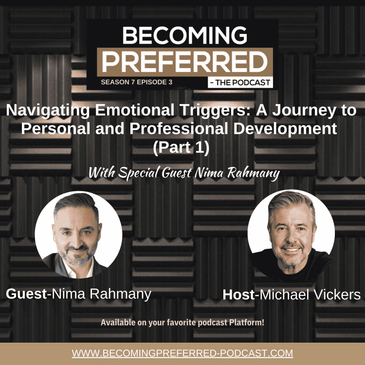
SEASON: 7 EPISODE: 3
Episode Overview:
Welcome back to Becoming Preferred, the podcast dedicated to helping you level up your game and become the best version of you.
Normally, we spend our time developing strategies for market dominance, leadership, and business growth. But true success isn't just about what you accomplish on paper—it's about how you show up as the highest, best version of yourself in every area of your life.
That’s why today’s episode is part one of a special two-part series. This week, we’re laying the foundation by focusing entirely on personal development. We’re joined by Nima Rahmany to explore what it means to become 'trigger-proof,' break intergenerational patterns, and build genuine emotional safety.
Then, be sure to tune in next week for part two, where we’ll build on these insights and pivot the conversation directly toward professional development! So, let's get into part one—join me for my conversation with Nima Rahmany.
Guest Bio:
Nima Rahmany helps high-performing individuals, couples, and families heal relational wounds, regulate their nervous systems, and become trigger-proof in love, leadership, and connection.
Formerly a chiropractor, Nima now guides clients through somatic and shadow integration to interrupt unconscious relational patterns and create emotionally safe, co-regulated relationships. Nima's work blends neuroscience, polyvagal theory, attachment theory, and transformational coaching to help people build more secure, authentic connections.
Resource Links:
- Website: https://becometriggerproof.com/
- Product Link: https://becometriggerproof.com/shop/
Insight Gold Timestamps:
04:35 By the age of 13, I was like hellbent on becoming a chiropractor
05:13 I inherited this intergenerational angst of this constant feeling of hypervigilance
10:02 This is what they call the anxiety alarm loop
14:56 It was like the universe gifted me this experience...
17:16 There's no gap between stimulus and response if you're carrying shame
22:01 The true test of somebody's teaching of something is what are they living?
24:40 What you're talking about is the concept of creating emotional safety
27:26 The first thing is when I put an expectation on myself to make a quick turnaround...
30:15 There's an unconscious covert expectation that we have
35:32 The problem is actually called enmeshment
38:00 Just normal experiences of people with different values
44:46 What would love do?
46:28 A true successful person, I look at the way their partner looks at them
47:19 The website is becometriggerproof.com
Connect Socially:
Facebook: facebook.com/nimarahmanyofficial
Instagram: instagram.com/nimarahmanyofficial
YouTube: youtube.com/@NimaRahmanyOfficial
Email: support@becometriggerproof.com
Sponsors:
Rainmaker LeadGen Platform Demo: https://calendar.summit-learning.com/widget/booking/JKItVP7WErmCBjU2cCIx
Rainmaker Digital Solutions: https://www.rainmakerdigitalsolutions.com/
In 3, 2, 1.
Speaker BWelcome back to Becoming Preferred, the podcast dedicated to helping you level up your game and become the best version of you.
Speaker BNormally, we spend our time developing strategies for market dominance, leadership and business growth.
Speaker BBut true success isn't just about what you accomplish on paper.
Speaker BIt's about how you show up as the highest, best version of yourself in every area of your life.
Speaker BThat's why today's episode is part one, a special two part series.
Speaker BThis week we're laying the foundation by focusing entirely on personal development.
Speaker BWe're joined by Nima Romani to explore what it means to become trigger proof, break intergenerational patterns and build genuine emotional safety.
Speaker BThen be sure to tune in next week for part two, where we'll build on these insights and pivot the conversation directly towards professional development.
Speaker BSo let's get into part one.
Speaker BJoin me now for my conversation with Nima Romani.
Speaker CWell, hi, Nima, welcome to the program.
Speaker CWe're delighted to have you.
Speaker AI am stoked to be here.
Speaker AJust a few minutes of chatting with you and I'm like, I could hang with this guy.
Speaker CHey, I'm excited about this.
Speaker CI love the subject matter which we're going to be talking about how you can become trigger proofs, how to stop reacting and start reconnecting.
Speaker CAnd I said, it's so timely and even on a personal level, I'm interested in this as a personal, always interested in personal development, making ourselves better.
Speaker CAnd our whole show is really about how do we level up our game and become preferred emotionally in our world and how do we make the best versions of ourselves.
Speaker CSo I'm excited about the topic, but before we kind of delve into it, our audiences always like to go back and go, how did you get here?
Speaker CWhat was your transformations?
Speaker CGo back to high school.
Speaker CYou're in high school.
Speaker CWhere are you living?
Speaker CWhat do you want to be when you grow up?
Speaker AI am in Stittsville, Ontario, Canada, just outside of Ottawa.
Speaker APersian immigrant who came to Canada at the age of four, Parents leaving the Iranian general.
Speaker ALike IRGC came in the Revolutionary Guards.
Speaker AThe Shah days.
Speaker AYeah, exactly.
Speaker AAs soon as Shaw was out, my parents took us.
Speaker AImagine two, a young couple, Persian couple in their twenties having twins that are now four years old and now in your early mid twenties.
Speaker AIt's like, I got to get the fuck out of here with my kids to have a future.
Speaker AAnd they uproot and they come to Canada and unbeknownst to me, it's a traumatic experience that, that they're, you know, constantly in hyper vigilance for religious persecution from the Baha', I, as Baha'.
Speaker AIs.
Speaker AWe were raised as Baha'.
Speaker AIs.
Speaker ASo this experience of fleeing, this experience of being othered is what I was kind of like born and raised into in my very formative years without the awareness of that happening.
Speaker AKind of like Covid, children are in today's day and age, very similar type of intergenerational stuff that you don't know is a wound because you're literally swimming in it.
Speaker CAnd multigenerational.
Speaker CThat's a good way to phrase it.
Speaker COkay.
Speaker CSo you're growing up and you're going to school.
Speaker CYou've got career path ahead of you.
Speaker CYou come from, you know.
Speaker CAnd though I remember being around in the political days, that was what some people might remember.
Speaker CWhen we had the Iranian hostage situation, Reagan was coming in, Jimmy Carter was the president, United States.
Speaker CThere's a lot going on.
Speaker CThe revolution was going on with the ayatollahs.
Speaker CI mean, it was a big disruption.
Speaker CSo to be able to out of your family culture, you probably left family behind.
Speaker CSo.
Speaker CYes, that's all part of it.
Speaker AYeah.
Speaker CI'm assuming.
Speaker CDo you still have family there tonight?
Speaker ANot really.
Speaker AEverybody's kind of immigrated.
Speaker AAnybody who I have a connection with, so we don't really have that many family back back home.
Speaker CYeah.
Speaker CAnd of course we can see the trauma that's even going on today that's going to create.
Speaker AYes.
Speaker CGenerations again.
Speaker CAll right, so you're in, you're in high school, your college.
Speaker CYou got to decide on a career path.
Speaker CWhat was your, your father obviously as a businessman or did he create his own?
Speaker AHe's a mechanical engineer.
Speaker ASo he came, he got educated to upgrade.
Speaker AThey both upgraded their educations in Canada.
Speaker AThey got, you know, college and university kind of degrees.
Speaker AMy dad got his masters and he was just like all about education.
Speaker AEducation.
Speaker AYou got to be a doctor.
Speaker AGot to be a doctor, Got to be a do.
Speaker ASo when I discovered chiropractic at a career day, I'm at a career day, I'm the eighth grade in Stittsville.
Speaker AA chiropractor comes in, shows the spine, talks about what they do, the whole philosophy of the nervous system and removing interference in the body healing itself.
Speaker AAnd I'm like, that sounds like me.
Speaker AAnd by the age of 13, I was like hell bent in becoming a chiropractor.
Speaker AI was like, nothing's going to stop me.
Speaker AAnd I graduated CMCC Chiropractic in 2001.
Speaker CAll right, so you did that.
Speaker CHow long did you practice for?
Speaker APractice for 25 years left as a member in good standing.
Speaker ABut within the first 10, 15 years, I started discovering that patients that are coming in with stress related problems and their aches and pains, there's something far deeper and in this unconscious kind of anxiety that's been in my nervous system ever since we had moved to Canada, not really knowing it.
Speaker AI inherited this intergenerational angst of this constant feeling of hypervigilance that I inherited.
Speaker AI went down a path of personal development unknowingly trying to solve that experience.
Speaker AAnd I found all of these amazing tools, especially Dr. John DeMartini in chiropractic school.
Speaker AHe blew my mind.
Speaker AAnd he taught me how by changing our perceptions, you can actually shift how you perceive the world.
Speaker AAnd I just went all in and it was amazing.
Speaker AAnd so I started integrating that into my practice just on Saturdays, just saying, hey guys, I want to offer you a little gift.
Speaker ACome in and learn some skills, life skills for a stressful world.
Speaker ASo that we're lowering our resistance and our friction with reality, or specifically from our past, which we're carrying around with us, we could remove that friction.
Speaker AWe feel better, we feel healthier, we feel more vibrant and more alive.
Speaker AAnd so I started kind of like going down that path.
Speaker CAnd yeah, that's where you are.
Speaker CThis is what's interesting.
Speaker CChiropractic has a.
Speaker COne of the major tenets of chiropractic.
Speaker CAnd if I misspeak on this, please clarify.
Speaker CBut that disease and disease conditions, you know, originate from the spine and work its way out.
Speaker CSo if we can fix those issues.
Speaker ABut a little, I need to jump in and kind of correct that philosophy.
Speaker AThere's very.
Speaker AChiropractic is very divided.
Speaker ALike many professions like Islam, like Jew Christianity, like as an entity, it's divided in the middle.
Speaker AAnd on one side is a group of people who believe that it's more of the holistic type of view.
Speaker ATheir approach to the body is that the nervous system, that there's an intelligence in the body.
Speaker AAnd by removing the interference through points in the nervous system, through the spine, oftentimes you can bring that nervous system back into a state of harmony, equilibrium, relaxation, state of ease.
Speaker AAnd then another group which is kind of like the medically minded, they're looking for validation from the medical.
Speaker ASo they just want to keep it as like the 3D reality.
Speaker AAnd back pain, let's just keep it to back pain.
Speaker ALet's just talk about only back pain, only neck pain.
Speaker AAnd anything else is quackery because we want medical validation.
Speaker ASo I was kind of More of, you know, the middle.
Speaker CYeah.
Speaker AI don't go too far.
Speaker AAnd I'm kind of like it.
Speaker AI see the energetic component of releasing nervous system dysregulation so that you can bring safety into the body.
Speaker AAnd then on the other hand, yeah, we all want to be out of pain.
Speaker AI had an extreme amount of back pain, and I was getting adjusted because I just wanted to be out of pain.
Speaker ASo both can coexist is what I love to see.
Speaker CYeah, it's interesting why, if you get the physical structure going, the body can heal itself.
Speaker CIt's its best healer.
Speaker CAnd I know you believe that.
Speaker CAnd then what's interesting, though, is now that connection with that brain of ours where we develop that fight or flight and so much of our childhood traumas, if you will, and we all have them, everybody has them, everybody's experiencing them start to manifest themselves just like an injury would, just like a structural injury would.
Speaker CAnd so you're working now on the internal systems to get that right as well, and structure.
Speaker CSo let's go.
Speaker CSo what have you discovered there?
Speaker CYou work with a lot of professionals, you work with entrepreneurs, you work with successful people.
Speaker CNot successful.
Speaker CDo you start to see patterns that you're starting to see?
Speaker AOh, yeah.
Speaker CAnd then let's talk about those patterns.
Speaker BWhat did you notice?
Speaker AYeah, well, I noticed the patterns in everybody now, because I look.
Speaker AI first had to look at the patterns within myself.
Speaker AAnd so instead of talking about them, I want to tell you about the patterns that were really challenging, which is I've did a lot of personal development work, followed the big names.
Speaker ABut on a cognitive level, we can get to an understanding of these changes.
Speaker ABut the embodiment of all of these concepts are really what are demonstrated.
Speaker AThe proof is in what the body is saying.
Speaker ASo if I'm caught, if I'm building wealth or I'm trying to do personal development to become more, quote, unquote, successful.
Speaker AAnd I built this on a wound that deep down, because of those experiences from childhood, because of that shock and trauma or experience like I had when I was 2 years old and I was separated from my mother for a period of about three months while she was exploring immigrating to Canada with my twin brother, because she could only bring one of us that wound that becomes a wound that often, at 2 years old, you don't really have the language to describe.
Speaker ARight.
Speaker ASo it's an experience that's in the body, and it creates anxiety, it creates this alarm in the system, which then we go into the head to try to Create stories about our lives in order to cope with that alarm.
Speaker ASo this is what they call the anxiety alarm, arm loop.
Speaker AMy friend Dr. Russell Kennedy taught me about that.
Speaker AAnd it was like, oh, eureka.
Speaker AI realize when you're doing personal development and you're unaware of this wound of unworthiness that you're trying to seek success for, you will get that success.
Speaker AYou will achieve it.
Speaker ALike I did all these awards for best chiropractor.
Speaker AOne of the biggest practices, making a lot of money.
Speaker AAnd all of this drive and this push to try to get some level of worthiness from an external perspective is exactly the manifestation of that wound.
Speaker AAnd we don't really know it.
Speaker AAnd the sneaky part was I was using personal development as a means of negating or avoiding or exiling that wound even further.
Speaker AAnd that led to a really toxic relationship where one divorce, several failed relationships after that, leading to this one really toxic one, which I didn't understand.
Speaker ACodependency.
Speaker AI didn't know about attachment theory, but we were in a codependent trauma bond, push, pull dynamic which ended up escalating in intensity.
Speaker AAnd then we would have amazing sex because it was all driven by the sex.
Speaker AAnd so this push and pull dynamic that I felt powerless to get out of because the sex was so amazing, eventually that spell was broken.
Speaker AOne night, March 11, 2018, where after a five hour argument, I slapped her.
Speaker AAnd in that moment I was like, wait.
Speaker AI had left chiropractic at the time.
Speaker AWe were teaching this personal development stuff.
Speaker ABut in our personal lives, we were not living congruently with all of whatever the stage Persona is.
Speaker AI don't know if you know anybody like that, but that was me.
Speaker CIt's.
Speaker CYeah, I do.
Speaker AAnd that was the symptom.
Speaker CI've seen it.
Speaker CI've had lunch with big names, as big as names as you can in the business and.
Speaker COr in events and seeing how they treat people.
Speaker CServers.
Speaker CYeah, A server coming for lunch and be treated rudely by somebody who's in the self help guru stat, who I was, you know, falling, or their microphone went out and their battery died.
Speaker CAnd they berated the.
Speaker CThe person handling the audio technician in front of an entire audience.
Speaker CRight.
Speaker CAnd that kind of.
Speaker CThat just to watch the reaction of the audience and how this person was treated, they kind of lost all credibility there.
Speaker AYes.
Speaker CAnd I understand.
Speaker CAnd you know what?
Speaker CIn my own personal behavior, I could probably say the same thing.
Speaker CIn other words, guilty.
Speaker AI've been guilty of that too.
Speaker ASo you're saying that I'm kind of Cringing a little bit because I'm looking at all the times in which I reacted beyond what the situation called for.
Speaker CYeah.
Speaker CI've, you know, my Persona, the most of the time I'm this way.
Speaker C90% Of the time, I'm in a positive framework.
Speaker CBut then every once in a while, there's those triggers.
Speaker CYou have a shadow and, you know, I'm a petulant 7 year old and.
Speaker COr, you know, and that's me just self diagnosing.
Speaker CAnd it's like.
Speaker CAnd it's frustrating because you have it when you're triggered, you feel it in real time and it's almost like you don't care.
Speaker CYou know, it's bad.
Speaker CYou know, it's that there's an element of control to it, for sure.
Speaker AYeah.
Speaker CBecause how, how we can control.
Speaker CBut it's kind of like you're okay in this spot.
Speaker CAnd that's the problem is it feels okay.
Speaker CYou actually don't care.
Speaker CYou start pulling away from everything in that environment and it's an awful place.
Speaker CAnd then afterwards when you come down and that adrenaline dissipates and that.
Speaker CBecause it's instant, it's an instant thing and it's that I think it's trying to find that gap.
Speaker CAnd like, I've looked at things would have set me off and some of us have been angry.
Speaker CIt could be road rage, it could be other, you know, whatever the issue is.
Speaker CAnd we try and manage that anger, all right, Instead of actually identifying what's that real, what's the root cause of that, that trigger, and then how can we pause that gap so it doesn't.
Speaker AFly into it as you're talking, I'm just channel, I'm just getting all these downloads.
Speaker ASo I can't wait to answer those questions.
Speaker CPlease, Please.
Speaker CYeah.
Speaker ASo essentially, how do we, how do we expand that gap?
Speaker AThat was the first question that I had to ask after I had done that to my ex.
Speaker AAnd we sat there and I was just like, oh my God.
Speaker ALike, it was like the biggest wake up call that I could go through because I can't tell you how much shame that I felt in that moment.
Speaker CRight.
Speaker AAnd so one of the most important parts of shifting our reactivity was after this came up, I started looking.
Speaker AI couldn't do the usual entrepreneurial things that we use to distract ourselves from that feeling, which is, oh, let's go make more money, let's go create another offer, let's go build something so that I could kind of avoid this shameful, pitiful part of Me.
Speaker AAnd it was like the universe gifted me this experience where nothing, none of the previous methodologies of this mindset work that I could see was actually working to absolve me from the deep emotional pain I was feeling after having gone through that, after having put my ex through that and having gone through that.
Speaker AAnd now we're in this dynamic where the whole world around us, our community found out and they're all just.
Speaker AIt was all during the MeToo type of experience.
Speaker AAnd it was like, are we going to, are we going to basically destroy this man's career?
Speaker AThere was a little group kind of in that situation.
Speaker ASo my nervous system went into a freeze because doing what I do, I'm teaching, I'm speaking, I'm using my voice, but there was no power behind my voice.
Speaker AI couldn't even get myself up to, to say anything because I thought, oh my God, I am such a fucking fraud.
Speaker AI cannot believe the self loathing is.
Speaker CThe natural follow up to that.
Speaker ASo I had, I realized that I had built my entire identity on that wound that just got exposed in that moment.
Speaker AAnd so the gift of that experience was learning how to understand this aspect of myself that I had been creating, this public Persona to not deal with, to not feel.
Speaker AAnd so I stopped doing all the things that, you know, distracted me and then I went inside.
Speaker AAnd so how do we expand that gap?
Speaker AIt's done through expanding your capacity to sit with your shame in a high level.
Speaker AThis is what I'm doing.
Speaker ACase in point, a man who just said the exact same thing.
Speaker ASuccessful, you know, amazing marriage.
Speaker AThey have their grandparents now, you know, in their mid-50s.
Speaker AAnd it's like this experience of betrayal happened in their relationship.
Speaker AAnd she's very public about it, she's open about it.
Speaker AShe runs a podcast around this whole topic.
Speaker AAnd I'm helping him.
Speaker AAnd basically without the experience of being able to sit in our shame, any form of negative feedback towards you, you're going to perceive as an attack and you're going to get super duper reactive.
Speaker AThat's.
Speaker AThere's no gap between stimulus and response if you're carrying shame.
Speaker CInteresting.
Speaker AEssentially that's what I discovered.
Speaker CYeah, it's instant.
Speaker CIt's like a switch gone.
Speaker CAnd what's interesting, do you find that there's times, yeah.
Speaker CIn a public environment.
Speaker CAnd I, I'm a trigger.
Speaker CI can manage, I want to use the word manage.
Speaker CI, I can delay.
Speaker CIt's a delay really, than anything that whatever that trigger, that feeling is, because I'm that, that Persona, that visual plus, it's terrible.
Speaker CYou'd be ashamed if anyone even saw you behaving that way or saying things that you would regret saying.
Speaker CWhere.
Speaker CAnd then in the privacy, it maybe it dissipates or maybe you'll come back to it later.
Speaker CBut it's like a.
Speaker CAnd I don't know if all the triggers are the same.
Speaker CLike, I'll give you an example.
Speaker CMy parents were immigrants.
Speaker CDad World War II went through 29 homes in.
Speaker CBack in London.
Speaker CWhen they were bombing London, they kept taking kids out and putting them into different homes, just knocking on the door, can you take this kid?
Speaker CSo we had 29 homes and paperwork wasn't done.
Speaker CAnd there was probably issues that he went through.
Speaker CI, based on my conversations with him, that abuse all kinds of different things.
Speaker CHe's watching airplanes, machine gun schoolyards and kids trauma.
Speaker CMy mother was kidnapped at age six in England from her dad during the war.
Speaker CAnd she never saw her mom for two years.
Speaker CRight.
Speaker CAnd then lived with night terrors for her.
Speaker CI used to wake up the house, she'd be screaming in the middle of night.
Speaker CAnd then the anger.
Speaker AYou would wake up.
Speaker AYou would wake up in that.
Speaker CYeah, I'd wake up listening to her waking up, screaming, having a nightmare.
Speaker CAnd then when it came time for punishment, it was.
Speaker CThe punishment was always way worse than the crime.
Speaker CAs a kid, like, for me, if I did something really that was not a parent wanted to do, it was.
Speaker CI've been black and blue from my ankles to my shoulder blades.
Speaker CIt was a whipping.
Speaker CIt was.
Speaker CYou were.
Speaker CAnd I only had that a few.
Speaker ATimes, but I did black and blue.
Speaker CBlack and blue.
Speaker CAnd you'd be taken away in today's world.
Speaker CAnd I still love my parents.
Speaker CI still love them.
Speaker CI was able to reconcile as their.
Speaker COh, this is what they went through.
Speaker CBut I also.
Speaker ABut it made an impact huge.
Speaker CAnd I was that way, but I was like.
Speaker CMy mom was very verbal.
Speaker CAnd so when I'm triggered, I get verbal.
Speaker CI can get.
Speaker AYou go into the verbal violence.
Speaker AThere's a gradient of violence.
Speaker ARight.
Speaker AWhat I discovered verbally, you can be violent.
Speaker CThat's what we saw.
Speaker AThat's how we learned it.
Speaker CThe issues.
Speaker CYeah, yeah.
Speaker CSo it's ideally like, for me is it's that pause.
Speaker CCan we create that pause between.
Speaker AYeah.
Speaker CThat gap to.
Speaker COkay, here's the trigger.
Speaker CI know this is a trigger.
Speaker CSo for me, it's really a trigger of disrespect.
Speaker CIf I feel disrespected, I feel like I'm being totally disrespected.
Speaker CI'm now lashing out and going to be disrespectful.
Speaker ARight, Exactly.
Speaker AAnd that.
Speaker AThat moment where that boundary is violated in your energy and you feel personally attacked.
Speaker CYeah.
Speaker CYes, exactly.
Speaker AThere's a shame that gets evoked internally, and it's so painful that the only way is to.
Speaker AThis is what I learned from my integration.
Speaker AThe only way to cope with the shame is to say something so hurtful back or do something hurtful back or physically do something, break something, so that that shame instantly turns into pride.
Speaker AIt's kind of like a cooling system for the shame.
Speaker ASo this is why, if we don't integrate shame, we will respond with verbal violence, physical violence.
Speaker AIt's like, end.
Speaker AEnd domestic violence.
Speaker AWell, no, Sherlock, nobody raises their hand and says, hey, this is such a great idea.
Speaker ALet's do this consciously.
Speaker AIt's not a conscious choice to do that until you really understand the mechanism of shame and how verbal violence or physical violence, like.
Speaker ALike any type of attack energetically that goes from a thought, a judgment, to verbal to physical violence, to murder, like, everything in that spectrum is a.
Speaker AIs an energetic reaction to a feeling of profound hurt, namely shame.
Speaker ASo what I discovered, and it was like, nobody's really talking about it at this level.
Speaker ASo I went and I studied somatic experiencing.
Speaker AI went and studied polyvagal theory, shadow work.
Speaker AAnd I was like, these were all the somatics, breath work.
Speaker AThese were all the things that I was missing in the mindset, work that I had done in my personal development.
Speaker ABecause the true test of embody, the true test of somebody's teaching of something is what are they living?
Speaker ARight?
Speaker ASo now I have a son.
Speaker AHe's five.
Speaker AAnd I've dedicated my life to integrating this work because.
Speaker AWhat did you learn, Michael, growing up?
Speaker AWell, guess what?
Speaker AI learned it too.
Speaker AAnd it's just intergenerational, unresolved stuff just bouncing into the next generation.
Speaker AAnd so the people I love working with are the ones who've done a lot of personal development.
Speaker AThey understand the frameworks, but they still find themselves reacting, acting the same way.
Speaker CYeah, yeah.
Speaker AJust like my client, who I was talking about, he was like, look, I see the reaction coming.
Speaker AI know when it's happening, but I just can't seem to get off of that train.
Speaker AAnd guess what?
Speaker AI told him what I'm telling you.
Speaker AI said, you can.
Speaker AWe just have to be intentional with going after the root of this because it's not coming from your wife.
Speaker AWe have to go after the unconscious complex that this kind of like, Repeated default reaction is coming from.
Speaker AAnd then we have to unearth it and then create an entirely new pathway.
Speaker AIt's like learning a new step in a dance.
Speaker ASo it's possible, but with the right guidance, the right practices.
Speaker AAnd now when his wife shares her emotions, now just after three months of rewiring this with the kind of becoming trigger proof to it, she's now able to share her feelings with him.
Speaker AAnd he doesn't get defensive, he's able to hold it, he's able to listen and he's able to validate something he's never been able to do in their 30 some odd years of marriage.
Speaker ASo it's possible, if you're willing to take the time and stretch it, but it can't be done just by cognitively.
Speaker AOkay, I'll get to it.
Speaker AIt's a dance that can be trained and taught.
Speaker CI think it's a.
Speaker CLike, what I've noticed is if I'm blindsided or if it comes out of the blue and.
Speaker COr I'm tired, say I'm fatigued, I'm tired, or maybe you've had a glass or two of wine, or relax.
Speaker CThose are not the time to get into those conversations.
Speaker CNow, if they're prefaced meaning, okay, you and I are going to have a conversation now.
Speaker CWe're going to talk about sensitive things.
Speaker CWe're going.
Speaker CAnd we kind of lay out the framework for it.
Speaker CYeah, it's like, I can, I can go there.
Speaker CLike, for me, I can go there.
Speaker CIf you and I were going to have this conversation and it's prefaced and it's set up so I'm not.
Speaker CIt's not a surprise.
Speaker CDoes that make sense?
Speaker AYeah.
Speaker AYeah.
Speaker AWhat you're saying is there's a container that's set for it with parameters.
Speaker AHey, let's talk about this.
Speaker AThis is what it's going to be.
Speaker AAnd what you're talking about is the concept of creating emotional safety.
Speaker ASo in order for this to happen, like let's say my wife and I are.
Speaker AWe had a rupture or an argument yesterday and we had discussion about something.
Speaker AAnd so now in this moment in time, I'm processing and we are going to have.
Speaker AWe're going to have a conversation of repair.
Speaker AAnd what you're saying is absolutely right, which is, all right, so let's set that container and this is what we're going to talk about.
Speaker ABut you're already making a few very bold assumptions that I want to invite you to really look at.
Speaker AAnd the first one is, are you open first of all, are you open to hearing it?
Speaker AYes.
Speaker CYeah, sure.
Speaker AI. I can share.
Speaker ASo the first one.
Speaker AThe first one is you're assuming that when you're having that conversation with her, that your nervous system is in a safe place, that you feel a sense of internal safety.
Speaker AIf I'm not feeling a sense of internal safety.
Speaker AAnd in what we call polyvagal theory, in a sympathetic tone, the words that I use to talk to you, the tone of voice that I have, the kind of like, prosody in my voice is going to either cause you to go further into sympathetic or you're going to actually go into what's called ventral safety.
Speaker AAnd so how I show up is the next thing.
Speaker AAnd the next part is.
Speaker ANow you're discussing the concept of leadership and polarity.
Speaker AWho's going to drive the bus on that?
Speaker AMichael, for the most part, what I've observed is that most of the time it's women.
Speaker AThe female that's driving the bus and initiating a repair with someone who oftentimes doesn't have the skills in how to do it and just expects her to be like his mother and soothe him, which creates a lack of polarity, which creates this sense of.
Speaker AShe becomes his mother.
Speaker AShe's exhausted and burnt out and feeling, you know, not held and not seen.
Speaker AAnd he's now the little child that has this entitlement and expectation that she's going to soothe him.
Speaker AAnd they're both playing this really shitty game that nobody's winning.
Speaker AAnd.
Speaker CNo, no.
Speaker CIt's interesting you use the term rupture.
Speaker ASo.
Speaker CYeah, you know what?
Speaker CYou know, you've developed these modalities to deal with and processes to deal with things.
Speaker CDo you fall off the wagon every once in a while and you have it a rupture where, yeah, you're here.
Speaker CAnd then it's like.
Speaker CAnd the key is to repair quickly the repair problem.
Speaker CFor me, personally, that's.
Speaker CI've learned that, hey, repair quickly because you always feel bad afterwards.
Speaker CBut yeah, so it's.
Speaker CHow do you do that?
Speaker CWhat do you notice in your great question, if you don't mind me asking, and how that ruptured that quick turnaround.
Speaker AQuick turnaround.
Speaker AOkay.
Speaker AThe first thing is when I put an expectation on myself to make a quick turnaround, what happens is I put pressure on myself and I can do what's called cognitive or spiritual bypass, which is rampant in the personal development, because I'm supposed to do it quickly.
Speaker AThere are parts of me that feel really protective, parts that are parts of me that are like, ooh, I can't believe.
Speaker AI just don't want to, like, constantly abandon myself.
Speaker AI've been abandoning myself all my life to keep the peace, people pleasing.
Speaker AAnd there's a resentful part.
Speaker ASo you got to make sure that you are not invalidating this part of you that needs a little bit of space and needs permission to be seen and heard.
Speaker ASo that can be done by yourself.
Speaker AYou have.
Speaker AI have my methodologies that I kind of put together is being able to create that within yourself self so that you can bring your adult self online and then initiate repair.
Speaker ABut make sure you're doing it as your adult self, because if you're doing it as your child self and I'm rushing through it, and there's a part of me that just wants to appease you because I don't want you to be mad at me, and I just want to be.
Speaker ANow you.
Speaker AI'm.
Speaker AI'm kind of manipul.
Speaker AI'm being manipulative both to you and myself, and that's not sustainable.
Speaker CDo you find that there are certain things.
Speaker CAre you seeing commonalities of what triggers are like?
Speaker CSo for me, you know, I can be driving down the road, somebody cuts me off, whatever.
Speaker CThere was a time I'd be mad, flipping the bird and move on.
Speaker CRight.
Speaker CBut now I just move over, somebody's on my back bumper, just move over and go.
Speaker CAnd I'm just not letting them get my blood pressure up.
Speaker AYeah.
Speaker CI think as we get older, we start to go, sure want to get my blood pressure up over this.
Speaker CAre there certain common triggers that you see that are everyone.
Speaker CLike, for me, it's disrespect for sure, but only from people close to me.
Speaker CSo children, my spouse, if I feel disrupted, doesn't mean they're trying.
Speaker CAnd most of the times they're not.
Speaker CI just interpret it as a disrespect.
Speaker ACorrect.
Speaker CCould be my wife talking.
Speaker AGood call.
Speaker AGood catch.
Speaker CCan be.
Speaker CShe can be direct, right?
Speaker CWell, my mother was really direct, you know, and I don't like the directness.
Speaker BDon't.
Speaker CAnd because we're tired, we get grumpy, we get irritable.
Speaker CWe get it.
Speaker CDo you see?
Speaker ABut if other people taught other people are disrespectful, you don't really care.
Speaker CYeah, I could care.
Speaker AInteresting.
Speaker AOkay, cool.
Speaker ASo I have a few thoughts on that.
Speaker AAnd your question.
Speaker ACould you remind me of your question a little bit later?
Speaker ABecause I'm going to completely forget it because I.
Speaker AYou've really inspired this.
Speaker AThis track.
Speaker ASo the first thing that you brought up is other people around me, they can say whatever, and it doesn't.
Speaker ADoesn't bother me.
Speaker ABut when they're close to me, this is what happens.
Speaker ARight?
Speaker ASo people will say that like.
Speaker ALike.
Speaker ALike what hurts when it's my partner.
Speaker AAnd it's.
Speaker ABecause when there's an unconscious complex happening, when there's intimacy, right?
Speaker ASo if they're in your family system, there's an unconscious covert expectation that we have, and this is going to sound weird, that we parentify them, whether it's our children or whether it's our partner, we've unconsciously placed them in the parent role.
Speaker AUnconsciously.
Speaker ASo when they're being a certain way, it carries more weight for us.
Speaker CRight.
Speaker AThan.
Speaker AThan, you know, some dude off the street who's just, you know, flipping the bird off you.
Speaker AOkay, cool.
Speaker AWhatever.
Speaker CYeah, whatever.
Speaker CYeah, no, exactly.
Speaker ASo.
Speaker AExactly.
Speaker ASo what that does is that trigger sends us back in time and it brings us to a younger part of us that experience that which then we're unconscious of.
Speaker ASo our job is to slowly start to notice it, periodically going, oh, there it is again.
Speaker AThere it is again.
Speaker ASo, yes, you will slip up.
Speaker ASo when you're like, do you.
Speaker AYou know, I teach this stuff.
Speaker AWell, does that mean that I don't get triggered and we don't get into conflict?
Speaker AAbsolutely not.
Speaker AI think it's healthy for my child to witness us in conflict and then witness us repairing.
Speaker CYeah, I agree.
Speaker ASo watching, going, hey, bud, we're gonna get.
Speaker AAnd it's like his.
Speaker AThe messaging he's getting is, your mom and I are not always going to agree, but we're always going to repair, and we always love you no matter what.
Speaker ARight.
Speaker AAnd so it's important to really understand, like, we're literally modeling it for him.
Speaker AI mean, wouldn't that have been fun for you growing up to be able to have had that modeled?
Speaker ARight?
Speaker ASo that's what becoming a cycle breaker is all about.
Speaker ASo remind me of your question and I'll weave it in.
Speaker CSo the question is, do you see common things that do trigger?
Speaker CSo for me, again, if it's somebody personal going, hey, you're the worst speaker.
Speaker CThis is the worst podcast I've ever listened to listen to.
Speaker CThis is.
Speaker CI'm like, oh, yeah, good.
Speaker CWow.
Speaker CWow.
Speaker CThat's all, you know, hey, awesome, tell me, why is that?
Speaker CI can explore it.
Speaker CI can question it and go, how did you come up with that?
Speaker CI can deal with it.
Speaker CSo it's not even.
Speaker CIt doesn't even trigger me.
Speaker CIt Just doesn't right now.
Speaker CThere probably was a time in my early life where it did, but I don't recall it.
Speaker CBut when it's personal, let's say for instance, you're my partner, I'm talking to you and I ask a question and maybe you give me a sharp answer or a snug denied comment, or yes, something.
Speaker CAfter that it's like, okay, the most common one.
Speaker AYeah, the most common.
Speaker AYou want to know what it is?
Speaker CWhat?
Speaker AA woman will express her emotions.
Speaker AShe's sad, she's grieving.
Speaker AAnd a woman is more biologically connected, especially when everybody's healthy, for sure.
Speaker ABiologically connected to her intuition, her sixth sense, the feminine, the mysterious feminine, the, the unseen world, if we can get spiritual around.
Speaker CIt's a superpower.
Speaker AIt's a superpower that a woman.
Speaker ARight.
Speaker AAnd the shadow part of that is that she feels everything, you know, up and down and good and bad.
Speaker AAnd so these waves of these emotions and sadness when she loves her partner sometimes come off as complaining.
Speaker AA sound of like, you know, a woman who's exhausted because a part of her doesn't feel worthy of receiving, so she over functions and she's tired of it and she's burnt out and she's, she's sad and she's scared and she needs just that.
Speaker ASo that expression of emotion, in whatever way that she does it in form of complaining, critical, whatever.
Speaker CYeah.
Speaker ACauses a trigger in him where he feels like he's not good enough.
Speaker AInstead of hearing the child's complaint as it is, he is interpreting her sadness as a failure on his part.
Speaker AAnd, and that triggers his shame.
Speaker AAnd he doesn't want to feel his shame.
Speaker ASo instead of integrating that shame becoming trigger proof to it, he then gets defensive and then tells her why her emotions are bad or wrong or why all the evidence for why he's wrong, she's wrong.
Speaker AAnd look at him.
Speaker AAnd then he unconsciously is prioritizing being right over the actual connection.
Speaker ABecause as a little boy, if you're not right, then you're not lovable.
Speaker AThat's the message you're given.
Speaker ASo in order for you to be correct, perfect, right.
Speaker AThat makes you lovable.
Speaker ASo what he's saying is, no, I am lovable.
Speaker AYou're wrong, I'm lovable.
Speaker AAnd she's now feeling anything but that love.
Speaker AAnd this becomes this push and pull dynamic, which is where the anxious and avoidant trap come in her anxiety or his anxiety.
Speaker AIt can also happen in that triggers her avoidance, which triggers his anxiousness, triggers her avoidance and it just becomes that infinite loop of doom.
Speaker AAnd that's the most common one.
Speaker AAnd it's reversible.
Speaker CNo, it's as you're saying it.
Speaker CMy wife would.
Speaker CI remember conversations where she might be angry or mad.
Speaker CAnd then all of a sudden I'm getting angry and mad and she goes, I just want to be angry and mad.
Speaker CYou don't need to get angry and mad.
Speaker CI'm just going to be.
Speaker CBe the one that's angry around.
Speaker CBut I.
Speaker CSo if she prefaces it, hey, I just want to vent here and be judgy and do this.
Speaker CIt's like, oh, okay.
Speaker CIn other words, shut up and listen.
Speaker CRight?
Speaker AAnd in other words, that's where you have an elegant boundary around it.
Speaker CYeah, it's interesting.
Speaker AIt's called elegant boundaries.
Speaker ASo what you're talking about is a very foundational root cause of this trigger that happens.
Speaker AAnd the problem is actually called enmeshment.
Speaker AEnmeshment is an, a lack of an emotional boundary between one person and another.
Speaker ASo they bleed into another person.
Speaker AI was at a retreat recently and watching this couple just struggling for decades over this.
Speaker AOf when he goes into his avoidance and he goes into his little poor me victim story about life, about his father.
Speaker AShe then feels anxious, like she's gotta soothe him because his emotions bleed into hers.
Speaker AAnd then when he sees her over functioning, it causes him to shut down even more.
Speaker ASo she bleeds into him and they're literally bleeding into each other and they're miserable.
Speaker AAnd it's just not sustainable.
Speaker AAnd that is the root of it.
Speaker AIt's so painful.
Speaker AAnd I.
Speaker AThis was me and my ex and I just want anybody to know who's living in that, that there's a much better way of when you can have a conflict but then have your own experience, clean that up and then repair as two functional adults.
Speaker CAnd it.
Speaker CThat's an interesting expression of that.
Speaker CLet's talk about children a little bit.
Speaker CBecause like I said, when they're little, my wife and I would raise seven and five daughters, two sons.
Speaker CSo we're.
Speaker AWow, is that all good family?
Speaker CYeah.
Speaker AGood for you.
Speaker CAnd you know, 90 of the time, it's amazing, right?
Speaker CAnd what I used to always, what I, my wife and I talk about is I go, hey, if we were in school, our relationship would be an A or an A minus or an A plus.
Speaker CBecause 90%, I'm in the 90s, like 10%.
Speaker CYeah.
Speaker CWhere it's very small percentage, but it feels like great.
Speaker CAnd I'm more of an all or Nothing kind of guy.
Speaker CSo in other words, when I go into that state, if I've been triggered, it's all bad.
Speaker CEverything's bad.
Speaker CThere's nothing redeeming about this.
Speaker CIt's all good because we're in this place.
Speaker CAnd I'm sure you see that as well.
Speaker CAnd I'm wondering as they become adults and adult children, because now I see where they get triggered.
Speaker CI know what triggers them.
Speaker CAnd I can watch maybe when I've been the cause of the trigger based on that.
Speaker CSo it's identifying then going, not going there.
Speaker COr maybe you have to walk on eggshells with one or somewhere else.
Speaker COr we, this topic's off limits.
Speaker CWe can talk about this.
Speaker CAnd of course, we're seeing that now with politics.
Speaker CWe see it with families, you know, with what's going on in the US and we say a massive division going on.
Speaker CIt's that whole divide and conquer thing.
Speaker CAnd families is there.
Speaker CAre you seeing that with the families, with the children become adult children as well?
Speaker AA hundred percent.
Speaker AAnd what you're talking about is just normal experiences of people with different values.
Speaker ARight.
Speaker AAnd someone's going to say something that crosses a boundary.
Speaker AThis is what will happen in a family system.
Speaker AThis is what will happen if you go to a kind of like a group retreat.
Speaker AThis is what happens.
Speaker ASo the question here isn't, is a boundary going to be violated?
Speaker AIs can we talk?
Speaker AHow do we talk about it when it does?
Speaker AHow do we communicate it in a way which both parties can feel seen and heard and there's repair.
Speaker AThis is unfortunately, with all you can do all the work in the world and you won't be able to avoid, like, you know, let's say you go camping with a family in tight quarters for a week.
Speaker ANext week you're going to have boundary violations that happen.
Speaker AAnd there's a practice and a process and it's messy of repair.
Speaker AThat's really all it is.
Speaker AIt's like you set it up and go, look, we're not going to always get along.
Speaker AI'm going to have my side of the story and you're going to have yours.
Speaker ABut I'm committed for us to owning our parts and then understanding one another.
Speaker ACan we start like that?
Speaker AYeah.
Speaker AOkay, cool.
Speaker AAre we in this together to do that?
Speaker ANo.
Speaker AOkay, well, why would I want to continue?
Speaker ANow I get to examine why I would want to continue to be in an engagement, in a relationship with somebody who has no desire to own their part, who has no desire to look at themselves.
Speaker AAnd that might Be your parents.
Speaker AAnd so if that's the case, okay, so now I get to make a decision.
Speaker ADo I want them in my life and my family's life?
Speaker AYes.
Speaker AOkay.
Speaker AIn order to do that, how do I boundary the situation?
Speaker AHow do I make sure that my wife feels emotionally safe so that any processing or problems that happen, I'm able to show up as the person that could have her feel seen and heard?
Speaker AAnd then if there's an argument coming with my parents and they have their perspective and they are not emotionally mature enough to be able to kind of like concede and be like parents, which is often the case with boomer type of parents, Baby boomer type of parents.
Speaker AHow do I elegantly boundary the situation so that everybody has as great of an experience as in their capacities according to the word capacity.
Speaker ASo that's where the word capacity comes up, and that's where the cycle breaker gets to make.
Speaker AIt becomes the shapeshifter and goes, what do I want?
Speaker AHow do I make sure everybody is kind of.
Speaker AHow do I lead the container in such a way where there's co regulation happening?
Speaker ASo this becomes a skill.
Speaker CI love how you're talking about setting the boundaries.
Speaker COne of the trends that we're seeing.
Speaker CAnd as parents, as baby boomer parents, parents, we talk to other friends.
Speaker CAnd based on what you're talking about, we're seeing a lot of.
Speaker CAnd it seems like it's a fad.
Speaker CAnd I'm sure you see this, so I'd love your perspective on it.
Speaker CWhere there's.
Speaker CWhat's the word in a strange.
Speaker ANo contact.
Speaker ANo contact.
Speaker CAnd it's rampant.
Speaker CIt's rampant.
Speaker CAll of a sudden it's like, hey, I don't want anything more to do with you.
Speaker CI don't want to talk to you.
Speaker CBoom.
Speaker CAnd you're like, well, can we check?
Speaker CNothing.
Speaker CThey won't even discuss what the issues are.
Speaker CThe problems are.
Speaker CThey leave you guessing on what.
Speaker AThat's hard.
Speaker CIt's.
Speaker CAnd based on research, it seems like it's prevalent.
Speaker CIt's almost.
Speaker AYes.
Speaker CEpidemic level.
Speaker CAre you seeing that as well?
Speaker AWell, I've experienced it.
Speaker AYou know, April, my wife's birthday, my parents and I had a rupture for the first time since I had my own family.
Speaker AIt's been five, six years.
Speaker AI did so much healing work to get to a really great place.
Speaker AAnd now after a trigger that escalates.
Speaker AThis is just a few months ago in the recording of this, all of a sudden, I'm in a situation where I was kicked out of the home.
Speaker ANow my son and wife were also kicked out.
Speaker AFor whatever reason that escalated.
Speaker AAnd now not only do I have to deal with my own experience of feeling anger and bitterness and resentment and all of my own childhood stuff coming up.
Speaker ANow I got to worry about these guys now I got to feel how are they doing.
Speaker ASo going through this experience and now walking through and going through the work of beginning that repair process and now initiating it, and we're now moving in those steps without rushing my family.
Speaker ASome huge perspective of what do you do?
Speaker AIs you focus on your own inner work.
Speaker AWhat you do is whatever's coming up.
Speaker AYour child is a mirror.
Speaker AThey are reflecting something that you maybe can't see right now or have the unwillingness to see, but it's an invitation to dive deeper into understanding yourself and them and then being the source of repair.
Speaker ASo I went and I did that repair and I made.
Speaker AI got to that place where I no longer am in that space of victimhood.
Speaker AI made that.
Speaker AI made that contact and I was okay regardless because I got to a place of peace with it.
Speaker ASo the answer is to get to a place of peace and heal the hurts before making any contact.
Speaker AAnd that's what I'm interested in.
Speaker CAnd it's a tough thing.
Speaker CAnd there's degrees.
Speaker CIt's spectrum as well.
Speaker A100.
Speaker CI think over time.
Speaker CIf you're approaching it, like just on a personal level.
Speaker CI have is initially it's disappointment.
Speaker CInitially it's like, why the anger, the frustration.
Speaker CAre you kidding me?
Speaker AYeah.
Speaker CAnd then it's as you're evolving through and processing that, it's.
Speaker CHey, you know what?
Speaker CI love this person and I want them to be happy.
Speaker CAnd if I've.
Speaker CWhatever there is.
Speaker CIf.
Speaker CIf this removes.
Speaker BYeah.
Speaker CFor them.
Speaker CBecause they're obviously dealing with some trauma.
Speaker CRight.
Speaker CThat they're dealing with.
Speaker CAnd it's correct that my wife always says it's not personal.
Speaker CIt feels personal, but it's not personal.
Speaker CIt's.
Speaker CIt's their issues.
Speaker CSo the best we can do is love them more.
Speaker CAll right.
Speaker CAnd which is true.
Speaker CAnd hopefully they come back again.
Speaker CAny.
Speaker CIf you do get interactions, make them positive expressions of that.
Speaker AYeah.
Speaker AAnd everything you're saying is 100% true.
Speaker AAnd what I would add to that is careful.
Speaker AYou're not spiritually or cognitively bypassing that.
Speaker AThere is a younger part of you that feels rejected.
Speaker CFor sure.
Speaker AAnd to address that first and to heal the hurt of that and the anger and the bitterness so that you can get to a place of understanding.
Speaker ASo when you do show up.
Speaker AIt's not being led by the wound.
Speaker AYeah, there's an emotional sense of safety there.
Speaker ABecause the reason why somebody will shut me out, it's because they're having an experience of a lack of emotional safety.
Speaker AWhether I had intentions of it or not, I clearly, I don't intend on making people feel unsafe, but that they're projecting their stuff.
Speaker ASo.
Speaker ASo what would love do?
Speaker AHow can I approach it in the most loving way?
Speaker ASo that becomes my work to become that source of love and understanding and use that to heal the hurts.
Speaker AThat's what being trigger proof is all about.
Speaker COh, makes sense.
Speaker CHey, let's get a business question.
Speaker CAnd just in as we're wrapping up.
Speaker CTime moves so fast.
Speaker BYeah.
Speaker CI call this the paradox of the decorated wreck in your work.
Speaker CYou use the term that I know is going to hit home for a lot of our listeners.
Speaker CYou call it the decorated rack.
Speaker CThese are professionals who are highly decorated.
Speaker CThey're successful, capable on the outside, but quietly they're struggling or spiraling in their personal relationships.
Speaker CWhy is it so common for high achieving business professionals, entrepreneurs, to master business execution, but feel completely unequipped when a partner pulls away or a child pushes back?
Speaker ABecause the wound that has us being able to push through things is what makes us successful at work.
Speaker AThat same wound in a personal relationship dynamic, you can't use the same tactics that made us successful at work, which is, by the way, a paralyzing insecurity and a need for validation that gets ex.
Speaker AYou can hide that from the stage, right?
Speaker AThose speakers that you're talking about hide it very well because it's based on a performance.
Speaker AYour skills that make you successful performers, high performers.
Speaker AThe decorated wreck is a high performer.
Speaker APerformer in intimacy.
Speaker AYour performances are all exposed.
Speaker AYour family can spot right through your bullshit.
Speaker AAnd so to me, a true successful person, I look at the way that, that their partner looks at them.
Speaker AYou can tell.
Speaker AYou can tell.
Speaker ALike if I'm seeing a guy and he's teaching, whatever.
Speaker AThe true test of his success is a radiant partner who just feels really safe and seen and heard.
Speaker AAnd if he's too far into his ego, which is what it often takes to become a nine figure entrepreneur, your health and your relationships suffer.
Speaker ASo the skills that make you successful.
Speaker AYou can become successful at work because you delegate your weaknesses to teammates who do better.
Speaker ABut you can't delegate in an intimate relationship.
Speaker AYou have to become that person.
Speaker CSo that's why amazing become trigger proof.
Speaker CThe website is become triggerproof dot com.
Speaker CNina Romani this has been amazing on a personal level and a professional level as well.
Speaker CAmazing.
Speaker CLove to have you back brother.
Speaker ALet's do this again.
Speaker AI'd love to chat more.
Speaker CGreat having you as a guest.
Speaker CThanks for being here.
Speaker AI had a great time.
Speaker BAs you are listening to this episode, what is one idea that you've heard that's caught your attention and why does it matter so much to you?
Speaker BAnd who is one person who you can share that with, either sharing this episode or just sharing that insight that occurred to you while you were listening?
Speaker BPerhaps it is that true emotional freedom requires changing our internal perceptions and healing past wounds rather than relying strictly on cognitive willpower.
Speaker BOr maybe it's that we achieve genuine relational success when we expand our capacity to sit with difficult feelings like shame, allowing us to pause rather than react.
Speaker BThank you for listening, for learning, and for investing in yourself so that you can become the best version of you.
Speaker BIf you found value in this episode, please write a review on Apple Podcasts.
Speaker BIf you haven't subscribed yet, please do so so you can get a new episode and start your week off right every Monday.
Speaker BUntil next time.
Speaker BThis podcast is created and associated with Summit Media.
Speaker BMy Executive producer is Beth Smith and.
Speaker CDirector of Research Tori Smith.
Speaker CThe fee for the show is that you share it with friends when you find something useful or interesting.
Speaker BThis podcast is subject to copyright by Summit Media.
Speaker AGoodbye.