
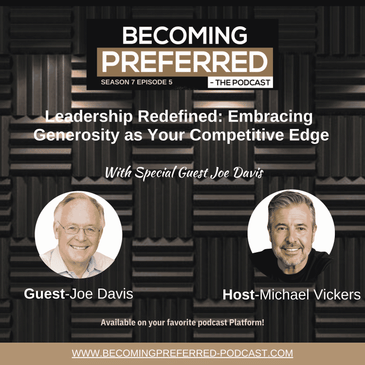
SEASON: 7 EPISODE: 5
Episode Overview:
Welcome back to the Becoming Preferred Podcast, where we focus on insights to help you level up your game and become the best version of you.
When you think about what makes a business or a leader valuable, it’s easy to focus on strategy, metrics, and technical execution.
Most people associate top-tier strategy consulting with pure analytics and spreadsheets—our guest today proves that the highest-yield leadership strategy on Earth is actually generosity.
Joe Davis spent nearly four decades at Boston Consulting Group, serving as Managing Director and Senior Partner, leading BCG North America, and co-founding its Public Sector practice—guiding leaders right through the heart of the 2008 banking crisis. He’s helped build innovation hubs across Silicon Valley and now serves as an award-winning author and speaker on a mission to redefine high-performance leadership.
In his landmark book, The Generous Leader, Joe shows us why treating people with deep, intentional generosity isn't soft—it’s your greatest competitive advantage. Please join me for my conversation with Joe Davis.
Guest Bio:
Joe Davis is an award-winning author and speaker on a mission to bring generosity to leadership. He spent 1987 to 2025 at the Boston Consulting Group (BCG), where he served as a Managing Director and Senior Partner. Joe led BCG North America and founded its Center for Inclusion and Equity.
After working in BCG’s Boston and Australia offices, Joe co-founded BCG’s Washington, DC, office in 1996 and took over its leadership in 2006. While leading the Washington, DC, office, he became the firm’s first Northeast System Leader. In 2008, Joe launched BCG’s US public sector practice, where he worked with Sheila Bair and the FDIC during the peak of the banking crisis. In 2011, Joe was recognized as one of Consulting Magazine’s Top 25 Consultants for excellence in the public sector.
In 2013, Joe moved to San Francisco to lead BCG’s West Coast System. While on the West Coast, he was instrumental in founding BCG Digital Ventures. Joe also served as the BCG Executive Sponsor and Vice Chairman of B Capital Group, working with founders Eduardo Severin and Raj Ganguly. During this time, his team worked with Bay Area leaders to bring Super Bowl 50 to San Francisco in 2016–an experience Joe reflected on in his 2013 Ted Talk.
In his book, The Generous Leader, Joe offers a seven-part guide to heartfelt and collaborative actions that transform the reader into a generous leader.
Joe earned a BA in Economics from Whitman College—where he now serves as Chair of the Board of Trustees—and an MBA from Harvard Business School. Throughout his career, Joe has led with a collaborative approach, a commitment to equity, and a track record of delivering results that shape both organizations and communities.
Joe has been married to his wife, Sarah, for over four decades. They have four wonderful children and eight grandchildren.
Resource Links:
- Website: https://www.joedavis.com/
- Product Link: https://www.joedavis.com/#row-book
Insight Gold Timestamps:
01:50 We're talking about your book The Generous Leader
03:52 The value of hard work, that was clear
07:18 The work-life world has blurred
09:24 Let's invert the pyramid and that leader should be at the bottom supporting the organization
11:42 You can't say you don't know, you're the CEO, you have to have all the answers
16:54 Today it seems like we're looking for creativity, we're looking for innovation
17:58 40+ percent of the Gen Z and millennials are stressed every day
19:57 To be really an inspiring leader and move mountains, you need to be connecting
25:36 If you're not inspiring your people, listening to them, motivating them to deliver in those moments with some humbleness, good luck
29:38 Those that burn out early are those that think they can do it all themselves
32:06 How can leaders give generously to others without running their own batteries down to zero?
34:26 If someone does a job well done, take a moment to write an email to them or a text
37:25 Just say I don't know, if you don't know
40:15 The book's called The Generous Leader: Seven Ways to Give of Yourself for Everyone's Game by Joe Davis
Connect Socially:
LinkedIn: https://www.linkedin.com/in/joedavis1313/
YouTube: https://www.youtube.com/@JoeDavisTGL
Email: joedavistgl@gmail.com
Sponsors:
Rainmaker LeadGen Platform Demo: https://calendar.summit-learning.com/widget/booking/JKItVP7WErmCBjU2cCIx
Rainmaker Digital Solutions: https://www.rainmakerdigitalsolutions.com/
In 3, 2, 1.
Speaker BWelcome back to the Becoming Preferred podcast where we focus on insights to help you level up your game and become the best version of you.
Speaker BWhen you think about what makes a business or a leader valuable, it's easy to focus on strategy metrics and technical execution.
Speaker BMost people associate top tier strategy consulting with pure analytics and spreadsheets.
Speaker BOur guest today proves that the highest yield leadership strategy on earth is actually generosity.
Speaker BJoe Davis spent nearly four decades at Boston Consulting Group serving as Managing director and Senior partner leading the BCG North America and co founding its public sector practice, guiding leaders right through the heart of the 2008 banking crisis.
Speaker BHe's helped build innovation hubs across Silicon Valley and now serves as an award winning author and speaker on a mission to redefine high performance leadership.
Speaker BIn his landmark book, the Leader, Joe shows us why treating people with deep intentional generosity isn't soft.
Speaker BIt's your greatest competitive advantage.
Speaker BPlease join me for my conversation with Joe Davis.
Speaker CWell, hi Joe, welcome to the program.
Speaker CWe're delighted to have you.
Speaker DHi.
Speaker DThank you, Michael.
Speaker DIt's great to be here.
Speaker CNow, where are we speaking to you from today, Joe?
Speaker DWell, I'm in northern Minnesota, a small town named Cloquet, Minnesota, near Duluth.
Speaker DSome people probably heard of Duluth, Cloque maybe.
Speaker BBeautiful.
Speaker CBeen to Duluth a few times.
Speaker CSo I've been flying airplanes for about 40 years and I picked up an airplane out of Duluth that was made.
Speaker CSo it's kind of like an airplane capital of the world there.
Speaker CYeah, no, very beautiful.
Speaker CAnd that northern Minnesota, some lots of lakes, lots of fishing.
Speaker CSo I'm glad you're having a good summer.
Speaker CBeautiful summer.
Speaker CI'm excited about our topic today.
Speaker CWe're talking about your book the Generous Leader and how that works and basically how leadership as evolving because a lot of us are entrepreneurs, a lot of us are business executives and we're always trying to figure out what's that latest tool that we can use to help our organizations, how can we build our cultures?
Speaker CThe book, you've obviously been thinking about it.
Speaker CWe're going to have it in the show notes.
Speaker CBut You've got a 40 year career working with Boston Consulting Group.
Speaker CYou went to, got a Harvard mba.
Speaker CYou've done and accomplished a lot of different things.
Speaker CI thought one of the most interesting things was getting the 50th Super bowl over to San Francisco, being part of that.
Speaker DThat was fun.
Speaker CYeah, I'm jealous about that.
Speaker CSo we have, we maybe talk about that.
Speaker CBut let's talk, let's go back in time.
Speaker CFirst, Joe Back in high.
Speaker CI want you to go back to.
Speaker CYou're in high school.
Speaker CYou're deciding what I want to be when I grow up and go to college or university.
Speaker CTake us back there.
Speaker CWhat put you on the path that brought you to where you are today?
Speaker DYeah, it's an interesting question.
Speaker DI listened to some of your shows, so I knew you'd ask me this and you know.
Speaker DWell, first off, I grew up in Seattle, Washington.
Speaker DBellevue, Washington.
Speaker DWent to Bellevue High School, which is not really relevant to anything.
Speaker DI think there's a couple things.
Speaker DAs I thought about that I had jobs like from sixth grade.
Speaker DI had two paper routes.
Speaker DNow, a lot of your listeners may or may not remember what a paper route is, where we had a morning and an afternoon paper, which is unheard of.
Speaker DTwo papers in one town, which was a little bit of teaching me the value of hard work.
Speaker DAnd then I started working once I was 16, at a restaurant.
Speaker DIce cream, it was called.
Speaker DIt was a food plus an ice cream place.
Speaker DLike it was called Early Dawn Ice Cream.
Speaker DYou kind of like Farrell's if you made it out of Swensons.
Speaker DAnd there the real thing that put me on the tracks, I had a mentor.
Speaker DAnd I didn't think about this until your question, but the owners of the company, Roy was the guy.
Speaker DHe was intense and hardworking, but he cared about you.
Speaker DAnd his wife Marie seemed to be nicer, but she wanted the numbers to get hit.
Speaker DAnd they took me under their wing.
Speaker DI started with them.
Speaker DI was 16.
Speaker DI was an assistant manager at 17.
Speaker DAnd I managed two of the restaurants in Montana and Seattle area during college summers.
Speaker DAnd really what was.
Speaker DObviously there's a couple points there, the value of hard work, that was clear.
Speaker DI don't think I knew I was learning it, but I was learning it.
Speaker DThe value of mentors who push you because they want you.
Speaker DYou to be better.
Speaker DAnd then I think and I one little silly thing, but I did want to go to Harvard Business School like from age 8.
Speaker DI have no idea why.
Speaker DI read about it somewhere now.
Speaker DYou know what?
Speaker D10,000.
Speaker DIt's luck that you get in because I'm sure half the people that applied are actually good enough.
Speaker DBut only, you know, 8% get in or something.
Speaker DSo that was the only thing at that early days.
Speaker DBut I went to.
Speaker DWent to college, went to business school.
Speaker DAnd then that's how I landed the BCG career.
Speaker DEveryone interviews for consulting firms.
Speaker DSounds silly.
Speaker DInvestment banks.
Speaker DI got BCG offer the summer, stayed there.
Speaker DAnd 37 years later, but the same thing to Keep me, people.
Speaker DWhy do you stay 37 years?
Speaker DAnd obviously there's many reasons, but one of the main ones, I had a mentor from my second year until I actually was running North America, or maybe the north eventually stepped back, but.
Speaker DBut he was my mentor for 20.
Speaker DAnd he also pushed me very hard.
Speaker DVery hard.
Speaker DBut it was also, he's one of those guys that the minute he wasn't pushing you, you know, he wrote you off.
Speaker DIt was like, oh, that's a bummer.
Speaker DBecause you didn't, you know, because he wasn't.
Speaker DYou thought, okay, this person' going to really drive to improve themselves, deliver.
Speaker CYeah.
Speaker CSo what was he pushing you on, if you don't mind?
Speaker CWhat would be a typical Something where he's making you stretch for me.
Speaker DCouple things.
Speaker DThat's two.
Speaker DInchy thing.
Speaker DOne, and all of us could learn this.
Speaker DHe said, joe, you have tummy rumbles when something's wrong.
Speaker DYou can tell it, but you don't want to go deal with it because it's a hassle.
Speaker DIt's hard.
Speaker DYou're afraid.
Speaker DDo not run from that.
Speaker DThe minute you feel that tummy ruble, go face it.
Speaker DI know you're scared.
Speaker DBut that was pretty interesting because he was right.
Speaker DThis is, oh, I don't want to deal with it, but how easy all of us do that.
Speaker DThat was one thing that I remember early on.
Speaker DThe other one, he once said a story to me, I'll tell it all those little.
Speaker DHe said, joe, if I put you in a room with four white walls and.
Speaker DAnd this other guy, not together, but it gave you the hardest BCG problem you come up with, this other guy would solve it every time and get out of the room.
Speaker DYou probably wouldn't solve it by yourself.
Speaker DYou won't get out of the room.
Speaker DHowever, when you get out and now we get it done.
Speaker DHe'll never get it done.
Speaker DNever.
Speaker DBut you will get it done every single time.
Speaker DSo there was a but.
Speaker DHe said, now I'm saying just because I'm saying that, keep pushing yourself to try to solve the problem.
Speaker DSo he also said, you know, just do not give up.
Speaker DDo not quit.
Speaker DYou know, push, push, push to solve the analytics.
Speaker DBut the message that was positive was you actually are incredible at collaborating, teaming with others.
Speaker DYou're willing to leverage them and work with others and willing to put people that are better than you in different place, in different aspects around you.
Speaker DDon't lose that.
Speaker CThose are good advice.
Speaker CAnd we're getting that from you, from your mentor as well.
Speaker CSo we're killing Two birds with one stone, so to speak.
Speaker CThat's good.
Speaker CSo let's talk about leadership.
Speaker CI remember, you know, I grew up in the one minute manager.
Speaker CYou grow up at the same time all the different management by walking around, there's all these leadership, different styles.
Speaker CTom Peters In Search of Excellence.
Speaker CThese are all books that I know you've read and gone through and became themes.
Speaker CHow have you seen it evolve in leadership and then how did it evolve from?
Speaker CYou know, when you're building your career, when you were first put in positions of leadership and then where do you see it moving to today?
Speaker CAnd you've added an element, the generous leader which we want to unpack for sure.
Speaker CBut how have you seen it evolve over that 37 year career?
Speaker DWell, you know, I think at the bottom line and you say the thing that's evolved is that the work life world has blurred.
Speaker DBlackBerry started it.
Speaker DNow it's 247 every day.
Speaker DAnd Covid and now AI is going to only accelerate it even more.
Speaker DAnd when the work life world evolved, you as a leader of all the people that working need to bring a bit of their human self to work and they want to see a bit of the human from you.
Speaker DSo the tough guy, everything's great.
Speaker DI know all the answers those days just don't resonate.
Speaker DNo certain genius who's got a lot of companies but it seemed to collapse right and left as people quit on him too.
Speaker DBut the tough guy, I think a Jack Welch who someone said no, Jack, Joe, Jack, Kel cared very deeply but it was all a tough guy thing.
Speaker DYou couldn't get the tough guy world.
Speaker DThat world has evolved.
Speaker DSo that's a evolved.
Speaker DThat's what I've seen evolve over time.
Speaker DEspecially this whole who are the people I'm working with and teaming with or that work for me?
Speaker DHow am I connecting with what matters to them so I can inspire and motivate them as opposed to dictating what you do.
Speaker DAnd the other thing that's changed is you say no, they just keep telling they have a job.
Speaker DBut the ability, especially in the tech world to kind of change this is the ability to change jobs went through the roof as well as the world.
Speaker DWe didn't have a guaranteed life in Japan, but IBM once you worked there, you were there forever, you know, cog in the wheel.
Speaker DSo that got broken as well as employees said well wait a minute, I don't like working here, especially in Silicon Valley.
Speaker DI can walk down the street and now with COVID you can walk to Dallas and Not move your house and go work for another employee.
Speaker DSo I think two things have happened.
Speaker DThe work life blur because of technology and the ability to quit or the need to retain your best people.
Speaker CThat's no, it's interesting.
Speaker CAnd you use some examples like Jack Welchley.
Speaker CYou know, these were all the stalwarts of business, but it was more, it.
Speaker BSeemed like a command and control structure.
Speaker CAnd the way I would describe it, I was working for some of the banks around Y2K era.
Speaker CAnd my philosophy has always been, you know, the old philosophy was there was this pyramid and you're at the top, the leaders at the top and driving everything down the organization.
Speaker CTo me, I always thought let's invert the pyramid and that leader should be at the bottom supporting the organization and to be, let's use your words, generous with that organization.
Speaker CAnd it takes a different kind of leader and there's an evolution to that.
Speaker CAnd I think I'd be interested in examples of who does it well in today's world.
Speaker CSo for instance, we see, even in our politics we're seeing the old style command and control and it doesn't work well.
Speaker CWe get decisions that are not by consensus.
Speaker CWe get unilateral thinking, we get disharmony.
Speaker CYou know, culturally look at it without picking a team or a side.
Speaker CBut our results, we gotta look at the results.
Speaker CAnd if we look at our results, we've got a divided company or that is country or countries because we've got different ideals and different plans of debt from a leadership point of view.
Speaker CAnd there's those who want to follow the old.
Speaker CI want that strong leader.
Speaker CAnd we still have a lot of biases because of that.
Speaker CRight.
Speaker CAnd people are worried.
Speaker CThey want to keep those old structures.
Speaker CIs there an example of a leader that you in your mind that is generous has evolved into the kind of leader can you think, or any of that?
Speaker DYeah, yeah.
Speaker DWell, I can give you some examples.
Speaker DI just want to first comment on your comment on government, the country.
Speaker DBecause I did worry, oh my gosh, this new, not this old attitudes trying to come back.
Speaker DIs my theme generous leader going to be any.
Speaker DThe fact of the matter is it's just gone the other way.
Speaker DPeople say, wait a minute here, they want to talk about that.
Speaker DAnd maybe if you work in the White House, there's the way it is.
Speaker DBut the rest of us are still employees somewhere.
Speaker DAnd you know, we got.
Speaker DWe gotta be inspired to stay there.
Speaker DThat hasn't changed.
Speaker DSo a couple people, I will tell one guy named Scott Kirby, CEO of United who?
Speaker DStories about in my book.
Speaker DAnd he's a.
Speaker DHe's.
Speaker DI can't remember.
Speaker DHe's military guy.
Speaker DI can't blank him, which I think he was Air Force.
Speaker DHe's not some lightweight guy.
Speaker DHe went through the Air Force Academy, blah, blah, blah.
Speaker DAnd he's pretty impressive as what you and I would call it, whether you're going to call it humble or someone that listens.
Speaker DCan I get a quick couple quick stories?
Speaker DOne thing.
Speaker CYeah, please.
Speaker DTold me one thing.
Speaker DHe told me when Covid hit.
Speaker DHe said he wanted to go on the video and tell his town hall and tell everybody.
Speaker DI don't know when we're going to fly again.
Speaker DWe'll do our best to take care of everybody and furlough if we have to and.
Speaker DBut not fire people.
Speaker DAnd his team said, you can't say you don't know.
Speaker DYou're the CEO.
Speaker DYou have to have all the answers.
Speaker DOld school.
Speaker DHe said, this one's obvious a guy, but I don't.
Speaker DSo what do you mean to go lie?
Speaker DThese people aren't stupid out there.
Speaker DAnd so Scott just said, you know, humbly.
Speaker DHe said, I don't know.
Speaker DBoom, boom, boom.
Speaker DAnother quick story.
Speaker DWhen after George Floyd's shooting and murder, Scott's wife was on a flight and the captain came out, said, oh, Mrs. Kirby, it's so great to see you.
Speaker DYou know, thank you.
Speaker DI'd be on my flight and I just love your husband, not the boss.
Speaker DAnd I would do anything to fall for United.
Speaker DShe goes, why so?
Speaker DOh, and it was a black female.
Speaker DAnd she said after the George Floyd murder, he called every captain black person of color just to check in.
Speaker DDidn't have an answer, didn't have anything to do, just to check in.
Speaker DSimple, small act of humility, caring about what was important to them at that moment, not to him.
Speaker DAnd it was a huge impact.
Speaker DSo I can.
Speaker DWe'll wait till we go.
Speaker DI have other stories about Scott, but he's very good at engaging with the people, listening to them, thinking about where they are humble acts.
Speaker DThat's one example.
Speaker DAnother great example.
Speaker DIf you.
Speaker DSorry, I'm picking Covid, but arnie Sorensen, the CEO of Marriott, this one, you can see it on YouTube.
Speaker DBut when Covid hit, he was dying of cancer.
Speaker DHe was in the middle of chemo and he has a video there, it's bald.
Speaker DAnd it went on and on about all the articles about it, but he talked about same thing.
Speaker DI don't know where we are, where, when it's going to reopen all the hotels are shut.
Speaker DI'm sorry, we'll furlough you.
Speaker DWe won't fire anybody.
Speaker DWe're taking pay cuts at the executive level and we'll just all be in this together.
Speaker DAnd he was, you knew he was dying of cancer.
Speaker DHere he is bald, but didn't hide it.
Speaker DAnd it was a very humble, vulnerable talk, you know, another example of.
Speaker DNot the Jack Welch bottle, you know.
Speaker CYeah, exactly.
Speaker DInspired.
Speaker DInspired everybody.
Speaker DAnd even in the tech world, I was once.
Speaker DSomeone asked me once, what about all these guys?
Speaker DZuckerberg, Musk, blah, blah, blah.
Speaker DI said, fine.
Speaker DThere are some people that create a technology and a product that's so unique, they get to ride it for a long time.
Speaker DBut I don't know about you.
Speaker DI have a lot of friends whose kids went into Facebook for three years and they said, I'm out of here because they like the resume, they like the money, but they were out.
Speaker DThey want to work in that environment.
Speaker DWhereas the other guy is Satya Nadella.
Speaker DYou know, he turned around Microsoft after Ballmer took it nowhere.
Speaker DAnd Ballmer is the old school.
Speaker DAnd it was culture that he talked about.
Speaker DNo more silos.
Speaker DWe're gonna question each other and ask and listen to each other.
Speaker DWe're going to work together.
Speaker DHe was still tough, he still had clear strategy and he still expected excellence.
Speaker DBut he did it more in a team environment versus a command and control.
Speaker DSo there's.
Speaker DSorry, there's a few examples.
Speaker COh, it makes sense.
Speaker CYour pilot example with United.
Speaker CThat's.
Speaker DIsn't that incredible?
Speaker COne of your key principles, that's your generous inclusion, inclusive to invite collaboration, show respect, which they're doing.
Speaker CAnd then you talked about generous communication with the CEO of Marriott.
Speaker CYeah, that's.
Speaker CYou're connecting.
Speaker CYou're being real, right?
Speaker CAnd authentic.
Speaker CAnd I think it matters with the generations.
Speaker CLike, I don't know what you've noticed.
Speaker CYou and I are baby boomers.
Speaker CAnd we saw Kennedy get shot, we saw Martin Luther King get shot.
Speaker CWe had black and white baby photos.
Speaker CThat's that we.
Speaker CBlack and white tv.
Speaker CWe watched the Ed Self.
Speaker CWe saw the Beatles arrive, right.
Speaker CAnd sing on television.
Speaker CSo the other generations think that was, you know, lasted forever.
Speaker CAnd you have all these different generations now.
Speaker CWe have five generations of workers out there and balancing work, life, balance.
Speaker CAnd so the millennials and the Gen X and the Y's, they're all products of our upbringing and they don't want to be us.
Speaker CThey don't want to be us.
Speaker CNow you, you talked about paper routes.
Speaker CYou know, I Whenever I talk to successful professionals, I always ask them if they're a certain age.
Speaker CI go, did you have a paper out?
Speaker CThe answer is always yes.
Speaker CI can almost predict it.
Speaker CThat's really cool.
Speaker CYeah, same for me.
Speaker CBecause you had to learn to deliver the papers, then you had to collect.
Speaker CThen you had to go knock on the door and get the money from Mrs. Johnson and get her $2.50 a week or whatever that was.
Speaker CAnd hopefully you got a tip at Christmas time or some cookies or something like that.
Speaker CSo I remember those.
Speaker CI did the same thing.
Speaker DI'll tell you the other thing that you can interrupt is if I had the morning round, if I delivered late, in other words, the dad had gone to work.
Speaker DOh, my.
Speaker DI heard about it.
Speaker DSo customer service mattered too.
Speaker DIf you deliver after they left, they can't read their paper.
Speaker CYou were mad.
Speaker CYou gotta be on time.
Speaker CYeah.
Speaker CYou were more important than the milkman.
Speaker CYeah.
Speaker CSo with the different generations, has that been part of it, why it's evolved that way?
Speaker CI call it consciousness, and evolvement is called eq.
Speaker CSo, you know, I have a new book, we were talking about it earlier coming out about staying relevant, and I say EQ is the new mba.
Speaker CYou've gone through a traditional and had Harvard mba.
Speaker CYou work on cases, you're looking at analytics, you're working on all those details.
Speaker CDo you think with the generations, it's kind of forced, that evolution?
Speaker CLike, I took calculus and trig when I was in college, they're teaching it in high school.
Speaker CAnd now I can just simply ask my AI tool or say, my professor said to me, the reason you need to learn how to do this in long form is one day you won't have your calculator with you.
Speaker CWell, that's not true.
Speaker DI've had that one the other direction.
Speaker CI've had it with me the whole time.
Speaker CAnd it does even more now.
Speaker CI have my personal assistant.
Speaker CSo, you know, it's like school.
Speaker CIf you were math and science, you went to, you were in one track.
Speaker CIf you were vocational, you went another way in a different truck.
Speaker CToday it seems like we're looking for creativity.
Speaker CWe're looking for innovation.
Speaker CWe're looking at, can you see the big picture?
Speaker CCan you think?
Speaker CTo me, it's an evolution of our consciousness.
Speaker CEven as society, I mean, you know, black people got the right to vote in 1965, and we're still challenging those things, those norms.
Speaker CWhere we've evolved, there's still part of society wants to go back versus the younger folks that are More idealistic.
Speaker CThey're looking for purpose.
Speaker CWhat are you saying?
Speaker DWell, a couple of things I think someone once asked me, isn't it just the young kids will grow up one day like us and have a mortgage and go back to normal, whatever that meant, you know, our normal and just do what you're told.
Speaker DI don't believe that actually, but I don't.
Speaker DIt's not just sure.
Speaker DI think it's because the world has changed.
Speaker DI mentioned the technology.
Speaker DNow you could be on all the time.
Speaker DIt changed the workforce.
Speaker DNow you work at 9 at night at home.
Speaker DSo now you got to figure out how to draw boundaries or your life's just screwed.
Speaker DYou know, we, we drew a boundary by going home or working harder than going.
Speaker BRight.
Speaker DSo the technology made a big change.
Speaker DThe other thing, you probably know this data too, but all these Gallup Survey, Deloitte survey is that 40 plus percent of the gen Z millennials are stressed every day.
Speaker DEvery day they're feeling anxious.
Speaker DSee I think what also happened is we got to the next.
Speaker DThen the social media thing and now you picked your phone.
Speaker DYou just go like that.
Speaker DYou can be depressed because Iran bombed this and they bombed that and this or Trump said that or someone else didn't take long some shooting.
Speaker DNow your whole like holy crap.
Speaker DSo this is why I think that this generation is a little bit about wait a minute.
Speaker DFirst off, you better connect me with you boss as a person because nothing else is.
Speaker DThese machines are helping and the idealistic that I don't know, we'd have to really look.
Speaker DI think that you could find people that had talked about purpose but sure the ideals are always different.
Speaker DThe younger people that Mark might change.
Speaker CThe values, it's a value difference.
Speaker DBut the value of how am I getting engaged?
Speaker DWell you talk to me in advance about being with your grandchildren on Saturday they would think even harder about how am I going to be engaged with my family because otherwise I'm on all the time.
Speaker DAnd we were not all we could go home now.
Speaker DI worked all the time.
Speaker DYou probably did too.
Speaker DBut not everybody worked as many hours.
Speaker DYou didn't have to.
Speaker DIt's your paper route point.
Speaker DSo I think that's one of the big changes is the technology is forced to and the social media and the world just comes at you so fast.
Speaker DSo now the stress is a different level.
Speaker DThe anxiety that's real.
Speaker DThat is.
Speaker DYou've seen the charts.
Speaker DYou can see the anxiety in young people and, and the, the phone, the ubiquity of the phone and social Media.
Speaker DIt's the most perfect line in the world.
Speaker DYou don't need two dots and have a partner just say, oh, that's a line.
Speaker DThis is a real line year after year.
Speaker DAnd so that's I think the biggest change.
Speaker DWhich means as a manager, or not even a manager, because a manager can just do their job.
Speaker DBut as a leader, you really want to be a leader.
Speaker DLike, wow, people say I want to follow you, you know, like that black captain.
Speaker DI will do follow Scott and united anywhere within reason.
Speaker DOf course.
Speaker DIf you want to be that kind of leader, you have to connect with your people.
Speaker DIt's just you have to, you can be a fine manager, you can get a long ways up.
Speaker DI'm not saying that won't happen.
Speaker DBut to be really an inspiring leader and move mountains, you need to be connecting.
Speaker CYeah.
Speaker CAnd I think thinking of them first, that's why I say it's an EQ item.
Speaker DYes.
Speaker CI think that's the course action and it's the.
Speaker CAnd I'm curious because realm of with AI affecting us.
Speaker CTo me, the AI is an application tool that just like every other you and I have lived through several disruptions.
Speaker CRight.
Speaker CWe saw computers, we've seen how that works.
Speaker CEverybody, oh, the end of the world.
Speaker CWell, now it's, it can now allow us to do even more.
Speaker CAnd if you look at the core essence of your book, you've got generous communication, generous listening, include generous inclusion, generous ally, generous development.
Speaker CWe're going to pick a couple of those apart generous moments.
Speaker CGive up the mask, which I love that one.
Speaker CThose are evolutionary thinking things.
Speaker CSo I'm curious.
Speaker CLet's talk about.
Speaker CI call it debunking the weakness myth.
Speaker CYou came from a high stakes consulting firm like BCG and they're famously intense competitions there.
Speaker CYou've got to produce.
Speaker CThere's a lot of executives out there that and entrepreneurs hear the word generous and maybe they worry about it being too soft or avoiding hard conversations or lowering expectations.
Speaker CHow do you define generosity in a high performance environment?
Speaker DYeah, well, it could be in a low performance environment too, but this is actually very relevant consulting.
Speaker DSo I define generous leadership as really you, the leader given of yourself freely, without expectation of direct benefit, to help others grow and develop and thrive at their full potential.
Speaker DNow, the obvious point, first off is that they're humming.
Speaker DYour team's humming.
Speaker DOh, guess what, you're humming too.
Speaker DSo there is benefit.
Speaker DBut at the minute the people think, oh, you're just doing it because you want to be better.
Speaker DGood luck actually really getting them to follow you.
Speaker DSo that's some how I think of generosity, but that's how I define it.
Speaker DAnd I think, I think actually that's been around for a long time because you can come back to you.
Speaker DIt's your inverted pyramid.
Speaker DYou as the leader think about, okay, everybody else has got to be humming.
Speaker DIt's not soft, someone's, oh, it's all fluffy crowds, clouds and unicorns and ponies.
Speaker DThat's not true.
Speaker DIf you're really doing what I say, saying you're going to develop people.
Speaker DIf people need to hear clear, direct, tough feedback you will give them that.
Speaker DI learned this when I was like 24, maybe 25.
Speaker DI was Procter and Gamble sales manager.
Speaker DI started sales rep and got promoted three career reps working for me.
Speaker DThey were like 40 years old.
Speaker DI thought they were old guys, but I now know they weren't.
Speaker DBut I was 25 so they were I with them every, every two weeks and I this one guy was at the doing his year interview.
Speaker DI'd written down everything he should have worked on according to what, what I observed.
Speaker DBut who am I.
Speaker DBut according to the manual I'd been taught with and I get about a minute into this thing or two May.
Speaker DSo wait a minute.
Speaker DJoe probably swore like what the blank.
Speaker DYou ride with me every two weeks and you've never told me anything.
Speaker DWhat the hell is going on?
Speaker DI mean, whoa.
Speaker DI just, you know, that was now I was scared first point, I didn't.
Speaker DWho am I to tell him something?
Speaker DBut the interesting thing is that guy was sitting there and then I write it all down at the end.
Speaker DThat was massively indirect and not on point, not at the moment but.
Speaker DAnd he was telling me though wait a minute.
Speaker DI would have preferred to have the feedback throughout the time where I was afraid this 40 year old guy thinks I'm a dumb snot nosed kid.
Speaker DYou know, if my, my boss said never again do you write after the guy left, never again do you write a review where every word on that page or they don't haven't heard already.
Speaker CNo, no, it makes sense.
Speaker CWell and I think your book speaks to it.
Speaker CWell, generosity means holding high standards while giving people the resources, the mentorship and psychological safety that they need to reach those standards and you take care of it.
Speaker AAre you tired of chasing leads and ready to start effortlessly attracting more high value clients?
Speaker AIntroducing Rainmaker Yi Gen, the old ultimate sales engagement and client acquisition platform that takes the stress out of outreach.
Speaker AWith Rainmaker Lead Gen, you can easily identify, engage, educate and convert your ideal prospects into loyal clients.
Speaker AOur industry leading automation and email sequencing empowers you to reach more ideal clients, accelerate the sales cycle and close more business.
Speaker AImagine authentically engaging engaging with your prospects while the platform handles the heavy lifting.
Speaker ASay goodbye to the endless hustle and embrace a more efficient, effective approach to business development.
Speaker AReady to witness the magic?
Speaker ABook a 20 minute demo today and see how Rainmaker Lead Gen can revolutionize and level up your client acquisition game.
Speaker AThere's nothing to lose and everything to gain.
Speaker ADon't miss out on this opportunity to supercharge your client acquisition acquisition process.
Speaker AVisit rainmakerdigitalsolutions.com or check out the link in the show Notes to book your demo.
Speaker ARainmaker Lead Gen Spend less time hunting for your ideal clients and more time having high value sales conversations with your ideal clients.
Speaker BAnd now back to my conversation with Joe Davis.
Speaker CLet's talk about leading through high stake crisis.
Speaker CBack in 2008 you worked with Sheila Blair in the FDIC in the eye of the banking crisis.
Speaker CSo everything's on fire.
Speaker CHuman instinct is to retreat, protect resources, micromanage.
Speaker CWe always kind of take, we circle the wagons, right?
Speaker CHow does a leader stay generous when the stakes are existential?
Speaker DQuite frankly, what's different?
Speaker DI mean if your team is not humming now, you might have to be more clear on the expectations, more clear on lines, more clear on time.
Speaker DI mean the standard management stuff, that's changing one bit.
Speaker DBut if you're not inspiring your people, listening to them, motivating them to deliver in those moments with some humbleness, good luck.
Speaker DI'll tell another story, another friend of mine, this I was asking him when he takes down his mass and showed some vulnerability and he said the thing is, I'm afraid to say, I don't know, that's like the simplest thing in the world except we were trained not to say that.
Speaker DAnd he said if I'm working with the team and just think if the team were in a crisis and they turned to me, want help and I don't know the answer.
Speaker DHe said I'll leave the room before I'll say anything.
Speaker DNow that's very unproductive.
Speaker DAnd he said one day I stayed in the room, said oh well, you know, I don't know the answer either.
Speaker DHe said it was like the energy went oh, boss doesn't know, we don't know, nobody knows.
Speaker DCreativity started flowing but what he did was remove their roadblocks of admitting they didn't know and so nothing was getting done.
Speaker DSo I tell you, in the crisis Showing that level of humbleness or humanity, probably even more valuable because if there's a roadblock and you don't have time, you can't be futzing around, you know, you can't just dictate to what I mean, sure, yeah, it's a three week thing.
Speaker DYou can say, come on guys, we gotta do this and this, this, everybody gets that.
Speaker DBut, but even then, you better have earned some of the right for them to follow you.
Speaker CYeah, they don't need the panic.
Speaker CThey don't need to see you freaking out.
Speaker CMy hair's on fire.
Speaker CThey want to see you radiate that composure so that they can go.
Speaker CThe calmness and go, hey, we're gonna get through this.
Speaker CIt's a challenge.
Speaker CWe'll figure it out.
Speaker CAnd I think that's.
Speaker CAnd if they can be part of the solution, I think that's, you know.
Speaker DYeah.
Speaker BOh, that's.
Speaker DYou just said the other element.
Speaker DI think that underpins my sense of a real generous leader.
Speaker DWhat we're talking about is study after study.
Speaker DAnd every CEO I talk to is they're exceptional, asking questions and listening to the answer.
Speaker DAnd that's just what you, if I'm not included, you asking me, what do you think we ought to do?
Speaker DAnd I used to say at work, I said, the BCG years, because we're supposed to drive change through our client, but there'd always be no ologists.
Speaker DOh, it's not going to work.
Speaker DAnd I said, most of those neurologists actually know something you don't know.
Speaker DAnd without knowing that, you can't solve it and we won't deliver.
Speaker DSo you engage the skeptics and uncover the nose and then work to find it.
Speaker DBut rarely are they just a pain in the neck.
Speaker DRarely are they just blocking you.
Speaker DThey actually know that the knob on that door won't open so that you want to go to that door, but you can't.
Speaker DBut you're complaining about.
Speaker DOh, you just think I'm complaining about the door's broken.
Speaker DYeah, it is.
Speaker DYou know, I mean, it's a silly example.
Speaker DI just think an example.
Speaker DSo this is even more important in a crisis.
Speaker DYou just, you said the word engage.
Speaker DBut.
Speaker DAnd listen.
Speaker DAsk and listen.
Speaker CNo, and delve into the question.
Speaker CLet's talk about.
Speaker CIn your book, the Generous Leader, you break down seven specific ways leaders can give of themselves for an entrepreneur running at 100 miles an hour, which of these seven give the highest immediate return on leadership energy?
Speaker DWell, I think, I think generous listening curiosity, which really is ask Questions.
Speaker DAnd yeah, just.
Speaker DI could go on story after story.
Speaker CBut yeah, I agree.
Speaker DThat's the best way to learn instantly.
Speaker DAnd especially if you got.
Speaker DYou're just you and you got 19 people out there, 47 people or 200 people.
Speaker DThey know a lot, you know, but the arrogance, which is for stubbornness or lack of humbleness to not say, I don't know it all.
Speaker DAnd I ask, I just think that's the number one.
Speaker CAnd yeah, and I think listening means being present in that moment.
Speaker CIt's actually.
Speaker CAnd I've been guilty of that, like, you know, even raising kids and family.
Speaker CWe both, we talked about this earlier.
Speaker CNow when my grandkids come in and talk to me, I stop working on the computer and I stop and I look at them in the eyes and talk to them.
Speaker CI'm fortunate.
Speaker CI get to spend Fridays with Nana and Papa Fridays.
Speaker CAnd it's challenging because sometimes you got other things on your mind.
Speaker CAnd I don't want to read the Gruffalo for the 50th millionth time, but to make it come alive again or to go through that process and really enjoy the joy that comes from that.
Speaker CSo let's talk about mentoring and scaling the next generation.
Speaker CYou spent decades mentoring elite talent working alongside startup founders at bcg.
Speaker CWhat separates leaders to build enduring institutions from those that, say, burn out early?
Speaker DThat's interesting.
Speaker DI would think the main thing, the same thing we're saying, those that burn out early are those that think they can do it all themselves.
Speaker CYeah.
Speaker DYou know, and I know they're typically brilliant and they typically have all the great ideas, but just like I tell people, when you're a first manager and you manage three people, if they screw up, you could stay up all night and get it done.
Speaker DYou know what the three.
Speaker DBut when it's 10, and I don't know where the line is, but at 10, you can't stay up all night and get it done.
Speaker DSo now if you're really going to be.
Speaker DYou're really going to win in your company, there's all the things you have to do with those people.
Speaker DDevelop them, grow them, Pick the best ones.
Speaker DLet the ones that aren't performing the level you expect go.
Speaker DNone of this doesn't stop.
Speaker CNo.
Speaker DBut I think that's the biggest difference is those that leverage their teams massively.
Speaker DYes.
Speaker DYeah.
Speaker DI'm working with a startup right now.
Speaker DThis guy's an AI company.
Speaker DIt's great.
Speaker DGuys had three startups.
Speaker DStartups.
Speaker DHe's very successful.
Speaker DBut I just know it's getting A little bit bigger.
Speaker DAnd the other day he said to me, I want to get the system in place to monitor what everybody's doing.
Speaker DI said, what you want to know?
Speaker DThey go to the bathroom.
Speaker DIt was just felt like that.
Speaker DHe said, well, I don't mean that.
Speaker DBut I said, what are you talking about?
Speaker DHe said, when I was running this other company, we got to a thousand people, and I discovered 100 weren't doing anything useful.
Speaker DI said, what answer.
Speaker DThat's corporate America, my friend.
Speaker CYou just.
Speaker DNot everybody is doing something.
Speaker DIt is a job.
Speaker DWork.
Speaker CI would say he missed 15%.
Speaker DYeah, yeah.
Speaker DI said, fine.
Speaker DBut he wanted to micromanage this thing, and no chance.
Speaker DNo chance.
Speaker DSo delegate.
Speaker DDon't micromanage the standard things, give away.
Speaker CThe credit, delegate the authority, celebrate their wins.
Speaker CPublic.
Speaker CAnd it's our egos that I think that get in there.
Speaker CAnd we've all met leaders with egos, and it's all about them.
Speaker CAnd you know what I've learned a long time ago is if you don't get the issues raised, you got to be able to have a safe environment where you can raise issues.
Speaker CThen you get better decisions.
Speaker CWhen we don't do that, we surround ourselves with yes people.
Speaker CAnd I know you've seen it.
Speaker CJust tell me what I want to hear.
Speaker CAnd I get that all the time.
Speaker CWork with CEOs like G. You mentioned Jack Welch.
Speaker CI've done work for some of these clients.
Speaker CThey all ask me all the time, what do you think about this?
Speaker CWhat do you think about that?
Speaker CAnd I tell them, and they go, why won't my own people tell me that?
Speaker CAnd it's because they're so busy kissing their butts there or playing the politics to it, where, as outsiders, we don't have to kiss that.
Speaker CBut we're there for the engagement.
Speaker CWe're there to tell them the truth.
Speaker CTruth and how that works.
Speaker CI want to talk about.
Speaker CI want to get this in because it's.
Speaker CAnd like you say, don't be a lone ranger in your business.
Speaker CStart.
Speaker CWe all need sidekicks, right?
Speaker CSo start developing your sidekicks.
Speaker CLet's talk about overcoming executive loneliness.
Speaker CMany CEOs founders feel very isolated at the top.
Speaker CThey always feel like they have to be on and have all the answers.
Speaker CHow can leaders give generously to others without running their own batteries down to zero?
Speaker DI'm laughing because a friend of mine, when I, she read my book, she goes, joe, you just forgot the take care of yourself chapter.
Speaker DI said, oh, very good.
Speaker CWe're all guilty of this.
Speaker CWe're all.
Speaker CBecause we just keep doing it.
Speaker CRight.
Speaker DYeah.
Speaker DYou know what I would say to that?
Speaker DAnd it's gonna be more practical.
Speaker DAnswer is you individually need to find your recharging thing.
Speaker DI had a friend that used to say the glass gets half full or half empty.
Speaker DAnd he refilled the glass up for me.
Speaker DIt's pretty simple.
Speaker DI like to run.
Speaker DI needed to run.
Speaker DI love to run.
Speaker DAnd so I exercise.
Speaker DBut I just think it.
Speaker DYou're gonna have to.
Speaker DYou said loneliness and you said recharge are two different things.
Speaker DLoneliness.
Speaker DI'm probably not.
Speaker DWell, I'm not qualified.
Speaker DI mean, get some circle of friends in which you trust, you know, but the.
Speaker DBut the recharging.
Speaker DI just think everyone's got to find their recharging mechanisms.
Speaker DAnd you do not compromise those.
Speaker DI mean, you do in a crisis for a couple of weeks kind of thing, but you do not compromise those.
Speaker DYou know, if you read it, more power to you.
Speaker DThat's really good.
Speaker DIf it's running fine and you got to think about it carefully, you can't say, well, I want to play golf three times a week.
Speaker DBecause that's a lot of hours, you know, so.
Speaker DSorry.
Speaker DSome days you have to give up.
Speaker DJust if you really are doing what you and I are talking about.
Speaker CNo, it's.
Speaker CFor me, it's spin class.
Speaker CI go to sp.
Speaker CMy knees.
Speaker CI used to run and can't.
Speaker CThe knees wear out.
Speaker CAnd I go to spin five, six times a week and I enjoy it.
Speaker CIt's 50 to 60 minutes of high intensity.
Speaker CAnd I go in dragging and come out just elevated, feeling great.
Speaker CThe endorphins have kicked in and it makes me feel better.
Speaker DI had one manager, she's a partner at bcg, worked on a project with me, and she would literally at 5:30, say, I'm done.
Speaker DNo, not done.
Speaker DShe wasn't done.
Speaker DI'm leaving.
Speaker DAnd she'd go work out, then had she have a quick meal, then she'd be back for her team at seven.
Speaker DNow that's a little tricky because if they wanted to work till 7, then go to dinner, it wasn't really fair.
Speaker DBut she was very disciplined.
Speaker DThis is how I quote, unquote, recharge.
Speaker DBut the main point is she was disciplined about it.
Speaker DShe had her thing and did it.
Speaker CYeah.
Speaker BLet's focus.
Speaker CLet's dive in on generous moments where you make small acts of acknowledgment, important moments to make maybe a big impact.
Speaker CSo I call it the microhabits of generous leadership.
Speaker CSo you've got all these little habits.
Speaker CRight?
Speaker CRight.
Speaker CSo what is one microhabit a listener can start tomorrow morning.
Speaker CCosts nothing.
Speaker CTakes them less than five minutes, but fundamentally shifts their team dynamic.
Speaker DI'll give you.
Speaker DI'll give you three real fast.
Speaker DOne, if someone does a job well done, take a moment to write an email to them or text.
Speaker DBut email's better because they can print it and just congratulate them if you.
Speaker DEven better if you can copy your boss.
Speaker DCopying the team may be a problem.
Speaker DYou know, one time I was talking to someone who was writing a book about leadership because.
Speaker DOh, that's amazing.
Speaker DYou said that.
Speaker DMy daughter.
Speaker DLast night I got an email about a great job or yesterday at work and we sat there at dinner and dissected the email.
Speaker DWe were so proud of her.
Speaker DShe was a stupid little.
Speaker DNot really.
Speaker DBut a stupid email on a job well done.
Speaker DAnd the whole family would talking.
Speaker DThat's what the other thing I would say is if you can remember their birthday, you want a simple one, get the birthday, put in your damn calendar.
Speaker DAnd then I.
Speaker DWhat I do is I write in the subject line, happy birthday, Jimmy.
Speaker DHope you have a great day.
Speaker DYou don't have to write a novel.
Speaker DAnd the people if I miss now, even though I retired, I still do a lot of my.
Speaker DOh my God, it was like a different year.
Speaker DI didn't get your note.
Speaker DSo that.
Speaker CNo, I tell you.
Speaker CWell, I called the first one a gratitude drop too, as well.
Speaker CSo just a.
Speaker CHey, great job.
Speaker CHere's what it did.
Speaker CHere was its impact to the organization.
Speaker CLove your thinking.
Speaker CAnd then on birthdays, I got a good friend of mine, he phones on your birthday and he always calls.
Speaker CHe tells me, he goes like, I don't really want to talk to them all because I got not too much time.
Speaker CSo I call when I know I'm going to get a voicemail and he dumps it into the voicemail and just go, hey, Joe, just wanted to call.
Speaker CWish you a happy birthday.
Speaker CI hope it's a great one.
Speaker CHope you get spoiled.
Speaker CGreat having you on the team.
Speaker CAnd they're getting their voice or personal.
Speaker CThey don't delete those voice.
Speaker CThose ones kind of say.
Speaker CBut like I say with the email.
Speaker DAs well, you're dating yourself on voicemail.
Speaker DYou know, the CEO of BCG2, two CEOs ago used to call every partner.
Speaker DIt was stunning.
Speaker DIt was stunning.
Speaker DThere's one point, he was like 500, 700, maybe a thousand by time he quit.
Speaker DAnd I'm sure he got a lot of voice but fine, yeah, let's talk.
Speaker CAbout giving up the mask.
Speaker CBe emotionally accessible with authenticity and vulnerability.
Speaker CI learned this as a speaker when I started my career over 30 years ago.
Speaker CI was younger.
Speaker CI didn't want to show any weakness whatsoever.
Speaker CAnd it was always, here we are.
Speaker CThese superhuman people see what we do, and they see us on stage, see us with books, and they.
Speaker CThere's a Persona that's crafted and constructed and same way in our roles in leadership, whatever they're crafted and constructed, we manage those Personas and behind the scenes, you know, marriages could be falling apart.
Speaker CThe vulnerability, things all happening, and it's tough to be vulnerable.
Speaker COnce I brought in the authenticity and vulnerability to it, it lost the slickness, but resonated more.
Speaker CAnd to your point, the connection word connected with my audiences more and my work went through the roof.
Speaker CIt just kept us busy, and it's what keeps us busy today.
Speaker CAnd it's a hard thing to do because you have to have faith in that in order to do that.
Speaker CWhat's a good place to start?
Speaker CCan you think of any examples of, hey, giving up that mask and going, and this is who I am, and should there be some boundaries around that?
Speaker CWhat should they be and how can we make that work?
Speaker DWell, I told you the story of the guy that said, I don't know in the room.
Speaker DI mean, the simplest way to start to give up the mask is just say, I don't know.
Speaker DIf you don't know now, if it's three plus three and you should know the answer, then you better not say duh.
Speaker DBut otherwise, the simple I don't know frees so many other people.
Speaker DThe boundaries point's interesting that I tend to cry, and I only cried when I was leading North America.
Speaker DBut someone said to me, Joe, you're 62 years old, you're a white male, and you're the head of BCG North America.
Speaker DYou can cry all you want.
Speaker DIt ain't gonna cost you anything.
Speaker DI mean, if I was a female, 33 year old, or maybe any, you know, the social norms make that hard, but you can push past those a little bit.
Speaker DSo one simple one is the.
Speaker DI don't know.
Speaker DThe other thing I have to tell you not to say like that, I'm sorry, but if you're really gonna ask questions and you talked about it, understand where they're coming from, what are they saying?
Speaker DListen to the words they're saying and process them them.
Speaker DYou have to be humble enough to ask the question and to shut up, which is a different Point.
Speaker DSo I think this, I don't know, is the easiest example.
Speaker DJust stepping across the line and sharing a little bit of your human self.
Speaker DI'll get real intense for one minute.
Speaker DYou and I talked about this at the beginning.
Speaker DMy dad was gay.
Speaker DAnd for many years I've never talked about it.
Speaker DAnd then finally talked a little some people.
Speaker DAnd I was at the Pride Network at bcg Pride Network meeting in Chicago.
Speaker DAnd I said, okay, I'm going to tell these guys say this now.
Speaker DIt's very dangerous because I didn't want them to think I know what their life's like because I didn't exactly.
Speaker DBut I said it, I said it.
Speaker DActually prepped my chief of staff, happened to be gay.
Speaker DHe'll prep me.
Speaker DYou know, I prepped it carefully.
Speaker DBut I said, I don't really live your life, but I have a little inkling because my father was gay.
Speaker DI'll tell you, that group of people, there's like a hundred of them, they, their whole opinion of me changed.
Speaker DAnd by the way, in a good way, you know, because first off, I said that out loud.
Speaker DKnowledge that I don't know if I broke up or not, but.
Speaker DAnd they were my friend or whatever friends, but you know, they, to this day I get noticed.
Speaker DThat was so nice, that meeting in Chicago.
Speaker DI've never forgotten that.
Speaker DYou know, that's, that's a little big step.
Speaker DYou got to think about your step across your line.
Speaker DBut once you make one step, you can make another, you can make another.
Speaker DIt's not so hard.
Speaker CAnd that's what makes us human.
Speaker CAnd I, I think that's the biggest part.
Speaker CAnd we talked about this.
Speaker CEven in the age of AI, with all the AI tools, you've seen the tools come and go.
Speaker CYou've seen computers, PCs come into the market.
Speaker CYou've seen a thing.
Speaker CIt's the humanity.
Speaker CAnd that's the part I love about what you're book kind of covers is it's an innovative, heartfelt, seven part guide to collaborative actions that people can take, all right?
Speaker CTo elevate their heart and lead with humanity.
Speaker CBecause that's going to be the new competitive advantage.
Speaker CI think what AI can't do is be responsible.
Speaker CIt can't be accountable.
Speaker CIt just isn't.
Speaker CCan't connect.
Speaker DReally, truly.
Speaker CNo, no, it can't.
Speaker CIt can't read the room, okay?
Speaker CIt can't look for those verbal clues.
Speaker CIt can't be intuitive, all right?
Speaker CIt can read patterns.
Speaker CIt's great.
Speaker CIt can create content, it can create all.
Speaker CIt can analyze Those are great.
Speaker CThat's where we should elevate and use those things.
Speaker CBut I really think you've nailed it and it's a perfect time for the book.
Speaker CThe book's called the Generous Leader.
Speaker CSeven Ways to Give of Yourself for Everyone's Game by Joe Davis.
Speaker CAnd Joe, thanks for being our guest.
Speaker CLots of great insights, lots of good value that we can all take back and I love where this is all going and I'm glad that you're still staying relevant.
Speaker CI know you've left your career in the consulting world, but now you're speaker and if people want to get hold of you, we'll have everything in the show notes.
Speaker CSo if they want to talk to you about speaking engagements, help to inform and educate their leadership teams.
Speaker CI know you got a great program.
Speaker CThanks again for being our guest today.
Speaker DThank you very much, Michael.
Speaker DIt's a lot of fun.
Speaker DI appreciate it.
Speaker BAs you're listening to this episode, what is one idea that you've heard that's caught your attention and why does it.
Speaker CMatter so much to you?
Speaker BAnd who is one person who can.
Speaker CShare that idea with either sharing this.
Speaker BEpisode or just sharing that insight that occurred to you while you were listening?
Speaker BPerhaps it is that generosity drives performance.
Speaker BTrue leadership generosity isn't soft.
Speaker BIt holds high standards while providing the mentorship resources and psychological safety people need to excel.
Speaker BOr maybe it's that small axe.
Speaker BBuild trust microhabits like sending a prompt thank you email, remembering birthdays or simply saying I don't know, create massive alignment.
Speaker CAnd long term trust.
Speaker BThank you for listening, for learning and for investing in yourself so that you can become the best version of you.
Speaker BIf you found value in this episode, please write a review on Apple Podcasts.
Speaker CIf you haven't subscribed yet, please do.
Speaker BSo so you can get a new episode and start your week off right every Monday.
Speaker BUntil next time.
Speaker BThis podcast is created and associated with Summit Media.
Speaker BMy Executive producer is Beth Smith and Director of Research, Tori Smith.
Speaker CThe fee for the show is that you share it with friends when you.
Speaker BFind something useful or interesting.
Speaker CThis podcast is subject to copyright by Summit Media.
Speaker DGoodbye.