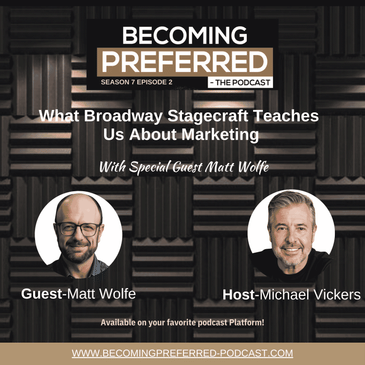
SEASON: 7 EPISODE: 2
Episode Overview:
Welcome back to Becoming Preferred, the podcast for business professionals and entrepreneurs who want to level up their game and become preferred in the markets they serve.
If you run a B2B company, there’s a high probability you’ve hit a very specific growth ceiling: you built a fantastic business through relationships and word-of-mouth, but the moment you try to scale beyond referrals, your marketing completely stalls out. You keep tweaking your website, changing ad agencies, and wondering why it’s not converting.'
Our guest today says the problem isn't your marketing tactics; it's that you are performing the wrong show. Matt Wolfe is a brand strategist, Partner at Brand3, and one of the country's most experienced StoryBrand Certified Guides, having transformed the messaging of over two hundred and fifty organizations across thirty industries.
But what makes him truly unique in this space is his background: before moving into full-time marketing, Matt spent twenty-five years on professional stages, including Broadway. He understands better than anyone alive why some scripts grip an audience and others cause them to walk out by intermission. Today, we are unpacking his 'Brand-First Rule,' how to scale a relationship-driven B2B beyond referrals, and how to make your marketing look less digital and significantly more human. Join me for my conversation with Matt Wolfe.
Guest Bio:
Matt Wolfe spent 25 years on professional stages, including Broadway, before pivoting to full-time marketing. That path looks like a detour until you hear him explain why a business’s brand message works the same way a script does. Every word either earns an audience’s attention or loses it, and most companies are performing the wrong show.
Today, Matt is a Partner at Brand3 and one of the most experienced StoryBrand Certified Guides in the country, with work across 250+ organizations in more than 30 industries. He helps B2B leaders who’ve built businesses on strong word-of-mouth figure out why their marketing doesn’t reflect that fact - and fix it at the source. Brand3’s Scale Beyond Referrals program helps relationship-driven B2Bs tell a story that connects with their ideal clients. In a world that’s growing more digital, his team makes marketing more human - and makes B2Bs the obvious choice to their ideal clients.
Resource Links:
- Website: https://www.brand3.net/
- Website: https://www.mattwolfemarketing.com/
- Product Link: https://www.brand3.net/ways-to-engage/
Insight Gold Timestamps:
03:40 You have this fantastic phrase where you say that most B2B companies are performing the wrong show with their marketing
05:05 That's really all that is at the end of the day, is the right story to the right people
06:36 StoryBrand says make your audience the hero of the story
07:53 I think StoryBrand has moved the needle on that conversation
11:43 I'm going to make this bold statement, and then I'll qualify it: Demographics don't work
13:47 At the end of the day, these sales only happen through carefully built trust and relationships
17:02 We've been using the phrase: trust recession
19:30 You have a strict brand first rule that says, "Stop marketing a message you haven't built yet"
21:22 The game's going to be won or lost on that header and whether or not that says to somebody, "I'm telling your story"
23:39 Good marketing is shining the spotlight back on the ideal client
25:06 If you don't articulate the problem that they're facing, there just is no story
26:57 We just have to keep asking the question, how will this digital thing that we're doing now lead to a human encounter?
32:36 If you do this right, you're putting more humans in front of the right ideal client humans to have these great encounters
36:03 We were like, "Why aren't we telling that story?"
38:34 Matt Wolfe, the website is brand3.net
38:41 Your personal website as well mattwolfemarketing.com
38:58 You can also go to scalebeyondreferrals.com
39:13 We have a podcast called The CEO's Heart for Service
Connect Socially:
LinkedIn: linkedin.com/in/MattWolfeMarketing
Facebook: https://www.facebook.com/brand3marketing/
The CEO's Heart for Service Podcast: https://podcasts.apple.com/us/podcast/the-ceos-heart-for-service-scaling-business-without/id1896298694
Email: mwolfe@brand3.net
Sponsors:
Rainmaker LeadGen Platform Demo: https://calendar.summit-learning.com/widget/booking/JKItVP7WErmCBjU2cCIx
Rainmaker Digital Solutions: https://www.rainmakerdigitalsolutions.com/
[00:00:00] In 3, 2, 1 Welcome back to Becoming Preferred, the podcast for business professionals and entrepreneurs who want to level up their game and become preferred in the markets they serve. If you run a B2B company, there's a high probability you've hit a very specific growth ceiling. You built a fantastic business through relationships and word of mouth, but the moment you try to scale beyond referrals, your marketing completely stalls out.
[00:00:29] You keep tweaking your website, changing ad agencies, and wondering why it's not converting. Our guest today says the problem isn't your marketing tactics, it's that you're performing the wrong show. Matt Wolfe is a brand strategist, partner at Brand3, and one of the country's most experienced story brand certified guides, having transformed the messaging of over 250 organizations across 30 industries.
[00:00:56] But what makes him truly unique in this space is his background before moving into full-time marketing. Matt spent 25 years on professional stages, including Broadway. He understands better than anyone alive why some scripts grip an audience and others cause them to walk out by intermission. Today we are unpacking his brand first rule, how to scale a relationship-driven B2B beyond referrals, and how to make your marketing look less digital and significantly more human.
[00:01:25] Join me now for my conversation with Matt Wolfe. Well, hi, Matt. Welcome to the program. We're delighted to have you. Hi, I'm so glad to meet you. This is fun. Yeah, I'm excited about this. And when I saw the promo material coming through and from our research, hey, this is going to be a fun session. And we have a lot of entrepreneurs, business professionals, I think are going to benefit from a lot of your insights. But before we get started, I always like to, first of all, where are we speaking to you from? Where's home?
[00:01:50] I'm in Lake Stevens, Washington right now, which is just a half hour north of Seattle, a little bit closer to the mountains. Gorgeous. You get the best of both worlds. You get the best of both worlds there for sure. Listen, we like to go back in time. Now, I know you're not from the West Coast, and I think you grew up in the Midwest somewhere. So let's go back. We're in high school. And Matt's got to decide what he wants to be when he grows up. And I know you were in theater. That was of interest to you, but you're in high school. What were the choices? What were you looking at?
[00:02:19] What made you pick the path you did? Yeah, I think it was always theater. This was Southern Illinois is where I grew up, almost down by Kentucky. That's how far down the state I was. And I think I knew from when I was a little kid that I wanted to do it. I remember watching, I've been trying to figure out where it started. And honestly, I think it started with The Muppet Show. I'm like a little kid watching The Muppet Show. And they're having so much fun. And then the Muppet movie came along.
[00:02:46] And if you remember, the theme in that, the chord running through that Kermit keeps coming back to, is this makes a difference for people. It makes people happy. It gives them hope. It helps them dream, whatever. So there was this little seed planted in my tiny brain. Like, oh, this is something that does good for people. But high school is when I really started to get the opportunities that locked me into it. So then I started to do the plays at school. And then there was community theater.
[00:03:12] And I even ran a, it was called a puppet ministry for my dad's church. And we traveled around doing puppetry. So I was like experiencing the arts and storytelling from different angles. And I really was like on that train, I think, from freshman year of high school. I didn't know what I was getting into, but I was, I was on that train. And it's great training for everything because you're really learning how to communicate and tell stories. And it's kind of what you're doing today is communicating and telling stories or through story. And we'll talk about that.
[00:03:39] Let's talk about, you know, you have this fantastic phrase where you say that most B2B companies are performing the wrong show with their marketing. So when you audit a company that has reached, say, a growth ceiling, what are the signs that they're reading from a bad script? Yeah, you know, most, most B2B service providers, this is what we see. We run into B2B service providers all the time who are great people.
[00:04:05] And we look for these people who have a great heart for service, who do an exceptional job of taking care of the people in their charge. But they have hit that growth ceiling and they just, they're disappointed. They really, as much as they want to raise their revenue, they also want to help people because they know they do make a difference. So what we see is at some point they gave up on marketing because it didn't work. And they just kind of have leaned in to rely on referrals and warm introductions. And it's not that those don't work.
[00:04:32] Those do work, but there's a growth ceiling on that. At some point you're going to have to still reach a wider audience. You're going to have to reach more people with your message. But they were so discouraged by what they saw in the world of marketing and it didn't work. So, and so what they don't know usually is that the reason it didn't work is because they weren't telling the right story to the right people. That all of everything, literally everything that's gone haywire with what they've done and all the time and money that they lost, which is really heartbreaking.
[00:05:01] Started because they didn't have a strong brand strategy on the front end. And that's really all that is at the end of the day is right story to the right people and having that in place. It's like, I remember when websites first came into the marketplace, basically they're online brochures and many companies still have online brochures. And when you're following and telling a story through the website, we've got 30 seconds to get my attention. If I'm in the right place or I'm leaving. And then a lot of them are just confusing and there's no clarity.
[00:05:30] There's too many calls to action. Where am I going? And what's the purpose of that? Where has it evolved to? So over the last eight to 10 years, we've started to see lots of evolution to this. What would you say the state of the union is today when it comes to websites? And what should most companies be looking at or businesses that have a website on, hey, here's my checklist. Here are the things. Are we still doing this? Here's where we need to evolve to. Mm-hmm.
[00:05:56] Boy, you know, that's interesting because I don't know that it's evolved as much as it should have because you still have a lot of, I mean, the state of the union is you probably have most businesses out there still in brochure mode, like you said. Well, what brochure mode really means, though, is people are telling their own story first. They're leaning into their own story. So I'm a story brand consultant. I'm one of the old guard, one of the, at this point, original story brand consultants.
[00:06:23] And what that teaches, it teaches people to stop focusing on their story first and instead tell the story of the person who's the potential client, who's the actual audience. So the thing that story brand says is make your audience the hero of the story and then you emerge as the guide. In other words, they're the protagonist. You and I on this call right now and anyone listening, we see ourselves as the protagonist of our own narrative. We are the hero of our own story and we need people to talk to us in that way.
[00:06:52] What these businesses end up doing is they end up putting the brochure forward because the only thing we've known to do until somebody teaches us a new way is we know we've got to prove that we're qualified and prove that we care. So we put all this information forward. I've been doing this for 30 years and I have this certification and we have this success story and these people have talked to us. And we just sort of vomit a lot of stuff at people in brochure mode to say, I'm good at this, I promise, pick me.
[00:07:19] And even if you just hear me say that, we all kind of recoil from that kind of communication. So it short circuits the story because we're not telling a story in the way that you and I actually perceive it, that we are the hero of our own story. So instead, there's an opportunity to come to people and say, hey, I see what you're up against. I see what you're trying to accomplish, why it's not working. I've been down the road in this and I would love to show you the way.
[00:07:45] I mean, it's really at the end of the day, it's that simple, but immediately people feel understood and heard. So I think StoryBrand has moved the needle on that conversation. So you're seeing more websites trying to do that, but there's still a missing piece. So having the right framework of how you tell a story and help people understand it is part of clarity. But the other piece of it is, wait, who are we talking to? And that's the other thing that a lot, especially B2B service providers haven't been taught to do.
[00:08:15] Again, out of anxiety, just out of anxiety to try and find work. We end up a lot of B2B services, if it's finance, if it's tech, take an MSP, for example. Like we can help anybody with your tech who needs help. It's kind of how the messaging comes out. And the problem with saying it that way is no one's ever going to answer that question for you. No one's ever going to answer the question, how can I help you? But if you say to them, I see, again, I see what you're trying to do, what you're up against, and I know how to help you with that specific thing.
[00:08:44] That's a very different story. So a lot of people call it the ideal client. We call it finding your hidden opportunity because all these B2B services have been working with a whole bunch of different people. But they know if they just sit down and think about it, there's a handful of people or maybe just one kind of person that if they had more of that kind of client, man, that thing would sing. And it would just, both the client and the business would be better served. So we try and help them focus in.
[00:09:12] So sorry, that was a long way of answering the state of the union. Yeah. No, it would make sense. What you're saying is find that, get your messaging out there, and then look at that niche or niche that you're going to follow. And we have a little saying we teach is smaller than niche, bigger than market. And who makes more money, dentist or orthodontist, right? Well, the orthodontist does. But who does the marketing for the orthodontist? The dentist. There's your referrals. And we're going to segue into that. That's a good segue.
[00:09:39] I think theater, though, probably give you a good foundation of that because they all use our TV shows, our movies, the best movies, the best screenplays. We see that hero's journey. And really, that hero's journey is, like you said, to have the protagonist and then we've got the guide. And, you know, the example that comes to mind, and, you know, we've talked about it before, is you take Hunger Games. You take Katniss. She's out in the desert shooting bunny rabbits with her boyfriend. And Donald Southeron comes in with, you know, attacking the districts.
[00:10:08] And all of a sudden, the guide comes in, Woody Harrelson. He doesn't solve her problem, but he helps to guide Katniss. So she becomes that hero of that story. Or you could pick Star Wars and Luke Skywalker. You could pick, we're dating ourselves there now, but they all have that. So it's kind of like we want it. It's that arc of the story. And we have to do that through our websites, through our communications as well. And it still works today. And like I said, I think there's a lot more we can deal with that. And that's what people talk about. Sorry, go ahead. Yeah.
[00:10:38] No, if I can punch in on that Hunger Games thing, that's a wonderful example because it's so specific, right? Katniss is in a very specific and rare situation that she's been selected to go into the Hunger Games, a rabbit hunter who has to learn to become a warrior. And then on the train, she meets this guy, Hamich, who has been in her exact situation, right?
[00:11:00] I was also a random guy who got picked out of nowhere to go into this crazy spotlight, face all this pressure, try and survive, and I'm going to help you do that. It's such a specific and emotional story. But why I love that example is because it captures both things. It's the hero guide relationship and the hero's journey, but it is also the specificity of situation and that connection with Katniss is Hamich's ideal client. No, it's perfect. It's a good now. Yeah.
[00:11:29] No, it works. And I think, and that's when people talk about it. We look at shows and we just watched a series recently and then we tell our friends. We have a whole network of friends. And so, you know, when I talk to marketing people, I'm going to make this bold statement and then I'll qualify it. Demographics don't work. And when I say that, now do they work? Yes, sort of. They tell us that, hey, we got 50, 60% of the population's a baby boomer. It tells us it's a group of people that we have.
[00:11:59] But that's not how people communicate. In my mind, it's networking. You and I are talking. Hey, I just saw a good film. I just saw this. We just watched one with Steve Carell, Rooster. If you like him and you like The Office, you're going to like that show. So we'll ask people, hey, did you like this show? Yeah, go watch this show. It's hilarious, right? And you'll laugh every episode, every line in it. It's so funny. Well, not everyone's going to love that. But it's through referrals. We talk to our kids. I got millennial kids. I've got our friends that are Gen Xers.
[00:12:29] We tell, they're all over the demographic map. But what we have in common is we network and we communicate with one another. So I always look at those networking, communicate. Thespians hang out with who? Thespians, right? Oh, yeah. Authors and writers with authors. Marketing people with marketing. Birds of a feather flock together. So to me, that's starting it. And that's where that word of mouth. So what you're talking about is how do we get more word of mouth and that referability? So let's talk about the mechanics of Scale Beyond Referrals program.
[00:12:59] Your signature framework at Brand3 focuses heavily on helping relationship-driven B2Bs scale beyond referrals. Why is that a business that can be world-class at keeping clients via relationships, but totally helpless at attracting new ones through traditional marketing channels? Yeah. When you think about B2B services, and especially the ones that we work with, most of them are, I would call them high stakes, high trust services. So they're things where the B2B is saying to the business,
[00:13:29] hey, why don't you trust me with this extremely critical, important piece of your business and all that you are? Your finances, your cybersecurity, your tech platform, which now at this point equals your ability to make revenue. These are big asks. And so we know, especially if you're on the sales side, we know that the truth is at the end of the day, these sales only happen through carefully built trust and relationship. And what's happened is a lot of B2Bs have been led to market in a traditional way,
[00:13:58] what we're calling a traditional way, which is put your information out there and that will turn into leads. And then you can talk to that lead and eventually earn their trust and work them down the funnel. But that's only after you've spent six months to a year to two years warming up that lead. So maybe they want to talk to you, right? Like it's slow, it's agonizing, and it also feels kind of transactional. So the scale beyond referrals program is all about, we just call it relational marketing. It's if this is all about relationships, we have to market in that way.
[00:14:27] And so we have to think about if we're going to put something digital out there, how is that going to lead to a real world encounter with the human, with what we're doing right now? Like, can I, can I get my clients to show up on podcasts in keynotes like you do in networking events somewhere where they can see the real human behind the brand? And because that's where the trust is really going to come from. I mean, I need info about how you do things, but I really need to meet you.
[00:14:54] I really need to know who you are and get a sense of your authenticity and care and passion for if before I hand you this thing. But if people market that way, then they're really starting to build trust early on in a powerful way that accelerates the sales process and then carries over into the client experience. And if it's all nurtured well and cared for, well, eventually you're going to get more referrals in the backend, but it starts with, it starts with being present, people being
[00:15:23] present on the front end in a human way. Rob Markman, Authenticity in a human way. And I think that's going to be a significant difference in future with our influx of AI. I know a lot of people are worried, but I believe personally, AI is great. It helps our business. We can do ad mock-ups. We can do a lot of traditional marketing functions can be done quickly for looking at things. But at the end of the day, it doesn't bring in, might have some strategy ideas, but it doesn't bring in the human to human element.
[00:15:50] And so I think we have to focus on in our campaigns on what makes us human and what are the things that AI can't do? Well, AI can't be empathetic. It'll write a poem that can make you cry, but it's never experienced heartache. You know, won't hold your hand while you're getting a procedure, right? Whatever, if you're working with a vet or whatever your clinic is, you want that human to human touch. It can't be accountable. It can't be responsible. And people, you're seeing a lot of backlash against AI. People want that human connection.
[00:16:20] We don't care if you're using it to do analysis, if you're doing diagnosis, but I think that EQ, in my mind, is the new MBA. We need to focus that because analytical stuff, yeah, we can get all that done. We can get spreadsheets analyzed. I think it's great for doing that. But I think we need to make it our ally. We have to collaborate with it. We need to partner with it. But at the real time, I want to talk to a human being. I want to talk to you. So if I'm having you work on my campaigns for our business, I want your insights.
[00:16:49] I want your 25 years of experience that you have versus somebody fresh out of school knows how to use AI, but doesn't have a quarter century worth of experience, right? It's a nuance. And is that how you see it as well? It is. We've been using the phrase trust recession that we see there's a trust recession being caused that was already there because of so much digital marketing out there that was transactional and sort of what's your angle and lacking that human touch. And then AI is just making us starve for that connection. And yeah, you're right.
[00:17:19] I do see it acutely because like you said, I spent 25 years in professional theater before I went full time into marketing. My whole job for 25 years was to ask the question, why is this person doing what they're doing? It's usually a fictional character, but it was still about why every step of the way through putting a show together, you have to understand why people are doing what they're doing, which is all about empathy and intuition that, like you said so beautifully, the AI
[00:17:48] can't replicate. And that's why I think it's going to be a useful tool like any other tool, but I don't think it's going to replace that human. Matter of fact, that's what we should focus on is more of the human content and that insight. Are you tired of chasing leads and ready to start effortlessly attracting more high value clients? Introducing Rainmaker LeadGen, the ultimate sales engagement and client acquisition platform that takes the stress out of outreach.
[00:18:15] With Rainmaker LeadGen, you can easily identify, engage, educate, and convert your ideal prospects into loyal clients. Our industry-leading automation and email sequencing empowers you to reach more ideal clients, accelerate the sales cycle, and close more business. Imagine authentically engaging with your prospects while the platform handles the heavy lifting. Say goodbye to the endless hustle and embrace a more efficient, effective approach to business
[00:18:45] development. Ready to witness the magic? Book a 20-minute demo today and see how Rainmaker LeadGen can revolutionize and level up your client acquisition game. There's nothing to lose and everything to gain. Don't miss out on this opportunity to supercharge your client acquisition process. Visit RainmakerDigitalSolutions.com or check out the link in the show notes to book your demo. Rainmaker LeadGen.
[00:19:11] Spend less time hunting for your ideal clients and more time having high value sales conversations with your ideal clients. And now back to my conversation with Matt Wolf. Let's talk about money. Business owners get frustrated with marketing because they feel like they're burning cash. You have a strict brand first rule that says, stop marketing a message you haven't built yet. What happens to a business bank account when they break this rule? Yeah.
[00:19:40] I mean, you're just going to waste a lot of money and time. And I honestly, I think that hurts as much as anything. People tend to focus on the money side, but I spent six months. I spent a year trying to get this engine to run and it just never took off. And then it's all that opportunity cost as well as the money sunk into it. So we don't, we won't let somebody build a website. I mean, if they're working with us, we won't let them build a website or start running ads or any of that stuff
[00:20:06] until that right story to the right person brand first foundation is there because we know that's the beginning of it. And then of course you put it out in the world and you monitor and you do look at analytics and you do look at the response and you're responsible to, to tweak it and grow it in its understanding. But that's really where, that's really where it begins. Yeah. I remember the day where we used to stand, you know, 20 years ago, we'd sit in front of a CEO and say, Hey, we know we're spending a million dollars on marketing.
[00:20:35] We know half of it's going in the toilet. We just don't know which half, right? And that's it. But, and I like some of the new technologies because we do get good analytics. We can get very specific versus just a mass, you know, show up and throw up kind of approach to it. So I think for instance, you've got, you can hire an SEO agency, you can buy ads, you can build a shiny new website. But if you don't have a define that core brand strategy, you're just spending thousands of dollars to,
[00:21:04] as you would say, amplify the confusion, right? Versus provide the clarity that people want. They need to know, like, what do you have 30 seconds when we come to the website? And most people don't scroll beyond page two, three or four to know that. I mean, I'm in the right. Probably three, probably three seconds. You know, really it's the gate to me, the game's going to be won or lost on that header. And whether or not that says to somebody, I'm telling your story, I'm speaking to you right now. And if you can win that game, then that'll get them to scroll further.
[00:21:33] Back to the hero and guide thing, right? If you tell the hero story first on the header, and then articulate the problem that they're up against right beneath that header. And then they're ready. They feel heard. It's a bridge of empathy to them that helps them feel heard. And then you start talking about what you do. You're still important. You still have to share all that information that you're sort of itching to share with them. It just comes a little later when they're more willing to hear it.
[00:21:58] What I love about your insight and your experience is what StageCraft teaches us about human attention. And you spent 25 years in professional theater and on Broadway. When you're directing or acting on a stage, you learn exactly what keeps a human being locked into the seat. What is the number one theatrical secret to holding an audience's attention that corporate leaders completely ignore? Ooh. Oh, wow. What a great story. What a great question.
[00:22:27] Well, it's probably two. I'm going to say it's two. You asked me for one. I'll say it's two things. It's a well. Yeah, no problem. It's a well-written script, right? Where someone really has thought about why people do what they do and all of those steps connect. But this character responds to that because the one before did that. And there's something they want that they can't get. They keep fighting for it. But the craft that hopefully you don't notice when you sit in theater, because I was a director as well, is there's a lot of things.
[00:22:56] All that technical stuff and the staging is really helping you understand where to look. If you're in a big house, like a big touring house, it's really the staging and the positioning of the people. And then the lighting that's helping you know where the actual story is in this moment. Especially a big musical. You might have a ton of people on stage and they're all singing a big song. But there's that one character we need you to track.
[00:23:18] And there's some way that they're being changed and transformed in the middle of that big choreographed number that we got to make sure you don't lose track of that person. And that has to do with where we put them on stage and how they're lit and focused on. And then the eye of the audience knows to go there. So I guess in a way, no one's ever asked me this way before. But I guess in a way, good marketing is shining the spotlight back on the ideal client, back on the audience. So that they know that you are telling their story.
[00:23:46] It's really helping them see themselves in it.
[00:24:19] There's a couple of movies that come to mind where it did not follow the journey, right? It was actually a shocker and disappointing when that happens. We all want those happy endings. So we want to see the problems. We want to see the struggle because we can put ourselves in there. And I think that's what you're saying is they got to see themselves in that issue and that you're the person who can guide and solve that issue for me. Is that about right? Yeah, I love how you said that. You're right. We do know in a lot of movies we go into, it's probably going to work out okay.
[00:24:47] So the fun of it is how it's going to happen. So once that problem is really clearly articulated, actually, you get to get back to the fun stuff, which is how are we going to solve this in the B2B space together? How are we going to do this together? But I'll just say the thing you said again, just so people hear it really clearly. If you don't articulate the problem that they're facing, there just is no story. And I think sales guys get that more intuitively.
[00:25:16] They've been running that playbook their whole career and the marketing kind of had to catch up to it because a lot of them were stuck in brochure mode instead of story mode. That's right. There's always a disconnect. I've always thought that they should report to the same person. So marketing comes out with great strategy, good collateral, awesome materials. And the salespeople are going, we don't need this. This hasn't worked. They're not hitting it. And then each silo bleams the other for poor execution.
[00:25:43] So I think it should always report to the same executive and going, hey, here's our story. Here's how we're going to execute on that story. That's one of our favorite things to talk about. We see ourselves as silo smashers. And a good brand story does that because suddenly marketing and sales both know that they're part of the same story instead of two camps sort of feeling unheard and fighting each other. And then they can start to see, like, they're both missing out. The sales guys are missing out usually on the storytelling capabilities of marketing.
[00:26:13] Marketing is missing out on listening to the sales guys who know the ideal client better than anybody and have spent the most time with them. And they're missing all those great insights. And I think that's why both sides get frustrated. They're like, I could help you if you'd let me help you. And then if we align their incentives and align their KPIs or key performance indicators, I think then they're working to the same thing, right? They're all working the same thing. Let's talk about less digital, more human marketing.
[00:26:39] We live in an era obsessed with AI automation, complex digital funnels. Yet at Brand3, your team advocates for making marketing less digital and more human. For a relationship-driven business, how do you inject humanity into a digital footprint? For me, it comes back to that thing I was talking about earlier of we just have to keep asking the question, how will this digital thing that we're doing now lead to a human encounter? Instead of how will it lead to a blog? How will it lead to our newsletter?
[00:27:07] It's how does all of that stuff point the way towards, hey, you can experience this human on this podcast, on this video, at this conference, at this event. And, you know, we're working with largely, I don't know, 5 million and up, 10, 20 million size businesses in annual revenue. When you're in that space in B2B, they're usually still founder-led and founder-driven. There is a face of the brand. And that's not going to change anytime soon.
[00:27:37] And there's a good argument to be made to do that at any scale of business, right, because of that need for human connection. We've kind of gotten into the mode of burying the people that we need people to meet and trust in the name of scaling a brand, when probably what we needed to do was pull those people back out and make sure that, again, this is high trust in our space. This is high trust, high stakes stuff. And people need to meet a person. They need to meet a human behind all of that. No, it makes sense.
[00:28:06] You're one of the most elite story brand guides in the country. And many of our listeners love the story brand framework, but they often get stuck or lost when trying to implement it themselves. So when companies usually go off the rails when trying to apply the framework to a complex B2B service? Yeah. The first thing they run off the rails in is you can't be helped. They try to do it on their own. And I've just learned the hard way, honestly. In my own journey, we're all too close to our own story, too close to our own stuff. So we just got to have that outside eye.
[00:28:35] And in the case of story brand, it does really help to have a trained person who knows to look for all the pitfalls. Beyond that, what tends to happen are there's two things. People try to shove too much in like story brand has defined sort of buckets, right? There's a framework that it goes like this. It goes, you have a character who has a problem. They meet a guide who gives them a plan and calls them to action on a journey that ends in either failure or success. So each of those things I said is where you can put some information.
[00:29:04] People try and shove too much into it when you get the best impact by making one really clear choice for each thing. I need to make a really clear choice, one thing about what that character wants, one choice about what the problem is. And that's how people lock in. So they'll throw too much stuff. They'll also throw things that don't belong in the wrong part of the story.
[00:29:27] And a good example of that is probably the biggest issue I think I see, and I even fall into it myself until someone catches me on my team, is especially service providers. We want to jump again. We've been in brochure mode our whole lives. We want to jump to the point where we tell people, I know how to help you. So we try and make the thing, we try to assume that the thing they want is the thing that we offer. And it almost never is. I'm trying to think of a good example for that.
[00:29:55] You know, like, well, for us, okay, let's, we have a program called Scale Beyond Referrals, right? That helps people see the difference between traditional and relational marketing. But no one we're talking to knows to think about that yet. But we are talking to service providers who wish they could do something other than referrals, and they know they're stuck. So we'll speak to that want first on the front end. And the problem for us that we speak to is traditional, you know, marketing hasn't worked for them.
[00:30:23] So they're, of course, they don't, what's my other option until someone shows me a better way to do marketing. But we have to bridge to the solution that we're offering through the story rather than throwing it at people because then they'll be confused. That makes sense. Well, let's talk about the impact of doing that correctly. We always view branding as external marketing to get sales, but you've seen this work across 250 plus companies.
[00:30:47] What happens internally to an executive team, their sales reps, and their operations when a company finally clarifies their brand story? Oh, well, okay, here's my favorite thing about this is this, this is my favorite thing. And then I'll get to the wider impact. But when you think about, and if you're in the middle of this right now, like most B2Bs, founder-led, there isn't time to have these conversations. There isn't, there's the day-to-day, the next thing, the next fire to put out, the next thing to do.
[00:31:17] Nobody has time to sit and just talk about, okay, wait a minute. We've been at this for another five or 10 years since we redid our marketing. Who are we? Who do we serve? What impact do we have? What difference do we make? There just isn't time. But when you have that conversation with them in discovery, there's always a moment that comes up where you get to really celebrate what they've accomplished. The stories that we create, we didn't make them up out of nowhere.
[00:31:42] We're editing their lived experience for the last 5, 10, 15, 20 years to help people understand it better. But they did that. It's their blood, sweat, and tears, and time given up with family and all of that that they spent creating something really special, creating a way to make a difference in people's lives. So my first favorite thing is like honoring that in the process. But it does pay off. So I lead with the heart stuff, but it does pay off because marketing begins to earn trust faster.
[00:32:11] That accelerates the sales process. And then we also look at client experience. So we do customer journey mapping with people because that handoff of trust is going to go to your service team. And if everyone's not telling the same story, you're going to lose that. But if you can hold that and build in it and deepen it, then you have your core of advocates and referrals who are just going to help grow the business.
[00:32:34] So eventually, if you do this right, you're putting more humans in front of the right ideal client humans to have these great encounters. That's accelerating to sales. That's carrying over to client experience, and you're getting more referrals on the back end. So wider funnel on the front, and then a stronger community of people who tell you, hey, go watch that Steve Carell show on the back end. It's all connected. It's a holistic approach to it. Let's talk about auditing your own particular script.
[00:33:04] If, say, a founder or executive is listening to us right now and their gut is telling them, hey, we might be performing the wrong show. What's a quick diagnostic test that they can run on their current website or sales deck to see if the message is broken? Yeah. Number one is look at the first two sections of your website and tell me whose story you're telling. Are you telling the story of the people you serve, or are you jumping in to talk about your qualifications and why you're good at what you do? And if it's the latter. Yeah. Yeah. Yeah.
[00:33:34] If it's the latter, you've got a problem. The other thing I would look at is, does your website only have all things to all people marketing? Like, right? That we can help anybody who needs help kind of marketing? Or does it have the capability, whether it's on the homepage or on dedicated landing pages, to speak to specific ideal clients, to speak to specific people in their world and in their industry? Because that's really where you're going to win the day, especially in the service space.
[00:34:02] Because it becomes more emotional and specific. We got passionate last year about working with independent insurance brokers. Because they have this great story where they're just being hammered by the giant industries, the giant, the Geico's and the Allstates and the whatever in their local communities. But the truth is, they're the local people who offer the best service model, the best connection, the best relationship for the people they care for. And they just need to get that story out.
[00:34:32] They're doing something exceptional. And oftentimes, they are family-run businesses. We worked with one that was like fourth generation over 100 years, right? These are beautiful stories to tell. But you can't tell that at the high level we're all things to all people marketing. You can only tell that once you dial into that ideal client and what their story is. And there's a lot of ways to do that without niching the whole business but still having the opportunity to speak to those people. Oh, that makes sense.
[00:35:00] Let's go back to your Scale Beyond Referrals program that you've just launched. Can you give us an example of a transformative setting? You obviously went down this road. You've obviously tested it with clients where without naming a specific client, maybe the kind of business before they went through this process with your new program and what they're seeing or what their experience, what those outcomes might be? We've been doing a lot of work with MSPs.
[00:35:27] And so there's an MSP out west that was doing all things to all people marketing, right? Who needs help? Define MSP for just the audience. Oh, thank you. Managed service provider. So they're your tech support. Although most of them want to be seen as more than that. Tech support, tech strategy, how to care for your entire tech foundation for your business. That's an MSP at its best. We were working with one that just had the door open to all people. But the truth was 80% of their client list was nonprofits. And they even had a nonprofit.
[00:35:57] Like they were the nonprofit champions of San Francisco is where they're located. And we're like, why aren't we telling that story? Because then you get to connect with those nonprofits who operate in a very unique environment, if anything about it, and just help them feel understood and heard. So that's happening. That's a newer project. There's another one, a healthcare. So this was an MSP, managed service provider that was focused on healthcare.
[00:36:22] And once they dialed into that, they actually started living into this idea of how do we show up as a human in the right places? So the founder starts showing up at the healthcare conferences and networking events as the expert in that space. And they're able to have a conversation in that healthcare environment. What's happened is, whereas tech might have used to be convenient or helpful or an accelerant, it's now essential.
[00:36:50] You literally cannot deliver quality healthcare and take good care of people without the tech because everything is so knit together now. But they can meet people at that level, have that conversation. And so we figured out that story at the brand level, right? At that start, we applied it to their marketing and he started to go out and show up as the human in his marketing, which only made the sales part easier. But then he went to every client experience team that he had. And he said, here's the story we're telling now.
[00:37:20] How do we do better at it? And what happened for them is they started to get year over year growth of 20 to 30%. The last time they did an NPS score, which was pretty recent, they were at 85.1 on their NPS score. So it was working. They were growing. They were taking good care of people. And they wanted to do an exit. And this guy with the MSP that was sold got everything he could have ever dreamed for in that exit. On his multiplier, on the terms, on the conditions.
[00:37:49] One of which was that he and his wife wanted to stay on and keep growing the company. I don't know exactly why, but they wanted to sell it but stay in it, right? And still see through the promise of what it was. Bank it and then work on someone else's dollar. Sure. Yeah, exactly. They wanted that. And now the group that they're in of several MSPs is turning to them and saying, how did you do that? How did you grow the way you grew? How did you build that loyalty with your customer base? And now they're training the rest.
[00:38:16] And I don't want to, I mean, look, they do all of the heavy lifting as a business to make all of that happen. Credit where credit's due. But they were running on a strategy of speaking to specific people and doing a relational human form of marketing. So it's a great example. Matt, this was great. Matt Wolfe. The website is brand3.net, director of strategy. Congratulations. I know you're heading in the right direction. We'll have your personal website as well. MattWolfeMarketing.com. All that will be on the show notes.
[00:38:46] And I'm assuming if potential clients want to explore potentially working with you in the future, they can reach out to you. We'll have all that information. They can call for a consult, I'm assuming. Yeah. Yeah. You can also go to scalebeyondreferrals.com. That link will introduce you to an introductory workshop to the framework that we teach for B2B. It's everything we've been talking about today. That's an introductory workshop when you take the first steps into applying the framework there.
[00:39:12] And we have a podcast called The CEO's Heart for Service where we talk about these same issues too. Awesome. Well, terrific. I get to do this a lot and I love what you're doing. And I think you're totally going down the right road. And lots of great insights, lots of good value for our audience listeners. Thanks for being our guest today, Matt. Thank you. As you were listening to this episode, what is one idea that you've heard that's caught your attention? And why does it matter so much to you?
[00:39:36] And who is one person who you can share that with, either sharing this episode or just sharing that insight that occurred to you while you were listening? Perhaps it is that you should stop making your business the hero of your own marketing and instead make your client the hero while you act as their guide. Or maybe it's that traditional marketing fails when you rush to sell a solution before you have clearly defined the specific problem your ideal client faces. Thank you for listening, for learning, and for investing in yourself so that you can become the best version of you.
[00:40:05] If you found value in this episode, please write a review on Apple Podcasts. If you haven't subscribed yet, please do so, so you can get a new episode and start your week off right every Monday. Until next time. This podcast is created and associated with Summit Media. My executive producer is Beth Smith and director of research, Tori Smith. The fee for the show is that you share it with friends when you find something useful or interesting. This podcast is subject to copyright by Summit Media. Goodbye.