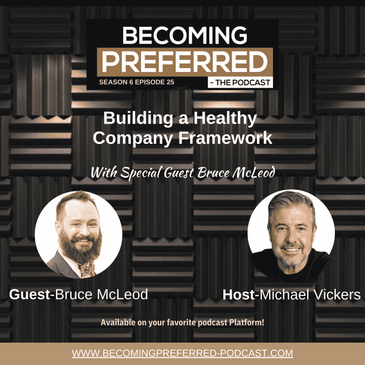
SEASON: 6 EPISODE: 25
Episode Overview:
Welcome back to Becoming Preferred, the podcast where we help you level up your business and become the best version of you. We talk a lot on this show about how individuals can become the preferred choice in their industry. But what about the ecosystems we build? What happens when a company grows so fast that it starts to consume the very people who made it successful?
Our guest today has seen the 'dark side' of rapid growth from the front row of corporate America. Bruce McLeod is the founder of Company Connections and the author of The Healthy Company Framework. Bruce has developed a revolutionary approach to business that doesn't start with the balance sheet or the C-suite's wealth—it starts with the health of the employee.
Today, we’re going to discuss how to heal your organization, why 'people-first' is actually the ultimate growth hack, and how to build a legacy that lasts far beyond the next quarterly report. Join me for my conversation with Bruce McLeod.
Guest Bio:
Bruce McLeod is the author of The Healthy Company Framework and founder of Company Connections, a professional services organization designed to help companies and individuals who want to change their business and their life for the better.
Bruce has spent over a dozen years in corporate America. In those years, he had a front-row seat to the negative effects rapid growth has on companies. From increased customer drops, high turnover and burnout of top talent, and the inability to solve new problems with new solutions, he developed and implemented an infinitely scalable framework that addresses these problems.
And, unlike most approaches that focus on shareholder value or C-suite wealth, his solution starts with taking care of the people responsible for getting the work done: the employee. By healing the individual, companies are able to increase customer satisfaction, retain superstar employees, and leave a lasting legacy.
Bruce is a native of Birmingham, Alabama and is happily married to his wife Emily.
Resource Links:
- Website: https://www.company-connections.com/
- Product Link: https://a.co/d/8iLAMEO
Insight Gold Timestamps:
02:57 I eventually realized that I'm most successful when I put all this stuff together
06:46 You can't have a healthy company without healthy employees
10:22 I do talk about boundaries a good bit
12:31 If I have people that really want to work here and are really connected to where I want to take this business, you end up at with a whole lot of wins
16:59 You call it healing the individual to save the company
20:43 That's the first principle, is having a good foundation
22:47 So, I think you've got two kinds of superstars
24:37 You have to know who hands me work and am I communicating with them in a way that makes sure they're equipping me well
28:25 What are we doing? Who is it for? How does it provide value?
32:41 A lot of companies and a lot of people are really good at reacting
34:19 Let's get everybody to think problems are solved two ways: reactionary and proactive
36:55 Let's talk about identifying the neglect early
38:48 How is your job impacting your life?
40:05 We've got company-connections.com
40:17 Look for the Healthy Company Framework
Connect Socially:
LinkedIn: https://www.linkedin.com/in/rbmcleod
Email: rbruce.mcleod@gmail.com
Sponsors:
Rainmaker LeadGen Platform Demo: https://calendar.summit-learning.com/widget/booking/JKItVP7WErmCBjU2cCIx
Rainmaker Digital Solutions: https://www.rainmakerdigitalsolutions.com/
In 3, 2, 1.
Speaker BWelcome back to Becoming Preferred, the podcast where we help you level up your business and become the best version of you.
Speaker BWe talk a lot on this show about how individuals can become the preferred choice in their industry.
Speaker BBut what about the ecosystems we build?
Speaker BWhat happens when a company grows so fast that it starts to consume the very people who made it successful?
Speaker BOur guest today has the dark side of rapid growth from the front row of Corporate America.
Speaker BBruce McLeod is the founder of Company Connections and the author of the Healthy Company Framework.
Speaker BBruce has developed a revolutionary approach to business that doesn't start with the balance sheet or the C Suite's wealth.
Speaker BIt starts with the health of the employee.
Speaker BToday we're going to discuss how to heal your organization, why People first is actually the ultimate growth hack, and how to build a legacy that lasts far.
Speaker CBeyond the next quarterly report.
Speaker BJoin me now for my conversation with Bruce McLeod.
Speaker CWell, hi, Bruce.
Speaker CWelcome to the program.
Speaker CWe're delighted to have you.
Speaker DHey, thanks so much for having me.
Speaker DI'm excited to be here.
Speaker CYeah, I'm excited to have you here.
Speaker CNow, where are we speaking to you from today?
Speaker DComing out of Birmingham, Alabama.
Speaker CBeautiful.
Speaker CNice and warm this time of year.
Speaker CYou guys warm up before the rest of the company, so you thaw out before everybody else does.
Speaker DI think we've got lots in bloom.
Speaker DThe aals are in bloom.
Speaker DJust about anything you can imagine.
Speaker DOf course, that comes with a whole lot of pollen, but that'll go away in a little bit.
Speaker DAnd that's just a good side effect of having all the good stuff here.
Speaker CSo if you've got allergies, it's not a fun time, but pretty part of the country.
Speaker CSo you're.
Speaker CAnd great food where you are, too.
Speaker CSo glad speaking to you in your home turf.
Speaker CI'm excited about this subject matter.
Speaker CWe've not really covered it within the podcast and we're on season six, and it's what's unique is looking at companies and how do we make companies better and how do we become healthy as companies?
Speaker CBefore we get into it, though, and some of those details, let's go back to where Bruce started.
Speaker CYou're back in high school.
Speaker CYou're deciding what you want to be when you grow up.
Speaker CHow did you get on this path?
Speaker CWhat was the initial plan and how did you end up here?
Speaker DWell, it's ironic as life often is.
Speaker DI was a music major, so loved trombone performance.
Speaker DThat's, you know, that was my passion.
Speaker DI went to college to.
Speaker DTo do trombone and I chose performance because I didn't want to teach people.
Speaker DI said, no, I don't want to be a conductor, an educator.
Speaker DWell, like most of the men in my family, we all were music majors and wound up in software because.
Speaker DRight.
Speaker DThat helps pay the bills.
Speaker DBut throughout all of that, I really learned my style of just sort of approaching problems, included a lot of the components that ended up writing this book.
Speaker DSo the Healthy Company Framework.
Speaker DRight.
Speaker DThat's the book.
Speaker DAnd all of the pieces in there, I realized I was doing since college.
Speaker DSo how I got better at my grades, how I started departments, how I did well at my jobs included all these pieces and components.
Speaker DAnd I eventually realized that I'm most successful when I put all this stuff together.
Speaker DAnd it got to a point to where I said, what I could do is keep sort of helping out with point solutions and projects.
Speaker DOr I can be a lot more effective if I make this methodology, codify it into something that is, I think, universally applicable and infinitely scalable.
Speaker DAnd that's how I wound up here.
Speaker DI felt it was very easy to write the book.
Speaker DReally want to tell people about, you know, I think the impact it'll have.
Speaker CWell, that's interesting.
Speaker CWell, it's interesting with the music background.
Speaker CMy father was a professional musician as well, trumpet player.
Speaker CSo I grew up playing trumpet and bass.
Speaker CSo I get it.
Speaker CTrombonist.
Speaker CAnd I think you guys have eight positions in a trombone, if I recall.
Speaker CSomething like that.
Speaker DWe got seven.
Speaker DWe got seven.
Speaker CSo that's what it is.
Speaker CAll right.
Speaker DThat's pretty good, though.
Speaker CIt was pretty close.
Speaker CMost people probably wouldn't know that one.
Speaker CBut what's interesting is what made you pick this subject matter.
Speaker CSo you're doing what you're doing.
Speaker CSo you've got a front row seat to, let's call it corporate dysfunction, if you will.
Speaker CSo you've spent a dozen years in corporate America watching rapid growth actually hurt companies.
Speaker CWhat's the single most common symptom of a company?
Speaker CThat it's growing too fast for its own health.
Speaker DI think just sort of the recognition that, boy, we aren't small anymore.
Speaker DThat's usually a pretty lagging indicator of things.
Speaker DSort of.
Speaker DI write in the book, pain is a lagging indicator.
Speaker DI use the example you start getting a headache because you're dehydrated.
Speaker DThat didn't start when you realized, hey, I've got a headache.
Speaker DThat started when you stopped drinking water the night before the trip before, whatever it is.
Speaker DRight.
Speaker DAnd I think it's sort of that lagging realization of, oh, we aren't Communicating like we used to.
Speaker DWhen you have that realization of we aren't communicating like we used to, that is arguably a little late to act.
Speaker DBut that's the second best time to act.
Speaker DKind of, you know, they talk about best time to plant a tree is 30 years ago.
Speaker DSecond best time is right now.
Speaker DSo when you realize we as a company aren't communicating as well as we used to, that's a wonderful time to say, hey, how did we get here?
Speaker CYeah.
Speaker CDo you see similar problems across different organizations, depending on their size, where you can almost predict the kind of health issues they're going to run into, if you will?
Speaker DYeah, I really think you can.
Speaker DYou go into sort of, hey, this has always worked for us.
Speaker DPeople get this sort of a good cadence of, hey, we've operated this way for maybe, you know, a year or maybe 10 years or even 20 years.
Speaker DI've seen where you go, hey, this has always worked for us.
Speaker DWe just need people who are good enough to do that old pattern that usually is right before you realize, hey, we need to change our system.
Speaker DBecause right.
Speaker DAt some point you can work faster, you can work harder, but at some point that doesn't go well enough.
Speaker DI'll use a music analogy and you should relate to this, having played trumpet yourself.
Speaker DBut I had a professor in a lesson one time say, hey, that was really good.
Speaker DLet's do it to a metronome now, let's do it a little faster.
Speaker DAnd we got up to I think 120 clicks.
Speaker DHe said, okay, now Bruce, at what point are you going to start double tonguing this exercise?
Speaker DRight.
Speaker DBecause you know, music wise, you can single tongue, double tongue or triple tongue to be more articulate.
Speaker DAnd he recognized that while I was really good at single tonguing, at some point I was going to have to learn a new technique and switch to double tonguing.
Speaker DI think the same thing applies in business where you go, hey, we've operated this way for months or years.
Speaker DAnd when you start having those communication problems, that may be a good indicator that, hey, we might need to change how we do things just because we're at a scale we haven't previously been at.
Speaker CWell, you talk about this, that companies, they lose that ability to solve new problems with new solutions because they're stuck in their old processes in ways.
Speaker CSo they have the manual processes to solve high volume problems, which leads to, of course, employee burnout.
Speaker CAnd, you know, their best people end up suffering from it.
Speaker CNow you teach and believe that an advocate for the employee.
Speaker CIn other words, you can't have a healthy company without healthy employees.
Speaker CIs that the starting place typically for most companies?
Speaker DI don't know if it's for most companies, but I think it's the right place to start because you've got countless books out there about how to cultivate your customer.
Speaker DMost schooling is on how to take care of your shareholder.
Speaker DEven if you're the shareholder.
Speaker DRight.
Speaker DIf you're the business owner, you're the shareholder.
Speaker DThere's not a lot out there that really helps companies take care of the employees.
Speaker DNow, I'll tell you, there are loads of books about how you, an individual, can do better.
Speaker DAnd I think the healthy company framework can help with individuals.
Speaker DBut it's a good recognition for, I think, company leadership to say, hey, are we doing the best job we can at making sure the employees are taken care of?
Speaker DAre we as sort of the coaches doing a good job at making sure they're in the best position to win at their job, whatever that is.
Speaker CDo you see common problems with the employees?
Speaker CLike, what kinds of things do you see that will have a material impact on the business itself?
Speaker DI think one of the biggest that is maybe hard for some people to recognize because they're too familiar with the problem.
Speaker DBut at some point, the employees no longer understand how they impact the vision.
Speaker DRight.
Speaker DAs a business owner, as somebody in upper management, you say, well, yeah, I know what my KPIs are, my OKRs.
Speaker DI know the vision we're trying to do.
Speaker DI know what we're trying to do next quarter, next year, everything.
Speaker DYou're going 100 miles an hour.
Speaker DAnd the person on the front line is going, yeah, I have no clue how my job affects what you end up getting paid.
Speaker CSure.
Speaker DAnd when I don't have that connection, well, I'm not going to care or I'm going to be working too hard on the wrong thing.
Speaker DRight.
Speaker DSo they're putting all their time and energy into something that doesn't move the needle.
Speaker DAnd that disconnect really hurts.
Speaker DThat's where I go back to communication.
Speaker DWhen you feel like you're not communicating as well, maybe you as the business leader have a great vision and you keep touting it very well and you're just confused why people don't seem to be jumping on board with things.
Speaker DSo I think that's a very common tell.
Speaker DA couple other just really ones that jump out to me are when you have high turnover in a department.
Speaker DI worked at one company where One department of 10 or 20 people, which was, I'll call it 5% of the company was responsible for 50% of the company's turnover.
Speaker DOne department should not by far and away be leading your company's turnover.
Speaker DThat's a pretty good indicator too.
Speaker DGosh, we've got something going on here.
Speaker DAnother good indicator that maybe easy to dismiss in your mind is when your long tenured people or your superstars start either leaving or checking out.
Speaker DBecause your long tenured people generally care a lot about what they do.
Speaker DThey care about themselves, right?
Speaker DThey care about the product they deliver to you.
Speaker DAnd when they start checking out, it's usually not a personal change as much as it is the environment around them has changed to a degree.
Speaker DThey can no longer produce their top quality work.
Speaker CDo you find that there are things going on a personal level like I know it'll work for me sometimes is it's a place to go, it's a nice distraction sometimes from daily issues.
Speaker CRight.
Speaker CWe all have lots of stress going on in our lives.
Speaker CEveryone's dealing with stress, just different levels of it.
Speaker CSo when they bring that into the workforce, it's how important is it to really work on the individual and do you address that in your framework at all and what the individual can do to get themselves in a healthy place or to create that healthy environment?
Speaker DSo there's not a lot that the book focuses on as far as, you know, not bringing in the outside, personal things into the workplace.
Speaker DRight.
Speaker DI do talk about boundaries a good bit.
Speaker DOne of the things that's hard or difficult to do sometimes is to say, hey, I've brought in too much of the home life, the outside world into my job.
Speaker DThat's not good.
Speaker DBut then more of what the book talks about is the I'm pouring too much of myself into my job that has evolved into me doing other people's jobs.
Speaker DSo that's more of where the book does address some of that.
Speaker DPeople are stretched too thin because they're overperforming, right?
Speaker DSo a lot of superstars will, in order to help either their own job or the company, or because they love what they do, they start taking on a lot of micro work from other departments.
Speaker DAnd that's where the boundaries can really help.
Speaker DBecause it's very important to understand what the people left and right of you do.
Speaker DAnd it's also very important that you not do their job for them.
Speaker DAnd I'm not talking about you can never step up for somebody.
Speaker DRight?
Speaker DWe all have to pitch in here and there.
Speaker DBut that's a way that the book does help with individuals being able to say, gosh I feel like I'm doing too much.
Speaker DHow do I not do that?
Speaker CInteresting.
Speaker CMost traditional frameworks, and you teach a framework, prioritize shareholder value above everything else, you kind of flip that on its head.
Speaker CSo why is starting with the employee actually the most profitable long term strategy for the C suite?
Speaker DYeah.
Speaker DSo if you say, hey, all we have to do is hit next quarter's numbers, you're going to make a lot of sacrifices.
Speaker DThis is a bit hyperbolic, but you may or may not know the human head weighs roughly 10 pounds.
Speaker DSo the easiest way to lose 10 pounds, you could argue, would be to cut off your head.
Speaker DOkay.
Speaker DI don't advocate, don't recommend that, do not do that.
Speaker DRight.
Speaker DBut oftentimes in business you can do that.
Speaker DA real world example, Circuit City was a giant back in the day and a buddy of mine experienced this.
Speaker DHe was one of the higher paid managers there.
Speaker DAnd to help save money, they said, we're going to fire every manager that's making more than X number of dollars.
Speaker DAnd that did it.
Speaker DThat helped them with that quarter.
Speaker DIt didn't help them long term.
Speaker DWhen you invest in the individual, when you invest in your employees and say, hey, if I have people that really want to work here and are really connected to where I want to take this business, you end up with a whole lot of wins.
Speaker DYou're not having to spend any time or effort training people to take care of your customer.
Speaker DThey want to do that.
Speaker DRight.
Speaker DYou have people who are giving you better ideas about, hey, here's how we can make sure we stay ahead in the marketplace, react to this change, handle this downturn, do all those other kinds of good things.
Speaker DYou also have a workforce that says, hey, come work with me.
Speaker DCome work where I work.
Speaker DYou want to work here?
Speaker DWhat does that do to your recruiting efforts?
Speaker DWell, now, you aren't necessarily working to find people.
Speaker DYou're going, I can now find the best people from a great pool of talent and, and on and on there.
Speaker DThere are many more benefits of that.
Speaker CWell, you're attracting them.
Speaker CAnd it's that culture, that environment where it's a safe environment and the workforce has changed.
Speaker CI mean, and what people view as healthy and do you see a difference with employee health related to the different generations?
Speaker CWe've got five generations of workers still out there today, so baby boomers all the way down.
Speaker CAnd I remember, you know, the younger folks today, and I'm not saying they're wrong on this, it's actually probably healthier where they go, hey, you know what I'm taking a personal day or, and you talked about boundaries or I don't feel at it today, therefore I'm, you know, I'm gonna not come in.
Speaker CMy generation was, suck it up, buttercup.
Speaker CYou know, you got a job to do and just do it.
Speaker CIt was work and perform.
Speaker CAnd I'm not saying that's the best way.
Speaker CFor me, it worked out fine, but I sort of get it.
Speaker CI mean, if you're taking advantage of it, it's one thing.
Speaker CBut do you notice a difference within the different generations, within workforce and what healthy looks like?
Speaker DI do.
Speaker DAnd I think with the, you know, I'll just sort of broadly say the older and younger generation.
Speaker DAnd I'm going to put millennials.
Speaker DI'm a millennial.
Speaker DI'm going to put us kind of on the fence.
Speaker DRight.
Speaker DBecause depending on the person, okay, are they the youngest sibling or the oldest sibling?
Speaker DYou're going to get a very different sort of millennial.
Speaker DBut healthy, I think to some people means, hey, the company's doing well and my paycheck's okay.
Speaker DAnd there's a lot more willingness to sacrifice, a lot more personal well being because those other things are there.
Speaker DAnd I think it's exactly flipped on its head the younger you get.
Speaker DRight.
Speaker DI don't really care about the paycheck.
Speaker DI care about how I'm feeling as a person.
Speaker DAm I contributing to the group?
Speaker DDo I understand how my work is getting there?
Speaker DDo I understand?
Speaker DDo I believe in even where the company's going?
Speaker CAm I feeling valued?
Speaker CYeah, exactly.
Speaker DBecause if the company can't say, here's where we're headed and here's how you personally make a difference, then I don't want to work here.
Speaker DEven if you're paying me six figures.
Speaker DYeah, I'll go work somewhere that's paying me minimum wage because, boy, I like the people and I like what we're doing.
Speaker CYeah, I have to admit that's.
Speaker CThat was eye opening for me.
Speaker CLike, I grew up old school.
Speaker CIt was about the paycheck and you did the job and the task and you kind of moved on.
Speaker CBut today is creating that culture, that environment at the safe place to work.
Speaker CYou need your needs met.
Speaker CBut beyond that, it's Maslow's hierarchy.
Speaker CRight, all over again.
Speaker CYou've got to move up your food chain and go from there.
Speaker AAre you tired of chasing leads and ready to start effortlessly attracting more high value clients?
Speaker AIntroducing Rainmaker Lead Gen, the ultimate sales, engagement and client acquisition platform that takes the stress out of outreach with Rainmaker Lead Gen. You can easily identify, engage, educate and convert your ideal products prospects into loyal clients.
Speaker AOur industry leading automation and email sequencing empowers you to reach more ideal clients, accelerate the sales cycle and close more business.
Speaker AImagine authentically engaging with your prospects while the platform handles the heavy lifting.
Speaker ASay goodbye to the endless hustle and embrace a more efficient, effective approach to business development.
Speaker AReady to witness the magic?
Speaker ABook a 20 minute demo today and see how Rainmaker Lead Gen can revolutionize and level up your client acquisition game.
Speaker AThere's nothing to lose and everything to gain.
Speaker ADon't miss out on this opportunity to supercharge your client acquisition process.
Speaker AVisit rainmakerdigitalsolutions.com or check out the link in the show notes to book your demo.
Speaker ARainmaker Lead Gen Spend less time hunting for your ideal clients and more time having high value sales conversations with your ideal clients.
Speaker BAnd now back to my conversation with Bruce McLeod.
Speaker CI love some of the words that you use in the language you use.
Speaker CCall it healing the individual to save the company.
Speaker CThat sounds almost clinical for a business book.
Speaker CBut what does a wounded employee look like in a corporate setting?
Speaker CAnd how does that wound drain the company's bottom line?
Speaker DI'll take two sort of ends of the spectrum where you've got the superstar and the underperformer.
Speaker DSo the underperformer is really doing what they're allowed to do.
Speaker DSo the underperformer is there because their manager or their boss or whoever is ultimately okay with what they're doing.
Speaker DNow you may say, no, I'm not okay with the underperformer.
Speaker DWell then how do they still have their job?
Speaker DBecause if you weren't okay with it, they would have been fired, they would have been corrected, they would have been doing whatever.
Speaker DThey're doing what they're allowed to do, right?
Speaker DAnd frankly, that's also the superstar.
Speaker DThey're also doing what they are allowed to do.
Speaker DAnd that's a double edged sword that ultimately hurts both people, right?
Speaker DSo you can say, hey, I love my superstar.
Speaker DThey're going above and beyond.
Speaker DThey're doing all this extra stuff.
Speaker DYou might even be saying to yourself, boy, what a deal.
Speaker DI'm paying them for this one role.
Speaker DAnd I mean secretly I know they were doing like two, three, maybe four jobs.
Speaker DBut hey, if that's what they want to do, then that's okay.
Speaker DBecause again, maybe you're of the older mindset where it's hey, okay, everything for the paycheck.
Speaker DThey're obviously okay with it.
Speaker CYeah, they're high Achievers.
Speaker CYeah.
Speaker DAt some point that breaks, right?
Speaker DThe underachievers are hurting your customers, they're hurting your co workers.
Speaker DThey're certainly not recruiting the best talent there.
Speaker DAnd the superstars, they get burned out, they start dropping more.
Speaker DThey start, and I talk about this in the book a little bit.
Speaker DSuperstars can have a negative effect in that they train people into incompetence.
Speaker DIf you and I are working together and you always do half of my job, well, after enough time, I'm going to think my whole job is only the half that you've left for me.
Speaker DSo then when you come to me and say, hey, Bruce, you haven't been doing your fair share, I'm going to say, absolutely not.
Speaker DI've been doing everything you've expected from me for the past six months or years.
Speaker DSo, you know, I'll go into.
Speaker DOne of the techniques that I have in the framework is what I call success scorecards.
Speaker DAnd it's a way to say, hey, here's what we expect from everybody.
Speaker DThis is sort of a baseline that we need everybody to perform to.
Speaker DI talk about some people are more familiar with this in terms of PIPs, Performance Improvement Plans.
Speaker DRight.
Speaker DBut the time to introduce, am I doing a good job at my job?
Speaker DShouldn't be when you're trying to fire me.
Speaker DThat should be something on the very front end.
Speaker DYou say, hey, here's what we expect of you.
Speaker DHere's what we want you to get done.
Speaker DHere's how you get this done.
Speaker DHere's sort of how much we need you to get done so that out of the gate, you know what's expected of you, that helps bring in and normalize some of the, hey, you're overachievers.
Speaker DWe appreciate it, we love it, and we need you here for the next 20 years.
Speaker DWe don't want you to burn out.
Speaker DHey, person who is just trying to get the bare minimum done, here's what we say the bare minimum is.
Speaker DSo I think I answered the question, but that's one way to say, hey, here's how both the superstar and underperformer can hurt your business.
Speaker DBut then one part of the framework that helps you say, how do I fix both of those with a single technique?
Speaker CYou know, like, I've always been high achiever, but I know what it's like to burn out and to feel burnt out.
Speaker CRight.
Speaker CYou're just overachieving.
Speaker CSo there's that happy medium and that boundary you talk about, and it's about setting those boundaries for seeking out new employees.
Speaker CIf we're going to be hiring and recruiting.
Speaker CIs there a way to identify that middle ground where they've got, you know, they've got potential to develop to a high performer and to identify them if they're not that way?
Speaker DI think you can.
Speaker DYou know, the framework itself begins with what I call a good foundation.
Speaker DThat's the first principle is having a good foundation.
Speaker DAnd that helps you connect where your company's going, why a job matters, what a person does and how they're supposed to win at their job.
Speaker DAnd what's nice about that is that covers, as you mentioned, all five generations.
Speaker DSo you can say, hey to the person that needs to feel connected to where the company's going.
Speaker DThat takes care of that.
Speaker DYou can say, well, I just need to get my job done and perform.
Speaker DYou have those expectations already set and somebody who says, hey, I just need my paycheck.
Speaker DOkay, well, simpler conversation, but all of that's there.
Speaker DYou, as an employer who has these things figured out is able to really ask better questions and give candidates better information.
Speaker DSo you can know not just, hey, they seem like a good personality fit.
Speaker CRight.
Speaker DBut you have some of the technical details.
Speaker DEven if you don't do the job, you can have some good questions to ask people.
Speaker DI'll give you an example.
Speaker DOne of the roles I was hiring for was very checklist oriented.
Speaker DIt was a very detailed, contract like thing where you really couldn't miss anything.
Speaker DAnd I asked a candidate a question.
Speaker DI said, do you like checklists?
Speaker DAnd they went well.
Speaker DRight.
Speaker DThen I knew they weren't the candidate.
Speaker DI didn't have to hear anything else they said because it's a role where if you don't go, man, I love checklists.
Speaker DLet me tell you about the checklists I've made for my personal life.
Speaker CI have checklists for my checklists.
Speaker CYeah.
Speaker DYou're not going to this job.
Speaker CNo.
Speaker DAnd so if you don't like the job, I don't want you to have it either because you're going to be miserable.
Speaker DNo matter what the pay is, no matter what the other things is, even if you can muscle through it, you're going to make the rest of the team miserable.
Speaker DRight?
Speaker CYeah.
Speaker DWhen you go to the detail of saying, hey, I want to know how to structure these things as far as knowing my jobs, knowing how things should be, I've corrected the under and over.
Speaker DPerformers, you can ask way better questions for your candidates you're looking to hire.
Speaker CGood point.
Speaker CYou mentioned superstar.
Speaker CLet's talk about superstar retention strategies.
Speaker CWe've all Seen the superstar employees, they burn out, they leave.
Speaker CBut beyond just paying them more, what does the healthy company framework suggest is the real secret for keeping top talent when the pressure's on?
Speaker DYeah, so I think you've got two kinds of superstars.
Speaker DYou've got the one that's happy in their current role and they want to stay there forever, and you've got the one that wants to climb the ladder.
Speaker DRight.
Speaker DSo I'll try and address both of those.
Speaker DThe superstar that is just.
Speaker DI had somebody tell me this one time, they understand their little cog and the whole company, but they love being their little cog.
Speaker DAnd you need people like that.
Speaker DRight.
Speaker DIt's important to, for especially that superstar's role, know what the upper end of the limit looks like and know what the boundaries of that role are.
Speaker DBecause, yes, the superstar can keep taking on more and more at your current pace of business, but if you're looking to grow your company and your company grows, all of a sudden, they're going to burn out real fast.
Speaker DSo having those good boundaries of here's what the role looks like, here's what we expect from this role, and you're always at the top end.
Speaker DYou can monitor that to say, is it realistic to now say, hey, we need to raise everybody up, or is it realistic to say they're an anomaly, they're just so good at this job that this is, you know, way at the top end.
Speaker DThe framework helps you really do a good job of understanding sort of that balance and giving you the right tools to make informed decisions around that.
Speaker DAnd that can help prevent burnout from top talent going into the superstar that wants to either climb the ladder or just work different jobs.
Speaker DI have a friend who, he gets bored.
Speaker DHe's so brilliant, he can't work in the same role year after year because he's become the expert at it and needs to move on.
Speaker DWhen you use the healthy company framework, I'll jump to the third component, which is know what you're doing.
Speaker DIt operates in what I call a 20, 60, 20 way of thinking, where people don't just know how to do their job, but they know who is left of them and right of them.
Speaker DWhat do I mean by that?
Speaker DWell, you have to know who hands me work, and am I communicating with them in a way that makes sure they're equipping me?
Speaker DWell, the last 20% is the inverse.
Speaker DWho do I give my work to, and am I actually giving them the work they need?
Speaker DYou might think all I have to do is my job.
Speaker DThat's 60% of it.
Speaker DThat's a good start.
Speaker DYou have to take a full 20, 60, 20 approach to really know what you're doing, I think as an individual.
Speaker DBut when you apply that to a company, what you're able to do is understand how all work is connected throughout your company.
Speaker DSo for the superstar that wants to move up or move on, they've got an easy built in bridge, an easy built in map to say, I know where all this stuff goes throughout the whole company and this job does or doesn't interest me.
Speaker DI now can communicate better with upper management because I want to go higher up the corporate ladder or this other department really interests me.
Speaker DAnd I've been working on talking to these people to get over there to know those things.
Speaker DSo it gives the superstar really a built in map as well as you, the business owner, a built in map of how work moves across and throughout the company.
Speaker CI can see where your background in music, it really comes and lends value to this because it's.
Speaker CIf you take an orchestra or a band, you've got your orchestra conductor.
Speaker CAll right, so you're a leader.
Speaker CBut now you might have solo acts.
Speaker CYou know, like in trumpet, I was not a first trumpet, I was a third trumpet.
Speaker CSo my dad was a first trumpet.
Speaker CI just didn't have the lip.
Speaker CAnd so I was good filling in.
Speaker CI was a good player, could play the music.
Speaker CBut then I looked at the drums and I went, that's a cooler job.
Speaker CSo I want to go learn percussion.
Speaker CSo I went to learn percussion.
Speaker CAnd then when you got to do a solo, it was fun.
Speaker CAnd plus the girls liked it, right?
Speaker COh, you're the drummer versus the trumpet.
Speaker DThere you go.
Speaker CAnd so there are different roles within that orchestra and it's getting everything moving at the same time and knowing what the pieces are and the orchestra's job to make sure, hey, this, everybody's in tune.
Speaker CWhich would be the same as everybody's healthy.
Speaker CBecause if you got somebody who's not or you don't show up or whatever the case, it can throw off the whole song, if you will, or the whole performance.
Speaker CRight.
Speaker CSo it's almost a perfect metaphor really for running an organization, wouldn't you say?
Speaker DI would, and I agree with that a lot because I can recall times where, and I won't say I was never called out for this, but the conductor would ask, hey, who has the melody right now?
Speaker DAnd no one would raise their hand and say, who has the melody?
Speaker DBecause everybody was just playing their music as loud as they could.
Speaker CYeah.
Speaker DWell, that doesn't help anything for the listener.
Speaker DRight.
Speaker DAnd this analogy, the listener, the audience, that's your customer, that's who you're providing value to.
Speaker DSo when you're able to say, hey, we need to know who has the melody, how does that get handed off?
Speaker DHow do we transition these things?
Speaker DThat very much does overlay very well.
Speaker DI have some friends who are conductors that I'm actually trying to work with them on getting the framework and getting their input on that.
Speaker DBecause it, it does apply very well.
Speaker CYeah, I think so.
Speaker CLet's talk about scaling without breaking.
Speaker CYour framework is described as infinitely scalable.
Speaker CSo for the entrepreneur currently at say a five person team looking to get.
Speaker BTo 50, what is the first structural.
Speaker CPillar that they need to put in place to ensure they don't lose their culture during that leap or jump?
Speaker DYeah.
Speaker DSo I'll take this opportunity to tell you that the Healthy Company framework has three principles.
Speaker DYou got the foundation, you have a two part epoxy and you have know what you're doing.
Speaker DAnd they're in that order for a reason.
Speaker DIf you're saying, hey, I want to go from 5 to 50 without doing it wrong, maybe I want to go even from 50 to 500, how do I do that?
Speaker DI'm going to zoom in on the foundation and say it begins with three components where you have to have vision with purposes first, units per group second and success scorecards third.
Speaker DOkay.
Speaker DThose are terms that I've come up with, read about them in the book.
Speaker DBut what does that really do for you?
Speaker DIt helps you keep up with, and I mentioned this earlier, where is your company going?
Speaker DYou have to have that first and foremost.
Speaker DWhat is your company trying to do?
Speaker DWhat's the action?
Speaker DWho and benefit?
Speaker DWhat are we doing?
Speaker DWho is it for?
Speaker DHow does it provide value?
Speaker DYou as the business owner probably have that pretty well.
Speaker CYeah.
Speaker DYou then have to make sure you understand why each person's job matters.
Speaker DIf you lose that why I think you really lose, maybe not the older generations, but you lose the younger generations of why do you need me to come in and push these buttons?
Speaker DAnybody can come in and do that.
Speaker DWhy should I care?
Speaker DBut then as we talked about for the underperformers and over performers and just anybody you're going to hire, you have to know what is it that they're going to do and how do they win?
Speaker DI'll use a brief story here about NASA.
Speaker DWe just launched, I believe, the Artemis 2 to do all that.
Speaker DLet's go back to the first time we did this.
Speaker DPresident Kennedy said that I think by the end of the decade, we should bring a man to the moon and home safely.
Speaker DOkay, fast forward.
Speaker DThere's a story about how he went to the halls of NASA, met a custodian, and said, what is it you do here?
Speaker DAnd the Custodian replied, well, Mr. President, I'm helping put a man on the moon.
Speaker DIf you pause briefly, it's a wonderful story, right?
Speaker DHow is this guy really doing that?
Speaker DWas he just saying the company line or did he believe it?
Speaker DI'm going to argue he believed it because he said, hey, if I can keep the facilities clean, the restrooms, the floors, the waste baskets, all those things, that's going to free up the engineers because they have to do the math to come up with a trajectory to build the rocket, to put a man, to send him to the moon, to bring him home safely.
Speaker DSo I actually am helping put a man on the moon.
Speaker DSo I went through sort of that.
Speaker DWhere, why, what, how?
Speaker DAnd that's the custodian helping put a man on the moon.
Speaker DThat's how you as a business owner can say, as we grow, as we add departments, which you have to do, you add layers, you add departments, you add people.
Speaker DWhen you do that, I really encourage you to go through the framework and say, okay, why do we need this department?
Speaker DWhy do we need this person?
Speaker DWhat is this person going to do?
Speaker DHow do we know what success looks like with this?
Speaker DBecause when you do that, people stay connected.
Speaker DLet me do one other sort of quick story that may make it more real.
Speaker DLet's suppose you, me, and the listener start a business.
Speaker DThe three of us do.
Speaker DIf I'm the detail guy and I take a week off on vacation, the two of you instantly know.
Speaker DWe got to pay more attention this week because Bruce is the detail guy, but he's not here.
Speaker CYeah.
Speaker DOkay, great.
Speaker DWe didn't have to tell each other that.
Speaker DWe just knew.
Speaker DAnd let's say you're the big picture guy.
Speaker DYou're gone for a week.
Speaker DOh, we really got to make sure we don't get stuck in the weeds.
Speaker DOtherwise he's going to come back and be mad at us, Right?
Speaker DWell, when you go from three to 30 people, if you're not intentional about teaching that connectivity, and then you go from 30 to 300 people, you lose the fact that all the people, all employees, are working for the same company.
Speaker DSo the framework helps you do that with those questions.
Speaker DAnd that's why.
Speaker DThat's the first principle of the framework.
Speaker CWell, again, I Bring it back to music, you know, for a four or five man band and we get to play with each other.
Speaker CWe're knowing you got your rhythm.
Speaker CGuys who are set the rhythm, they make the guy with the vocals, those upfront guy sound better, the instruments better.
Speaker CYou take away any one of those components and it starts to fall down, falls apart.
Speaker CRight.
Speaker CUnless it was designed that way or as an acoustic thing or a solo.
Speaker CGet into an organization where you get 30 or 40 or an orchestra and all of a sudden you could have something that just goes awry and it takes out down the whole performance.
Speaker CSo again you're seeing that.
Speaker CI think what you're saying there is, you've got, we need to document our values, our purpose, our way we do things, our processes and move from tribal knowledge to where everybody knows everything to a system of health where the company and it's baked into the systems, the processes.
Speaker CSo you might have a different function or different role eventually.
Speaker CAnd that's why sometimes I think it takes a different band leader for a small company to become a big company.
Speaker CSometimes it's not the same person.
Speaker CThey can't migrate, they don't move.
Speaker CThat's why you get bigger.
Speaker CCompanies as they scale might need a different leader for that time in order to take that.
Speaker CRight.
Speaker CLike they don't understand all those nuances.
Speaker CSo that's interesting.
Speaker CLet's talk about the danger of new problems using old solutions.
Speaker BSure.
Speaker CYou noted that companies often fail because they try to solve new problems with old solutions.
Speaker CSo how can a leader foster a culture of innovative problem solving when the team's already exhausted just by the daily grind?
Speaker DYeah, you alluded to it a little bit.
Speaker DI'll touch a little bit on one of the components which I call self healing.
Speaker DA lot of companies and a lot of people are really good at reacting, right?
Speaker DOh gosh, there's a fire, we gotta put it out.
Speaker DAnd some people love that environment.
Speaker DBless em.
Speaker DWe need em.
Speaker DThat's wonderful.
Speaker DWhat you can do when you're overwhelmed is you get stuck in the reactionary state.
Speaker DSo when I talk about self healing, what I mean is you yourself have to bring healing in a twofold fashion.
Speaker DYou do have to react and put out the immediate problem, but you also have to be proactive and say, how are we going to prevent this from happening in the future?
Speaker DSo if you make it a part of your culture to say, hey, we aren't just going to put out fires, we're going to see what we can do to even prevent embers, not even put out embers, but prevent embers.
Speaker DWhen you do that and you make that a part of your culture and that's expected from every role.
Speaker DYou've got everybody coming up with, hey, we've been able to put this fire out.
Speaker DWe've been able to put these embers out with this little squirt gun, but the fires are bigger now.
Speaker DSo now we actually need to, ooh, we need a fire hose.
Speaker DBut that means we need a new water main now.
Speaker DThat means we need these new things.
Speaker DThe people who are doing the work are going to be a lot better at helping you go, we need to rethink this.
Speaker DAnd when they're not, because they're in the habit of saying, how do we both fix the immediate problem and prevent it from happening again?
Speaker DLeadership's in a position to see patterns better.
Speaker DThey can look at the patterns and say, hey, this keeps failing.
Speaker DWe don't recognize it in the moment, but this keeps failing.
Speaker DSo we need to reimagine what we've been doing.
Speaker DI think that sort of ability to say, hey, instead of being stuck in a reactionary state, let's get everybody to think problems are solved two ways, reactionary and proactive.
Speaker DHow do I prevent it from happening again?
Speaker DGets you more ideas and it gets you able to see patterns better and think more strategically if you're more in that leadership position.
Speaker CMakes sense.
Speaker CLet's talk about legacy versus liquidity, because there's an ROI to having a healthy company.
Speaker DAbsolutely.
Speaker CA lot of people, you know, entrepreneurs, they founders, they focus on the exit, you focus on legacy.
Speaker CSo is it possible to build a company that is both a healthy place to work and an attractive acquisition target for those who only care about the.
Speaker DNumbers, I absolutely think you can.
Speaker DIf you're thinking more of legacy and you're going, hey, I want to have a company way outlast me.
Speaker DI want it to be so much better.
Speaker DA lot of things that I found, unfortunately, many of those leaders have done the double edged sword, good job of making them the identity of the company.
Speaker DBut if you're the identity of a company or even a department, say you want to retire now, what happens to your legacy?
Speaker DIf you were the linchpin, it's going to fail when you leave.
Speaker DSo by implementing a healthy framework, you're able to say, hey, I started it, I built these things.
Speaker DAnd you know, I had the initial vision, but because I've set up a vision where people understand where we're headed, why their work matters, other people can say, I want to go where he said, It.
Speaker DAnd you know what, we're going to carry this on even though they've retired, even though they've left.
Speaker DOne of my favorite examples of that is Magellan.
Speaker DHe's credited with the first person to circumnavigate the globe.
Speaker DBut if you know the story, he didn't make it.
Speaker DHe didn't finish the voyage.
Speaker DI think he passed away somewhere in India.
Speaker DHis crew said, we're going to finish this anyway.
Speaker DSo even though he's credited with it, his legacy is he circumnavigated the globe.
Speaker DHe didn't do that.
Speaker DRight.
Speaker DSo the Framework helps with that.
Speaker DBut you also look at that and say, how is that helpful for acquisition acquisitions is, from my observation, they want it to go as smoothly as possible, right?
Speaker DYeah.
Speaker CThey want a de risk asset.
Speaker CThey want, you got.
Speaker CYour retention is going to be big, your customer satisfaction is big.
Speaker CThat all goes to the multiple.
Speaker DI mean, from everything I've seen, they want to come in and say, hey, we're going to buy this, and then we don't ever want to hear from you again and we want to collect our paycheck.
Speaker DNow, how nice of a deal is that?
Speaker DIf you're looking to say, hey, I want somebody to sell it, if you've done what the framework has in there, you're able to say, hey, look, whether I'm running it or you're running it, this thing's going to do real well.
Speaker DHere's all the fundamental reasons on paper and culturally, they're going to make it a very lucrative investment for you.
Speaker CYeah.
Speaker CLet's talk about identifying the neglect early.
Speaker CIf a CEO is listening right now and suspects that their company is unhealthy, what is the one question they should ask their frontline employees or employees today to get the most honest answer?
Speaker DYeah, I do think that does depend a little bit on sort of the state and culture of your company.
Speaker DI think one of the biggest tells that you can do is it's a two part question.
Speaker DWhat's the vision of the company and how does your job impact it?
Speaker DBecause I think even Amongst the best CEOs, if you've pulled your C suite, unless you're in the habit of constantly talking about your company's vision, I think even your C suite is not going to answer that the same.
Speaker DIf your C suite can't answer that the same, the front line certainly can't.
Speaker DSo when you ask all your front lines, hey, where's the company headed?
Speaker DWhat's the company's vision?
Speaker DHow do you impact that the Bigger the variety of answers, probably the bigger disconnect there is in your company.
Speaker CThey should all be on the same page or on the same bus.
Speaker CYeah.
Speaker DBecause we talked about that five person company going to 50.
Speaker DAt five people, everyone should answer about the same thing.
Speaker DThe framework allows you to say even when you get to 50 or 500, people are still answering about the same thing.
Speaker DSo I think that's a very good question to help business owners understand.
Speaker DDoes everybody understand where we're going and do they understand how they're helping us.
Speaker CDo that objective and then communicating that obviously, which is get everybody on the same page?
Speaker CNo.
Speaker CThat makes sense.
Speaker CLet's talk about.
Speaker CWe call it the Birmingham Influence.
Speaker CYou're a native of Birmingham, Alabama.
Speaker CHow is your background or your personal life with your lovely wife Emily shaped your view of what a good life looks like compared to the standard corporate ladder definition?
Speaker DSure.
Speaker DFor me, personally brought her up because.
Speaker CShe's prominently displayed in your website and everything else out there.
Speaker CAnd you're obviously a good salesman too, to land such a lovely lady.
Speaker DNo, she easily the best decision I've made and I'm grateful she has agreed to stay with me.
Speaker DTo me, a lot of that health looks in.
Speaker DHow is your job impacting your life?
Speaker DYeah, because that can be very positive.
Speaker DRight.
Speaker DMy job has brought me all kinds of opportunity, all kinds of wealth, all kinds of connections, lots of positive things.
Speaker DYou can also.
Speaker DAnd for a period it was, oh my goodness, my job is having negative effects that I don't realize.
Speaker DA lot of people use the frog in water.
Speaker DYou can't put a frog in boiling water.
Speaker DYou can put them in water and turn the heat up and before they know it, oh, they can't get out.
Speaker DAnd I think especially with corporate America, that can happen to you.
Speaker DAnd I unfortunately experienced some of that before I really codified the framework and I've also watched that happen to a number of my friends.
Speaker DAnd for me, success looks like helping people either personally or company wide navigate.
Speaker DHow do I have.
Speaker DYes, my job is absolutely having a big impact on me to the very positive as opposed to, yeah, my job's having a big impact on me.
Speaker DSo same question, same answer, very different tone, very different outcome.
Speaker DSo that's.
Speaker CYeah, you're going to bring it home.
Speaker CYou're going to bring it home.
Speaker CIf it's an unhealthy place at home, it's.
Speaker CYou're going to bring it into the workplace and if it's an unhealthy workplace, you're going to bring it home.
Speaker DSo Absolutely.
Speaker CThat holds and it.
Speaker CWell, very interesting conversation.
Speaker COur time runs quickly here on the show.
Speaker CBruce McLeod, if people want to get hold of you, what's the best place for them to find.
Speaker CWe got company-connections.com I know they can reach out to you as far as finding the book, I'm assuming anywhere they.
Speaker DFind books or website, the book is available on Amazon.
Speaker DIt's available just through Amazon.com, look for the Healthy Company Framework.
Speaker DThat's going to be the best place to get it.
Speaker DYou mentioned my website.
Speaker DLinkedIn is another great place to find me.
Speaker DLook for Bruce McLeod would love for you to connect with me there and I may be jumping the gun.
Speaker DI'll volunteer that.
Speaker DIf you're curious about any of this, contact me either on LinkedIn or through my website.
Speaker DTell me a little bit about your situation because what I'd love to do is respond with a here's how I think the Healthy Company Framework is going to benefit me you.
Speaker DWe've talked about a wide variety of topics.
Speaker DThere's an infinite number more we could talk about.
Speaker DI want to make it personal to you.
Speaker DSo if you reach out to me on LinkedIn or my website, Company Dash Connections, I'll respond, respond there and give.
Speaker CYou a personal an initial consult.
Speaker CIf there's something that they're looking at and they already know, I think those listening you already know if you're in an unhealthy environment.
Speaker CSo I strongly encourage them to reach out.
Speaker CBruce, you advocate your position real well and your insights.
Speaker CThank you so much for sharing them with us and lots of good value in there and something we should all be paying attention and look to.
Speaker CSo thanks for being our guest today.
Speaker DYes, Michael, thank you.
Speaker DAnd I'll leave with one final thought and it's that you have so much more control over what you realize.
Speaker DSo take that, be heartened and enjoy.
Speaker BAs you are listening to this episode, what is one idea that you've heard that's caught your attention and why does it matter so much to you?
Speaker BAnd who is one person who you can share that with?
Speaker BEither sharing this episode or just sharing that insight that occurred to you while you were listening?
Speaker BPerhaps it is that employee disconnect is a primary driver of turnover, specifically when team members no longer understand how their daily tasks impact the company's ultimate vision.
Speaker BOr maybe it is that superstars can inadvertently train their colleagues into incompetence by consistently performing portions of others roles, which eventually lowers the standard of the entire team.
Speaker BThank you for listening, for learning and for investing in yourself so that you can become the best version of you.
Speaker BIf you found value in this episode, please write a review on Apple Podcasts.
Speaker BIf you haven't subscribed yet, please do.
Speaker CSo so you can get a new.
Speaker BEpisode and start your week off right every Monday.
Speaker BUntil next time.
Speaker BThis podcast is created and associated with Summit Media.
Speaker BMy Executive producer is Beth Smith and.
Speaker CDirector of Research Tori Smith.
Speaker CThe fee for the show is that you share it with friends when you find something useful or interesting.
Speaker BThis podcast is subject to copyright by Summit Media.
Speaker DGoodbye.