
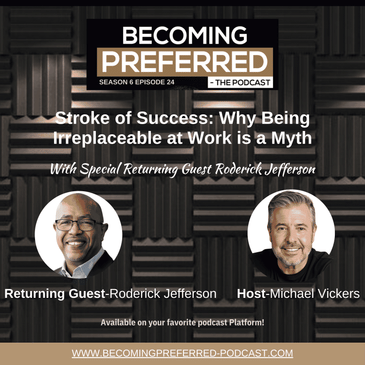
SEASON: 6 EPISODE: 24
Episode Overview:
Welcome back to Becoming Preferred. The podcast to help you level up your game and become the best version of you. Today, we are joined by a returning guest who has reached the literal summits of the corporate world.
He’s been a senior leader at Salesforce, PayPal, and Oracle, and he literally wrote the book on Sales Enablement. But today, we’re talking about a different kind of mastery. Imagine reaching the peak of your career, only to wake up surviving a stroke with a 2% chance of survival.
Roderick Jefferson is back with us to discuss his powerful new book and movement, Stroke of Success™. This isn't just a survival story; it’s a strategic roadmap for every entrepreneur and executive who has ever traded their health for a headline or their peace for a paycheck. We’re going to talk about how to redefine resilience, why 'wholeness' is the ultimate KPI, and how to build a life that is as successful on the inside as it looks on the outside. Join me for my conversation with Roderick Jefferson.
Guest Bio:
Roderick Jefferson is a senior executive with over 25 years of experience in sales enablement leadership. He is also an acknowledged practitioner and a global keynote speaker. He understands how to create bridges between internal organizations to empower sales to exceed expectations.
Recognized for his expertise, Roderick has earned numerous accolades, including being named among America’s Best Speakers by Selling Power Magazine, receiving the Sales Enablement Lifetime Achievement Award, and recognition as a Top Black Executive Leader. He is also a founding member of the Sales Enablement Society.
He frequently presents at industry events and is the author of the Amazon #1 new release and bestselling books, Sales Enablement 3.0: The Blueprint to Sales Enablement Excellence™, The Sales Enablement 3.0 Companion Workbook™, and Stroke of Success™.
Roderick has served on several Advisory Boards, including Autobound, Capella University, DemandFarm, Koridor, Leadoff.ai, National Speakers Association (NorCal), Sales for the Culture, Selleration Inc., and Walli Hr.
Roderick has held roles in executive leadership, sales, sales enablement, operations, and customer service at 3PAR, AT&T, BusinessObjects, Magnit, Marketo, Oracle Marketing Cloud, NetApp, Netskope, PayPal, Roderick Jefferson & Associates, Salesforce, Siebel Systems, and Siteimprove.
When he’s not working on consulting projects or onstage delivering a keynote, he can be found perfecting the art of barbecuing or playing bocce in his backyard with his family.
Regarding my signature topic, keynote, and bestselling book, they have shifted from AI, sales, and the current state of selling to something I call “Stroke of Success™.” You can learn more here.
Resource Links:
- Website: https://roderickjefferson.com/
- Stroke of Success Book: https://www.roderickjefferson.com/stroke-of-success
- Sales 3.0 Book Link: https://roderickjefferson.com/book
- Sales 3.0 Companion Workbook: https://roderickjefferson.com/companion-workbook
- Keynote Speaker Highlight Reel: https://bit.ly/3zRVNJa
- Social Media Channels: https://linktr.ee/roderickjefferson
Insight Gold Timestamps:
06:52 I was at 22% heart function that gave me 2% chance to live
10:22 From the American Stroke Association, that one out of every four people, not just Americans, but people over the age of 25 in the world, will incur a stroke and you many not even know it
11:43 What was the first corporate habit you realized you had to permanently delete to protect your new life?
14:14 Literally I'm recharging my batteries every day rather than waiting until the weekend to recharge
17:30 Money just buys independence
18:25 Stop thinking that you're irreplaceable at work because you're not, and start acting like you're irreplaceable at home
20:17 I believe selfishness, if you do it right, it becomes self-care
22:35 If it's not something that you're putting out that's going to help others, then it's just marketing
26:35 I had to learn how to be present
29:48 Can you look in the mirror and say you like yourself, the person that's looking back at you?
34:19 Was I productive or was I just busy?
35:44 In your book you talk about relationships as being critical as achievement is
38:19 How well can you say you really knew the hopes, dreams, and experiences of your grandparents?
40:50 That's what I want my legacy to be, how I made people feel
41:27 Send folks to roderickjefferson.com because then you'll get a signed book and I can get that out to you
Connect Socially:
LinkedIn: https://www.linkedin.com/in/roderickjefferson/
YouTube: https://www.youtube.com/watch?v=I_Npxk-Ws48
Instagram: https://www.instagram.com/roderick_j_associates/
Roderick's Sales Enablement Spotify Podcast Playlist: https://tr.ee/tywJiGJxdg
Sales Enablement Online Course: https://www.udemy.com/course/applying-the-art-and-science-of-sales-enablement/?referralCode=6CF22D97C842CCC0E07C
Social Media Channels: https://linktr.ee/roderickjefferson
Email: roderick@roderickjefferson.com
Sponsors:
Rainmaker LeadGen Platform Demo: https://calendar.summit-learning.com/widget/booking/JKItVP7WErmCBjU2cCIx
Rainmaker Digital Solutions: https://www.rainmakerdigitalsolutions.com/
In 3, 2, 1.
Speaker BWelcome back to Becoming Preferred, the podcast to help you level up your game and become the best version of you.
Speaker BToday we are joined by a returning guest who has reached the literal summits of the corporate world.
Speaker BHe's been a senior leader at Salesforce, PayPal, and Oracle, and he literally wrote the book on sales enablement.
Speaker BBut today, we're talking about a different kind of mastery.
Speaker BImagine reaching the peak of your career, only to wake up surviving a stroke with a 2% chance of survival.
Speaker BRoderick Jefferson is back with us to discuss his powerful new book and movement, Stroke of Success.
Speaker BThis isn't just a survival story.
Speaker BIt's a strategic roadmap for every entrepreneur and executive who has ever traded their health for a headline or their peace for a paycheck.
Speaker BWe're going to talk about how to redefine resilience while wholeness is the ultimate KPI and how to build a life that is successful on the inside.
Speaker BInside as it looks on the outside.
Speaker BJoin me now for my conversation with Roderick Jefferson.
Speaker CHey, Roderick.
Speaker CWelcome back to the program.
Speaker CWe're delighted to have you back again, my man.
Speaker AIt has been ages since we got together.
Speaker AI am so happy to finally catch up with you.
Speaker AYou're a busy man.
Speaker CYou're a busy man, too.
Speaker CAnd lots going on, for sure.
Speaker CYou know, our last conversation that we had was around one of your areas of expertise, which was Sales Enablement 3.0 in your book and which you know is a must read.
Speaker CAnd I know it is a good read because it's in most of the business schools in America.
Speaker CAnd so where you've migrated and you've kind of made a little bit of a 360 turn here, and you've got a new book called Stroke of Success.
Speaker CAnd I'm excited to talk about that one because it's.
Speaker CI mean, it's good and it's bad.
Speaker CIt's something that's occurred and happened to you.
Speaker CBut I'm going to let you set the stage.
Speaker CSo let's go back to your work in sales enablement.
Speaker CYou're focused on that, and then something happens.
Speaker CAnd that something that happened was a major pivotal point for you, and it changed the direction of your life.
Speaker CSo let's start there.
Speaker AAbsolutely.
Speaker ASo let's go back to the future.
Speaker ASo I've gotten to the level of VP, SVP.
Speaker AI've been in corporate for 30 years.
Speaker ARight.
Speaker AOracle, Salesforce, Marketo, ebay bomb.
Speaker CYep.
Speaker AYeah.
Speaker AAnd it got really well.
Speaker ABut a couple of things happened.
Speaker AOne, I got to that VP level And a really bad change happened, and that was I created this character that I called rj.
Speaker ARJ was the quintessential vp.
Speaker AI had the right car, the right look, the right shoes, lived in the right neighborhood kids, went to the right school.
Speaker ABut it was me trying to fit in or overcompensate for things that were missing in me personally.
Speaker AAnd so I was doing this as a mask and even got worse when I moved up to svp.
Speaker ABecause svp, I really became a leader of leaders, right?
Speaker AI wasn't a practitioner anymore in enablement.
Speaker AI was just moving things around and playing demon chess, if you will.
Speaker AAnd so it was almost sales kickoff time.
Speaker AWe were doing a visit and a walkthrough at the hotel we're gonna do in LA for our skl.
Speaker AAnd we were at dinner, I had my most of my team with me, and I woke up looking at everyone, and they were looking really terrified and scared.
Speaker AAnd I go, what happened here?
Speaker AWhat's going on?
Speaker AThey're like, boss, you fell asleep in the middle of a sentence on the head, hit the table hard.
Speaker AI looked up, I'm like, you know, it's been a long day, maybe eight.
Speaker AWe've been walking hills up and down stairs.
Speaker AMaybe I got narcolepsy trying to play it off.
Speaker ABut I said, you know what?
Speaker AIn all xy, I'm going to go get some rest because I am a little tired.
Speaker AI wasn't very far, my room being from the restaurant, but it felt like I was walking in quicksand.
Speaker AI had to remind myself, lift your right leg, lift your left leg, lift your right leg.
Speaker AAnd I got back to my room and I was sweating.
Speaker AI was so tired.
Speaker AAnd I'm like, I know I'm not that far out of shape.
Speaker AAnd so I did a little work, prepared for the next day, which was the big day to do all of our details.
Speaker AAnd then I was supposed to fly home.
Speaker AI get up the next morning, and I felt even more tired than I was when I fell asleep.
Speaker ANow, thankfully, my wife and I, every time I'm on the road, we jump on a call, hey, what's going on at home?
Speaker AHow are your kids?
Speaker AWhat's going on with you?
Speaker AWhat's your day look like?
Speaker AWhat's happening with me?
Speaker AAnd when I heard, my head sounded exactly like what you're hearing right now.
Speaker AWhat she heard was.
Speaker AAnd she said, this doesn't sound like that.
Speaker ANow, thankfully, she had just had a friend who had recently had a stroke.
Speaker AAnd so she walked me through protocol.
Speaker ASay your name what's your middle name?
Speaker AI don't know.
Speaker ARoderick's my middle name.
Speaker AI should probably know that.
Speaker ACount to 10.
Speaker AI was like, really?
Speaker A1, 7, 52, 95, 16, 43.
Speaker ASay your ABC.
Speaker AA, B, L, Q, X, W, Y, H, B, U.
Speaker AShe said, if I need you to jump on FaceTime with me, I want to see if your face is rude.
Speaker AAnd it wasn't.
Speaker ABut you could tell that I was just out of it.
Speaker ASo she called my director.
Speaker AAnd I say this every time I tell the story.
Speaker ATim Carlson, thank you for saving my life that day.
Speaker AAnd I mean that from the bottom of my heart, because he called 911, he got emergency out.
Speaker AThey took me in an ambulance into the emergency room.
Speaker AHere's where things get really crazy.
Speaker AThey only kept me for 90 minutes and released me.
Speaker ANow I'm stuttering so hard I can't even talk.
Speaker AI can't count, I can't say my edc.
Speaker ANot only did they release me, but it was the day I was supposed to fly home.
Speaker ASo they take me to the airport, I'm literally dropped, passed out.
Speaker AThey put me into a wheelchair, rolled me onto the plane.
Speaker AI land.
Speaker AIn the midst of this, he has talked to my wife and she's already making preparations to meet me at the airport because we live in San Francisco Bay Area and I've got to fly back up from la.
Speaker AIt's only an hour and a half.
Speaker CYeah.
Speaker ABut here's where it got really interesting.
Speaker AI get there, she takes me and rushes me to the emergency room.
Speaker AThey've got a neurologist, they've got a cardiologist on site.
Speaker AThey take me in right away, put me in a stroke protocol.
Speaker AFirst thing they say to my wife is, your husband is a miracle because he's mid stroke.
Speaker ACabin pressure, altitude, there's no reason this guy should be alive.
Speaker ARight?
Speaker ABut that was the best that was going to happen in this story, by the way.
Speaker ASo I'll warn people.
Speaker AThey take me, they do all kinds of scans.
Speaker AAnd so the normal heart squeezes at about 55 to 65% on average.
Speaker ARight.
Speaker AWhen it gets down to 20%, cardiac arrest hits.
Speaker AEither you fall, you die in your sleep, or you get a massive heart attack and you're still dead.
Speaker AYeah, well, I was at 22% heart function.
Speaker AThat gave me two chances.
Speaker ASo they admitted me and we move forward.
Speaker ALet's fast forward 10, 12 days, two weeks out.
Speaker AI'm having a really hard time breathing.
Speaker ANow, bear in mind, this is during COVID and this was only four years ago.
Speaker ARight.
Speaker A20, 21, October 28th were the day.
Speaker AAnd it's getting worse now.
Speaker AI can't talk.
Speaker AMy entire left side is paralyzed.
Speaker AI can't use my arms or my legs.
Speaker AAnd at night, I hear code blue.
Speaker ALights are flashing, machines are beeping.
Speaker AAnd it's my room now.
Speaker AI go from beep, beep to be.
Speaker AI'm flatlined.
Speaker AI don't leave the room.
Speaker AI float up to the corner of the room.
Speaker AI'm looking down on the doctors and nurses sucking fluids out of me.
Speaker AThey're doing chest compression.
Speaker AAnd I am flatlined now.
Speaker AIt sounded a lot like Charlie Brown's teacher.
Speaker AAnd I couldn't tell what they were saying.
Speaker ABut what happened now is.
Speaker AAnd I wear these glasses because old man stuff comes with the territory.
Speaker CYeah, it does.
Speaker AI didn't have my glasses on.
Speaker AI saw the most vibrant blues, yellows and oranges and purple I've ever seen in my life.
Speaker AAnd I look to my left and I'm floating in the room up in the corner.
Speaker AAnd it's my mom.
Speaker AMy mom died in 1999.
Speaker AThis was only four years ago.
Speaker AAnd I say, okay, mom been faithful servant.
Speaker AI've done everything that I can here.
Speaker AI'm ready to go home.
Speaker ALet's go.
Speaker AShe says, no, baby, I was sent to tell you that they're going to figure out what's going on with you.
Speaker ABut I have to tell you now you have a new purpose in life.
Speaker AShe told me my marching orders, if you will.
Speaker AAnd I'm sucked back into my body.
Speaker AShe's gone.
Speaker AI'm looking around for her.
Speaker AShe is gone.
Speaker AAnd it wasn't a mirage because I know my mom.
Speaker CYeah.
Speaker AAnd she had the same purple mumu.
Speaker AShe always wore the same look.
Speaker AShe looked younger than I remembered her.
Speaker ABut now I get sucked back into my body.
Speaker AAnd now I'm still flatlined.
Speaker AAnd I hear the one word that nobody ever wants to hear.
Speaker AClear.
Speaker CYeah.
Speaker AHe starts rubbing the pad.
Speaker AHe's coming down to zap me, to try and bring me back and restart my heart.
Speaker AAs he's coming down, I go from beep to beep.
Speaker AAnd I grab his hand.
Speaker AThank God he's on my right side because remember, my entire left side is paralyzed now.
Speaker AI grab his hand.
Speaker AHe stops.
Speaker AHe's yelling out, ert.
Speaker AAnd I find out later it's the emergency response team now.
Speaker AThey all come in and they take over.
Speaker ASo fast forward.
Speaker AI have to go to physical therapy, speech therapy, occupational therapy, learn how to tie shoes, do a knot, just bone all this all over Again.
Speaker AAnd they finally released me and I still can't talk now.
Speaker AI lost 40 pounds because the muscles in my throat were so weak and I couldn't swallow anything I was eating insure.
Speaker AI went from not being able to walk to being on a walker, to crutches, to a cane, and then being able to walk again, learning how to talk all over it.
Speaker AI had so many different things that I had to work on speech wise.
Speaker AAnd I realized two things, right?
Speaker AOne is the space between your brain and your mouth is a lot wider than it looks like.
Speaker AAnd secondly, I realized how far my couch was from my bathroom because couldn't walk.
Speaker ABut it made me appreciate all.
Speaker AAnd I was telling you before we started that the one thing I say all the time about this is I am so thankful I had that stroke now, by the way, this was my second stroke.
Speaker AI had one before I didn't even know it.
Speaker AI realize now from the American Stroke association that one out of every four people, not just Americans, but people over the age of 25 in the world, will incur a stroke.
Speaker AYou may not even know it.
Speaker AThat's why it's called the silent killer.
Speaker CYeah.
Speaker CWhat's interesting to me is you've spent, as you said, 25, 30 years at the top of the corporate ladder at some of the giants, and you've always lived the always on executive lifestyle.
Speaker CSo your definition of success has changed the morning, you know, when you woke up in recovery versus going into it.
Speaker CAnd, and I share that.
Speaker CI share that.
Speaker CYou know, in our 20s and 30s and 40s, where it's all about accumulation, status, image, all that's why we choose the job in the first place.
Speaker CWe write books, we love speaking in front of audiences.
Speaker CIt's, it's great, it's an awesome job and it is a great role and it's a privilege to be able to do what we're doing.
Speaker CAnd now you measure success by wholeness.
Speaker CAnd it's that realization that if you're not healthy enough to enjoy the fruit of your labor, then the labor itself is a failure.
Speaker CAnd, and it's changed the way you've looked at it.
Speaker CLet's talk about the, the 2% perspective.
Speaker CSo you faced a 2% survival rate.
Speaker CSo when the odds are that slim, the noise of business, the emails, the quotas, the politics, it disappears.
Speaker AWhat was the none of that matter?
Speaker CYeah, exactly.
Speaker CWhat was the first corporate habit you realized you had to permanently delete to protect your, your new life?
Speaker AGreat question.
Speaker AI had to put me and my health first.
Speaker AIt Wasn't about my team.
Speaker AIt wasn't about the quotas, it wasn't about the jets and helicopters and all the people that I had dinners with and all of that and President Obama and blah blah, blah, blah, blah.
Speaker AWhat it was about is every day I woke up now, I had the same prayer right now that I had when I was in hospital.
Speaker AAnd that was not make me whole, not get me wrong.
Speaker AGod, just let me wake up to see another day and allow me to be able to help someone else, not necessarily with a stroke, just in general to give.
Speaker AAnd that's why my new hashtag is give to give.
Speaker AIt is.
Speaker AWhat can I do?
Speaker ARemember I said earlier my mom gave me where marching orders were different one she said I need to start taking care of myself better and putting myself first and being focused on self care.
Speaker AAnd it's not selfishness.
Speaker AThe second one, that every day it's my job to give at least one person a smile that they would not have gotten had I not come in contact with and or make them just be seen.
Speaker AAnd my mom called them the invisible.
Speaker AThe people that you check in the hotels, the valet, the waiters or some kind.
Speaker CThat's just the first at the supermarket.
Speaker AYeah, it could be somebody at the supermarket that looks down.
Speaker AI always carry a couple of extra smiles in my back pocket now so I can hand them out.
Speaker AAnd it's amazing what happens when you make someone feel seen and worth.
Speaker ANot just worthy, but worth.
Speaker ASo the first thing I did was it's interesting because I actually put this up as a post on LinkedIn today.
Speaker AAnd it is every morning after I do my morning routine, I come into my office before I look at my email.
Speaker ABecause if you do that now you're firefighter, I want to stay in fire prevention.
Speaker AAnd you're also reactive.
Speaker AI've got a whiteboard right up here in front of me.
Speaker AAnd every day I write three things.
Speaker AThose are three things professionally that I'm going to do today before I walk away from my laptop.
Speaker AThe fourth one is something just for me.
Speaker AAnd it's not like a cheat day when you're on a diet, right?
Speaker AThis is literally something that's ingrained.
Speaker ACertain days I sit in my backyard and just watch the hummingbirds and put some sun on my face.
Speaker AOther times it's taking the dog for a long walk.
Speaker ASometimes, honestly, it's barbecue and Baskin Robbins.
Speaker ABut it's just for me and I don't feel bad about it.
Speaker AI don't feel selfish.
Speaker AIt literally is.
Speaker AI'm recharging my batteries every day rather than waiting till the weekend to recharge.
Speaker AAnd the other thing is something you and I talked about.
Speaker AI used to block out Wednesdays.
Speaker ANo meetings, just admin or whatever I want.
Speaker AYeah.
Speaker ANow I block out Fridays because it gives me a three day weekend.
Speaker AAnd I have a small two year old granddaughter.
Speaker AWe get her for a few hours every Friday.
Speaker CIf the stroke didn't change your behaviors, the two year old certainly will.
Speaker AWell, because now I'm focused more on legacy.
Speaker AWhat am I leaving?
Speaker AAnd I don't mean material things, but memories, engagement and interaction.
Speaker CExperiences.
Speaker CYeah.
Speaker AAnd experiences.
Speaker AAbsolutely.
Speaker CNo, I get it.
Speaker A100.
Speaker CIt's funny how you.
Speaker CIt's older and I want to talk about this ambition versus well, being.
Speaker CRight.
Speaker CAnd you address this because we start off focus, you know, we're in our teens.
Speaker CWe want, we want, we want.
Speaker CWe want things.
Speaker CWe want the car, we want the woman, the girl, the partner.
Speaker CWe want the job.
Speaker CWe want the.
Speaker AWe want the logo.
Speaker AWe want the salary, we want the products.
Speaker CBig tattoo on my arm.
Speaker CIt says ego is the enemy.
Speaker CRight.
Speaker CWell, I woke up one morning and it was on my arm.
Speaker CAnd I think my wife roofied me and had me tattooed.
Speaker CI say, hey honey, what are you about getting this.
Speaker CAnd she goes, I think you should just read your right arm.
Speaker CAnd that's Marcus Aurelius, one of the Stoics from 2,000 years ago.
Speaker CRight.
Speaker CAnd so it was.
Speaker AAnd it still rings true.
Speaker CCompletely true.
Speaker CAnd what's interesting is I've had to evolve.
Speaker CAnd it wasn't probably till I was about 50 and I started realizing, I'm going, you know what?
Speaker CNone of this matters.
Speaker CI'm all of time.
Speaker CAnd the family and my children were sacrificed, my older ones particularly, because I was building a career on the road.
Speaker CBut when the grandbaby started coming, it's like it changed the game.
Speaker AIt was no longer about you anymore.
Speaker CNo.
Speaker CAnd it's such a joy.
Speaker CAnd so Friday morning we get two.
Speaker CAnd Friday afternoon I get one.
Speaker CAnd sometimes Friday evening get another two.
Speaker ALoved.
Speaker CAnd so they'll.
Speaker CAnd it's.
Speaker CThey're full days.
Speaker CAnd yeah, they're tiring too, but in a good way.
Speaker AAnd you're not just feeding your family now, you're also feeding your soul.
Speaker COh, 100%.
Speaker CAnd the other ones are soul sucking.
Speaker CLike your job.
Speaker CIt can be soul sucking because none of that is going with us and at all.
Speaker AMy uncle used to say something that.
Speaker AThat rings like.
Speaker AOr he says, have nephew, have you ever seen a U haul behind A hearse?
Speaker CYeah.
Speaker ANever know because you can't take it with you.
Speaker ANone of that really matters.
Speaker CNo, I was actually at a panel where they had, you know, T. Boom Pickens, Warren Buffett, all these great billionaires, and they're all in older suits talking about their old suits, but every single one of them, there was about seven of them, all said they would give up everything they've ever done to maintain their health.
Speaker CAnd that's why you see them 80 and 90 years old, still working and still functioning all right.
Speaker CThey just work on their own schedules, they do their own things, but health was the number one.
Speaker CPeople would pay any price.
Speaker CAnd it's like when you have a granddaughter, you know, if that granddaughter needed some financial support for a medical procedure, but you consider it done in a sec.
Speaker CYeah.
Speaker CIt's where.
Speaker CWhere do I send the check?
Speaker CBecause that's the value.
Speaker CWe use the money, but we want.
Speaker ATo, I think money, for me, money just buys independence.
Speaker ATo your point, you now own your own challenge.
Speaker CFreedom.
Speaker CYeah, freedom.
Speaker ABuy freedom.
Speaker CThat's what it means to me too.
Speaker CSo entrepreneurs, solopreneurs, executives are often told that balance is a lie, that obsession is the only way to win.
Speaker CSo in stroke of success, you challenge that.
Speaker CHow can a high performer stay competitive without sacrificing their physical survival?
Speaker AIt starts with never forget your why what we were just talking about.
Speaker ARight.
Speaker ABecause it's why we do all of this family, is it?
Speaker AYour significant other.
Speaker ABut you've got again, take care of you health as well.
Speaker AAnd the second piece is, and I wish I would have learned that earlier than my 50s.
Speaker AWhat I'm about to say, whether you're an entrepreneur or in corporate, that job is here to make a profit, not friends.
Speaker AIf you're gone, it doesn't really care.
Speaker ANo.
Speaker ASomeone else will step into the gap.
Speaker ASo stop thinking that you're irreplaceable at work because you're not, and start acting like you're irreplaceable at home.
Speaker CYeah, that makes sense.
Speaker CAnd I think you talk about it as you basically are this corporate athlete.
Speaker BSo.
Speaker CNo.
Speaker CProfessional athletes train 247 without recovery.
Speaker CThey break.
Speaker CYeah.
Speaker CYou can only have so many game days.
Speaker CAnd I see professionals, myself included, where I have a couple of days a week that are game days.
Speaker CIf we have a game.
Speaker CIf we have a game day every day, and I'm talking full throttle.
Speaker CYeah, we're gone.
Speaker ARight.
Speaker CYou can't have those every day.
Speaker CYou will burn out on those things.
Speaker CAnd we need, in my mind, we need recovery days.
Speaker CRejuvenation days equal to the amount of game days.
Speaker CAnd so in professional sports, and these are the most finely tuned athletes, it's one or two game days a week, maybe three.
Speaker CAnd I think people were so driven by, by the things we want or we think that we need.
Speaker CAnd you know, my dad always said it best, he goes, you spend the first half of your life accumulating.
Speaker CYou want this, you want that, and then you spend the last half getting rid of it all.
Speaker AAbsolutely.
Speaker CYou just realize it's just a, it's just a game.
Speaker AJust the older we get, we realize there are less physical things we actually need.
Speaker AAnd to go back to something you were just saying, as a former high level athlete myself, you learned early on that when you're working hard in your training, it builds up lactic acid in your muscle.
Speaker ASo you need those off days, those massages, those rest days to break up that lactic acid.
Speaker AThe same thing happens with your brain and your soul.
Speaker AIf you don't take time off to recharge your batteries, you can look at how you want to.
Speaker AI'm charging my batteries.
Speaker AI can't pour from an empty cup.
Speaker AAll of it is true.
Speaker AIf I am in poor health, I am good to no one and for nothing.
Speaker ASo take some time and stop feeling bad about being selfish.
Speaker AIt's okay.
Speaker ABecause literally, I believe selfishness, if you do it right, it becomes self care.
Speaker CYeah.
Speaker AAnd you don't need permission from anyone for you to do self care.
Speaker CThere's an interesting correlation.
Speaker CYou know, you're the master when it comes to Sales Enablement 3.0 and Sales Enablement in general.
Speaker CWe built a whole career on that.
Speaker AThank you.
Speaker CI see a nice correlation to how did you apply your own enablement frameworks, breaking down silos, creating bridges to your own physical and mental recovery.
Speaker CSo let's call it life enablement.
Speaker CAll right.
Speaker AYeah, that's a great statement.
Speaker AOh, of life enablement, I think what I did was, first of all, I did an analysis.
Speaker AWhatever does not serve me needed to go.
Speaker AWhether it was friendships, associations, subscription, whatever it was, I had to clean house first.
Speaker ARight.
Speaker AAnd I had to do it on my own terms.
Speaker AAnd secondly, I looked at where are things that are literally making me better in life and what is just an echo chamber because it made me feel good.
Speaker AI had to look at the difference between ego and ambition.
Speaker ARight.
Speaker AIs this serving me and others or is this just placating my ego?
Speaker AThen I looked at it pretty and go, the five piece that's people, processes, platforms, programs, et cetera and so I started building those out in a way that was scalable and repeatable and AI was a big piece of it because now I can work smarter, not harder, and I can build multiplicity.
Speaker AAnd the last piece was I had to limit access to me.
Speaker ANow I don't think I'm some big celebrity, maybe in the enablement world, but I was allowing too many different people too close to me, if that makes sense.
Speaker ASo I had to make myself a bit more untouchable for my own well being.
Speaker CYeah, I hear you.
Speaker AAnd so I don't do as many.
Speaker CWant space for yourself?
Speaker AYeah, I don't do as many maintainees as I used to have online courses.
Speaker ANow rather than speaking live, I don't speak more than X number of times.
Speaker AAnd like we're doing now, I'm not going to do three, four podcasts a week.
Speaker AI'll do one, maybe two in a week, but that's it.
Speaker AAnd I also had to once I got my business coach, he taught me something, a valuable lesson I want to share with him.
Speaker AIf it's not something that you're putting out that's going to help others, then it's just marketing.
Speaker AIf you're putting something out that's going to drive business and going to help others and it's business development.
Speaker ASo whatever was marketing, I just put it aside.
Speaker AThen I also realized when I did that inventory, Michael, that I could literally go two plus years without creating.
Speaker AI love canva, don't get me wrong.
Speaker ABut I could go two plus years without creating another single asset because that was my happy place.
Speaker AIt was what made me feel good.
Speaker AIt was a great dopamine and it worked out because now I've got all these things to be able to put out.
Speaker ANow it's about how do you message and position it differently for others rather than marketing.
Speaker CThat's a great insight.
Speaker CExcellent insight.
Speaker DAre you tired of chasing leads and ready to start effortlessly attracting more high value clients?
Speaker DIntroducing Rainmaker Lead Gen, the ultimate sales, engagement and client acquisition platform that takes the stress out of outreach.
Speaker DWith Rainmaker Lead Gen, you can easily identify, engage, educate and convert your ideas prospects into loyal clients.
Speaker DOur industry leading automation and email sequencing empowers you to reach more ideal clients, accelerate the sales cycle and close more business.
Speaker DImagine authentically engaging with your prospects while the platform handles the heavy lifting.
Speaker DSay goodbye to the endless hustle and embrace a more efficient, effective approach to business development.
Speaker DReady to Ready to witness the magic?
Speaker DBook a 20 minute demo today and see how Rainmaker Lead Gen can revolutionize and level up your client acquisition game.
Speaker DThere's nothing to lose and everything to gain.
Speaker DDon't miss out on this opportunity to supercharge your client acquisition process.
Speaker DVisit rainmakerdigitalsolutions.com or check out the link in the Show Notes to book your demo.
Speaker DRainmaker Lead Gen Spend less time hunting for your ideal clients and more time having high value sales conversations with your ideal clients.
Speaker BAnd now back to my conversation with Roderick Jefferson.
Speaker CIt's interesting how we get here in the journey in life because I've talked to other people in our age group because you and I are very similar.
Speaker CYou're catching up to me anyway, but.
Speaker AI hope I don't ever catch up with you.
Speaker AThat means you're not here.
Speaker CI don't know.
Speaker CI'm going to try and stall it.
Speaker CI'm trying to stall my time and bite.
Speaker CAnd what's interesting is I actually figured it because it's going fast and the older you get.
Speaker COh yeah, ramps up.
Speaker CIt accelerates thinking, oh, I got lots of time to do this as you get a little older.
Speaker CTrust me, it moves quickly for me.
Speaker CWhat's interesting, the way to slow it down that I've discovered slow down is you have to unplug.
Speaker CUnplug.
Speaker CDon't check your emails, don't look on the computer, get off your phone.
Speaker CJust try.
Speaker CAnd you'll be sitting there and it goes, this is uncore and it's lunchtime.
Speaker CRight.
Speaker CAnd you've spent it seems like a long, long day, but the time can just disappear and none of this is going to, you know, we're not saving dolphins or we're not solving world peace.
Speaker CNo, let's talk about the hidden costs of the climb because you've held roles.
Speaker COracle, NetApp, LinkedIn.
Speaker CLooking back, what were the early warning signs of burnout or health neglect that you ignored in favor of maybe the next promotion, the next level up?
Speaker CAnd what should our listeners be looking for in themselves?
Speaker AYeah, that's a great question.
Speaker AWhen you get comfortable with doing email at 8, 9, 10, 11 o' clock at night, you've got a problem.
Speaker ARight?
Speaker ABecause the purpose of especially corporate America is there should always be more in your inbox than you can actually do.
Speaker AWhen you've got a dry inbox.
Speaker AThat's when you start worrying.
Speaker AThe other thing is putting parameters around time.
Speaker ALike you were saying seven o' clock every night.
Speaker ATurn your phone, turn the noisemakers off of your phone so that you don't have this Pavlovs dollar mentality.
Speaker CYeah.
Speaker AAnd then the other piece is figure out how.
Speaker AAnd I had to learn this.
Speaker AAnd I know it sounds crazy, I had to learn how to be present.
Speaker AI'm the guy that would be watching TV while I'm scrolling on my phone on social media.
Speaker ANow, there's no such thing as multitasking.
Speaker AWhat you're doing literally is stretching your brain to the nth degree.
Speaker AIt's not just burning the candle, it built in.
Speaker AEventually it's going to meet in the middle.
Speaker AThat story I told you earlier, that was me meeting in the middle.
Speaker AYou may say, oh, I'm not worried about a stroke.
Speaker AOh, but wait, let's go back to what I said about mental health.
Speaker AI had the first stroke and it could have just felt like it was a little dizziness, I was tired, I was a little off balance.
Speaker ABut if you don't listen to your body, then you don't know the differences.
Speaker AThe other piece is about being present, Remember in an 18 month period.
Speaker ALondon, Paris, Geneva, Sao Paulo, Rio, Toronto, Beijing, Hong Kong City in 18 months.
Speaker AI was never home.
Speaker ARemember I said my why is to provide and protect for my family.
Speaker ABut I had gotten into this eagle thing where I'm flying in corporate jets, corporate helicopters, high end hotels, celebrity filled events.
Speaker AAnd I got comfortable with that.
Speaker AYeah, I had to get comfortable being uncomfortable with that because I remember coming home one time from a two week trip I never learned.
Speaker AUsually I'd come home, see the kids, see my wife a little bit and then hit the dry cleaners and I'm back out.
Speaker AThis time I was home for a little bit and I said, babe, I've been on the road for two weeks.
Speaker AI am sick of hotel food.
Speaker AI just won greasy taco.
Speaker AMy little son happened to be staying there, he looked at me and he goes, dad, Thursday shake and bake.
Speaker AYeah.
Speaker AThe light went off and it said to me, they have a whole life that I'm not included in.
Speaker AAll I do is blending it.
Speaker CYeah.
Speaker AAnd that I missed birthday parties.
Speaker AI miss my daughter's 8th grade graduation.
Speaker AI miss football games, basketball games, dance recital.
Speaker AAnd at some point after the stroke I went, that's not going to happen again because you can't get that back.
Speaker AYou cannot buy memories.
Speaker CNo, no, that's right, you missed out on.
Speaker ASure, it could be recorded, but it's not the same.
Speaker AAnd I talked to my kids earlier and they're much older, they're, you know, in their 30s and late 20s now.
Speaker AAnd I said, did I provide a good life?
Speaker AAnd they said, absolutely, that.
Speaker AAn amazing life.
Speaker AI said, what would you have changed?
Speaker AAnd he said to a team, both of them, we wish you would have been home.
Speaker CYeah.
Speaker AWe would have given up the vacation, the cars, the clothes.
Speaker AAll that I wanted.
Speaker AMy dad sitting out watching my recital, my dad watching my cheerleading competition, just like the other parents were there.
Speaker AOne, I was gone so much.
Speaker AOne of my daughter's friends actually thought I worked in the CIA because I was never home and my daughter couldn't.
Speaker CShe was yelling, serious job.
Speaker CYeah.
Speaker AAnd she didn't know how to explain what I did.
Speaker ASo her friend thought, oh, sure, you don't know what your dad does.
Speaker AHe's not allowed to tell you he's in CIA.
Speaker CYeah, yeah.
Speaker AAnd I can laugh at that now, but in hindsight, that's funny.
Speaker AIt's scary how comfortable we get with that.
Speaker ASo ask one question and I'll stop talking for a moment.
Speaker AAnd I want to challenge the folks watching this and listening in your audience.
Speaker AWhen you're honest with yourself.
Speaker AYou may love yourself, but can you look in the mirror and say you like yourself?
Speaker AThe person that's looking back at you?
Speaker ANo.
Speaker CWell said.
Speaker CLike, I think the point is, listen to the whispers before they come.
Speaker CScreams and chronic fatigue, irritability.
Speaker CMissing the milestones of life.
Speaker AYeah.
Speaker CThey're not badges of honor.
Speaker CAnd some.
Speaker CNo, they're the check engine lights of your life.
Speaker CAnd look at it.
Speaker CSo, no, I think it makes sense.
Speaker CLet's talk about setbacks as stepping stones.
Speaker CSo you describe stroke of success as a personal success accelerator.
Speaker CHow can a professional who has just experienced a major career setback, maybe a failed business or a layoff in particular, in the age of AI, people are losing their jobs.
Speaker CUse your recovery roadmap to bounce back faster.
Speaker AYeah.
Speaker AI think the first thing is to be able to look yourself in the face and be completely honest with yourself.
Speaker AWhy did this not work?
Speaker AWas I not prepared?
Speaker ARight?
Speaker ADid I not do everything I wanted to?
Speaker AWas I all in?
Speaker AOr did I focus on things that really weren't important?
Speaker AAnd so let's say the business failed.
Speaker AIs it because I didn't have a strong enough business plan?
Speaker ADid I not follow the business plan?
Speaker ADid I, like I was saying with Canva earlier, did I focus on things that made me feel good versus things that were actually making me revenue?
Speaker AAnd you've got all of these available tools.
Speaker AAre you using it for marketing or for business development?
Speaker AIt's time for a complete overall and reevaluation.
Speaker CYeah.
Speaker AWhat does success look like?
Speaker AThat's the first question, right?
Speaker ATruly, what does success mean for You.
Speaker CHow are we going to define it?
Speaker CYeah.
Speaker CIndependently.
Speaker AYeah.
Speaker AHow you define then and only then can you reverse engineer and work towards that.
Speaker AIt could be like us Fridays are off.
Speaker AOkay, that's a great start.
Speaker ABut then what's the next step after that?
Speaker CRight, good point.
Speaker CI'm going to start doing some homework.
Speaker CWell, and I know you talk about resilience and I believe it's not about getting back to normal.
Speaker CIt's about incorporating the change used to set back to audit what wasn't working and build more stable, purposeful foundation for the next chapter, whatever that's going to be.
Speaker CSo no, it's interesting.
Speaker CLet's talk about ape wholeness and protecting wholeness in a remote AI world.
Speaker CAs we move further into the age of AI and 247 connectivity, that bridge between work and home has vanished for many.
Speaker CThey're working out whenever leaving the job.
Speaker CRight.
Speaker CAnd we deal with that as entrepreneurs, you and I.
Speaker AAbsolutely.
Speaker CI have a hard time shut it off.
Speaker CMy studio is in my home.
Speaker CI work.
Speaker CI have to actually shut it off.
Speaker AYeah.
Speaker CAnd I call it, I schedule it.
Speaker CI schedule wind down.
Speaker CMy job's to get dinner, grocery shopping and dinner.
Speaker CSo that's one of my roles.
Speaker CAnd 4 o', clock, 4:30.
Speaker CI'm a 4:35am Guy.
Speaker CSo I'm at it earlier and I call it the daily wind up.
Speaker CAnd so the first part of that day is for me, I don't not to your point.
Speaker CI'm not checking emails, I'm not looking at that part at all till the work hours.
Speaker BRight.
Speaker CAnd then I don't actually check emails all day.
Speaker CI process emails.
Speaker CSo I have a couple of times where I process them so I'm not touching them again just like I'm processing anything.
Speaker CAnd I work on that time to my own personal development.
Speaker CFirst part of the day, first few hours are all about me.
Speaker CSo as we work out of home, between work and home, it's kind of vanished for many of us.
Speaker CWhat is the practical boundary that you've set for yourself that every entrepreneur could or business professional could adopt today?
Speaker AYeah, I'll give you a couple of those.
Speaker AThe first is on Sunday.
Speaker AI take a little time and I stage all of my social media for the week.
Speaker AThat way it's not hanging over me and it's not on my shoulders.
Speaker AIt's done that day and then I schedule and it just rolls out.
Speaker AThe next is on my calendar because I use calendly.
Speaker ALike a lot of us, I block out times for mental recharge.
Speaker ASo I don't do two, three back to back back meetings.
Speaker AAnd here's the thing, even if you work in corporate or an entrepreneur, especially if you're entrepreneur, let's not forget, if it's not on your calendar, it doesn't exist.
Speaker ABut I'll say the end because of that too.
Speaker AYou own your calendar, so you determine what's blocked out.
Speaker ARight.
Speaker ABecause we all know if you got a calendar like how many times can have people schedule the next available job.
Speaker AThat's how it works most of the time.
Speaker ASo block that out.
Speaker ARight.
Speaker AAnd then the third piece, which is extremely important.
Speaker AEvery Friday I take time to now take stock of what did I actually get done this week versus where did I move forward?
Speaker AWas I productive or was I just busy?
Speaker CYeah.
Speaker AAnd the final piece.
Speaker AAnd I just started doing this the other day and learned from my friend Cheryl Parks.
Speaker AShe gave me a prompt whereby I told Claude all the different things I have going on from a project perspective.
Speaker AAnd I said, build out a 30 day sequencing process.
Speaker AHere's what I should be working on, here's what I can kind of wait later to do, and here's what you shouldn't even be looking at in the next 30 days.
Speaker AAnd it's amazing how much more time I got back because I didn't feel like I was a pinball trying to do everything.
Speaker AMy old adage has always been I can do anything.
Speaker AI can't do everything.
Speaker AI was trying to do everything.
Speaker ABut with that sequencing piece, I'm constantly reminded I don't have to do everything all at once.
Speaker ASpace it out and.
Speaker ABecause most of the time.
Speaker AWould you agree, Michael, that our deadlines are mostly self imposed?
Speaker C100%.
Speaker CYeah.
Speaker CThe work always expands to the time we allow for it.
Speaker CAnd like sometimes, you know, we create tasks and projects.
Speaker AYeah.
Speaker CBut one thing I've noticed that we think are important because we like to look busy and productive.
Speaker CBut I find if I leave them alone long enough, they disappear all on their own.
Speaker AAll right?
Speaker AAnd everything can't be a P0 or a P1 or not the years.
Speaker CYeah.
Speaker CInteresting.
Speaker CLet's talk about the role of relationships.
Speaker CYou mentioned playing bot.
Speaker CI think it's botchy.
Speaker CAnd with your family in your book, you talk about relationships as being critical, as achievement is how do you respond to professionals who say, well, I'm going to focus on my family.
Speaker COnce I hit my goal, once I hit my exit strategy, once I'm going, then I'll have time for the family.
Speaker CAnd I know you believe you can't buy that Time back with your loved ones.
Speaker CAnd if you wait to the end of the race to check on the cheering section, you might just find the stands empty.
Speaker CRight, Unpack that for us a little bit.
Speaker ALet's start with nobody's promise tomorrow.
Speaker AAnd I know it better than most because that night when I flatline and died, I didn't have it tomorrow.
Speaker ASo act like tomorrow is not promise.
Speaker CThat's a good insight.
Speaker ARight.
Speaker AAnd I know it better than most.
Speaker AThe other thing is, if you wait until something happens, you don't have control of the peaks and valleys of actually happening.
Speaker AWhat if that exit never happened?
Speaker AThen what?
Speaker AYou've wasted so much time and you've taken time away from your family.
Speaker CYeah.
Speaker ASo go back to what's your why?
Speaker AWhatever your why is that has to be your North Star.
Speaker CYeah.
Speaker AAnd for me, it was family.
Speaker AAlways been family.
Speaker AAnd so back to reevaluating at what I call this age and stage of life.
Speaker AI would love for these folks to go back and reevaluate what family.
Speaker AWhat's your real definition right now?
Speaker AFail.
Speaker AYeah.
Speaker AAnd that is the driver.
Speaker CYeah.
Speaker CI think you're bang on.
Speaker CIf you knew tomorrow, you were a goner.
Speaker CYou know, the.
Speaker CThe Stoics have a saying, death will come for us all.
Speaker CAnd it's coming.
Speaker CAnd you never know when that number's up.
Speaker CWe don't get a boat, you're going.
Speaker CNo.
Speaker CAnd so it's.
Speaker CIf you lived each day like this was your last day, who are the people you're hanging out with?
Speaker CIs this what I really want to be doing today?
Speaker CIs this serving me?
Speaker CAnd you've addressed that?
Speaker CWell, I think it.
Speaker CYou start looking at a lot of activities.
Speaker CYou know, it's like I see people complaining about their jobs or work, and they spend hours a day just on scrolling or television not making their lives better.
Speaker CThey're just.
Speaker CThey're captured by the trappings of society, if you will, instead of focus on what really matters.
Speaker CBecause, you know, I work with some pretty interesting companies and successful individuals as you do, and it never lasts more than two or three generations.
Speaker CSo you work your butt off, hand off your kids a bunch of money, and if it lasts one more generation, you'll be lucky if you're building generational wealth.
Speaker CSo I think the real wealth comes.
Speaker CRelationships are the real wealth, and that doesn't.
Speaker CWhen the market crashes 100%.
Speaker CYeah.
Speaker AMichael, you just said something really interesting.
Speaker ATwo generations, and you were talking financially.
Speaker ALet's talk about memories now.
Speaker AHow well do you really.
Speaker AHow well can you say you really knew the hopes, dreams and experiences of your grandparents.
Speaker AThat's two generations.
Speaker ANot very well for most of us.
Speaker CRight?
Speaker ASo imagine two generations from now, those grandkids that you and I have, how well are they going to know us?
Speaker AEspecially if they're young.
Speaker AMine is two.
Speaker AI'm taking as much footage, as much pictures, as much memory building as possible.
Speaker AHere's a quick story for you.
Speaker AI am not a big Disney fan.
Speaker AMy family are Disney fanatics.
Speaker ALike, yeah, annual pass kind of people, right?
Speaker ABut something flipped a switch this year.
Speaker AI'm going to be 60 in a couple of weeks.
Speaker AAnd my wife said, it's a big one.
Speaker AWhat do you want to do?
Speaker AAnd I shocked my whole family.
Speaker AI said, I want to take the family to Disneyland first.
Speaker AThey almost fell off their chairs.
Speaker AThey're like, you sure, dad?
Speaker AAre you off on your meds?
Speaker ARight?
Speaker AAnd my wife said, why?
Speaker AAnd I said, well, my.
Speaker AMy father in law has passed now, but my favorite picture of all times is a back shot that I took of my son holding his grandpa's hand and walking into because he became a different person there.
Speaker AHe was a somewhat of a curmudgeon.
Speaker AI love him, but he was curmudgeon, right?
Speaker AYeah.
Speaker AMy mom that kind of guy.
Speaker ABut when he got there, he became grandpa.
Speaker AAnd so I'm going to actually recreate that picture with my granddaughter in the very same spot as that picture.
Speaker ABecause when I'm gone, I'm hoping that will be one of her favorite pictures.
Speaker CMake a nice memory.
Speaker CWell, time goes fast, Roderick, for sure.
Speaker CSo I do have one last question for you.
Speaker CAnd let's talk about the legacy of the Voice of Rod.
Speaker CSo you've received lifetime achievement awards and have been named the top black executive leader.
Speaker CSo when people hear the voice of Rod now, what is the one message you want to be the lead note of your legacy?
Speaker AOh, love that question.
Speaker AI had this conversation with my wife just over the weekend.
Speaker AAnd that is whenever I do die, whether it's two weeks, 200 weeks, 400 years, whatever it is, there are two roles.
Speaker AOne, I want no sad, sappy funeral.
Speaker AI want it to be a celebration.
Speaker AAnd secondly, people, they can't talk about any of my awards.
Speaker AThey can't talk about any of the companies I work for, none of the keynote speeches I gave.
Speaker AThey're only allowed to talk about one thing.
Speaker AHow did he make me feel when he was around me?
Speaker AAnd how did I feel better after he left him?
Speaker AThat's what I want my legacy to be, how I made people feel.
Speaker CAnd you show that you can be a world class professional and a whole human being simultaneously.
Speaker CYou don't have to choose between a stroke of luck and a stroke of success.
Speaker CYou can choose to thrive by design, not by chance.
Speaker AIt's an and it's not an or.
Speaker CYeah, exactly.
Speaker CNo.
Speaker CBrilliant.
Speaker CBrilliant.
Speaker CLove what you're doing my friend and always great to see you.
Speaker CThank you.
Speaker AAlways good to see you.
Speaker CThank you for sharing your insights.
Speaker CI'm glad to see you're healthy and on the right track and sharing your stories and your insights.
Speaker CThe book Stroke of Success and even sales enable 3.0 wherever you get your favorite books.
Speaker AI would send folks to roderickjefferson.com because then you'll get a signed book and I can get that out to you.
Speaker CAnd I think you have extra little resources that can go along to it.
Speaker AI've got some free things in the.
Speaker CShow notes as well and that's awesome.
Speaker CRoderick, thank you for being our guest today.
Speaker AThank you my friend.
Speaker AAnytime.
Speaker AI'm honored to be here.
Speaker BAs you are listening to this episode, what is one idea that you've heard that has caught your attention and why does it matter so much to you?
Speaker BAnd who is one person who you.
Speaker CCan share that with, either sharing this.
Speaker BEpisode or just sharing that insight that occurred to you while you were listening?
Speaker BPerhaps it is understanding how important it is to prioritize being irreplaceable at home over being irreplaceable at work because the corporate world will quickly fill your gap.
Speaker CWhile your family never can.
Speaker BOr maybe it is that true professional success is a failure if you aren't healthy enough to enjoy the fruit of your labor.
Speaker BSo listen to the whispers of burnout before they become screams.
Speaker BThank you for listening, for learning, and for investing in yourself so that you can become the best version of you.
Speaker BIf you found value in this episode, please write a review on Apple Podcasts.
Speaker BIf you haven't subscribed yet, please do so so you can get a new episode and start your week off right every Monday.
Speaker BUntil next time.
Speaker BThis podcast is created and associated with Summit Media.
Speaker BMy executive producer is Beth Smith and Director of Research, Tory Smith.
Speaker BThe fee for the show is that.
Speaker CYou share it with friends when you find something useful or interesting.
Speaker BThis podcast is subject to copyright by Summit Media.
Speaker AGoodbye.