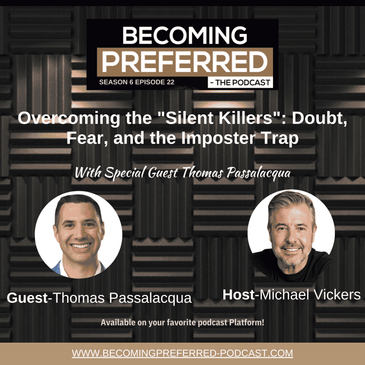
SEASON: 6 EPISODE: 22
Episode Overview:
Welcome back to Becoming Preferred, the podcast dedicated to the high-level strategies that transform professionals and level up performance.
Today, we are exploring a truth that every professional eventually hits: Success isn't just about what you do; it’s about the clarity with which you lead. Many leaders reach a plateau not because they lack resources, but because they are navigating through the 'fog' of doubt, rapid growth, or shifting industries.
Joining us is someone who has mastered the art of the pivot and the science of leadership. Thomas Passalacqua is a certified Executive Coach and the founder of Ascend Professional Pathways. From his early days as a founding teacher in New York City to driving high-stakes mergers and acquisitions and executive coaching, Thomas has seen firsthand how the right mindset can turn a 'good' professional into an 'elite' leader.
In this episode, we’re going to help you identify your own blind spots, overcome the silent fears that stall growth, and learn how to align your daily decisions with your highest professional goals. Join me for my conversation with Thomas Passalacqua.
Guest Bio:
Thomas Passalacqua is a certified Executive Coach who specializes in customized professional & leadership development. With a master’s in education, Thomas started his career as a founding teacher in New York City. He then transitioned into dental manufacturing sales, where he was an award-winning consultant who trained and mentored other sales professionals.
Transitioning again, Thomas was the director of business development for a growing dental group practice in the Northeast where he led sales and marketing for mergers & acquisitions. In his executive coaching and professional training platform, Ascend Professional Pathways LLC, he enables various industry leaders to gain clarity and improve their business leadership skills.
Thomas' clients are empowered to reach the next level in their businesses and careers by overcoming doubts, fears, and uncertainty and making strategic decisions to better align with their goals.
Resource Links:
- Website: https://ascendpropathways.com/
- Product Link: https://ascendpropathways.com/executive-coaching
Insight Gold Timestamps:
02:44 I found myself being relevant to my fellow classmates and seeing them take my advice
06:41 The pathway reference really is a nod to the individual coach and because there are multiple directions
09:49 My main focus is, okay, what do we do moving forward?
12:01 What kinds of things do you see for obstacles that are common?
13:58 The 'why' behind it all is important
16:10 If you have a question, you can most likely find the answer to it in this day and age
18:31 I wanted to follow my own expectation and blaze my own path
22:35 If your default is an excuse, then that's a red flag to know that you're operating from a doubt or a state of fear
25:17 Vision work is huge
28:44 Let's talk about clarity and getting clarity, but also clarity as a competitive advantage
32:20 You've already proved to yourself that you can go from where you were to where you are...
38:36 In this day and age, there's more tools and resources and information
41:33 What's a good step that they can take?
42:18 You have resources, and you have the skills and capabilities already within you, you just have to uncover what's blocking you
42:38 My website ascendpropathways.com
Connect Socially:
LinkedIn: https://www.linkedin.com/in/thomaspassalacqua/
Email: thomas@ascendpropathways.com
Sponsors:
Rainmaker LeadGen Platform Demo: https://calendar.summit-learning.com/widget/booking/JKItVP7WErmCBjU2cCIx
Rainmaker Digital Solutions: https://www.rainmakerdigitalsolutions.com/
In 3, 2, 1.
Speaker BWelcome back to Becoming Preferred, the podcast dedicated to the high level strategies that transform professionals and level up performance.
Speaker BToday we are exploring a truth that.
Speaker CEvery professional eventually hits.
Speaker BSuccess isn't just about what you do.
Speaker BIt's about the clarity with which you lead.
Speaker BMany leaders reach a plateau not because they lack resources, but because they are navigating through the fog of doubt, rapid growth or shifting industries.
Speaker BJoining us is someone who has mastered the art of the pivot and the science of leadership.
Speaker BThomas Pasilacqua is a certified executive coach and the founder of Ascend Professional Pathways.
Speaker BFrom his early days as the founding teacher in New York City to driving high stakes mergers and acquisitions in executive coaching, Thomas has seen firsthand how the right mindset can turn a good professional.
Speaker CInto an elite leader.
Speaker BIn this episode, we're going to help you identify your own blind spots over overcome the silent fears that stall growth.
Speaker CAnd learn how to align your daily.
Speaker BDecisions with your highest professional goals.
Speaker BJoin me now for my conversation with Thomas Passilacqua.
Speaker CWell, hi Thomas.
Speaker CWelcome to the program.
Speaker CWe're delighted to have you.
Speaker AThanks Michael.
Speaker AGreat to be here.
Speaker CNow, where are we speaking to you from today, Thomas?
Speaker AOh, I'm in New York.
Speaker AHome.
Speaker CGood old New York.
Speaker CAre you right in the city?
Speaker ARight outside the city on Long island, so a little east of Manhattan.
Speaker CWell, we're delighted to have you.
Speaker CWell, I'm really excited about this topic.
Speaker CI had a chance to look through some of your videos and visit your website, which is very rich, very generous with the resource material and things that you provide for your clients and people who are interested in your services.
Speaker CBut we're here to talk about coaching.
Speaker CWe're here to talk about how to realign ourselves, how to set our goals.
Speaker CWhat are the things which are the obstacles that are hindering us and stop us from achieving what we need to achieve.
Speaker CAnd so I appreciate you sharing some of your insights with our audience on what they can do to become preferred in their markets and but also achieve their goals and dreams as well and become the best versions of themselves.
Speaker CSo I really love that quote from some of your talks.
Speaker CBefore we get started though, let's do a little backstory.
Speaker CSo you're back in education, you were, you're a teacher and let's start there.
Speaker COr maybe you're back in high school and you got, hey, what am I going to be when I grow up?
Speaker CLet's start there.
Speaker CAnd how did you get to where you're at?
Speaker AYeah, no, I appreciate that question.
Speaker ASo, yeah, the first, the first Real moment where I kind of figured out what I wanted to do was back in high school and it was through athletics that I often found myself helping fellow athletes.
Speaker AI was often asked advice, how do I get faster, stronger, how do I, you know, get better at my sport?
Speaker AAnd I found myself being relevant to my fellow classmates and seeing them take my advice, doing what I suggested for them to do, and them coming back saying, yeah, it worked, or them excited to get better, that really connected with me.
Speaker AThat really resonated with how I enjoyed helping people.
Speaker ASo I said, well, I want to pursue this, I want to pursue helping people, but what does that even mean for me?
Speaker AAnd it just kind of fell into the education world.
Speaker ASo I, out of high school, I wanted to be a teacher, I wanted to help people directly.
Speaker ASo I went for education and got my master's in ed and taught for many years throughout New York City.
Speaker ASo that was kind of the starting point of me wanting to work directly with individuals on the sense of I can help them.
Speaker CWell, you must have been good at the sports for them to ask for advice.
Speaker CI would have been one of those guys asking you, so what was your sport?
Speaker CWhat were you?
Speaker AProbably all of them, actually it was baseball.
Speaker ABut what really allowed me to stand out was fitness.
Speaker AAnd I got into lifting weights fairly young, even before high school.
Speaker AAnd my parents were fitness enthusiasts.
Speaker AWe had weight room in my house.
Speaker AI found myself lifting weights and being in the gym quite a bit when I was younger and that allowed me to stand out a little bit.
Speaker AAll the football players were like, you know, what is Tom doing?
Speaker AThat we got to do?
Speaker AAnd really it was just a disciplined routine, eating very well, lifting very specifically.
Speaker AAnd that allowed me to stand out and for people to value the advice I would give.
Speaker CWell, it's interesting that, and I think that weaves into a little bit of what we'll talk about today as well, because I think fitness is part of it, as is part of an overall plan for achieving our objectives.
Speaker CAnd we'll talk about that because I think that's important.
Speaker CThere's an interesting correlation that I see in looking through the things you talk about, things you write about, where as a teacher you designed curriculum for the school systems.
Speaker CAnd we're as far as that in the New York area, which is you're looking, what's the curriculum?
Speaker CHow do we design curriculum?
Speaker CAnd really what I think you're doing now in the coaching is designing a curriculum or a pathway.
Speaker CAlright?
Speaker CLike we have a path for education.
Speaker CLike when I went to school, you were either good at math and science, or you went the vocational route.
Speaker CLike back in my day, it was one of the other.
Speaker CThey had all these tests, and if you're really good at this, you went this way, and you're gonna be an engineer, a lawyer, you could go be anything.
Speaker CBut if you weren't, they kind of pointed you in a different direction, even though the learning style might have been different.
Speaker CBut at the end of the day, there's a curriculum, there's a path that you have to follow to do that.
Speaker CIs that where you first got the concept of that, with that curriculum?
Speaker CDesigning personal curriculums for people?
Speaker AIt was really.
Speaker AI taught every student in the school.
Speaker AI was a special area teacher.
Speaker ASo I had to engage every personality, every learning style from every student in the building, because I saw everybody.
Speaker ASo I had to approach curriculum design in a way that was engaging for all different learning styles, all different personalities, all different interests, and.
Speaker AAnd getting everyone to be engaged at the same time.
Speaker ASo it was really trying to be as engaging and relevant to all these different individuals as a collective.
Speaker ASo I did that with the approach of, well, how do I make it interesting to everyone?
Speaker ABut also having them go in the same direction.
Speaker AAnd the curriculum allowed a little bit of flexibility based on skills, interest, experience, passion, levels of whatever activity we were doing, a learning activity we were doing.
Speaker ASo there was flexibility built into the system, but it also allowed structure for everyone to behave in a certain way and to go in the direction that the entire group can go.
Speaker CHow does that structure work today when you work on a one to one basis?
Speaker CBecause when you meet with them, you don't just work on methodologies or processes or techniques.
Speaker CIt's really about clarity, isn't it?
Speaker CAnd what is that pathway?
Speaker CWhat is the curriculum for me in order to get from where I am today and where I want to be tomorrow?
Speaker AYeah, yeah.
Speaker AAnd the pathway reference really is a nod to the individual coach because there are multiple directions, multiple paths that someone can take to get to the outcome they want.
Speaker AAnd my role as the coach is really identifying what is the outcome that my client or the individual I'm working with, where do they want to go?
Speaker AAnd the unclarity that they have is they don't know how to get there.
Speaker AThere's something in the way, there's mental blocks in the way, there's attitudes, beliefs, there's years of preconceived thoughts that are clouding someone's vision to get to where they want to go.
Speaker AThey understand.
Speaker AI have this desire to improve myself professionally I don't know how to get there or I don't know why I'm constantly running into this roadblock.
Speaker AAnd my job as developing the program is a very customized program based on their needs, their skills, their interests, their unique abilities, at the same time identifying what's really in the way for them.
Speaker AAnd a lot of times it's the limiting beliefs, the doubts, the fear and the uncertainty that they can or they know how to achieve what they want to achieve.
Speaker ASo the coach is having that different perspective.
Speaker CYeah, we all have blind spots.
Speaker CSo it's nice.
Speaker CAll of us, even as coaches.
Speaker CRight.
Speaker CAnd speakers, we don't see everything.
Speaker CSo sometimes we need that feedback.
Speaker CWhy do we have those roadblocks in the first place?
Speaker CYou think?
Speaker CWhy do we have that poor programming?
Speaker CAnd it's like when I think back to childhood, I had entrepreneurial parents, so everything was always positive, maybe even too positive and or brought that positivity into raising our own children, which sometimes we get an unrealistic expectation because they're so positive.
Speaker CBut I see a lot of professionals and executives and entrepreneurs that just don't have, I call it rudders on their boat.
Speaker CThey're going through the motions, they're busy, they're active.
Speaker CSome are really successful, some are in spite of themselves, but they're overwhelmed.
Speaker CThey're struggling with hitting their goals, their objectives.
Speaker CThey're stretched too thin.
Speaker CAnd I know you address all those issues.
Speaker CWhere does that, the programming come from?
Speaker CWhere does the negative program, where do we get that?
Speaker CBecause we start off, we're little children, positive, and all of a sudden we're taught this somehow in your mind, where does that come from?
Speaker AFrom my experience and how I pay attention to others.
Speaker AI mean, everyone has their own unique formation into adulthood, into the professional world, right?
Speaker AYeah.
Speaker AYou go from being a child to a student to a professional in a number of years.
Speaker AAnd I think it just, it forms from some expectation of society, some expectation of yourself.
Speaker AAnd then when we're young, you know, I'm sure we all remember moments of being embarrassed for the first time or socially awkward.
Speaker AAnd those are really prime moments to imprint upon us expectations.
Speaker AAnd then that becomes like the standard and you just operate from there.
Speaker AAnd I don't spend so much time in my coaching programs.
Speaker AI don't really spend a lot of time on the past.
Speaker AAnd why?
Speaker ABecause there's a lot of different reasons why we behave the way we behave.
Speaker AMy main focus is, okay, what do we do moving forward?
Speaker AMy programs are very future driven, very action driven towards the goals that you want.
Speaker ASo I don't specialize in understanding why we are the way we are.
Speaker AI'm trying to get to, well, how do we change?
Speaker ABut nonetheless, I do think that many people do operate for many, many years with this kind of baseline operating system.
Speaker AAnd if we don't really need to change, or if we're not passionate enough to change or have that motivating driver or circumstance that forces us to change, we can remain status quo for a long time.
Speaker AAnd that's where my program kind of challenges like, well, why are you operating the way you are?
Speaker AWhy are you making those decisions?
Speaker AWhy are you having those reactions?
Speaker AWhy are your emotions, why is that your default?
Speaker CYeah.
Speaker AAnd then how do we break through that?
Speaker CYeah.
Speaker CNo, it's interesting how, like I say, the programming, when you start to work with people, do you see similar objectives or goals?
Speaker CSo as they set their goals and get clarity, they all over the map.
Speaker CAre they.
Speaker CAre there things that are you see that are consistent with people?
Speaker CLike for me, for instance, it would be time if you said to me, what's your big objective?
Speaker CLike for me now, the currency of time.
Speaker CI have more time behind me than I do ahead of me.
Speaker CTherefore, I want to maximize my time that's ahead of me.
Speaker ARight.
Speaker CThe financial is not the big driver at this stage of life.
Speaker CAt one time it was, you know, so do you see goals and objectives?
Speaker CSo, like, for instance, if I engage with you, I'm going, help me find more time, quality time to do with those things.
Speaker CIt's not about, don't make me more money.
Speaker CI want to spend more time with my family, enrich myself with those experiences.
Speaker CAnd how can I create that environment?
Speaker CWhat kinds of things do you see when you're working with executives or entrepreneurs or business professionals?
Speaker AYeah, it's funny, I think there's a variety of different goals and specific outcomes that those I work with want.
Speaker ASo I don't necessarily hone in on the goal.
Speaker AThe outcome that everyone I work with wants.
Speaker AThat's pretty, pretty varied.
Speaker CYeah.
Speaker AWhat is consistent are the blocks, the challenges, the obstacles.
Speaker AThose have the repetitive themes and the consistent themes that keep coming up.
Speaker CWhat do you see, like, what kinds of things do you see for obstacles that are common?
Speaker AThe doubt, the self doubt kind of that.
Speaker AImposter syndrome.
Speaker AThat's definitely.
Speaker AAnd people define imposter syndrome a variety of different ways, but that term people can relate to.
Speaker AAnd it really is just some sense of doubt or uncertainty that they can do what they want to do.
Speaker AAnd one thing I realized from myself and Working with others is that we are more capable than we believe we are.
Speaker CRight.
Speaker AAnd my goal, again, is trying to get what's in the way out of the way, because we generally have those resources and the skills and the abilities, but we cloud ourselves with distractions.
Speaker AWe cloud ourselves with these beliefs that we can't do something.
Speaker AAnd that was my own experience.
Speaker AI was my own worst enemy.
Speaker AAnd I wouldn't be where I am today if I didn't.
Speaker AYeah.
Speaker AIf I didn't have a chance to get out of my own way.
Speaker AAnd, yeah, my outcome was creating a business that aligned with my values.
Speaker ABut I work with people who want to get promoted in their companies.
Speaker AI work with people who want to launch their own business.
Speaker AI work with people who want to gain clients of their own.
Speaker ASo I work with a variety of different individuals and professionals on different goals.
Speaker ABut generally, the themes between them, all of the challenges are very consistent.
Speaker CThat's interesting.
Speaker CYeah.
Speaker CThere's a common baseline I think, that they all have in common.
Speaker CAnd like I say, I think it changes.
Speaker CIt evolves with our seasons as we get older and what's important to us.
Speaker CRight.
Speaker CSo early in our careers, we want all the trappings of success, what we deem as success.
Speaker CYou know, like my dad always used to say, you get first half of your life, Michael.
Speaker CYou're going to accumulate second half of your life.
Speaker CYou want to get rid of it all.
Speaker CAnd it's unleashing and.
Speaker CAnd it's decluttering.
Speaker CRight?
Speaker CIt's decluttering.
Speaker CSo one of the challenges that a lot of entrepreneurs have is what goals should I be setting?
Speaker CWhat are the obstacles again, in the way that are getting me there and keeping that motivation up?
Speaker CHow important are values and identifying our values at the start of this whole process?
Speaker CSo that why are we doing this?
Speaker AYeah, the why behind it all is important.
Speaker AAnd to define kind of what we were talking about before, the driving why, like the reasoning behind the motivation behind it.
Speaker ABecause once you're on a journey and you have this goal that you want to achieve or you have the outcome you want to get to, you're going to face resistance.
Speaker AIt's just natural.
Speaker ARight.
Speaker AYou're trying to manifest something that you haven't done before or that has didn't exist before, there's going to be resistance.
Speaker ASo you need to build in that drive behind you, the purpose behind you, the reasoning, you're doing it, and that's what you default back to when you do meet that resistance, when things get tough or you're grinding it out day to day and you're in the nuances and you're living it minute by minute, not on a broader spectrum.
Speaker AWhen you're driving it every day, you're going to need something to come back to to say, well, this will be worth it because of whatever my passion is.
Speaker ASo, yeah, identifying the purpose behind your ambition is key.
Speaker CWell, I think that's what helps you get out of bed in the morning when you're focused on that and you.
Speaker CSometimes we need external motivation to do that.
Speaker CIt's like, you know, maybe you went to the doctor and your blood pressure is too high or you're borderline diabetic.
Speaker CAnd that's the impetus, that's the catalyst that goes, hey, I want something different.
Speaker CAnd because life is overwhelming, there's so much coming at us all the time.
Speaker CFrom an education point of view, I heard that, like in one hour of a day, we learn more information has passed through to us than people that over 100 years ago in their entire lifetime and just because we didn't have the media and now you're bombarded with things.
Speaker CAs far as overwhelm goes or getting focused, is there a process to clearing out the clutter?
Speaker AYeah, it's funny that you just kind of mentioned that with information, definitely.
Speaker ABecause we have more access to more information than we've ever had.
Speaker AAnd I think it's changing probably by the week at this point in the world right now.
Speaker AAnd depending where you are in the world and what you have access to, I feel that more information, yes, it's great and all, but it definitely overwhelms us to where you do get that paralysis because there's just so many directions you can go.
Speaker AIf you have a question, you can most likely find the answer to it in this day and age.
Speaker AAnd it's easier to find the answer where, you know, with just all the prompts and the AI and everything.
Speaker ABut at the same time, that keeps us stuck because we feel that all we need to do is find the answer and then we'll be where we want to be.
Speaker ABut knowing the information doesn't mean we implement the information or we don't create the action to execute.
Speaker ARight.
Speaker ASo what I have found is action.
Speaker AAnd just any action to get you forward momentum is more important and more relevant than knowing the action or knowing the path or knowing that bit of information.
Speaker ABecause I can have every aspect of running a business, it doesn't mean I have a viable business.
Speaker AYou have to execute, you have to implement.
Speaker AYou have to get other people on board you have to create the systems.
Speaker AYou have to create that business machine.
Speaker ABut just knowing doesn't necessarily empower me.
Speaker AIt's part of it.
Speaker ABut how do you implement?
Speaker AAnd I feel like the scale is tilted in a way where we feel like we just need more information because we have access to information, because it's easy to get that information, and that starts skewing our perspective.
Speaker CYeah, it's interesting.
Speaker CAnd there's lots of perspectives.
Speaker CWell, it's like you say, it's knowing what we should be doing.
Speaker CAnd to know what to do but not do it is to not know it, in my opinion.
Speaker CSo you got.
Speaker CYou learn by doing right.
Speaker CAnd talk about unique ability used an interesting couple of words there, that people.
Speaker CI believe personally that everyone has a unique ability.
Speaker CAnd it's hard for them to find that.
Speaker CIt's very difficult.
Speaker CThat's why you need somebody external to ask all the hard questions to uncover the unique ability.
Speaker CDo you really believe that people have unique ability?
Speaker CAnd what's the process we can use to find our.
Speaker CWhat's unique for us, that we can do that makes us unique, distinctive, rare, precious.
Speaker CHow would you approach it?
Speaker AYeah, I definitely do think everyone is unique in their own way.
Speaker AAnd that's something that we should amplify.
Speaker AThat's something that should allow us to stand out.
Speaker AYes, you could be a part of a group or part of a system, but you can still be a unique individual.
Speaker AYou could still be your own person.
Speaker AAnd one thing that empowered me was feeling like I didn't have to just conform to society's norms or to whatever the expectation of someone else.
Speaker AI wanted to follow my own expectation and blaze my own path.
Speaker AAnd you find that didn't just hold you back, that was your superpower that allowed you to stand out and to be of value to others.
Speaker AI feel like, yes, identifying someone's unique attributes to allow them to live an authentic life and to align to their values what's important to you, you can showcase that and be successful.
Speaker AYou don't have to feel hindered or afraid or shy to truly be who you are.
Speaker AAnd if you are in that situation, well, then, then you're not aligned in your goals or in your ambitions.
Speaker AAnd if you feel like you have to behave a certain way or make decisions a certain way or have certain outcomes, then you're living someone else's agenda.
Speaker AAnd that's one thing that for me to be able to break through, and I think a lot of other professionals I work with in order to break through was someone else dictated your operation system.
Speaker ASomeone else dictated the expectation and you're living someone else's plan.
Speaker CRight?
Speaker AThat never sat well with me.
Speaker AI wanted to live a plan that was again, aligned with my values of helping people.
Speaker ASo I had to build that on my own.
Speaker AAnd that's what I also empower my clients to do.
Speaker AIt's like you have to be authentic, go back to that why and, and live that authentic life in order to reach the goal.
Speaker ABecause I think hit those ceilings if you're not truly aligned and resonating with what's truly important as a unique individual.
Speaker CWell said.
Speaker CI think we have to develop our own, I call it our own personal constitution, which also has amendments.
Speaker CSo I have my personal concept which my founding adulthood, if you will.
Speaker CI created what I liked, what I didn't like.
Speaker CFigure out, hey, this is for me.
Speaker CThis isn't for me.
Speaker CWhat can I say yes to and what to say no to?
Speaker CAnd I said yes to a lot of things and I sometimes still do.
Speaker CSo it's chasing those shiny objects like we're always looking for that next coming thing.
Speaker CSo I go back to the constitution as this part of the overall plan and if it requires an amendment, then we get an amendment.
Speaker CIt's easy to make that amendment work and fit into the Constitution because it's, you know, my wife and I, so we can usually make that fit.
Speaker DAre you tired of chasing leads and ready to start effortlessly attracting more high value clients?
Speaker DIntroducing Rainmaker Lead Gen the ultimate sales, engagement and client acquisition platform that takes the stress out of outreach.
Speaker DWith Rainmaker Lead Gen, you can easily identify, engage, educate and convert your ideal prospects into loyal clients.
Speaker DOur industry leading automation and email sequencing empowers you to reach more ideal clients, accelerate the sales cycle and close more business.
Speaker DImagine authentically engaging with your prospects while the platform handles the heavy lifting.
Speaker DSay goodbye to the endless hustle and embrace a more efficient, effective approach to business development.
Speaker DReady to witness the magic?
Speaker DBook a 20 minute demo today and see how Rainmaker Lead Gen can revolutionize and level up your client acquisition game.
Speaker DThere's nothing to lose and everything to gain.
Speaker DDon't miss out on this opportunity to supercharge your client acquisition process.
Speaker DVisit rainmakerdigitalsolutions.com or check out the link in the show Notes to book your demo.
Speaker DRainmaker Lead Gen Spend less time hunting for your ideal clients and more time having high value sales conversations with your ideal clients.
Speaker BAnd now back to my conversation with Thomas Passilacqua.
Speaker CI want to talk about overcoming the silent killers you talked about it.
Speaker CDoubt and fear.
Speaker CSo you mentioned that you help your clients overcome doubts and fears.
Speaker CFor a successful entrepreneur, business professional, who seems to have it all together on the outside, what do those internal fears usually look like and how do they stall growth?
Speaker AYeah, that's a big one.
Speaker AThat's one that, that comes up quite often.
Speaker AAnd the one I feel most relatable, that I can help with, I would say pay attention to the first emotion you feel whenever you have an ambitious idea.
Speaker AIf your default is an excuse, then that's a red flag to know that you're operating from a doubt or a state of fear.
Speaker AAnd that at least gives you a pulse on how you are leading yourself.
Speaker ABut the doubt, if you have your goal, that outcome or that ambition that you strive for, and then you're thinking, well, I don't know how to do that, or I'm not sure, I've never done this before.
Speaker AAnd you start kind of creating a list of reasons why you shouldn't or couldn't pursue something that's kind of red flag number one, the fear.
Speaker AYou could feel confident that you can do it, but you're afraid you're going to fail.
Speaker AAnd if you're defaulting to the negative outcome, well, then you're putting your energy into those potential pathways and you're most likely to find a solution to fail.
Speaker AIt's not so much being optimistic as being realistic and being more solution and growth oriented.
Speaker AAnd yes, there's going to be challenges, but there generally is a way to produce the outcome you want.
Speaker AAs long as you're focusing on the positive outcomes, what can go, well, let me put my energy into those decisions, those actions, those outcomes, and then you tilt the scale in that favor.
Speaker ABut yeah, it generally is one of the more common things that come up is the operation from doubt or fear.
Speaker CYeah, well, and it's a matter of having the boldness.
Speaker CLike I come up with ideas myself.
Speaker CPersonally, I think, you know, I should try this, I should do this.
Speaker CAnd whenever I've taken that leap, cross that chasm, if you will, it's always paid off fine.
Speaker CLike it's, it always worked.
Speaker CThe worst thing that possibly happened, you know.
Speaker CWell, I think the worst thing that happened is we get embarrassable.
Speaker CBig deal.
Speaker CI've been embarrassed many, many, many times.
Speaker CI've looked foolish.
Speaker CMany, many, many.
Speaker CI've got a master's degree in foolishness and looking stupid and embarrassment.
Speaker CRight.
Speaker CSo I think if you can overcome that and embrace that as, hey, that's just part of it, it happens and we all do it.
Speaker CAnd it goes to the authenticity.
Speaker CIt doesn't have to be perfect.
Speaker CPeople get that.
Speaker CRight.
Speaker CIt's where we don't have those failures you talked about.
Speaker CAnd you use the word manifest, which is interesting.
Speaker CI see.
Speaker CGenerationally that seems to be the buzzword these days.
Speaker CMy, my daughters use it.
Speaker CHey, I manifested this in my world, you know, my day.
Speaker CWe call that envisioning.
Speaker CSame, same story, right.
Speaker CAnd the example I use are the bobsled and the luge guys during the Winter Olympics.
Speaker CThe cameras cut to them and just before they do their runs, they're visualizing the course.
Speaker CThey're actually going to the core.
Speaker CThey see that outcome in mind before.
Speaker CAnd professionals do that, talk about the importance of envisioning or manifesting and is there a process that we can do for ourselves that's realistic without, you know, something that's wishful thinking?
Speaker AYeah, yeah.
Speaker ANo, the vision work is huge.
Speaker AAnd that's something I have experience with as well and something I work with my clients as well.
Speaker ASo the vision work allows you to really, really home in on that outcome.
Speaker AWhat do you want to achieve?
Speaker AAnd every decision, every action, every emotion along the way supports that ultimate vision.
Speaker AAnd even if again, it comes back to that action and that information, even if it's not completely directly related to the outcome, you'll find a way through.
Speaker AIt's just navigating the day to day choices, the day to day operations in order to produce that outcome.
Speaker AAnd every thought, emotion and action will be in support of where you want to go.
Speaker AAnd the vision work skews your perception to that outcome and it puts on blinders to anything else that's not directly related.
Speaker AIt's.
Speaker AIt's like how horses have those blinders on, right?
Speaker ALike they're focused on the course, the end goal.
Speaker AAnd you're more immune to distractions.
Speaker AYou're more immune to things taking you off course.
Speaker ASo once you get really focused and do that vision work, the outcome is more likely to happen because everything is in support of that.
Speaker CMakes sense.
Speaker CLet's talk about alignment.
Speaker CYou call it the secret to strategic decisions.
Speaker CYou emphasize making decisions that are aligned with our goals.
Speaker CHow can a busy professional tell the difference between a.
Speaker COr entrepreneur or leader, a shiny new opportunity and a truly aligned strategic move?
Speaker AYeah, that's a great question.
Speaker ARight?
Speaker ALike how do you know that this opportunity over here is not going to be directly related to where you're currently going?
Speaker CRight.
Speaker CLike a filter of purpose, like how to do that?
Speaker AYeah, yeah.
Speaker AIt's probably analyzing it and understanding, is this going to complement where I want to go right now?
Speaker AIs this in support of my current ambition or my current goal, or is this an opportunity for me to reconsider where I'm going or reconsider my choices?
Speaker AAnd I think you can kind of analyze it, but until you make those decisions and start to experience it, you're not really going to know.
Speaker ASo it's.
Speaker AIs this the time to maybe pivot?
Speaker AWell, if so, what are the parameters that you're doing that under?
Speaker AHow do you know this is going to take you to the course that you want to go to?
Speaker AOr is this going to take you to a different outcome?
Speaker AAnd as long as you're intentional and you're paying attention to the results, you'll know if you're going to hit your goal or is it taking you to another outcome?
Speaker ASo it's being intentional, it's understanding, well, what are the parameters around this decision?
Speaker AHow much time are you giving to it?
Speaker AWhat are the metrics?
Speaker AWhat are the benchmarks that you're assessing?
Speaker AIf this is a positive decision outcome or one that's taking you off course?
Speaker AAnd if it is, is this a time that you want to do it?
Speaker AAnd if it's not the time, then maybe tabling it for another time.
Speaker ASo it's being intentional, tracking, measuring and trying to control as many variables as possible during that phase of maybe I'm changing directions and it's okay to change directions, but you have to be intentional on coming back to it if you need to.
Speaker AIt's just being intentional and tracking everything that you need to.
Speaker CWell, I think that's why your mission, or as you would call it, maybe your ascend pathway and am I incongruent?
Speaker CAm I aligned to the pathway that I've set for myself or, or my constitution or my operating system or my.
Speaker CThey're all great words, right?
Speaker CWhich I think make it fit.
Speaker CLet's talk about clarity and getting clarity, but also clarity as a competitive advantage.
Speaker CSo it's a cornerstone of your platform, gaining clarity.
Speaker CWhy is a leader with 100% clarity more dangerous and accompanied to their competition than a leader with 100% more resources, but only 50% clarity?
Speaker AIt goes back to that vision, that alignment, that determination, that understanding that you will produce that outcome regardless of any other variables that may or may not be in your control?
Speaker ASo the clarity part really motivates someone because now you know what you're trying to accomplish.
Speaker ANow you know how to accomplish it, and there's less things to stop you doing that.
Speaker AThere's less distractions that will get in the way.
Speaker AThere's less aspects or variables to pull you off course.
Speaker AAnd once you're clear, you operate at another engagement level because you're not spending time and energy figuring things out anymore.
Speaker ANow, you understand, here's exactly how I have to do it.
Speaker AYou just have to manipulate time or manipulate other resources that you can control or can't control.
Speaker ABut at least it narrows in on the variables that you're dealing with.
Speaker CYeah, focuses.
Speaker CLet's talk about transitioning.
Speaker CYou know, when I grew up, I grew up.
Speaker CI was a child of the 60s and school in the 70s and finished.
Speaker CYou chose a path.
Speaker CAnd in my day, we used to say, well, you'd have about five to eight careers in your lifetime.
Speaker CAnd I believe today that's much more than that.
Speaker CI think the average person probably have a dozen different choices and you've had several, and you've transitioned.
Speaker CYou might call it leveling up instead of, you know, starting over.
Speaker CSo it's not a matter of, oh, that didn't work.
Speaker CI'm now going to do this or do this.
Speaker CLet's talk about the mindset that goes into that, because at the end of the day, we need mindset, we need our skill sets, and we need tool sets in order to make all those things work.
Speaker CBut talk about transitioning and getting the courage to transition.
Speaker CWhen do you know it's time to transition?
Speaker CBecause you took a leap, you've recently taken a leap into Q1.
Speaker CYou're doing something different than you did in 2025.
Speaker CAs you know, we all remember the pandemic.
Speaker CAnd as speakers, my career transitioned.
Speaker CWe had to level up and create online versions of what we do because we couldn't meet in person.
Speaker CRight.
Speaker CAnd we had to, and I call them pivots.
Speaker CSo transitions or pivots, what's your.
Speaker CWhat's the process?
Speaker CYou've done this several times.
Speaker CWhat do we need to have to transition successfully?
Speaker AYeah, great question.
Speaker AAnd it's funny, in hindsight, it all makes sense, Right.
Speaker AWhen you look back, it's, yeah, everything fell the way it perfectly did.
Speaker ARight?
Speaker AYeah.
Speaker AIt might have been difficult, but you can then see the successful path when you're in it.
Speaker AWhen you are transitioning or pivoting and when you're living it day to day and you have those emotions and you're feeling things start to shift.
Speaker AThat's when those emotions, the fear, the doubt, the uncertainty, that's when that starts clouding your vision because you're more susceptible to those distracting emotions.
Speaker ABut when you're looking back, it all complemented one another.
Speaker AAnd you can find the through line when you're reflecting.
Speaker ABut when you're living it and you're on the precipice of that comfort zone and that ability and that capability, you don't know what the future holds.
Speaker AYou don't know if my choice today is going to have the complementing direction that you want it to go.
Speaker ABut the work I do to help others in these situations is being strategic, paying attention to those variables, making decisions that complement that vision that you have, and realizing that you have the resources, you have the skills, you feel that you don't.
Speaker ABut look at your past.
Speaker AYou've already proved to yourself that you can go from where you were to where you are now.
Speaker AYou just need to go from where you are, where you want to be and where you strive to be.
Speaker ASo uncover those roadblocks knowing that you already have the resources and generally you can find complementing skills to allow you to succeed at what you want to succeed at.
Speaker AAnd that, that was true for me.
Speaker AWhere I went from education to sales to business development, to being a business owner.
Speaker AI mean, there were complimenting skills through every chapter.
Speaker AI couldn't see it at the moment, but looking back, I had all the resources.
Speaker AI didn't have to acquire anything new.
Speaker AI just had to peel out what was clouding my way.
Speaker CNo, it's, it's getting that clarity and knowing, hey, these are the skills.
Speaker CAnd I think it's just line upon line.
Speaker CWe build, we're continuously building.
Speaker CIt's kind of like prompt stacking.
Speaker CI remember most people use prompts as an advanced Google search, right?
Speaker CBut then you add a prompt to the prompt and add a prompt to that prompt to add a prompt and you start to build upon it.
Speaker CSo it's just like school.
Speaker CAnd I say you learn the fundamentals, we learn to read and write, and then we continue the learning.
Speaker CLet's talk about personal development just for a little bit, and the importance of neglecting self care and personal development.
Speaker CWhat's your feel around the personal development and neglecting our own self care?
Speaker AI think it comes down to comfort.
Speaker AIt comes down to kind of defaulting at a certain operating level and feeling like things are good enough, right?
Speaker AAnd that middle ground of kind of mediocrity for me and for the people I work with is a very dangerous place because that allows you to tolerate a level of complacency that doesn't really push you high into the stratosphere of achievement.
Speaker ABut it also doesn't allow you to fail.
Speaker AYou just kind of coast.
Speaker AAnd if that's your goal, if that's your intention and you're aware of that, then fine.
Speaker ABut if you have higher aspirations, but you never engage yourself in a way to level up, you're going to stay at that default baseline because that's what your comfort level is.
Speaker AAnd it could be your comfort level in your health and behaviors and eating patterns and your exercise habits, but it could be comfort level in your business where things are just kind of moving along.
Speaker AIt's all well and good, but if you have higher aspirations, I believe there's only really two ways to get to a new level.
Speaker AOne is your pain kind of exceeds your tolerance for where you are.
Speaker AAnd you just, you had enough.
Speaker AAnd that was my experience.
Speaker AI had to get myself into a new direction or there is an outside circumstance that forces your head, a tragedy or a pandemic if you will, something so grand that you have to transition or you have to pivot.
Speaker AAnd if you don't have generally those two situations, you can coast.
Speaker AAnd that's, you know, very stable but also very dangerous place to be because you do kind of endure for quite a bit of years.
Speaker CWell, no, and well said.
Speaker CI think I've always believed people don't change unless the pain is so great they have to, which you've outlined, or the pleasure so good they want to.
Speaker CAnd the problem is we can have such a nice standard of life.
Speaker CI think of your back in education.
Speaker CI think of Maslow's hierarchy of needs, right.
Speaker CAnd food and shelter as our base level.
Speaker CThat's what we strive for.
Speaker CAnd then once we get that, we kind of move up a little bit.
Speaker CWe're on our journey towards self actualization.
Speaker CRight.
Speaker CWe might be moving up the pyramid.
Speaker CWe've got security, we're getting recognition, we've got our self esteem.
Speaker CEverything's going good.
Speaker CBut we can actually, I believe we can move up and down that pyramid.
Speaker CSo for instance, in 2019, I'm focused towards my self actual.
Speaker CHow do I make become the greatest version of myself?
Speaker CAnd I know you believe that and help your clients get there.
Speaker CAnd then all of a sudden we have this global pandemic which was a slap.
Speaker CAnd man, everything canceled.
Speaker COur whole lives changed.
Speaker CYou know, in my world, stock market tank, 60%, all my speaking contracts, I went right back to level one for at least a week.
Speaker CYou know, okay, two weeks and sipping on some really good bourbon.
Speaker CWell, actually probably guzzling it a little bit maybe.
Speaker CNo, but during that Time, it was a pivot time.
Speaker CAnd it was like, okay, where this is the new reality.
Speaker CSuck it up, buttercup.
Speaker CWhat can I do here?
Speaker CRight?
Speaker CAnd change and I.
Speaker COnce you learn how to pivot or evolve, then you can start moving back up again.
Speaker CSo I think practically we move up and down, we move up and down.
Speaker CThis just kind of an interesting thing there.
Speaker CBut we look at people and their, and their growth and what limits them and they get paralyzed.
Speaker CAnd there's a quote by Warren Buffett is food always tastes best when you're hungry.
Speaker CAnd I think, and I love that quote because it's true.
Speaker CRemember when you start, it's like now you're going in a new direction, evolving.
Speaker CAnd you're probably watching the pennies.
Speaker CYou're looking at this, you're going, how's this going to go?
Speaker CHow am I?
Speaker CBalance?
Speaker CYou don't know.
Speaker CYou don't know how it's going to go.
Speaker CBut you do know you.
Speaker CAnd you've been doing this for working business for what, I'm assuming, 20 years or so.
Speaker AYeah, it's my whole professional career.
Speaker AYeah, I would say a little shy of 20 years.
Speaker CYeah.
Speaker CSo what I would say to you is if you were a stock, and this goes to your point, like for a middle manager or a middle mid tier worker, somebody who's working or running their business, if you were a stock, you've got 20 years of track record as a stock, would you be a good investment or would you be an okay investment?
Speaker CAre you a value investment?
Speaker CAre you a unicorn?
Speaker CAre you just a good solid utility?
Speaker CAll right, that just pays off dividend.
Speaker CBut to your point, and you said it, what evidence do you need other than your Last past year, 20 year track record?
Speaker CAnd Apple makes new stuff today that they weren't making 20 years ago, that they've, they're transforming, they're evolving, they're into services.
Speaker CPick the most successful companies.
Speaker CI think those are the models for all of us.
Speaker CI really do.
Speaker CSo let's talk about salespeople.
Speaker CI'd be remiss if we didn't bring them into the loop.
Speaker CWe have a lot of listeners who are professional salespeople.
Speaker CThe market's changing, it's evolving.
Speaker CBack when I started, it was, I could come see you and you'd make that decision.
Speaker CAnd today it seems more like consensus.
Speaker CWhat's the state of the union in your mind, in the world of selling?
Speaker CI see a dysfunctional selling process myself because I believe there's a dysfunctional buying process.
Speaker CWhat's your take on it.
Speaker AYeah, I, for me, it was always going back to foundations, going back to what do you know that works?
Speaker ABecause again, in this day and age, there's more tools and resources and information that we feel like we have to be a part of.
Speaker AAnd there's a skewed perception with that where, you know, if you're not jumping on this AI bandwagon, you're going to be obsolete in the next two days.
Speaker ARight.
Speaker AAnd yeah, obviously things are going a certain direction, but does that mean everything needs to shift in that direction?
Speaker AWhat happens to reliability and trust and building a solid relationship with somebody?
Speaker AGoing back to those interpersonal skills, those actually stand out more now 100% than.
Speaker AYeah, they're foundational skills.
Speaker ABut when they're compared to where things are and where things are shifting, just being a well rounded, trusted, reliable professional, regardless of the product or service or brand you're representing, will allow you to stand out.
Speaker ADo you answer your phone when someone calls?
Speaker ADo you ghost people or not ghost like that?
Speaker AThat alone will allow you to stand out.
Speaker AAnd I feel like that's what's missing.
Speaker AAnd I like to say I work on the human side of business development or professional development because in a sense, people are still craving connection.
Speaker AAnd yes, you can have all the automation and all the innovation in the world.
Speaker AAt the end of the day, you still want to just chat with somebody or talk to someone or have someone just be there for you.
Speaker AAnd that trust, that reliability, you can't replace that and you can't outsource that.
Speaker AAnd those are the skills that you have to almost double down on nowadays because that's almost what's lacking.
Speaker CNo, I agree.
Speaker CI think EQ is the new mba.
Speaker CAnd if you look at AI, what it can't do, it can't be empathetic, it can't take responsibility.
Speaker CIt can amplify your skill.
Speaker CIt gets rid of the mundane, the stuff that's brutal.
Speaker CI can do reports, I can analyze data.
Speaker CThat's what it ought to do.
Speaker CRight?
Speaker CAnd am I going to lose my job to somebody to AI?
Speaker CProbably not.
Speaker CBut I would lose my job to someone who knows how to employ AI because I think it's a great amplifier and it's a great, you know, our democratizes business because now I can do what 3M does or I can do what FedEx does.
Speaker CAnd I have a team and we have agents and we have.
Speaker CMy business is more fun.
Speaker CI wish I had this 20 years ago.
Speaker CBut to your point, it's.
Speaker CThat connection is why, you know, we have all these tools to connect and yet we fail to connect.
Speaker CYou know, I was a joke that boys today to meet girls swipe.
Speaker CRight.
Speaker CIt's like in my day we had to go and risk it.
Speaker CAnd that when you came on the Internet was just getting going, I think.
Speaker CBut, but.
Speaker CAnd devices.
Speaker CRight.
Speaker CBut that's where we're at.
Speaker CAnd so the more you focus on those human skills, the H to h instead of B2B or B2C I think is huge.
Speaker CI absolutely think that.
Speaker CAnd so I think you've got a great program and I was delighted to see that you focus on that.
Speaker CWhat are the things?
Speaker CIf somebody's feeling stuck right now, if they're feeling, you know, overwhelmed, if they're feeling scared, they're feeling frightened, they're, they're paralyzed.
Speaker CAll right, what's a good step that they can take?
Speaker CWe're going to put your website and information come there.
Speaker CBut do you offer a consult, an initial consult with clients?
Speaker CCan they reach out to you and we'll give them the, the website and everything.
Speaker CWhat would be a good next step and what should be their next step?
Speaker AYeah, I would say even before you reach out, just pay more attention to your reactions.
Speaker AEvery time you have that aspiration, that ambition you want to hit professionally and that could be within your business as an entrepreneur, it could be within a profess in a company if you have that ambition and when you think about it, your reaction is less than favorable reaction and you have that just internal tension.
Speaker AKnow that many people experience the same things and you have resources and you have the skills and capabilities already within you.
Speaker AYou just have to uncover what's blocking you.
Speaker ASo just pay more attention to how you're feeling about the future of your professional journey.
Speaker AAnd I help allow you to manifest and envision that outcome to get you where you want to go and then you can reach out to us, Reach out to me.
Speaker AMy website, ascendprofathways.com has my email on there.
Speaker AIt has a message board on there.
Speaker AI'm also really active on LinkedIn.
Speaker ASo reach out to me on LinkedIn and send me a message.
Speaker AI'll respond to you there.
Speaker ABut I do offer a complimentary coaching session.
Speaker AThat's deep, one hour intensive session to allow you to think differently, envision what you want to achieve, figure what's in the way, how do you get there.
Speaker AAnd we spend that time on finding solutions, finding strategies that are relevant to you.
Speaker AYour unique attributes, your skills, your interests, your passions, your challenges.
Speaker AAnd it's a very client centered process, so I would love to offer your listeners a complimentary session with me to just explore those solutions.
Speaker CWell, if you're looking to gain clarity on how you can reach the next level in your business or career, reach out to tom@ascendpropathways.com Tom, this has been a real pleasure.
Speaker CThank you so much for sharing your insights with us.
Speaker CLots of good gems and value there and best of luck and in your new endeavors going into 2026.
Speaker AThanks Michael.
Speaker AI appreciate it and I appreciate everything you're doing.
Speaker AThanks so much.
Speaker BAs you are listening to this episode, what is one idea that you've heard that's caught your attention and why does it matter so much to you and who is one person who you can share that with, either sharing this episode or just sharing that insight that occurred to you while you were listening?
Speaker BPerhaps it is how clarity creates speed.
Speaker BWhen you are clear, you don't waste time second guessing.
Speaker BOr maybe it's the idea of looking for the gap in your client's world, truly slowing down to understand the distance between where they are and where they want to be so you can help them bridge it.
Speaker BThank you for listening, for learning, and for investing in yourself so that you can become the best version of you.
Speaker BIf you found value in this episode, please write a review on Apple Podcasts.
Speaker BIf you haven't subscribed yet, please do so so you can get a new episode and start your week off right every Monday.
Speaker BUntil next time.
Speaker CThis podcast is created and associated with Summit Media.
Speaker BMy Executive Producer is Beth Smith and.
Speaker CDirector of Research Tori Smith.
Speaker CThe fee for the show is that you share it with friends when you you find something useful or interesting.
Speaker CThis podcast is subject to copyright by Summit Media.
Speaker AGoodbye.