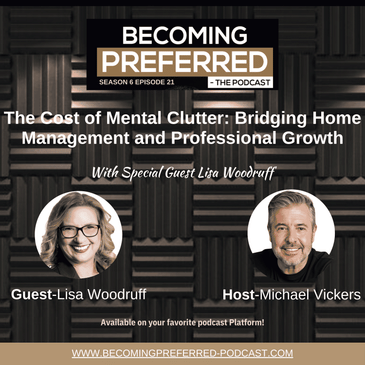
SEASON: 6 EPISODE: 21
Episode Overview:
Welcome back to Becoming Preferred, the podcast for the professional who wants to level up their skillset and focus on continuous improvement. Today, we’re tackling the silent killer of professional peak performance: The Invisible Quicksand.
We spend our lives optimizing our businesses, our processes, and our leadership teams. But what happens when you are being held back by a disorganized home? What is the cost of the 'mental clutter' that follows you from the kitchen table to the office?
Our guest today is a powerhouse who transformed from a stay-at-home mom at forty to the CEO of a million dollar empire. Lisa Woodruff, the founder of Organize 365 and host of a podcast with over 24 million downloads, believes that organization isn't a personality trait—it’s a learnable, high-level business skill.
She’s here to show us how to bridge the gap between household management and professional scaling, and to give us a sneak peek into her upcoming book, Escaping Quicksand. If you’ve ever felt like you’re winning at work but sinking at home, this conversation is your lifeline. Join me for my conversation with Lisa Woodruff.
Guest Bio:
Lisa Woodruff is the founder & CEO of Organize 365. Lisa and 87% of Americans believe organization is a learnable skill. Yet less than 18% of those same Americans feel they are organized.
As the host of the top-rated Organize 365 Podcast, with 24 million downloads & counting, Lisa shares strategies for reducing the overwhelm, clearing the mental clutter, and living a productive and organized life.
Resource Links:
- Website: http://organize365.com/
- Product Link: https://organize365.com/escapingquicksand/
Insight Gold Timestamps:
04:34 I started to really think back on, what was my story going to be
06:22 I realized I was a professional organizer
08:28 My PhD is on the invisible load and the cognitive load of organizing
10:11 I'm an educator and so I'm going to give you a lot of options
14:39 Organization is a learnable skill
16:31 In my opinion, your child's bedroom is their mini apartment
19:55 I had to grow those muscles of being a business owner and doing the work of the business
20:30 Let's talk about your upcoming book, Escaping Quicksand
26:54 It's not a department, it's a whole separate business, the household is the economic entity
28:12 My higher and best use is being strategic
30:34 I took all of my bank statements from Wells Fargo, dumped them into an AI tool (Claude)
31:55 Organization happens in analog, productivity happens in digital
34:58 What's the number one organizational lie that keeps people and entrepreneurs stuck in that gap?
39:48 I realized in hindsight, once I firmly went into excellence versus perfectionism, is not accepting others' judgment of myself
44:55 You have so much more control than you think you do...at home
46:10 Just really think through, is the improvement really the improvement you want?
48:11 Website is organize365.com
48:38 Get organized and you get your time back
Connect Socially:
LinkedIn: https://www.linkedin.com/in/lisawoodruff/
YouTube: https://www.youtube.com/channel/UC2w8BMBq25cswE7mVRX1bDA
Instagram: http://instagram.com/organize365
Lisa's Podcast: https://organize365.com/podcast-landing-page/
Email: Lisa@organize365.com
Sponsors:
Rainmaker LeadGen Platform Demo: https://calendar.summit-learning.com/widget/booking/JKItVP7WErmCBjU2cCIx
Rainmaker Digital Solutions: https://www.rainmakerdigitalsolutions.com/
In 3, 2, 1.
Speaker BWelcome back to Becoming Preferred, the podcast for the professional who wants to level up their skill set and focus on continuous improvement.
Speaker BToday, we're tackling the silent killer professional peak performance, the invisible quicksand.
Speaker BWe spend our lives optimizing our businesses, our processes, and our leadership teams.
Speaker BBut what happens when you are being held back by a disorganized home?
Speaker BWhat is the cost of the mental clutter that follows you from the kitchen table to the office?
Speaker BOur guest today is a powerhouse who transformed from stay at home mom at 40 to the CEO of a million dollar empire.
Speaker BLisa Woodruff, the founder of Organize365 and host of a podcast with over 24 million downloads, believes that organization isn't a personality trait.
Speaker BIt's a learnable, high level business skill.
Speaker BShe's here to show us how to bridge the gap between household management and and professional scaling and to give us a sneak peek into her upcoming book, Escaping Quicksand.
Speaker BIf you've ever felt like you're winning at work but sinking at home, this conversation is your lifeline.
Speaker BJoin me now for my conversation with Lisa Woodruff.
Speaker BWell, hi Lisa.
Speaker BWelcome to the program.
Speaker BWe're delighted to have you.
Speaker AThank you so much for having me.
Speaker BWell, I'm really excited about this.
Speaker BWe're going to talk about your book.
Speaker BYou got a new upcoming book called Escaping Quicksand.
Speaker BAnd.
Speaker BAnd we're going to talk about that and why the book.
Speaker BBut I'm really excited about your topic.
Speaker BWe've never had that on the podcast.
Speaker BWe're in season six and we've really never talked about making the invisible work visible or organizing ourselves in your company.
Speaker BYou're the founder of Organize360 and I want to talk about strategies, tactics and frameworks for organizing our lives.
Speaker BWhy we do it, why we don't do it, but really the outcome from when we do.
Speaker BYou're also built a business as an entrepreneur and you have a really interesting story.
Speaker BSo let's kind of start back there.
Speaker BYou're back in high school.
Speaker BYou're living where you decide what do you want to be when you grow up.
Speaker BLet's go there first.
Speaker AOkay.
Speaker AAll right.
Speaker ASo back in high school, I was very ambitious, so I went to high school, but I didn't have a lot of peers as my friends.
Speaker ASo the day that I turned 12, I got my Red Cross babysitting course done and I started babysitting at the age of 12.
Speaker ASo by high school, I had a full time job babysitting.
Speaker AI babysat for three different doctors Families.
Speaker AAnd in the summer, I would call up the wives and I was like, okay, which day of the week do you want?
Speaker AAnd then the family of five got me twice a week, and then they would rotate which Saturdays and Sundays they got me and I went on their vacation.
Speaker ASo I was running a full, you know, multiple households and all of the children and doing all that.
Speaker ALoved it.
Speaker AWent to college, got my degree in early childhood education, and could not wait to be a stay at home mom.
Speaker BOh, excellent.
Speaker BWow.
Speaker BAnd, well, it's a mission, it's a purpose, and you either know it or you don't.
Speaker BI get that.
Speaker BMy wife had the same trajectory, so it was like, looking forward to that.
Speaker BAll right, so you're a stay at home mom.
Speaker BMom, you're working.
Speaker BHow many children did you have?
Speaker ASo we ended up adopting two, which is wonderful.
Speaker AWeren't able to get pregnant.
Speaker ASo by the end of my 20s, I had two children.
Speaker AAnd in my 30s, I mean, I just, I just loved everything about it.
Speaker ADid direct sales, brought in a little bit of money, ran the kids everywhere.
Speaker ABut by the end of my 30s, life was getting hard.
Speaker AMy parents had gotten divorced, and then my father was sick.
Speaker AHe ultimately passed away, so my sister and I had to settle his estate.
Speaker AThe kids had some extra challenges and needs that were taking a lot of our time and our finances.
Speaker AWe ran out of money.
Speaker ASo I went back to teaching, but my kids needed me home more.
Speaker ASo as I was turning 40, I quit so I could stay home with them.
Speaker ABut we desperately needed me to make an income.
Speaker AAnd also I was very depleted.
Speaker ALike, I no longer had any passions that I was working for.
Speaker AI wasn't taking care of myself.
Speaker AWe were out of money, I was overweight, I was on antidepressants.
Speaker ALike, I had thought about getting married and having children and being a stay at home mom.
Speaker AI hadn't thought beyond that.
Speaker AAnd here I was with middle school kids and my father already gone, and I was like, I didn't have a roadmap at that point, and I was about to turn 40.
Speaker BWow.
Speaker BSo what was the big turning point?
Speaker BOkay, you're in 40, you're going through all these issues.
Speaker BSorry about your dad.
Speaker BThat always sucks, you know, as our parents.
Speaker AYeah, happens.
Speaker BAnd you're raising kids and good for you.
Speaker BBut what was a big turning point for you?
Speaker BSo things are going not looking good, you're feeling bummed out, you're feeling depressed.
Speaker BWhat was the pivot point for you?
Speaker ASo I would say that's probably the lowest I've ever been in my life.
Speaker AAnd I am an optimist.
Speaker ALike I always say to my husband, like he married Tigger.
Speaker ABecause I'm always bouncing around.
Speaker AI have all this energy and I'm always positive, but I was not bouncing and I was not positive.
Speaker AAnd it was right after the 2008, 2009 recession and I thought the world was coming to an end.
Speaker AAnd so I started to really think back on what was my story going to be like.
Speaker AThe women in my family lived until their 90s and 1/ hundreds.
Speaker AI'm not getting out of this life anytime soon.
Speaker ASo what am I going to do with myself, my time, talent and treasure?
Speaker AAnd it was then that I really realized that I watched my mom start a business when I was in second grade grade and sell it in eighth grade.
Speaker AAnd I'm a fourth generation female college graduate.
Speaker AAll the women in my family have a college degree and they started and sold their own businesses, which is not normal.
Speaker ASo I thought to myself, I thought, you know what, that's what I'm supposed to do.
Speaker AI need to start a business, make some money and ultimately I'll have a team and grow a business.
Speaker ASo what is this business going to be?
Speaker AIt's 2012.
Speaker AI knew that everything I had done up until that point, either I was successful because I was already organized or because I was able to organize someone, including the teaching job that I left.
Speaker ASo knowing a little bit about SEO, I named the company Organize 365 and then just started a blog.
Speaker ANo idea how I was going to monetize it or anything.
Speaker BWow, that's amazing.
Speaker BWell, and what made you pick the topic?
Speaker BI mean, you were good at it.
Speaker BSo you just started looking at your skill sets and said, okay, I'm going to take this, build a business around it because I see it as a problem.
Speaker AYeah.
Speaker ASo specifically the teaching job I left was a Montessori job where you have to teach individually.
Speaker ASo I had 16 students in middle school and I was teaching 16 different math lessons.
Speaker AAnd my advisor told me that I was not a very good teacher.
Speaker AThat's why I quit.
Speaker AI was like, well, if I'm not a good teacher, I can tell you what I'm not a good, I'm not a good wife, I'm not a good mother, not a good house.
Speaker AThere are a lot of things I'm failing at.
Speaker ABut I didn't think I was failing.
Speaker BAt teaching for sure.
Speaker AYeah.
Speaker AAnd I thought, well, what she really hired me to do is organize that school and that co teacher, which I did do well.
Speaker AAnd I was like, oh, she hired me to organize, not to teach.
Speaker ASo there must be something with this organizing thing.
Speaker AAnd after a couple of months in business doing the blog, I joined another direct sales company.
Speaker AI realized I was a professional organizer.
Speaker AStarted doing in home professional organizing for a series of years, making that money as a service professional, and then took those learnings and turned them into books and products and a podcast.
Speaker BWell, it's amazing.
Speaker BWell, it's.
Speaker BWe all need those turning points.
Speaker BAnd you know what?
Speaker BThere's a correlation, I think, between educators, teachers, entrepreneurs, those who I see successful entrepreneurs all the time.
Speaker BAnd they all have a teaching background and a psychology background.
Speaker BSo they.
Speaker BOr they come from.
Speaker BBecause you're learning to communicate.
Speaker BYou're communicating with people.
Speaker BWell, let's talk about organizing, why we do it, why we don't, why we do it.
Speaker BAnd just with my experience with organizing, I've got a disclaimer here.
Speaker BYears ago, when the Marie Kondo started to hit the airwaves and my wife bought into that concept, really hook, line and sinker and I called it condoized our entire lives and our home.
Speaker BSo everything has its purpose.
Speaker BWe tossed out a ton of stuff and contagious.
Speaker BSo we started over probably a dozen years ago and started getting rid of things.
Speaker BOne thing after.
Speaker BThey're just getting rid of it, getting rid of it.
Speaker BAnd each time we did was amazing.
Speaker BIt was very liberating and I felt very.
Speaker BJust light.
Speaker BThings were just getting lighter all the time.
Speaker BAnd it was about.
Speaker BAnd organizing.
Speaker BEverything has its special purpose in its special place.
Speaker BSo that was her system was, hey, if it doesn't bring us joy, it's tossed.
Speaker BAnd I have to say, I'm.
Speaker BYou probably don't know many men who would do this, but I'm happy to show you my underwear and sock drawer because if you open up my drawer and sock drawer, it looks like it always bought from a boutique.
Speaker BIf anything has shabby or it's gone and.
Speaker BBut it's all folded in a certain way that looks like it comes from the fifth Avenue boutique.
Speaker BAnd you look at it and it's.
Speaker BI don't like taking something out of it because I feel like I'm ruining the display.
Speaker BSo just the way T shirt shirts, everything, drawers, everything has its place.
Speaker BAnd so I'm a fan of organizing.
Speaker BThat's why I'm excited about this and.
Speaker BAnd just why we do it, why we don't do it, and what are the potential outcomes when we do or we don't.
Speaker BSo let's kind of dive into that.
Speaker BWhat's the psychology behind that?
Speaker BBecause I know you're working.
Speaker BI think you're just finishing up your Ph.D. here in the next eight weeks or so.
Speaker AI am, yeah.
Speaker ASo my, my Ph.D. is on the invisible load and the cognitive load of organizing, which is a little bit different than what you're talking about.
Speaker ALet me talk about what you're talking about.
Speaker ASo, couple of things.
Speaker AOne, you're talking about the design aesthetic of organizing, how it looks when you're done organizing, which a lot of people like the way organization look books.
Speaker AI'm not able to maintain that level of organizing.
Speaker AI'm not your Pinterest organizer.
Speaker AMy drawers look good, but you're not going to put them in a magazine or anything.
Speaker AAnd also you mentioned you have seven kids.
Speaker AI know you have grandchildren.
Speaker ASo I'm thinking about the time that Marie Kondo intersected you and your wife's life.
Speaker AThe kids were probably on their way, if not already out of the house.
Speaker APerfect time to be doing a lot of purging and decluttering and really reclaiming your household as husband and wife again, getting ready for those grandkids.
Speaker AWhen I experienced Marie Kondo, my kids were much younger and I was in the accumulation years.
Speaker AAnd so I couldn't get rid of their things, so I ended up getting rid of a lot of mine.
Speaker ANow, I love how Marie Kondos can organize your closet.
Speaker AGame on.
Speaker AGo all in.
Speaker ABut one of the things that she said was to get rid of your books.
Speaker AAnd I had a bookshelf in every single room, including the storage room in our house.
Speaker AAnd I got rid of all my books.
Speaker AAnd I regret it to this day because every single book I own, I have read.
Speaker AAnd so I think there are seasons also where decluttering is a great solution.
Speaker ASolution.
Speaker AEspecially as you're transitioning from one life phase to the other.
Speaker ATo your point, I know you're always talking about what makes you different and what's your unique selling proposition.
Speaker AMarie Kondo can be great for some people in some seasons and in some spaces.
Speaker AI could be great for some people in some seasons, in some spaces.
Speaker ABut to take one organizer and then just apply it to your whole life without really any other checks and balances, while it'll be amazingly fantastic for one person, may not be for the other.
Speaker ASo I'm an educator.
Speaker AAnd so I'm going to give you a lot of options, like how you look at things based on the generation you are.
Speaker AIf you're a millennial, a Gen X, a baby boomer, is Completely different how you utilize your house, if you have children, don't have children, which part of the country you're in, what your socioeconomic status is.
Speaker AThat's more of how I look at organizing.
Speaker AAnd my goal of organizing is that you know where your stuff is.
Speaker AYou have the stuff that you want and then you don't have a lot of time to maintain your stuff so that you have more time to do what you're uniquely gifted and created to do.
Speaker AAnd for most women, that's going to take one to three years to really process through the whole entire house and reset it to the phase of life that you're in now.
Speaker AAnd then you kind of run on autopilot until you hit another big life change.
Speaker AIt's a little different perspective.
Speaker BIt's kind of like from what I'm hearing you say, there's the why and the how.
Speaker BMARIE KONDO here's yeah, organize and do this.
Speaker BAnd you're.
Speaker BWe always start with why.
Speaker BThanks.
Speaker AYeah.
Speaker BSIMON SINEK so you're giving us the why, the motivation.
Speaker BHere's why we should do it.
Speaker BAnd you're right.
Speaker BI think the stages of life now, when we had our seven children around the house, you never saw toy people came to our home and they would always like, were surprised that we had that many because you never saw toys hanging out.
Speaker BYou never saw we had certain rules.
Speaker BSo the rules were community property.
Speaker BWherever it's community, you got to keep clean your private space.
Speaker ALove it.
Speaker BBut it really does affect us in a psychological way that actually surprises me and not everyone like you talk about changes of life.
Speaker BI also find personality type, style.
Speaker BSo for instance, like a director, C level executive or whatever is going to have a neat and tidy desk.
Speaker BYou go into the IT department or the let's call it the company nerd, and it's packed full of things they stacked miles high but don't touch a darn thing because they know exactly where it is.
Speaker BSo what goes into that?
Speaker BWhere does the whole theory why are some people neat and organized when they're little people?
Speaker BAnd then where do we develop the bad habits?
Speaker BAnd why did we.
Speaker BWhat happens along the way?
Speaker ASo I can't speak authoritatively to clutter, like the psychology behind clutter.
Speaker ABut what I have observed and what I teach is that there is a difference between analog and digital.
Speaker AAnd I primarily am an analog organizer in that I specialize in executive function, like how do we organize and think and start and get things done in our brain.
Speaker AAnd for me personally, the IT guy that has papers everywhere and don't touch it, has externalized everything that is in their brain and possibly on the computer so that they can see it in physical form, so they can move it around and manipulate it, create something new and then upload it for me, if you have a lot of things that are digital and analog, I have to cognitively remember where to go look for that.
Speaker AAnd I'm probably not going to remember.
Speaker ASo, like, for example, we obviously have a Google Drive.
Speaker AWe're a digital company.
Speaker AMy chief of staff came in and she's like, and I also uploaded that to my Google Drive.
Speaker ADo you want me to put it in your Google Drive?
Speaker AI was like, stephanie, if you think I know where my Google Drive is, that's funny, that's what you are for.
Speaker ABut I have all these bookmarks and I have all these slash pockets and I have everything physical and what I'm finding and what the research I'm going to do is, is there statistical support for this cognitive offloading from your brain to the environment in physical form, does that reduce anxiety?
Speaker ADoes that reduce the executive load in order to be able to make decisions and do planning?
Speaker BIt's interesting.
Speaker ADifferent than what you're.
Speaker BAnecdotally, I would say yes, just based on my.
Speaker ARight.
Speaker ANo one's ever studied it.
Speaker ASo we'll.
Speaker BAnd I think that's a great topic because when I come in and I look and everything's tidy and I clean up, by the end of the day I have to straighten out maybe ocd.
Speaker BIt's just, it's got to be neat and tidy.
Speaker BI have to clear the inbox, otherwise it nags at me.
Speaker BAnd half the time when I have a chore or something I have to do and I'm procrastinating it, that piles on.
Speaker BAnd so I'm organizing my day or my week.
Speaker AYes, yes.
Speaker BThen all of a sudden that I was to the start.
Speaker BAnd then when I actually attacked the choreograph, it only takes a few minutes.
Speaker BI think, why the hell did I not just attack that and get it done?
Speaker BBecause it took 10 minutes to actually get it done.
Speaker BSo every week I, for instance, I'll organize my week and then I on Sunday nights I'll review and go, how do I create the perfect week next week?
Speaker BHow do.
Speaker BSo I keep referring.
Speaker AYes.
Speaker BWhat's.
Speaker AOh, I love it.
Speaker BPerfect week.
Speaker BWhat's it look like if I.
Speaker BMy last week on the planet, what's it going to look like?
Speaker BRight.
Speaker BAnd I find that that really, really helps.
Speaker BWell, let's start this way.
Speaker BYou Say often that organizations, it's a learnable skill, yet most people treat it like a personality trait that you're either born with or you're not.
Speaker BSo for the entrepreneur who feels, say, naturally messy, where does the shift from chaos to system actually begin?
Speaker AYeah.
Speaker ASo organizations, learnable skills.
Speaker ASo I was talking about the executive function.
Speaker AYou know, if you have deficits in executive function, that's where ADHD comes from.
Speaker ASo the first thing we use our executive function for is working memory.
Speaker AThat's the primary role of your executive function.
Speaker ALike we're having this conversation.
Speaker ASo we're thinking about this conversation we're having what the next question might be.
Speaker AWe're not thinking about other things.
Speaker AWell, your executive function also does a bunch of other things.
Speaker AAnd the last thing it does is planning.
Speaker ASo planning and doing something can't happen at the same time.
Speaker ASo every week when you're refining your week and you're coming up like, what is the best week going to be?
Speaker AYou're making a more and more refined plan in your planning part of executive function.
Speaker AAnd then your working memory runs with that plan the next week because you can't do the two things at the same time.
Speaker ASo organization is a learnable skill.
Speaker AWe're talking about the organizing of your week and the tasks that need to be done.
Speaker AWell, how do you organize your house?
Speaker AFirst of all, I would have loved to have come to your house when you had seven kids.
Speaker AI'm like, I still can't even believe you don't have toys out.
Speaker AI remember I only had two kids and my mother in law came over and they were like, I don't know, 5 and 7.
Speaker AIt looks like a bomb went off in our house and I was folding laundry in the middle of the family room.
Speaker AAnd she's a perfectionist.
Speaker AShe's sitting on the edge of a chair, like just barely sitting on the chair because my house is trashed.
Speaker AAnd I said, well, I'm sure this is what your house looked like when your kids were little.
Speaker AAnd she goes, no.
Speaker AAnd I was like, oh gosh, okay, fine.
Speaker ASo it's not how it looked like, but this learnable skill.
Speaker AWe can learn how to plan our week because there are gajillion people who talk about it.
Speaker AWe can learn how to refine our closets because there are gajillion organizers that talk about it.
Speaker ABut how do we teach kids how to organize their bedroom?
Speaker ANot a lot of people talk about that.
Speaker ASo I have a program as a teacher that I create where I talk directly to your kids.
Speaker AAbout organizing their room.
Speaker ASo when you said the kids rooms are their own and they could be trashed, that's where I came in.
Speaker AAnd I was like, okay, how do we teach kids to organize their bedrooms?
Speaker ABecause in my opinion, your child's bedroom is their mini apartment.
Speaker AAnd eventually it will become their apartment, dorm room, or condo.
Speaker AAnd from the time that they leave home until they're running that household the way your wife is, which is amazing, they either learned it through osmosis, through her, or they didn't.
Speaker AOnce they're on their own, they're on their own.
Speaker ABut there are learnable skills.
Speaker ASo a child's bedroom is a mini apartment because it has so many functions.
Speaker AYou sleep there, you play there, some eat there, you do your schoolwork there, you have your clothes there, you have your passion projects there.
Speaker ALike their whole worlds are in their bedrooms.
Speaker AAnd that is where you start to learn the skill of organizing.
Speaker AWhen you can maintain your bedroom, then you can maintain your dorm room, your apartment, your condo, and future house.
Speaker AAnd as you get into bigger and bigger houses, they're just more and more of those microcosms of places to organize.
Speaker BYeah, I wonder if it's not osmosis but neurosis that does the learning and the training, because they're.
Speaker BYeah, you see it.
Speaker BBut you're right.
Speaker BYou know, we set up their bedrooms when they were young.
Speaker BWe had, you know, the girls had to team up because seven kids we didn't have.
Speaker AThat's a lot of kids.
Speaker BBut, yeah, it is.
Speaker BAnd that kind of worked.
Speaker BAnd we showed them, this has to be picked up once a week.
Speaker BI told them, I want to see the floor.
Speaker BI want to know, right, there's still carpeting in here.
Speaker BRight.
Speaker BAnd honestly, they were just messy.
Speaker BAnd as long as they.
Speaker BWe let them get away with it, they had to clean it once a week, be organized for the next week, but then it would be trashed.
Speaker BWhat was interesting to your point is when they left home and when they got roommates, their first complaints were, my roommates are pigs.
Speaker BAnd, oh, they're messy.
Speaker BOh, they're.
Speaker BYeah.
Speaker BAnd this is just, you know, for parents, whatever you teach them when they're young, even if they don't do it when they're under stress, I've learned they do it, taught them to look both ways for the cross the road.
Speaker BThey look both ways when you're not around.
Speaker BSo teach them and understand that one day it probably will sink in, and then they'll be repeating what you said to their chagrin, you know, years later and go, oh my goodness, I just sound like my mother, right?
Speaker BOr my dad.
Speaker BEither way.
Speaker BSo I get that.
Speaker BThat's funny.
Speaker BYou started organized365 at 40, transitioning from stay at home mom to CEO of your own successful brand.
Speaker BWhat was the biggest operational hurdle you faced in treating your household like the foundation of your business?
Speaker ASo the biggest problem for me is because I was working from home, I would always prioritize the household related tasks.
Speaker ASo I remember I was a couple years into the business, I was finally replacing my teaching salary.
Speaker ASo I was blogging, I was trying to grow this online brand we were doing in home professional organizing.
Speaker AI was doing all the stay at home mom things of driving the kids to school as if I didn't work.
Speaker AAnd I came home and I would pick up the house and do everything I normally do and I'd start blogging.
Speaker AThen I go do all the driving in the afternoon and then in the evening I would go upstairs to work on my business and my husband and the kids would complain because I was always working.
Speaker AAnd I was like, oh, Lisa, you idiot, you're the one that is not working when they're at work at school.
Speaker ASo the next day I dropped the kids off at school, walked in, filled up my water, walked over the laundry and everything went straight upstairs.
Speaker AWorked for the solid six hours left, came home, picked them up, and then that night I was doing dishes and laundry and prep and they're like, you're always busy, you're never sitting down.
Speaker ABut they weren't saying I was always working because now I was doing my housework during the family time and my work work during the work time.
Speaker AThis was huge to me because this added like 10 hours of work to my work during the week and it was uninterrupted.
Speaker AAnd honestly, I hadn't been doing it that way because I also got tired because I had to push through the mental of being able to work six hours cognitively on marketing pages and sales pages, stuff I didn't know how to do or write three blog posts instead of one.
Speaker ALike I had to grow those muscles of being a business owner and doing the work of the business.
Speaker AIt was much easier to be like, oh, I'll just do one thing and then go straigh house.
Speaker BWell, you know, the one thing I've learned, I meant there's a lot of men who work really hard.
Speaker BBut when we compare it to what you ladies do, and I don't mean to just prepare, I have five daughters, so I see it, you're Expected, you got the 9 to 5, then you got the, you know, 7am to 9pm mom.
Speaker BThen maybe we have the nana roll or grandmother role.
Speaker BAnd then your husband and wife.
Speaker BIt's like you're wearing so many hats.
Speaker BSo I see it and we recognize it.
Speaker BAnd so you help out where you can help out.
Speaker ADon't.
Speaker BLet's talk about your upcoming book, Escaping Quicksand.
Speaker BGreat name.
Speaker BIt focuses on prioritizing adult care needs alongside family and business.
Speaker BSo.
Speaker BAnd a lot of us are baby boomers are coming into that or we have parents that are aging.
Speaker BSo for the type A professional, why is self care often the wrong word and care systems the right one?
Speaker AOkay, so thank you so much for asking this question.
Speaker AAnd this is something that came to me while I was getting my PhD.
Speaker AI was in a developmental class, like learning the development of Humans.
Speaker AAnd I was asking what we knew about adult development and we don't know very much.
Speaker AThere's only two psychologists that have ever studied adult development.
Speaker AThey were both 50 year old white men when they studied it.
Speaker AAnd I said, well, you know, so menopause must be a phase of life because puberty is a phase of life.
Speaker AAnd they were like, no, not in the literature.
Speaker AI was like, well, let's update it then, because I mean, everybody knows that's true.
Speaker AAnd so I was like, well, I'm not gonna get anywhere because this professor is much younger than me and hasn't been through menopause, so she doesn't know what I'm talking about.
Speaker ASo I got this picture in my head of the St. Louis Arch and I was thinking about, like, what we think of as adults that hasn't been studied at all in psychology or science.
Speaker AAnd I was like, we talk about this idea of self care.
Speaker AAnd I, in my 50s now, am doing a lot of things my family thinks are selfish, like getting a PhD and traveling for work and going to an office to work instead of working from home and laying the dog out at noon.
Speaker ALike, they see all these things as selfish.
Speaker AAnd I'm like, no, I'm just being a worker.
Speaker ALike this is.
Speaker ALots of workers are working like this.
Speaker ABut I feel as a woman I have to justify every minute that I spend that is a benefit of myself and my work that is not directly related to care or the household.
Speaker AAnd maybe I don't, but that's just how I feel.
Speaker AAnd so when we say self care, we think, oh, you can get a bubble bath or you can get your nails done and then that should shore you up for six to nine months.
Speaker ARight.
Speaker ASo I got this picture of the St. Louis Arch and I was thinking about childcare and I was thinking about elder care.
Speaker ASo childcare is when you take care of a child and elder care is when an adult can no longer care for themselves.
Speaker AAnd so in both of these cases, obviously we're going to feed them, bathe them, clothe them, shelter them, we're going to provide for their essential care needs.
Speaker ABut it's more than that.
Speaker AWe're also going to provide education and recreation and we're going to give them spiritual outlets and we're going to go have relations with them and we're going to converse and we're going to go out to dinner, we're going to celebrate their birthdays and we're going to do things that are unique for them and explore what talents they want to do.
Speaker AThat is self care from 18 to 88.
Speaker ASelf care is for yourself.
Speaker AYou will do all of those things just like your parents did for you when you were a child or you will do for your parents and grandparents when they are older.
Speaker ANow women, for whatever reason.
Speaker AWell, I think the reason, especially if you have children, you can't do that for yourself.
Speaker AWhen you have a newborn, like, you must prioritize the newborn.
Speaker AAnd by the time the youngest one is in school full time, you forgot what it looked like before you had kids.
Speaker AAnd so then you're just like, now you're just like the mom and you're just doing all of the things.
Speaker ABut it also happens when like I have a couple of cousins that had children later and they were in accounting and they literally worked like 80 hour weeks.
Speaker ALike they didn't feed themselves well because they were literally staying at hotels because they didn't have enough bandwidth to drive home.
Speaker AThey were worked so hard at those top four agencies.
Speaker AAnd so I think we get through our 20s and 30s really trying to be the best we can at our job, whether it's parenting, homemaking, whatever it is.
Speaker AAnd we wake up in our late 30s and 40s and we're like, I don't even know how to feed myself anymore.
Speaker ANone of my clothes fit.
Speaker ALike, and then you think, well, it's selfish to go buy new clothes.
Speaker ALike you'll buy a new wardrobe for a kid every six months.
Speaker ABut for yourself, like, I'm sure that this, these clothes will get me a little bit farther.
Speaker AA little bit farther.
Speaker BWell, moms are always the one who eat the burnt toast, right?
Speaker BLike you just do.
Speaker BAnd they're, and I don't know if it's in our I hate stereotyping, but I've seen the women I know and the professional women I know or those who are bringing their professional skills to the home just do so much more and more capable than their male counterparts.
Speaker BI'm just male counter.
Speaker BIt's almost like that the male wants to go out and hunt and kill the thing, whatever it is.
Speaker AYeah.
Speaker BAnd then he wants to bring it home and say, okay, now you clean it, get it ready for and take care of it.
Speaker BSo there's so many departments that you have to manage where maybe we're a little more singular focus and maybe that's a older perspective, but just from what I've witnessed in my world too, the women are great multitaskers.
Speaker BAnd I don't believe in multitasking as a rule.
Speaker AI don't think I do.
Speaker BI witness it.
Speaker BIt's like you have sections of your brain.
Speaker AHow else are we supposed to get done work differently?
Speaker BYeah, well, it's, you know, I, I.
Speaker BThe story that comes to mind is Fred Astaire and Ginger Rogers where they're being interviewed and said, what's it like you're dancing with Fred Astaire, like one of the best dancers in the world.
Speaker BThat guy's amazing.
Speaker BAnd she says, well, I do it backwards and in heels.
Speaker BIt really is that kind of perspective.
Speaker CAre you tired of chasing leads and ready to start effortlessly attracting more high value clients?
Speaker CIntroducing Rainmaker Lead Gen, the ultimate sales, engagement and client acquisition platform that takes the stress out of outreach.
Speaker CWith Rainmaker Lead Gen, you can easily identify, engage, educate and convert your ideal prospects into loyal clients.
Speaker COur industry leading automation and email sequencing empowers you to reach more ideal clients, accelerate the sales cycle and close more business.
Speaker CImagine authentically engaging with your prospects while the platform handles the heavy lifting.
Speaker CSay goodbye to the endless hustle and embrace a more efficient, effective approach to business development.
Speaker CReady to witness the magic?
Speaker CBook a 20 minute demo today and see how Rainmaker Lead Gen can revolutionize and level up your client acquisition game.
Speaker CThere's nothing to lose and everything to gain.
Speaker CDon't miss out on this opportunity to supercharge your client acquisition process.
Speaker CVisit rainmakerdigitalsolutions.com or check out the link in the show Notes to book your demo.
Speaker CRainmaker Lead Gen Spend less time hunting for your ideal clients and more time having high value sales conversations with your ideal clients.
Speaker CClients.
Speaker BAnd now back to my conversation with Lisa Woodruff.
Speaker BYou built a million dollar revenue company around household project management.
Speaker BWhy should a business professional view Their home as a department that requires its own sop, standard operating procedures.
Speaker AOh, yeah, it's better than that.
Speaker AIt's not a department.
Speaker AIt's a whole separate business.
Speaker AThe household is the economic entity.
Speaker AIt is the economic entity of, like, ever.
Speaker A68 Of US GDP is household spending.
Speaker ASo if you want to know what's going to sell in the United States, you should ask somebody who runs a household, because we are where all the money comes from.
Speaker AAll the rest goes to the government and the military.
Speaker ASo how a household manager runs the household, how she redistributes that money into society, is the future of the society.
Speaker AAlso, you know, there is not just one department, There are departments.
Speaker ASo in psychology, we've studied house work, but really we've conflated housework with also parenting and household management.
Speaker ASo now that's three departments.
Speaker AWell, if you own the house, then there's also maintenance of the house, which is a current investment for a future investment.
Speaker AWell, if you want to get organized, you have more time.
Speaker AThat's a current investment of time for a future return on time.
Speaker AI've only named five departments.
Speaker ALike, as a household manager, I'm a cfo, CEO, CEO.
Speaker AI'm like, I'm all of those things.
Speaker AAnd we.
Speaker AThat's right.
Speaker AAnd we have mostly the robots, which don't do a good job because the humans, they're all volunteer.
Speaker ASo my robot vacuum, a big thing.
Speaker AIt won't.
Speaker AIt won't vacuum for me.
Speaker ABut often I, as a household manager, will default to, okay, are the dishes done?
Speaker AIs the laundry done?
Speaker AWhen's the next time we have to change the smoke detector barriers?
Speaker ADa, da, da, da, da.
Speaker AWhen really my higher and best use is being strategic and being the CEO and cfo.
Speaker ALike, when I sit down, which I'm doing this week, actually, and go through all the recurring expenses and cut a bunch of those.
Speaker AI'm going to save thousands of dollars this year.
Speaker AI'm going to look at our AAA membership, which we've had for six years.
Speaker AWhat are all the things that I could be getting discounts on?
Speaker AWe're going to Legoland this summer.
Speaker AYou get 55% off of Legoland.
Speaker ALike, I'm going to save us as much money as I can in my CFO hat.
Speaker AThen my CEO hat three times a year, I look at the next four months and I'm like, okay, strategically thinking how old the children are, the grandchildren are, what season we're in, how to best deploy our money.
Speaker AIs now the time we get a gym membership, or is now the time that we take a vacation, or is now the time that we invest in schooling or some additional therapies?
Speaker ALike, how are we going to meet all the needs of the family at that time?
Speaker AAnd those things happen at planning.
Speaker ALike we talked at weekly.
Speaker AYour weekly plan.
Speaker AYou cannot be doing the housework and also planning strategically.
Speaker ASo you need to set aside some time to be the strategic CEO and CFO of the household and then get the task done.
Speaker ABut here's how I want you to find the time.
Speaker ADo less housework.
Speaker ALike, I love that you love your underwear and sock drawer.
Speaker ABut what I tell a lot of people is if your kids are under the age of five, like, just have a clean laundry basket and a dirty one, because by the time you're done washing the clothes, they're all going to be dirty again.
Speaker ABecause the kids through clothes so fast.
Speaker AIt's not until their school age that you need more of that structure.
Speaker AAnd even then, it doesn't have to be super structured because nobody's looking at your underwear drawer.
Speaker BNo, I want to show.
Speaker AMuch to your chagrin.
Speaker BMaybe I'll post pictures.
Speaker AYou should, just so you can get the.
Speaker AAttaboy.
Speaker AI'll give it to you.
Speaker BIt's just impressive.
Speaker BI show friends that.
Speaker BCome on, say you got to show you something, and it just looks like it's a store.
Speaker ALove it.
Speaker BAnd I hate to.
Speaker BYeah, I'm always like, oh, and I don't want to ruin this.
Speaker BOr if I take something out.
Speaker BWell, they all fall.
Speaker BAnd she folds them all in unique ways.
Speaker BRight.
Speaker BBut that's her way.
Speaker BWell, let's talk about the sop.
Speaker BNow, we're using technology to stay organized.
Speaker BAI has been amazing.
Speaker BThe last three, four years, we've been using AI to structure our TO dos, record our sop, look at things, set calendars, optimize our time.
Speaker BIs this the best schedule?
Speaker BWhat's a better schedule?
Speaker BAnd it can get it 80, 85% there.
Speaker BBut then that last personalization touches ours.
Speaker BHow does AI fit in?
Speaker BWhat have you experimented in that?
Speaker BHave you gone down that road?
Speaker BOr you're looking at, hey, here's how the CEO of the home use some AI tools to maybe help them look at the bills faster.
Speaker BLook at, for instance, your expenses.
Speaker BI, for instance, took all of my bank statements from Wells Fargo, dumped them into an AI tool I used Claude, and I said, I want you to analyze all these expenses, put them in categories, and 15 minutes later, I had what you were about to go and attack.
Speaker BSo I could see what was going on.
Speaker BSo that saves hours of looking at.
Speaker AYeah, yeah.
Speaker BIt's like a lawnmower versus or a snowblower versus shoveling snow is using a lawnmower instead of hand cutting it.
Speaker BWhat tools are available or new technologies?
Speaker BAre you exploring any that maybe help with this a little bit?
Speaker ASo I did dump all of my stuff into origin, so I'm going to go look at that this weekend.
Speaker ASo I'm not a Neanderthal.
Speaker AHowever, I stink at this.
Speaker AI mean, this is my biggest weakness because as an organizer and as a teacher, I want to teach you an analog.
Speaker ASo the way that I taught algebra in Montessori was through manipulative, which was so great.
Speaker ALike, you really understand things when you can manipulate it with your hands.
Speaker ASo I love to get organized by going through all the physical stuff in your house, going through all the paper, actually printing out the emails, printing out all the things you have in bags.
Speaker AAnd I know, stick with me for just one second because there are so many different AI tools, different phone systems, different whatever, that if I were to pick one and you're an iPhone user and I pick the whatever, not an iPhone is because I have an iPhone, you're gonna be like, oh, I can't do it because I'm an Apple person.
Speaker ASo organization happens in analog.
Speaker AProductivity happens in digital.
Speaker ASo if you.
Speaker ASo, like, for food, you could go through and clean out your.
Speaker AClean out your kitchen, clean out your pantry, then you could upload that into whatever AI you want.
Speaker ASay, these are the ingredients I have.
Speaker AMake lists for me.
Speaker AOr these are my food restrictions.
Speaker AThese are my macros.
Speaker AMake lists for me.
Speaker AGreat use of AI.
Speaker AI am.
Speaker AI'm not your nutrition consultant.
Speaker AI'm like, like, how do you create a breakfast and lunch station so that all your breakfast and lunch stuff is in one cabinet, not all over the kitchen?
Speaker AThat's how I'm organizing you.
Speaker AI'm not organizing the productivity parts which are going to happen in digital.
Speaker ABut one other reason why I'm analog and not digital is because productivity and digital is personal.
Speaker AAnalog is universal.
Speaker ASo if you have a binder of information and you go to a tax lawyer, you have it all in front of you.
Speaker AYou're not like trying to look it up on your phone and send it to them.
Speaker AIf you are with your siblings, taking care of your parents, and you've printed everything out and it's in a little tabletop filing system, you all have access to the same documents.
Speaker ANow, could you digitize and put those in Dropbox?
Speaker AYes, you probably could, but it is just so much easier to grab the death certificate and take it somewhere.
Speaker AAnd death certificates are physical.
Speaker ABirth certificates are physical.
Speaker APassports are physical.
Speaker ALike there is physical.
Speaker AAnd physical is just so much faster and easier when you need to take it somewhere and when you need to communicate to a professional or another family member.
Speaker ASo I find that productivity and digital is great, personally, but as far as doing the active organizing and then sharing it with others, it's easier to do an analog.
Speaker BThat's interesting.
Speaker BNo, I can see it's using the right tool for the right job.
Speaker BIt's.
Speaker BYou know, my wife makes sourdough.
Speaker BShe's.
Speaker AMan, your wife is amazing.
Speaker BShe's totally amazing.
Speaker BAnd.
Speaker BAnd she works.
Speaker BSo she runs our company, actually, so her organizational skills.
Speaker BBut I do the cooking.
Speaker BMy job is grocery shopping and cooking.
Speaker ACooking and my husband's as well because I abdicated.
Speaker BSo.
Speaker BYeah, she did, years ago.
Speaker BAnd, you know, we just made the decide, here's our roles, and we both love those roles.
Speaker BSo for me, it's a wood chop.
Speaker BI get done at the end of the day.
Speaker BI like to take my time, go to the market.
Speaker BIt's a decompressed time.
Speaker BSo it's never really a chore.
Speaker BIf it is, we're going out for dinner.
Speaker BSo if it feels like a chore tonight, I'm buying.
Speaker BYou know, we're gone.
Speaker BAnd she's.
Speaker BShe's good with that.
Speaker BBut it's interesting because the.
Speaker BThe analog versus digital, there's things you can do.
Speaker BLike, for instance, you talked about books.
Speaker BI was a book guy.
Speaker BBoxes of them.
Speaker BBut when we downsized, they couldn't all come with me.
Speaker BI had no room for them.
Speaker BSo I put a list, took pictures of them all, and then I just ordered on digital.
Speaker BAnd so my iPad is completely organized with all my favorite books that I revisit again and again.
Speaker BAnd now everything's online.
Speaker BIt's kind of like music libraries.
Speaker BI used to have all the albums.
Speaker BNow I wish I kept all the albums, but just because they've gone up in value.
Speaker BBut I got rid of all the albums and we use Spotify and I can listen to the songs and just a click and I'm there.
Speaker BSo it's finding what tool works best for that job.
Speaker BYeah, heard you loud and clear on that.
Speaker BLet's talk about the 87% versus 18 gap.
Speaker BMost Americans are Canadians or people anywhere listening to this podcast.
Speaker BThey believe that organization is learnable, but very few feel that they've mastered it.
Speaker BWhat's the number one organizational lie that keeps people and entrepreneurs stuck in that gap.
Speaker AWell, if I was listening to this podcast episode, I would thinking, man, Michael is organized.
Speaker ALike, I mean, you believe organization is learnable skill, and you've given lots of data as to how you are organized.
Speaker AAnd over time, you've really refined your organization to really match your phase of life and all of that.
Speaker AAnd you may be listening to me and go, well, Lisa's okay, Lisa.
Speaker AAnd I do fold my underwear in the six little spots.
Speaker ABut.
Speaker ABut I just.
Speaker AWe've got a newborn living at the house.
Speaker ALike, I know that life's not perfect.
Speaker AI'm a woman of excellence, and so I will often.
Speaker AJust the other day on Instagram, I came down on Sunday.
Speaker AI showed everybody what a cluster my house looks like, because there are little kids that live in my house, and I just would rather play with them than worry about what it looks like.
Speaker AOrganization.
Speaker AWhen people say they are done organized, it is different for every person.
Speaker AI would say, Michael, you're probably done being organized, and in your face of life, that wouldn't make sense.
Speaker ABut when you're in a younger phase of life and you have more people living in your household, you feel that there's so many things that are on your to do list that are yet to be organized.
Speaker ASo you can't say that you're done.
Speaker ALike, okay, I got the bedroom and the playrooms organized, but I haven't done the storage room room.
Speaker AI did the storage room, but I haven't gotten the paper organized.
Speaker AAnd so I find a lot of times for women, it's decades before they finally get done.
Speaker ANow, people who are in my programs do get all the way done.
Speaker AIt takes one to three years, and then I love it because then they're all ticked at me and they go, oh, darn you, Lisa.
Speaker ANow I have nothing left to organize.
Speaker ASo I have to wrestle with what I'm uniquely gifted and created to do because there's no more hobby work to do around this house.
Speaker BThat makes sense.
Speaker BI've always kind of viewed it as an operating system system.
Speaker BSo the organization, just like by DOS and Windows, and each stage, there's an evolution to it.
Speaker BAnd you're right, we had three grandbabies born this last year and our daughters, they're exhausted.
Speaker BAnd yes, they have their own companies.
Speaker BThey work, they're employees.
Speaker BThey have responsibilities.
Speaker BWe've taken off Fridays, which required a massive organizational change.
Speaker BSo on Fridays, we have one set in the morning and another set in the afternoon so that they have a free day to go and get caught up.
Speaker BAnd it's nice having that on.
Speaker BPop around to do that.
Speaker BBut I had to give up my Fridays, which was very challenging.
Speaker BSo I had to organize my week different.
Speaker BAnd what I found was just by simply adding that extra hour throughout the week, it was not a big deal.
Speaker BJust reorganizing and moving things around a little bit, I was able to free up.
Speaker BSo Friday, Saturday and Sundays were available for family.
Speaker AYes.
Speaker BAnd in that role, I'm not going to be.
Speaker BBe a workaholic until it stops.
Speaker BAnd I find that works pretty good.
Speaker BBut, but watching them organize their tools and some people have better means than others.
Speaker BSome can hire someone to come clean the house, some can't.
Speaker BAnd it's tough.
Speaker BSo we understand what that looks like.
Speaker BMy friends who have two kids who complain about, you know, they're busy, they'll complain and I'll say just times that by three and add one more.
Speaker BAnd I said, then come back and talk to me.
Speaker BBut it's all relative to that individual.
Speaker BAnd like I said, I married somebody who's phenomenal at organizing, who loves it, breathes it, studies it, and just like yourself and could, you know, I'd read her book as well.
Speaker BSo you'll have to have a good conversation.
Speaker BI should have had her do this podcast interview.
Speaker BI think it would have been a little better.
Speaker BLet's talk about the power of adult care in the 40s and 50s, because that's coming into a little.
Speaker BYou do touch on this and it's part of your motivation as well.
Speaker BSo you mentioned that in your 50s you can finally see the path you took to pull yourself out of the quicksand.
Speaker BSo what is one thing a 30 or 40 year old entrepreneur business professional can do today to prevent that mid career sink?
Speaker AYeah, I don't know if you can prevent it.
Speaker AThe literature is clear.
Speaker AIn all, all academia, all the studies, there is this dip in happiness that happens in your mid-40s, into your 50s and then after that you just kind of move back up into happiness, which is, I mean it just is, it's just something that happens.
Speaker AWe do tend to get overwhelmed.
Speaker AThe book Escaping Quicksand really is not how to get organized.
Speaker AIt's the mental mindset shifts I made in my 40s in order to get and stay organized.
Speaker AAnd I would say if there's just one that I was going to share with you, it would be this idea of moving from a perfectionist to a woman of excellence.
Speaker AI tried to be perfect, I tried to be great in my motherhood.
Speaker AAnd as soon as I thought I had all the ducks in a row.
Speaker ASomeone would point out one little flaw or one little flaw.
Speaker AAnd I took that as a personal character assault, that I'm not good enough, that I need to be better, I need to be perfect, and I would try harder.
Speaker AAnd then I finally realized that I wasn't going to be able to meet that mark.
Speaker AThere's always going to be something I was missing.
Speaker ASo for a while I was like, well, I'm not a perfectionist.
Speaker AI just kind of be sarcastic.
Speaker ALike, well, I just, you know, I'm not good enough.
Speaker AI'm not as good as you are.
Speaker ABut that didn't really sit well with me either because I was trying really hard.
Speaker AIt wasn't like I didn't care.
Speaker AAnd it was coming off as if I didn't care.
Speaker AAnd I almost was telling myself I didn't care.
Speaker ABut I did.
Speaker AI really did care.
Speaker AI really wanted to be good.
Speaker AAnd in my 40s, I realized that I'm an excellent person, I bring excellent effort, all the resources I have to bear for every problem that I solve.
Speaker ABut it's not going to be perfect.
Speaker AThere are always going to be things that I could do differently.
Speaker AAnd the biggest difference I realized in hindsight once I firmly went into excellence versus perfectionism, is not accepting others, judgment of myself, or judging others, and instead giving myself grace and accepting grace from others when I wasn't perfect and just living a human experience without expecting that.
Speaker BRobot perfectionism, I think that's a common problem.
Speaker BWe've got imposter syndrome.
Speaker BWe've got issues.
Speaker BAnd it seems, yeah, prevalent.
Speaker BIt seems more prevalent with females than it does with males.
Speaker BI think males suffer from it as well.
Speaker BI do, but I see it a lot.
Speaker BAnd probably because I'm surrounded by amazing women and I hear their conversations and they're talking about it.
Speaker BThere's so much that's expected of them.
Speaker BAnd I'll say it again, and I don't mind saying it, we're physically strong, generally speaking, but boy, it stops there.
Speaker BAnd you know, it's interesting.
Speaker BWhen I started my speaking career, I started speaking and I'd open for another speaker by the name of, of Tom Peters.
Speaker BAnd Tom Peters wrote In Search of Excellence.
Speaker BSo it's a school book of the younger generations, wouldn't even unless they learned it in school.
Speaker BAnd his first statement, this is 25, 30 years ago, he would come out to an audience with mixed audience and he'd say, Mr. President, CEO.
Speaker BHe goes, here's my best advice I could possibly give you.
Speaker BHe goes, fire all the men.
Speaker BAnd he saw.
Speaker BAnd he goes, just fire all the men and you'll, you'll be on the truck.
Speaker BAnd then of course, all the men are gasping, the women are applauding, going, that's what we've been saying.
Speaker BAnd.
Speaker BBut the point he was making was funny.
Speaker BWe have to be more like women.
Speaker BAnd it's not about being feminine.
Speaker BIt's not about that.
Speaker AIt's right, right, right.
Speaker BThe organization.
Speaker BIt's about looking at the priorities, getting those things done, because we just don't see it.
Speaker BAnd I think it's.
Speaker BIs it environmental?
Speaker BAre we right?
Speaker BBecause when we grow up in school, we weren't really taught.
Speaker BWe were taught the three Rs.
Speaker BMy parents were British, so they put us in private school.
Speaker BSo I had eight kids in the class, so I got a great education.
Speaker BYeah, why don't we teach this stuff, though?
Speaker BWe don't teach financial acumen, we don't teach organizational skills.
Speaker BWe just teach memorization, rote memorization.
Speaker BLearn two plus two.
Speaker BLearn how to operate a number two pencil and write, you know, and then go be a factory worker somewhere.
Speaker BLike, why is it as an educator and what are you saying?
Speaker BAnd, and do you see that changing or evolving?
Speaker AWell, it's going to have to change.
Speaker AI mean.
Speaker AAnd yes, that's exactly how it was set up.
Speaker ASo I mean, if you go all the way back to the 1800s and early 1900s, like, yes, children went to school, but also they learned a lot in their environment, in their community, in their village, because it was a village.
Speaker AAnd like, you wouldn't learn from your neighbors and you would live with your grandmother and you would have many more generations together and you would live closer together.
Speaker ASo we were much more communal in how we taught.
Speaker AAnd absolutely, with the industrial revolution came public schooling.
Speaker AAnd the goal was to create factory workers.
Speaker ALike that is, that's not a secret.
Speaker AThat is exactly what public school was for.
Speaker AAnd yes, we need to move into critical thinking.
Speaker ANow.
Speaker AWhat's interesting is schools have been trying to move into critical thinking in these things that you're talking about.
Speaker AAnd I think they were starting to make some progress before COVID but then with COVID there definitely was a break that happened not in the system, but just in humanity.
Speaker AAnd even before COVID colleges were having a hard time with students coming in with critical thinking.
Speaker ANow it's just like non existent.
Speaker AAnd so this idea of being able to think and ask questions, things that entrepreneurs naturally do, ask questions, look people in the eye, shake their hand, think about where things come from.
Speaker AFollow your uniqueness, follow your passions.
Speaker AAs you were talking about with your new book coming out, like, how do we remain human?
Speaker AFor so long in schools, we've been trying to produce an outcome, a worker in society.
Speaker ANow we need to figure out how do we have people understand their uniqueness, this, but be able to communicate that and then work in collaboration to make something new and bigger.
Speaker AI don't have answers for it, but that is what we need to figure out how to do.
Speaker BIt's interesting, societally wise that we're focused on, they're, you know, closing down.
Speaker BCritical thinking, we always call it.
Speaker BOh, it's a liberal education or.
Speaker BBut no, it's called learning to ask questions.
Speaker ARight.
Speaker BAsk questions that you might not have the answer to or that answer doesn't work or it's not valid because people have their perspectives and their perceptions of what that is.
Speaker BSo I think that's part of it.
Speaker BI have to ask you to future proof the household if we're looking forward to, as we move into an increasingly automated age, robots.
Speaker BYou know, Elon is talking about coming out with a twenty thousand dollar robot that can do simple chores and help with things.
Speaker BSo I get it.
Speaker BWe have.
Speaker ASign me up vacuum cleaners.
Speaker BYeah, I think so.
Speaker BWhat?
Speaker BBut in the automated age, what human organizational skills do you think will remain.
Speaker BThe human skills will remain the most competitive advantages for professionals over the next decade.
Speaker BSo what can we do professionally and where, hey, automation might look after this?
Speaker BYou know, the robots, AIs.
Speaker BBut if we're going to focus on our skills from an organizational point of view, what should we be focused on to enhance those skills?
Speaker BAnd most importantly, what's the payoff if we do employ those and apply those strategies?
Speaker AYeah.
Speaker ASo my mind went to the house.
Speaker AI'm trying to translate to business and I can't, so I'm gonna stick in the house.
Speaker AOne of the things I've been saying to my audience all the way back to when Covid started is that you have so much more control than you think you do at home.
Speaker AAnd that when the political things are railing all over the place, you can turn that off at home.
Speaker BYeah.
Speaker AAnd what I found recently is, you know, I have a lot of cognitive load on remembering to do this app with the robot.
Speaker AAnd then my, my washing machine is telling me this and that and the other thing.
Speaker AAnd I asked my audience, I was like, what are you guys doing?
Speaker AAnd they're like, we don't install the apps.
Speaker AI'm like, what?
Speaker AAnd they go, yeah, you don't have to install the app.
Speaker AAnd I was like, they're like, just put, push the button and the robot will just start going.
Speaker AI was like, oh my gosh, I'm such a rule follower.
Speaker AI have like 18 apps to run my household.
Speaker ASo I think that's what I would leave you with.
Speaker AThis is your household, you can run it how you want.
Speaker AI don't care if Your neighbor has 19 apps and they do all these things.
Speaker AEvery app is actually adding to your cognitive load load, and that's what a problem is for women is this invisible load, the cognitive load, the mental load.
Speaker AIt is much easier to go over and push the button on top of the robot than to open up the phone, go to the app.
Speaker AYou forgot what you were doing.
Speaker ANow you're on Instagram.
Speaker AOh, dang it.
Speaker AThat's right.
Speaker AI was supposed to start the robot.
Speaker AYou go in, the robot's not connected to the WI fi.
Speaker AOkay, I need to connect the robot to the WI fi.
Speaker ADo you need the automation?
Speaker ADo you need the twenty thousand dollar robot?
Speaker AProbably not, right?
Speaker AWait till it comes down to like $4,000, $2,000, you probably don't need it.
Speaker AAnd just really think through is the improvement really the improvement you want?
Speaker ASo a lot of the machines we have in our households have saved us time.
Speaker AWashing machines, all of these things.
Speaker AA better question I think is what are you going to use your time for?
Speaker ABecause we're obviously where we're going, we're not going to need to work as many hours for pay and maybe not to do as many hours for labor in the household.
Speaker AOkay, if you got an extra 5, 10, 15, 20 hours a week, what do you want to do?
Speaker AHow do you want to spend that with your family?
Speaker AWhat do you give, want to give back to your community?
Speaker AWhat do you want to learn?
Speaker AHow do you want to grow?
Speaker AAnd I think that's the better question.
Speaker BYeah, no, that's a great question.
Speaker BFind that motivation and what to do with that time when you do sit down and go, I don't know what to do with myself.
Speaker BMy wife will sit down, she'll do some of the domestic things, she'll do laundry and cleaning.
Speaker BAnd she actually likes doing laundry and cleaning.
Speaker BSo it's not.
Speaker BWe couldn't get somebody to do it.
Speaker BShe actually prefers.
Speaker BI've suggested it.
Speaker ARight, right.
Speaker BShe goes, no, no, no.
Speaker BI like this part of her exercise routine.
Speaker ARoutine when it came to doing it is exercise.
Speaker BIt is exercise.
Speaker BAnd when it is the steps and she counts it as exercise when it comes to planning meals I found I don't leave it to the last minute in order to plan.
Speaker BI always plan my meals a day in advance or that morning of and that way I don't binge, I don't snack.
Speaker BIf you wait till dinner time that Mac and cheese is going in the oven.
Speaker BI can't wait to get that.
Speaker AOh yeah, it is with some brownies.
Speaker BI eat better workout and I again it's scheduling that perfect week.
Speaker BJust a little tidbit when we had the all the kids at home so there's nine of us on Friday nights.
Speaker BThey all everybody's gone to bed and do whatever.
Speaker BShe would put a list of 14 chores out on a piece of paper and the first one up you have to pick two and first or first one up you can sleep in if you want to sleep in on a Saturday morning.
Speaker BBut next one up first you'll be.
Speaker APicking up dog poop and taking out trash.
Speaker BExactly.
Speaker BYou just had to have it.
Speaker BSo it can be tough and it is tough for parents or if you're a single mom or a single parent and you're having to deal with it, you have to again you have to dance backwards and wear heels and I get that.
Speaker BThe book is called Escaping Quicksand.
Speaker BYou can get to your website and order anywhere you get books you can pre order is now available website is organize365.com great name.
Speaker BWe'll have all of that in the show notes.
Speaker BYou've also got a podcast and lots of good resources and to your products so we'll encourage our listeners go visit your website.
Speaker BBut if you're looking for more organization in your life life and if you're going to sum it up into a 30 second summary of if you get it all right, get your life organized.
Speaker BGet your work and all those things and it's always going to be evolving.
Speaker BWe get that, right?
Speaker BWhat's the payoff?
Speaker AYou get time.
Speaker AGet organized so you get your time back.
Speaker BYeah, get your time back.
Speaker BDo the things that you love to do when you want to do them.
Speaker BLisa, this was insightful.
Speaker BThank you so much for being our guest today and we're looking forward to seeing your book.
Speaker AMichael, thank you so much.
Speaker BAs you are listening to this episode, what is one idea that you've heard that's caught your attention and why does it matter so much to you and who is one person who you can share that with either sharing this episode or just sharing that insight that occurred to you while you were listening?
Speaker BPerhaps it is organization is a learnable functional skill that acts as an essential foundation for reducing mental clutter and scaling your professional life.
Speaker BOr when your home is in order, your mental RAM is free to focus entirely on making you more present and productive.
Speaker BThank you for listening, for learning, and for investing in yourself so that you can become the best version of you.
Speaker BIf you found value in this episode, please write a review on Apple Podcasts.
Speaker BIf you haven't subscribed yet, please do so so you can get a new episode and start your week off right every Monday.
Speaker BUntil next time.
Speaker BThis podcast is created and associated with Summit Media.
Speaker BMy Executive producer is Beth Smith and Director of Research, Tori Smith.
Speaker BThe fee for the show is that you share it with friends when you find something useful or interesting.
Speaker BThis podcast is subject to copyright by Summit Media.
Speaker AGoodbye.