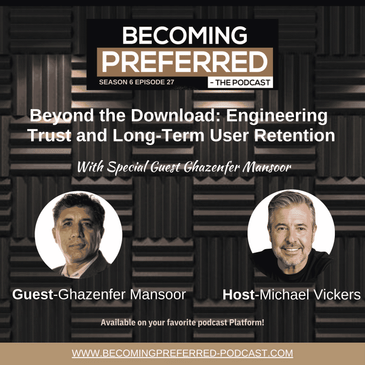
SEASON: 6 EPISODE: 27
Episode Overview:
Welcome to another episode of Becoming Preferred, the show where we dive deep into the strategies that help you level up your game and stay relevant in an ever-shifting marketplace.
I am happy to introduce our guest today, a man who sits at the intersection of high-level software innovation and human-centric design. Ghazenfer Mansoor is the CEO of Technology Rivers, a powerhouse firm known for building everything from HIPAA-compliant healthcare tech to cutting-edge AI solutions.
But Ghazenfer doesn’t just build software; he understands the psychology of why we use it. He is the author of Beyond the Download, where he breaks down the alchemy of creating mobile apps that people actually love and share. Beyond his technical expertise, he’s a fellow storyteller as the host of the Lessons from the Leap podcast, uncovering the raw failures and bold breakthroughs that define the entrepreneurial journey.
Whether you’re looking to scale your startup, automate your processes, or simply build a brand that resonates, you’re going to want to take notes. Join me for my conversation with Ghazenfer Mansoor!
Guest Bio:
Ghazenfer Mansoor is the CEO of Technology Rivers, a software development firm recognized in Washington, D.C. for creating AI-powered solutions, innovative SaaS products, and HIPAA-compliant healthcare technologies. He helps startups and service businesses scale faster, automate processes, and build technology that drives real-world impact.
As the author of Beyond the Download: How to Build Mobile Apps That People Love, Use, and Share Every Day, he shares practical insights and proven strategies to help app developers and entrepreneurs build mobile apps that not only acquire users but keep them engaged and growing.
In addition to being a thought leader and speaker, Ghazenfer hosts the Lessons from the Leap podcast, where he uncovers the bold decisions, failures, and breakthroughs that shape entrepreneurial success.
Resource Links:
- Website: https://ghazenfer.com/
- Business Website: https://technologyrivers.com/
- Product Link: https://www.amazon.com/Beyond-Download-Build-Mobile-People/dp/B0GP9T86DZ/
Insight Gold Timestamps:
03:17 Technology's changing with amazing speed
04:58 To your point, it can be disruptive if we don't evolve
05:07 In your latest book, Beyond the Download...
08:03 How are you competing? Are you competing on people? Are you competing on pricing?
09:21 You want to look at what are the bottlenecks in your business?
13:44 I think security ought to be a feature, not a footnote
16:02 The focus has to be building the product the right way the first time, so that you can focus on growing your business
17:45 You build the foundation, you have the sketch, and then you gradually scale
21:00 It's not easy for existing users of other products to just switch to your product
22:56 So it's about what is missing in the industry
26:04 Everybody is trying to get into the AI race, which is exciting, but at the same time, some people are scared to take that leap
26:15 On our Lessons from the Leap (podcast)
28:11 So I think as a society, we have to evolve our EQ...
32:19 There's something called RAG, (Retrieval Augmented Generation)
34:20 It's ghazenfer.com and technologyrivers.com is your company
34:33 Beyond the Download: How to Build Mobile Apps that People Love, Use, and Share Every Day
Connect Socially:
LinkedIn: https://www.linkedin.com/in/gmansoor/
Facebook: https://www.facebook.com/techrivers
YouTube: https://www.youtube.com/@technologyrivers
Instagram: https://www.instagram.com/techrivers/
Lessons from the Leap Podcast: https://ghazenfer.com/lessons-from-the-leap/
Email: GMansoor@TechnologyRivers.com
Sponsors:
Rainmaker LeadGen Platform Demo: https://calendar.summit-learning.com/widget/booking/JKItVP7WErmCBjU2cCIx
Rainmaker Digital Solutions: https://www.rainmakerdigitalsolutions.com/
In 3, 2, 1.
Speaker BWelcome back to another episode of Becoming Preferred, the podcast where we dive deep into the strategies that help you level up your game and stay relevant in an ever shifting marketplace.
Speaker BI'm happy to introduce our guest today, a man who sits at the intersection of eye level software innovation and human centric design.
Speaker BGhazanfur Mansoor is the CEO of Technology Rivers, a powerhouse firm known for building everything from HIPAA compliant healthcare tech to cutting edge AI solutions.
Speaker BBut Guzenfur doesn't just build software, he understands the psychology of why we use it.
Speaker BHe is the author of beyond the Download where he breaks down the alchemy of creating mobile apps that people actually love and share.
Speaker BBeyond his technical expertise, he's a fellow storyteller as the host of the Lessons from the Leap podcast, uncovering the raw failures and bold breakthroughs that define the entrepreneurial journey.
Speaker BWhether you're looking to scale your startup, automate your processes, or simply build a brand that resonates, you're going to want to take notes.
Speaker BJoin me for my conversation with Ghazanfur Mansour.
Speaker BWell, hi Ghazanfur, welcome to the program.
Speaker BWe're delighted to have you.
Speaker AThanks Michael.
Speaker AThanks for having me.
Speaker BAn interesting topic today and we're going to talk about it because a lot of our listeners want to understand today's technologies.
Speaker BThey're entrepreneurs, they're business professionals.
Speaker BThey how do I take my business to the next level?
Speaker BHow do I grow my business in today's competitive marketplace?
Speaker BAnd you've definitely got some experience in there.
Speaker BBut let's go back in, in time here you're back in high school, maybe going to school and you've got this path in front of you and you go where am I going to go?
Speaker BHow did Gosan for become guns and for how did you decide to go down this road and end up where you are?
Speaker ASo I have a computer science background.
Speaker AI have a master's degree in computer science and I worked as an early engineer with two startups.
Speaker ASo and I got involved in mobile the very early stage around 2000 when it was just those flip phones.
Speaker ASo along the way when I work with the startups obviously that gives you more motivation towards working on your own ideas.
Speaker ASo that gave me a push towards that and every engineer like to build things and I started a recruitment software startup and that's how I got into the entrepreneurial.
Speaker ASo after that then I started this business in 2015 helping businesses and the product development, building it the right way the first time.
Speaker BHow have you seen the technologies change Like I remember back when I took computer science, it was FORTRAN and cobol.
Speaker BI hate to date myself.
Speaker BAnd we just come off of punch cards, just go.
Speaker BSo I've seen that migration, then C and C plus and all the developing.
Speaker BAnd then I remember there was a whole period of time where hey, I'm going to be a coder in my next life.
Speaker BAnd that's the way to go, that's the future.
Speaker BAnd that seemed to serve a purpose for a while, but now we've got AI and AI tools coming.
Speaker BHow do you see the landscape?
Speaker BHow's it evolved just in your time, you know, as a professional working in.
Speaker BWhen it comes to tech, yeah, I've.
Speaker ASeen the COBOL and Visual Basic time, definitely I can resonate that technology is changing with amazing speed.
Speaker AI think it's one of those cases where it never stopped to amaze us.
Speaker ABut this AI change is the biggest of all.
Speaker ASo when I started my career earlier, it was an early web time.
Speaker AAnd then obviously everybody, even building a website was a big thing.
Speaker AAnd then after that, mobile became a pretty big thing.
Speaker AAnd now AI is changing everything.
Speaker ASo definitely it's a bigger chain, but I would say it's much bigger than everything else.
Speaker AThat's a big disruption in the industry because every other thing is didn't create as scariness as this one.
Speaker ASo even though there are a lot more opportunity, but you do see that in general public you may hear a lot of that fear as well that AI is taking away all those jobs.
Speaker AThat was not the case before.
Speaker APreviously it was okay.
Speaker ANow all these opportunities are coming and it's going to create more jobs.
Speaker BSo yeah, it always has.
Speaker BYou call it a disruption.
Speaker BI, I think it's the fourth great disruption that we've had.
Speaker BThe industrial age, the technological age, that where we live today.
Speaker BAnd you're right, I think people who don't embrace the technologies will always lose to someone who does embrace them.
Speaker BBut it's just changing and leveling up our work.
Speaker BIt's helping with that productivity, in my opinion.
Speaker BI remember websites, we needed coders to do websites.
Speaker BThen we had the what you see what you get.
Speaker BWe had drag and drop.
Speaker BYou could build your own website and those came into play.
Speaker BAnd now even when it comes to coding, I'm not a coder, but I've had AI explain coding to me, explain it to me like I'm an 8 year old now, a 12 year old now, explain it like a 20 year old, all within an hour.
Speaker BAnd it gives me a good sense of how this works or how to find this inside the code.
Speaker BSo I think to your point, it can be disruptive if we don't evolve.
Speaker BSo we got to keep evolving.
Speaker BAnd as business owners, that's always the big challenge.
Speaker BWhere do we go and how do we do it?
Speaker BNow, in your latest book, beyond the Download, you emphasize that getting, say an app on a phone is only half the battle for a business leader.
Speaker BWhat's the single biggest reason users abandon a product, say within the first 30 days?
Speaker BThey look at it, they're interested in it, they.
Speaker BBut then they come off of it.
Speaker BWhat are some of the issues and challenges that business owners face there?
Speaker AI think the basics are still the same.
Speaker AThe foundational problem is like, are you solving a customer's pain?
Speaker AI always give example.
Speaker AWe both have seen the Craig List time.
Speaker AWas it a good user experience?
Speaker ANo.
Speaker ABut how much traffic you had, like every time you go there because they were solving one specific pain.
Speaker AWhen you solve pain, people will come back and they will download, they'll keep using.
Speaker AAnd some of those apps that we are using on a daily basis, they are solving some problem, they're providing some value to the users and those users keep coming back.
Speaker ASo yeah, that's the gist of it.
Speaker AWhat problem you are solving.
Speaker AAnd then the second part that changed after that Craig List and doing the Apple time is the user experience and design.
Speaker AIn the past, the importance was user experience and simplicity was not as important.
Speaker AYou just solve some problem.
Speaker ANow you don't have to just solve, but you also solve it in a really simple way.
Speaker ASo if the user have to think what to do on this app, it's late, you're not going to get them back again.
Speaker ASo your app has to be remarkable.
Speaker AIt has to solve a problem, it has to provide a value, it has to have an amazing user experience and design.
Speaker AIt's not the time when you have to watch the YouTube tutorial to learn how to use an app, which surprisingly, a lot of people are still doing it.
Speaker BYeah, you focus on that user success.
Speaker BAnd a lot of companies for years it was all just about user acquisition, how many acquisition.
Speaker BThat's where the value came from.
Speaker BBut then your churn rates were so significant because people weren't implementing it or internalizing it.
Speaker BSo the abandonment usually happens because of that time to value.
Speaker BIf they don't experience the win within the first few minutes or an easy use, they're moving, they're moving on to something that's even easier.
Speaker BWhich brings us to where we are today for how do we Create strategies using today's technologies of AI.
Speaker BFor instance, how does AI strategy work for non tech firms?
Speaker BSo many of our listeners run service based businesses.
Speaker BHow should a non technical entrepreneur decide between say buying an off the shelf AI tool or investing in a custom AI powered solution?
Speaker ASo it's a tricky situation.
Speaker AI would say not every company have the same DNA.
Speaker AEvery company is different.
Speaker AYou have to look at specific use case, specific problem you are solving.
Speaker AThere are some, I would say agents, some solution that are customized, those are commoditized, it does make sense to license them, use them.
Speaker AYou don't want to be building everything.
Speaker ABut at the same time that's also the differentiator in every service business.
Speaker ASo if you're using the same system that your competition is using, that means you're not really how are you competing?
Speaker AAre you competing on people?
Speaker AAre you competing on pricing?
Speaker AAre you competing on speed?
Speaker AAre you competing on better customer service?
Speaker AAnd all those could easily, easily be replicated by your competitor and they can beat you, especially the one with more money.
Speaker ASo how do you differentiate?
Speaker AThat's where the technology can come in.
Speaker ASo technology can make a big difference and help you 10x your business not only bring efficiency but also increase the value of the business as you're going to sell it.
Speaker AIn the long run, it's going to make a huge difference.
Speaker ASo when I say technology, what does that mean?
Speaker AIt's a proprietary technology we're talking about.
Speaker ABut at the same time that doesn't mean you replace your regular scheduling or regular routine software with custom.
Speaker AWhen we say technology, that means building a very specific workflow that are unique to your business.
Speaker AIt could be integrations with existing system, whether it's scheduling, whether it's CRM, cms, whatever are the different tools you're using, Maybe integration with your payrolls and all of those things.
Speaker AAnd you need to have a dashboard, you need to have all those things in that help you move the needle in your business.
Speaker ASo your competitor may be able to copy the other tools that people are using, but they won't be able to copy the unique workflows that you have.
Speaker ASo we talk about when in the service business growth you want to look at what are the bottlenecks in your business, what are the manual workflows.
Speaker ASome of those could be replaced by existing tools, some may need to be created, some need integration.
Speaker AAnd every business has unique ways of doing things.
Speaker AIf you can optimize that, that would make a difference.
Speaker ABecause now you can do things much faster than your competition.
Speaker ANow your team can identify the problem, you can identify the risk.
Speaker AInstead of learning about losing a customer if you get the red flags ahead of time because you have a system that monitors.
Speaker ASo there's no one case I can specify, but it's just unique.
Speaker AYou have to look at your specific workflow processes and then come up with a strategy to implement those.
Speaker ABut it could be again, it could be starting out with just one agent and then maybe adding into multiple agents or workflows.
Speaker BWell, and that's good advice.
Speaker BI think.
Speaker BYou know the old 8020 rule.
Speaker BI think if an off the shelf tool solves 80% of your problem, great.
Speaker BThere's some good project managers, there's some good programs.
Speaker BYou can look at the workflows.
Speaker BIf you're competitive advantage, the thing that makes you preferred lies in that remaining 20%.
Speaker BThen you got to build your own iPad and build your own system.
Speaker BAnd with the agents now that seems to be also making that a little easier.
Speaker BIt's we had bots for a while and bots are still prevalent.
Speaker BWe see a lot of them, but people are getting bot fatigue.
Speaker BI think they say a bot the bot where an agent is kind of like really an advanced bot, really.
Speaker BBut we just call it something else I think.
Speaker CAre you tired of chasing leads and ready to start effortlessly attracting more high value clients?
Speaker CIntroducing Rainmaker Lead Gen, the ultimate solution sales, engagement and client acquisition platform that takes the stress out of outreach.
Speaker CWith Rainmaker Lead Gen, you can easily identify, engage, educate and convert your ideal prospects into loyal clients.
Speaker COur industry leading automation and email sequencing empowers you to reach more ideal clients, accelerate the sales cycle and close more business.
Speaker CImagine authentically engaging with your prospects while the platform handles the heavy lifting.
Speaker CSay goodbye to the endless hustle and embrace a more efficient, effective approach to business development.
Speaker CReady to witness the magic?
Speaker CBook a 20 minute demo today and see how Rainmaker Lead Gen can revolutionize and level up your client acquisition game.
Speaker CThere's nothing to lose and everything to gain.
Speaker CDon't miss out on this opportunity to supercharge your client acquisition process.
Speaker CVisit rainmakerdigitalsolutions.com or check out the link in the Show Notes to book your demo Rainmaker Lead Gen Spend less time hunting for your ideal clients and more time having high value sales conversations with your ideal clients.
Speaker BAnd now back to my conversation with Ghazanfur Mansoor.
Speaker BLet's talk about trust level.
Speaker BOne of the things that areas that you specialize in is HIPAA level trust standards.
Speaker BSo you specialize in HIPAA compliant healthcare tech as for those that aren't in medical fields, what can entrepreneurs learn from healthcare about building digital trust and data security.
Speaker ASo any application that has a phi personal health information it has to follow certain HIPAA regulations.
Speaker ASo that includes obviously the physical controls as well as the software part.
Speaker ASo we'll only talk about the software part.
Speaker ASo how do you exchange your data?
Speaker AWho access the data?
Speaker AAre the users authorized to access the data, what time they access so that later on you could track the history and all of the audit logging.
Speaker AThere are a whole lot of different rules that you have to follow when it comes to hipaa.
Speaker AAnd in reality even though the government regulations are on that healthcare data, that really applies to many of those businesses.
Speaker AMy business has a personal sensitive data, yes, it's not a phi data but all of the employees information is also as critical as my healthcare data.
Speaker AIn fact that even many times more critical.
Speaker ASo it does require the compliance so all the data.
Speaker ASo I think as you we are building these applications, we build that process and structures of how to build those applying those in a similar other businesses even though they may not necessarily be officially HIPAA compliant, but making it compliant makes it much easier and build the trust and give the confidence.
Speaker BYeah, I think security ought to be a feature, not a footnote, you know, not.
Speaker BOh yeah, by the way we're also this, hey, by the way we're focused on your security and feature it, highlight it, amplify it, it gives the user helps to build that trust.
Speaker BHey, my data is secure because we trust our banks, we trust our systems, we sometimes give up a lot of information.
Speaker BSo I think having that HIPAA level security in our programs or apps I think become critical.
Speaker BLet's talk about scaling without breaking your company technology rivers.
Speaker BYou help startups scale faster.
Speaker BSo when a business experiences sudden growth spurt, where does technology, where does it usually break first and how can we future proof for it?
Speaker ASo I think the foundation is the key.
Speaker AAs we are building these applications, if we are just ductating the systems, that's where the problem comes.
Speaker ABecause now the foundation was not set from day one.
Speaker AIn today's time with AI, with the cloud, all of those infrastructure is cheaper, it's easier.
Speaker ABuilding scalable tech is much easier than it used to be.
Speaker ASo in fact in our experiences, if you're not thinking about the scalability from day one, you're actually making it slower because that means you have that infrastructure, you have your pipelines and all of that infrastructure, you just automate a lot of those things that you build it Once and then you repeat that.
Speaker ASo a lot of those scalability things are much easier to implement because if you're not doing it, then you are doing it more like a traditional way.
Speaker AYou're taking probably more time anyway.
Speaker ABut that's a big misconception.
Speaker AWe have seen when people are building these, okay, we just need an MVP and we don't need any of this.
Speaker ABut in reality, you're re spending a lot of time.
Speaker ARemember I talked earlier about when I got into this build, and one of the goal was to build the product the first time, the right way.
Speaker AOne of the things we have noticed that a lot of people coming from different backgrounds building these products that are never finishing because you build something and then keep updating, patching, ductating, and you're focused on now fixing all those things for every new feature you're building, it's taking much longer.
Speaker ASo you're running out of money just because your tech is taking so much time, obviously, along with many other things.
Speaker ASo the focus has to be building the product the right way the first time so that you can focus on growing your business rather than just fixing and patching the technology all the time.
Speaker BRight.
Speaker BIt's very tough.
Speaker BI believe you teach that 1 in 10,000 become a true success.
Speaker B95% Of apps fail within the first year.
Speaker BSo architecting, designing, how does an entrepreneur avoid that scope creep, if you will, where they have an idea and it takes forever and ever to get it on.
Speaker BAnd basically they run out of financial Runway in order to get that app to market.
Speaker BBecause sometimes it might be, hey, let's get it out there and then keep evolving it and going through.
Speaker BIs there the right approach and how long on average should an app taken?
Speaker BI realize that based on the complexity, it could vary.
Speaker BBut what kinds of things are you seeing?
Speaker BYou know, from concept to we're rolling it out and we're implementing it.
Speaker BWhat kind of time frames should someone expect?
Speaker AThe time frame used to be different than now.
Speaker ASo I'll talk about the process first.
Speaker ASo I think the most important part is really narrowing the scope of the MVP to building something that your customer need.
Speaker AI think one of the bigger challenges, the feature race.
Speaker APeople start building too many things and want to have a perfect product before you can launch.
Speaker ASo that perfect product, if you're taking a year, two year to just build it, and then you realize nobody's using it, that's a big risk.
Speaker ASo we recommend you build a very tiny mvp, even if that means one feature or two feature, one use case, two Use cases that your customers really need.
Speaker AOut of the 50 features you want to build, start with one.
Speaker APut it out in front of the customer.
Speaker AIt's like you build the foundation, you have the sketch and then you gradually scale.
Speaker AOne of the examples I gave, like if you're building a house and your vision is a mansion, you want to start with a studio and then gradually expand.
Speaker AWhen I say studio, that means it's a livable space that has a bathroom, kitchen.
Speaker ARight.
Speaker AIt's not a room that's not usable.
Speaker ASo make a usable MVP that may have just the login and two other things, or may not even have a login, but it's doing something for your customers.
Speaker AAnd then you keep giving them features every week, every two weeks.
Speaker AAnd you're exciting your customers as well.
Speaker ABecause now you're releasing every week and they are seeing that something happening rather than you build something, nothing happened for six months.
Speaker AYou lost trust in your customer because they don't know when the next set is coming.
Speaker ABecause you're going to make a big patch and then this another whole learning the data migration issues, all of those.
Speaker ASo you want to focus on building just the tiny part.
Speaker AThat's one thing.
Speaker AIn the past we always recommend the MVP should not be more than two to three months.
Speaker ABuild it in two testing, get feedback.
Speaker AWell, it could be a bigger one, but that you can still even have a tiny version that you could test with your users.
Speaker AIt could be internal mvp, but it has to be long.
Speaker AIf it's not deployed, it's not launched, your users cannot see it.
Speaker AEven if it's internal, limited users, you can see some problems potentially down the road.
Speaker ANow with AI, even those things have improved.
Speaker ANow with wipe coding, now we can even do a lot more faster.
Speaker ASo one of the things we recommend, use one of these white coding tool.
Speaker AWhether it's replied lovable v0 there are many create an MVP like rather than in the past, as you were clarifying the scope, you were creating those sketches.
Speaker ANow use the wipe coding for initial proof of concept and that could be done really quickly in hours and days.
Speaker AAnd then you gradually define, let's say in a week to two week time frame, you refine your flows in the wipe coding.
Speaker ANow the next job is to take that and convert it into a real working mvp.
Speaker ASo that's the flow.
Speaker AWe recommend now building the initial MVP with the wide coding and the first two to three weeks and then expand and make it production ready or make it HIPAA compliant and make it live in four to six Weeks.
Speaker ABut then that four to six week is much bigger than what it used to be.
Speaker AThe three month or six month time.
Speaker BFrame for mvp, which stands for a minimum viable product for those who aren't focused on that.
Speaker BIs there a danger of being too minimal?
Speaker BLike when does good enough actually hurt a professional brand?
Speaker AIt really depends on a specific problem we are trying to solve.
Speaker ALet's say if you are building a product that is you think that you're creating a replacement of whatever, let's say a bigger tool, maybe a salesforce or HubSpot or any of those.
Speaker ANow what is your selling point?
Speaker ASo are you competing on oh, I have five more features.
Speaker AEven in that case we say, well, you still have some differentiators.
Speaker AWhy don't you build something just on that differentiator?
Speaker AJust line those and gradually and maybe start with integrating with existing one.
Speaker ABecause change is difficult.
Speaker AIt's not easy for existing users of other products to just switch to your product.
Speaker AIt has to solve something specific that others are learning.
Speaker AWhat if you bring something that just integrates with other so that it's complementary for them and then gradually you add other features into those smaller product and expand.
Speaker ABut yeah, that's really a risk as well because now again it also depends on your customers or the type of product.
Speaker ASo you have to figure out who your customers are, are they willing to buy what you are building.
Speaker ASo if we cannot narrow those into a smaller one, that means our problem is complicated.
Speaker AThat doesn't mean it won't be solved easily.
Speaker ABut you're making a bigger problem.
Speaker ASo anything that is bigger, obviously that becomes a bigger project than that means a lot more stakeholders, a lot of other sectors get involved.
Speaker AThe smaller you break your problem into and solve it, then that small problem is much easier to solve.
Speaker BAre there different types of genres of I want to use the word genre or types or categories of apps that have a higher chance of success versus those who don't.
Speaker BYou know, I've got tons of apps on my phones and every once in a while I'm getting rid of some and then I like to chase them.
Speaker BIf I see something new that's focused, I like those as well.
Speaker BBut are you seeing somewhere, hey, we got too many of these.
Speaker BWe don't need these anymore.
Speaker BBut this is open territory.
Speaker BThis is a good field.
Speaker BThis is a good area where an entrepreneur might want to add an application.
Speaker ASo we don't look at it from an app perspective.
Speaker AThis is not really just the app problem.
Speaker AThis is in general any business idea problem.
Speaker BRight?
Speaker ASo you have to identify the pain, what people are looking for.
Speaker AAnd if we know the examples of all these, let's say social networks and all of those.
Speaker ATikTok is solving one problem, Facebook is solving another one.
Speaker AThey're all different.
Speaker AAnd there are a lot of other competitive products as well.
Speaker ANot everybody got their adoption.
Speaker ASo it's about what is missing in the industry, what is missing in that specific domain and then to multiple categories because there are some that are internal users.
Speaker ALet's say you build an app that may work out really just for the specific types of user.
Speaker ALet's say you're a patient, so it's just a necessity.
Speaker AYou have to use it because now you're selling it to your whatever hospitals or providers versus those are consumer ones, hard to scale.
Speaker ABut once you get that vitality, then it can go crazy as well.
Speaker ASo it really depends on a specific problem you're trying to solve and what is your approach of solving that problem.
Speaker AAnd sometimes app is just a complimentary of what you're doing versus app is a necessity, let's say, to talk about Uber, Lyft, those kind without the app.
Speaker AObviously it's a real time experience.
Speaker AWe are tracking your ride and everything.
Speaker AYou need an app.
Speaker AIn some cases it's a business, but app is a good to have.
Speaker ASome people will have it, some not because they can still do it through the web or through other ways.
Speaker BIs there for entrepreneurs who are looking at perhaps adding an app or expanding and trying to scale their existing environment, Is there a hey, on the low side like how do we budget for those types of things?
Speaker BIs there a good rule of thumb for budgeting?
Speaker BAnd I realize how long is a piece of string?
Speaker BHow long do you want it to be?
Speaker BIt's like a marketing campaign or an ad campaign.
Speaker BAnd this is I think the thing that creates that blind spot for people where they get nervous about it because they've heard the horror stories, you know, millions versus tens of thousands.
Speaker BFor someone to even consider, you know, if there's a range and hey, they should consider this on the low side and then it can go anywhere.
Speaker BBut what can usually solve a problem because it's not like it used to be.
Speaker BI don't believe it takes millions and millions to do it unless you're building something massively complex.
Speaker BIs there any guidelines that we should be following?
Speaker AWe have built apps that were, I mean, in today's time you can build it maybe like as low as 10,000 and maybe few hundred thousand dollars.
Speaker AAgain, it depends on what is included.
Speaker AAnd Sometimes the cost is not the first time cost.
Speaker AThe cost may be over time because you're building and growing.
Speaker ABecause as we talk about, we gave example Uber, Lyft and some of DoorDash, all of those.
Speaker AIt's not about just the app, it's about the operations that runs behind it.
Speaker ABecause now you're servicing your customers as well.
Speaker ASo building an app that is not in production is one price, but once it goes live, then you have to build the supporting software as well.
Speaker AMaybe admin dashboard, maybe as the user is using, getting some kind of feedback.
Speaker ANow you're tracking analytics, there are a whole lot of other things that you're doing so to support that.
Speaker ASo then your cost is more of managing than building the new features.
Speaker ASo the Start MVP could be really cheap.
Speaker BYeah, bring that.
Speaker BOn your podcast, Lessons from the Leap, you talk about the bold decisions entrepreneurs make.
Speaker BWhat is one leap you see most business owners are currently afraid to take, but probably should?
Speaker AWell, that's the hard one.
Speaker AEverybody is trying to get into the AI race, which is exciting, but at the same time some people are scared to take that leap.
Speaker ABut on our lessons from the leap, most people are the ones who are actually taking those leaps because those are the ones that we are talking.
Speaker AThe ones that are afraid are not much on the podcast yet.
Speaker AYeah, I think from, I mean if I talk about it from the lessons from the leap, it's mostly the AI race that people are taking.
Speaker AIt's just a different approach people are taking.
Speaker BWell, and I think you do talk about niche specialization as well.
Speaker BMany entrepreneurs fear that narrowing their focus kind of limits their market.
Speaker BBut in reality it can actually you avoid being a commodity when you start to focus and you start to niche down on it.
Speaker BBut let's talk about AI because I think that's an important characteristic.
Speaker BI believe there's the human side of AI.
Speaker BSo as an expert in AI powered solutions, where do you believe the human touch is most irreplaceable in the modern business journey?
Speaker ASo AI is still, obviously, I would say still at the early stage.
Speaker AEven though it's great, it's in many cases perfect.
Speaker ABut at the same time it does need human involvement.
Speaker AThere's a lot of hallucination, a lot of mistakes.
Speaker ASo you do need human to verify those things before, especially on a critical cases.
Speaker AThe way people are using AI, it's also another big challenge because if you're not providing the context properly, if you're not articulating your problem properly, you have to work on it to get to the Result that you want, it takes time for that.
Speaker ASo there's a lot of training involved in that.
Speaker ALike as people are using it, it's learning and improving that as well.
Speaker BAnd we've got two types.
Speaker BLike, I'm in agreement with you.
Speaker BI think AI is good for information.
Speaker BThere's generative and then there's agentic.
Speaker BWe've had agentic since, you know, 1967 was as far back as I can go, where we've had a Gentex where we get an agent to do it versus interacting with something like a chat GPT which we talk about.
Speaker BI believe that humans, for instance, we need them for empathy, we need them for interpretation, we need them for insights, we need them for accountability.
Speaker BAI can't be accountable.
Speaker BSo I think as a society, we have to evolve our eq, all right, so that we can handle this high level of IQ that's being generated for us and take care of it.
Speaker BSo it needs that balance.
Speaker BAnd I think that's really what protects humans in the age of AI and so we can thrive and survive is build our human skills.
Speaker BYou know, if I'm talking to a nurse, if I'm getting a procedure, I want that nurse to hold my hand and talk to me.
Speaker BIf I'm going through something that might be fearful, if, you know, I was talking to a radiologist who now does.
Speaker BUsed to take them four to five hours to diagnose, knows charts can now do four or five people within that same time frame where the AI can analyze it.
Speaker B99% Accuracy.
Speaker BBut I don't want a computer explaining my chart.
Speaker BI want that radiologist talking to me.
Speaker BSo it seems like everything's designed to level up our productivity, but we should really be focused on to stay competitive, to stay distinctive and unique is focus and enhance our human skills.
Speaker BWould you agree with that?
Speaker AOh, absolutely, absolutely.
Speaker AAnd you gave example of healthcare.
Speaker AIt's a majority of our work is healthcare and we have built those kind of applications.
Speaker ASo definitely that's a human part that does come in.
Speaker AAnd as you give a good example of the radiology.
Speaker ASo rather than spending too much time on figuring it out, now with all the data you're getting the results now you can focus on communicating with the, with the patient or solving other problems because now you're not spending as much time.
Speaker ASo technology is there, AI is there to support you, but the human part does come in.
Speaker ASo in our applications, for example, we worked on multiple predictive, personal predictive health applications where you load your blood work and other data and gives you predictions.
Speaker ASo obviously that's also a regulatory risk as well.
Speaker AYou can't just give the prediction so because then who's liable for that?
Speaker AWho's accountable for that?
Speaker ABut then you're building a system on top so that, okay, it is trained based on how the doctors were previously recommending.
Speaker ASo it, it is suggesting accordingly.
Speaker ABut then there's a do doctors review?
Speaker AThey will have all of those insights and then maybe changing those.
Speaker ABut now it's giving a lot easier for Dr. To review all of that information and quickly add their notes into it and in some cases converting those recommendations into the format that is more human format.
Speaker AAnd then again there's a human part of it where somebody's reviewing.
Speaker ASo by the way, even now in one of our applications, we're also adding a podcast option where AI would not only do the analysis, but also you can generate the scripts and two doctors are talking discussing your specific report.
Speaker ASo that's another aspect.
Speaker ABut again there's still not a human part.
Speaker ASo maybe once as a patient you listen to that, then Dr. Can provide additional feedback on top of that afterward.
Speaker ABut then rather than explaining for one hour now you already got that podcast summary, now it's just a matter of a smaller conversation because now you know exactly what specific points to talk to.
Speaker BInteresting.
Speaker BIf we're building say our own knowledge base or we're interacting with an AI tool, a lot of people are concerned about the safety of that data.
Speaker BAnd so a lot of companies have policies, for instance, about hey, what to put in their client data.
Speaker BAgain, the HIPAA argument, again, it's all about that security.
Speaker BHow secure can we feel that our data, if we're putting in personal information into an AI tool that we're actually paying a subscription for, isn't going into the learning model and that we're staying contained and it's protected or should we be concerned?
Speaker AYeah, absolutely we should be.
Speaker AAnd then we have to follow certain rules for making sure the data is secure in a normal way.
Speaker APeople are just uploading all the data in ChatGPT that's being used by ChatGPT to get trained on.
Speaker ABut again that's if your personal data, then you are responsible.
Speaker AAnd, and when it comes to the other data, the phi data in the hospital system environments or providers or whatever, the health tech applications or even non healthcare, there's an architecture, there's a process to build it.
Speaker ASo for example, there's something called rag retrieval, augmented generation.
Speaker ASo this is where all of your internal sensitive data is tokenized and there's a semantic.
Speaker ASo results are filter off of that.
Speaker AThen AI gets only the limited data and give you a recommendation off of that rather than just you give everything.
Speaker AIn reality, if you load like hundreds of files in your AI, you may have noticed that it will not be searching in all the files.
Speaker AMany times you get the results, you realize, oh this information was in the document but AI didn't give because it has the limited context, it cannot process all of those documents at once.
Speaker AIt can, but it wouldn't for whatever the pricing and all other reasons.
Speaker ASo you have limited files, limited data and then I mean that's where the hallucination comes in with this new approach.
Speaker AWhen you have the sensitive data, you don't have a hallucination, you reduce that.
Speaker ABut at the same time you are also giving limited data to AI.
Speaker ANow the second part comes in.
Speaker ADoes the AI use that data to train?
Speaker AThat's where some regulations also come in.
Speaker ALet's say.
Speaker ASo we work with the AI, the LLM vendors to have them sign ba business Associate agreement where the commit to zero retention policy they commit to not using that data for training LLM.
Speaker ASo when we are building the RAG architecture along with the BEA sign, now we're sure that the data being sent is not being trained and it's not being retained by the LLMs.
Speaker ASo then you're pretty sure okay that this data is not being used.
Speaker AAnd again this is where we are talking about the cloud based LLMs.
Speaker AAlternately, you can build the internal on premise LLMs and use that so that it's not touching any of the public data.
Speaker AAnd in those cases you, you still need RAG for other reasons, but then you're not using it for this reason of safety of the data.
Speaker BYou got a fence around it.
Speaker BWell, it's definitely interesting Guzen for this was a very interesting conversation.
Speaker BWe'll have all your contact information in our show notes.
Speaker BSo it's gosenfur.com and technologyrivers.com is your company and they can can access your blog, they can access your podcast and all different information.
Speaker BThey can find you on LinkedIn.
Speaker BThe book.
Speaker BCongratulations on the book too.
Speaker BIt's always kind of fun to do it beyond the download how to build mobile apps that people love, use and share every day.
Speaker BSo if you're looking for practical insights and proven strategies to help app developers and entrepreneurs build apps that not only acquire users, but keep them engaged and growing, they can check you out.
Speaker BThanks so much for being our guest today.
Speaker AOh, thanks for having me.
Speaker BLike as you're listening to this episode?
Speaker BWhat is one idea that you've heard that's caught your attention, and why does it matter so much to you?
Speaker BAnd who is one person who you can share that with, either sharing this episode or just sharing that insight that occurred to you while you were listening?
Speaker BPerhaps it is that true product success comes from shifting your focus from mere user acquisition to ensuring user success, creating an experience that keeps customers from ever wanting to leave.
Speaker BOr maybe it's that in a crowded market you must transition from building a minimum viable product to a minimum lovable product that establishes an immediate emotional connection with your niche audience.
Speaker BThank you for listening, for learning, and for investing in yourself so that you can become the best version of you.
Speaker BIf you found value in this episode, please write a review on Apple Podcasts.
Speaker BIf you haven't subscribed yet, please do so so you can get a new episode and start your week off right every Monday.
Speaker BUntil next time.
Speaker BThis podcast is created and associated with Summit Media.
Speaker BMy Executive producer is Beth Smith and Director of Research Tori Smith.
Speaker BThe fee for the show is that you share it with friends when you find something useful or interesting.
Speaker BThis podcast is subject to copyright by Summit Media.
Speaker AGoodbye.