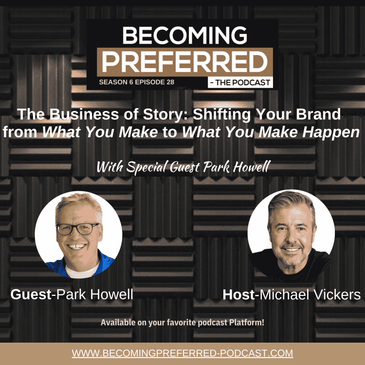
SEASON: 6 EPISODE: 28
Episode Overview:
Welcome to Becoming Preferred, the show where we level up your business and become the best version of you. Today we are tackling the one tool that separates iconic brands from the 'white noise' of the marketplace: Story.
Our guest today is an Emmy Award-winning advertising veteran who has spent over forty years proving that story isn't just a creative exercise—it’s a growth engine. Park Howell is the founder of The Business of Story and the creator of the StoryCycle System™, a framework that has helped brands scale by as much as 600 percent.
He’s the author of Brand Bewitchery and has just pioneered a way to merge human emotional intelligence with AI through his StoryCycle Genie™.
If you’ve ever felt like your message is getting lost, or if you're struggling to explain your value with a 20-slide deck, this episode is for you. Park is going to show us how to use 'Artful Intelligence' to sharpen your positioning, reduce the cost of brand development, and ultimately, help you win the battle for the mind of your customer. Join me for my conversation with Park Howell.
Guest Bio:
Park Howell is the founder of The Business of Story and creator of the StoryCycle System™, a proven brand narrative framework that has grown purpose-driven brands by as much as 600 percent. An EMMY Award-winning advertising veteran with more than four decades in the industry, Park hosts the Business of Story podcast, authored Brand Bewitchery, and co-authored The Narrative Gym for Business.
He recently co-created the StoryCycle Genie™, an AI-driven (Artful Intelligence), narrative-native platform designed to help agencies and consultants craft powerful brand strategies in minutes instead of months.
Today, Park helps agency principals turn storytelling into a scalable growth engine. By combining emotional intelligence with AI, agencies can amplify impact, sharpen positioning, and dramatically reduce the time and cost of brand development. For firms looking to grow revenue without adding headcount, his frameworks and tools provide a practical path to smarter, faster, more profitable brand strategy.
Resource Links:
- Website: https://businessofstory.com/
- Product Link: https://businessofstory.com/storytelling-resources/
Insight Gold Timestamps:
04:03 I knew I'd starve as a composer, but thought I could make it in the ad world
05:44 What is a brand? It's the story people tell about you when you are not in the room
06:52 Why is story so important, and why is it so effective
08:36 People buy first with emotion and back it up with logic,second
10:55 When I looked at the hero's journey, Michael, I said, "Oh my God, well, this is a customer journey."
14:04 What do you stand for in the world that makes you stand out
15:34 The AND, statement of agreement, is your setup. The BUT, statement of contradiction, is the problem, and the THEREFORE, statement of consequence, is your way forward or your call to action
17:45 You basically deliver or manifest what I call the three forces of trust-building
20:14 But people will buy into a story
23:18 The reason I bought it is not so much because it was a Rolex...
27:00 You are not the center of your story, your audience always is
30:25 Go and look at your bio, and rewrite it as an And/But/Therefore (LinkedIn)
32:57 You've talked about 400%, 600%
37:34 Yeah, we're all homo sapiens storytelling apes, aren't we?
42:26 So, it's a tool specifically to help you develop world-class branding and make you stand out in the world very, very quickly
45:03 You can go to storycyclegenie.ai
47:05 I've got my Business of Story podcast every Monday
47:14 Go test your brand's story, storycyclegenie.ai
Connect Socially:
LinkedIn: https://www.linkedin.com/in/parkhowell/
Facebook: https://www.facebook.com/groups/BusinessOfStory/
YouTube: https://www.youtube.com/@Businessofstory
Instagram: https://www.instagram.com/businessofstory/
Podcast: https://podcasts.apple.com/us/podcast/business-of-story/id1012379862
Email: park@businessofstory.com
Sponsors:
Rainmaker LeadGen Platform Demo: https://calendar.summit-learning.com/widget/booking/JKItVP7WErmCBjU2cCIx
Rainmaker Digital Solutions: https://www.rainmakerdigitalsolutions.com/
In 3, 2, 1.
Speaker BWelcome to Becoming Preferred, the podcast where we help you level up your business and become the best version of you.
Speaker BToday, we're tackling the one tool that separates iconic brands from the white noise of the marketplace.
Speaker AStory.
Speaker COur guest today is an Emmy award.
Speaker BWinning advertising veteran who has spent over 40 years proving that story isn't just a creative exercise, it's a growth engine.
Speaker BPark Howell is the founder of the business of Story and the creator of this store, Cycle System, a framework that has helped brands scale by as much as 600%.
Speaker BHe is the author of Brad B. Witchery and has just pioneered a way to merge human emotional intelligence with AI through his story Cycle Genie.
Speaker CIf you've ever felt like your message.
Speaker BIs getting lost, or if you're struggling.
Speaker CTo explain your value with a 20.
Speaker BSlide deck, this episode is for you.
Speaker BPark is going to show us how to use artful intelligence to sharpen your positioning, reduce the cost of brand deposits development, and ultimately help you win the battle for the mind of your customer.
Speaker BJoin me now for my conversation with Park Howell.
Speaker CWell, hey, park, welcome to the show.
Speaker CWe're delighted to have you.
Speaker AOh, thanks, Michael.
Speaker AIt's great to be here.
Speaker CNow I see you're in Munds Park, Arizona, and I'm embarrassed because we have an office in Tempe and I forgot where Muns was.
Speaker CSo you're just south of Flagstaff?
Speaker AYeah, about 17 miles south of Flagstaff.
Speaker AIn fact, my wife just is heading into town right now to get some more flowers for the front of the house and it'll take her about 20 minutes to get there.
Speaker ASo it's not too bad.
Speaker AIt's a little bit like we were in Phoenix.
Speaker AAnd if I was to drive from 44th street and Camelback to Thomas and 32nd street, it'd take me 20 minutes and, you know, through harrowing stoplights.
Speaker ANow we have a beautiful drive.
Speaker AThe only thing you have to watch out for, the elk and the deer, basically.
Speaker CIt's got one of the largest elkers in in the country.
Speaker CPeople don't realize that here in Arizona.
Speaker CAnd what's nice is I think you're about 6,000ft plus.
Speaker CSo in the summertime, that's the destination place.
Speaker CIt's beautiful.
Speaker CYou get a game of golfing without sweating out a couple of gallons.
Speaker AOh, yeah.
Speaker AAnd we live in the largest contiguous ponderosa pine forest in the world.
Speaker AAnd most people outside of Arizona don't know that.
Speaker AThey think Arizona is just flat desert, but it's very much not.
Speaker AWe are up on the mogollon Rim just the very south end of the Colorado Plateau and it's absolutely spectacular up here.
Speaker CI've skied on the San Francisco Peaks and water skied the same day.
Speaker CSo I've actually done it in the same and you can actually see the desert from the top of the chairlift.
Speaker CSo interesting as.
Speaker COh, awesome.
Speaker CHey, we're delighted to have you part we're here going to be talking about story and storytelling and you've created some pretty cool tools which I'm excited to talk about.
Speaker CYou've written books on the subject which we'll also talk about.
Speaker CBut before we get there because we have a lot of business professionals, entrepreneurs, executives, organizations and and right now with AI kind of hitting the marketplace and we've got this new evolution, I call it the big disruption.
Speaker CWhere do we find ourselves?
Speaker CHow do we place ourselves, how do we position ourselves so that we can out position the competition and the power of story?
Speaker CBut before we get there, let's go back.
Speaker CYou're in high school, where are you?
Speaker CWhere are you?
Speaker CI think you were up in the Northwest somewhere.
Speaker CYou're trying to decide what you want to be when you grow up.
Speaker CHow did we get here?
Speaker AYeah, I grew up in the Pacific Northwest just north of Seattle.
Speaker AWent to Buffalo High School, went to Washington State University and when I was studying at wsu, you I knew I was going to go into the communications program because I wanted to be in either journalist, PR or advertising.
Speaker AAnd I kept walking by the school of Music every day and I thought, you know, because I'd been playing the piano and writing songs since the third grade and I thought, you know what, maybe I'll just do some studying, get a minor in music while I'm getting this major in communications.
Speaker AAnd it turned out I got a major in music composition and theory first and then that second major 1/2 year later in advertising and marketing.
Speaker AAnd really I knew I'd starve as a composer but thought I could make it in the ad world.
Speaker AAnd I've been in the advertising, branding, marketing world for 40 plus years and I ran my own agency for 20 of those years down in Phoenix.
Speaker CAll over the place.
Speaker CDifferent vertical markets or was there a specific market you focused on?
Speaker AYeah, at first we were kind of all over the place.
Speaker AAnd this was 1995 when I launched it, I had one gigantic customer forever Living Products International.
Speaker AThey were an international network marketing company selling aloe vera products and I had them for 18 years.
Speaker AThey were a fantastic company client.
Speaker AThe second one was Sky Harbor International Airport, which now I had them for 10 years, and then we added a bunch and brought in a lot more people after that.
Speaker AReally about halfway.
Speaker AIn the first 10 years, I was doing that, just building it.
Speaker AThe second 10 years, we did a lot of work in sustainability, green marketing, that kind of work.
Speaker AIn fact, Arizona State University called me and had me come in.
Speaker AI taught a master's class in the school of sustainability around sustainable storytelling for business.
Speaker ASo it just kind of evolved, as it does, and long comes 2016, and I really wasn't that excited about running an ad agency anymore.
Speaker ASo I just wound it down.
Speaker AI didn't sell it.
Speaker AI just said, you know, I'm done with this.
Speaker ABut I'm using it as a springboard into what I do today.
Speaker AAnd that's consult, teach, coach, and speak on the power of story.
Speaker AAnd I do it internationally for leaders and their people.
Speaker AAnd it typically is coming from very much of a brand storytelling framework, because I believe everything is a brand.
Speaker AAnd what I mean by that is, what is a brand?
Speaker AIt's the story people tell about you when you are not in the room.
Speaker AAnd you want to control that story and make sure that that story is accurate as to who you are, what you stand for, and how you contribute to the world.
Speaker AAnd that's a ubiquitous you being personal, professional, and of course, your brand, your business brand.
Speaker CMy wife and I, we have eight and a half grandchildren.
Speaker CBut with the grandchildren, they're always like, hey, Papa, Hey, Nana.
Speaker CCan you guys tell us a story?
Speaker CCan we get ready to go to story?
Speaker CWhen I was raising our children, I traveled a lot.
Speaker CI was building my speaking career, so I used one of those little speaker boxes.
Speaker CWe didn't have FaceTime back in those days, and.
Speaker CBut so we'd call in on telephone, had one of those speaker boxes that you saw in Charlie's Angels, where Charlie's talking to the angels, so you never saw his face.
Speaker CAnd I took a storybook with me, and I would read the kids stories from the road.
Speaker CSo that way, hey, get ready for have your basket.
Speaker CYour jam is on.
Speaker CDad's going to call in and read your story or tell you a story.
Speaker CAnd they love stories.
Speaker CAnd throughout history, we tell stories.
Speaker CAnd it's been going on for literally thousands of years.
Speaker CSo why is story so important, and why is it so effective, according to you?
Speaker AYeah, well, if you think about it, and its story has really been around about 70,000 years.
Speaker AAnd we Homo sapiens, or storytelling apes, you might call us, are the only organisms that we know of that plan, organize, and act in story.
Speaker ABecause you think about it, anytime you're trying to get a group together or you're trying to attract customers in, you are telling them a story about how much better tomorrow can be.
Speaker AAnd if you just do this with me today, which is fiction until you make it fact, until they say, yes, let me buy in, let's do this.
Speaker ANow.
Speaker AStorytelling is probably, I would argue, our very first technology.
Speaker ABecause you think about it, stories are the software that drive the hardware of our meaning making machine.
Speaker AAnd you know, our ancestors navigated and survived the savannah on story.
Speaker AAnd it's the same thing we do today to navigate, survive this onslaught of communication.
Speaker AAnd now, you know, you can add to that AI that is bringing it at us even faster.
Speaker ASure, sloppier in hell.
Speaker ABut story is so important because like I said, when people think about you or your brand or your company, what story are they telling themselves?
Speaker ABecause they're not telling themselves data, you know, and features and functions list.
Speaker ANo, they are telling themselves a story about the impact you're making in the world.
Speaker AThat's the importance of having your story dialed in.
Speaker CAnd I think the story invokes the emotions.
Speaker CAnd we know from advertising and from marketing that people buy first with emotion, back it up with logic, second or reasoning.
Speaker CSo they do the homework with their head, but they pull their trigger with their heart.
Speaker CIf they don't like you, it's not, or they resonate with you, it's not going to happen.
Speaker CNow the stories have evolved, but what's interesting is there's always a framework to a story.
Speaker CSo we watch television, we watch, you know, it could be back in the sitcom days, it was always a 30 minute story.
Speaker CNow we have Netflix and we got 60, 90 minute stories.
Speaker CBut it seems like Hollywood seems to follow that hero's journey model.
Speaker CAnd maybe we can talk about the framework of the story because a lot of people don't really dissect it.
Speaker CWe watch a movie, it's boy meets girl, girl takes off in Europe on a trip, boys trying to find girl.
Speaker CThere's all those things or whether it's Hunger Games or whatever your favorite movie is going to be, there's always this over riding arc to the story where you might Star wars.
Speaker CYou've got, you know, Luke running along the planet shooting critters on his planet.
Speaker CAnd Darth Vader comes in with the dark store, starts destroying everything and it kind of moves on from there.
Speaker CAnd all of a sudden in comes a guide.
Speaker CAnd in that particular case, the guide was Obi Wan.
Speaker CObi Wan comes in, he doesn't fix the problem.
Speaker CHe helps guide the problem.
Speaker CAnd I think we.
Speaker CWhat happens is most people in their story, they make their company the hero of the story.
Speaker CWhere I believe we need to make our clients the hero of the story.
Speaker CLet's talk about if you would unpack that a little bit, and how Hero's Journey fits into the basic framework.
Speaker AYeah.
Speaker AWhen I was first introduced to the Hero's Journey, it was back in 2006, and our son Parker was going to film school at Chapman University in Orange, California, very prominent film school.
Speaker AAnd he graduated in 2010, and he worked in Hollywood for a dozen years and then moved on to Austin, Texas.
Speaker AAnd now he's very, very successful in virtual reality and mixed reality filmmaking.
Speaker ABut while he was going to school there, I was running my ad agency, Park Co.
Speaker AIn Phoenix.
Speaker AAnd I was having a hard time really understanding this whole new digital world and this amount of information we were just getting blasted by and how our traditional forms of branding and advertising were going to compete in this world.
Speaker AAnd so I told Parker, I said, you know, send me your books and your recorded lectures when you're done with them, since I'm paying for them, because I want to know, what does Hollywood know?
Speaker AAnd of course, one of the first things he sent me was Joseph Campbell's Heroes with a Thousand Faces.
Speaker AAnd when I looked at the Hero's Journey, Michael, I said, oh, my God, this is a customer journey.
Speaker AThis is a colleague's journey.
Speaker AThis is my journey.
Speaker AWhy don't they teach this in marketing and advertising?
Speaker ABecause it is a blueprint, a universal blueprint to how we all experience life and how we experience brands that we want to buy into.
Speaker AAnd so I mapped out to business and I created the 10 step story cycle system that I used starting back in 2008 for branding and brand story development.
Speaker AAnd first, it was just kind of a science project, thinking, will this really translate over into our world?
Speaker AAnd the very first client I used it on over the course of a few years, once they adopted the story we built through the Story Cycle Genie, they grew by 6, 100%.
Speaker AAnd they said it was precisely because they dialed in their story for themselves, for their colleagues, for their customers, and for the communities they serve, all wrapped into one overall brand narrative arc.
Speaker AAnd that's my goal when I knew I was onto something and actually was about the time that I realized it was going to jumpstart me to get out of the advertising agency business 10 years later and do exclusive brand story and leadership story development using My story cycle system.
Speaker CYeah, it's quite interesting.
Speaker CAnd how people can tell if you look at your website.
Speaker CA lot of times when the websites first came out, they're just brochures.
Speaker COnline brochures.
Speaker CHere you find me.
Speaker CWe do a lot of paid advertising and people will tell the story just like they'll tell a movie story.
Speaker CMay recommend a TV story or a book story because we love stories we like to hear.
Speaker CYou can walk into a room and say, here, I want to tell you this, and facts and figures, data as you put it.
Speaker COr I can say, hey, do you guys want to hear a cool story?
Speaker CAnd everybody stops talking and listens because they want to hear the story.
Speaker CHey, I got to tell you guys a story.
Speaker CAnd they'll listen to it.
Speaker CSo it's really creating that story in that narrative.
Speaker CSo first question, big question I have for you.
Speaker CIn a world of endless noise, why is having a brand narrative no longer a luxury, but it's a mechanical necessity for a business that wants to be preferred over its competitors?
Speaker AYeah.
Speaker AWhat do you stand for?
Speaker AWe live in a land of abundance.
Speaker AWe have abundant choices on who to buy from, where to go to eat, what car to drive.
Speaker AI mean, you know, it used to be marketing was all about scarcity.
Speaker AYou want to be the most scarcest offering.
Speaker AIf you don't have your brand story really dialed into that number one audience that you serve and how you serve them, what problem you help them overcome, and people understand and can digest that story immediately, well, then you are in a wash of commoditized offerings, you know, so if you are going to stand out, well, like I said, you are, or you had mentioned that you are, have seven kids and I'm one of seven kids.
Speaker AIf you don't stand out in that brood of seven kids, you don't get fed like the rest of them.
Speaker AYou don't get your, you know, you get nothing but hand me down.
Speaker ASo, you know, it's kind of the same sort of thing as what do you stand for in the world that makes you stand out?
Speaker AAnd how do you tell that story so that everybody knows what that is?
Speaker AYou now own some real estate between the ears of your customers, your colleagues and those communities you serve because they understand you, you have meaning in their world.
Speaker AAnd you will only get that through the stories you tell.
Speaker CInteresting.
Speaker CYou often talk about the ABT framework.
Speaker CCan you explain how a simple three word structure can actually transform a rambling elevator space that 30 second elevator spit into a compelling value proposition?
Speaker AYeah, I love the ABT.
Speaker AI learned about it from Dr. Randy Olson, a Harvard PhD evolutionary biologist who then gave up tenure, went to USC film school, graduated, produced three documentaries on climate change and global warming.
Speaker ABut his real bulk of his work was teaching scientists and academics how to use what he learned in story, much like I did.
Speaker AI teach business how to he does it from science.
Speaker AAnd he introduced to me this concept of the and but therefore back in 2013.
Speaker AAnd when I saw it, it hit me like a ton of bricks, like the Hero's Journey did, because it boils down a very complex message and makes it as simple as possible.
Speaker AAnd in fact, the big large Hero's Journey is built on the superstructure of the and but therefore it's a way you can just think of them each as one sentence.
Speaker AThe and statement of agreement is your setup.
Speaker AThe but statement of contradiction is the problem.
Speaker AAnd the therefore statement of consequence is your way forward or your call to action.
Speaker AAnd the way that marketers and branders use this is you identify your audience.
Speaker AYou name them at the very beginning, just like you said, because you want to place them as the hero in the story.
Speaker ASo you name them, you describe what they want relative to your offering, even if they don't know what your offering is, yet in essence you are foreshadowing your offering.
Speaker ASo who are they?
Speaker AWhat do they want?
Speaker AAnd you want to raise the stakes here.
Speaker AWhy is it important to them?
Speaker AThat's your statement of agreement.
Speaker AAnd all you want to do is get your audience nodding yes.
Speaker ASay you understand me, you get me, you appreciate what I want.
Speaker AWhy that's important to me.
Speaker ANow you introduce the but statement of contradiction.
Speaker ABut they don't have what they want currently.
Speaker AAnd so you say but and then you introduce a negative emotion.
Speaker AYou're frustrated, you're fearful, you're annoyed, you're exhausted, you're whatever because of this problem that they have not yet solved, that you of course are going to solve for them, that becomes your but statement of consequence.
Speaker AAnd then you get to the therefore therefore and you stay on them.
Speaker AYou don't introduce the brand or your solution immediately.
Speaker AStay focused on them.
Speaker AImagine what it's going to look like.
Speaker AImagine what it's going to feel like when this happens by doing such and such with us.
Speaker AAnd then you deliver your solution.
Speaker AThe second clause in the therefore statement of consequence.
Speaker ASo it uses what we call the three forces of story of agreement, contradiction and consequence that our primal pattern seeking, problem solving, decision making, buying, limbic brain loves.
Speaker ABecause it's the software that speaks to that limbic brain to make the meaning out of the madness of being human beings or the meaning out of that complex message.
Speaker AAnd then Michael, it does one other thing.
Speaker ASo it uses those three forces of story of agreement, contradiction and consequence.
Speaker AAnd when you do it well, you basically deliver manifest what I call the three forces of trust building.
Speaker AAnd I already had mentioned them, that and statement of agreement it is you demonstrate that you understand your audience and you appreciate what they want, why that's important to them.
Speaker AThen in the but statement of contradiction, when done right, you are demonstrating that you empathize with why they don't have what they want.
Speaker AAnd then the therefore is where the trust has been built.
Speaker ATherefore, let me share, show you the way forward on how I can help you get it.
Speaker ABasic three act structure to story.
Speaker ABut you can share an ABT in less than 15 seconds to hook that limbic brain getting them leaning in.
Speaker AAnd then maybe you share a little short anecdotal story that shows that gets them to picture that problem solution dynamic.
Speaker AThen and only then do you start bringing in the logic and reason, the data points or whatever to support what you're trying to tell.
Speaker AThat's the power of the ant.
Speaker CBut therefore it's interesting and you've talked about it in that hero's journey.
Speaker CThe it's a common mistake, I think in business storytelling is making the company the hero.
Speaker ARight.
Speaker CWhat we're trying to do is they're actually the guide in the process, aren't they?
Speaker CYeah, we want to make the client the actual hero.
Speaker CSo who should be the hero?
Speaker CAnd actually.
Speaker CAnd what's our role as business owners?
Speaker CSo again, the example, you know, Star wars, you got Obi Wan, he became the guide.
Speaker CLuke did all the work.
Speaker CHe had his doubt, didn't know what he's doing, but he got the map, the road map, the encouragement from his guide.
Speaker CThen comes along Yoda.
Speaker CSo sometimes you change those guys if you want.
Speaker CYou could use Hunger Games for those who are big fans of that one.
Speaker CYou had Katniss out hunting bunny rabbits, Right.
Speaker CAnd all of a sudden Donald Sutherland comes into the district and starts blowing up things and destroying everything and take care of it.
Speaker CSo Woody Harrelson was now the guide who started helping Katniss and do what she needed to do.
Speaker CSo our role is the guide and our customers.
Speaker CSo we have to look at our marketing, look at the stories we're telling, what are our salespeople talking about and follow that ABT formula and go from there.
Speaker CSo I think you've unpacked it really well.
Speaker CYou talked about this, you actually gave the number.
Speaker CMany entrepreneurs feel stuck in a price where.
Speaker CHow does a well crafted story allow a business to increase its margins and grow as much as you've seen by as much as you've said?
Speaker C600%?
Speaker AYeah.
Speaker AWell, it separates you from the commoditized world out there when you are just leading with features and functions and who's going to win that game is the low price leader.
Speaker AAnd there's no margin in the low price leader.
Speaker ABut people will buy into a story.
Speaker ADo you remember Michael, was it last year that some tech dope paid like $4 million for a banana taped to the wall, you know, with masking tape or duct tape, I guess to the wall.
Speaker AThere's no value in that.
Speaker AIt's not even really that valuable as a piece of art.
Speaker ABut that dude bought the story and then the story that surrounded that.
Speaker AAnd you think about anytime you make a big purchase, you're telling yourself a story as to why you absolutely need that big.
Speaker AIn fact, I just did it yesterday.
Speaker AI bought myself a new putter and it cost me $380.
Speaker AAnd people who don't play golf think I am mad.
Speaker ABut you know what, A lot of my friends have been using that putter.
Speaker AThey've had a lot of success with it.
Speaker AMy putting has been kind of wobbly.
Speaker ASo I told my story yesterday that I need that $380 putter.
Speaker AI could go to Goodwill and buy an eight dollar putter.
Speaker ABut why would I spend the 380 for this brand new technology?
Speaker ABecause of the story I told myself.
Speaker CYeah, no, it's interesting and that's the emotional connection.
Speaker CAnd we believe it, right?
Speaker CWe believe in those things.
Speaker CYou know, I'll give you an example.
Speaker CMy wife and I have matching wedding rings and it's hard to see it and those on screen unless you're seeing on video.
Speaker CBut it's two metals in there.
Speaker CYou have tungsten and you have gold.
Speaker CNow if anybody knows anything about metallurgy, you can't do this.
Speaker CThis is a physical scientific impossibility to see what you're seeing.
Speaker CYou cannot merge gold as a soft metal with tungsten, which is hard metal.
Speaker CNow this ring, but obviously it is.
Speaker CSo this ring, you can't cut it.
Speaker CIt fits on her fingers.
Speaker CShe has a matching one.
Speaker CYou get to send it back in once in your lifetime if your fingers shrink or get big.
Speaker CBut if it goes, if your fingers get too big for it, you lose the finger before you lose the ring.
Speaker CThere's just no way to cut it, it never loses its brilliance.
Speaker CSo why did we buy it?
Speaker CWhat was the story?
Speaker CWell, there's a guy by the name of True True tungsten and he knew it didn't work, but he developed a 29 step process by which you could fuse gold with tungsten.
Speaker CBut 29 steps of process.
Speaker CSo he took two separate independent metals that don't have any shared characteristics, fused them using 29 step process.
Speaker CAnd now that you see it.
Speaker CSo my wife and I each have it and it's the metaphor for us.
Speaker CWe're two different metals, we're two separate individuals and we actually survive and have a wonderful marriage and raise seven children because of process.
Speaker CSo for us it was the process that got to us because that's what created a successful ring.
Speaker CAnd it's also helped create a successful marriage.
Speaker CAnd anyone's been married for any length of time understands that, right?
Speaker AYeah.
Speaker CYou have to work out those processes to make it work and raising big families.
Speaker CSo that's what the power of story is and that's the ring to it.
Speaker CYou know, back in my earlier days I bought beautiful watches and for my 40th I wanted to buy some Rolexes just as a something of showing significant value and.
Speaker CBut the reason I bought it is not so much because it was a Rolex, but what I love as a speaker and what we both do in our work is there's 150 moving parts inside that watch.
Speaker CSo there's a lot of behind the scenes.
Speaker CAnd what you see up front looks elegant, it looks simple, it looks straightforward.
Speaker CPeople go, what's the big deal?
Speaker CIt's just a.
Speaker CMy Apple watch does far more than that ever does and keeps better time, right?
Speaker CIt gives better time.
Speaker CBut the 150 moving parts, not just a chip inside, is symbolic of what we do.
Speaker CIt's a metaphor of what we do when we go on stage and we do our work or you're creating all that is going into the development of what we do and people don't see it, but we get a nice elegant finish to it.
Speaker CSo there's two examples of story and how that works.
Speaker CMake sense?
Speaker AYeah, it absolutely does.
Speaker AYou know, I mean we have a beautiful golden doodle Hazel and she's getting on in life.
Speaker AWe're not going to have her for much longer.
Speaker AWe've had her for almost 13 years and we paid a thousand dollars.
Speaker APeople can pay a lot more for that dog in other places.
Speaker AI could have gone to the pound and picked one up for free.
Speaker ABut it's the story I'm telling myself is what did I want?
Speaker AAnd then where do I go to get that?
Speaker AWhere do I find a reputable breeder in that case, you know, or if I'm buying anything, if I'm buying a Rolex, where do I find a reputable watch shop that's going to sell Funny Rolex story.
Speaker AWhen we were raising our kids, they're in high school, one of our youngest sons, Cade's friend's dad was an attorney and he loved going down to Mexico and he loved getting great deals and he went down and he came back with a Rolex on his wrist and his son said, wow dad, what'd you pay for?
Speaker AAnd I can't remember, it was really cheap.
Speaker AAnd he jumps in, goes into the swimming pool, comes out the R and the X fell off the watch and now it says Olay, who got taken in that little anecdote, but he bought it because of the story he told himself, right?
Speaker DAre you tired of chasing leads and ready to start effortlessly attracting more high value clients?
Speaker DIntroducing Rainmaker Lead Gen, the ultimate sales, engagement and client acquisition platform that takes the stress out of outreach.
Speaker DWith Rainmaker Lead Gen, you can easily identify, engage, educate and convert your ideal prospects into loyalty clients.
Speaker DOur industry leading automation and email sequencing empowers you to reach more ideal clients, accelerate the sales cycle and close more business.
Speaker DImagine authentically engaging with your prospects while the platform handles the heavy lifting.
Speaker DSay goodbye to the endless hustle and embrace a more efficient, effective approach to business development.
Speaker DReady to witness the magic?
Speaker DBook a 20 minute demo today and see how Rainmaker Lead Gen can revolutionize and level up your client acquisition game.
Speaker DThere's nothing to lose and everything to gain.
Speaker DDon't miss out on this opportunity to supercharge your client acquisition process.
Speaker DVisit rainmakerdigitalsolutions.com or check out the link in the show Notes to book your demo.
Speaker DRainmaker Lead Gen Spend less time hunting for your ideal clients and more time having high value sales conversations with your ideal clients.
Speaker BAnd now back to my conversation with Park Howell.
Speaker CLet's talk about why the story helps with what we call the fog of features.
Speaker CBusiness professionals often get the, you know, we call it the curse of knowledge where they talk too much about features and actually lose the audience.
Speaker CHow do we strip away that fog to find the core message?
Speaker ASo I've got two big beliefs in story and you've been talking about the first one and that is you are not the center of your story.
Speaker AYour audience always is right.
Speaker AThe second one is your story is not about what you make, but what you make happen in your customer's life.
Speaker AAnd it's a paradigm shift.
Speaker AAnd I hear this all the time.
Speaker AThat first was, oh, wow.
Speaker AWe're always just talking about ourselves.
Speaker AWe need to put our audience at the center.
Speaker AThen that second one is, well, what do you mean?
Speaker AThey don't, you know, they don't want to hear about my widgets and all the great advancements and the innovation.
Speaker AAnd I go, no, they don't.
Speaker AThey actually don't give a crap about it.
Speaker AThey only care about what you make happen in their lives.
Speaker AOutcomes, outcomes, outcomes, outcomes.
Speaker AStart writing from that perspective, your audience's perspective, and how you are going to change their life for the better with what you do.
Speaker CYeah, no, I love it.
Speaker CIt's like, you know, form factor.
Speaker CWhen our kids all get together, we're all together on the weekend for Mother's Day and for birthdays and with the grandkids.
Speaker CAnd when the phones are all sitting on the table, I can't tell mine.
Speaker CI have to touch the screen, see the grandkids, or find my wife's picture on there because I kept.
Speaker CThey all look the same, whether it's an Android, whether it's.
Speaker CAnd we have mixed bags in the family.
Speaker CRight.
Speaker CSo I don't know which model it is.
Speaker CAnd so to me, I really can't tell.
Speaker CI really don't buy for its form factor.
Speaker CI buy what it does.
Speaker CSo what it does is it unleashes me.
Speaker CI can sit on a beach in Australia and have talking to clients.
Speaker CThey don't difference.
Speaker COr a riverboat in Europe doing FaceTime meetings.
Speaker CAnd my clients think I'm in the office.
Speaker CSo we buy what the outcome is.
Speaker CThat's what we're always buying.
Speaker CToo often we get stuck on all those features and those benefits.
Speaker CSo.
Speaker AWell, you know, a brand that does it.
Speaker AWell, Michael, you're.
Speaker AAnd you do a lot of traveling, so maybe you use them as booking.com.
Speaker CYeah.
Speaker ASo what's their tagline?
Speaker ABooking.com.
Speaker ABooking.
Speaker AYeah.
Speaker AThat is the best example of your story's not about what you make booking dot com.
Speaker AIt's what you make happen.
Speaker ABooking dot.
Speaker AYeah.
Speaker AThey're gonna put you in the right place.
Speaker ASo anybody out there that's stuck on features and functions and that kind of thing, just think of booking.
Speaker CYeah.
Speaker AAnd what is the.
Speaker AYeah to your business?
Speaker CYeah.
Speaker CNo, it makes it.
Speaker CIt's kind of like a.
Speaker CAn insurance policy.
Speaker CWhen I buy an insurance policy, I'm not paying all that money for a piece of paper that has A bunch of things I'm buying.
Speaker CSo when something happens or happens to me, well, I'm either building an estate or protecting one that is covered.
Speaker CWhen we were young and starting on the road as there were speakers, I needed to create an estate.
Speaker CNow it's more about protecting an estate.
Speaker CSo it's, that's what I'm buying, the alcohol.
Speaker CI don't care what it looks like when I get in a car.
Speaker CI don't care what's under the hood.
Speaker CNow some people do, some people really care about all the what's in there.
Speaker CI don't.
Speaker CI just want to know how good do I look in this thing?
Speaker CGet out of the way.
Speaker CI can't see myself.
Speaker CDoes it, do I look good?
Speaker CIt's.
Speaker CEveryone has their reasons, right?
Speaker CWhy do we buy the things we do?
Speaker CAnd if you want to look at emotion, how it fits into it.
Speaker CIf everything was logical and we purchased logically, we would all dress the same, we'd all wear the same clothes, we'd all have the same jewelry, the same watches and our kids would all be named Parker.
Speaker CWe just use the same name because it's practical, it's logical, but it's emotional.
Speaker CIt evokes emotions.
Speaker CWe are naming after a grandmother, a mother, a family.
Speaker CThose become those main reasons.
Speaker CLet's talk about sales and LinkedIn.
Speaker CWe have a lot of people in storytelling sales and LinkedIn.
Speaker CThis one doing some of the background on your work I thought was very interesting.
Speaker CSo for the entrepreneurs listening who use LinkedIn for business development or building networks and communication, what is one story driven tweak that they can make in their content today to get more engagement?
Speaker AYeah, right.
Speaker AWell, their bio.
Speaker AGo and look at the bio and rewrite it as an anbut therefore that's the first thing you can do.
Speaker AYou probably end up shortening it a little bit, but you'll get very specific.
Speaker AAnd you are going to not necessarily be writing about you right off the bat.
Speaker AYou are going to be writing about your number one audience.
Speaker AThat number one profile and people.
Speaker AMichael, you probably hear this too, is like, oh my God, park.
Speaker AYou know, I've got 10 different kinds of customers that come to me and I go now yeah, maybe you do.
Speaker ABut you have one.
Speaker AIt's the Pareto principle.
Speaker AYou have one customer profile that makes up 80% of your revenue.
Speaker ASo pay attention to them and rewrite that bio right there using an and.
Speaker ABut therefore identify them right up top.
Speaker AWhat do they want relative to following you?
Speaker AWhy?
Speaker AYou know why.
Speaker AFrom their point of view, would it be important for them to connect with you and why is it important to them?
Speaker AAnd then.
Speaker ABut what is that problem that you are going to help them solve by following you?
Speaker AAnd then therefore how do you do it?
Speaker AAnd then that's where you bring in your curriculum vitae.
Speaker AYou know all the major points of what you do, but you're writing it from your audience's point of view.
Speaker AThat's job number one.
Speaker AAnd then job number two is that next time you start posting and you could a B test this.
Speaker AWrite a post the way you would normally write it and then write it and post it the next day again using an and but therefore framework.
Speaker AAnd watch what happens to your engagement.
Speaker AIf you don't believe these three words are that powerful, just do an a B test and you are going to see engagement go up.
Speaker AIncredible.
Speaker AAnd maybe it won't hit on the first one, but on the second one.
Speaker ABut on the third one, it doesn't take too many.
Speaker AWe've had some SaaS companies using the ABT for their LinkedIn campaigns and they saw engagement increase by 400%.
Speaker AAnd all we did was reformatted their copy using an anbut therefore.
Speaker ASo those are the two things.
Speaker AGo to your bio, make it an ABT and then go and start posting as an ABT and watch what happens with your engagement rates.
Speaker CYeah, I think you say stop posting, start provoking.
Speaker CSo you know, we call it.
Speaker CWe call it agitate.
Speaker CDon't irritate, but agitate.
Speaker AYeah.
Speaker CAsk questions or something that get them.
Speaker CHey, because you're.
Speaker CWe're always a solution to a problem, I believe.
Speaker CRight.
Speaker CSo your product or your service is a solution to a problem.
Speaker CWhat problem?
Speaker CUnless that gets articulated from the client or we articulate that in story, you're just wasting your time.
Speaker CYou're just hot air, you know, squeaking at them.
Speaker AAbsolutely.
Speaker CAre there examples?
Speaker CHave you got an example that comes to mind?
Speaker CYou don't have to actually mention the brand.
Speaker CYou've talked about 400, 600.
Speaker CHave you got a specific company or a consult?
Speaker CWe have a lot of entrepreneurs, a lot of consultants.
Speaker CThen you've worked with many of those where.
Speaker CWhat was that transformation like?
Speaker CSo you got them, they were doing this.
Speaker CThey then applied the frameworks that you teach and you're.
Speaker CAnd then we'll talk about the genie as well in a minute.
Speaker CAnd then what was that transformation?
Speaker CWhat kind of things did you see come out the other end?
Speaker AYeah, one of my favorite stories is actually a Canadian company up in Quebec, Pret Otto Partez and That's my butchered French for ready.
Speaker AVery well for ready cargo.
Speaker AThat's the translation.
Speaker AAndre Martin Hops was the founder of Prate Auto Partez and he connected with me back in 2017 following a story workshop I did at Social Media Marketing World.
Speaker AAnd he said, hey Park, I want to talk to you about helping me develop the brand story for Auto Partez.
Speaker AAnd I go, what is that?
Speaker AHe goes, well, we are a used car dealership for at risk buyers, people that have poor credits and we're in Quebec.
Speaker AAnd quite honestly, Michael, I told myself an anti story thing and I don't, I don't know if I want to work with a used car dealership for at risk credit buyers.
Speaker AYou know, it sounds like kind of a shark.
Speaker AThey're going to take advantage of them.
Speaker AThey're going to sell them something they can't afford.
Speaker AThey'll repo it in three months, they'll wash, rinse and repeat, right?
Speaker ASo Andre says, I'm going to call you in three weeks and we'll start working together.
Speaker AI go, I'm sure, okay, great.
Speaker AAnd I didn't really think he was going to call because nobody ever does after they do that, right?
Speaker AWell, sure enough to his word, he called me up and I said, okay, let's just make sure that this relationship is right for both of us.
Speaker ALet me just ask you a few questions before you hire me, before I say yes, I said, can you help me better understand what you're actually trying to build there?
Speaker AAnd he said, I just am looking for 20% growth over the next two, three years.
Speaker AAnd he goes, I've got a car dealership here and yeah, we sell used cars, but we've got a bigger mission and our mission is to help Canadians who to no fault of their own, got in real difficult financial straits.
Speaker AIt could have been the worldwide recession.
Speaker AAnd maybe it's a health issue that took all their money, maybe it's a divorce and they just, they want to get back at their feet.
Speaker AThey haven't had a vehicle, they've lost that self esteem and they've lost freedom.
Speaker AHe said, that's the word we hear time and time again.
Speaker ASo they come in to buy a car and we won't sell them any old car.
Speaker AWe first make them go through a two to three hour financial planning seminar with us and they have to fully disclose their financial well being.
Speaker AAnd then he said, we will only put them into a car that they can afford.
Speaker AOur goal is to make sure they make every car payment for the next two years.
Speaker AIf they do that, then they significantly repair their credit.
Speaker ASo he said, yeah, we are a used car dealership to financially strap Canadians, but our bigger picture is to get them back on their feet.
Speaker ASo the and but therefore was something to the effect of you, I'm going to say you as the buyer coming in, you want the freedom of owning your own car and the convenience of being able to drive yourself anywhere, but you've got bad credit.
Speaker ATherefore, imagine getting a vehicle that will help repair your credit right here at Prey Auto Partez.
Speaker AThat's something that's roughly what the ABT was, the foundational ABT was.
Speaker AIt all led to then their cornerstone campaign theme tagline that they're still using today.
Speaker APre Auto Partez your vehicle to financial freedom.
Speaker ASo it becomes an aspirational brand story.
Speaker AHe said he got rid of all of his salespeople.
Speaker AHe brought in only people that work for him, that care about helping Canadians repair their financial standing, and then got him in cars.
Speaker AAnd people started taking the bus eight hours across the country to come and buy a car from him because they know he would and his team put them in a car they could afford and start repairing their financial freedom.
Speaker ATo me, that's the power of a really solid brand story.
Speaker AIt helps drive the business, it reduces risks, and of course, it enhances the brand because everybody is living into the same story.
Speaker CWell, you raise an interesting point.
Speaker CQuebec is a bilingual province.
Speaker CIt's French and English.
Speaker CAnd so obviously, the methodologies and frameworks that you're teaching work in any language.
Speaker AYeah, we're all homo sapiens storytelling apes, are we?
Speaker AWe all process content the same way through the story structures of our brain.
Speaker CWell, it's interesting.
Speaker CYou know, my wife and I were talking about, we were watching people at the airport in different cultures, and everybody was hugging.
Speaker CSo one thing that we have that's in common even with story, is we hug our loved ones, friends and everything.
Speaker CSo I think that is a common human thing for sure.
Speaker CLet's talk about the future of brand strategy.
Speaker CSo with the rapid evolution of AI, where do you see the business of story heading in the next three to five years?
Speaker AYeah, well, we're already there.
Speaker AWe've arrived at it.
Speaker AAnd that is the fact that you use AI to expedite your brand storytelling process creation, which usually, or in the old way, do it take three, four, five, six months to really get your brand story dialed in.
Speaker AAnd you pay anywhere from 30 grand to 150 grand to make that happen while using AI properly.
Speaker ANow you can actually dial in one to two to three days tops.
Speaker AAnd we're talking a couple of hundred bucks, maybe a thousand bucks when you're all said and done and you can get world class branding.
Speaker AAnd that is what AI has brought to the brand story world.
Speaker ANow.
Speaker AIt does not replace the brander, it does not replace the business owner, does not replace a marketer.
Speaker AWhen done right, you collaborate with AI to amplify, to augment your abilities and your capabilities at a fraction of the amount of time and energy it used to take and of course the fraction amount of the money it used to take so that you can get to market faster.
Speaker AAnd those that are using generic AI to create sloppy brands, it's not working for them because they look and sound like everybody else.
Speaker ASo they are wallowing in the garbage.
Speaker CAnd garbage in, garbage out.
Speaker ABut if you're using one that is specifically built for brand story development, strategy, creation, then content, then you're way ahead of the curve.
Speaker CWell, let's put in a shameless plug here because you actually did this and we're talking about the power of story, but you actually created a product called Brand Cycle Genie.
Speaker CStory Cycle Genie or sorry, beg your pardon.
Speaker CYes, that's okay.
Speaker CYeah, your pardon.
Speaker CAnd we've been doing it in the manual process for years.
Speaker CSo following the formula with the Hero's Journey, you know, we were using Don Miller's formula, wrote the book Brand Story.
Speaker CGreat, very successful.
Speaker CDon does a great job.
Speaker CSo he's also capitalized on that whole story.
Speaker CWe call it Brand Story Story, but it doesn't matter that.
Speaker CStay within the proper trademarks.
Speaker CBut how is AI changing?
Speaker CBecause you sent me a, I think about a 13 page report where you took one of our websites and you just did it on your own.
Speaker CWe didn't ask to do it, but boy, you nailed it.
Speaker CWhat was the process?
Speaker CWhat went on behind it?
Speaker CYou covered all our key points, identified some areas that we didn't even think about.
Speaker CBut more importantly, you gave us some direction of where to go.
Speaker CHow did that framework come?
Speaker CLike what happened behind the scenes and what would someone have to do maybe in a manual process versus just plugging in the information and going from there.
Speaker AWe took our story cycle system that I've been doing since 2008 and by the way, you mentioned story brand and a lot of people say, oh, park is a story cycle Genie and just a knockoff of Donald Miller's story brand.
Speaker ANow as a matter of fact, we were doing the story brand type thing with our Story cycle system eight years before he even launched StoryBrand.
Speaker AWe did it internally in our agency and built it.
Speaker AHe did it on an industrialized level.
Speaker AHis is more of a kind of a marketing tool.
Speaker AOurs is a deep dive brand story creation tool.
Speaker AAnd so it took us two years to build it.
Speaker AAnd it was a customer of mine who had been through our story cycle system process for his digital agency in Sacramento and for this Mira content platform that they had built the SaaS product, we branded it, pulling them together, they flourished, they ended up selling both.
Speaker AAnd he came to me and said, I love your process so much.
Speaker AAI is perfect for we can now collapse that development time for months into literally minutes.
Speaker AYou can really what I yours?
Speaker AI simply fed it your website in two minutes.
Speaker AIt gave me a brand assessment of how you're showing up in the world.
Speaker AAnd then, and because I didn't know your brand, I just said, okay, that looks good, move on.
Speaker AAnd then from the brand assessment it created your complete brand narrative strategy.
Speaker AAnd that took about five minutes.
Speaker ASo within 10 minutes I had that whole piece done.
Speaker AI sent it to you so that you could review it.
Speaker AAnd that's just the beginning of building your brand brain inside of the Genie.
Speaker AOnce it knows you and build your customer stories and your overall content playbook, which could take you a couple of hours with your iteration in there, then it'll develop all of your strategy, all of your content always on brand.
Speaker AAnd it's all locked down on our Brightsee platform.
Speaker ASo it's not hallucinating, is not pulling in general stuff from generic AI.
Speaker AAnd so it's a tool specifically to help you develop world class branding and make you stand out in the world very, very quickly.
Speaker CWho's that best designed for you?
Speaker CObviously agencies.
Speaker CI know you have an agency platform, but also individuals, companies, marketing departments, people working with clients, independent business people.
Speaker CCan they all use the same tools?
Speaker AAbsolutely.
Speaker ASo it's built by agency principals, myself, my two partners for agency professionals.
Speaker AYou can white label it and you can just, I mean, if you go in for a pitch, think about it, Michael.
Speaker AIf you go in to pitch and you're going up against some other agencies and they're showing up with capabilities, but you're showing up with what I gave you in that pitch and said, here's some of our thinking.
Speaker AIt's not completely fleshed out, but here's the platform we'll be working from.
Speaker AWhat do you think you are delivering value immediately.
Speaker AAnd then of course you use the story cycle Genie to build on that and get them to market faster than you've ever gotten Anybody to market before then.
Speaker ASmall, medium sized businesses that can't afford the big branding agency, they don't have the time to do it.
Speaker AThey can simply use the GENIE to very quickly build that world class branding.
Speaker AAnd because it sits on our enterprise MCP server and I don't begin to understand all the acronyms of the development side, a lot of it is built for enterprises.
Speaker ASo we've got a few enterprises on there right now so that their entire teams can be working from the same genie, not a bunch of disparate different generic AI custom chat bots out there that aren't speaking to each other.
Speaker AWe've got over 33, 34 experts inside the story cycle genie all connected with our cognitive mesh architecture.
Speaker ASo they're all speaking.
Speaker AIt's like you've got a 30 plus person brand content agency sitting right there for you.
Speaker CWell, it's like the small, you know the beautiful part with AI and I think we talked in the prior to the show going on.
Speaker CI have a new book coming out a couple of weeks, Staying relevant in the future of AI and we talk about how it's amplified and use that word and it accelerates the process so it levels it up.
Speaker CSo if you're a marketing agency, if you're a business professional marketing specialist within a company organization, it's just going to save you time, help you focus.
Speaker CThe key word I would use is the clarity.
Speaker CYou get the clarity to clarity quickly.
Speaker BSimply.
Speaker CIt used to take us days to actually do it.
Speaker CWe'd have to charge a client thousands of dollars and now this is affordable.
Speaker CIt's something, it's a tool.
Speaker CSo I think that's a good application of AI.
Speaker CLike you said, you can, it's democratized it to where the small companies can now compete and even out compete and out position.
Speaker CThe enterprise type level companies can't think.
Speaker AWell.
Speaker AYeah.
Speaker AAnd absolutely.
Speaker AAnd you can go to StoryCycleGenie AI, we've got a red button right there and get a free brand story.
Speaker AGreat.
Speaker AAnd so all you'll do is give it your name, your email address and the URL to your website and in about 60 seconds it's going to give you a grade from A plus to F minus depending on how well you're telling your story and then a 14 point storytelling assessment that will validate what you're doing well, it will reveal gaps that you can easily fix and even inspire you with new ways to think about your brand story.
Speaker AIt's not what I sent you.
Speaker AWhat I sent you would have been the next Step.
Speaker AOkay, here's what, what it's telling me.
Speaker ALet's start fixing it.
Speaker ASo I went into the genie brain and actually ran yours to build the assessment and the narrative strategy.
Speaker AWhat people get here though, is tremendous insight into how their brand is currently showing up in the world.
Speaker AI like to say it's like, like mirror, mirror on the wall.
Speaker AHow is my brand showing up for all?
Speaker AAnd then you might cringe at it.
Speaker AYou might be excited about it.
Speaker AYou might go, we got a little bit of work to do.
Speaker CWell, we'll have all those links into the show notes.
Speaker CIf business owners or entrepreneurs feel like their brand is currently invisible or confusing, I think those are excellent places to start.
Speaker CAnd it's offering a free resource definitely worth checking into and can save them literally thousands of dollars.
Speaker CAgain, it's disrupting that whole marketing.
Speaker CIt's kind of like, like ad buys.
Speaker CYou know, back in the day we used to make a premium on ad buys.
Speaker CIt might be 10, 15% back when you're doing sky harbor or you're doing something else.
Speaker COh yeah, that's all gone by the wayside.
Speaker CAnd people can do their thing.
Speaker CSo small can compete.
Speaker CThe Davis can compete and beat the Goliaths.
Speaker CHey, Park.
Speaker CThis was fantastic.
Speaker CTime runs out quickly when we're having fun.
Speaker CThanks for creating all this.
Speaker CWe'll put all that information into the show notes.
Speaker CAny final words for our listeners before we start?
Speaker CSay goodbye.
Speaker AYeah.
Speaker AMichael, number one, thank you so much for being here and for the rest of you out there, my whole job is to help you excel through the stories you tell.
Speaker ASo please, if I could be a service to you, hit me up on LinkedIn.
Speaker AI've got my Business of Story podcast every Monday.
Speaker AMichael, I need to get you on there to talk about your new book.
Speaker AThat'd be awesome.
Speaker AAnd just know that I'm here for you all and go test your brand story.
Speaker AStoryCycle, Genie, AI and it's Park Howell Park.
Speaker CThanks for being our guest today.
Speaker AThank you.
Speaker BAs you are listening to this episode, what is one idea that you've heard that's caught your attention and why does it matter so much to you?
Speaker CAnd who is one person who you.
Speaker BCan share that with, either sharing this episode or just sharing that insight that occurred to you while you were listening?
Speaker BPerhaps it is that your brand story.
Speaker CIs not about what you make, but.
Speaker BWhat you make happen in your customer's life.
Speaker BOr maybe it's a simple three word framework like and.
Speaker BBut therefore that can immediately strip away features and functions noise to build deep trust with your audience.
Speaker BThank you for listening, for learning, and for investing in yourself so that you can become the best version of you.
Speaker BIf you found value in this episode, please write a review on Apple Podcasts.
Speaker BIf you haven't subscribed yet, please do.
Speaker CSo so you can get a new.
Speaker BEpisode and start your week off right every Monday.
Speaker BUntil next time.
Speaker BThis podcast is created and associated with Summit Media.
Speaker BMy Executive producer is Beth Smith and Director of Research, Tori Smith.
Speaker BThe fee for the show is that.
Speaker CYou share it with friends when you.
Speaker BFind something useful or interesting.
Speaker BThis podcast is subject to copyright by Summit Media.
Speaker AGoodbye.