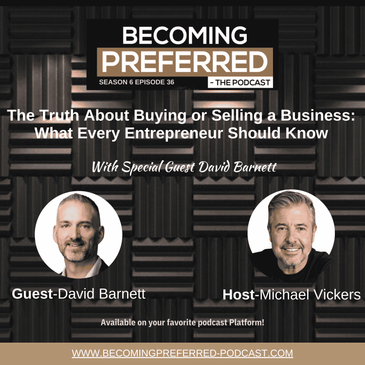
SEASON: 6 EPISODE: 36
Episode Overview:
Welcome back to Becoming Preferred, the podcast for ambitious entrepreneurs and business professionals who want to level up their game and become the best version of you.
Every week, we talk about how to become preferred, but let me ask you a tough question: You might be building a brand that customers love, but are you building a business that an investor would actually buy?
Whether you’re an established entrepreneur looking for an exit strategy, an investor looking for high-yield cash flow, or a professional wanting to skip the startup phase and buy an existing company, today’s episode is your ultimate playbook.
Joining us is David C. Barnett, an international private transaction consultant, 3-time best-selling author, and the master strategist behind 11 books on business acquisitions, financing, and valuation.
Today, we are pulling back the curtain on how businesses are actually bought, sold, and valued in the real world. Join me now for my conversation with David Barnett.
Guest Bio:
David Barnett has been working with small and medium sized businesses for over 20 years. He has helped entrepreneurs buy and sell them. He has helped them grow. He has helped people finance them.
David is the host of a YouTube channel with hundreds of videos about buying, selling, financing and managing small and medium sized businesses and can be found anytime at his blog site www.DavidCBarnett.com.
Resource Links:
- Website: www.DavidCBarnett.com
- David's Books: https://www.investlocalbook.com/p/buy-book.html
- Product Link: https://www.investlocalbook.com/p/courses.html
Insight Gold Timestamps:
03:13 It seems very obvious to me, and I didn't understand why they didn't see what I saw
07:07 I was with the Yellow Pages for about seven years, it was fantastic
10:46 If they don't pay for it, they don't value it
13:54 People seem to have a lack of imagination
19:06 All you're doing if you overpay for a business is you're trading startup risk for financing risk
20:40 There isn't anyone who is cautious, intelligent, and wise who's willing to write a check for that business
23:23 Would you like to hear some sobering statistics?
24:53 Cashing out of a business is something that happens in Silicon Valley, i's, it's really a unicorn story
29:15 Let me get something absolutely clear, it is possible for somebody to buy a business with none of their own money
30:15 How do you expect to trade nothing for something of great value...
31:28 I'll say, "What's the debt to equity ratio on your opening balance sheet?"
34:27 Do you know what it's called when you run a household profitably
38:57 Can you invest in a small business and outperform things like the stock market and all those other kinds of things?
41:05 You can actually get paid to learn about businesses by going and working there
43:25 Whether or not you're going to be able to sell your business comes down to two questions
46:01 The top 5 reasons small, privately controlled businesses go up for sale are...
43:37 You authored a book called 21 Stupid Things People Do When Trying to Buy a Business
47:05 You become the end of all blame-chains
49:08 If you're buying, selling, or starting, davidcbarnett.com
Connect Socially:
LinkedIn: https://www.linkedin.com/in/davidbarnettmoncton/
YouTube: https://www.youtube.com/@DavidCBarnett
Instagram: https://www.instagram.com/dbarnettmoncton/
Email: info@alpatlantic.com
Sponsors:
Rainmaker LeadGen Platform Demo: https://calendar.summit-learning.com/widget/booking/JKItVP7WErmCBjU2cCIx
Rainmaker Digital Solutions: https://www.rainmakerdigitalsolutions.com/
In 3, 2, 1.
Speaker BWelcome back to Becoming Preferred, the podcast for ambitious entrepreneurs and business professionals who want to level up their game and become the best version of you.
Speaker BEvery week we talk about how to become preferred.
Speaker BBut let me ask you a tough question.
Speaker BYou might be building a brand that customers love, but are you building a business that an investor would actually buy?
Speaker BWhether you're an established entrepreneur looking for an exit strategy, an investor looking for high yield cash flow, or a professional wanting to skip the startup phase and buy an existing company, today's episode is your ultimate playbook.
Speaker BJoining us is David C. Barnett, an international private transaction consultant, three time best selling author and the master strategist behind 11 books on business acquisitions, financing and valuation.
Speaker BToday we are pulling back the curtain on how businesses are actually bought, sold and valued in the real world.
Speaker BJoin me now for my conversation with David Barnet.
Speaker CWell, hey David, welcome to the program.
Speaker CWe're delighted to have you.
Speaker AMichael, thanks for inviting me.
Speaker AIt's great to be here today.
Speaker CHey.
Speaker CWell, I'm excited about our topic.
Speaker CYou got lots of good things that we're going to be able to talk about and you've been around for quite a while doing what you do and.
Speaker BI think a lot of our listeners.
Speaker CAre going to benefit from some of your insights.
Speaker CWe're going to be talking about businesses buying businesses, building businesses, selling businesses, what's hot today, what's not.
Speaker CMaybe they might be looking at franchises, opportunities, the whole gambit.
Speaker CSo we're going to chat all about it.
Speaker CWhat makes a successful business in 2026?
Speaker CBut where are we speaking to you from, David?
Speaker BWhere yet?
Speaker AToday I'm in Moncton, New Brunswick.
Speaker ASo this is, this is my home turf here on the east coast near the Bay of Fundy.
Speaker AAnd finally it's starting to be warm here, which is always nice.
Speaker CI hear you.
Speaker CI'm in the Calgary studio and we're just, we've been raining for a month and so I get it.
Speaker CAnd I've been to Moncton and beautiful people haven't been to New Brunswick.
Speaker CAwesome place.
Speaker CPeople are amazing.
Speaker CAnd just north of Maine there and you can get in cross that border pretty easily and particularly if you're chasing some lobster up the coast.
Speaker CSo.
Speaker CGood spot.
Speaker AYep, absolutely.
Speaker COkay, well, let's go back to high school for a minute.
Speaker CI always like to go backwards.
Speaker CYou're back in school, you're deciding which, I don't know, if you were a jock or into sports, deciding what you wanted to be when you grow up.
Speaker CHow did you get on this path?
Speaker AYeah.
Speaker ASo I always knew that I had an affinity for business when I used to watch that old TV show Family Ties when I was maybe in middle school.
Speaker AMy favorite character was Alex P. Keaton, if you remember him.
Speaker CRight, Fox.
Speaker AYeah, yeah, that's right.
Speaker AAnd so I got into sales.
Speaker ADo you remember those Dicky D ice cream bikes?
Speaker AThe three wheelers with.
Speaker AI.
Speaker ASo when I was 14 years old, I did that for the summer and I was selling on average like 400 a day worth of ice cream on the route that I developed.
Speaker AI was earning myself like 80, $90 a day cash.
Speaker AAnd that was it.
Speaker AI was, I was hooked.
Speaker AYou know, people would come over and I would upsell them to the drumstick, which was at the time like 225 or something.
Speaker AYou away from the little fudge bar.
Speaker AThat was 80 cents.
Speaker AAnd.
Speaker AAnd I did well with it.
Speaker AAnd it gave me that taste for business.
Speaker AAnd I would always walk into these businesses and just see something that was inefficient and it would irritate me.
Speaker AI would be like, why aren't they doing it this way?
Speaker AWhy aren't they doing it that way?
Speaker ALike, it seems very obvious to me.
Speaker AAnd I didn't understand why they didn't see what I saw.
Speaker CI love that.
Speaker CI totally get that 100%.
Speaker CI always say there, I see a new way to make a million dollars every week.
Speaker CAnd if it's not every week, it's every two weeks.
Speaker CAnd because there's.
Speaker CYou just look for those opportunities.
Speaker CHow do I disrupt this?
Speaker CAnd it's a thinking, it's a mindset.
Speaker CAnd we're not taught that.
Speaker CWe aren't taught that in school.
Speaker CYou didn't learn that in school.
Speaker CYou learn that because were you raised with an entrepreneurial family or both parents working?
Speaker AYou know, this is, this is incredible.
Speaker AOkay, Michael.
Speaker ABecause I was raised by an electrical engineer and a stay at home mom, but I was adopted.
Speaker AAnd when I was in my early 20s, I managed to connect with my biological father's side.
Speaker AAnd when I met he had been a gas station franchisee, he had owned a cabinetry business, he had owned a house contracting business.
Speaker ALike the guy had owned four different businesses and his father had owned three different businesses.
Speaker AAnd I was just like, huh, puts a new spin on nature versus nurture, you know, like, totally.
Speaker CI think, I think it mattered.
Speaker CMy parents were immigrants from England and they both came over, landed with the nickel.
Speaker CThey both had jobs, but I always knew them to have two jobs.
Speaker CMy dad was with the service air force years, but he had a Second job as a musician and playing gigs every night.
Speaker CMy mom worked at the bank and then sold cosmetics on the site.
Speaker CKind of like the old before the Mary Kay thing.
Speaker CYeah, but before that even.
Speaker CAnd so I always saw them working, always working, and we always had everything we needed.
Speaker CBut it was entrepreneurial time.
Speaker CAnd I remember just watching and watching them talk to people and how they talk to people.
Speaker CI always ask people, did you have a paper route?
Speaker CSo when I talked to entrepreneurs, did you ever have a paper out?
Speaker CAnd a lot of successful entrepreneurs, some of you wonder what's the newspaper?
Speaker CListening to the show.
Speaker CBut in those days we had paper routes.
Speaker CAnd I remember I lived in Toronto at the time and I was 10 years old and I wanted a paper, but you had to be 12.
Speaker CAnd so I went to the 12 year old kid who had the paper routes of the apartment buildings we lived in and I said, look, let me deliver them.
Speaker CYou just go and do the collection.
Speaker CSo we used to have to go and collect money once a week, $3 a week or whatever it was, they would go do that because I wasn't old enough, I delivered the papers.
Speaker CWell, once I turned 4 or 12, I got the paper, they had to be gone at 14.
Speaker CSo I'd go get other buildings and then I would Simply hire other 10 year olds and pay them half the money.
Speaker CAnd I just handled the collection.
Speaker CSo I Learned that literally 10 and 11 and 12 years old, you were subconscious.
Speaker CI was subcontracting and I learned the power of that.
Speaker CBut once you get that bug, you start to see it.
Speaker CAnd so you see all the time.
Speaker CAll right, so you're in school, you decided business was it, you connected with your dad and good for you, congratulations, hopefully still got a good relationship.
Speaker CYou have been able to form that connection.
Speaker AYeah, yeah, I talked to him occasionally.
Speaker AAnd what was great about that is I met a bunch of half siblings that I never knew existed.
Speaker AIt was kind of cool, we made a lot of family connections there.
Speaker ABut when I went to university it was to study business.
Speaker AAnd I believed, kind of erroneously, that I thought they were going to turn me into a businessman by going to get a business degree.
Speaker ABut that's really not what they do there.
Speaker ABy about third year, I realized that they were trying to change me into this like what I now call a Fortune 500 bureaucrat, which is some kind of middle manager in a big company.
Speaker AAnd all the businesses I wanted to work with were the ones that you see when you're driving through a community.
Speaker AThe small businesses, the mom and Pop shops, the sort of the small manufacturer with two dozen employees, that kind of thing.
Speaker AAnd the real learning curve for me was after I finished my university program, I became a sales rep for the Yellow Pages.
Speaker AAnd so I got to go and sit down with all of those people that I was just talking about, right?
Speaker AThe owners and managers of all the small local businesses.
Speaker AAnd I got to ask them, how do you make money?
Speaker AThe next time the phone rings, who would you like it to be?
Speaker AWho would you like to walk through the door of the shop next time, right?
Speaker AAnd so I got to learn about all of their business models, what their margins were like, how many sales they would have to make in order to pay off the investment in the ad that they were going to buy from me.
Speaker AAnd so that, again, I call that my small business mba.
Speaker AAnd I was with the Yellow Pages for about seven years.
Speaker AIt was fantastic.
Speaker COh, I remember.
Speaker CThat's how I started my career.
Speaker CI meant, well, I want to come to that.
Speaker CBut going back to university, same story.
Speaker CBut you're being taught by someone who's never left university and never done it.
Speaker CAnd so learning it.
Speaker CI remember I opened up my first office.
Speaker CI got everything else done, and I was.
Speaker CIt was nervous, and I got the Yellow Pages, and I just waited for the phone to ring.
Speaker CNothing.
Speaker CI opened up the Yellow Pages, started making calls and set up some meetings, and from there, I never looked back.
Speaker CIt was about being proactive.
Speaker CHow do you address, though?
Speaker CThere are people who, you know, it's like I say, if you want to be a speaker, people say, well, I thought I said, if you can look at speakers and you do that, what I do, we're in the same profession, and go, hey, I could do that.
Speaker CMaybe not that way, maybe with my own style, but I could do that.
Speaker CI was telling me how you could.
Speaker CSo I think it's the same way for business.
Speaker CIf you have the mindset and go, hey, you know what?
Speaker CI'm tired of being on that hamster wheel, all right, and just spinning my wheels, working for somebody else.
Speaker CBecause what people don't realize is if, say, you want 100,000 a year, well, you got to earn me more than 100,000 a year based on value, or I'm not going to be paying you 100,000 a year.
Speaker CSo it's probably got to be 2, 3, 400,000 years.
Speaker CSo, yeah, you could do it.
Speaker CWhat do you say to people who maybe aren't sure?
Speaker CIs there a mindset that you look for first when it comes to, hey, you're Perfect for running your own business, either buying or selling or starting your own.
Speaker AIt has to do with understanding the value that's required.
Speaker ASo, you know, I will sometimes meet people who want to, maybe there's some kind of professional, they want to get into their own consulting practice and they're thinking like a wage earning employee, you know, maybe they were earning 50 or $60 an hour equivalent sal salary at the place that they were working.
Speaker AAnd so they come out into the consulting world and they hear that consultants are charging 2,500 a day or something like this, and they're like, oh my goodness, those rates are so much higher.
Speaker AAnd what they don't understand is that 80% of a consultant's time is often spent chasing work.
Speaker AAnd so the marketing versus delivery is radically different.
Speaker ASo if you're going to spend 80% of your time finding the work, then you've got to make your entire annual salary on 20% of your time.
Speaker AAnd then if someone is going to pay you say 2500 or three grand for that day of consulting work, what do you have to deliver for them in order for it to be worthwhile for them to pay you that?
Speaker AAnd oftentimes there's no guarantees in business, of course, but they have to have the belief that they're going to earn 2, 3 times the value of what it's going to cost to hire you, or else it likely doesn't make sense in that they probably have other places they can deploy their capital that likely will have a better opportunity for them to pay off.
Speaker AAnd so understanding the point of view of your prospect, understanding what it is that they're looking for is key.
Speaker AAnd then you have to be able to confidently present that, which I think is a real issue for people.
Speaker AYou know, I've spoken a lot to real estate agents over the course of time, and I've always said that if I was going to be a real estate agent, I would work with buyers who were looking for a certain kind of thing and I would make them pay me upfront.
Speaker AAnd because I'm going to do X, Y and Z for them and I'm going to deliver in a certain way and present them with certain value.
Speaker AAnd almost every real estate agent I've ever heard or ever spoken to says, oh my God, you can't charge a buyer money.
Speaker AThey expect to get it for free because that's the way it always has been.
Speaker AAnd you know what I hear when I hear someone say that is I hear somebody who's not confident in the value that they Deliver, they'll talk all day long about the value of their service.
Speaker AIf it's worth something, shouldn't someone pay for it?
Speaker ARight.
Speaker CThat's the way I believe no 100%.
Speaker CI've talked to realtors that were actually said start charging for the listing agreement 50007500 as an advance and then that fee will come out of the final closing costs.
Speaker CBut if you're going to engage me, develop strategy and whatever, what's that worth?
Speaker CIf they don't pay for it, they don't value it.
Speaker ARight.
Speaker CAnd that's the bottom line.
Speaker CSo it's re.
Speaker CIt's changing the game.
Speaker CIt's disrupting.
Speaker CDo you find you've.
Speaker CYou've seen hundreds of different types of businesses and industries in today's world?
Speaker CThere's always quick fix.
Speaker CPeople are looking to build something quickly.
Speaker CIt's the younger generation.
Speaker CThey want to be influencers.
Speaker CAre there businesses that hey are just going to do well?
Speaker CAnd in the age of AI, for instance, like to me, service business, if you're an electrician, if you're.
Speaker CThere's just a new angle to it or new pro.
Speaker CAre there certain companies or businesses that hey, they're going to be successful versus hey, don't do this one.
Speaker ASo there are some ideas or investment theses out there.
Speaker AI work with buyers and sellers and one of the things that I hear a lot in the online media about buying businesses in particular is that you want to get into a business that Amazon can't deliver and the Chinese can't execute.
Speaker ARight.
Speaker ASo, so this is where like this is, this is where you get this idea that people want to own like plumbing companies or air conditioning repair businesses.
Speaker BRight.
Speaker AThey have these ideas that number one, people need plumbing so the demand is always going to be there.
Speaker AAnd nobody can ever deliver air conditioning in an Amazon box.
Speaker ARight.
Speaker AOr repairing it at least.
Speaker ARight.
Speaker AAnd I find it fascinating that people will hear these kinds of stories and not ever question them.
Speaker AI had a conversation the other day with someone who is chasing after plumbing and electrical businesses and they said it's recession proof.
Speaker AAnd I said, recession proof.
Speaker AI said, explain to me why it is.
Speaker AAnd the guy just said, well, if my plumbing in my house breaks, I've got to get it fixed.
Speaker AAnd I asked him, I said, have you ever been unemployed?
Speaker AHe hadn't.
Speaker AAnd I said, if you are unemployed and the plumbing in your bathroom breaks, you are not going to pay $300 to get a plumber to come and fix it.
Speaker CYou're going to do it yourself.
Speaker AWhat you're going to do is you're going to go on YouTube and then you're going to go bug the guy at Home Depot and you're going to go back home with the things that he sold you for 30 bucks.
Speaker AYou're going to fiddle around with it for half a day and then you're gonna go back there and ask him more questions.
Speaker AThen you're gonna come back to your house and you're gonna fiddle with it for the rest of the day and you'll get it fixed in something a plumber could have done in 20 minutes.
Speaker AYou're gonna spend 12 hours doing it, but you're gonna save $280.
Speaker AThat's what happens when people are unemployed and we have all these big skyscrapers going up all over the place, and because of the current economic conditions, nobody's starting new ones.
Speaker AWell, guess what happens to all the tradesmen busy in those towers when their projects come to a completion.
Speaker AThey're going to be looking for work and they're going to end up in the service side of things and they're going to put an ad on Facebook saying, I'll fix your pipes for $100 cash.
Speaker ARight?
Speaker AAnd so I know tradespeople who've been through recessions and they say it's brutal.
Speaker AThere's price competition, there's all these one man show pickup truck outfits that get started during those times.
Speaker AIt's hard to compete.
Speaker AAnd the last thing you want is to have bought a business with 80% leverage with a huge bank payment and then all of a sudden be facing those kinds of pressures in the marketplace.
Speaker ABut the problem is we've got people chasing plumbing businesses who've never been plumbers or never been in the industry and don't understand how these forces come into play.
Speaker AAnd that's the thing that I find just absolutely weird is that people seem to have a lack of imagination or empathy or being able to actually kind of role play in their mind what they think might happen given certain scenarios.
Speaker AAnd I don't know if it's just a lack of creativity or if people really are so eager to get this magic bullet, get rich quick kind of thing that you mentioned that when something sounds like it could be true, they just grab onto that with both arms and hope that it's real and pursue it.
Speaker CWell, they seem, I think you're bang on.
Speaker CThey take the least line of resistance and they don't think it through.
Speaker CThis is why I think having the value of that coach on the outside, somebody who can look at the blind spots and question things and going here's why that doesn't work, here's why it could work, here's how you could make it unique.
Speaker CSo I think having someone like what you do becomes valuable to it because it's like, hey, is this a good opportunity?
Speaker COr create something new, unique, rare and precious, Something distinctive.
Speaker CSo I think that matters Are you.
Speaker DTired of chasing leads and ready to start effortlessly attracting more high value clients?
Speaker DIntroducing Rainmaker Lead Gen the ultimate sales, engagement and client acquisition platform that takes the stress out of outreach.
Speaker DWith Rainmaker Lead Gen, you can easily identify, engage, educate and convert your ideal prospects into loyal clients.
Speaker DOur industry leading automation and email sequencing empowers you to reach more ideal clients, accelerate the sales cycle and close more business.
Speaker DImagine authentically engaging with your product prospects while the platform handles the heavy lifting.
Speaker DSay goodbye to the endless hustle and embrace a more efficient, effective approach to business development.
Speaker DReady to witness the magic?
Speaker DBook a 20 minute demo today and see how Rainmaker Lead Gen can revolutionize and level up your client acquisition game.
Speaker DThere's nothing to lose and everything to gain.
Speaker DDon't miss out on this opportunity to supercharge your client acquisition process.
Speaker DVisit rainmakerdigitalsolutions.com or check out the link in the show Notes to book your demo.
Speaker DRainmaker Lead Gen Spend less time hunting for your ideal clients and more time having high value sales conversations with your ideal clients.
Speaker BAnd now back to my conversation with David Barnett.
Speaker CA lot of people wonder sometimes, you know, do I buy a business or start a new business?
Speaker CAnd you kind of wrote the book on that.
Speaker CSo buying versus starting a small business.
Speaker CWhat's the pro and cons?
Speaker CWhen should we be looking at buying something existing and when should I be thinking, hey, maybe I should just start one?
Speaker ASo when you start a business, you've got usually some degree of overheads.
Speaker ANow this is getting easier all the time here.
Speaker AWith all of our technology, you don't need to buy a $3,000 cash register anymore.
Speaker AYou can subscribe to a Shopify point of sale for 20 bucks a month or whatever it is.
Speaker AAnd so it's getting easier and easier to start a business.
Speaker ABut you've always got this certain Runway where you have to bring in enough paying customers to breach that break.
Speaker AAnd I describe it as multiple break even points.
Speaker ABecause when people typically start a business at first they're just trying to get their costs covered and they're not paying themselves maybe for the first while.
Speaker AAnd then as soon as they get those costs covers now they need to try to draw a salary.
Speaker ASo there's like a second break even.
Speaker AAnd once they start drawing a salary, then they, they're exhausted because they've been working so much, they want to bring in an employee.
Speaker ASo now there's like a third level of break even.
Speaker AThey get to.
Speaker AAnd the problem is we don't know when specifically you're going to hit those three points.
Speaker AAnd so this is where it introduces risk.
Speaker AAnd when you start a business, you can, you're risking your time, you're risking your startup capital.
Speaker ABanks don't generally lend to new business startups.
Speaker AYou might be able to lease a van or something from Ford or something like that.
Speaker AAnd so the amount that you're risking can, you know, not get too bad for most people.
Speaker AWhen you buy a business, you've got the customers, you have the employees in place, you can be reasonably sure what sort of cash flow is going to exist.
Speaker ASo for the longest time I used to tell people that by hands down, the lower risk path is to buy the business.
Speaker ABut here's what's happened is there's been a lot of excitement around this idea of buying a business.
Speaker AAnd people are talking about the silver tsunami and all these baby boomers getting into retirement age and they're sucking in these people, like the people I mentioned who were looking at the plumbing business, who have this notion that there's this absolute guaranteed gold mine in doing business acquisition.
Speaker AAnd what's happening is people are paying higher and higher prices for these businesses and they're applying more and more leverage to buy them.
Speaker AAnd the problem is if you overpay from a business, what you actually are in the same position as the startup.
Speaker ABecause now everything has to maintain itself perfectly in order for you to make the debt service.
Speaker AAnd if you lose a customer, that's the same as not being able to hit your break even.
Speaker AYou can start to fall behind.
Speaker ANow.
Speaker AYou're cutting, you're cutting your salary, you're increasing your hours.
Speaker AAnd not only have you risked your down payment money or like the startup person put in their money to begin with, but often you've borrowed now hundreds of thousands of dollars or millions of dollars from a bank.
Speaker AAnd so if things don't work out precisely perfectly, you're like guaranteed to end up in some kind of insolvency.
Speaker AAll you're doing if you overpay for a business is you're trading startup risk for financing risk.
Speaker AAnd this is why it's so important to understand how to make a deal work for you and to Manage the risks properly.
Speaker AThat's a big part of what I do with people that I'm working with who are trying to buy, is identifying the risks.
Speaker AAnd I'll give you a quick example.
Speaker AThere could be a business that has a customer concentration risk.
Speaker A40% Of sales go to one customer.
Speaker AWell, when we look at a business like that, if it's risky, because if you lose that one customer, the whole business doesn't work.
Speaker ASo how would you be able to buy that business?
Speaker AAnd so we'll go through thought experiments like what would the business look like without that customer?
Speaker AHow could you adapt?
Speaker ACould you actually turn it into a money making business again?
Speaker AYou'd have to lay off some people, maybe you'd have to sell some equipment or, or shrink your footprint of is it even possible?
Speaker AIs there a 10 year lease in place?
Speaker ALike we look at this and then we say, okay, so here's the business without the customer, here's the business with the customer.
Speaker ANow we can safely buy this thing if we make a deal for the business without the customer.
Speaker AAnd then we make the difference in the values contingent upon that big customer's continued participation with the firm.
Speaker AAnd so what we do is we organize a deal such that the seller of the business continues to be exposed to the risk of that big customer concentration that they created when they were building the business.
Speaker ABut it's the only way the buyer can do the deal safely.
Speaker AAnd when the seller sees what that looks like, it could be, hey, I'll give you 50% down for the business and the other 50% you're going to take payments for over the next seven years.
Speaker AThey don't like it.
Speaker ABut there isn't anyone who is cautious, intelligent and wise who's willing to write a check for that business.
Speaker AAnd here's what messes up this marketplace so much, Michael, is because there are buyers in the marketplace who are not intelligent, wise or cautious who come in, look at a business like that and go, great, I'll buy it.
Speaker AAnd then they get a mortgage on their house and they pay the price.
Speaker AAnd then that guy goes and talks about it at the golf course and they skew the expectation of all the other business owners.
Speaker ABecause people hear about these incredible deals that people are making and these sums of money that they're getting for their businesses and it's, it really makes it difficult.
Speaker AAnd so doing a deal to buy a business can be a lot of work.
Speaker ATo find the right deal to negotiate a deal that makes sense from a risk point of view, selling a business can Be difficult too, because it is a secret marketplace.
Speaker AYou can have a really great business and if you can't connect with the right buyers, you're going to have a hard time too.
Speaker AWhen back years ago, I started off as a business broker between 08 and 11, which was, you know, a great time to be a business broker.
Speaker AAs you might imagine, we routinely had selling clients who, who would be with us for years and they had good businesses.
Speaker AIt was just the problem was finding the right buyer who was going to have the skills required to be able to take over that business.
Speaker ABecause again, different kinds of businesses have different degrees of transferability depending on how you've built the business, the systems you have in place, the governance structures and the processes, all the stuff that people talk about, that Michael Gerber E myth stuff.
Speaker AIf you don't have that in place, you can still sell a business.
Speaker AIt's just you need somebody with a special skill set who is kind of like you, but younger.
Speaker AAnd it can take a long time to find that perfect person to fit into your organization.
Speaker CNo, it makes sense.
Speaker CI've seen it work both ways.
Speaker CI've seen, I've got a buddy of mine and he's got a number of businesses and people, you know, in that 7,800,000 a year range, they want a retirement, they're not able to grow it.
Speaker CHe brings some technology into, change the game a little bit and improve it.
Speaker CBut then he'll go from a nice check up front and then he's got some financial staying power.
Speaker CBut he also shows him, hey, we'll keep the client base and every year we're going to release more and more to you and keeping the clients or key personnel or key individuals.
Speaker CAnd I've seen it work the other way where a key personnel person leaves, goes and starts their own business with it and take 30, 40% of the client.
Speaker CSo I think having somebody who can ask the tough questions because I think we get into it emotionally, we want this to happen and therefore we put the blinders on and we don't actually do our diligence the way we ought to be doing and create opportunities from there.
Speaker AWould you like to hear some sobering statistics?
Speaker CYeah.
Speaker AYeah.
Speaker ASo the best we know, about one in five businesses will ever change hands.
Speaker ASo there's a lot of people out there who are building a business and taking profits out of it.
Speaker AAnd it works really well for them.
Speaker AAnd they may have the assumption that they're going to be able to sell that business someday when they choose that they want to.
Speaker AAnd that sale is going to be able to fund some part of their retirement or what have you.
Speaker AAnd the reality is that it is very difficult to do a successful transaction to sell a business.
Speaker AAnd there are a lot of business owners out there who have deceived themselves as to what the value of their business may be.
Speaker AThey've heard something, they were told something that is completely off the wall.
Speaker AAnd then they're operating with the assumption that somehow applies to their business.
Speaker AThey see something in the news about some kind of firm that sold for a certain multiple of cash flow and they just assume that is going to apply equally to their business when they could be talking about apples and oranges.
Speaker ACompletely different situations.
Speaker AAnd this is why we get scenarios where people vastly overestimate what someone would be willing to pay for their business.
Speaker AAnd when people rely on those valuations, what ends up happening is they get to the point where they want to retire, they're expecting that their business is going to sell for $3 million or whatever.
Speaker AThen they're shown that nobody could possibly pay more than maybe 1.2 and that's not enough money.
Speaker AAnd then they end up stuck.
Speaker AAnd this is when you see these 75, 78 year old business owners that are still in their business because they didn't have a choice.
Speaker AThey're cashing out of a business is something that happens in Silicon Valley.
Speaker AIt's really a unicorn story that is great in a podcast.
Speaker AIt just sounds wonderful.
Speaker AWonderful.
Speaker AWhen people have these huge exits, the reality is that small businesses sell for a relatively low multiple of cash flow.
Speaker AAnd the true value in a profitable small business is never the exit.
Speaker AIt's always just in the operation.
Speaker AIt's in owning the thing and making the profits.
Speaker AAnd here's the key.
Speaker AYou've got to pull money out of that business, develop some alternative wealth on the side.
Speaker AStocks, bonds, real estate, whatever it's going to be for you so that you have a fallback, a plan B if you, if things don't work out in the sale, or if things just don't work out in the business, period.
Speaker ANow people who run a business for 20 years really get sucked into that normalcy bias.
Speaker AThey really think that because they've been doing it for 20 years that it's going to carry on for another 20 years.
Speaker AAnd I've just seen the wackiest things ruin businesses that are completely outside the control of the owner.
Speaker CYou know, well, it's like our businesses, my speaking business, there's no way I can sell it.
Speaker CIt's me.
Speaker CAll right?
Speaker CMy training company, our intellectual property.
Speaker CYeah, somebody could buy it.
Speaker CBut it changes.
Speaker CAnd in today's world, it changes all the time.
Speaker CI call them engines of revenue.
Speaker CSo I might have a financial portfolio of investments that I manage and look after that.
Speaker CThat creates income.
Speaker CThen I have.
Speaker CMy speaking business.
Speaker CCreates income.
Speaker CThree or four.
Speaker CYou can have three or four and have little businesses that generate income, supplement pensions.
Speaker CAnd pensions can be another form.
Speaker CBut.
Speaker CBut don't plan on living on it.
Speaker CAnd what if it's not here one day?
Speaker CSo I think you're right.
Speaker CIt's having something.
Speaker CHave some fun now.
Speaker CThere are also some great tax advantages to having your own business.
Speaker CLike I've.
Speaker CI'm at retirement age now, where I'm at, but.
Speaker CAnd I actually don't take a salary any longer because my, my wife runs our company and you know, people get their paychecks.
Speaker CBut I don't take a salary at this point just because I'm trying to see how much can I actually live into retirement for.
Speaker CAnd I don't believe in retirement.
Speaker CSo that's probably the big key right there, is I like what I'm doing.
Speaker CI mean, you're a speaker.
Speaker CWe write the books, we've got new projects coming up.
Speaker CI'm still relevant today as I've ever been.
Speaker CBut I'm trying to say, okay, if I don't take a salary now and how can I do this?
Speaker CHow can I live?
Speaker CBecause I still want to stay active.
Speaker CWhat are you seeing out there?
Speaker CAre you seeing that with a, you know, people, Maybe the other business?
Speaker CBecause I've talked to people in retire.
Speaker CI moved into a retirement community and for five years and you know, we moved out because the thinking was guys were missing the deals.
Speaker CThey were missing working.
Speaker CIf you've been an entrepreneur and you've worked for yourself working for someone else or not doing it, like, what would you do?
Speaker CAre you looking forward to that day yourself where you can go, hey, I'm done.
Speaker CI'm not.
Speaker ANo, listen, I just turned 50 in the past year, so I'm eager to get to work here every morning.
Speaker AI'm not even thinking about retirement, but I can see in 15 years time that I will maybe want to do fewer hours per week in the office and maybe focus more on going to conferences and giving presentations and workshops and things like that because I enjoy it.
Speaker AIt's fun.
Speaker AWill I still be writing books?
Speaker AOf course.
Speaker AI'll just be downloading it directly from my mind into my computer probably by that time.
Speaker AYou know, just like inspiring ideas flowing through Some kind of brain.
Speaker AWi Fi, Bi fi.
Speaker AI'm going to pat.
Speaker AI'm going to trademark that right now.
Speaker ABi fi.
Speaker AYeah, I'm going to keep doing this stuff.
Speaker CNo, I am that age right now.
Speaker CI'm 66.
Speaker CAnd I'm still getting.
Speaker CI'm better now I've ever been from my perspective and my audiences.
Speaker CI've got what.
Speaker CWhy would we give this up?
Speaker CI'm collaborating with the new technologies and with AI.
Speaker CI'm making them my partner.
Speaker CI'm senior partner, they're the junior partner, they're the interns.
Speaker CAnd I'm bringing it.
Speaker CAnd it's still fun.
Speaker CSo what, what am I going to do?
Speaker CStay home and do gardening or.
Speaker CThat's not my thing.
Speaker CRight.
Speaker CAnd you know, 60s, the new 50.
Speaker C50 Is the new 40 and we're living longer and healthier.
Speaker CSo hey, why not?
Speaker CYou know, it's interesting, the illusion.
Speaker CLet's talk about the illusion of zero down business deal.
Speaker CThe Internet is flooded with get rich quick gurus claiming you can buy a highly profitable cash flow business with absolutely zero money down.
Speaker CSo let's separate fiction from reality.
Speaker CWe've all seen the videos or headlines claiming you can buy an existing business with no money down.
Speaker CAs someone who spent over 20 years structuring real deals, what's the real truth behind the myth?
Speaker CAnd what does a healthy financial structure actually look like for a first time buyer?
Speaker ASure.
Speaker ASo let me get something absolutely clear.
Speaker AIt is possible for somebody to buy a business with none of their own money.
Speaker AIt happens all the time.
Speaker ABut it's almost impossible for someone who is broke to do that.
Speaker ASo here's the clear distinction, right?
Speaker AIf you own a million dollar house mortgage free and decide to buy a business for half a million dollars, you just get a mortgage from the bank for half a million, you buy the business, right?
Speaker AYou just bought a business using none of your own money.
Speaker AAnd so for a lot of these sort of get rich quick online guru people, there are nuggets of absolute truth in everything that they say.
Speaker ABut the presentation, in the way they frame it, creates an optimism in people who cannot actually execute the deals.
Speaker ABecause what they want is they want to inspire you to have hope.
Speaker ASo you'll sign up for their $10,000 program.
Speaker ASo here's the absolute clear first principles way to think about this.
Speaker AA good, profitable cash flowing business is something of value.
Speaker AIt is an asset, right?
Speaker ASo if you are coming to the table with nothing, how do you expect to trade nothing for something of great value, right?
Speaker AAnd so I've heard it 101 different ways.
Speaker AAnd it all comes back to the same sort of formula, which is that you have to find some kind of doddering old character who happens to own this profitable business who doesn't really know what's in their best interest, has no good advisors who is somehow going to be willing to allow you to leverage up all the assets of the business, and then they're going to sell or finance whatever balance is left owing beyond that.
Speaker AAnd somehow you're going to find a banker who's willing to do any kind of loan with no equity put into the deal.
Speaker ARight?
Speaker ANo equity on the balance sheet.
Speaker AAnd so I unfortunately meet a lot of people who've fallen for this.
Speaker AThey've heard the stories, they get excited, they buy the $10,000 course, and then they'll start spamming people online.
Speaker AThey'll find these deals, they'll make offers and then they apply at banks and the bankers keep saying no.
Speaker AAnd when they keep having these deals fall apart, they'll go online looking for answers and they'll eventually find my content.
Speaker AI've been making YouTube videos for 12 years on these topics.
Speaker AAnd one of the very first questions that I'll ask them if they talk to me over the phone or over a zoom call is I'll say, what's the debt to equity ratio on your opening balance sheet?
Speaker AAnd they'll be like, what's that?
Speaker AWhat's a balance sheet?
Speaker AWhat's a debt to equity ratio?
Speaker AAnd like, it's the most basic fundamental concept in lending for commercial lenders is debt to equity ratio is how they measure risk.
Speaker AAnd if you are putting no money into a deal, then you have zero equity and you are entirely debt.
Speaker AThat's infinity to one is your debt to equity ratio.
Speaker AAnd most bankers don't like to go beyond three to one unless there's some kind of government guarantee involved, right?
Speaker AAnd in the United States, you got this small business administration who's guaranteeing slightly higher leverage ratios.
Speaker ASo that's the basic truth is if you can do deals with no money down, if you have assets and you can manipulate those assets in the right way, there's a big one of these characters out of the uk, he wrote a book about how he bought a business using no money when he was the owner of a rather large business.
Speaker AAnd so I read his book and I'm like, okay, so you leverage the balance sheet of your existing business in order to basically buy the other business.
Speaker AAnd the lender looked at the combined debt to equity of both enterprises when they made their lending decision, but he never talked about that.
Speaker AAll he talked about was how he got a banker to lend him the money.
Speaker AAnd it totally positions it as though anyone can just walk in off the street and a banker is going to lend them 100% of the money they need to buy a business, which is not going to happen.
Speaker AYou have to have skill, you've got to have character, you have to have reputation, you have to know what you're doing in order to even get past the application process on a business loan.
Speaker AAnd if you are broke, the only way that I can think of that you can actually do a deal is by expanding what I call the buyer envelope to include other people.
Speaker ASo this would mean that you're going to get some equity partners who are going to contribute money, too.
Speaker ABut if you're broke, like, are your friends likely broke too?
Speaker ASure they are.
Speaker ARight.
Speaker AIf you're broke, are you going to go knock on the doors of millionaires and get them all to kick in 50, 100 grand a piece so you can make an equity down payment In a business?
Speaker ALike those people, if they've succeeded in business, they're going to ask tough questions.
Speaker AThey're going to want to know, how does this work?
Speaker AYou might be able to find an opportunity, work with those guys, and end up with a slice of the equity for yourself if you're qualified to run the business.
Speaker ABut now we're getting into more realistic strategies which are not as exciting as you can buy a business using no money.
Speaker CNo, that makes sense.
Speaker CNo, I get you've got a.
Speaker CWell, it takes money to make money.
Speaker CUnless you've got a really great idea and something where you're on Shark tank and even then you've invested some money to it and you've got an angel investor or something.
Speaker CWe know most of those deals all fail.
Speaker CThey'll invest in hundreds of them and you might get one unicorn out of the whole group.
Speaker CSo that kind of makes sense.
Speaker ALet's look at the most basic tests that a banker will put on any kind of person for a business loan.
Speaker AThey will ask themselves, can this person run their household profitably?
Speaker ADo you know what it's called?
Speaker ADo you know what it's called when you run a household profitably, what the profit is called?
Speaker AIt's called savings.
Speaker ARight.
Speaker ABecause it means that you are running your household with less money than you have coming in and you're able to save some money.
Speaker AAnd so someone who can properly manage a household has an accumulation of savings and they start to develop some Wealth, They've got some money that maybe they invest it, what have you.
Speaker AThey have home equity.
Speaker AIf you're broke, it means you have not been able to manage your household successfully.
Speaker AAnd now you're telling a banker that you're going to run a business successfully.
Speaker CRight.
Speaker AYou see the stretch there?
Speaker CYep, I do.
Speaker CNo, that's a great analogy.
Speaker CPerfect question to ask as well.
Speaker CYou know, a major trend right now is the concept of buying a job versus buying an investment.
Speaker CYou specialize in discussing FIRE strategies, specifically investing in small businesses for higher yields and absentee ownership.
Speaker CIs it really realistic for a professional to buy an existing small business and manage it successfully while keeping their day job or remaining entirely hands off and maybe define fire, that acronym.
Speaker AYeah.
Speaker ASo I spoke at a FIRE conference last year in Cincinnati and that was the topic.
Speaker ACan buying a small business be an accelerated pathway to financial independence?
Speaker AThe financial independence retire early movement.
Speaker AAnd what I did is I showed people how businesses are an accelerant.
Speaker AThey are both a form of financial and labor leverage.
Speaker AAnd if everything works out well, it can be very lucrative and exciting.
Speaker ABut then I showed people how the leverage works in the other way too.
Speaker AAnd that's sort of when the gas got deflated from the room and people realized, oh my God, this is risky.
Speaker AAnd that was the whole point.
Speaker ABuying a business while you keep your job.
Speaker AIn my mind, there's only a couple of safe ways to do it.
Speaker AYou're either buying a business that is so simple and formulaic, like a subway franchise, where all of the dashboards and everything have been put in place for you to keep an eye on that operation.
Speaker AThose people might be able to pull it off.
Speaker ABut the only successful pathway I've seen for people to successfully step away from a small business is this one.
Speaker AI'll give you the formula right here.
Speaker ASo you buy the business, which is typically owner managed, and then you go in and learn from the seller and you become the new operator.
Speaker AAnd maybe you're going to be there for a year.
Speaker AAnd while you're there, you're learning everything about the business.
Speaker AYou're creating the systems, processes, the dashboards, etc.
Speaker ASo that you can then step back and have somebody else run the day to day.
Speaker ABut you can keep an eye on them with these key metrics that you've developed.
Speaker ASo I call it developing the area manager skill set.
Speaker AIf you think about a gas station, think about any chain of gas stations.
Speaker AEvery one of those gas stations has a manager.
Speaker ABut the people at the Exxon head office don't Let a manager run a station for a year and then send in the financial statements at the end of the year.
Speaker AThere is somebody overlooking the performance of that location.
Speaker AThey're looking at how many gallons of gas were sold, what the pop and potato chip sales were, and all that kind of stuff.
Speaker AIf things start to slip, that area manager is on the phone with the manager saying, what's going on?
Speaker AOh, construction on the road this week.
Speaker AOkay.
Speaker ALike, okay, I can see why the sales have gone down.
Speaker AOr if we don't know, well, let's start watching the tapes.
Speaker AMaybe we have a theft problem.
Speaker ARight.
Speaker ASo that area manager understands the business, but they're not in the business.
Speaker ABut they know what to watch because they understand the business.
Speaker AOne of the biggest traps I've seen people fall for.
Speaker AI'll give an example.
Speaker AThis was in Pennsylvania.
Speaker AIt was a transmission shop a Guy ran for 20 years.
Speaker AHe then moves to Florida.
Speaker AOkay.
Speaker AAnd after another 15 years of running it from Florida, they advertise it as an absentee owned business with a manager in place.
Speaker AEasy peasy.
Speaker AHere's the reality though.
Speaker AA guy in Florida who ran the shop for 20 years knows everything about that business.
Speaker AHe can call the manager, he can log into the video cameras on his computer.
Speaker AHe's still running payroll from his kitchen table in Florida.
Speaker AAnd in a brief conversation with the manager, he knows what's going on in the business.
Speaker AIf you've never run a transmission shop, you can't do that.
Speaker ARight.
Speaker ABecause that guy has the area manager skill set.
Speaker ASo it's possible, it's not easy.
Speaker AAnd that's one of the things I like to get to all the time in this whole world of small business, is that small businesses are risky.
Speaker AIt's one of the riskiest asset classes there are.
Speaker AThat's why the failure rates are high in small business.
Speaker AYou know, you had, had asked me about.
Speaker AWhat was the other point that you had asked me about?
Speaker AThat I kind of skipped over there a moment ago.
Speaker AOh, buying a job.
Speaker AYeah, yeah.
Speaker ASo.
Speaker ASo can you invest in a small business and outperform things like the stock market and all those other kinds of things?
Speaker AIt's possible, absolutely.
Speaker AIs it guaranteed?
Speaker ANo way.
Speaker AYou're talking about higher, much larger oscillations in potential swings in value, revenue, profit, etc.
Speaker AThan what's going to happen over a Coca Cola, for example.
Speaker ARight.
Speaker AMost people who go into this world of buying a small business, they are interested in buying a job because they're being motivated to get out of something.
Speaker ATypically they don't like they don't like their corporate job.
Speaker AThey want to have more freedom and control in their life.
Speaker ASo they're going to look for a business.
Speaker AAnd this is the ideal scenario is you look for a business that is earning money and has a real value because it's cash flow positive, but it has problems you can identify and you know how to fix.
Speaker CYeah.
Speaker ABecause if you can bring your skill set from whatever your background is and you can make the business better, then you're going to pay a fair price and then you're going to get in there, you're going to improve the business as you're going to have a higher cash flow.
Speaker AThis is where you get the sort of outstanding returns.
Speaker AIt's by having the inside knowledge.
Speaker AAnd that's why I always say to people as they're getting started in a buyer journey, what is your experience, what is your background?
Speaker AWhat do you know about that's applicable in this space?
Speaker AAnd if you are a person who, a corporate person, that is a very pigeonholed role that you do your one little thing and you do it very well, it can become easy to believe that because you do your one corporate job very well, that business is easy.
Speaker AAnd what corporate people are insulated from is all the other roles that exist in the business.
Speaker AThey just don't see, they don't see what's going on.
Speaker ARight.
Speaker AAnd so I've challenged people before.
Speaker ALike before you quit your job at the big Fortune 500 company and go buy the, the gourmet burger stand or whatever it is, go work there on the weekend, see what it's really like in there, see what it's like to serve the customers, what goes on in the kitchen, see what happens amongst the staff and you know, the issues that come up and really, really good.
Speaker CYeah.
Speaker AGet an idea of what goes on in that business.
Speaker AYou, you can actually get, get paid to learn about businesses by going and working there.
Speaker AAnd it, that's what I have to say about that.
Speaker ADoes that answer your question?
Speaker CNo, it's good.
Speaker CLet's talk about buy versus build.
Speaker CSo sure, starting from scratch has a certain romantic appeal, but the data says it's statistically a fast track to failure.
Speaker CRight.
Speaker CSo why should an ambitious entrepreneur consider spending the capital to buy an established business?
Speaker CMight be boring over the excitement of starting something brand new one from scratch.
Speaker CWhat are the immediate advantages you get on day one when you buy instead of build?
Speaker AWell, you get the cash flow right away on day one when you buy a business.
Speaker ARight.
Speaker AAnd so the trouble though is that if you overpay, you end up with those risks we talked about earlier.
Speaker AI'm not always a fan of starting something that is entirely new or novel.
Speaker AYou know, some of the greatest stories we have about entrepreneurship are the people who created some absolutely new, novel thing that was totally new.
Speaker AAnd the problem with that is that not only do you have to find customers, but you have to educate people as to why they need your thing or your service.
Speaker AWhereas if there's a new town that's growing quickly because they opened a mine or something, hey, there's more and more people moving there.
Speaker AI'm going to go open a shoe store.
Speaker AEverybody knows what a shoe store is.
Speaker AEverybody knows what shoes are, Right?
Speaker AAnd if there's more and more people there, they're going to need shoes.
Speaker AAnd so if someone's going to start a business, I'm actually more a fan of starting a business that everybody already understands.
Speaker AYou just have to find a market that is somehow underserved and look for that opportunity to open your door and get in there.
Speaker ABut creating something entirely novel and new, I just.
Speaker AYou've got such a huge headwind.
Speaker ANot only do you have to find the customers, but you got to teach them why they need it.
Speaker AIt's tough.
Speaker CGood product.
Speaker CLet's talk about designing a business to sell, even if that's not plan A.
Speaker CSo building a business without an exit strategy in mind, it's kind of like jumping out of the plane and trying to sew a parachute on the way down.
Speaker CIn your book, how to Sell My own Business, you emphasize that owners must build and manage businesses in a way that allows it to be sold, even if selling isn't their current plan.
Speaker CWhat are two or three operational habits business owners should start implementing today to ensure their business remains sellable tomorrow?
Speaker AYeah.
Speaker ASo whether or not you're going to be able to sell your business comes down to two questions.
Speaker AThe number one question people have is, what is the demonstrable cash flow?
Speaker ASo the demonstrable provable cash flow that is seen to be resilient and continuous.
Speaker ASo that's the first thing that's going to determine the value of your business.
Speaker AThe second question is going to be from a buyer is will that cash flow continue once I buy it?
Speaker AThat's when you get into all that e myth Michael Gerber stuff of systems and all that kind of stuff.
Speaker ARight.
Speaker AAnd so here's why it's important for people to make their business salable immediately.
Speaker AOkay.
Speaker AThe top five reasons small, privately controlled businesses go up for sale are burnout Boredom and fatigue, divorce, poor health, the need to relocate and retirement.
Speaker AOnly one of those things is planned for.
Speaker AThe other four things come at you out of the blue that you never plan for them.
Speaker AAnd all of a sudden you have to deal with them.
Speaker AAnd what ends up happening is you realize I cannot continue to manage this business because of the reason.
Speaker AAnd then you realize, shoot, if I'm stuck here, this personal motivation, this personal reason is going to cause this business to deteriorate because I can't give it the attention, care, vigor, energy, etc.
Speaker AIt reflects requires to keep moving on all cylinders.
Speaker AAnd so things will start to fall apart.
Speaker AAnd when people get to that point and they have not been managing the business in a proper way, then they need to get out fast.
Speaker AThey will end up doing a deal that is not attractive to them because they've got to sell it quickly.
Speaker AAs soon as you get more than two calendar quarters of decline in sales or profitability, everyone starts to assume there's something major wrong with the business and they don't believe that they can fix it.
Speaker AThey're all of a sudden start discounting you for all the risks they perceive might exist because you've got a downward trend.
Speaker AAnd so this is why it's key to make that business into a saleable condition.
Speaker AKeep it that way at all times.
Speaker AAnd if you are planning to retire, you need to seriously move towards exiting.
Speaker AWhen you are on an uptrend, that is the time to go.
Speaker AAnd that's the least attractive time to go because.
Speaker ABecause people will say no, things are ro cozy right now.
Speaker AI'm making lots of money.
Speaker AAnd.
Speaker AAnd this is the thing you have to realize is that because businesses sell for a relatively low multiple of cash flow, it could make sense to keep running it at full power for another three years and then sell it for less later.
Speaker ABut you want to be the one that makes that decision.
Speaker AYou don't want that decision forced upon you when you'd rather be doing something else.
Speaker CNo.
Speaker CGood question.
Speaker CLast question for you.
Speaker CYou authored a book called 21 Stupid Things People do When Trying to Buy a Business.
Speaker CI know you're on the second edition.
Speaker CSo it's got more available.
Speaker CIt's now available with more stupidity in real life case studies.
Speaker AYeah.
Speaker CSo without naming names, what is one of the most common yet completely avoidable blunders you often see smart corporate executives make when negotiating a private business transaction?
Speaker AYeah, it's getting advice from the wrong people so people will go and seek counsel from people they trust, even though those people may have no particular insight, credibility or capability in the world of business.
Speaker AAnd so that's got to be one of the number one things that I.
Speaker CSee quite often we have time for one more.
Speaker CSo let me get this one in.
Speaker CUltimate skill set For a modern business buyer, it's not just about having the money, it's about having the right tool belt to handle the asset once the keys are handed over.
Speaker CSo if someone listening today is inspired, take a leap, buy a small to medium business.
Speaker CWhat are the primary skills that they need to cultivate within themselves to ensure they don't just close the deal but actually successfully manage and grow it post acquisition?
Speaker AIt's to make sure that they have a capacity for accountability and responsibility because you become the end of all blame chains like you are the one that's in charge of everything.
Speaker CYeah.
Speaker AAnd some teenager that you hire that drives a two wheel handcart into some lady's dog and or scratches the side of her car or whatever, that could make its way all the way up to you, you, and this is the reality of small business is that the buck stops with you and you have to be ready to shoulder that and to be able to compartmentalize, I think to be able to survive day to day.
Speaker CHey, that's good advice.
Speaker CWhen should people who are listening contact David Barnett and get his insights and wisdom?
Speaker CWhat's the right client for you and what's the best way for them to find you?
Speaker ASure.
Speaker ASo anyone who's interested maybe in buying a business one day or if you own a business and you want to expand it through an acquisition, then and I'd be here to help you out.
Speaker AAnd anyone who owns a business that would like to exit sometime in the future, Even if it's 10 years away, you should reach out as well.
Speaker ABecause doing a most probable selling price evaluation to really show you what your business would sell for in the marketplace would be of huge value for you because not only does it show you what the business is worth today, but if you start to get them updated every couple of years, it gives you a scorecard of where you're going and it can help with big decision making.
Speaker ASo I've seen people, for example, invest hundreds of thousands of dollars in upgrading equipment and stuff and then later they'll meet me and I'll show them their business is actually worth less than what they invested recently in their new equipment and they'll say, how can my business be worth less than the money I just invested?
Speaker AAnd I'll say, well, because you're not getting a required rate of return out of that capital.
Speaker AYour business has never been worth that amount of money.
Speaker AIn fact, you probably should never have made those investments.
Speaker AYou probably should just taking the capital out and close it up or something.
Speaker AAnd the problem is that people have these notions of what their business is worth.
Speaker AThey have these expectations based around the effort and the time and the labor they've put into their business rather than having an understanding of what the market actually sees as value in their business.
Speaker AAnd that that differential can be huge.
Speaker COh good stuff.
Speaker CSo if you're buying, selling or starting davidcbarnett.com and they can call you for a consultation, I'm imagining and we'll have all that information in the show notes hey David, thanks so much for being our guest today.
Speaker CLots of great value, lots of good insights for our listeners.
Speaker CThanks for being here.
Speaker AThanks Michael.
Speaker AThis has been great.
Speaker AIf anyone's interested in these topics, just look up David Barnett, YouTube, any audio podcast app.
Speaker AI've got hundreds of podcasts out there.
Speaker AI'd love for you to come and join me.
Speaker CThere's a ton of great stuff and value stuff there.
Speaker CSo thanks again for being our guest.
Speaker BAs you were listening to this episode, what is one idea that you've heard that's caught your attention and why does it matter so much to you?
Speaker BAnd who is one person who you can share that with, either sharing this episode or just sharing that insight that occurred to you while you were listening?
Speaker BPerhaps it is understanding that overpaying for an established business simply trades startup risk for heavy financing risk.
Speaker BOr maybe it is recognizing that major life disruptions like health issues, divorce or burnout are usually unplanned.
Speaker BYou must actively keep your business in a sellable condition at all times.
Speaker BThank you for listening, for learning, and for investing in yourself so that you can become the best version of you.
Speaker BIf you found value in this episode, please write a review on Apple Podcasts.
Speaker BIf you haven't subscribed yet, please do so so you can get a new episode and start your week off right every Monday.
Speaker CUntil next time.
Speaker BThis podcast is created and associated with Summit Media.
Speaker BMy Executive producer is Beth Smith and Director of Research, Tori Smith.
Speaker BThe fee for the show is that you share it with friends when you find something useful or interesting.
Speaker BThis podcast is subject to copyright by Summit Media.
Speaker AGoodbye.