
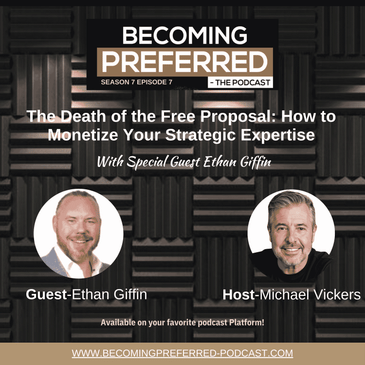
SEASON: 7 EPISODE: 7
Episode Overview:
Welcome back to Becoming Preferred, the podcast dedicated to helping you level up your game and become the best version of you.
Every business professional or owner reaches a critical crossroad: Do you keep chasing every revenue dollar by trying to be everything to everyone? Or do you have the courage to go narrow, dominate a specific niche, and build a truly scalable revenue engine?
Our guest today spent fifteen years running a broad, generalist agency before he finally made the hard call most founders avoid. He went narrow. Today, he is the Founder and CEO of The B2B eCommerce Agency, author of the definitive guide Closing the Digital Revenue Gap, and an elite event producer who has commanded high-stakes stages since age sixteen.
He’s here to share the blueprints on how to turn deep expertise into a powerful book, stop giving away your strategy for free, and discover the highly profitable niche that is likely already hiding inside your current client roster. Join me for my conversation with Ethan Giffin.
Guest Bio:
Ethan Giffin founded his agency in 2007 with a broad mandate and a lot of ambition. Two decades later, he has done what most founders only talk about: picked a specific lane, built deep expertise in it, and turned that expertise into a consulting practice, a summit, and a book.
As Founder and CEO of The B2B eCommerce Agency, he works with mid-market manufacturers and distributors, and his book Closing the Digital Revenue Gap distills everything he learned the hard way. Ethan has spent two decades making the hard calls most founders avoid: going narrow when the easier path was to stay broad and rebuilding when things stopped working. He also runs a second business most people never see coming. As DJ Opie, he has produced high-end nonprofit galas since the age of 16, with a full production operation that has run alongside his agency career for over thirty years.
Resource Links:
- Website: https://ethangiffin.com/
- Business Website: https://b2becommerceagency.com/
- Free Book: https://b2becommerceagency.com/free-consultation/
Insight Gold Timestamps:
02:46 When the internet came in the in the mid-90s I got very involved in that and so it's just been this like constant entrepreneurship
04:16 Let's talk about your book, Closing the Digital Revenue Gap: 10 Revenue Blind Spots That are Costing You More Than You Think
07:22 AI touches every aspect of what we're doing
08:30 I think actually that's the competitive advantage in the future is H to H, human to human
10:08 I wanted to play a bigger role and have a larger voice in the industry
13:01 Especially in a world of AI, people are looking for greater degrees of trust
16:14 I think that you should be evaluating your customers on an annual basis and figuring out are there ones that aren't a fit?
19:26 I was tired of dealing with a**holes
21:09 We're not a quantity business, we're a quality organization
24:57 I think prescription before diagnosis is malpractice
28:15 For entrepreneurs listening who want to write a book to build authority, how do you ensure the book doesn't just sit on a shelf?
31:12 It's glaringly across the board that your customers want to buy from you digitally
33:32 How are you applying AI now to help close that digital revenue gap?
37:06 It's really helping to read the room and understand where people wanna go
38:59 We have to understand that these digital systems are not meant to take commission away from your sales team
39:51 The book's called Closing the Digital Revenue Gap
39:59 The website is EthanGiffin.com
Connect Socially:
LinkedIn: https://www.linkedin.com/in/EthanGiffin/
LinkedIn Business: https://www.linkedin.com/company/b2becommerceagency/
B2B eCommerce Podcast: https://www.ecommercemaste.rs/
Email: ethan@groovecommerce.com
Sponsors:
Rainmaker LeadGen Platform Demo: https://calendar.summit-learning.com/widget/booking/JKItVP7WErmCBjU2cCIx
Rainmaker Digital Solutions: https://www.rainmakerdigitalsolutions.com/
In 3, 2, 1.
Speaker BWelcome back to Becoming Preferred, the podcast dedicated to helping you level up your game and become the best version of you.
Speaker BEvery business professional or owner reaches a critical crossroad.
Speaker BYou keep chasing every revenue dollar by trying to be everything to everyone.
Speaker BOr do you have the courage to go narrow, dominate a specific niche, and build a truly scalable revenue engine?
Speaker BOur Guest today spent 15 years running a broad generalist agenc before he finally made the hard call most founders avoid.
Speaker BHe went narrow.
Speaker BToday he is the founder and CEO of the B2B E Commerce Agency, author of the definitive guide Closing the Digital Revenue Gap, and an elite event producer who has commanded high stakes stages since age 16.
Speaker BHe's here to share the blueprints on how to turn deep expertise into a powerful book, stop giving away your strategy for free, and discover the highly profitable niche that is likely already hiding inside your current client roster.
Speaker BJoin me now for my conversation with Ethan Giffen.
Speaker CWell, hey, Ethan, welcome to the program.
Speaker CWe're delighted to have you.
Speaker DThank you for having me, Michael.
Speaker DI'm excited to be here with you today and have a wonderful conversation.
Speaker CYeah, me too.
Speaker CI'm excited, actually, and chatting about your book Closing the Digital Revenue Gap.
Speaker CAnd you're going to be talking all about blind spots, which I think many of us as entrepreneurs and business professionals, we, we have them.
Speaker CWe all have them.
Speaker CAnd so you help identify some of those.
Speaker CI want to talk and unpack a lot of those as well.
Speaker CBut before we get into it, Ethan, I always like to start with, you know, how did Ethan become Ethan?
Speaker CSo we're back in high school.
Speaker CSo you're living in Maryland.
Speaker CYou're, we're talking to you today.
Speaker CI believe you're in Baltimore and you're, you decided, hey, what am I going to be when I grow up?
Speaker CAnd if you're like the rest of us, we probably had multiple careers.
Speaker CSo let's go back to that high school days.
Speaker CAnd how did Ethan become Ethan Giffen?
Speaker DWell, it's funny, I actually got a letter in, in high school that was sent to me from the Ringling Brothers Clown College.
Speaker DSo I brought that to my guidance counselor and to my f. Father.
Speaker DAnd, you know, you can imagine the type of response you get, you get to that.
Speaker DBut I've been an entrepreneur.
Speaker DI've always enjoyed business.
Speaker DAnd so from a young age, I started having yard sales for my grandmother to help clean out her house so she could downsize.
Speaker DAnd I was 8 years old back in the early 80s.
Speaker DAnd then I started a DJ company when I was about 16 years old and ran that through my early 20s and kind of paid for the beer budgets of my friends and I and bought lots of music and, and did lots of fun stuff.
Speaker DAnd then I evolved from that, learning about the Internet and learning about desktop publishing, like.
Speaker DCause I had to create flyers and all the pieces of this.
Speaker DAnd so when the Internet came in the, in the mid-90s, I got very involved in that.
Speaker DAnd so it's just been this, like, constant entrepreneurship.
Speaker DI took a break in my twenties to go work for one of the world's largest staffing companies and learned a lot there.
Speaker DBut I was an intrapreneur.
Speaker DBut it's just, I've always.
Speaker DI've always had something going on with this since I, you know, for basically the last 42 years of my life.
Speaker CDid you have mentors?
Speaker CWere your parents entrepreneurs at all?
Speaker COr did you see them working or multiple jobs or.
Speaker DMy dad did some.
Speaker DDid some thing.
Speaker DHe was a.
Speaker DHe, he.
Speaker DHe did his carpentry was his hobby.
Speaker DSo from time to time he did some carpentry and other things for people that kind of.
Speaker DThe older we got, the less of that he did.
Speaker DMy UN was an executive for the Sears Corporation.
Speaker DHe graduated college at the University of Maryland and went to work in the Sears executive program where they moved them all over the country.
Speaker DI was always way into that.
Speaker DI was always like, oh, that's.
Speaker DThat's my dream.
Speaker DWhen I got into music and things, I told my dad that I was going to move to Las Vegas and go to hospitality school and work in a casino.
Speaker DThat didn't work.
Speaker DThat didn't work out.
Speaker DBut, you know, I've had people around.
Speaker DI've.
Speaker DI've actually, from a young age, I've been able to like, meet people and find mentors that have.
Speaker DThat have helped me very strongly in different areas.
Speaker DAnd so sometimes I've sought them out and sometimes I've bumped into them in my, in my travels.
Speaker DBut I've always had mentors around me to ask questions and figure out how to.
Speaker DHow to move.
Speaker CSo you've always been curious.
Speaker CIt sounds like always exploring.
Speaker CNo, I think that's huge.
Speaker CWell, let's talk about your book, Closing the digital revenue gap.
Speaker C10 Revenue blind spots that are costing you more than you think.
Speaker CSo digital transformation.
Speaker CThere's pros and cons.
Speaker CWe hear good things, bad things.
Speaker CSome companies hate it.
Speaker CIt's been around for a little while.
Speaker CYou say it isn't failing because of technology, but it's failing because of how the businesses are built.
Speaker CIn the first place.
Speaker CCan you unpack that a little bit?
Speaker DYeah, absolutely.
Speaker DSo, you know, one of the things that we're saying, and we work a lot with manufacturing and distribution clients where they're modernizing their factories.
Speaker DRight.
Speaker DBut they've got industry 4.0 is kind of the touch phrase that we're kind of in the fourth industrial revolution.
Speaker CThat's right.
Speaker DBut when you actually go into the front office, into their sales process, they're still taking orders on notepads over text message, via email.
Speaker DOften it's still a very manual process with either a person in a call center or a salesperson.
Speaker DAnd so as we're seeing an evolution, we're seeing that like we think companies should be thinking about this as a true revenue channel for them and not just a project.
Speaker DAnd so oftentimes when somebody tries to go down this path of digital transformation, they'll, they'll send the VP of marketing to go do it, or the head, the VP of IT or someone and just say, go figure this website thing out for us.
Speaker DWhen literally we say that digital revenue takes the sales team, the marketing team, the operations team, the IT team and the finance team.
Speaker DAnd you've got to put that together and have the CEO really say, hey, this is a direction that we're going.
Speaker DAnd so like traditionally a company will just say, hey, VP of marketing, go look at this, find a software and try to implement it.
Speaker DWhen it's a much bigger conversation.
Speaker DIt's a much bigger conversation about how you're going to operate, you know, going into the next generation.
Speaker CYeah, well, we've seen whether they're moving from an ERP system, automation, operations.
Speaker CThere's so many variables.
Speaker CLike I know in our small boutique we use certain software and it's evolving all the time.
Speaker CBut no, I remember back in the day, starting with CRMs and I consulted to the CRM industry, wrote for the magazines.
Speaker CIt was evolving.
Speaker CIt was all done single unit systems.
Speaker CIf you remember act and you remember some of these things.
Speaker CI'm dating myself and then became peer to peer.
Speaker CAnd then we bring in, you got companies like HubSpot, Marketo and all these different things that bring it all together and where is it evolving to.
Speaker CSo as the technology is evolving, sometimes we spend millions and hundreds of thousands and tens of thousands on technology.
Speaker CAnd I'm a big technology guy, I love technology.
Speaker CI've wasted more on technology, but it's also given me an advantage.
Speaker CWhere do you see it going, particularly in the light of AI?
Speaker CYou talked about the industrial Revolution, number four I call it the fourth Great Disruption.
Speaker CAnd because, you know, we had the mechanical looms, then we had electricity, then we had computers, and now, voila, we have AI.
Speaker CHow is AI fit?
Speaker CBecause it seems like many of the AI tools, they're all starting to cross over.
Speaker CLike even just in the last six months, I'm saying we're.
Speaker CThey now do this one as well.
Speaker CDon't need this anymore.
Speaker CThis one does.
Speaker CThis one.
Speaker CIt's almost like they get the base model.
Speaker CSo it's a complete system.
Speaker CIs that what you're seeing as well or.
Speaker CAnd where do you see it move into in the next 12 to 24 months?
Speaker DYeah, that's a great question.
Speaker DSo AI touches every aspect of what we're doing.
Speaker CYeah.
Speaker DYou know, often in our industry people are talking about something like, called a gentic E commerce where the agents are actually going to just work together and shake hands and you know, like trade dollars and products back and forth.
Speaker DAnd I think we're seeing a true evolution, but I think we're a long way from that.
Speaker DI think if you're crawling, walking, running, I think that's running an ironman, you know, type situation.
Speaker DBut I think AI has helped us significantly to, you know, we come upon somebody that doesn't have a fully built out catalog for the public.
Speaker DWe think leveraging AI to help ingest spec sheets and other data and information and create product descriptions and product specifications and information, as long as that's manually check checked and edited, that we think that's a fantastic use of AI.
Speaker DWe think we're going to continue to see an evolution of AI with product recommendation.
Speaker DWe use AI to read and analyze data.
Speaker DAnd really I think that it's going to be significant as we continue to go.
Speaker DI don't think, I don't think it's the end of people, so to speak, for work.
Speaker DAnd I think like, I think there's always a human component.
Speaker CYeah, I think actually that's the competitive advantage in the future is that H to H, human to human and focus on the things that are only human.
Speaker CFor instance, responsibility, who's going to take, be accountable, who's going to show empathy, who's going to read the room, who's going to, you know, I can write a poem, it'll make you cry.
Speaker CBut it's never had its heart broken.
Speaker CSo we're always going to want that wisdom.
Speaker CAnd it's about, I think it's collaboration and partnering.
Speaker CSo you ran an agency and I want to talk about that because you spent 15 years running a broad agency before making the decision to go narrow.
Speaker CAnd there are so many areas that you can go narrow.
Speaker CSo let's talk about what does narrow look like.
Speaker CSo for business owners listening who are currently terrified that narrowing their focus means turning away money, and that's a good concern, what was the exact breaking point of realization that made you say we can't keep serving everyone?
Speaker DWell, like for me, I was, I was turning 50 a couple years ago and I was kind of thinking about every aspect of my life and my work and thinking about like, was I happy with where I was?
Speaker DYou know, am I happy with.
Speaker DWith every part, like from top to bottom?
Speaker DAnd I realized that there were certain parts of what we were doing at work.
Speaker DAnd at this point, you know, my company is attached to me.
Speaker DYou know, it's been my life's work at this point.
Speaker DAnd I was just unhappy with how we were maybe perceived in the market.
Speaker DI was unhappy how aspects of our business had been commoditized and people trying to strip away our expertise or downplay our expertise and thought about how I really wanted to be a much bigger thought leader or within the industry.
Speaker DI hate words like thought leader and guru and stuff like that, but I wanted to play a bigger role and have a larger voice in the industry.
Speaker DAnd I found that there was a subset of the work that we were doing that was just healthier for us.
Speaker DIt was customers that respected us.
Speaker DWe had like decent margins.
Speaker DOur expertise really kind of showed.
Speaker DYou know, myself personally, I'm a little bit CRM, a little bit E commerce, I'm like a little bit marketing, a little bit it, a little bit business.
Speaker DI've got all these kind of multitude of skills that when, when, when I apply overlaid that to this particular sector.
Speaker DIt just like all the boxes checked and I'm like, you know, I'm thinking about turning 50 and I'm going to work another 15 or so years doing this.
Speaker DHopefully I need to be happy.
Speaker DIt doesn't need to be my favorite thing.
Speaker DIt doesn't need to be my passion because I have other things that I'm passionate about in my life.
Speaker DBut it needs to be something where I'm respected and we can generate revenue and like kind of check all the boxes for that.
Speaker BYeah.
Speaker CWhat's it.
Speaker CWhen you started the agency business, you know, you probably had an Adobe suite, you do ads, you work on creative and that that old models kind of died as you know and it's a buy and you came in later in the game, I think around 20 2007.
Speaker COr so, you know, for almost 20 years you've been doing that and involved.
Speaker CAnd now people can get ads created on AI.
Speaker CThey can get, they get some really good advice.
Speaker CWhat they don't have is wisdom, but they don't have is the insights.
Speaker CWhat they don't have is the, is this the right tool for that?
Speaker CBecause, you know, AI likes to value itself.
Speaker CIt's very complimentary.
Speaker CIt's going to tell you what you want to hear in a lot of places unless you instruct it otherwise.
Speaker CAnd it can then be mean or critical.
Speaker CSo when you're seeing it from a focus point of view and getting rid of and shaving, how does that translate to other companies?
Speaker CLike, let me set it up this way.
Speaker CI've always taught a principle of smaller the niche, bigger the market.
Speaker CSo, so who makes more money?
Speaker CThe dentist and the.
Speaker COr the orthodontist?
Speaker CI believe the orthodontist does.
Speaker CWho does the marketing for the orthodontist?
Speaker CThe dentist.
Speaker CSo how do we build a practice and a business and a niche or niche that the market actually does the marketing for us or does the advocacy for us?
Speaker DYeah, I think that's another great, a great question.
Speaker DAnd so I really turned into that in terms of we wanted to just understand, you know, and show our expertise to the world.
Speaker DAnd I wanted to be kind of consulting first.
Speaker DAnd we will do the implementation for you, but the front door is through the strategy.
Speaker DRight?
Speaker DLike that's how you get to us first and then we'll line all this up for you.
Speaker DBut I think about it like a couple of different ways.
Speaker DI want to have people that refer us business and we do that through our technology and platform partners.
Speaker DThey refer us, you know, business.
Speaker DI want to be able to talk about and understand and show that expertise to the world.
Speaker DAnd so that's how we started thinking about it, even down to our go to market strategy, which is built around some in person events and some virtual events.
Speaker DWe think that especially in a world of AI, people are looking for greater degrees of trust that they're not getting digitally that happen in person.
Speaker DSo those are, those are all ways that we think about that.
Speaker CYeah, I think so.
Speaker CIt's always challenging because if you're giving away revenue.
Speaker CBut do you have any examples that come to mind where maybe you had a client beforehand, you developed a good strategy for them and then the execution came out of the strategy where maybe they shaved off some SKUs, maybe they got rid of some product mixes.
Speaker CAnd because I wrestle with this one myself, because we want revenue so we're looking at different mixes.
Speaker CAnd as an agency, oh, yes, we can do that.
Speaker CAnd you want to figure it out versus focusing on something that you can do just extremely well.
Speaker CAnd then as they followed your advice and they closed that gap by shutting off all those other things that all of a sudden they built something that was stronger, bigger, better.
Speaker DYeah, I think that regularly happens with when.
Speaker DWhen we're working and engaging on projects, somebody will say, well, we have access to a million products through all of these suppliers.
Speaker DWe want to get all million products on our website.
Speaker DAnd I'm like, oh, no, no.
Speaker DLike we'll be here for five years waiting for that to kind of happen.
Speaker DAnd so we regularly say it's the 8020 rule.
Speaker DRight.
Speaker DLet's either focus on a dozen of your top clients and the specific products that they purchase first, or let's focus on the 20% of your catalog that is the most commonly purchased.
Speaker DGet that right.
Speaker DThen have a game plan for adding more.
Speaker DRight.
Speaker DBut often things create clutter too.
Speaker DRight.
Speaker DSo.
Speaker DSo you've got to find the right amount of things to offer, you know, and it allows us, we regularly have to push on folks to say, hey, like, let's dial that catalog in.
Speaker DLet's pick this specific thing.
Speaker DBecause that's the difference between this.
Speaker DThe faster you get going, the sooner you start to generate revenue.
Speaker DAnd we've had clients where, you know, they literally have a hundred percent revenue growth from the channel because it's all new.
Speaker DRight.
Speaker DAnd so, you know, they.
Speaker DWe have countless examples of how people have gotten to market faster and started to generate revenue earlier from them.
Speaker CYeah, well, interesting.
Speaker CWell, one of the core concepts that is a company's best niche that you talk about is usually hiding inside the clients they already have.
Speaker CSo how can an entrepreneur audit their current client roster to uncover those hidden gems?
Speaker DYeah, I think there's a couple of ways that you can as an entrepreneur.
Speaker DYou should be looking and evaluating what you're doing at least annually.
Speaker DAnd I think you can look at print out.
Speaker DGo into QuickBooks and print out a descending order of your sales by customer for the last year.
Speaker DRight.
Speaker DYou start to look at that.
Speaker DAnd can you find any trends?
Speaker DYou know, we found that the bottom third of our customer list didn't generate it.
Speaker DIt was when you combine the bottom third of our customer list, you know, out of about 35 customers, the bottom third didn't even equal the sixth largest.
Speaker DThe total revenues that generated from the six largest customers.
Speaker DAnd we started to look at that and just to say that if you think about that, that was a third of the resources internally going to manage this group, you know, in some capacity.
Speaker DAnd so I think that you should be evaluating your customers on an annual basis and figuring out are there ones that aren't a fit, are there ones that you need to renegotiate, are their customers evolving with you as your business evolves?
Speaker DOr they kind of stayed from 10 years ago.
Speaker DRight.
Speaker DIn that, in that process.
Speaker DAnd I think that you should look at that and have some tough conversations if necessary.
Speaker DAnd I think there's probably a group of customers that are your lighthouse customers.
Speaker DI think you have some in the middle that that may all.
Speaker DThey may be good and great and consistent customers, some of them, but half of them you might be able to push up into lighthouse customers.
Speaker DAnd I think there are some ones at the bottom that either need to kind of, you know, maybe they're using you more tactically and at some point evaluate, do we need to raise our rates?
Speaker CYeah, it's looking at that.
Speaker CAnd no.
Speaker CAnd those are all good suggestions.
Speaker CI've always been a fan for 20 years of niching down or niching down, however you want to say it, niche, niche.
Speaker CAnd focusing on those because niches I found tend to trend and they.
Speaker CThere's correlations of, of niches as well.
Speaker CFor instance, I started off in the oil and gas industry and I, we were in, I'm in the Calgary, Alberta, Canada office.
Speaker CWe also have a Phoenix office.
Speaker CAnd back and forth.
Speaker COil and gas isn't a big thing down there, but here it was.
Speaker CSo it was a natural starting point.
Speaker CWell, now who is in the vertical so at oil and gas companies.
Speaker CAnd I started looking at, you know, Shell, Exxon, BP had all the majors and then golf.
Speaker CAnd then it was like, well, who services those companies?
Speaker CBecause they all have something in common and that is networking and communication patterns.
Speaker CThey meet together, they talk together, they go to trade shows, they go to events, they go to corporate events.
Speaker CSo I started getting the service companies, the Baker Hughes, the Halliburtons, the Precisions, the all the everybody in the supply part.
Speaker CAnd then.
Speaker CAnd I've done that with each vertical.
Speaker CSo I try and work the vertical deep.
Speaker CI try and work the vertical wide.
Speaker CNow to your point, looking at the last for two years, three years, customers put them into buckets and go.
Speaker CWhich was good, which was bad, which was.
Speaker CAnd you can find who you don't want to work with.
Speaker CI, you know, I'm sure you'll appreciate this.
Speaker CI was doing a speaking engagement to an insurance Company had a thousand of their reps, so.
Speaker CAnd a guy puts his hand up, this is about a decade ago, and he says, I got a problem.
Speaker CAnd I said, what's your problem?
Speaker CHe goes, people can't afford my premiums.
Speaker CAnd I'm like, holy cow, how expensive are your premiums?
Speaker CLike now I'm curious.
Speaker CAnd he goes, 50 bucks a month.
Speaker CAnd I said, well that's your problem.
Speaker CI said, you're quit selling to poor people.
Speaker CI, and I, I said I'm not trying to be mean and please listen, I'm not trying to be mean or you know, disparaging, but it's a bad vertical.
Speaker CIt's about, you know, birds of a feather flock together and so there's a market for them.
Speaker CIf that's your market, great, go after it with a vengeance.
Speaker CBut if it's not, don't be surprised.
Speaker CSo you can figure out who you, you don't want their friends either, you know, you don't.
Speaker CSo if you get a bad client, can you think of any examples where as you were shaving in your own business and you got rid of one and it was like, was it a clear line for you?
Speaker CWas there some that are on the fence?
Speaker DI mean there was, there was, we had a client and that no one wanted to work with that just had gotten passed through person after person because they were kind of disrespectful like across the board, right.
Speaker DAnd at some point, at the end of the day, if they're your smallest client or your second smallest client, like, you know, I was, I was tired of dealing with assholes, right?
Speaker DLike, and pardon my friendship and I deeply love my customers.
Speaker DBut as I was turning 50, I was like, I have these kind of things in my life, both personally and professionally that either don't respect our expertise or our time, or they don't respect me as a friend or it's one sided.
Speaker DAnd so we shed some clients in the process of doing this and it was very healthy.
Speaker DAnd quite frankly, the revenue that was lost was quickly, quickly found with existing customers.
Speaker CThat was my next question to you.
Speaker DYeah, like the time that was being spent on it was so much more time than I had even recognized being spent with some of the folks in the bottom rungs.
Speaker DAnd so by creating a transition period with them and assisting them and you know, just saying, hey, we may not be a good fit anymore for you and maybe this might move on, you know.
Speaker DAnd so we, we found that the time that we had available was so much more productive and quickly existing accounts wanted more from us.
Speaker CAnd so that makes sense.
Speaker CWell, there's always that momentary panic, but the market actually, as you're saying, responds with speed when your messaging targets that specific pain point.
Speaker CSo you, you have everything to gain.
Speaker DAnd as an agency, we really only need 6 to 10 new customers to have a fantastic year.
Speaker DRight.
Speaker DAnd so we can be much more selective about picking those six that we think we can be successful with.
Speaker DAnd we think that are a good fit and we think that it doesn't mean they can't be challenging or tough or have a high level of expectation.
Speaker DIn fact, we actually respect that.
Speaker DYeah, but it can we as an organization be like successful?
Speaker DSo we're not a quantity business.
Speaker DWe're a quality organization in terms of that.
Speaker CWell, creating a boutique.
Speaker CYou're small but mighty and you're strong.
Speaker CYou can react quickly and focus on it.
Speaker AAre you tired of chasing leads and ready to start effortlessly attracting more high value clients?
Speaker AIntroducing Rainmaker Lead Gen, the ultimate sales engagement and client acquisition platform that takes the stress out of outreach.
Speaker AWith Rainmaker Lead Gen, you can easily identify, engage, educate and convert your ideal prospects into loyal clients.
Speaker AOur industry leading automation and email sequencing empowers you to reach more ideal clients, accelerate the sales cycle and close more business.
Speaker AImagine authentically engaging with your prospects while the platform handles the heavy lifting.
Speaker ASay goodbye to the endless hustle and embrace a more efficient, effective approach to business development.
Speaker AReady to witness the magic?
Speaker ABook a 20 minute demo today and see how Rainmaker Lead Gen can revolutionize and level up your client acquisition game.
Speaker AThere's nothing to lose and everything to gain.
Speaker ADon't miss out on this opportunity to supercharge your client acquisition process.
Speaker AVisit rainmakerdigitalsolutions.com or check out the link in the show Notes to book your demo Rainmaker Lead Gen Spend less time hunting for your ideal clients and more time having high value sales conversations with your ideal clients.
Speaker BAnd now back to my conversation with Ethan Giffen.
Speaker CLet's talk about stopping the free strategy trap because you talked about strategy and I want to explore that a little more because I'm seeing that more and more and I like the model.
Speaker CBut a major trap for professional service providers and consultants is giving away the strategy for free during the sales process just to prove they know their stuff.
Speaker CYou had a specific moment where you stopped doing this.
Speaker CHow do you draw the line between a great sales conversation and giving away the farm?
Speaker DWell, I think, you know, we kind of got led into the the RFP trap, the pitch presentation trap, the free advice Trap with things.
Speaker DAnd what we found was that people would take our deck or our ideas and go to a lower price vendor and say, can you, can you do this?
Speaker DAnd quite frankly, they would never get what we had envisioned for them in the process of doing that.
Speaker DAnd so our process is now you book a consultation, we'll ask you a handful of questions about your business, where your frustrations are, where your challenges are, where you think some of the problems are.
Speaker DAnd if there is a desire and a willingness to solve those challenges, we will put them through a three week paid work diagnostic workshop with us where we go so much further than we did with when we would pitch, when we would do like a pitch presentation.
Speaker DWe spend more time, more surveys, more conversations, and we produce both a presentation and a written report that is so much deeper in terms of what our ability to do is.
Speaker DAnd so that's just under 10 grand to do that workshop.
Speaker DSo it's a smaller amount, a lower commitment, it's an easier way to get into a conversation.
Speaker DAnd so we have no desire to kind of scope.
Speaker DIf somebody says, here's an rfp, will you scope this implementation?
Speaker DWe, we just don't even have the, we don't even mess with that.
Speaker DWe're, we're, you know, we're trying to, we want to talk to you, we want to hear where your, where your challenges are.
Speaker DYou know, think about if you went to a doctor, right?
Speaker DLike when you go to the pharmacist, you put an order in, right?
Speaker DLike you kind of just hand the slip and they kind of, I want.
Speaker CTo execute this prescription.
Speaker DRight?
Speaker DRight.
Speaker DWhere a doctor sits and kind of asks you how you're feeling.
Speaker DThey, they run diagnostics and they come back with a diagnosis and a treatment plan.
Speaker DAnd we believe we're the same way.
Speaker DAfter doing this for 20 some years,.
Speaker CI think prescription before diagnosis is malpractice.
Speaker CAnd I see so much malpractice in the marketplace.
Speaker CSo 100%.
Speaker CWhen you, so you're leading with diagnosis and you feed for it, how often does that convert into, hey, can you help us execute?
Speaker CSo let's say you did 10 of those.
Speaker CAre you winning?
Speaker CI'm assuming you're winning most of them.
Speaker DYeah.
Speaker DYou're winning a high degree.
Speaker DGenerally, our pricing is somewhere between, you know, 350,000 to 700,000 to a million dollars to implement a system like this.
Speaker DRight.
Speaker DAnd we have a three year kind of system that we put people through.
Speaker DSo there is a commitment to doing this.
Speaker DAnd sometimes they say, hey, I don't have the commitment yet from our leadership.
Speaker DBut I will.
Speaker DI can get that for next year.
Speaker DRight.
Speaker COr I can do the strategy now.
Speaker DRight.
Speaker DI can do the strategy now and I can come back next year.
Speaker DRight.
Speaker DOr, you know, something may happen.
Speaker DBut a very high percentage of those convert over into larger engagements.
Speaker DLike four out of five, three and a half out of five.
Speaker DReally depends.
Speaker DYou may also meet some along the way that you don't want to convert into.
Speaker CYeah, exactly.
Speaker DThe larger thing as well.
Speaker DSomebody that may not be ready for you.
Speaker DHey, you've got to go do this homework first.
Speaker DLike, you've got to go.
Speaker DYour ERP is three versions behind.
Speaker DYou don't have a API, you know, that we can communicate with.
Speaker DRight.
Speaker DSo you gotta go do that first or you're not able to make decisions and you kind of spin the wheels.
Speaker DAnd we think that this is gonna be a disaster.
Speaker DWe don't say it like that, but.
Speaker DSo you'll meet people along the way that, that are perfect fits and you'll, you'll close a high, close a high percentage of those.
Speaker DYou'll have some that are future.
Speaker DYou're planning seeds for future.
Speaker DThat's fine.
Speaker DThen you have some that have some prerequisites they need to go get done.
Speaker DOr you have people that just say, hey, you know, maybe we're not a fit.
Speaker DIt's maybe a little bit of oil and water and that's okay.
Speaker DLike as well, you know.
Speaker CNow, if I'm a solopreneur, if I'm an entrepreneur solopreneur, and I don't have 350,000 in order to put it, but I read your book and I want to get the strategy down.
Speaker CAnd my execution is going to be at a different scale level because that's what we're paying for for that level of client you're going for.
Speaker CIs it something they can do themselves if they read the book?
Speaker CAre they getting enough in the frameworks in order to take their small business to the next level?
Speaker DWell, I think there's enough like, think points to think about, you know, within that.
Speaker DI think at the end of the day, what we do is, is private buyer portals for manufacturers and distributors who want to give their customers a way to buy from them electronically.
Speaker DAnd so you've got to be a certain size manufacturer to be able to like that work, to make that work right for it to be worthwhile for you.
Speaker DSo we start to see it when people are in the 5 to 10 million, our average customer is in the 50 to 500 million.
Speaker DBut depending upon what you're doing.
Speaker DIf you're a manufacturer especially that has commodity type products or products that you can kind of cash and carry in a box, I would be thinking about how to create an online system for yourself in order to do this.
Speaker CWell, let's, let's turn into the book and turning deep expertise into book and sales engine because I think this will be helpful to the entrepreneurs and the solopreneurs that are listening as well.
Speaker CBecause you, you have your skill levels, the client that you after I have a certain client I go after.
Speaker CIt's not for the majority of my audience.
Speaker CThat's who my client is.
Speaker CAnd similarly, your book is titled Closing the Digital Revenue Gap.
Speaker CSo for entrepreneurs listening who want to write a book to build authority, how do you ensure the book doesn't just sit on a shelf, but actually functions as a literal sales engine for your primary business?
Speaker DWell, you know, again, if I were to do anything over again, if I were to go back in time and start over, I should have niched down, written a book and taken our system, created a signature system around our sops and processes and put it into the market.
Speaker DThat's the biggest mistake that I didn't do 15 years ago.
Speaker DRight.
Speaker DAnd so I'm a part of something called EO Entrepreneurs Organization and I'm helping, you know, was talking to one of the companies in the accelerator program that can't quite join yet and I was like, the one thing that you should do is you've got kind of a niche here.
Speaker DYou should dial in this niche, take only clients in this niche, even if it's painful, write a book and figure out how to get yourself speaking opportunities to get out there in front of folks.
Speaker DI actually, you know, from my point of view, while we do sell some books on Amazon, our industry is pretty specific and niche.
Speaker DSo I'm actually happy to give away more books.
Speaker CYeah, exactly.
Speaker CThen I it's the best business card ever.
Speaker DLike best business card ever.
Speaker CYou and I talked ahead of time.
Speaker CI took delivery of my latest book and on the bookshelf behind me are two of my books.
Speaker CBut I've in 20 in my first book was Becoming Preferred, which is the name of the podcast I built to your point.
Speaker CI built a franchise out of that.
Speaker CSo we're in season seven of Becoming Preferred.
Speaker CIf you Google Becoming Preferred, the first two pages is all us and I haven't paid for a single ad.
Speaker CAll organic, just from our content and from our shows.
Speaker CAnd you know, what I made off of the book is like a Good salary for a year for a good executive in 20 years.
Speaker CBut over 20 years, seven figure business that's provided for our company and organization to your point.
Speaker CAnd so when we're going up against somebody, you know, and I bring now the third, I bring all three books to the meeting and I'm up going against Joe over here or Sally and she doesn't have any, I win.
Speaker CAnd if price is the same, I really win.
Speaker CAnd so that's the whole point is to credibility and authority.
Speaker CSo books still work to your point.
Speaker C17% Of people finish a book.
Speaker CI do, I read them.
Speaker CI read them.
Speaker COne a week, I'll read.
Speaker CI'm going to read your book and finish your book.
Speaker CAnd it's available, I'm looking at the Canadian store, but it's in hardcover there.
Speaker CBut I believe it's in all formats in the United States.
Speaker DIt's just hardcover.
Speaker DSo hardcover only.
Speaker DWe, we, we haven't released the Kindle version yet.
Speaker DI guess we should.
Speaker CI did on the first two.
Speaker CThat's exactly how I did cover on that.
Speaker CLet's talk about the B2B digital revenue gap in 2026.
Speaker CSo speaking of the book, what is the biggest digital revenue gap you see mid market manufacturers, distributors leaving on the table right now, especially as B2B buyers increasingly expect Amazon like seamless digital experience.
Speaker CSo you're competing with some of that.
Speaker CWhat are you saying?
Speaker DYeah, listen, so Mackenzie Gartner, all like Forester, all these folks have done big surveys and it's glaringly across the board that your customers want to buy from you digitally.
Speaker DThey want to have some type of e commerce situation to buy from you.
Speaker DThey buy from Amazon like personally, they use Uber, they use the Target app, they use the Starbucks app.
Speaker DYou don't have to be Amazon, but your customers want to be able to have a shopping list of the things that they get from you on a regular basis, log into a system, see their terms, their pricing hit, add to cart, buy it all and go about their day.
Speaker DThey still love their salesperson, they still want to have a conversation.
Speaker DBut a cost of buying of an order over E commerce is around five bucks.
Speaker DAnd the cost of doing it over the phone with a B2B organization is somewhere between 50 and 70 bucks.
Speaker DRight?
Speaker DYou've got errors and issues and all the things that kind of happen when humans touch things.
Speaker DAnd so you know, I like to say that the average 23 year old college graduate entering the workforce was just 5 years old when the iPhone was released.
Speaker DRight.
Speaker DAnd what's going to happen when they become the director of purchasing in the next five years, when the 23 year old entering the workforce was zero, when the iPhone existed.
Speaker DRight.
Speaker DAnd so I'm not one of those people that say, oh, it's coming or the end of the world is here.
Speaker DBut I'm going to say that your buyers tendencies are changing and they want digital systems to purchase from you.
Speaker DAnd I've been in plenty of factories where they've got the latest IoT devices and they're using AI to tell them what the challenges, what the faults of their systems are, but they still take orders out front in a spreadsheet and we've got to figure out how to get, get past that.
Speaker CYeah, well, that's where you're going to lose in that weak spot.
Speaker CYou know, there's five generations of buyers, as you know, and each generation has its values and the way they like to purchase.
Speaker CI'm baby boomer.
Speaker CI like to go.
Speaker CI love Amazon.
Speaker CI mean, we're on it all the time.
Speaker CIt makes it simple.
Speaker CI compare it, I go shopping.
Speaker CIf I see the item in a store, I always double check and see what it's going for on Amazon and can I get it better and with the return policy and whatever.
Speaker CSo I use it as a tool.
Speaker CHow do you see AI fitting into all of this?
Speaker CSo the AI technology is killing a lot of.
Speaker CWell, let's just say it's amplifying the good things, but it's also killing the obsolete and redundant things.
Speaker CHow does it fit in to your strategy?
Speaker CHow are you applying AI now to help close that digital revenue gap?
Speaker DSo we're leveraging AI in terms of product recommendations, engines.
Speaker DWe're leveraging AI to write content and product data and analyze CAD files and sell sheets and other things to kind of capture that.
Speaker DWe're leveraging AI in the assistance of email marketing.
Speaker DAnd like every aspect of what we're doing, we're leveraging AI to assist with and we think that's going to continue to grow and evolve.
Speaker CYeah, no, I think so too.
Speaker CI, you know, since it came out, we started using it more and more and the tools are evolving and we're trying to stay up.
Speaker CAnd I mean, you go home for the weekend on Friday, it's already smarter on Monday, and what have you done lately?
Speaker CAnd so it's really about staying up.
Speaker CBut I see it as an amplification tool.
Speaker CI see it as a way to get rid of that boring, redundant stuff.
Speaker CIt can do the analytics, it can do that, but we still need judgment we still need authority, we still need accountability, we still need responsibility, empathy.
Speaker CAI is never going to do that.
Speaker CSo it's bringing that, how can we maybe align a human element into that E commerce solution?
Speaker CHow are you employing that?
Speaker DWell, I think, you know, a great example of this in my personal life, I just bought some new speakers.
Speaker DI'm a DJ for fun.
Speaker DAnd so I bought some new speakers from Guitar center.
Speaker DAnd so I've got a salesperson, a gear advisor there.
Speaker DAnd when I added those speakers to my cart just to see what the cost would be and what the shipping would be, my salesperson reached out to me and said, hey, I saw you looking at those.
Speaker CWow.
Speaker DLooking at those speakers.
Speaker DRight.
Speaker DAnd so what I, what I say about that is that like that is that type of feature set is within arm's reach of a mid market organization if they have the right team to know about that and know how to implement that.
Speaker DRight.
Speaker DAnd so we need continued human intervention in every aspect of this.
Speaker DSo we would never put a product catalog out that had been, AI generated that, that the customer hadn't reviewed one by one.
Speaker DRight.
Speaker DYou know, and, and looked at.
Speaker DSo you need that continued human intervention in each stage of this.
Speaker DI, I, I think that that is how, you know, I see things where people use AI to write their wedding vows and I'm like, well, what was personal?
Speaker DWhat was personal in that?
Speaker CYeah, right, right, right.
Speaker CLike, you know, and what, no, honey, I wrote mine.
Speaker CHoney, I, I wrote mine myself.
Speaker CIt was too long ago, way before AI.
Speaker CLet's talk about what I call lessons from the main stage.
Speaker CSo DJ Opie and corporate leadership.
Speaker CSo I love the side of your background.
Speaker CSince you were 16, you've run a highly successful second business producing massive non profit galas or galas.
Speaker CAs DJ Opie, what is, you know, what has command over a crowded room in managing high stakes live event production and taught, taught you about leadership, reading people, managing client expectations in the corporate world.
Speaker DI appreciate the, that, I appreciate that.
Speaker DSo what I do is I've been a DJ since the 80s and I worked in the mid to late 90s and early 2000s.
Speaker DI did work as a DJ in a professional capacity in large nightclubs.
Speaker DI did a big events and things and then as I was kind of going, as I've, you know, been around in business, I'd been asked to get on the boards of these various nonprofit events and galas, give money, do all the things which I love to support.
Speaker DBut I got tired of going to these events and having a bad DJ or just having somebody like the room is, you know, 40 to 70 in terms of age group, but they're playing music for like an 18 year old, right?
Speaker DSo, so I said to my wife, I gotta get involved.
Speaker DAnd she's like, do it.
Speaker DNow.
Speaker DI have a nightclub worth of equipment in my garage.
Speaker DBut it's really helping to read the room and understand like where people want to go, right?
Speaker DAnd it's about elevating energy.
Speaker DSo you start with some great chill music these days.
Speaker DA lot of yacht rock.
Speaker DThen we kind of move into some 80s, like 90s.
Speaker DThen, you know, then the dance floor gets going and then you kind of reach this inflection point where you're able to kind of like bam.
Speaker DAnd get everybody kind of moving in the, in the same direction there.
Speaker DSo being able to harness that momentum and get it moving has been fantastic.
Speaker DI also feel like I bring a lot of entrepreneurial and business type experience to these galas.
Speaker DI'm like, if we're not going to figure out how to raise the most money, money, too much work goes into this to not to not, you know, raise as much money for these causes as we can.
Speaker CWell, there's a correlation between that and your business, really, because you're working with three or four segments or verticals, demographics, if you will, and it's appealing to it.
Speaker CSo it might be time for an ABBA song.
Speaker CAnd then, you know, you might have to throw, you know, pretend you're Avicii or David Guetta, right?
Speaker CThrow it.
Speaker CThrow in something for there.
Speaker CAnd you know, and I've seen these.
Speaker CAnd that's a whole different vertical all to itself.
Speaker CAnd better if you're probably using some substance abuse of some sort.
Speaker CSo it wasn't my kind of thing.
Speaker CI was a classic rock guy.
Speaker CSo to me, anytime you're bringing on anything from the 70s or 80s, you're getting my attention.
Speaker CWe have it constantly playing, but I think you're, you're still reading it because you still have to sell that vibe.
Speaker CYou still have to create that vibe.
Speaker CAnd really what you're doing is you're creating an experience.
Speaker CSo just to kind of wrap this full circle, how can we, as you're creating experiences, DJ Opie, and for a gala where you're, you know, it's an experiment, they go, this was great, let's do this again.
Speaker CHow can we create that same experience?
Speaker CAnd you give an example with Guitar City.
Speaker CBut within most businesses, what kind of things can we do so that we, we have the commerce, we can make it simple.
Speaker COrder but at the same time, we can bring another human element to it and create a better experience.
Speaker DYeah.
Speaker DWe have to understand that these digital systems are not meant to take commission away from your sales team.
Speaker DRight.
Speaker DLike you'll hear that somebody say, oh, well, we can bring the commission back.
Speaker DThey're meant to, to be a tool for your sales team to be able to go out and sell more.
Speaker DAnd Instead of spending 30% of their time selling and 70% of their time doing admin, they're able to spend 60% of their time selling and 40% of that on admin.
Speaker DAnd they're able to put the time in to maybe your long tail customers and try to turn them into lighthouse customers.
Speaker DRight.
Speaker DAnd so think about as you're implementing a system like this of how it's going to touch each department to either grow revenue, cut costs, or increase customer satisfaction.
Speaker DAnd this is a project that kind of generally does all three, you know, within that.
Speaker CYeah, no, makes sense.
Speaker CThe book's called Closing the Digital Revenue Gap.
Speaker CAnywhere you buy your books, get on Amazon, you can get it in hardcover.
Speaker CLots of good wisdom and insights in there.
Speaker CThe website.
Speaker CYeah.
Speaker CThanks, ethan.
Speaker CIs ethan giffen.com.
Speaker CWe'll have all of those coordinates and your contact information in the show notes.
Speaker CThey can, I know, can reach out and follow you and connect with you on LinkedIn.
Speaker CI know you're fairly active there as well, and lots of great, lots of great insights there.
Speaker CSo congratulations on the book and I know speaking opportunities.
Speaker CIf they want to get engaged with you, I know they can reach out to you and contact and they can start that assessment process if they want to explore that conversation with you.
Speaker CAnd thanks for being our guest today, Ethan.
Speaker CReally appreciate it.
Speaker DThank you.
Speaker DThank you, Michael.
Speaker DReally appreciate it.
Speaker BAs you're listening to this episode, what is one idea that you've heard that has caught your attention and why does it matter so much to you?
Speaker BAnd who is one person who you can share that with, either sharing this episode or just sharing that insight that occurred to you while you were listening.
Speaker BPerhaps it is the realization that your best niche is already hiding inside the clients you already have, and all you.
Speaker CNeed to do is look at the.
Speaker BData and listen to it.
Speaker BOr maybe it is having the courage to be irrelevant to 95% of the market so you can become absolutely indispensable to the 5% who truly need you.
Speaker BThank you for listening, for learning, and for investing in yourself so that you can become the best version of you.
Speaker BIf you found value in this episode, please write a review on Apple Podcasts.
Speaker BIf you haven't subscribed yet, please do so so you can get a new episode and start your week off right every Monday.
Speaker BUntil next time.
Speaker BThis podcast is created and associated with Summit Media.
Speaker BMy Executive producer is Beth Smith and Director of Research Tory Smith.
Speaker BThe fee for the show is that.
Speaker CYou share it with friends when you find something useful or interesting.
Speaker BThis podcast is subject to copyright by Summit Media.
Speaker DGoodby.