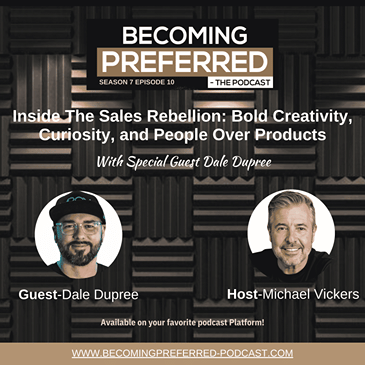
SEASON: 7 EPISODE: 10
Episode Overview:
Welcome back to Becoming Preferred, the podcast where we share with entrepreneurs and business professionals the mindset, strategies, tactics and frameworks to help you level up your game and become the best version of you.
When was the last time you were genuinely excited to talk to a salesperson? Probably never, right? Most sales processes are boring, transactional, and full of tired scripts like 'just checking in.'
My guest today turned that entire industry on its head. Dale Dupree spent 13 years in the brutally competitive world of copier sales. A space known for cold calls and quick hang-ups. But instead of playing by the old rules, he created a movement called The Sales Rebellion. He broke industry records by putting people over products, community over commission checks, and replacing generic pitches with unforgettable experiences.
Whether you're a founder trying to break through digital noise, a team leader looking to inspire your reps, or an entrepreneur ready to stand out, today’s episode is packed with practical strategies to help you disrupt the status quo and 'choose legendary.' Please join me for my conversation with Dale Dupree.
Guest Bio:
Dale Dupree was once known as The Copier Warrior as he spent 13 years making a boring copier sales process, the most fun anyone in the buying world has ever had. While also breaking company and industry wide records, gaining recognition globally. In 2019 he left the corporate world to become a much louder voice in the sales world and pursue a different kind of life. Dale is born and raised in Orlando, Florida. A 3rd generation Orlandoian, but don’t get it twisted, this does not mean he lives at Disney.
Dale has a sales background that dates back to his childhood, as he was raised wandering the halls of his father's business but has been a full-time sales professional since 2007. Dale now provides selling services, sales training and personal development through The Sales Rebellion, a movement that challenges the status quo and gives Hope back to the sales profession. He is audacious with his outreach, intentional in his sales walk, and driven to create a community of sales professionals that cause undeniable curiosity and true impact in their daily life with prospects and clients alike by teaching the masses how to choose legendary in their sales career. The Rebellion believes in people over products, community over commission checks, fellowship over negotiations and giving an experience over performing a pitch.
Resource Links:
- Website: www.thesalesrebellion.com
- Product Link: www.crumpledletter.com
Insight Gold Timestamps:
04:33 I had toner coursing through my bloodstream when I came out of the womb and was just destined to sell copy machines
07:18 What I learned from my father was I learned a whole different methodology of selling
09:47 I still sucked in the early stages trying to find my voice, my authenticity, my knack
11:31 You're famous for your audacious outreach for sure
15:57 So, to your point, it's about getting attention
17:00 LinkedIn is to some people still kind of like a a placeholder for their resume or a mini website
19:45 I am so old school around the idea of human connection and the human experience, that I usually tend to just lean into that more so than the digital side
22:27 When you're not working 60 hours a week, what do you do for fun?
26:49 Even when you're a preferred provider you have to still remember that the people that you seek to serve they operate their business through profit and on a budget
30:53 So, I always like to use their currency
31:27 An abundance mindset I think is the most important thing
33:58 If you have a prospect that's not responding to you...
40:56 How do we overcome the fear of audacity?
45:50 Let's talk about the experience over the pitch
49:32 There's a lot of different ways that the front desk person, reception, greeter, whatever we're calling them these days, can really benefit us
52:00 I believe there's more power in delighting a person than there is in making them feel like they're a tool or they're part of your sales process
52:56 The website is the salesrebellion.com
54:20 The more that you can tap into this idea of being brilliantly yourself, the further you'll get on those platforms
Connect Socially:
LinkedIn: linkedin.com/in/copierwarrior
Email: dale@thesalesrebellion.com
Sponsors:
Rainmaker LeadGen Platform Demo: https://calendar.summit-learning.com/widget/booking/JKItVP7WErmCBjU2cCIx
Rainmaker Digital Solutions: https://www.rainmakerdigitalsolutions.com/
In 3, 2, 1.
Speaker BWelcome back to Becoming Preferred, the podcast where we share with entrepreneurs and business professionals the mindset, strategies, tactics and frameworks.
Speaker CTo help you level up your game.
Speaker BAnd become the best version of you.
Speaker CWhen was the last time you were.
Speaker BGenuinely excited to talk to a salesperson?
Speaker CProbably never, right?
Speaker BMost sales processes are boring, transactional, and full of tired scripts like just checking in.
Speaker BMy guest today turned that entire industry.
Speaker BGil Dupree spent 13 years in the brutally competitive world of copier sales, a space known for cold calls and quick hangouts.
Speaker BBut instead of playing by the old rules, he created a movement called the Sales Rebellion.
Speaker BHe broke industry records by putting people over products, community over commission checks, and replacing generic pitches with unforgettable experiences.
Speaker BWhether you're a founder trying to break through digital noise, a team leader looking to inspire your reps, or an entrepreneur ready to stand, today's episode is packed with practical strategies to help you disrupt the status quo and choose legendary.
Speaker BPlease join me for my conversation with Dale Dupre.
Speaker CWell, hey, Dale, welcome to the program.
Speaker CWe're delighted to have you.
Speaker AThanks for having me.
Speaker CWell, I'm excited about this.
Speaker CYou're a sales coach and trainer and after my own heart, you know, I've been at it a long time and I love to see that people with winning strategies, tactics for frameworks, evolving it.
Speaker CAnd you've really done a great job.
Speaker CAnd we're going to be talking the website's thesales rebellion.com but I want to talk about your tactics.
Speaker CI want to talk about your approach.
Speaker CI want to talk about how you've seen the evolution of selling, how it's evolved because you've been at it now for probably close to 20 years, I think professionally.
Speaker CAnd let's, let's go back to high school.
Speaker CDale, you're in high school.
Speaker CWhere are you living and what do you want to be when you grow up?
Speaker AIn high school, I'm so, I'm homeschooled.
Speaker AI'm in Orlando, Florida.
Speaker AI'm actually starting my first band in a garage with a couple of my friends.
Speaker AAnd I'd been playing music for a few years prior to at this point with like my cousin in his garage, but nothing real serious.
Speaker ABut now I'm dreaming of being a musician and touring and writing albums and getting on a major record label, which actually cut like my, my college years completely out because I, I pursued that lifestyle of playing music all the way through my senior year and ended up getting signed to a major record label and making music, my profession from about 17 years old and until about 21, 22, really.
Speaker CI would know.
Speaker CWhat was your instrument?
Speaker CAre you probably a guitar player?
Speaker CDid you have chops too?
Speaker AMy dad played the guitar and so I learned the guitar as well.
Speaker ABut I had the.
Speaker AJust the innate ability to play music, if you will, Slash.
Speaker AUnderstand rhythm, understand the art.
Speaker ASo I stood on a drum set even though I, I suck.
Speaker AI'm.
Speaker AI'm not that good.
Speaker AI could play with you.
Speaker AI could play in the church band.
Speaker AThat's how I used to joke, like, yeah, I can play in the church, man, that's not a problem.
Speaker ABut like, I wrote some of the riffs.
Speaker AI was very fun in the studio, if you will, or during the writing process because I had a big personality and a big opinion.
Speaker ASo there was lots of, hey, let's try this, let's do that.
Speaker AI got very involved with all the instruments, but main instrument of the band was that I sang.
Speaker AI was the vocalist.
Speaker CSmart.
Speaker CWell, if I had to do it all over again, I think I would have gone into music.
Speaker CI, you know, I. I never really was that talented.
Speaker CMy dad was professional musician, played with all the big bands back in those days and 40s and 50s.
Speaker CSo I grew up with music, just never had the skill set.
Speaker CBut what's nice about music is you learn structure.
Speaker CAnd I think if you've been trained and you've had any kind of training whatsoever, that kind of structure goes into our.
Speaker COurselves.
Speaker CIt's math, really.
Speaker CI mean, music to me.
Speaker CAnd so how did that then evolve?
Speaker CSo you're going along in your career, you decided, okay, the band, the music career lasted for a little while.
Speaker CSomething obviously happened that decided to get into business and you started to get into a career of selling.
Speaker CUnpack that one for us.
Speaker APretty simple, although weird.
Speaker AMy.
Speaker AMy father actually started a copier sales and service organization in the.
Speaker AIn the 80s.
Speaker A1984.
Speaker AAnd then I was actually born in 1985.
Speaker ASo lucky for me, I had toner coursing through my bloodstream when I came out of the womb and was just destined to sell copy machines.
Speaker AIt's kind of just that simple.
Speaker ASo I made my way back after spending 4, 5, 6 solid years playing music, dealing with the drama, dealing with the drugs, the alcohol, the promiscuity.
Speaker AAnd ultimately, even though I was just like as any other human would be very susceptible to those things, I was also able to put the right head on my shoulders, if you will, and make the decisions that were necessary in order to get myself out of that stuff.
Speaker AIs kind of the bottom Line, which is what I did.
Speaker AI just, I left and I started selling.
Speaker CWell, that's kind of goes with the culture and with the different bands and it's a demanding life and times have changed for sure.
Speaker CI think you were probably at the peak of it because it started going downhill.
Speaker CYou know, it's interesting you mentioned copiers because I know your firm and your dad's company.
Speaker CYou guys were Xerox dealers back in those days.
Speaker CAnd I started my training career.
Speaker CKind of like what you're doing.
Speaker CYou're as old as my eldest daughter and she was born in 85, but actually Xerox was one of my first clients and they had a program called PFS or PFS, professional selling skills.
Speaker CPFSs, I guess.
Speaker CAnd so your dad probably had that program that was something done on a national level.
Speaker CSo you started to come in and work for your dad or working within the organization.
Speaker CBut you didn't just, you know, get there from a nepotism point of you had some ability too because you, you killed it.
Speaker CYou were crushing it.
Speaker CWhat was your thinking at that time?
Speaker COkay, I'm going to get into sales.
Speaker CWas it a temporary role for you or did you have a longer term perspective of it?
Speaker ASo my dad actually sold Konica Minolta.
Speaker AHis original gig was Kyocera Mita, which is sharp technically.
Speaker CRight.
Speaker AThey were like the color version of, of Kyocera, if you will.
Speaker ABut he did.
Speaker AIt's funny that you mentioned Xerox because he did.
Speaker AHe trained for Xerox all over the United States because he was so good at selling.
Speaker AAnd it wasn't a whole lot of training.
Speaker ABut it's.
Speaker AI never knew that up until after my father passed away.
Speaker AActually I found out that information and actually it was like way after I even started this company and I happened to be with one of like his really old friends who was like, man, just crazy that you're out training coffee.
Speaker AYour guys.
Speaker AYou know, your dad did that for like two or three years like on the side while he was, you know, selling.
Speaker AAnd I, I was like, what?
Speaker ABut that generation would have been fud.
Speaker AThat's what my dad learned.
Speaker AAnd he hated it.
Speaker AYeah, so, so what's interesting about that, that timeline.
Speaker AAnd then what I learned from my father was I learned a whole different methodology of selling, if you will.
Speaker AAnd that methodology being relationships first, curiosity at the forefront, everything being about the value add ultimately, especially like back in the 80s and 90s when my dad was really developing his business.
Speaker ASo walking away from business was highly acceptable to my Father just dependent on the fit, not trying to force things, but finding the right folks.
Speaker AAnd so when I jumped in with him, it was kind of already a natural state of where I lived, if you will.
Speaker CYeah.
Speaker ASo it was easy for me to lean into his methodology of very non traditional selling in such a very blood in the water, sharks in the water type of sales structure that most people sold through.
Speaker ASo like, so I'm in this territory, there's 22 other people per se.
Speaker AThat's the number that I usually use that I'm up against in like every single sale.
Speaker AAnd these guys are just like racing to the bottom and just doing all the craziest things you could possibly imagine.
Speaker AThe way they're trying to get people to sign paperwork by agreeing to an appointment, by like signing a signature on a piece of paper.
Speaker ALike just crazy stuff, man.
Speaker AAnd then there was me, where my father was teaching me transparency.
Speaker AI was showing people the fine print of lease agreements which was like a big no, no, don't show people that, that's crazy.
Speaker AThey' if you see all the things we put in here.
Speaker AAnd my dad just treated the sales cycle much differently because that I treated it much differently as well too.
Speaker AAnd I stood out so well.
Speaker CWell, it's a tough day.
Speaker CAnd what was interesting about that industry, I worked with a lot of the different companies, Pitney, Bowes, Minolta, Canon, some of the different companies, just as a sales training organization.
Speaker CAnd they seem to close most of their deals just in the last week of the month.
Speaker CIt was always like that.
Speaker CLast week of the month is when 89.
Speaker CWhich drove a sales manager nuts just because they did it.
Speaker CNow you spent 13 years, I think in, in copier sales.
Speaker CSo it's a space famous for cold calls, quick hangups, and you became legendary.
Speaker CWhat was the moment you realized that traditional sales tactics were broken and what did you replace them with?
Speaker AYeah, so I, I, I completely broke the script altogether.
Speaker AMy first two years were still not the greatest, if you will, even though I had a better upbringing around the sales tactics that I used, if you want to even call them that.
Speaker ABut I still sucked in the early stages, trying to find my voice, my authenticity, my, my knack, if you will, where I fit in, who I fit in with.
Speaker AAnd I was trying to force my, you know, the round peg into the square hole way too many times kind of thing.
Speaker AAnd it was, it was an interesting time in my life.
Speaker ALots of learning, lots of failure.
Speaker AAnd in those first two years I had so much growth and self development for myself.
Speaker AI didn't know what to do with it, to be quite frank with you.
Speaker ABut the one thing that was very clear is I needed to differentiate myself.
Speaker ASo I built a personal brand, first and foremost called the Copier Warrior.
Speaker AAnd I, like, got props.
Speaker ASo I had a sword, I had hats that said Copier Warrior on them.
Speaker AWith me, like swinging the sword.
Speaker AI mean, I went all in.
Speaker AAnd all of a sudden, in these traditional sales cycles of banging the phone and knocking on the door and leaving a business card and a 50 page brochure and a cut sheet, and I was taking people like toner bottles that were half exploded with notes that were like, I can fix this for you, and bricks to throw at their copy machines.
Speaker AAnd it's pretty wild time.
Speaker AAnd I used a lot of pretty intense methodology overall in order to get people's attention and give them an experience unlike anybody else was giving them.
Speaker CNo.
Speaker CWell, I think you moved it.
Speaker CAnd you were kind of ahead of yourself because you moved from pitching products to focus on the human being across the desk from you.
Speaker CSo you shipped from commoditized vendor to a trusted advisor, which is where we're trying to educate and get people to go to today.
Speaker CLike, trusted advisor is going to show them all the ins and outs, the nuances, the clauses that they should be worried about, what should be there, all of those types of things.
Speaker CWell, you're famous for your audacious outreach, for sure, like the crumpled letter technique or how entrepreneurs can break through today's overwhelming digital noise without coming across as gimmicky.
Speaker CCan you unpack some of those for us and give us some of the top performers?
Speaker CWhat worked?
Speaker CWell?
Speaker AYeah, I learned from some pretty tight circles this idea of the gimmick, which I have nothing against.
Speaker AI just ultimately, it's not really, like authentic to me.
Speaker AAnd how I sell is the idea.
Speaker AAnd some people think of my stuff as gimmicks too, and I totally accept that and understand that perception.
Speaker ABut what I learned was like sending people shoes and telling them, now that I got a foot in the door, can I get a meeting?
Speaker AWhich is incredibly clever and really fun.
Speaker ABut I wanted to build.
Speaker AThere were three things.
Speaker AI'll tell you my exact formula.
Speaker AThe first is nostalgia.
Speaker AAttached to nostalgia.
Speaker AWhat I was trying to create is familiarity or moments that they can rationalize and reason through because they've experienced them to some capacity.
Speaker ANostalgia is attached to that just because at the base, or the foundation, if you will, of how I build out my experiences, I want people to have an emotion of familiarity and in most cases, when you can tap into nostalgia, you create a very memorable moment for people within that.
Speaker AThe second piece of all that is curiosity and not cleverness.
Speaker AOkay?
Speaker AThe goal here is to really drive someone to say, I gotta keep experiencing this, or I need to get to the end or I should reach out because I want to know more is the concept.
Speaker AAnd the difference between that, to me and, like, being clever is it's exactly like I just said.
Speaker AIt's you send a shoe.
Speaker AThat's clever.
Speaker AMaybe I'll take an appointment, maybe I won't.
Speaker ABut if I can create a moment of undeniable curiosity in a human, they'll say yes 99% of the time.
Speaker AEven.
Speaker AEven if they say yes with a caveat like, hey, I'll talk to you or I'll meet with you, but I have no need for what you sell either.
Speaker AAt this moment.
Speaker CThey want to know.
Speaker CYeah, they want.
Speaker AThey truly do.
Speaker ASo the third piece of that is that everything to me has got to always be diy, if you will, or created is the concept, right?
Speaker ASo.
Speaker ASo I never wanted to just simply go buy a shoe that somebody else made.
Speaker AI wanted to, like, sit in my lab, right?
Speaker APut some glue to some stuff and, you know, I spend my time on it and really commit intentionally to those moments.
Speaker CWell, they've forgetting attention.
Speaker CI think it works.
Speaker CYou know, I remember one time when I first got clued into this.
Speaker CThis is why I love.
Speaker CI was delighted to have you come on the show is one day, and this was over a decade ago, maybe 15 years ago.
Speaker CI get a FedEx and open up the FedEx, and there's a $50 bill in it.
Speaker CAnd it's from a sales guy who wants 20 minutes of my time.
Speaker CAnd he goes, hey, I know your time's worth a lot more than this, but at least have lunch on me or whatever.
Speaker CI just love 20 minutes of your time.
Speaker CI want to put my money where my mouth is.
Speaker CI've got a solution.
Speaker CI met with the guy, ended up buying from the guy.
Speaker CBut he got my attention.
Speaker CI didn't want to give back the 50 bucks.
Speaker CI felt bad.
Speaker CAnd he used what I call that trigger of reciprocity.
Speaker CHe gave me something, and it was like, okay, well, I kind of want the 50 bucks.
Speaker CI don't mind giving him 20 minutes for.
Speaker CIt'll be a nice lunch or two, right?
Speaker CAnd take care of it.
Speaker CI've seen it work with.
Speaker CI remember we had an oil and gas client that got fired.
Speaker CA gas, oil and gas services company.
Speaker CThey got Fired by their big oil company, cost them a ton of money.
Speaker CBut they were not looking after the relationships, they weren't looking after the company.
Speaker CSo they hired us, engaged us and said, hey, what can we do?
Speaker CHow can we do it?
Speaker CSo we actually had a tombstone made, an actual tombstone.
Speaker CAnd.
Speaker CAnd I think it goes to where you're talking about, let's call it, I don't want to use the word gimmick, but authentically on a one to one basis, create something because some things you can work in mass, other things not.
Speaker CBut understand and read your client.
Speaker CSo we sent in the tombstone with the birth of the relationship and the death of it.
Speaker CAnd one day and we actually delivered this $2,000 tombstone that was engraved and all done, sorry for the relationship.
Speaker CAnd we had a nice little slogan on it.
Speaker CThen the next day we had all these storks show up.
Speaker CThen we filled the room with storks, were being delivered with the baby, brand new baby that we're going to now work hard to earn your trust back again and grow that relationship.
Speaker CThe birth of a new relationship.
Speaker CBut it got the attention and they were in the penalty box for a good year.
Speaker CBut then they got back and won the client again.
Speaker CAnd so to your point, it's about getting attention.
Speaker CAnother one I remember we had was I found out that somebody does on a personal level you like to fly fish.
Speaker CSo I contacted a fly fishing shop in Jackson Hole, Wyoming.
Speaker CFound the floor, five top flies that were well known.
Speaker CI put these on a little card and I sent it to them.
Speaker CJust saying what these do for your trout?
Speaker CBecause they had the brand of that and it was not expensive.
Speaker CWe can do for your or you know, blah blah, blah.
Speaker CAnd they pick up the phone and they give you phone calls.
Speaker CSo I think it's personalizing on a one to one basis.
Speaker CAnd with LinkedIn, I mean do you have any strategies for.
Speaker CLinkedIn tells people's personal, their interest, who they like to read.
Speaker CWe got a trove of information.
Speaker CHow do you discover those kinds of things?
Speaker AYeah, LinkedIn is an interesting platform overall.
Speaker AI've been on it since 2017, posting content every day.
Speaker AAnd so I've seen the ups and downs of the platform over the last nine years.
Speaker AWhat works, what doesn't.
Speaker AJust like anybody else that's put the time in.
Speaker AAnd I would say two things.
Speaker AOne is that LinkedIn is to some people still kind of like a, a placeholder for their resume or a mini website of selling information, if you will not always can you get onto somebody's LinkedIn and learn things that you can learn about me as an example, there's still a very small group of people that put things that go beyond the surface as information inside of their LinkedIn.
Speaker AAnd when it, when it comes to like using LinkedIn for outreach, me personally, I think it works the best to cultivate a community more so than a client base.
Speaker ABut really, I think that all businesses, if they were really operating based around what their brand could achieve for them more so than their product or their service, I think everybody would see the alliance of LinkedIn through a different light and that if you approach LinkedIn to be more of a place where people could commune, they can agree with or even disagree with opinions and ideas around specific subjects and topics regarding business and leadership and sales or whatever that you have a big opinion on.
Speaker AYeah, I think that it does, it works, I should say wonders for the people on the outside looking in to build that and cultivate that community piece that if I were to pick up the phone and call somebody that's in my comments or who follows me and has been for a few years, and I've seen them like, you know, a few different posts here and there said, hey, this is dale Dupree from LinkedIn.
Speaker AI don't have to cold call that person.
Speaker AYeah, oh, hey.
Speaker AUsually the kind of response that you get in those moments, you know, So I believe that it can be used as an inbound and an outbound engine.
Speaker AI believe that it can be used as, through enablement tools like, as a great enrichment tool for data regarding, you know, personal information about people, very deep information about their businesses, what's going on in their business life.
Speaker ABut unfortunately it's still like a hit or miss thing.
Speaker AYou know, what you can really rely on and depend on in 2026 is the very local, communal type concept and how you approach businesses that if you go to like the local luncheon, you're going to meet Tammy or Nick from ABC Company and sure, they may be a representative, but gosh, I mean, you can still get more information from the two of them that you can on the Internet.
Speaker AYou know, like they got a softball team, they, they give to these two charities.
Speaker AOnce a year they have a breakfast for all their clients.
Speaker AEverybody's invited.
Speaker AYou know, there's just so much information that you can still find by finding that in person, connection with organizations.
Speaker AAnd so even though I love LinkedIn and I love the digital realm, I'm, I'm a hater all at the same time, right.
Speaker AAnd that I, I just, I am so old school around the idea of human connection and the human experience that I usually tend to just lean into that more so than the digital side.
Speaker CNo, it makes sense.
Speaker CWell, it's your core philosophy, people over products.
Speaker COne of the core tenets of the sales rebellion is people over product, community over commission checks.
Speaker CSo how does an entrepreneur scale a business with this mindset when quarterly targets and revenue pressures are looming?
Speaker AWell, the thing about that is, is that the more that you're focused on profit, the more that you're focused on margin, the more that you're focused on new business, more business, et cetera, the harder it is to achieve those things, quite, quite frankly.
Speaker ABut the more that I'm focused on not selling a copy machine, not selling my services, not winning the deal because I was the lowest price, not worrying so much about my monthly quota and just like cramming as much in as I possibly can, then I don't have to close all my deals the last week of the month, right?
Speaker AThen I.
Speaker AAnd then I don't have to focus so much on this scarcity and this chasing mindset around money and revenue.
Speaker AAnd really what I can focus more on is that hey, this is going to take time, it's going to suck at times, we're going to lose money.
Speaker ABut if I can cultivate something very long term that has 200 people that buy from me consistently and spend, let's just say 50 grand a year, that's a lot of money.
Speaker AI think when people just try to, instead of thinking so much about the margins and thinking so much about like I need a million dollar business, I need a $5 million business, I need a $10 million business.
Speaker AAnd instead say I want to do what I love, I want to cultivate community, I want to culture relationships through that, I want to serve others and I do it with excellence.
Speaker AThat if they stay in those core tenants, then it comes back to that piece, that quote that you just read, which is that people are more important.
Speaker AAnd sure, like at some point that definitely changes for you in regards to those same people that you place on a proverbial pedestal from a service standpoint, they will give you money.
Speaker CMan, I really like your approach and how you can continually to nurture a relationship as well.
Speaker CYou know, a question I'll ask.
Speaker CMatter of fact, I detail in one of my books where I met with this engineer, big engineering firm.
Speaker CIt was an important gig.
Speaker CBut the guy I'm talking to in the meeting, he's just stone faced great poker player, I can't read him I'm thinking, boy, he just wants me out of here.
Speaker CAnd I call this the Columbo question now.
Speaker CBut we get to the door, and I reach out to shake his hand, and I said, his name is Roger.
Speaker CI said, roger, when you're not working 12 hours a day, when you're not working 60 hours a week, what do you do for fun?
Speaker CAnd he stopped and he said, well, come here, I'll show you.
Speaker CAnd he had one of those whiteboards that opens up.
Speaker CAnd he opens up the whiteboard, and it was full of mountains and pictures of him on mountains and maps and.
Speaker CAnd, well, bingo, I know I got this guy.
Speaker CAnd now for the next half hour, he comes alive, and he's talking.
Speaker CI can see his passion, why he works and most of us work so we can do more of what we love.
Speaker CI like to fly airplanes.
Speaker CI like to go fly fishing.
Speaker CI work so I can do that.
Speaker CI want to work with, hang out with my kids.
Speaker CThat's why we work.
Speaker CSo anyway, bottom line is, I knew a mountain climber, climbed Everest immediately got in my car, sent him a book from that called Power and Passion from these Everest Climbers.
Speaker CThen went and checked my CRM database, and I had six other executives into technical mountain climbing.
Speaker CI called up.
Speaker CHis name was Lori Screslit, first Canadian to ever climb Everest.
Speaker CAnd I said to him, hey, how much would you charge me for doing a workshop, technical workshop for mountain climber executives that can hire you?
Speaker CAnd he goes, you've supplied the expenses.
Speaker CYou cover the costs.
Speaker CI'll do it for you.
Speaker CPhoned up Roger and said, hey, would you be interested in attending?
Speaker CI had six for six show up.
Speaker CI ended up landing that contract.
Speaker CAnd three months later, I get a call from one of my consultant buddies.
Speaker CAnd he said, what did you guys have on Roger?
Speaker CJenks, his name was Jenks.
Speaker CAnd I said, oh, nothing.
Speaker BWhy?
Speaker CAnd he goes, why?
Speaker CI was in the meeting when you got awarded the contract, and I've never seen a guy so enthusiastic about awarding a contract as he did yours.
Speaker CAnd speaking of your company, and I'm going, oh, no, just good stuff.
Speaker CLike, really, you know, appropriate stuff.
Speaker CI've seen that time and time again where.
Speaker CAnd it's easier.
Speaker CI'm coming at it from the corporate end of it, but I always like to ask them what they do for fun.
Speaker CAnd if you remember the TV show Columbo, he used to get there with a cigar, he'd ask you questions.
Speaker CHe was sloppy.
Speaker CHe'd get to the door and he'd look back and he'd go Dale.
Speaker CHe goes, one more question.
Speaker CAnd that was the one that hung you.
Speaker CAnd he'd get you.
Speaker CSo I always ask him, what do you do for fun when you're not working 60 hours a week?
Speaker CAnd I keep that in the database.
Speaker CAnd it could be, you know, with another major corporation.
Speaker CWe talk yoga.
Speaker CAnother one it's whiskey.
Speaker CAnother one it's cigars.
Speaker CAnother.
Speaker CI always like to know what it is that they like to do.
Speaker CAnd that's where I do those gimmicks, if you will, or the I call them high touches.
Speaker CSo things that are exceeding expectations.
Speaker CI love your idea of nostalgia, something nostalgic that brings them back to the past or something causes them to be curious.
Speaker CBut that's what you're talking about.
Speaker CYou're talking about enhancing a relationship and then using the tools to do it.
Speaker CAre there some?
Speaker CDoes that make sense to you?
Speaker CDoes anyone unpack there?
Speaker ANo, I think you said it very well.
Speaker DAre you tired of chasing leads and ready to start effortlessly attracting more more high value clients?
Speaker DIntroducing Rainmaker Lead Gen, the ultimate sales, engagement and client acquisition platform that takes the stress out of outreach.
Speaker DWith Rainmaker Lead Gen, you can easily identify, engage, educate and convert your ideal prospects into loyal clients.
Speaker DOur industry leading automation and email sequencing empowers you to reach more ideal clients, accelerate the sounds of cycle and close more business.
Speaker DImagine authentically engaging with your prospects while the platform handles the heavy lifting.
Speaker DSay goodbye to the endless hustle and embrace a more efficient, effective approach to business development.
Speaker DReady to witness the magic?
Speaker DBook a 20 minute demo today and see how Rainmaker Lead Gen can revolutionize and level up your client acquisition game.
Speaker DThere's nothing to lose and and everything to gain.
Speaker DDon't miss out on this opportunity to supercharge your client acquisition process.
Speaker DVisit rainmakerdigitalsolutions.com or check out the link in the show notes to book your demo.
Speaker DRainmaker Lead Gen Spend less time hunting for your ideal clients and more time having high value sales conversations with your ideal clients.
Speaker BAnd now back to my conversation with Dale Dupre.
Speaker CLet me ask you this question.
Speaker CIt's really uncovering needs.
Speaker COur listeners want to become the preferred choice in their markets and in a negotiation.
Speaker CHow do you move the conversation away from price?
Speaker CBecause today with AI tools, with price whatever towards true value and fellowship.
Speaker CYou talked about value add and I think you're on the right path with that there.
Speaker CHow do you get off of that pricing conversation?
Speaker CBecause that's an issue for so many people.
Speaker AYeah, I think that even when you're a preferred provider that you have to still remember that the people that you seek to serve, they operate their business through profit and on a budget.
Speaker AI just try to tell everybody that in the negotiation stage or the closing stages, it's important not to think of those areas as some kind of process or a workflow even, but to just be very blunt and honest with individuals that, like, as an example, if I sell my time as a coach, I tell a person it's a thousand dollars an hour.
Speaker AWell, on the other side of listening to that, I mean, you're.
Speaker AYou're looking at me right now.
Speaker AI mean, I live in the woods, in a.
Speaker AIn a cabin in the middle of nowhere.
Speaker AAnd, you know, I have no overhead.
Speaker AIt is, by the way, I have no overhead.
Speaker AI have no office.
Speaker AI sure, I have employees.
Speaker AAnd sure, we have some software bills here and there, but we're genuinely some of the best at making that affordable.
Speaker ALike, we don't have a lot of money associated to that.
Speaker AOr I should say earmark for that thousand dollars an hour that you're giving me.
Speaker AA lot of that is profit.
Speaker AIf I was to tell you that that was my price.
Speaker ASo if I'm on the other side listening to someone, I really want to sell, but I'm perceiving the cost of something that they're charging me to be kind of extravagant to an example, I'm going to start to eliminate why I should pay that.
Speaker AThat person is kind of the idea.
Speaker AAnd so I'm going to say things like, well, I don't really feel like funding Dale's lifestyle and he can do what he wants, and if he can get that kind of money, that's great, but probably not for me.
Speaker ASo this is typically where negotiations take place, is in a person's doubt and ultimately in a place where you have to meet that individual where they are, as opposed to forcing them to meet you.
Speaker ASo if I tell somebody I'm $1,000 an hour, it's not really meeting them where they are, is it?
Speaker ABut if I'm able to have conversations where I can get them to tell me We've got a $20,000 budget this year and I can then build something appropriate, effective, valuable for that amount of money, then there is no negotiation.
Speaker AThere is no race to the bottom.
Speaker AThere is no worry about what the budget looks like.
Speaker AIt's more or less just, hey, well, usually I charge 100 grand, but here's what I could do at 19,800.
Speaker AAnd if that's a stretch for you, and ultimately down Here, what I built for you isn't a value to you.
Speaker AThere's no harm, no foul.
Speaker AI'm not going to be offended.
Speaker AWe can go our separate ways, but most of the time, because of the way that we break that down as sellers and then we meet another person, where they are, if you will, principally, everything works out really well.
Speaker CNo, I agree with you 100% with the price.
Speaker CI've always worked with premium companies, so never the discounter.
Speaker CAnd the question I would ask, and I ask it every time, are you looking for the lowest acquisition costs or are you looking for the best total value?
Speaker CAnd most people don't want to look cheap.
Speaker CIf they say, I just want the lowest acquisition costs, I say I'm probably not it.
Speaker CSo let me ask you a couple questions.
Speaker CWhat's your budget?
Speaker CAnd I'll point you in another direction.
Speaker CAnd I take it away from them immediately.
Speaker COr they say, we're looking for the best total value.
Speaker CAnd I said, terrific, Then what's the outcome that you're looking for?
Speaker CThe other thing I like to do is I like to $.
Speaker CSo if you told me a thousand an hour, what I would in my mind right away is I want to use your own currency.
Speaker CSo in our world, and you would get this, as a musician, we call our speaking and training gigs.
Speaker CI know you probably still call it, I get a gig.
Speaker CAnd we're.
Speaker CI'm a wannabe musician, so we, we definitely just call my gig.
Speaker CBut what I do now is I use that currency.
Speaker CSo let's say you made mountain bikes.
Speaker CI would say to you, figure out your mountain bikes, how much you charge for, how many are you currently doing.
Speaker CAnd just so in one hour I could help you sell 10% more mountain bikes, I've now quantified what that hour is worth.
Speaker CWhat would that be worth doing?
Speaker CIf your bikes are at $8,000 apiece and you're making 5,000 in profit margin or 4,000 on the bike, whatever.
Speaker CYou got the math on that.
Speaker CYou've got 30, $40,000.
Speaker CMy thousand all of a sudden becomes insignificant.
Speaker CSo I always like to use their currency.
Speaker CWhen I work with oil companies, I use barrels of oil because they understand that they get that where money sometimes is a tough one.
Speaker CDo you have any strategies along that line?
Speaker CIn other words, in your mind, does that make sense and anything else that might add to that one?
Speaker AYeah, I mean, I look at budget very simply, that there's a lot of people that can't afford what you want them to pay.
Speaker AAnd for every single person that can afford what you want them to pay.
Speaker ADeeply down into that number, there is someone that will.
Speaker AAnd so an abundance mindset, I think, is the most important thing that, for me, a tactic or a workflow inside of negotiating with people.
Speaker AI think the line we tend to walk is the persuasive or manipulative tactic inside of our communication.
Speaker AI love to just tell a person, hey, up front, we're about 20 grand for this particular service.
Speaker AYou can tell me right now if that's too much money, and we can figure out whether or not there's another place for you to fit.
Speaker ABut ultimately, it's okay if you're not able to pay that amount inside of the project that you're looking to achieve.
Speaker AI just want you to know up front before we get started and you get super excited about everything that you're about to see, and then think to yourself, oh, shoot, I can't pay that.
Speaker AIt helps us both with this next 15 to 25 minutes.
Speaker AI love the idea of just being blunt and honest.
Speaker AAnd there's plenty of people out there that have $150,000 budget for training.
Speaker AAnd look, we don't really do as much training as we teach people the creative side of outbound, and we do it for them.
Speaker ASo in most cases, what a company hires us to do is, A, to teach their people how to essentially understand our creative mindset, but B, to trigger and turn on our mail room for them to start sending those crazy, wonky concepts that we talked a little bit about earlier that are giving relevant and familiar experiences to people that are causing them to stop in their tracks.
Speaker AAnd remember a guy named Max.
Speaker AAnd so when Max calls and says, hey, this is Max at ABC company.
Speaker AI sent you that little trash can in the mail.
Speaker AWanted to see if you got it.
Speaker AThat in tandem with me teaching Max these interrupt concepts.
Speaker ABut ultimately, this creativity and this human approach to sales, I'm also fulfilling for those same people.
Speaker AAnd I think what happens is that most people see very quickly that we don't really change anything in the way that they present themselves or communication styles.
Speaker AI mean, you could stumble right through that first call.
Speaker ABut what they do notice is the way that they're received differently.
Speaker CYeah.
Speaker AAnd it causes people to think different.
Speaker AThey start thinking less about how can I use shield tactics or how can I persuade people as much as they start to think, wow, if I can just give a really good experience and be very, like, blunt with my experience, that people most likely will change course.
Speaker AAs an example, just to anybody listening, it's like, well, what is, what does that look like if you have a prospect that's not responding to you?
Speaker AOne of the most favorite and now most famous things that I've come up with is an empty donut box that back in 2011, 2010, I constructed for the first time out of pure frustration with a client that had ghosted me for the third or fourth freaking meeting in a room, set it on my calendar.
Speaker AI went all the way to their office, waited in their waiting room for 30 plus minutes and was told they're not going to make it.
Speaker AAnd on that third, fourth trip, I went to Dunkin Donuts, bought a dozen donuts.
Speaker AI gave all of the donuts to the reps at my office, the technicians in my office.
Speaker AI crumbled up a little piece of one and stuck it down in the bottom and smeared the icing and I took.
Speaker AWas looking for a red Sharpie and couldn't find one.
Speaker AAnd actually somebody that works in my office had red lipstick at the time.
Speaker AAnd I wrote in the most unhinged font in red lipstick, hey, I ate these donuts waiting for you to meet with me because they were going stale.
Speaker ASorry.
Speaker AIt was kind of like the message, right?
Speaker AAnd I delivered that and I heard back from that guy literally in the parking lot when I was leaving his office after he told his friend to ask to tell me that he couldn't meet.
Speaker ARight.
Speaker AAnd it was a very blunt way to be honest with somebody in a way that's still human and has a little bit of empathy attached to it and ultimately is real, you know, so.
Speaker CI think the authenticity is the the and pull off, which actually raises a good question.
Speaker CSo a lot of our listeners and entrepreneurs, they are trying to break through that noise and a lot of times they'll make one pitch and they're done.
Speaker CThey don't have anything.
Speaker CSo I, you know, we try and encourage them to really qualify your client.
Speaker CBut let's say you've got somebody really, really qualified.
Speaker CIs there a budget range, in other words?
Speaker CLet's say we want to use your Rebel as a service and I think you called it ras, where you will handle that fulfillment based on obviously the sale price.
Speaker CSo if something's a thousand dollar item, a $20,000 item, or whatever the case is, that acquisition cost, what's a good rule of thumb?
Speaker CAnd what kinds of things can they do within a certain budget?
Speaker CAnd what, what would be the, I would call it, let's call it the close rate or the confirmation rate.
Speaker CLike what have you seen be, you know, before new client comes on board, they start doing some things to gain attention with highly qualified leads.
Speaker CAnd then what are some of the outcomes?
Speaker CWhat are the transformations that you see?
Speaker AYeah, I can very bluntly tell you that we on a low end, we charge about 40 to $45 per mailed item.
Speaker AAnd then we typically recommend people pick anywhere between 75 and 150 prospects.
Speaker AAnd it's a very low number.
Speaker AAnd then the goal is over the course of the next 90 to 120 days to elicit a response from 100% of that group.
Speaker AAnd now the response rates go anywhere between at the lowest, about 30% and at the highest, about 70, 75% at this stage when executing these concepts for people that we serve.
Speaker ABut regardless, like your cost of acquisition, just depending on like if you're selling a subscription for $99 a year, we're not a good fit.
Speaker AIf you sell something that makes you $5,000 per sale, it's very low cost of acquisition if you think about it.
Speaker AAnd really what we tell people is so on that low end, it'll work on some of the most hard to reach people.
Speaker ABut what we tell folks is that if you're willing to pay a little bit more per item, we'll build something that's very brand centric to what it is that you're putting out into the ecosystem of the B2B space.
Speaker AHow you want people to perceive you, brand colors, brand recognition.
Speaker ABut ultimately everything is wired around the experience.
Speaker ASo we don't throw your logo on everything.
Speaker AIt's a highly curated touchpiece meant for the 75, 150, 200 people that it goes to.
Speaker AAnd that's why they're impactful and that they work.
Speaker AAnd we get such a high response rate because, I mean, even our, some of our working groups right now we're like at a 17% response rate, which will get up to 25, 35%, you know, at some point in the future before the contract is up.
Speaker ARight.
Speaker ABut even in those low numbers, I mean, most of those people were getting 3 to 5% returns on outreach.
Speaker AAnd that's cold calling, cold email, the traditional mediums, if you will, and using a lot of volume, so burning through their tam, you know, just kind of like disrupting their own marketplace, if you will, in a bad way.
Speaker CSo how do you get around the.
Speaker CSome companies, major companies, enterprise, have policies against, you can't give something, you can't even give a mug with your logo on it.
Speaker CAnd I love the way you phrase it from an interrupting point of view.
Speaker CSo to me, like for instance, I use books because I'm working with the C level.
Speaker CI love to get the latest books, the business books, whatever they are.
Speaker CAnd I'll send that, maybe it's one I wrote, but I'll usually find something that's top selling author and I'll do a little book summary to it and I'll send the CEO executive with my card inside.
Speaker CSo it's really about the book.
Speaker CSo I'm not branding or using something along those lines.
Speaker CAnd usually you can get a phone call, at least get a conversation for a meeting or a reference or I'm using a connection to get to a connection.
Speaker CDo you run into that when it comes to, hey, there are certain things that we can do that just bypass all scrutiny.
Speaker CIt gets on their desk and you know, they're laughing about it or they go, hey, this is cool.
Speaker CYeah, I'm going to give this guy 30 minutes.
Speaker CWhatever they're requesting.
Speaker AYeah.
Speaker ASo I sold into government for a very long time, as you probably know.
Speaker CYeah.
Speaker AAnd the vertical of even like the defense and aerospace world and anybody that's a contractor with the government there, you know, I sold copiers to the world's largest privately held tank and gun museum that also happened to be a manufacturer of weapons for the United States military and other weapons, if you will, for other militaries across the world.
Speaker AAnd you're right, you can't send somebody a gift.
Speaker AThat's the literal verbiage.
Speaker APeople cannot receive an item that can be perceived as a gift.
Speaker ASo instead of a box of donuts as an example used earlier, if I send an empty box with a note inside that says, hey, I bought these donuts for our first meeting, but it's been like six months and I've, I've been met with nothing but your voicemail and it looks like you blocked me in your emails, so I had to eat these because they were going stale.
Speaker ABut I hope to connect with you soon.
Speaker AThen I'm on that person's radar.
Speaker ALike.
Speaker AYeah, yeah, that too.
Speaker AI'll be at the gym for the next three weeks working this off, but hopefully I'll get to chat with you at some point.
Speaker CWell, I think again, it's coming up with some different ideas.
Speaker CI remember seeing one of our sales ladies worked for our organization, trying to get in, they were getting going and this is before all the technology, before emails even.
Speaker CAnd she sent a beautiful fork that was all done, had it engraved and she sent a little thing, said, I want your business so bad.
Speaker CI can taste it.
Speaker CAnd she got a phone call, she got a phone call back again.
Speaker CSo it was kind of novel, but it's finding something that maybe that they can relate to.
Speaker CHow do we overcome the fear of audacity?
Speaker CYou know, many founders, sales professionals, struggle with the fear of rejection or they worry about looking unprofessional and trying bold sales ideas.
Speaker CHow do you help reps across, you know, across that bridge to choose Legendary.
Speaker ASo those guys and girls have to help themselves.
Speaker AIt's not my decision to make, unfortunately for all of us, because if it was my decision, we'd all be doing it right.
Speaker AIt's kind of the bottom line, but yeah, because it is something that is so unique but beneficial.
Speaker ABut the benefit is not understood until experienced.
Speaker AAnd most people don't want to have that as an experience under their belt because they fear it.
Speaker ASo I, I, I think it's less of a fear of audacity as well.
Speaker AAnd it's more of a self conscious thing.
Speaker AIt's more of a, what will this person think of me?
Speaker AIt's more of a, whoa, what if they tell my company something and they fire me?
Speaker AIt's like it's a lot of things webbed up into the mind that just cause congestion in general and it hard to think clearly about the concept.
Speaker AWhat I tell people that are listening, that are thinking to themselves, I could never send an empty donut box, is that I've secured billion dollar accounts with CFOs that are untouchable in most people's minds by being more audacious than you.
Speaker AAnd so if you're tired of silence being the soundtrack of your sales career and you're sick of being stuck in places that you've been stuck in for generations, even that you gotta look at something like what we do and think to yourself, am I willing?
Speaker AMore so than anything else.
Speaker AAnd not what could Dale say to convince me?
Speaker ABecause I'll tell you right now, I won't.
Speaker AAnd it's not my job.
Speaker AWhat my job is, is to shake the hands of the people that walk over our threshold and say, I'm willing to take this, do this.
Speaker AThat's, that's what we do.
Speaker AAnd so until people have chosen to overcome that fear, then I can't help them choose.
Speaker ALegendary.
Speaker AI get it.
Speaker CIt's that old, what will people think of me?
Speaker CI mean, I remember launching this podcast.
Speaker CI fought it for several years.
Speaker CI'm going, oh, it's going to suck.
Speaker CYou know, we're on season seven now and it's our Response has been great, it's been a great tool and it's a learning curve.
Speaker CObviously there's a big learning curve, but I think it's the key is to, you know, find something that gets attention.
Speaker CHow do we break through all that noise?
Speaker CAre there organizations or companies where it doesn't work?
Speaker CIn other words, don't do this, don't use these strategies in this business.
Speaker COr are there some good rules of thumb that, you know, smaller the company do this, bigger the company, are there, are there kind of like some guiding principles?
Speaker AIt's a great question.
Speaker ASo there, there isn't anything that we recommend that you don't use for one and that you do use for another.
Speaker ABut strategically, if we're to meet people where they are, like if I'm trying to sell to IT professionals, an example, and I incorporate dusty Cheeto fingers from late night snacking and energy drinks, trying to wake yourself up at 2 in the morning for an emergency hack on your network, then you will find a familiar moment in that and I will invoke the recognition of nostalgia, if you will, to some extent.
Speaker ASo there's definitely a strategy behind the art.
Speaker AYeah, but at the same time we tell everybody, you know, don't overthink that part of the process.
Speaker AI mean, that's why people hire us a, because we have the experience to be able to say, well, here's what we've done with those particular groups that you're talking about consecutively to make something work.
Speaker ABut at the same time, I've seen everything work to some extent.
Speaker CSo well, we spend all kinds of money and budget on trinkets and trash, which, you know, if you give me a water bottle with your logo on it, I'm not going to use it.
Speaker CYou give me a jacket, I'm not going to wear it.
Speaker CAnd I find pushback all the time on that stuff.
Speaker CIt's nice, but I'll hand it off and give it to somebody.
Speaker CIf you give me one that's framed clear, I think it's practical.
Speaker CI'm going, okay, got my attention.
Speaker COr maybe something inside it, you know, that gets my attention.
Speaker CSo that makes sense to me.
Speaker CLet's talk about.
Speaker CSo basically get over the what will people think of me?
Speaker CBecause the worst case scenario is no.
Speaker CIt's kind of like asking the pretty girl out.
Speaker CYou know, in college I found that, you know, no one asked the pretty girls out there.
Speaker CWas scared of the rejection.
Speaker CGuys had no game today.
Speaker CThey swipe right.
Speaker CSo they're terrible at it.
Speaker CBut in my day, and probably Your too.
Speaker CWe had to, hey, make the approach and face that possible rejection.
Speaker CBut at least people know you, right?
Speaker CAnd people would know you that way.
Speaker CSo I've seen all kinds of different things and calculators and all kinds of, let's call them gimmicks or gifts or what do you call them?
Speaker CAttention getters?
Speaker CDo you have a generic term for them?
Speaker AYeah, we call them devices is really what we call them.
Speaker AAnd I stole that right.
Speaker AFrom Stu Hynek, my mentor.
Speaker AWe call them devices and experiences.
Speaker AThose are the two ways that we identify them.
Speaker CYeah.
Speaker CYeah, that's good.
Speaker CWell, let's talk about the experience over the pitch.
Speaker CYou talk about giving an experience rather than performing a pitch.
Speaker CWhat does an experience driven discovery call look like in practice?
Speaker ASo the concept looks like this in a nutshell, and I'll do this in 30 seconds, is if I'm doing the dog and pony show and I'm selling copy machines, which, by the way, this still happens, even if it happens digitally.
Speaker APeople still want to see, like, the function of a machine, believe it or not, in 2026.
Speaker ARight.
Speaker AA demo is what we used to call them.
Speaker ARight.
Speaker ASo if you come into my office and you're coming to see my product, there's two tracks.
Speaker AThere's the track that, like everybody else runs on, which is, here's the features, here's the advantages, the benefits, here's this, here's that.
Speaker ASo bring one of your jobs in, you know, and these are all.
Speaker AAll well and dandy, but how do I stand out from the other 22 people that I'm selling against if I sound exactly the same?
Speaker ASo an experience is.
Speaker AIs that they come in and that first and foremost, there's always.
Speaker ASo our owner, Steve Klopp, he did a great job at.
Speaker AHe always had chocolate chip cookies ready to go.
Speaker AAnd, you know, he'd say that the famous North American Caron Alley chocolate chip cookies, they were really just famous.
Speaker AAmos is what they were.
Speaker ABut so you'd come into, like, warm, sugary goodness and you'd do a tour of the office.
Speaker ABut the difference between our tour of the offices is that we had the employees very interactive with people.
Speaker AAnd so the concept was like, you walk to a wall and you can see all 100 employees and their top five things they wanted to experience in life.
Speaker AAnd just like, very int.
Speaker AUltimate communication, if you will, through the experience.
Speaker ABut then imagine you come to the demo room instead of the typical dog and pony show that, you know.
Speaker AAnd this is.
Speaker AI encourage people to do this all the time.
Speaker AIn 2026 especially.
Speaker ABut imagine like the first thing you show somebody is the copy machine jamming instead of it like working.
Speaker ABecause the jam is what everyone experiences but no one wants to really talk about.
Speaker ARight?
Speaker CYeah.
Speaker CSo when it does.
Speaker CWhen it does.
Speaker CNot if it does, it's when it does.
Speaker CYeah.
Speaker ASo if I can just take people to that emotional place in a few different ways and a few different experiences.
Speaker AMy favorite being, again, the.
Speaker ALet's have the machine jam and show someone how to clear it and actually have them do the clearing and ask them, hey, was that much different than your current machine?
Speaker AWhat are your thoughts?
Speaker AA whole nother conversation.
Speaker CNo, it's brilliant.
Speaker CI actually saw a copier guy one time and this is going back back when things weren't so politically correct and he had, based on the machine, he had different copies of the butt or of somebody's butt and showing the clarity of the butt.
Speaker CSo this was done on this machine.
Speaker CThis was done for your best, but this was it.
Speaker CAnd it was all buts and pictures of butts.
Speaker CAnd then of course, this was prior to color, you know, thank goodness.
Speaker CBut anyway, it's, it's, it's really about breaking that attention and getting that, getting that through there.
Speaker CLast question I have for our time's moving.
Speaker CQuick navigating industry gatekeepers.
Speaker CGatekeepers are usually viewed as that obstacle and how do we get past?
Speaker CSo how does the sales rebellion approach, you know, from a training and coaching point of view, gatekeepers differently to build some momentum in an organization?
Speaker AYeah, that the number one way that we approach it differently is we don't even use the term.
Speaker AWe tell people two things.
Speaker AOne is the power of words.
Speaker ASo if we call somebody, you know, the window witch or the gatekeeper, we're like immediately creating a negative moment for ourselves more so than anybody else.
Speaker AThey're never going to know that we called them these things.
Speaker ABut.
Speaker ABut I promise it will have a negative outcome on the result.
Speaker ATotally.
Speaker AYou get it.
Speaker ASo, so if I start with words matter and that this person is more important than kind of how we label them, that you never know.
Speaker AThis could be the aunt of the owner.
Speaker AIt could be a, a, an intern that got so good at their job that they became very close knit to the organization and are trusted, you know, in more ways than we realize.
Speaker ALike there's a lot of different ways that the front desk person, reception greeter, whatever we're calling them these days can really benefit us because they know they have the pulse of the organization.
Speaker AThey know everything.
Speaker ASo if I can Help this person have the same type of experience that I'm trying to give to Kevin or Ashley or whoever is my contact at that organization and treat that person like an equal and ultimately just ask for help through that process, that they will think of us differently through that experience, and they will help us greatly in our conquest of new business and trying to find new people to serve.
Speaker CNo, it makes sense.
Speaker CI do a little Thanks a latte.
Speaker CSo I'll ask help.
Speaker CI'll call up the receptionist and I'll just sit there and I'll go, they don't know that.
Speaker CWe don't know who it is.
Speaker CSo if I was calling up from, I'm going to meet the executive Dale Dupre, I'd go, hey, it's Michael Vickers calling with Summit Learning Systems.
Speaker CHey, how's it going?
Speaker CGood morning.
Speaker CHey, we want to do something special for Dale.
Speaker CWe don't know if he's got a birthday coming up or a special event.
Speaker CWe want to do something unique, but we don't want to tell him, and we want to surprise him.
Speaker CAnd I said, we're kind of looking at anything personally that you're aware of, that he's.
Speaker CAny hobbies or something that he just loves, he's passionate about.
Speaker CWe just really want to do.
Speaker CThey don't know that there's been an existing relationship or not an existing relationship.
Speaker CAnd literally 90% of the time they go, oh, yeah, he's into this, or, yeah, well, he's restoring a Aston Martin automobile, or he's into old classic cars, or he's into.
Speaker CAnd then we send her a thank you, a thanks a lot date so she can go redeem it at a Starbucks or favorite coffee shop, which we can do.
Speaker CAnd we have an automated process for that.
Speaker CAnd then we'll go and actually do the homework.
Speaker CAnd we get phone calls back.
Speaker CAnd I've literally landed some huge contracts just by finding out what it is that they do for fun.
Speaker CWhat is it that they're hot?
Speaker CBecause again, we're working to do more of what we love to do.
Speaker CIf we had all the money in the world, we might not be working.
Speaker CSo any other strategies on figuring out, hey, what's the.
Speaker CThis one's going to knock them dead?
Speaker COr is it just trial and error and go, let's try this approach.
Speaker CIs there something as simple that they can do, listeners do that?
Speaker CMaybe hand out to them and say, because I will.
Speaker CThey can go to your website.
Speaker CThey can find out all the different things that you do, who's the right kind of customer for you.
Speaker CAnd what would be something if they can't quite afford you at this point, what could they do in the meantime?
Speaker AYeah, no, I think you nailed the perspective of really just trying to delight people.
Speaker AIs really that the concept, the core concept of the Rebellion?
Speaker AI believe there's more power in delighting a person than there is and making them feel like they're a tool or they're part of your sales process.
Speaker ABut delighting is something that we can all, from a human experience standpoint, get behind.
Speaker ASo I just encourage people to think that if, if they're trying to delight the people that they seek to serve, they're going to have better outcomes.
Speaker AAnd those are the people that we work with the best, or the people that they don't fear audacity or the idea of being different, but they also don't look at it as some kind of shortcut or even a strategy.
Speaker ABut they see it as like, you know what, this just makes sense from the perspective of what's normal and natural that we've gotten so far away from in the business world that we can tap back into through our organization and partnering with somebody like the sales rebellion.
Speaker AThat's, that's really what makes our, our best fit.
Speaker COh, perfect.
Speaker CHey.
Speaker CWell, Dell, this was certainly insightful.
Speaker CLots of great things in here and value that people can use.
Speaker CI know they can reach you on LinkedIn, but the website is thesalesrebellion.com and by the way, you've got, I mean, you're approaching a hundred thousand followers and connections on LinkedIn.
Speaker CThey always want to know because we do talk about that.
Speaker CWhat's been the secret of getting that and scaling that the day?
Speaker ALook, I have never really subscribed to a strategy or any kind of scaling and I didn't know I was going to be where I am today to any capacity, nor was I really pushing for it.
Speaker AI just simply believed in something bigger than myself.
Speaker AAnd I used that belief system to motivate me on a daily basis to do the things that are necessary from a hard work standpoint.
Speaker AAnd also, I think it's very important that people understand that social media is a living place.
Speaker AIt's an ecosystem.
Speaker AIt has an algorithm that is very intelligent, that understands what it's doing.
Speaker AAnd even if it frustrates you, it knows it's frustrating you, I promise you.
Speaker AAnd, and it's less of playing the games of the algorithm or falling victim to the algorithm and more of, well, don't forget that the, the social media world is developed for people.
Speaker AIt's for people to come to, to feel connected, to find information, to build a community.
Speaker AAnd if you can tap into that part of people, the way you write, not just your own post too, or the comments that you respond to on your post, but other people's writing, other people's thoughts, other people's expertise.
Speaker AThe more that you can tap into this idea of being brilliantly yourself, yeah, the further you'll get on those platforms.
Speaker CThat message comes louder and clearer.
Speaker CAnd you obviously practice what you preach.
Speaker CSales rebellion.com hey, thanks for doing this Dale.
Speaker CReally great stuff.
Speaker CI'm looking forward to following more of it.
Speaker CAnd we'll check out your services as well.
Speaker CSo I think you're onto something great there.
Speaker CThanks for being here.
Speaker CAppreciate your time.
Speaker AThank you.
Speaker BMichael as you are listening to this episode, what is one idea that you've heard that's caught your attention and why does it matter so much to you?
Speaker BAnd who is one person who you can share that with, either sharing this episode or just sharing that insight that occurred to you while you were listening?
Speaker BPerhaps it is that shifting from product pitching to creating memorable human created experience creates undeniable brand differentiation.
Speaker BOr maybe it's that front desk, reception and gatekeepers are not obstacles to bypass, but key partners who hold the pulse of the organization and should be treated as equals.
Speaker BThank you for listening, for learning, and for investing in yourself so that you can become the best version of you.
Speaker BIf you found value in this episode, please write a review on Apple Podcasts.
Speaker BIf you haven't subscribed yet, please do so so you can get a new episode and start your week off right every Monday.
Speaker BUntil next time.
Speaker BThis podcast is created and associated with Summit Media.
Speaker BMy executive producer is Beth Smith and Director of Research, Tori Smith.
Speaker BThe fee for the show is that.
Speaker CYou share it with friends when you.
Speaker BFind something useful or interesting.
Speaker BThis podcast is subject to copyright by Summit Media.
Speaker AGoodbye.