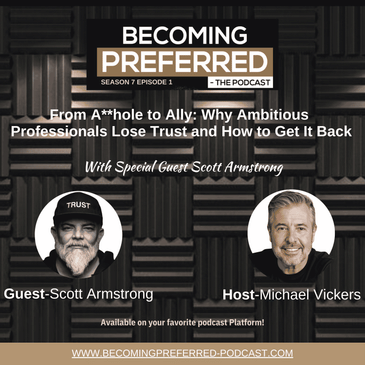
SEASON: 7 EPISODE: 1
Episode Overview:
Welcome back to Becoming Preferred, the podcast designed to help ambitious business professionals and entrepreneurs build unshakeable client trust, scale their impact, and become preferred in the markets they serve.
If you run a professional services firm, an agency, or a consulting practice, you’ve likely fallen into a very common trap: you try to win clients by being the smartest person in the room. You show up to pitches armed with deep expertise and immediate answers, only to wonder why the client chose someone else.
Our guest today says that over-indexing on your own 'smartness' is the fastest way to kill a deal. Scott Armstrong is a marketing veteran, global agency founder who scaled his business to over twenty-two million dollars, and the mastermind behind Win The Question.
He is also a self-reformed 'expert' who learned how to build trust the hard way. His upcoming book, From Asshole to Ally, is a field manual on how highly qualified professionals accidentally lose trust and exactly how to get it back. Today, we’re unpacking how to stop relying on rare 'rainmakers,' how to coach trust as a tactical skill across your entire team, and how to shift from pitching answers to truly winning the question. Please join me for my conversation with Scott Armstrong.
Guest Bio:
R. "Scott" Armstrong has spent 38 years learning what most ambitious professionals figure out the hard way: it's not about you. Scott is the founder of Win The Question, where he teaches ambitious professionals how to build trust by reducing their natural self-orientation and working to win the question before the answer.
Scott's book "From Asshole to Ally: How Ambitious Professionals Lose Trust and How To Get It Back" is the field manual and it will be launch in the fall. He lives at the end of a dirt road in Creemore where he trusts his neighbors and his motorcycle.
Resource Links:
- Website: winthequestion.com
- Product Link: https://www.winthequestion.com/book
Insight Gold Timestamps:
02:20 I hadn't really learned yet how to build trust, I just learned how to hustle
04:27 Trust has a math to it, or professional services trust at least has a math to it
05:15 Trust is really the shift from about me to about you
07:31 Your upcoming book has a brilliantly provocative title, From Asshole to Ally
10:30 What does it mean to win the question in a high-stakes client meeting?
12:12 Stephen Covey's fifth habit, "Seek first to understand, then seek to be understood."
14:23 Often the managing partner or the leader of the firm doesn't even really know what skills they're using successfully to build trust
16:28 Ask before you answer
17:05 You should be learning from my mistakes rather than my successes
20:28 At the top of my page, I just put a little reminder, "Shut up," that's my first prep note
22:38 Using that methodology, we lost a $10 million account in a review, and won it all back and more 12 months later
25:08 Give me 45 minutes to come and have a conversation, and then we'll craft a perfect solution for you based on that conversation
27:52 He was better at asking questions than I was, and his big win question's a real simple one
31:30 One of the things I like about your podcast is how much research you all do
34:05 Bottom line is if you're putting deposits into that relationship bank account on an ongoing basis, they don't divorce you when the proverbial hits the fan
37:49 The tagline for that company is not go fast, don't die, it's really go fast, go far
39:47 You might have a weather forecast, but it can change
42:10 You can literally these days run Otter on a call or in the meeting itself... after the meeting is over, will tell you not only how often did you speak versus when your client spoke...
42:49 The book is From Asshole to Ally: Why Ambitious Professionals Lose Trust and How to Get It Back by Scott Armstrong. (available Q4)
43:33 Scott Armstrong at winthequestion.com
Connect Socially:
LinkedIn: https://www.linkedin.com/in/rscottarmstrong/
Email: scott@thewtq.com
Sponsors:
Rainmaker LeadGen Platform Demo: https://calendar.summit-learning.com/widget/booking/JKItVP7WErmCBjU2cCIx
Rainmaker Digital Solutions: https://www.rainmakerdigitalsolutions.com/
In 3, 2, 1.
Speaker BWelcome back to Becoming Preferred, the podcast designed to help ambitious business professionals and entrepreneurs build unshakable client trust, scale their impact, and become preferred in the markets they serve.
Speaker BIf you run a professional services firm, an agency, or a consulting practice, you've likely fallen into a very common trap.
Speaker BYou try to win clients by being the smartest person in the room.
Speaker BYou show up to pitches armed with deep expertise, immediate answers, only to wonder why the client chose someone else.
Speaker BOur guest today says that over indexing on your own smartness is the fastest way to kill a deal.
Speaker BScott Armstrong is a marketing veteran global agency founder who scaled his business to over $22 million and the mastermind behind Win the Question.
Speaker BHe is also a self reformed expert who learned how to build trust the hard way.
Speaker BHis upcoming book, From Asshole to Ally is a field manual on how highly qualified professionals lose trust and exactly how to get it back.
Speaker BToday we're unpacking how to stop relying on rare rainmakers, how to coach trust as a tactical skill across your entire team, and how to shift from pitching answers to truly winning the question.
Speaker BPlease join me for my conversation with Scott Armstrong.
Speaker CWell, hey Scott, welcome to the program.
Speaker CWe're delighted to have you.
Speaker DThanks for having me on, Michael.
Speaker CI'm really intrigued about our topic today and what we're going to be talking about.
Speaker CAnd we're going to talk about how you can start winning the question and how we can build trust.
Speaker CAnd you've got a new book coming out, which I'm not sure if this gets, you know, blurbed out or not, but From Asshole to Ally.
Speaker CSo we're going to talk about that and why the title of the book, but hey, kind of makes sense to me.
Speaker CBut before we get started, Scott, let's go back.
Speaker CYou're in high school.
Speaker CWhere are you living?
Speaker CWhat's Scott want to be when he grows up?
Speaker DSure, I was a nice, curious, small town kid who did well in school.
Speaker DI did well and had a lot of fun in college.
Speaker DAnd then I got into the ad business.
Speaker DSo I spent about 20 years working mad Men style and advertising and I had lots of success there, moving down to Chicago until I didn't.
Speaker DAnd it all kind of came crashing down because I thought I was the smartest guy in the room and I hadn't really learned yet how to build trust.
Speaker DI just learned how to hustle.
Speaker DSo much so that the creative teams used to tease me and call me, I don't.
Speaker DHustle and jingle, I think is what they called me because they could Hear me running down the hallways to try to win business.
Speaker DAnd that's a hard way to get to the next level.
Speaker DSo that's kind of why I crashed and burned.
Speaker CIt's interesting.
Speaker CWhen did you discover that trust was really the secret formula and how we build trust?
Speaker CBecause a lot of people, they talk about it, hey, we got to have trust.
Speaker CAnd I believe it's the foundation of all relationships.
Speaker CRight?
Speaker CYou got to have trust.
Speaker CCan we have a relationship without trust?
Speaker CYou can, but you lose to one where trust exists.
Speaker CSo where did you discover that?
Speaker CAnd then what are some of the ways we can build trust quickly?
Speaker DSo I had this amazing president at Ynar Chicago, and I was trying to win Miller Brewing as an ad account.
Speaker DGreat account, pretty high stakes.
Speaker DAnd so I was so focused on that, I was running around being the asshole myself in the title of the book or I was being a jerk.
Speaker DIf we want to use it, keep it clean.
Speaker DAnd.
Speaker DBut she used the A word to describe me in her office when she said, no one's going to want to work for you or with you and clients are going to like you if you keep on this trajectory.
Speaker DAnd I trusted her a lot then.
Speaker DAnd so that hurt.
Speaker DThat really shook my whole world to get feedback like that.
Speaker DAnd I don't know if in your career you've hit a moment where it just sort of shook your foundations, but it shook my foundations.
Speaker CNo, I think it's important.
Speaker CThose are the catalysts.
Speaker CThose are.
Speaker CAnd once you realize it and go, you know what?
Speaker CThat's correct.
Speaker CYou know, I really love the byline on your website where it's field tested trust training for ambitious professionals smart enough to need it.
Speaker CAnd in other words, it's an awareness issue.
Speaker CThey don't even understand that it's there.
Speaker CAnd I'm curious about how you see the process because we try and get new clients.
Speaker CYou work with professional firms, and we haven't evolved like we should evolve with.
Speaker CTechnology's evolved, but we're still back there peddling services.
Speaker CAnd how do we evolve it?
Speaker CWhat's your state of the unit?
Speaker CWhat are you saying?
Speaker CBecause I know you're right in the thick of it.
Speaker CHow would you define it?
Speaker DWell, trust has a math to it.
Speaker DOr professional services trust at least has a math to it.
Speaker DSo everything you bring to the table as an ambitious professional, you know, your credibility, your reliability, how much you know the client and the industry, all of that gets divided by how much you make the conversation about proving you know all that stuff as opposed to focusing on what you're learning about your client and how you can use all that expertise to help them.
Speaker DSo if you can reduce that denominator in that equation, you can build professional trust.
Speaker DAnd getting through school in the early part of your career focuses on the top line.
Speaker DIt focuses on credibility and reliability and delivery.
Speaker DAnd all those are table stakes.
Speaker DOnce you get to a certain point, trust is everything else.
Speaker DAnd trust is really the shift from about me to about you.
Speaker CIf you look at most websites and it's all about them, and it's really about them, people are brochures.
Speaker CHere's how great we are, here's how wonderful we are.
Speaker CAnd I love the term, and I believe you're referencing it as self orientation.
Speaker CYou talked about math.
Speaker CI love formulas.
Speaker CAnd you have trust equals C plus R plus I divided by self orientation.
Speaker CCan you unpack that for us?
Speaker DYeah, sure.
Speaker DSo the.
Speaker DThe C is the credibility, and R is reliability, and I is intimacy, or how much you know your client and how much your client is relying on your expertise.
Speaker DBut as soon as you turn that conversation back to proving what you know, you not only stop talking about your client in constructive way, but you often leave them behind.
Speaker DYou know, a great example is a doctor.
Speaker DI don't know anything about medicine, and I usually.
Speaker DI'm not all that certain when I go into a doctor's office.
Speaker DThat's why I'm there.
Speaker DLike, I'm sick or there's something wrong or my case, I've broken a shoulder or an elbow or a wrist riding or skiing or all the stuff I do on the side.
Speaker DAnd so when I show up with a doctor, I'm saying, hey, this is my situation.
Speaker DThese are my problems.
Speaker DAnd what I first want to do is I want to be heard.
Speaker DI want to make sure the doctor understands exactly what I'm saying is wrong with me.
Speaker DRight.
Speaker DI know.
Speaker DFor example, I was riding down in Mojave, the bike crashed.
Speaker DI separated my shoulder.
Speaker DI knew my shoulder was separated.
Speaker DAnd it had been a month riding after that separation before I got back into the doctor's office.
Speaker DI want the doctors slow down and really hear the whole story and get me as a part of the diagnosis before they jump to a solution that says, okay, you.
Speaker DYou need a cast or you need a pill or you need whatever else.
Speaker DI mean, I'm already doing physio every day on my own.
Speaker DWhat I really want is to work together on the solution because I know my body just like my clients know their business.
Speaker CYeah, you're collaborating.
Speaker CDiagnosis before prescription is malpractice.
Speaker COr prescription before diagnosis.
Speaker CSo it's, you want to be properly diagnosed, and then what's the right solution for me to.
Speaker CAnd my body customer.
Speaker CAnd that works the same way for businesses as well.
Speaker CI know you get that your upcoming book has a brilliantly provocative title, From Asshole to Ally.
Speaker CYou argue that the very path of becoming a highly qualified professional actually trains us to lose client trust.
Speaker CWhy is being the smartest person in the room often a massive liability in a business development?
Speaker DWell, there's a couple of ways to look at that question.
Speaker DI'd start with something they call the curse of knowledge.
Speaker DAnd that is once you know something really well as an expert, it becomes really hard to understand it as someone who's not an expert.
Speaker CRight.
Speaker DAnd even harder to explain it and have some empathy around it.
Speaker DAnd so when you're an expert, you jump to jargon and shortcuts.
Speaker DLike the example of the doctor is the same example I feel when I go see my business lawyer or my accountants or consultants or even the ad guys that I've worked with or the high performers on my team.
Speaker DAnd so you really need to slow down those high performers and have them recognize when their knowledge is a curse as opposed to an advantage in building understanding and knowledge with your client.
Speaker CIs it about the rapport?
Speaker CIs it about the.
Speaker CIf I'm.
Speaker CAnd we have to watch that even as speakers, like, we come in and the keys to be authentic, you know, when we're delivering from the stage, as you know, because you do what I do and we have to connect with that audience.
Speaker CSo we need to be relatable and then maybe tell them about our journey.
Speaker CHey, I've been where you've been.
Speaker CHere are the questions I've asked.
Speaker CHere's the solutions.
Speaker CAnd we're kind of sharing that.
Speaker CIs that kind of what you're referencing?
Speaker DI think that's a lot.
Speaker DBut it's not about charm school.
Speaker DLike the.
Speaker DThe ad folks in the world are the weirdos in the business conversation.
Speaker DAnd I definitely sit in the iconoclastic zone of professionals.
Speaker DI usually wear this baseball and usually wear this black shirt.
Speaker DDoesn't matter what the meeting is.
Speaker CThe hat says go fast.
Speaker CDon't die for those who are listening.
Speaker CSo.
Speaker DRight.
Speaker BRight.
Speaker DOr something.
Speaker DSomething saucy.
Speaker DRight.
Speaker DThat's part of my personality.
Speaker DAnd it's going to show up as part of the conversation if I'm being authentic to myself.
Speaker DSo it's not about charm.
Speaker DIt's really the numbers prove it out.
Speaker DSo.
Speaker DAnd they're super rude.
Speaker DThe top performers in Client conversations talk about 43% of the time and people who lose deals talk about 65% of the time in climbing.
Speaker DRight.
Speaker DSo it's really how much am I making a client's briefing or a client talking about their situation or their need about me and what I know versus how much am I really trying to listen to better understand what they're telling me?
Speaker DAnd then framing up my answer.
Speaker DI call it trust framing.
Speaker DSo framing up my answers, my understanding of the problem in the language they gave me to prove that I was listening to them in the first place.
Speaker CNo, that makes sense.
Speaker CYou talk about a critical shift that every successful professional must make moving from trying to win the answer to winning the question.
Speaker CWhat does it mean to win the question in a high stakes client meeting?
Speaker DYeah, I can tell you a little story.
Speaker DSo I was at Y and R Chicago.
Speaker DWe were pitching United Global Airline account.
Speaker DAnd Y and R was a global business.
Speaker DSo I brought about 12, flew 12 people into Chicago to present our credentials and our capabilities and our thinking in this giant deck.
Speaker DThe binder was 2 inches wide.
Speaker DAnd we were pitching against Fallon out of Minneapolis.
Speaker DIt was a small shop.
Speaker DThey didn't bring a big deck.
Speaker DThey brought three people into the meeting room.
Speaker DWe had a presentation.
Speaker DFallon had a conversation.
Speaker DThey didn't even have a global agency.
Speaker DIn fact, one of their promises was, if you give us the global business, we'll launch a global agency to support it.
Speaker DMy pitch was, we are the global agency.
Speaker DYou want to work with Fallon.
Speaker DOne interesting, right?
Speaker DThey walked in as the likable, listening, empathetic and really authentic team.
Speaker DMy team was introducing themselves to each other as we were walking in the room to pitch the client.
Speaker DAnd the client clearly said, I want to work with the people who seem much more trustable and authentic than the people who seem like they've got lots of high powered credentials, but I'm not even sure those are going to be in the people in my business when the pitch is over.
Speaker CNo.
Speaker CYeah.
Speaker CAnd you see that a lot.
Speaker CThere are people coming in there.
Speaker CIt's all about them.
Speaker CAnd that's why I say I like the term you're using.
Speaker CThat or self orientation or it's about me where really it needs to be about them and ask the questions.
Speaker CYou know, I love the Stephen Covey's fifth habit.
Speaker CSeek first to understand, then seek to be understood.
Speaker CAnd I think that should be a tattoo for every professional is right on their forehead.
Speaker CSeek first to understand before you prescribe.
Speaker CAnd they've got to know, hey, we might not be a fit for you.
Speaker CThanks for doing this meeting, Scott.
Speaker CNot sure we're a perfect fit.
Speaker CThat's why we have these meetings.
Speaker CWe prepared some questions which we'd love to ask you mind if I ask questions?
Speaker CThen people don't mind answering those questions.
Speaker CIt's interesting.
Speaker CI'll give you an example because I'd love your comment on this because you're a speaker like I am.
Speaker CWe get committees will phone us up and go, hey, we were interviewing three or four speakers and we'd like to interview you to see if you're right for our particular engagement.
Speaker CSo I'll come online, there'll be a zoom call with four or five people on the call and they'll say to me, why should we hire you?
Speaker CWe're looking at others, but why should we hire you?
Speaker CAnd most people will jump in on this.
Speaker CAnd I go, my now response is, you know, going through the.
Speaker CSome things you talk about are you might not want to hire us, we might not be a perfect fit.
Speaker CMind if I ask you a few questions first which will help fine tune and tailor our 30 minutes together so that you have enough information to make the right choice.
Speaker CAnd they're going, sure.
Speaker CSo then my next question is, I want you to imagine the event is over.
Speaker CI want you imagine it's done.
Speaker CThey've had a great time, great location, they've been well fed, they've been educated.
Speaker CYou're interviewing your team on the way out the door.
Speaker CWhat do you want them thinking about?
Speaker CDo you want them doing?
Speaker CWhat do you want them feeling?
Speaker CAnd then I shut up.
Speaker CThey then start telling me all the outcomes that they're desiring for which I'm making little notes of, which go right into the presentation because they're actually telling me this is what the outcomes we're looking for.
Speaker CSo it's really about identifying those outcomes is that, I mean you can see where that just works.
Speaker CSo how are you finding that when it comes to teaching that within organization?
Speaker CBecause you go into organizations, you look at their existing processes.
Speaker CI'm assuming you map that out what they do, listen to the questions they are asking or what they're mostly telling about.
Speaker CHow do you solve the problem, how do you entrench that skill?
Speaker CAnd then there's different levels of the skill within an organization.
Speaker DYeah, I keep it simpler than that.
Speaker DSo I'm sort of like a quick hit.
Speaker DYou've already got an ambitious high performing teams, you want to try to get them to the next level.
Speaker DAnd often the managing partner or the leader of the firm doesn't even really know what skills they're using successfully to build trust and how they've changed their self orientation over time to win.
Speaker DAnd so when I go in to work with a team, the first thing is having them discover they're self oriented in lots of these conversations.
Speaker DAnd it's really easy to do.
Speaker DYou get them play acting, a client conversation, and you get everybody to watch this, this rehearsal or this play acting at the front of the room.
Speaker DAnd usually by the third question they're asking their new client, they're turning it into what they know, or even worse, what they can do to solve that problem.
Speaker DAnd then I just say, stop.
Speaker DLook at how quickly we got there.
Speaker DAnd then the second thing I point out is how eager the person playing the advisor was to interrupt and get their words into the conversation instead of slowing down and letting the client who's thinking on the spot about all these questions.
Speaker DAnd it's not a professional in law or banking or advertising or whatever else, formulating their thoughts.
Speaker DAnd I teach them, hey, count to five to seven seconds after they finish answering.
Speaker DAnd more times than not, that client will keep talking and they'll tell you more at a deeper level than they did in their first answer.
Speaker CYeah, or tell me more about that.
Speaker CTell me more, tell me more.
Speaker CWhy is it important to you?
Speaker CWhy is that important to you?
Speaker D100%.
Speaker DAnd it's active.
Speaker DYou know the five whys of Toyota, right?
Speaker DJust dive deeper and deeper.
Speaker DBut the mechanism they need to get there is to take that, that need to prove their credentials off their shoulder and say, you're already in the room.
Speaker DYou're in this conversation because you're qualified.
Speaker DNow you need to create client value.
Speaker DAnd I show them four skills they can use to do that.
Speaker DThe first is ask before you answer.
Speaker DSo really slow down the conversation.
Speaker DAsk a lot of questions before you jump in with a solution.
Speaker DBecause your client might be having a practical conversation with you where they want to figure out where a project is or how much it'll cost or what timeline is.
Speaker DBut the more senior you get, the more those conversations become nuanced.
Speaker DAnd your client might want to have an emotional conversation with you where they're sharing their worry about the project or their excitement about the project.
Speaker DAnd if you jump in with budget, which I've done countless times to my discredit in client, I've done more mistakes like you should be learning from my mistakes rather than my successes.
Speaker DTo be honest, it took me 20 years to get good at this.
Speaker DRight?
Speaker DIt's only the last 10 years that I've really become a better client whisperer.
Speaker DSo the first is ask, not answer.
Speaker DThe the second is listen to understand.
Speaker DYeah, I used to listen to reload so that I had my next answer ready.
Speaker DIf you're doing that, you're not listening.
Speaker CYeah.
Speaker DAnd then the third, we talked a bit earlier.
Speaker DTrust framing.
Speaker DSo frame up their problem with their words and have them do it as a draft.
Speaker DDon't feel like you need to be perfect in a client conversation.
Speaker DAs a senior person, what you want to be is collaborative your word with your client and that means leaving room for them to correct you and depreciating the clarity that they provide.
Speaker DAnd then the fourth is what to do when everything goes wrong.
Speaker DWhat I call moments of trust building.
Speaker DSo those are the four skills.
Speaker DBut you can't get to those skills until the ambitious professionals go, oh my God, I am the person interrupting in this conversation.
Speaker AAre you tired of chasing leads and ready to start effortlessly attracting more high value clients?
Speaker AIntroducing Rainmaker leadjack the ultimate sales, engagement and client acquisition platform that takes the stress out of outreach.
Speaker AWith Rainmaker Lead Gen you can easily identify, engage, educate and convert your ideal prospects into loyal clients.
Speaker AOur industry leading automation and email sequencing empowers you to reach more ideal clients, accelerate the sales cycle and close more business.
Speaker AImagine authentication engaging with your prospects while the platform handles the heavy lifting.
Speaker ASay goodbye to the endless hustle and embrace a more efficient, effective approach to business development.
Speaker AReady to witness the magic?
Speaker ABook a 20 minute demo today and see how Rainmaker Lead Gen can revolutionize and level up your client acquisition game.
Speaker AThere's nothing to lose and everything to gain.
Speaker ADon't miss out on this opportunity to supercharge your your client acquisition process.
Speaker AVisit rainmakerdigitalsolutions.com or check out the link in the show notes to book your demo.
Speaker ARainmaker Lead Gen Spend less time hunting for your ideal clients and more time having high value sales conversations with your ideal clients.
Speaker BAnd now back to my conversation with Scott Armstrong.
Speaker CWell, you know you talk about diagnosing our self orientation and building trust as a skill.
Speaker CSelf orientation or worrying more about how we look, how we pitch and perform.
Speaker CWhat the client needs are is a natural.
Speaker CIt's a natural human instinct.
Speaker CWe do it.
Speaker CBut how can an ambitious professional spot their own self orientation in real time during a call before it actively damages a client relationship?
Speaker DYeah, it's real hard.
Speaker DYou know they really need to work with their boss to be coached doing it.
Speaker DYou're right.
Speaker DAnd your whole practice kind of leans into this, right?
Speaker DLike it's in us to be the center of attention.
Speaker DAnd the smarter you are, the harder that habit is to break.
Speaker DThe more successful you are, the harder that habit is to break.
Speaker DThe second tip is to prepare for it in advance of the call.
Speaker DSo I do call notes.
Speaker DAll good sales professionals do call notes.
Speaker DGood professionals should do call notes.
Speaker DBut they do it less often than you think.
Speaker DAnd at the top of my page, I just put a little reminder.
Speaker DShut up.
Speaker DThat's my first prep note.
Speaker CThe point is, and you talked about percentages.
Speaker CWe have two ears, one mouth.
Speaker CWhat's the old adage?
Speaker CListen twice as much as you speak.
Speaker CThere's your ratio.
Speaker CBut if they're talking, you're doing good things.
Speaker CIf you're talking, you're losing them and you're boring them.
Speaker CNow, there's different questions.
Speaker CAnd many leaders treat trust and business professionals treat trust like it's a mystical binary thing.
Speaker CEither have chemistry with a client or you don't.
Speaker CYou treat trust as a teachable, coachable tactical skill.
Speaker CWhat are the core repeatable mechanics of earning trust that a professional can actually practice?
Speaker DYeah, so it's really those listening skills from a professional lens, it is.
Speaker DUnderstanding your value in your client relationship isn't always your answer.
Speaker DAnd when you're dealing with more senior clients, chances are they know what the answer is.
Speaker DThey're looking for an ally to help them get the answer across the line or reduce their doubts, or help them manage risk and uncertainty.
Speaker DAnd so jumping to the answer doesn't do that for them until they get all of those elements in place.
Speaker DAnd then I think the biggest one, the moments of trust skill, is when your client says something that is an emergency.
Speaker DSo, for example, for us, you didn't win the pitch.
Speaker DSo I've now spent hundreds of thousands of dollars and months getting ready for this pitch.
Speaker DI pitched it, I didn't win.
Speaker DIt's natural human physiology, right?
Speaker DYour amygdala jumps and suddenly you want to fight or flight.
Speaker DYou either want to run out of that room or you want to try to convince that client that their reasonable process oriented decision is wrong.
Speaker DAnd you lose the future relationship if you do either of those.
Speaker DAnd so moments of trust are where you can actually say, look, you're a smart client.
Speaker DClearly this is the right decision for you to take right now.
Speaker DWhat can I do to help make this decision come to life for you?
Speaker DBecause we are best partners and we want to continue to be best partners.
Speaker DAnd using that methodology, we lost a $10 million account in a review and won it all back and more 12 months later.
Speaker CA hard lesson to learn.
Speaker CIt's a scary one to learn it that way.
Speaker DRight?
Speaker DIt was about 90% of our firm revenue at that time, Michael.
Speaker DAnd I won't lie, when we lost that, we kicked and screamed and drank a little whiskey that night and really railed against procurement and the process and everything else.
Speaker DThe morning we woke up and said, wait, you know, they've been an amazing client for 10 years.
Speaker DWe've learned so much.
Speaker DWe really like them.
Speaker DWhat can we do that is best partner?
Speaker DWhat can we do that will build trust?
Speaker CWell, we have this dysfunctional selling process which has created a dysfunctional buying process.
Speaker CAnd so the key is to interrupt it.
Speaker CAnd how do we interrupt it?
Speaker CAnd I think it's done.
Speaker CI think it's done through good questions.
Speaker CYou know, I get a lot of questions companies will ask me about the rfp.
Speaker CThey're in the RFP world.
Speaker CSo I'll say, first question I ask is, well, how many are you winning out of 10?
Speaker CThey go one or two.
Speaker CAnd my answer back to him is, you know, an RFP is a train leaving the station.
Speaker CYou don't have a ticket.
Speaker CSo unless you're One of the three Cs, the committee that created it, the competitor or the consultant, you are missing the boat.
Speaker CSo what I.
Speaker CAnd this is the advice I gave, but it kind of worked in this scenario.
Speaker CThey said, hey, can you do an rfp?
Speaker CAnd I was so frustrated with when we started our career that with these RFPs, because they're just.
Speaker CI wasn't getting the conversations.
Speaker CThey were in control.
Speaker CSo it's like going to the doctor with the prescription in hand and going, this is the pill that I'm wanting.
Speaker CAnd versus actually meeting with an expert.
Speaker CSo I said out of frustration one day, I said, please take your.
Speaker CThank you for giving us an opportunity to respond to the proposal.
Speaker CPlease take your highest bid, add 10% and let that reflect my bid.
Speaker CWell, yeah, you get.
Speaker CSo I think I was the asshole on that one, actually.
Speaker CAnd to ally.
Speaker CWell, VP phones me up all pissed off in the afternoon, and he goes, you know, basically, you arrogant buggers, what are you doing?
Speaker CAnd he actually used the term arrogant asshole.
Speaker CWhy are you guys think you're so wonderful?
Speaker CAnd I said, well, you've got a major problem with your rfp.
Speaker CI said, who created it?
Speaker CThe committee, the consultant, or a competitor?
Speaker CAnd I go, what are you talking?
Speaker CI said, you want us to guess on a perfect solution for you?
Speaker CI said, at our Company.
Speaker CWe built our reputation on perfect solutions.
Speaker CAnd these are, somebody's prescribed this.
Speaker CAnd I said, can you really afford to have an imperfect solution or were you more interested in a perfect one?
Speaker CAnd I said, give me 45 minutes to come and have a conversation and then we'll craft a perfect solution for you based on that conversation.
Speaker CAnd he comes, but that wouldn't be fair to everyone else.
Speaker CI said, has anyone else even asked for it?
Speaker CAnd he goes, no.
Speaker CAnd I said, that ought to be a big red flag right there.
Speaker CAnd I said, so I changed the game all by asking questions, and then again went to outcome based thinking and we ended up winning that deal.
Speaker CSo we became an ally, you know, to borrow the title of your book from asshole to ally and work.
Speaker CAnd so that became, once you win a few of those, it's easy to, hey, I'm staying with, I'm gonna dance with the girl that I brought to the dance here.
Speaker CIt's a great way to do it.
Speaker CLet me ask you about the quality of questions, because I get asked this a lot.
Speaker CI believe when we meet with a client at any level, there's what we call a mutual value line.
Speaker CThere's a line and then we have low value questions which bore the hell out of them.
Speaker CAnd then we have the high value questions.
Speaker CSo to your point, you talk about your meeting notes.
Speaker CI call it pre flight planning.
Speaker CI've been a pilot for 40 years.
Speaker CI do flight planning.
Speaker CSo I want to know anything that I should know.
Speaker CI need to know that ahead.
Speaker CAnd I call that being one up or one ahead as well.
Speaker CSo I've got to be one ahead of you.
Speaker CExcept if I come in there and going, you know, asking a question that I could find out on the web or anything that's in public information, I'm boring.
Speaker CThe daylights up of you and you're going, hey, you obviously didn't do your homework.
Speaker CI want to ask you.
Speaker CSo I have what I call status questions.
Speaker CHey, you guys have nine locations.
Speaker CIs that boring?
Speaker CThen we have issue questions which we're moving up that value, but then we got across into the value line where it's in my mind, they're implication type questions.
Speaker CWhat if we don't do something?
Speaker CWhat if we say status quo and then move into solution type questions like what would be the outcomes if we were to do this or do that?
Speaker CSo, and the key is you're moving up and down throughout the whole questioning process in my mind.
Speaker CBut.
Speaker CSo you have to ask some of those.
Speaker CBut learn as much as you can.
Speaker CAnd I think people are just lazy.
Speaker CAnd professional rainmakers, true rainmakers are good at doing their homework.
Speaker CAnd you're going to go do an hour prep, two hours of prep, or before the pitch, as you say, back with your agency days where you're doing your homework.
Speaker CWhat do you see out there?
Speaker CIs that, is that what you're seeing when you work with some of these organizations as well?
Speaker DYeah, I mean, I was guilty a lot of that when I was an ad guy pitching.
Speaker DAnd it's really hard in professional services because you're not selling anything tangible.
Speaker DIt's really hard to show the specs or the product.
Speaker DYou're sort of, you're selling something that's ultimately going to be a deliverable in the future.
Speaker DNow, my business partner for last 20 years at Brainwriter, my marketing firm, is the best question asker I've ever met.
Speaker DHe was originally my client and I convinced him to come over and join me starting Brainwriter because he was better at asking questions than I was.
Speaker DAnd his big win questions, a real simple one.
Speaker DI don't think I've been in a conversation where he hasn't asked it.
Speaker DAnd it's a two parter.
Speaker DThe first is what's the objective?
Speaker DHelp me understand in your words, what we should be focused on, what's the win?
Speaker DAnd then he follows it up with what does success look like?
Speaker DWhat's the win?
Speaker DAnd there's not always the same pieces.
Speaker DThere might be success for the project, success for the firm.
Speaker DUltimately, if you're in a trusted rainmaker relationship, there's success for the person who is contracting you.
Speaker DNow, rainmakers do that naturally.
Speaker DThe challenge is when you want to grow your firm.
Speaker DYou're not always in those relationships or in those conversations when the opportunity to ask those questions and get that learning is in place.
Speaker DSo it's one thing to win RFPs when the managing partner is in charge of the relationships, but once your size of your firm scales beyond your own ability, you really have to start getting those ambitious professionals to start acting the same way you do, which is really asking high yield questions.
Speaker DAnd I think they would do well by reading your book and listening to the podcast because you cover all this ground really well, Michael.
Speaker CWell, and I think you do.
Speaker CThe way you've identified it, it's like when you're scaling client facing teams and building bench strength.
Speaker CYou know, a massive pain point for agencies, consulting firms, law firms, is that rainmaker trap relying entirely on one or two founders to bring in all the revenue.
Speaker CHow does shifting a Team's focus from selling harder to mastering trust skills help a larger scale business development across the entire bench.
Speaker DYeah, the senior person's not in every conversation, right?
Speaker DYou know, I'll tell you a story.
Speaker DI had a really smart account lead on a piece of business that I was running.
Speaker DThey were a rideshare app and we were doing lots of the creative execution for them.
Speaker DIt was high pressure, high growth, really fun client.
Speaker DThe business was changing every six months.
Speaker DIt was really hard to stay on top of.
Speaker DI loved working on that business, I loved the challenge of that business.
Speaker DBut our business was growing.
Speaker DSo once it was established, it was a few years in, I handed off the reins and the report that I would get is, everything's great or we had a few problems, but it's okay, we fixed them.
Speaker DAnd what that masks is that the relationship was eroding at the other end.
Speaker DWe were having problems.
Speaker DThe account lead was saying, okay, it's okay, I'll fix it and we'll make it better.
Speaker DAnd it wasn't earning the trust that I used to earn by slowing down and listening to the concern and understanding the concern as opposed to just duct taping over whatever was going wrong.
Speaker DAnd ultimately, when the business walked over the door, it was too late for me to save it.
Speaker DClient really liked me, but said, look, we've had too many misses and I just need to move in another direction right now.
Speaker DAnd that happens all the time in professional services when you have to hand the reins off to someone else to lead the assignment.
Speaker CNo, that makes sense.
Speaker CLet's talk about managing friction, because when you're handing it off, sometimes they're not going to look after it or you're getting how to navigate an adverse moment.
Speaker CSo basically, how do we turn a mistake into a deep relationship, ally or loyalty?
Speaker CAnd so every long term client relationship will eventually hit a rough patch.
Speaker CA missed deadline, budget overrun, strategic disagreement.
Speaker CHow does an ally handle a high friction crisis differently from an asshole trying to protect their position?
Speaker DYou know, one of the things I like about I'm going to go sideways on you for a second.
Speaker DOne of the things I like about your podcast is how much research you all do.
Speaker DI feel like you just quoted me right out of the in in that scenario because it's a really big challenge for all sales situations.
Speaker DBut it's definitely a big challenge for professional services because you hire a professional because the work is complicated or risky or very specialized.
Speaker DAnd so I always tell my teams, by definition, they hire an advertising agency because we're going to get it wrong, something is going to go wrong along the way.
Speaker DAnd if you look at the agreement you have with your law firm or your accountants or your consultant, your ad agency, the fine, like the, the legalese at the end of the agreement basically says, we, the accounting firm will be able to blame you for anything that goes wrong because ultimately you're the person who's going to sign off on all the statements that are submitted.
Speaker DThat's an asshole move.
Speaker DAnd I've used that move when I was a younger ad guy.
Speaker DYou know, I blown budgets or timelines that were off or campaigns that didn't work.
Speaker DAnd I was a master at blaming the client in those situations, as opposed to remembering the key is to be an ally.
Speaker DYou don't have to take the blame because your client's not usually looking for an apology.
Speaker DWhat they really want is, we're here, I need to be there.
Speaker DIt's gone wrong.
Speaker DWhat can we do to fix it?
Speaker DAnd if you can get to.
Speaker DI hear you on the problem.
Speaker DI see why this problem is important.
Speaker DI'm not going to minimize it.
Speaker DI'm not going to say contract says it's not a problem or I'm not responsible for you.
Speaker DThis is a big problem.
Speaker DTherefore, for me, this is a big problem.
Speaker DAnd I can see a couple of things that we can do to move forward.
Speaker DLet's work together to figure out the right next step.
Speaker DHave you, like, what do you do in that situation?
Speaker DI'd love to learn from you.
Speaker CYeah, no, it's a good approach.
Speaker CI think it's just own it whether it's yours or not.
Speaker CAnd it's accountability.
Speaker CAnd so I tell my clients, hey, if you're losing sleep over it, we're going to lose.
Speaker CI said, when you have a problem, it's a Rubik's Cube.
Speaker CTo me, it's a puzzle.
Speaker CI said, I love to bring come to those problems, even if it's not, if we're not billing for it, if we're not, please, please talk to us about it.
Speaker CBecause I want to know.
Speaker CI want to know what's going on with them and they appreciate that.
Speaker CIt's really about, you're going to screw up.
Speaker CI call it the relationship bank account.
Speaker CBottom line is, if you're putting deposits into that relationship bank account on an ongoing basis, they don't divorce you when the proverbial hits the fan.
Speaker CRight?
Speaker CThey'll forgive you, but you can't just be keeping it.
Speaker CIf it's transactional, they're going to dump you and move on.
Speaker CIf you're actually building a relationship, and they know that your carrier, being empathetic with them, helping with issues, then it makes a difference.
Speaker CSo that's how we would approach it.
Speaker CSo, hey, hey.
Speaker CI won't say it's outside our scope.
Speaker CI just say, if you're dealing with this, let's help you with that.
Speaker CAnd it could be on a personal level.
Speaker CIt could be on a professional level.
Speaker CIt could be whatever the case is,.
Speaker DYou know, penny's in the jar and pennies out of the jar.
Speaker DRight?
Speaker CThat's really what it is.
Speaker CAnd success in life and love is in the details.
Speaker CAnd so we always look at those details.
Speaker CSo I'm going to know your birthdays, your anniversary, maybe I landed your new client.
Speaker CIt was July 6th.
Speaker CAnd your new client, one year later, I'm going to send you an anniversary acknowledgement.
Speaker CHey, happy anniversary.
Speaker CIt's been one year since we've been working together.
Speaker CI'm going to know your special occasions.
Speaker CI'm going to know the anniversary of your company.
Speaker CI'm going to.
Speaker CI'm going to be looking for touch points where I can go outside the scope of service and level up those touch points to where, you know, I'm thinking about you when there's no transaction in play.
Speaker CAnd I think that becomes.
Speaker CThat's our motto.
Speaker CThat's how we work with it.
Speaker DI love that in my context, in professional services, the senior people that you work with as clients are often quite.
Speaker CLonely at the top.
Speaker CLonely.
Speaker DThey're at the top.
Speaker DIt's a pyramid, and there's only one or two or three of them at the top.
Speaker DAnd it's often quite political and competitive at the top, 100%.
Speaker CI get asked by major corporations and they'll ask me.
Speaker CThey'll go, what do you think of this?
Speaker CAnd I just tell them the truth.
Speaker CAnd they go, why won't my own people tell me that?
Speaker CAnd it's just because they're protecting their butts or silos.
Speaker CThey don't want to lock in.
Speaker CAnd it is political.
Speaker CSo one of the advantages of having a third party or an outsider is paid to tell the truth and just say, hey, you know, yeah, here's your problem.
Speaker CFire hr, whatever it is, and.
Speaker COr HR is your outsource it, whatever the case is, and get to it.
Speaker CLet's talk about that because it's.
Speaker CI wanted to focus on a little bit on extreme environments and the first step.
Speaker CTime moves fast here on these shows, and I love the conversation.
Speaker CSo we want to pull some wisdom from your background and Give some value to the audience this way.
Speaker CBut.
Speaker CSo in addition to your corporate and academic life, you're an adventure motorcyclist.
Speaker CI'm a motorcyclist myself.
Speaker CYou're an extreme skier, lives at the end of a dirt road.
Speaker CWhat has navigating high risk terrain taught you about rapid trust building, building and situational awareness that applies to a boardroom.
Speaker DOkay, I love that question, but let me slow down and ask you what you ride.
Speaker CSo I was motocross guy for, for years.
Speaker CSo road motocross.
Speaker CAnd then I was motocrossing with my son.
Speaker CThen I used to come off the bike every once in a while, so my Last one was 400 and I'd hit the berm and roll and then as I got older and bigger, I'd hit the berm and not roll.
Speaker CSo I've got a street glide now.
Speaker CAnd so my wife and I both enjoy riding and feel awesome riding.
Speaker CHow about yourself?
Speaker DI'm in, I'm in physio, I think more often than I'm not in physio.
Speaker DThankfully.
Speaker DI was not a motocross guy, but I do enjoy.
Speaker DI like long rides.
Speaker DSo yeah, we did Vegas down to Cabo and back in December we did Edmonton up to Tuktuktuk, the September the year before that.
Speaker DAnd I've ridden my KTM 500 exc in Baja 4 times now.
Speaker CBeautiful.
Speaker DI'm not racing, I'm adventuring.
Speaker DSo I have a little adventure company on the side.
Speaker DThe entrepreneur thing is a problem sometimes.
Speaker DAnd the tagline for that company is not go fast, don't die.
Speaker DIt's really go fast, go far.
Speaker DHow do you take that racing thing you had when you were 20 and combine it with the wisdom?
Speaker DI'm now 58 and still stay on the bike in a way that is enjoyable and still tickling my need for speed.
Speaker CYeah, and I love that feeling on the face.
Speaker CAnd like I said, for me it's about mitigating and the lesson I've learned from it.
Speaker CSo for me I was airplanes and motorbikes and I'm always mitigating.
Speaker CSo I pre flight.
Speaker CSo I use my pre flight, which I'm checking.
Speaker CI'll spend an hour pre flighting a flight that's half an hour.
Speaker CI'll spend two hours pre flight and flight.
Speaker CSo I preflight my sales calls.
Speaker CI preflight.
Speaker CWhat questions am I going to ask?
Speaker CI don't.
Speaker CI'm not attached to asking them all.
Speaker CBut I ask the same questions when I'm looking at a motorcycle or I'M looking at an airplane.
Speaker CWhat's this was my tire pressure.
Speaker CYou know, my wife and I'll go out tonight after dinner, we'll go for a nice ride.
Speaker CIt's beautiful summer night.
Speaker CAnd I'll check everything.
Speaker CI'll have all my systems check.
Speaker CAnd I'm asking the questions, all right?
Speaker CSo I have my awareness and my situational awareness.
Speaker CThat's what keeps me safe.
Speaker CSo people say, are you scared of risk?
Speaker CYes, always.
Speaker CI'm not scared of it because I'm risk adverse, but I look at my situational awareness and I think we have to bring that into the boardrooms and into our audiences and in front of our audience.
Speaker CSo to me, there's a direct correlation.
Speaker D100% Agree with you.
Speaker DAnd I really like that you noted that you have your pre flight questions.
Speaker DYou don't feel like you have to ask them all.
Speaker CNo.
Speaker DYou're trying to make sure that it stays situational to your need.
Speaker DBut I've done avalanche training.
Speaker DSo in avalanche training, they talk about three factors.
Speaker DThey talk about the weather, they talk about the team or the personalities you're with, and then they talk about the terrain.
Speaker DBut for safe backcountry skiing, the only decision you can actually control is what terrain you're going after.
Speaker DYou might have a weather forecast, but it can change.
Speaker DYeah, you might think you know your team well, but somebody could lose it along the way or be having something going on in their life that just makes them either not ready for risk or even worse, too ready for risk.
Speaker DAnd so when you're doing your pre flight from a flying term, or when you're doing your avalanche sort of checklist in advance, or if you're doing a client engagement engagement checklist, you really want to make sure you're focused on what are those things that are within my control and let's be ready on those.
Speaker DAnd then I'm here because I'm smart.
Speaker DI'm here because I'm qualified.
Speaker DI'm here because I'm good.
Speaker DI can handle the rest of it.
Speaker DIf I stay relaxed and in the moment and I focus on first backcountry skiing or riding a great adventure or in a meeting, a successful outcome for the client.
Speaker CYeah, no, it's well, and you, you've nailed it.
Speaker BReally.
Speaker CIt's in the moment, it's being present.
Speaker CSo when you're riding a motorcycle and you're going to spay or you're in a terrain that's rough terrain or a dangerous terrain, extreme terrain, it's about being present when you're flying an airplane, you have to be present when you're fly fishing, you have to be present when you're skating.
Speaker CSo in your meetings, be present, listen, you know, listen to what they're saying, listen to what they're feeling, listen to what they need.
Speaker CAll right?
Speaker CAnd listen from those perspectives and evolve when we can all evolve.
Speaker CAnd I think, and actually my last question.
Speaker CIf a professional services leader or entrepreneur or business professional is listening right now and realizes that their team is losing deals at the pitch stage because they're over indexing on smartness, what is one tactical exercise they can run in their next team meeting to start fixing it?
Speaker CAnd I'd highly recommend they can engage with you and come in because I know you can do that virtually or in person as well.
Speaker CBut what could they take and do that to actually start building that muscle, if you will?
Speaker DYeah, I would look at how quickly the team is jumping in with the next question and even worse, their next answer and focus on that.
Speaker D43% Of successful professionals, sorry, successful professionals are speaking 43% or less of the time in the meeting.
Speaker DAnd you can literally these days run otter on a call or in the meeting itself.
Speaker DAnd after the AI recorder after the meeting is over, will tell you not only how often do you speak versus when your client spoke, but it can identify how often you jumped into the conversation while the client was still hesitating to provide something else.
Speaker DBecause their ums or their pauses are not an invitation to jump in.
Speaker DThey're actually an invitation to just slow down, count to five, and let them say the next even higher yield thing that's on the tip of their tongue.
Speaker CFantastic.
Speaker CThe book is from To Ally why Ambitious Professionals Lose Trust and How to Get It Back by Scott Armstrong.
Speaker CThe book will be available when it should be available.
Speaker DQ4 this is my first book.
Speaker DSo the publishing adventure is almost like a dirt bike adventure in its complexity.
Speaker DI'm learning lots along the road.
Speaker DThat one.
Speaker DYeah, but it should, it should be Q4.
Speaker DIt's into copy editing now and it'll, it'll make its way through.
Speaker DBut if people connect with me on LinkedIn, I'm happy to give away all of the thinking.
Speaker DThe book's not about making money.
Speaker DIt's really about making sure that the next time I chat with a lawyer or an accountant or a doctor, they do a better job as a professional.
Speaker DI'd love to change the world.
Speaker AWorld.
Speaker CScott Armstrong@winthequestion.com they can go visit their great website.
Speaker CLots of good information.
Speaker CLots of good insights and value bumps for our audience.
Speaker CScott, thanks so much for being our guest today.
Speaker DI could stay on this conversation with you, Michael, for another hour.
Speaker DI really enjoyed it.
Speaker BAs you are listening to this episode, what is one idea that you've heard that's caught your attention and why does it matter so much to you?
Speaker BAnd who is one person who you can share that with, either sharing this episode or just sharing that insight that occurred to you while you were listening?
Speaker BPerhaps it is that building professional trust requires a critical shift away from proving your own expertise and toward winning the question.
Speaker BOr maybe it is that the most successful professionals speak less than 43% of the time, using intentional pauses to allow the client to share deeper insights.
Speaker BThank you for listening, for learning, and for investing in yourself so that you can become the best version of you.
Speaker BIf you found value in this episode, please write a review on Apple Podcasts.
Speaker BIf you haven't subscribed yet, please do so so you can get a new episode and start your week off right every Monday.
Speaker BUntil next time.
Speaker BAs you are listening to this episode, what is one idea that you've heard that's caught your attention and why does it matter so much to you?
Speaker BAnd who is one person who you can share that with, either sharing this episode or just sharing that insight that occurred to you while you were listening?
Speaker BPerhaps it is that building professional trust requires a critical shift away from proving your own expertise and toward winning the question.
Speaker BOr maybe it is that the most successful professionals speak less than 43% of the time, using intentional pauses to allow the client to share deeper insights.
Speaker BThank you for listening, for learning, and for investing in yourself so that you can become the best version of you.
Speaker BIf you found value in this episode, please write a review on Apple Podcasts.
Speaker BIf you haven't subscribed yet, please do so so you can get a new episode and start your week off right every Monday.
Speaker BUntil next time.
Speaker BThis podcast is created and associated with Summit Media.
Speaker BMy Executive producer is Beth Smith and Director of Research Tori Smith.
Speaker BThe fee for the show is that.
Speaker CYou share it with friends when you.
Speaker BFind something useful or interesting.
Speaker BThis podcast is subject to copyright by Summit Media.
Speaker DGoodbye.