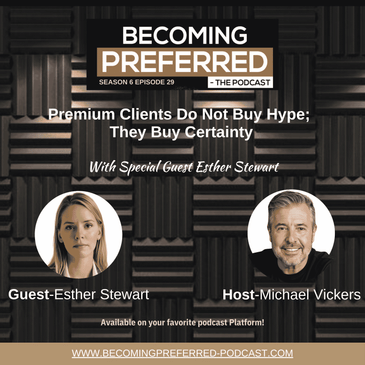
SEASON: 6 EPISODE: 29
Episode Overview:
Welcome back to Becoming Preferred. The podcast designed to help you level up your game and become the best version of you.
Our guest today built her career inside billion-dollar finance institutions before launching her own growth agency, Cottn Owl. Esther Stewart is a Business Growth Strategist who spent eight years as a Fortune 500 associate, training 7 and 8-figure executives in white-glove sales, client retention, and institutional-grade strategy.
Today, she architects high-converting paid acquisition systems for businesses who want predictable revenue without diluting their positioning. Esther’s philosophy is simple: premium clients do not buy hype; they buy certainty.
In this conversation, we’re diving into why most high-ticket marketing fails, how to attract premium clients without the gimmicks, and what it really takes to build scalable certainty in your business. Please join me for my conversation with Esther Stewart.
Guest Bio:
Esther Stewart is a Business Growth Strategist and founder of Cottn Owl, where she architects high-converting paid acquisition systems for founders selling premium offers. A former Fortune 500 finance associate, Esther spent eight years inside billion-dollar institutions training 7 and 8 figure executives in white-glove sales, client retention, and institutional-grade growth strategy. Today, she works with coaches, doctors, consultants, therapists, and high-level service providers who already have strong offers and want predictable, scalable client acquisition without diluting their positioning.
After leaving a multiple six-figure corporate career in 2023, Esther built two multi five-figure per month businesses using one offer, one sales system, and disciplined infrastructure. Her philosophy is simple: premium clients do not buy hype, they buy certainty. Esther teaches founders how to build strategic sales systems, refine positioning, and scale through paid traffic in a way that protects brand equity and supports long-term growth.
Resource Links:
- Website: https://cottnowlofficial.com/
- Product Link: https://cottnowlofficial.com/leaderscircle
Insight Gold Timestamps:
05:32 In the midst of that realizing that while I love that, it was time for the next step
07:30 Premium clients don't buy hype, they buy certainty
09:28 You're selling you at the end of the day
11:02 You've got to be a product of the product
13:03 They want to jump straight to what the biggest names in the industry are doing without putting in the time
15:08 Concept called 'lead cow theory'
19:24 I was also willing to hear no
23:24 They are so reluctant to leverage advertising because there's this online bias with marketers
24:35 The value that you bring to your clients is the relationship
27:46 So, when I tell people that you don't have to spend a lot on ads to see success, you do not, because I'm living proof of that
29:07 I'm clear that none of this was easy, and it took me getting really uncomfortable to get good at what I was doing
33:09 The only difference between spending $10 a day in ads and $100 a day in ads on Meta is how many people you reach
36:02 When you expand how much you spend on meta ads, the exact same ad is now going to go to a much, much broader audience
39:10 When is a founder truly ready for paid acquisition?
40:58 I would argue that everyone should be running ads
43:14 The relationship is never going to be replaced by AI
46:16 It's cottnowlofficial.com
Connect Socially:
LinkedIn: https://www.linkedin.com/in/estherstewart/
Facebook: https://www.facebook.com/people/Cottn-Owl/100090193514131/
Podcast-The Shifting Road of Business: https://open.spotify.com/show/2teA8oeVPUUREUaJPWxRBO
YouTube: https://www.youtube.com/@IAmEstherStewart
Instagram: https://www.instagram.com/cottnowlofficial/
Email: hello@cottnowl.com
Sponsors:
Rainmaker LeadGen Platform Demo: https://calendar.summit-learning.com/widget/booking/JKItVP7WErmCBjU2cCIx
Rainmaker Digital Solutions: https://www.rainmakerdigitalsolutions.com/
In 3, 2, 1.
Speaker BWelcome back to Becoming Preferred, the podcast designed to help you level up your game and become the best version of you.
Speaker BOur guest today built her career inside billion dollar finance institutions before launching her own growth agency, Cotton Owl.
Speaker BEsther Stewart is a business growth strategist who spent eight years as a Fortune 500 associate training seven and eight figure executives in white glove sales, client retention and institutional grade strategy.
Speaker BToday she architects high converting paid acquisition systems for businesses who want predictable revenue without diluting their positioning.
Speaker BEsther's philosophy is simple.
Speaker BPremium clients do not buy hype, they buy certainty.
Speaker BIn this conversation we're diving into why most high ticket marketing fails, how to attract premium clients without the gimmicks, and what it really takes to build scalable certainty into your business.
Speaker BPlease join me for my conversation with Esther Stewart.
Speaker BWell, hi Esther, welcome to the program.
Speaker BWe're delighted to have you.
Speaker AThank you, Michael.
Speaker AI'm excited to be here.
Speaker BYeah, I'm really excited about your approach to client acquisition and building businesses and some of the systems that you've created and you know, based on your experience.
Speaker BAnd I think our listeners are going to get a lot of value as they're building business founders, entrepreneurs, even existing organizations, whether you're Fortune 500 or whether you're just small mid size.
Speaker BI think there's lots of things that we're going to be able to talk about today that are going to really enhance their worlds if they follow some of your advice.
Speaker BSo thanks for joining us.
Speaker BLet's start with though, Esther, before you got here, you're back in high school.
Speaker BWhere are you growing up and what do you want to be when you grow up?
Speaker BLet's go back and get establish a little background.
Speaker BAnd how did Esther become Esther?
Speaker AYeah.
Speaker ASo first, thank you for having me on the podcast.
Speaker ASecondly, oh, we're gonna go way back.
Speaker ASo born and raised in North Carolina, lived there most of my life up until the age of 30.
Speaker AStarted my first job at the age of 14 making minimum wage.
Speaker ASo I grew up in an environment and around people who only worked minimum wage and then work their way up through the business.
Speaker ARight.
Speaker ASo not anyone of affluence, no entrepreneurs, no founders.
Speaker AIt was very much you go in and you find one business, which was the old strategy that you're going to work for one corporation and you work your way up.
Speaker AAnd from going to that.
Speaker AI then moved to Florida in my 30s, applied to a position.
Speaker AThey were a little vague around what the position was.
Speaker AI didn't realize it was actually a post for Merrill Lynch Stepped in, started working with that team, got the job, obviously they asked me if I would start doing all of my licensing.
Speaker ASo fast forward, fully licensed as a financial advisor within a year and then just kept getting promoted and ended up moving from Merrill lynch into Morgan Stanley.
Speaker ASo that was my life up until about four years ago.
Speaker AAnd that's when I left Morgan Stanley.
Speaker ABecause I realized as you know, when you are around massive wealth, as I was working with ultra high net worth clients, celebrities, many of whom actually followed me, I have several businesses and they are the business.
Speaker ABut when you are in that room and you're in that much in that proximity to wealth, you really realize how easy it is to make money.
Speaker ASo for me it was just a total flip from the 425 minimum wage when I was 14 to wow.
Speaker AMaking money is actually easy if you know how to do it.
Speaker AAnd it doesn't necessarily.
Speaker AIt requires hard work, but it doesn't require an exchange of you physically doing the work.
Speaker ARight.
Speaker AWhich is what I had always grown up in.
Speaker ASo once I realized that and that door was unlocked, it was like, all right, here we go.
Speaker AAnd now I left Morgan Stanley a little over four years ago, started Cottonow, the agency I have now as the primary business.
Speaker AAnd.
Speaker BYeah, well that's.
Speaker BWell, you're exactly right.
Speaker BI think it is mindset when you move from minimum wage.
Speaker BYou know, I remember when I started it was 265 an hour.
Speaker BIt was like, how do you make a living?
Speaker BYou work for a day, make $30.
Speaker BYeah, 600 a week or so when I was going to school and dating myself.
Speaker BAnd then when you change that mindset and I think it's a different mindset to your point where your first goal back then in my day was hey, how do I make $50,000 a year?
Speaker BSo what's it take to make 50,000?
Speaker BAnd probably the same for you.
Speaker BYeah, whatever that number was.
Speaker BAnd then it was like how do I make 100,000 dol a year?
Speaker BAnd it's different activity then how do I make 250 or how do I make.
Speaker BAnd each time you move up, it's a change in mindset.
Speaker BSo it's kind of like golfing.
Speaker BYou know, if you're golfing in the 90s, you want to get in the 80s, you got to change your form, you got to change your swing.
Speaker BAnd you obviously were able to identify that and navigate that.
Speaker BAnd then you realized, hey, I can go work for myself and earn six figures and you can earn less than you work for say Morgan Stanley or Merrill lynch and keep more and lots of entrepreneurs.
Speaker BPeople listening to the show feel the same way.
Speaker BSo we'd rather work for ourselves.
Speaker BEarn less and have your own freedom.
Speaker BAnd you live now home for you is I believe you're living in Arizona right now.
Speaker AYeah, yeah, exactly.
Speaker BWell, you're a neighbor to us there office in Phoenix, so.
Speaker BSo it's a gorgeous spot.
Speaker BWell, let's talk about your marketing now.
Speaker BYou decided to go out on your own.
Speaker BWhat was the impetus for that?
Speaker BSo you're doing well.
Speaker BI know you're training high end executives.
Speaker BYou were working on sales culture, you were working on creating white label sales experience.
Speaker BSo you're working on the brand experience as well.
Speaker BThen all of a sudden something obviously was nagging at you and you decided, hey, I think I can do this myself.
Speaker BI want to be a growth strategist and I'm going to open up Cottonow.
Speaker BWhat was the impetus for that?
Speaker AYeah, so that was me working with a really large team at Morgan Stanley, being the relationship manager for the team and in the midst of that realizing that while I loved that it was time for the next step as we all hit that right.
Speaker AWhether you're the person that owns it or an employee, it doesn't matter.
Speaker ASo working with this big team and was next step in on the wealth management side was to actually now become a financial advisor and have your own book of business, not just working inside of a team that already had that.
Speaker ASo that's what I was looking into.
Speaker AI came up with this whole marketing strategy for this team.
Speaker AI went, I did all the research, I found all the different strategies, realized I really loved it.
Speaker AAnd then they were like, yeah, thanks for all your work.
Speaker AWe don't want to do this anymore.
Speaker AWe'd rather just stay with what we're doing, which they didn't like.
Speaker AIt wasn't working, but it's okay.
Speaker ATo each their own.
Speaker AThat was really what kicked me in this direction was okay, I know how to do it now.
Speaker AI unlocked the door unknowingly by trying to build it for somebody else and then realized, okay, this really isn't that hard.
Speaker AAnd actually this sounds really interesting.
Speaker ASo how do I just go and replicate this myself without a team where I don't have to have buy in from anyone else.
Speaker ARight.
Speaker AIt was just the whole independence factor where you don't have to have seven people that have to buy into your idea.
Speaker AIt's like it's your idea for good or bad, it's your idea and you get to go out and implement it.
Speaker AAnd if it epically fails, it's completely your fault.
Speaker ALots of failures, yeah, but at least it's yours.
Speaker BI think that's just awesome.
Speaker BYou're in control of it.
Speaker BI was equated to making sourdough.
Speaker BYou know, my wife makes sourdough.
Speaker BNow you can go buy sourdough.
Speaker BYou go to a bakery and go buy a loaf and you can enjoy a loaf of sourdough.
Speaker BBut when you understand the process of sourdough and all the different steps with the starter, because there's multiple steps and if you miss one of those steps, it's a formula, it's a recipe.
Speaker BAnd what you did is you uncovered the recipe that the big corporations and in today's world, we've democratized growth because you can have the great state of the art CRM, you can have great AI, you can use all the same tools.
Speaker BBut now you've taken off the sales, you got rid of the sales prevention department and you got rid of that, those handcuffs and now you can kind of create whatever you're going to create.
Speaker BSo I like where you're going with this.
Speaker BYou often say, and I really love this is when this came through in on doing our research about you, that premium clients don't buy hype, they buy certainty.
Speaker BAnd such a simple statement boat is so perfect.
Speaker BSo for an entrepreneur used to the fake it till you make it culture of social media, what does delivering certainty actually look like in a sales process?
Speaker AIn a sales process, it's everything.
Speaker AIt's the certainty from.
Speaker ASo just to go back before I go forward, when I think about sales process, I'm speaking whether you're doing organic or paid advertising.
Speaker ARight.
Speaker ASo online selling in person as well.
Speaker ABut specifically for online selling, right now, when you are doing a social media reel, when you're making a YouTube video, whether even if it's an ad.
Speaker ARight.
Speaker ASo all the ads that we write for clients and that they record and that I use are mainly video ads because of what I'm about to say.
Speaker AIt's that certainty and the conviction that you have in your offer that really pulls somebody in.
Speaker AThis is why.
Speaker AAnd you know this, you can have a speaker who can go on and make an amazing YouTube video and they are so convicted in their offer and what they are selling and their impact on the world.
Speaker AAnd then you can have somebody who has the exact same offer and they can speak just as eloquently, but they aren't as passionate about what they're delivering.
Speaker ARight.
Speaker ALike maybe they just got this idea and they were like, here in the world of AI, we see this more and more where they get this idea on AI and they're like, hey, I could create this, I could do this.
Speaker AAnd so they have the knowledge, but they don't have the conviction behind what they're selling because they haven't actually done it.
Speaker ASo that person, they could take the exact same YouTube video in this example, replicate it, be them on camera and saying the exact same words, and it's going to have a totally different effect on the person on the other side.
Speaker ASo for me, when I think about conviction, it's conviction that you portray through how you're showing up online or through live events or in person.
Speaker ABut it's also how convicted are you in what you're selling and what you're delivering?
Speaker ABecause with premium services, with premium offers, whether it's wealth management, whether it's a bookkeeping service, family office, or a high level coach or executive, you're selling you, at the end of the day, they are buying the relationship and your expertise, but they are buying the relationship that they have with you.
Speaker AAnd that expertise is you.
Speaker AAnd so you as not you, but the person that is selling this premium service or offer, it's their conviction that is actually selling it.
Speaker AThis is why with premium offers and services, when you have any type of strategy where you're sending them and you have like those timers or any type of, you know, limited time access or all of these different things that flash on the website page or on the YouTube channel or the YouTube video, it doesn't translate because those are for lower strategies.
Speaker AThis, when you're selling your highest ticket service, your highest ticket offer, those are not going to move somebody.
Speaker AThey don't care if your service is going to be at a discount.
Speaker AAnd quite frankly, you should never be discounting a service or an offer anyway.
Speaker ABut if you do, that's not going to move them.
Speaker AYou know, a $3,000 discount on a $60,000 service is not going to move the needle for them.
Speaker AWhat is the certainty?
Speaker AHow certain are you behind that the deliverable?
Speaker AHow certain are you behind, if you're an attorney, that you can help them with this next, whatever this next legal step is in their business?
Speaker AIf you're interested in estates, how certain are you that you are the person who can come in and help them lay out the entire estate planning for not just their lifespan, but the lifespan and the future generations that are to come, Right?
Speaker AAnd then for coaching, it's the same.
Speaker ASo don't mean to ramble There.
Speaker ABut for me, that's the conviction.
Speaker AIt's in all the ways that it shows up in your business.
Speaker ABut that's what they're buying.
Speaker BWell, you're talking about you've got to be a product of the product and you have to have that experience or product of the service.
Speaker BSo you kind of have to live it.
Speaker BYou have to know it.
Speaker BIt's like, you know, I've been doing this for 30 years, and each year that 30 years of experience goes a long way.
Speaker BWisdom, insights, you're, I'm assuming in the millennial generation.
Speaker BRight.
Speaker BI'm baby boomer and we screwed up the planet for y', all.
Speaker BBut in social media, we got on Facebook and kind of ruined it for you.
Speaker BSo now you're on Insta and Instagram and some of the TikTok and other things.
Speaker BBut yeah, the bottom line is it goes to trust.
Speaker BAnd what you're saying in that certainty, how can we provide certainty?
Speaker BWhat are kinds of things that can provide that certainty?
Speaker BIf, say, maybe you're just starting out.
Speaker BSo for instance, you've been doing what you've been doing with Continental for four years now.
Speaker AYeah.
Speaker BWhat's your one.
Speaker BLike, what's your now, I know you had 10 years of corporate working with billion dollar industries, but how can we.
Speaker BMaybe somebody just starting out, maybe somebody's just leaving a corporate world or building their own business, how can they provide that?
Speaker BThey got the passion, they're excited about what they do.
Speaker BHow can they provide the certainty or ensure the certainty for the client?
Speaker ASo the core answer there is to have an offer you can actually deliver on.
Speaker AAnd that sounds so basic, but I see so many people that are.
Speaker ABecause we're talking to new.
Speaker ANew.
Speaker ARight.
Speaker AAnd they come in and they want to immediately replicate the big name in the industry.
Speaker AAnd that's great.
Speaker ABut what they are missing is the journey.
Speaker AJust like you said, you 30 years in your industry.
Speaker ARight.
Speaker AOr more.
Speaker ASo you think about, for example, I'll use Tony Robbins because I think he's just phenome and everybody knows who he is.
Speaker ASo I like to find people we can all relate to.
Speaker ABut Tony Robbins has been around forever.
Speaker AI mean, not literally, but it feels like he's been around forever.
Speaker AWe all grew up with him.
Speaker AWe know who he is.
Speaker AHe's everywhere.
Speaker AHe's on every social platform.
Speaker ABut you have that person who sees his offers and his price points and his sales pages and what he's offering, and they're like, I can do that.
Speaker AAnd then they go out and they, yes, Anyone could put together a sales page that looks like his.
Speaker AAnyone can go out and say they can do all the things, but have you actually lived in that experience?
Speaker AAnd if you're just starting out, I'm going to say no.
Speaker AAnd so that's just one example.
Speaker AI it a lot with business coaches, I see it a lot with marketers.
Speaker AThey want to jump straight to what the biggest names in the industry are doing without putting in the time.
Speaker ASo if you're just starting out and you want to have certainty, find the thing inside of what you want to do.
Speaker AIt doesn't mean you can't still offer that service, but find the thing inside of that service that you do like exceptionally well that you can deliver on and then focus on that.
Speaker AFor example, if you want to help businesses grow, if that's the industry you want to step into, there's so many ways to help businesses grow, right?
Speaker ASo find inside of what you know, the one thing that you are exceptional at and focus on that.
Speaker AAnd then that can be the thing that you get really good at.
Speaker ABut while you're getting really good at that and finding clients and being known for that one specific thing, whether it's funnels, whether it's messaging, whether it's all the different ways, systems, automation, ads, while you're building that up and getting known for that life and the world and all the clients that you're going to work with are naturally going to bring all the other stepping stones that you need along the way so that your business can evolve.
Speaker ASo perhaps you start with paid ads, like you're going to be an ads agency, but maybe down the road you then shift and pivot into an all encompassing growth agency.
Speaker AWhereas now I know the ads.
Speaker ABut hey, I can also help you with funnels and I can help you with this.
Speaker AAnd I can help you with this.
Speaker ARight.
Speaker AThat's just one example.
Speaker ABut it's making sure that you're selling and you're convicted in what you're actually selling in your offer.
Speaker BI think you have to, I think you're bang on.
Speaker BYou're right.
Speaker BAnd it's a challenge when you're first starting out because you have to have the legs to.
Speaker BWe live in a society where we want that instant gratification, right?
Speaker BYeah, we want to get the payoff.
Speaker BYou know, I'm reminded of a strategy.
Speaker BSo when I started we didn't have Internet, we didn't have any of those types of things.
Speaker BAnd I remember I, I was in my 20s and I created a, I thought was a pretty Good sales program based on a 25 year old's experience, right?
Speaker BAnd I started talking to clients and I do the presentation.
Speaker BAnd they'd come back to me and they'd say, well, who have you worked with?
Speaker BAnd I'd go, well, no one yet.
Speaker BYou'd be one of the first.
Speaker BThey said, go get some experience, come back and see us, right?
Speaker BAnd so I was going broke, getting rich really.
Speaker BAnd everywhere I was going, how do you get the experience?
Speaker BBecause it's that cart before the horse.
Speaker BAnd then I remembered when I was back in college, a concept called lead cow theory, and I think you might agree with this and lead cow theory.
Speaker BI used to milk 300 cows twice a day.
Speaker BAnd I had one time you had to line them up, they wrap their tails with crap all around your face.
Speaker BIt's messy job, smelly, yucky, everything you could possibly expect.
Speaker BAnd I had a sheep herder tell me, he goes, animals have pecking orders, all right?
Speaker BIt goes, look at animals like horse, right?
Speaker BYou get 10 horses in a row.
Speaker BNumber five horse gets ahead of number four, they'll nip at each other to get back in line.
Speaker BSo you go, go find the lead cow, line up the lead cow and the rest will just line up.
Speaker BAnd I thought, well, how do I find the lead cow?
Speaker BAnd he says, watch the herd, watch the market.
Speaker BSo I started watching the herd and I found the lead cow and I spray painted their ears fluorescent orange so I could find them again and easily enough line them up and sure enough, all the cows would line up.
Speaker BSo I applied that model to my career doing what you're suggesting, and I identified 10 companies that I thought would be good lead cows at and T. Bell Labs, loose all a lot of Intelco companies.
Speaker BAnd I had some experience with that.
Speaker BAnd I'd go see them and I'd say, hey, listen, I got a new program.
Speaker BNobody wants to hire me.
Speaker BAnd they go, yep, us either.
Speaker BAnd I said, let me do the program for you for free or I'll do this session for you for free.
Speaker BBut my payment will be a reference or a testimonial.
Speaker BAnd, and you're judge and jury.
Speaker BSo if you don't like it, you don't have to do it.
Speaker BBut if you do like it, then you do.
Speaker BWell, 10 out of 10 said okay.
Speaker B9 Out of 10 hired me back for real money once they got to see what I could do and deliver on.
Speaker BPepsi was the only company that said no to me.
Speaker BAnd by the way, I boycotted them.
Speaker BI'm still bitter about it.
Speaker BAnd I haven't had a pepsi since.
Speaker BIn 40, literally 40 years.
Speaker BSo I boycotted their products.
Speaker BSo drink Coke or Dr. Pepper.
Speaker BBut anyway, moral of the story is if you're starting off your business, it's like you started.
Speaker BYou started with what you know, who are the lead cows?
Speaker BSo this is why you have the Kardashians and some of the.
Speaker BThey're the lead cows in their markets.
Speaker BGet them using it from a social point of view and all of a sudden you start to build your practice because you're working anyway.
Speaker BWhy not build some clients and offer some.
Speaker BSomething along those lines.
Speaker BAny thoughts about that?
Speaker BDoes that resonate with you a little bit?
Speaker AYeah.
Speaker ANo.
Speaker AThat's what a lot of entrepreneurs and founders do at the beginning.
Speaker ARight.
Speaker ASo that's a great way to get your name and get your business out there.
Speaker AWhat I did is not what you did, but I think it's the same concept.
Speaker ASo I didn't have the testim.
Speaker ATestimonials.
Speaker ARight.
Speaker ABecause it's going from corporate into this online space.
Speaker BYeah.
Speaker AWhat I did is I just looked at the offer instead of going in with working for free, which I would never do in Morton Stanley because that was just.
Speaker AWe just didn't do that.
Speaker ARight.
Speaker ALike, I remember the teams that I worked with when they were going to put together a presentation, the sales process with the team was three, three different calls.
Speaker ACall one was a specific thing with the prospect.
Speaker ACall two was a specific thing.
Speaker AAnd then at that point there was nothing actually given a value.
Speaker AAnd so you had to make a Decision by Call 2 if you wanted to move forward.
Speaker ALike, was this a verbal yes, I'm ready to move forward.
Speaker AAnd then we get into the fees and what that looked like in Call 3.
Speaker ASo that was the mindset that I came in with.
Speaker ASo the concept that you're describing, which is very familiar to most of the people that are listening, is not anything that I had ever been around.
Speaker ASo for me, in no way was I going to step in and work for free.
Speaker AI'm not saying it's wrong, but this is my mindset, just having been in the wealth management industry.
Speaker ASo what I did was I came in and I looked at, okay, if this is the offer, this is what I'm putting together, this is what I'm doing for clients at the time, how do I make this one intangible but risk free?
Speaker ASo I looked more at the risk.
Speaker ASo not guarantees.
Speaker ASo what I did is I just spun it.
Speaker AWe'll do this for you and then we'll Work with you until X, Y, Z.
Speaker AAnd I was able to do that by just doing market research and seeing what my competitors were doing in the industry.
Speaker ASo if everyone else that was in my industry was doing and selling this specific way, I knew that my offer needed to be the same offer, but it needed to go above and beyond.
Speaker ASo my offer was huge.
Speaker AIt was all encompassing.
Speaker AIt was too much for what we were charging and I knew that.
Speaker ABut it was just another way to over deliver, do more in a way, probably still doing it for free, but at least getting compensated on the front end.
Speaker ASo that's how I started.
Speaker AI actually, for the first year of my business, not because I didn't have them, but the first five months of my business, I had no testimonials because we were brand new and we were building that up.
Speaker AOnce I had the testimonials, I still refused to put them on my website.
Speaker ASo I grew my business for the first year without testimonials or anything on there.
Speaker ABut I was also, for anyone that's listening, I was also willing to hear no.
Speaker ASo just like you, I did hear no's.
Speaker ALike somebody would get on a sales call and say, well, you don't have any testimonials.
Speaker AAnd I would tell them why and then I would say, and if that is a deal breaker for you, I absolutely understand.
Speaker ABut I was really comfortable with just stepping back and being willing to lose that sales deal.
Speaker AI didn't lose as many as I think people would think I would have in that it was really a small amount.
Speaker ABut I did lose some clients just because I didn't have them.
Speaker ASo that's how I navigated it.
Speaker ABut either way, I think it's a. Yeah, you have to start at the beginning.
Speaker AWe live in an age of entitlement where we all want to come in and have all, you know, well, I tell you I'm great, therefore you must know I'm great, therefore you should pay me premium prices.
Speaker ABecause everyone else in my industry is doing this right.
Speaker ASo if you're just starting out like as you know, you have to do the work.
Speaker AAnd I think for people that are my age that have been in corporate or that have always had a specific income, it's not the easiest thing to feel like you are going back to square one.
Speaker ABecause quite frankly, that is what you are doing right when you are now navigating your pricing, navigating how somebody's going to value the work that you do.
Speaker AAnd it feels like you're taking a step back.
Speaker ABut when you transition from one thing to the other.
Speaker AYou have to be willing to do that and you have to leave your ego at the door, which is really hard for a lot of people, myself included.
Speaker AI'm not saying that it was easy.
Speaker BFive generations of us out there in the workplace still, and it's still an issue.
Speaker BAnd like I say, there are just other approaches.
Speaker BYou know, I've always adopted the value first or at least demonstrate the value.
Speaker BIt's even like from keynote speaking point of view, my first 100 were basically for free.
Speaker BI didn't even know it was a business.
Speaker BAnd then finally out of, just because I was busy, I said no.
Speaker BAnd that's when they offered me money and I didn't even know you could get paid for it.
Speaker BRight.
Speaker BAnd it was like.
Speaker BBut that's what led to it.
Speaker BSo I always, even in our writing, and I know you post, I know you give information, you're.
Speaker BYou're producing, you're producing your content, you're kind of getting it out there.
Speaker BThat's why I think social media is so good.
Speaker BYou have a lot of things where if I see value from Esther, I'm going to go, oh, okay.
Speaker BHey, this is somebody that I want on my team because I know you, I like you, I trust you, and I think you capture it.
Speaker BSo that's why I think we do the social media part of it.
Speaker BRight?
Speaker AYeah.
Speaker AAre you tired of chasing leads and ready to start effortlessly attracting more high value clients?
Speaker AIntroducing Rainmaker Lead Gen, the ultimate sales, engagement and client acquisition platform that takes the stress out of outreach.
Speaker AWith Rainmaker Lead Gen, you can easily identify, engage, educate and connect.
Speaker AConvert your ideal prospects into loyal clients.
Speaker AOur industry leading automation and email sequencing empowers you to reach more ideal clients, accelerate the sales cycle and close more business.
Speaker AImagine authentically engaging with your prospects while the platform handles the heavy lifting.
Speaker ASay goodbye to the endless hustle and embrace a more efficient, effective approach to business development.
Speaker AReady to witness the magic?
Speaker ABook a 20 minute demo today and see how Rainmaker Lead Gen can revolutionize and level up your client acquisition game.
Speaker AThere's nothing to lose and everything to gain.
Speaker ADon't miss out on this opportunity to supercharge your client acquisition process.
Speaker AVisit rainmakerdigitalsolutions.com or check out the link in the show notes to book your demo.
Speaker ARainmaker Lead Gen.
Speaker ASpend less time hunting for your ideal clients and more time having high value sales conversations with your ideal clients.
Speaker BAnd now back to my conversation with Esther Stewart.
Speaker BYou've spent nearly a decade in billion Dollar finance institutions.
Speaker BWhat would you say is the number one institutional grade habit that small business owners or independent consultants or coaches are usually missing?
Speaker ASo many.
Speaker ABut I would say leaning on advertising.
Speaker AYeah.
Speaker ASo one thing that still continues to surprise me is so many, especially if we're going to speak to the ones that are just starting out, the beginners, they are so reluctant to leverage advertising because there's this online bias with marketers and I'm not sure where it came from that you should never advertise your offer until you've sold it organically.
Speaker AAnd that is not how I built my business.
Speaker AI went straight in and I built my business with ads, with meta ads.
Speaker ARight.
Speaker ASo for me, I was able to be really comfortable with advertising because I knew that's how Morgan Stanley acquire their clients.
Speaker ALike that was their branding.
Speaker AThey ran ads on the different platforms, but they also of course relied on referrals when you're at the wealth management level.
Speaker ABut I knew that for the corporation, not the wealth management, but for the corporation, the reason that they were so well branded and people knew who they were is because they were leveraging paid advertising in some way, shape or form.
Speaker ASo I would say that would be the one thing in terms of marketing that I see small business owners reluctant to step into, which is paying to be seen, paying to get more visibility.
Speaker AAnd right now is online social media is phenomenal.
Speaker AAs you said, I am on all platforms as are you.
Speaker AI use it as a digital business card.
Speaker ABut I rely on the ads to find the clients for me because I do not want just like, just like corporations.
Speaker AAnd this is what I learned in corporations.
Speaker AThe the value that you bring to your clients is the relationship.
Speaker AIf I am spending all of my time on client acquisition and not delivering to the client on the back end, then I don't have a business that's really going to make me happy.
Speaker ASo if I to spend all of my time on social media content and making sure that I'm producing this video and this reel and this YouTube piece and this podcast and then I have to go and work one on one with my clients or inside a group.
Speaker AHowever the it's structured, it's exhausting.
Speaker ASo I would start there.
Speaker AIn terms of what I learned, I've.
Speaker BGot to confess, Esther, I'm one of those, I have a hard time.
Speaker BSo what I've understood.
Speaker BSo I've always worked off of referrals and I built a nice business based on referrals which keeps us busy.
Speaker BBut yeah, we do the social media thing.
Speaker BWe do the podcast we're on season six.
Speaker BYou know, I write the book, so we're busy, which is good.
Speaker BBut from what I understand with the advertising.
Speaker BSo let's unpack that a little bit because I think it's a blind spot for me and I'd be curious on insights because what I've heard is that you find where your audience is.
Speaker BSo let's say it's on LinkedIn or Facebook or wherever it has.
Speaker BMy audience is business audience, so I'm assuming It's mostly on LinkedIn.
Speaker BAnd I've looked at LinkedIn ads and they're pricey, they're expensive.
Speaker BAnd then you start off with a formula, and then once you get that formula working and you've got the right roi because it only works on higher ticket items, I think, not like a $50 item, but on thousands of dollars per item, then you scale it accordingly and it's putting faith into that because we're looking.
Speaker BSo if you're starting off your business and you've got limited budget, maybe you're a small SaaS company, you're starting, you're hiring a salesforce.
Speaker BWhat's a good place to start?
Speaker BAnd how should we define if we are going to go that advertising route and put faith into that?
Speaker AYeah.
Speaker BHow does that work?
Speaker BCan you unpack that for us?
Speaker AOh, yes, absolutely.
Speaker AI love this question.
Speaker ASo when you're thinking about paid advertising, there is a. I'm not sure where it came from, but everybody believes that you need to spend a lot of money on ads.
Speaker AAnd I'll tell you a little story because I think it's going to segue into why I am passionate about this.
Speaker ASo when I was still at Morgan Stanley, still making a cushy salary, I was investing.
Speaker AAnd I still continue to invest in my business and myself.
Speaker ABut one of the first investments I made was in an ads agency.
Speaker AAnd now I'm a big advocate of not doing this right.
Speaker AWe have to learn through things so we can now help people not go through through it.
Speaker AI hired this ad agency and I'll never forget I was sitting at my desk at Morgan Stanley and I had to step away for lunch and my ads person called me and said that your ad account has been shut down and we can't get in there.
Speaker ASo I'm totally naive.
Speaker ANo idea how ads work at this point, because I just hired somebody.
Speaker ARight.
Speaker AWhich is now why I'm a big advocate of, like, you can hire people for certain things, but there are certain things in your business you should always know and this is one of them.
Speaker ASo I got home little naive thinking this was going to be a quick fix.
Speaker AIt wasn't a quick fix.
Speaker ALong story short, my ad account got hacked and I was never able to get it back.
Speaker AWhen that happens, Meta basically puts a restriction on your account and says, hey, we don't trust you anymore, even though it's not your fault.
Speaker ASo in the midst of me, so it was a $30,000 loss because now I can't run ads and I had to build up trust with Meta for a separate ad account.
Speaker ASo in the midst of all of this, had no revenue coming in brand new in my marketing experience.
Speaker AAnd like I said, I was fortunate to still have income coming in.
Speaker AAnd with that I could only spend for, I think it was two years, $50 a day in ad spend.
Speaker ASo when I tell people that you don't have to spend a lot in ads to see success, you do not.
Speaker ABecause I'm living proof of that.
Speaker ABut what that forced me to do, which actually is what has built my business and helps me build my clients businesses as well, is this knowing that I only had $50 a day in ad spend, I had to get really clear on what is the offer, what's the messaging, who is this for?
Speaker AAnd then the hook, how are we going to stop the scroll?
Speaker AAnd with $30 a day in ad spend within just five months of turning on the ad, making sure it was working, refining and tweaking the funnel on the back end.
Speaker ASo where were they going?
Speaker AAfter we clicked, the ad was all that buttoned up.
Speaker AI hit my first $40,000 month with that one testimonial on my website.
Speaker ASo when I talk to the power of advertising, that's what I'm talking about.
Speaker ANow that said, I'm not going to say that's easy to do.
Speaker AIt does require copy skills, understanding psychology, knowing your market inside and out.
Speaker ABut I was willing at that point to take the time to invest in learning all of those different strategies so that I could turn on an ad that was high, converting that got a lot of clicks that got people to the next page, that then moved them through so that they booked a call.
Speaker AAnd then on the back end of that, got really good at learning how to sell one on one on sales calls, which is very different than selling at Morgan Stanley to very wealthy families.
Speaker ASo I'm really careful when I tell people that it's part of my story, so I'm not not sharing it, but I'm really careful when I share that that I'm clear That none of this was easy.
Speaker AAnd it took me getting really uncomfortable to get good at what I was doing.
Speaker AFor example, once I got everything working, the reason it took five months isn't because the funnel wasn't bringing people through.
Speaker AIt was because I think month four, I was getting around 30 calls booked a month with $30 a day in ad spend, which is phenomenal.
Speaker AAt that point, my offer was $7,000 and the price was fully disclosed.
Speaker ASo every single person that was getting on a call with me knew the price.
Speaker ASo there wasn't even a price objection.
Speaker AAnd everyone was saying no, Every single person.
Speaker ASo after 30 calls, we're hearing no, no, no, no, no.
Speaker AI'm like, okay, it's not the offer, it's not the price point.
Speaker AIt's me.
Speaker AThere's something I'm doing wrong on the sales call.
Speaker AMost founders from my experience would then tear down the ads, tear down the funnel, say, it's not working, it's not bringing through qualified people.
Speaker AFor me, it was never, hey, it's not working.
Speaker AIt was like, okay, I'm not doing something right on the sales calls.
Speaker ASo made another big investment and I hired a high ticket coach who had closed hundreds of millions of dollars.
Speaker AAnd I brought him in and I was like, okay, this is what I'm doing.
Speaker AWhat am I doing wrong?
Speaker AAnd so we refined things and after working with him for a couple weeks, we shifted how I was presenting.
Speaker AIt wasn't even the conversation at the beginning of the sales call, it was how I was presenting the offer.
Speaker ASo we flipped that and then I started getting.
Speaker AAlmost every single person was saying yes, right?
Speaker ASo now I went from having a 0% close rate to an 85% close rate.
Speaker ASo that is the power of ads.
Speaker ANow, to answer your other question, I did meta ads, so Facebook and Instagram.
Speaker ABecause one thing you said, which is really interesting, but it's also a common.
Speaker AI think it's a misconception.
Speaker AEveryone believes that you should start with LinkedIn ads because they think that their ideal client is on LinkedIn, right?
Speaker ABecause they have a very professional service and their ideal client is absolutely on LinkedIn.
Speaker ABut and this is where it's just a little nuanced.
Speaker ATheir ideal client is on LinkedIn, but they also are on Facebook and, or Instagram.
Speaker AAnd so the only difference between somebody, it's the same person, they'll open up the LinkedIn app and they'll scroll through LinkedIn and they are there to network, they are there to sell their offer and build their relationships.
Speaker AAnd so they're not there to purchase.
Speaker AThat same person will close down the LinkedIn app.
Speaker AApp, open up Meta, be on Instagram or Facebook, scrolling through and they'll see your ad and something in them says, oh, this looks interesting.
Speaker AAnd they will click and they'll move through and they'll book a call with you.
Speaker AIt's the exact same person.
Speaker AIt's just the mental state that they're in when they're in LinkedIn versus on a social media platform.
Speaker ASo that's why I always recommend starting with meta and focusing there.
Speaker ABecause the other benefit of meta ads is not just the audience size, not the fact that they're more inclined to purchase, believe it or not, than they would be on LinkedIn, but is also you can go in with very small budgets with the targeting that meta has with the advancements that they made with Andromeda, which is their AI app that runs all of the AI systems on the back end for advertising.
Speaker ABut with those advancements, meta can find your ideal client more quickly and get your offer in front of them.
Speaker AAnd you can confirm that your ad hook is converting, that your funnel is converting.
Speaker AAnd you can know if everything's working in a month and then within that month, if it's not working, it's very rarely the offer is just tweaking and optimizing.
Speaker ASo if the ad is working, most of the time, it's really not the ad.
Speaker AIt's actually what happens after they click the ad.
Speaker ASo then you can just hone in on that.
Speaker ASo I think that answered your question.
Speaker BYeah, no, those are great insights on that.
Speaker BAnd is there a starting point for most businesses?
Speaker BSo let's say you're a coach or business coach or an entrepreneur.
Speaker BIs there a.
Speaker BIf you don't have this much to start?
Speaker BSo let's say we started with meta.
Speaker BYou're coaching me and you're going, okay, Mike, we've got, you know, your new books coming out.
Speaker BLet's market your new book.
Speaker BLet's do this thing.
Speaker BAnd it appeals to general business audience.
Speaker BSo Meadow could work.
Speaker BWhat's the minimum if we can't spend this much or invest this much in your advertising?
Speaker BDon't even, you know, save your pennies until you get to this point and then expect this kind of thing, say over a 90 day.
Speaker BAnd again, you're optimizing as you go.
Speaker BIs there a good starting point that we should keep in mind?
Speaker AYeah, minimum would be $10 a day.
Speaker AWe have, Yeah, I have a lot of clients who have actually come in and said, hey, I only have a budget for $10 a day.
Speaker AAnd we set it up because the way I think about ads, and this is where marketing, the ads agencies have really muddied the waters and people are so confused.
Speaker AThe only difference between spending $10 a day in ads and $100 a day in ads on Meta is how many people you reach.
Speaker AThat's it.
Speaker ASo you could still see success with a $10 a day campaign on a high ticket offer.
Speaker ABut what that looks like is if you have never, especially if you have a brand new ad account, then it's going to be a little bit longer because Meta has no data on who's come through.
Speaker ASo you have to take that into consideration.
Speaker ABut even if you have an established account and it's $10 a day, it might go a little bit more quickly.
Speaker ABut what that looks like is if you spend $10 a day, maybe, and you mentioned a book, then perhaps you might get, you know, a couple of purchases in the first month, but it's not going to be, you're probably just going to break even on the ads in that first month.
Speaker ABut at that point you want to think about that as one your book, probably the intent there is to upsell them into something on the back end.
Speaker ASo that's where the funnel is important, making sure that you have that in place, whether that's an email sequence that goes out after they purchase the book to re engage them and get them to move and work with you at a higher level.
Speaker ASo that's where you hear a lot of founders talk about, well, my ads are just break even because they don't care about the revenue.
Speaker AI mean, we all care about the revenue, but in this case they don't care about the revenue because what they're looking at is like the length of the value of that client.
Speaker BYeah, great, great insights.
Speaker BAnd that's because it's new technology.
Speaker BAs baby boomers, we look at it, we're, you know, think ad man.
Speaker BWe put on an ad like in my retail businesses, we'd spend a ton of money on ads, we'd sell a ton of stuff.
Speaker BWe got traffic, we drove traffic.
Speaker BAnd it was, you know, B2C marketing.
Speaker BBut usually we ended up just paying for the traffic.
Speaker BIn other words, it paid for itself.
Speaker BBut we did a lot of work and didn't really get, but it gave us awareness, it gave all of those things.
Speaker BSo from an exposure point of view, but with today's tools, there's just like you said, there's the funnel, there's the upsells, there's controlling things.
Speaker BSo interesting conversation.
Speaker BLet me ask you this question.
Speaker BWhy do high ticket marketing or when does it fail?
Speaker BSo many founders try to scale their high ticket offers using traditional Legion tactics only to see their brand equity diluted.
Speaker BWhere does most high ticket marketing go wrong?
Speaker AI don't think it goes wrong, but I think what happens is a lot of, and I just did this myself in my own business.
Speaker AA lot of founders have that one like they have one entry point into their business.
Speaker ASo give you an example of me when I'm currently navigating and just navigated at beginning of 2026.
Speaker ASo up until the end of 2025 for my business specifically, I only use one funnel because it works really, really well.
Speaker AIt's still in place and that was it.
Speaker AAnd I used relatively low cost in ads and booked my calendar and that was the means of client acquisition.
Speaker AHowever, when you want to scale.
Speaker ASo in this case, advertising spend.
Speaker ARight, because yep, I'm going to speak to ads only because if you're doing organic and if you're doing all the organic strategies, you're already capped, right.
Speaker ALike what you're currently seeing with organic is what you're going to see.
Speaker ASo in this case you would have to look at paid advertising to some degree.
Speaker ABut let's say that now you're, you're spending more on ads.
Speaker AWhen you expand how much you spend on, on meta ads, and I just tested this, when you expand how much you spend on meta ads, the exact same ad is now going to go to a much, much broader audience.
Speaker AAnd while that people say oh that sounds great, it's great.
Speaker ABut what happens is now you have a very diverse level of that buyer journey.
Speaker ASo you have some clients that are going to, they want to book a call right away.
Speaker AYou have some, excuse me, prospects.
Speaker AYou have some prospects that are going to see your ad and not actually move for three to five weeks.
Speaker AYou have some that are going to come through and go into your email sequence and they're going to wait a year.
Speaker ARight.
Speaker ASo what you want to have in place at that point, if you want to scale to the next level, is you need to have different entry points.
Speaker AYou need to have multiple funnels.
Speaker ASo that looks like keeping the funnel that's working.
Speaker AI see that mistake a lot.
Speaker AA lot of founders just tear down what's currently working, like keep what's working, but now you need to add on to it.
Speaker ASo for example, in my case that looked like adding in a webinar funnel and then a challenge funnel and then a low ticket offer so that I'm running ads to a lower ticket offer that they can come in and see the experience of working with me.
Speaker ABut now I'm appealing to people who are ready to move today, ones who are ready, but they need that trust.
Speaker AThey need to spend time with me in a virtual room.
Speaker AWhether that's a challenge or a webinar, or those ones that are like, hey, I'm okay to invest with you, but I want to invest low ticket to see what that experience looks like.
Speaker AAnd then if it's a good experience, then I'll go into your higher ticket offer.
Speaker ASo when you're thinking about scaling your revenue, you want to have more ways for your ideal client to come in.
Speaker AAnd then, like all things, nobody wants to hear this, but it's the truth.
Speaker ALike all things, it's never just a matter of just sending it in your business.
Speaker AIt's now you have to look at the data.
Speaker ASo if you've never had a webinar strategy, for example, is the webinar actually converting?
Speaker ARight.
Speaker AAnd if it's not converting, then you have to dissect it and you have to find out, okay, what's being said.
Speaker AJust like I had to do on those sales calls, right now, it's, what are we saying in the webinar?
Speaker AHow are we guiding the client through?
Speaker AIs it clear the value, what we're teaching in the webinar is just even what they want to hear.
Speaker AIt's all these little nuances that get lost in the marketing world because you see so many ads that talk about, hey, just put up a webinar and all the clients are going to flock in.
Speaker AYou're going to have a hundred thousand dollar day.
Speaker ALike in.
Speaker AIn theory, yes.
Speaker ABut what they're not showing you is all of the optimizing and then the refining.
Speaker AAnd just like you have to do with organic, right?
Speaker AThe founders who are very successful with YouTube didn't just get successful with YouTube because they had one video that went viral.
Speaker AWas it Stephen Bartlett?
Speaker AHe talks about this.
Speaker AHe dissected his YouTubes, his YouTube channel, his watch time, his hooks, his thumbnails.
Speaker ALike, his team went in with a microscope for years before he finally saw the success.
Speaker ABecause they went in and pinpointed, okay, at this point, views spiked and then this is where they dropped off.
Speaker ASo they were like, okay, well if this is where they dropped off and this is what we're doing inside of the YouTube video at this point, let's not do that anymore more and let's do this and that's where most founders don't want to hear that because it's not fun and it's not easy.
Speaker AAnd we would all just love to have that webinar that just goes viral and it all sells.
Speaker ARight.
Speaker ABut yeah.
Speaker BOh, it's interesting.
Speaker BLet's talk about transitioning from organic to paid.
Speaker BSo many of our listeners have built great businesses on referrals and organic content, but then they're hitting the ceiling.
Speaker BAnd we're a good example of that.
Speaker BEven our organization.
Speaker BWhen is a founder truly ready for paid acquisition?
Speaker AI think from day one, because that's what I've done.
Speaker AYeah, I don't think there's ever a time where you're not ready for paid acquisition.
Speaker ATo be honest, the only time would be, and this even then I would still say just get good at it.
Speaker ABut the only time would be if you have a high ticket premium offer or service that you're selling and you don't do well on camera.
Speaker AIf you don't do well on camera, then I would say don't just throw up an ad.
Speaker AMake sure that you get comfortable.
Speaker AI'm not saying you have to take public speaking lessons, although I'm not saying not to.
Speaker ABut when you are the founder and you're running an ad, and you should be in that ad, if you're selling a service that's 10,000, $60,000 or more because they need to engage with you via that ad virtually, you're still building a relationship.
Speaker AIt may not be one on one, but they're building a relationship.
Speaker ALike, what are you wearing?
Speaker AWhat's behind you on camera?
Speaker AHow are you articulating what you do?
Speaker AThat conviction.
Speaker ARight.
Speaker ALike that's where it all comes in.
Speaker ASo that would be the only time.
Speaker AIf it's somebody who has never done well virtually on camera, then I would say pause and start getting really good.
Speaker ALike just open up your phone and start doing little mini speeches and recording yourself.
Speaker AAnd you know, I'm sure all of us have a friend who can help with that if needed, to give you some feedback.
Speaker ARight.
Speaker ASometimes it's posture, sometimes it's how you're communicating.
Speaker AAgain, it just all goes back to conviction.
Speaker AThat would really be the only time, believe it or not, would just be that.
Speaker ABut even that, it's just that you can power through it, you can get good at it.
Speaker AAnd now that you are comfortable on camera, then do it.
Speaker ABut the reason is the founders who are the most successful right now, and I'm not going to name the names because everybody throws names but think about anyone on ads frequently.
Speaker AThey all the ones I'm thinking of right now, and I can think of Ten.
Speaker AThey all have millions of subscribers on YouTube.
Speaker ASo even with millions of subscribers, they still feel the need to run ads.
Speaker ASo I would argue that everyone should be running ads.
Speaker AI'm not saying to break your budget or your bank.
Speaker AAnd that's why I'm a big advocate of not working with ads agencies, because they have really excessive fees and really learning how to run them yourself.
Speaker ABecause ads, and I'll close here, ads are really easy to run.
Speaker AThey're not the most fun thing.
Speaker AAnd most people look at the dashboards and they're like, oh, this is intimidating.
Speaker ABut I'm in a program right now.
Speaker ASo I've always run my own ads, you know, since that agency issue.
Speaker AAnd one of the big investments I made this year was beginning of the year, working with a really good ads training program where I'm learning refined strategies, elevated strategies from Meta, but also learning LinkedIn ads and YouTube ads and Google search ads and all these, and Spotify ads so that I can have an omnipresent ad strategy for my business.
Speaker ASo you can find somebody who can teach you very easily how to navigate within the ads platforms to set up your own ads and still go in with small budgets.
Speaker ABecause even though I'm in those programs, I'm still not going in and spending thousands of dollars a day or hundreds of dollars a day in most cases.
Speaker AI'm going in with really small budgets.
Speaker BWell, you can scale when you need to, but what I'm hearing you saying is you're ready for paid traffic when you've got a proven conversion mechanism.
Speaker BIn other words, when you do get leads and referrals, you have the ability to convert.
Speaker BAnd if you're doing well there, then the next step is just to increase that traffic flow and go from it, which like in our old days, we use direct mail direct.
Speaker BWe used to look at a 1 2% response rate.
Speaker BRight.
Speaker BAnd you just publish it and dump it into their mailbox.
Speaker BWith this, we can get right into your.
Speaker BI can get right in front of your eyeballs and my demographic and whatever.
Speaker BEsther, this was absolutely insightful.
Speaker BGreat insights.
Speaker BIf you were looking at the marketplace, you know, going into 26 and beyond, how do you see it over the next two to three years?
Speaker BHow do you see it evolving?
Speaker BSo is there a.
Speaker BIs it an easy entrance point for companies that want to get in?
Speaker BI'm assuming they can contact you if they want to get some coaching or learn the sourdough recipe.
Speaker BRather than go through that tough learning curve, they can engage with you in your organization over at Continental.
Speaker BHow do you see it over the next couple of years?
Speaker BIs it just getting more of the same?
Speaker BIs it expanding?
Speaker BHow's AI impacting it?
Speaker AYeah, good question, I believe.
Speaker AWell, I know because there's a lot of people that are now even saying this as well.
Speaker AI've said it for years, as I'm sure you have.
Speaker AYou, the relationship is never going to be replaced by AI.
Speaker AAI can build funnels.
Speaker ANot very good yet, but I'm not conceited enough to believe that in a couple months or maybe even a year, AI might be able to build funnels that are exceptional at the level that we're seeing people manually doing them.
Speaker AThey copy all of those things.
Speaker ASo AI itself is not going away.
Speaker AWe still have to navigate within that.
Speaker ASo what I look for is where are we as founders?
Speaker AIrreplaceable.
Speaker AAnd we're irreplaceable in two places, sales and building relationships.
Speaker ASo I would say anyone who's thinking to the future and looking at their business and thinking about where they're driving their business to and whatever that looks like for them, whatever their big revenue goal is making sure that they're still keeping the relationship in the heart of the business that they're doing.
Speaker AAnd for me, that's not just on one to one conversations.
Speaker AThe relationship doesn't happen as you know, when they become a client, the relationship happens to well before they become a client.
Speaker ASo this is where you build the relationship with social media content with your funnel.
Speaker AIt's important, as you know, to have the relationship with your funnel and then to get really good at selling your offer in webinars and in challenges.
Speaker ABecause with the advancement of AI, the conversations that I'm hearing and whether or not it's true or not are yet to be seen.
Speaker ABut as you've seen, we're hearing that AI is going to get to the point where it can just replicate us as humans, where we can have our AI avatar that looks just like us and it can create YouTube content and LinkedIn content, and nobody's going to know if it's us or an AI bot.
Speaker ASo when I see that, and what I'm seeing others in the industry do, which I think is a great thing, is to also start incorporating live events where we prove that we're human.
Speaker AThat said, this is what I'm hearing in the industry.
Speaker AAnd so sometimes it's all hype and sometimes it's not.
Speaker ABut regardless it is is making sure that you're keeping the relationship in what you're doing and then in the selling component in your business.
Speaker ABecause those are the two things that are never going to be replaced by AI.
Speaker ABut if you're thinking about 2026, 2027, it's also about getting in front of more people than you're currently getting in front of.
Speaker AAnd that doesn't have to just be with paid ads.
Speaker AThat can be live events.
Speaker AWe're seeing a resurgence in live events.
Speaker APeople are going back to.
Speaker AIt's kind of funny.
Speaker ADuring COVID we all got excited because we didn't have to do it anymore.
Speaker AAnd now we the 2025, the end of 2025, but now 2026, everybody's doing live events, which is great because everybody's like craving that in person connection.
Speaker ASo looking to those, maybe that makes more sense for the strategy that the person has.
Speaker BBut yeah, yeah, oh, I agree with you.
Speaker BI think AI can help you with strategy, it can help you with process, it can help you with funnels, you know, ops, those types of things.
Speaker BThe admin aspect of it.
Speaker BBut the human to human AI can't be responsible.
Speaker BIt can't be empathetic, you know, can write a poem that'll make you cry, but it's never experienced heartache.
Speaker BSo I think our human personally, I think our EQ becomes the new mba and that's what makes the difference.
Speaker BIt's not about just facts and figures and numbers anymore.
Speaker BIt's that human to human.
Speaker BEsther, this was fantastic.
Speaker BThank you so much for being our guest today.
Speaker BThe website, so the website that will help put everything in the show notes but it's continental official.com and we'll put all that and we'll have all of that in the show notes.
Speaker BPeople can reach out to you if they want to have a conversation and possibly engaging you in your organization.
Speaker BThanks for being our guest today.
Speaker AThank you Michael.
Speaker AI've enjoyed it.
Speaker BAs you are listening to this episode, what is one idea that you've heard this caught your attention and why does it matter so much to you?
Speaker BAnd who is one person who you can share that with either sharing this episode or just sharing that insight that occurred to you while you were listening?
Speaker BPerhaps it is that premium clients do not buy hype, but they buy certainty and the deep conviction you have in your offer.
Speaker BOr maybe it is that you do not need a massive budget to see success with advertising.
Speaker BYou just need clear messaging and a high converting funnel.
Speaker BThank you for listening, for learning and for investing in yourself so that you can become the best version of you.
Speaker BIf you found value in this episode, please write a review on Apple Podcasts.
Speaker BIf you haven't subscribed yet, please do so so you can get a new episode and start your week off right every Monday.
Speaker BUntil next time.
Speaker BThis podcast is created and associated with Summit Media.
Speaker BMy Executive producer is Beth Smith and Director of Research Tori Smith.
Speaker BThe fee for the show is that you share it with friends when you find something useful or interesting.
Speaker BThis podcast is subject to copyright by Summit Media.
Speaker AGoodbye.