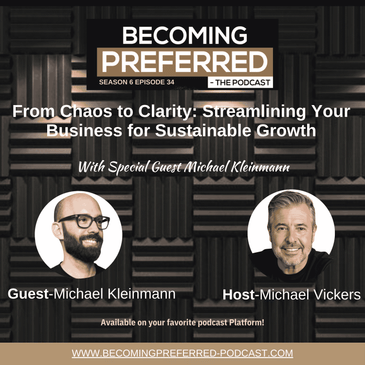
SEASON: 6 EPISODE: 34
Episode Overview:
Welcome back to Becoming Preferred, the podcast for entrepreneurs and business leaders who want to grow their business, level up their game and become preferred in the markets they serve.
Let’s be honest: in today’s market, growing your revenue is only half the battle. The real danger? Growing so fast that you break your own business. When your logistics fracture, your software stacks multiply, and your profit margins start bleeding cash, marketing success can quickly turn into an operational nightmare.
Our guest today is the man who steps in when guesswork fails. Michael Kleinmann is a seasoned D2C operator, founder, and fractional C-suite executive who has built and scaled multiple businesses to the mid-eight-figure mark. He is a master at turning back-end infrastructure, fulfillment, and supply chains away from boring cost centers and into lethal competitive advantages.
Whether you are running an e-commerce giant, scaling a subscription model, or just trying to protect your margins in a shifting economy, today’s conversation is a blueprint for logic-driven execution. Please join me for my conversation with Michael Kleinmann.
Guest Bio:
Michael Kleinmann is a seasoned direct-to-consumer (D2C) operator, founder, and executive advisor with more than two decades of experience building, scaling, and modernizing seven- and eight-figure e-commerce and subscription brands. A true pioneer in the digital retail space, Michael launched Freshpair from his New York City apartment in 2001, transforming it into a category leader with over 30,000 SKUs and even founding "National Underwear Day" before its successful acquisition. In 2012, he repeated his success by launching Underwear Expert, growing it from a massive content marketing platform into a high-performing subscription powerhouse driven by proprietary curation technology.
Today, Michael steps into organizations as a fractional C-suite executive, transforming logistics, fulfillment, and operational infrastructure into true strategic assets. He brings deep, end-to-end expertise across product, tech stacks, marketing, and supply chain management, replacing guesswork with practical, logic-driven execution. Throughout his career, he has built a reputation for engineering creative solutions to complex operational bottlenecks—delivering massive freight cost savings, optimizing 3PL partnerships, and turning around struggling business processes.
Michael is far from your typical, surface-level consultant. Having worn every imaginable hat over 25 years of hands-on business building, he knows exactly how to align infrastructure with rapid revenue growth while ruthlessly protecting profit margins. He joins us to share his proven systems for navigating the realities of scaling and removing the friction from modern e-commerce operations.
Resource Links:
- Website: https://www.mkinc.com/
- Product Link: https://www.mkinc.com/services
Insight Gold Timestamps:
02:40 I gravitated towards technology and business
04:41 We had just about every hurdle you can think of
06:12 I created National Underwear Day
08:20 How do you get from zero to 100 with next to nothing or maybe fumes?
10:38 I want to hear the problem from their perspective; that doesn't mean that that's what the problem is
15:11 There's a lot of analytics that you can get about different things to try to see if B2C makes sense
17:03 I was reading this morning that there's 73,000 3PLs in the United States
20:35 By moving to a 3PL, you can get your costs lower than if you did it yourself
21:48 Amazon is a shipping carrier that you can use separate from selling on Amazon
24:42 If you want to pick something easy to do, don't have a direct-to-consumer brand
28:40 I think asking for help is difficult
33:20 I just went through the whole entire business and tried to simplify everything
38:53 I think there's a lot more opportunity, but it's different
Connect Socially:
LinkedIn: https://www.linkedin.com/in/michaelkleinmann/
TikTok: https://www.tiktok.com/
YouTube: https://www.youtube.com/@poweredbymk
Instagram: https://www.instagram.com/poweredbymk
Email: mk@mkinc.com
Sponsors:
Rainmaker LeadGen Platform Demo: https://calendar.summit-learning.com/widget/booking/JKItVP7WErmCBjU2cCIx
Rainmaker Digital Solutions: https://www.rainmakerdigitalsolutions.com/
In 3, 2, 1.
Speaker BWelcome back to Becoming Preferred, the podcast for entrepreneurs and business leaders who want to grow their business, level up their game and become preferred in the markets they serve.
Speaker BLet's be honest, in today's market, growing your revenue is only half the battle.
Speaker CThe real danger?
Speaker BGrowing so fast that you break your own business when your logistics fracture, your software stacks multiply and your profit margin start bleeding cash.
Speaker BMarketing success can quickly turn into an operational nightmare.
Speaker BOur guest today is the man who steps in when guesswork fails.
Speaker BMichael Kleinman is a seasoned D2C operator, founder and fractional C suite executive who has built and scaled multiple businesses to the mid eight figure mark.
Speaker BHe is a master at turning back end infrastructure, fulfillment and supply chains away from boring cost centers and into lethal competitive advantages.
Speaker BWhether you are running an e commerce giant, skill scaling a subscription model, or just trying to protect your margins in a shifting economy, today's conversation is a blueprint for logic driven execution.
Speaker BPlease join me for my conversation with Michael Kleinman.
Speaker CWell, hi Michael, welcome to the program.
Speaker CWe're delighted to have you.
Speaker DThanks for having me.
Speaker CNow I'm excited about this.
Speaker CNow where are we speaking to you from?
Speaker CWhere did you happen to be today?
Speaker DToday I happen to be in New York City.
Speaker CBeautiful city.
Speaker CI've been going there for years and I always enjoy having a chance to visit.
Speaker CI'm really excited about today's episode because you've got some varied experiences.
Speaker CFor sure we're going to get into it.
Speaker CWe'll talk about building brands, what goes into building brands, what to look for, maybe some of the landmines when you're going to build a brand because I know you've had those, you've built many eight figure brands and lots of experience in your consulting practice.
Speaker CLet's go back to high school though for a minute because our listeners always like to know how you got into this and they like the backstory.
Speaker CSo you're back in high school.
Speaker CWhere were you living at the time?
Speaker CWhat were you going to be when you grow up?
Speaker DI mean, I was on Long island and I always wanted to be the CEO of something and I didn't really care what it was as long as it was the CEO of something.
Speaker DAnd I think in high school I just wanted to be out of high school because I knew if I was out of high school I could work and then I could do something more interesting.
Speaker DRight.
Speaker DI was always like ahead of my time.
Speaker CSo yeah, no, I get, I couldn't get out fast enough.
Speaker CSo yeah, I totally get.
Speaker CWhat were your Interest points.
Speaker CSo you wanted to be.
Speaker CYou wanted to do your own thing, obviously.
Speaker CSo you were probably bored in school, you probably excelled in school and you got hey, I want to do.
Speaker CBut were you tempted to go in one direction or another?
Speaker DI gravitated towards technology and business because I felt the most comfortable there.
Speaker DSomething math oriented and something with strategic thinking.
Speaker DBut I didn't know what I wanted to do.
Speaker DSo.
Speaker DYeah, I mean, when I was in college, I started my first business and I still didn't know what I wanted to do, but I just liked having a business and it was fun for me because most people did not own a business in college.
Speaker CNo, no.
Speaker CWell, it's.
Speaker CAnd like I said, I kind of did my own gig as well, so I understand it.
Speaker CSo going back to 2001.
Speaker CYeah, I believe you acquired.
Speaker CThe company was called freshpear.com and the dot coms were just kind of getting started and yeah, going in those days and I was an early investor and so.
Speaker CBut where do we go?
Speaker CIs this going to be a big thing or not?
Speaker CAnd did you start this one or.
Speaker DDid you acquire this one somewhere in the middle?
Speaker DIt kind of started in my apartment and it was more of an idea than anything else.
Speaker DAnd I'm the one who really took the idea and turned it into something tangible.
Speaker DYeah, it was the wild west of the Internet.
Speaker DWe had no idea what was going on.
Speaker DAnd anytime you want to do something, you had to do it from scratch, figure it out yourself.
Speaker DSo there was no Shopify.
Speaker DThere were these things that exist now that are plug and play.
Speaker DThat that was not a thing.
Speaker DSo it was fun.
Speaker DIt's a very fun time.
Speaker CYou had to build your own online stores.
Speaker CAnd I like, I say you had it with the concept, but then you built it into.
Speaker CAnd the product mix was, I think male, female, underwear and.
Speaker COr the categories we've seen those verticals, those, I guess, product lines, if you will.
Speaker CI happen to be a Tommy John's kind of a guy, so when those went online, I thought those are good.
Speaker CThose are marketing and ordering some products.
Speaker CMost of the time I still visited my stores, but now I look back at what I'm buying online and I buy almost everything online.
Speaker CThere's some things like a suit jacket, whenever I still go see my tailor, go see something along those lines.
Speaker CBut pretty much everything else you can find online and customized.
Speaker CSo as you're building that as an entrepreneur, what were some of the early hurdles that you had to overcome in order to get your company positioned?
Speaker DI mean, we had Just about every hurdle you can think of.
Speaker DWhen, when I started at Freshpear, vendors did not want to sell to online companies.
Speaker DThey didn't even understand online.
Speaker DThey didn't even have websites or they were just getting into it.
Speaker DRight.
Speaker DAmazon didn't sell clothing at that time.
Speaker DSo it was very different.
Speaker DI had conversations with really big companies.
Speaker DLike there were some companies I met with where they were doing hundreds of millions of dollars and I had to sit down with the CEO and explain to them why we should sell their product online and how it was not competitive to them.
Speaker DAnd it was really educating people as to what they should do because no one had any idea.
Speaker DAnd if I had to start that company all over again, it would be impossible because everyone sells direct to consumer now.
Speaker DSo I was really in the right place at the right time in a industry that was kind of slower, I think, to adapt to online shopping.
Speaker CNo, it's interesting now.
Speaker CPretty much you can find everything online and right.
Speaker CAmazon's come in and those categories are changing all the time.
Speaker CYou took the success of.
Speaker CAnd back in, I believe it was around 2012, you then leveraged, you went, you finished with that organization company and you started your own called the Underwear Expert.
Speaker CLet's talk about that particular.
Speaker CYou know, what were you seeing as the opportunity?
Speaker DYeah, I had been there.
Speaker DYou know, I was the president of the company for 10 years and I took it as far as I wanted to take it.
Speaker DWe were selling.
Speaker DWe had 30,000 SKUs that we sold.
Speaker DRight.
Speaker DWe had a huge staff and I created National Underwear Day.
Speaker DAnd we just had.
Speaker DIt was a.
Speaker DIt was a huge success right across, like, I kind of checked every box and I was kind of bored.
Speaker DI was like, I was ready for my next challenge.
Speaker DAnd I'm so programmed to the startup world that I'm, I think like, I think like a startup founder whether I want to or not.
Speaker DSo I was ready for my next thing and I decided that, okay, times had changed.
Speaker DI don't want to do the same thing all over again.
Speaker DI wanted to stay in the underwear business and I decided I would specialize a little more.
Speaker DSo I decided to specialize on the men's side, but again, didn't want to compete with Amazon, didn't want to compete with a brand selling direct.
Speaker DSo I decided subscription model.
Speaker DIt always intrigued me.
Speaker DI really did not know what I was getting myself into.
Speaker DBut if I could figure out my last company, I could figure out my next company.
Speaker DSo I figured it out and.
Speaker DAnd I launched a subscription.
Speaker DSo, yeah, that's that's how.
Speaker DPretty much how Underwear Expert was born.
Speaker CIn a NutShell, you've scaled two companies and a lot of our listeners are interested, whether they work for an organization or they're entrepreneurs.
Speaker CEven ourselves, we're always wrestling with what's the best way to scale an organization.
Speaker CAnd it seems like it comes down to some of the titles that you have in the C suite.
Speaker CYou pretty much warn every title.
Speaker DYeah.
Speaker CAround operations.
Speaker CSo I do want to talk about that.
Speaker CSo let's talk about the core philosophy of scaling.
Speaker CSo you talk a lot about helping brands in your consulting business, Power mq, and we'll talk more about that in a little bit.
Speaker CBut navigate the realities of scaling rather than just chasing raw growth.
Speaker CSo for listeners who might confuse the two, what's the critical difference between a business that's simply growing its revenue and one that's truly building a scalable infrastructure?
Speaker DSo as difficult as it may be to scale a business right, every.
Speaker DEvery business is a little different.
Speaker DIf the underlying foundation is not solid, then anything you do on top of it is eventually going to break and you're just not going to be scaling efficiently.
Speaker DSo I like to scale efficiently because as a startup founder, there's no cash and you have to figure out how to do the like, unthinkable, Right?
Speaker DLike how do you get from zero to a hundred with next to nothing or maybe fumes?
Speaker DThat's how I like to think.
Speaker DEven if you raise money, why waste it if you don't have to?
Speaker DSo I like to have a foundation that's efficient.
Speaker DThat way when you pour gasoline on it, it works efficiently as opposed to, you know, wasting tons of money on inefficient processes and then you run out of money.
Speaker CWell, I believe you say true scaling means to increase your revenue exponentially, but while your operating costs only increase in a linear way.
Speaker CSo if your backend infrastructure isn't designed to handle the weight of the marketing success or revenue growth, it'll actually break your business, won't it?
Speaker COr kill your customer experience and erode the margins.
Speaker DSo many different things can go wrong.
Speaker DYou can just waste money on your fulfillment operation, or you have a bad customer service experience, which you're spending all this money to acquire customers, and then they have a bad experience, they're never coming back.
Speaker DSo you want everything.
Speaker DObviously everything can't be perfect immediately, but you want to have as many things in place as possible.
Speaker DThat way, if you're doing double the business, triple the business, 10 times the business, your infrastructure doesn't need to change at all.
Speaker DYou just have, you know, more things happening, more transaction volume.
Speaker DRight.
Speaker DBut like the underlying system should work.
Speaker DSo that's how I like to operate.
Speaker DAnd in addition to the couple businesses that I've owned, I've also scaled a lot of other businesses.
Speaker DSo this is the philosophy that I use with clients with my own businesses.
Speaker DI like a solid foundation that works efficiently.
Speaker DThat way there are no surprises.
Speaker CLet's talk about that.
Speaker CSo you're working with an organization.
Speaker CWhen you come to companies and you've seen many of them, what's the first thing that you start to look at?
Speaker CFirst you talk about a strong foundation that might mean lots of things to lots of people.
Speaker CCan you unpack that, what a strong foundation looks like?
Speaker DYeah, I think everyone asks me what is the first thing you look at?
Speaker DAnd you know, I always look at the financials, right.
Speaker DBecause that tells the real story and I never believe financials when I see them.
Speaker DSo I validate the financials.
Speaker DRight.
Speaker DBecause the devil's in the details.
Speaker DBut in parallel to like kind of looking at the financials and really understanding it, the first thing I do is I talk to, you know, the founder, the CEO, whoever the top people are.
Speaker DI want to hear the problem from their perspective.
Speaker DThat doesn't mean that's what the problem is, but they know their business better than I do.
Speaker DSo let's hear what they have to say.
Speaker DRight?
Speaker DAnd then based on what they think the problem is and based on what the financials say, then there's some discovery to try to kind of poke at things and see where the problems really are, see if it matches up with the executives, you know, idea of where the problems are and then come up with a project plan of, here are the, here's some short term wins, here are some longer term things.
Speaker DDepends on the business.
Speaker CSo you're looking at where they're, where to be, what's that gap?
Speaker CAnd then maybe close, close that gap.
Speaker CDo you see commonalities when you're first going in?
Speaker CDo you start to see things which, from bad habits to, they don't have this, they have this are you see some things that are, you pretty much can always count on, typically in the.
Speaker DFirst conversation that I have with the CEO, they will know directionally what the issues are like.
Speaker DThey'll know the people that they need to replace, even though they may not do that for several years.
Speaker DThey know the, the weak links in the people and then they know the aspects of the business that, that they've not been able to fix.
Speaker DRight.
Speaker DThe areas like they know there's a problem with X, they've they haven't been able to figure it out for whatever reason and they need that addressed.
Speaker DSo they pretty much know, but they may not know the details and they may not be able to prioritize those things.
Speaker DAnd, and in a lot of cases, you know, you think something's important but it's not going to impact the business if you fix it.
Speaker DSo it's probably just a waste of time and money.
Speaker DBut so yeah, we, I kind of help synthesize all of that into an action plan.
Speaker AAre you tired of chasing leads and ready to start effortlessly attracting more high value clients?
Speaker AIntroducing Rainmaker Lead Gen, the ultimate sales, engagement and client acquisition platform that takes the stress out of outreach.
Speaker AWith Rainmaker Lead Gen, you can easily identify, engage, educate and convert your ideal prospects into loyal clients.
Speaker AOur industry leading automation and email sequencing empowers you to reach more ideal clients, accelerate the sales cycle and close more business.
Speaker AImagine authentically engaging with your prospects while the platform handles the heavy lifting.
Speaker ASay goodbye to the endless hustle and embrace a more efficient, effective approach to business development.
Speaker AReady to witness the magic?
Speaker ABook a 20 minute demo today and see how Rainmaker Lead Gen can revolutionize and level up your client acquisition game.
Speaker AThere's nothing to lose and everything to gain.
Speaker ADon't miss out on this opportunity to supercharge your client acquisition process.
Speaker AVisit rainmakerdigitalsolutions.com or check out the link in the show notes to book your demo.
Speaker ARainmaker Lead Gen Spend less time hunting for your ideal clients and more time having high value sales conversations with your ideal clients.
Speaker BAnd now back to my conversation with Michael Kleinman.
Speaker CNow you focus a lot on direct to consumer work in a world where it's B2B.
Speaker CSo I always went after B2B because it was if they weren't coming.
Speaker CI had retail stores at one time and retail business customers come in but it relied on advertising in order to get them to come into the store.
Speaker CAnd this would probably sound familiar and our cost of acquisition was huge.
Speaker CWe were spend if we spend a million dollars on advertising, we would almost just sell enough to cover the advertising and then some.
Speaker CAnd all that work just went on and it was kind of we weren't much further ahead.
Speaker CIt was really tricky that way because we didn't know we're spraying prey, we're trying radio advertise every medium that there is.
Speaker CWhen you're going into a direct to consumer, it's a different animal.
Speaker CAnd I have a lot of clients who don't know how to get there.
Speaker CThere are B2B, but they go through distribution channels.
Speaker CAnd can any business, say, in a B2B environment go to direct consumer?
Speaker CLike, have you seen where a B2B wants to go direct to consumer?
Speaker CD2C is there.
Speaker CDon't do that.
Speaker CIf you're this kind of business or if you're this kind of business, how does that apply across the spectrum?
Speaker DYeah, it's.
Speaker DI was talking to someone yesterday and it was like, do you do the movie first or the TV show first?
Speaker DRight.
Speaker DAnd some do one and some do the other and it does translate.
Speaker DI think if you have a really strong B2B business, that means that there's demand.
Speaker DAnd if there's demand, you can pretty much forecast what your revenue would be.
Speaker DRight.
Speaker DYou can look on Amazon and run reporting off of Amazon and see what the demand is on Amazon for that thing.
Speaker DRight.
Speaker DYou can look at.
Speaker DI mean, there's a lot of analytics that you can get about different things to try to see if B2C makes sense.
Speaker DBut I would say categorically, yeah, if you have a really big B2B business, that means there's some amount of demand and why not sell direct to consumer?
Speaker DYour margins are better.
Speaker CYeah.
Speaker CRight now, to run a B2B, you're going to end up.
Speaker CYou're paying for sales teams, you're paying for support teams, you're paying for CRM software, you're paying.
Speaker CIt sounds like Direct to Consumer is almost a cleaner operating business.
Speaker CWe don't need the manpower.
Speaker CIs that true or.
Speaker DA really long time ago, people used to say to me, oh, wow, you're running a website.
Speaker DThat's great.
Speaker DYour margins must be so much higher.
Speaker DAnd if you had any idea what goes into that, like, no.
Speaker DIf anything, your margins are probably lower.
Speaker DRight.
Speaker DYou know, instead of having rent, you have technology.
Speaker DThere are other things that you need.
Speaker DSo I think if you are the brand and you have B2B and you have infrastructure in place, you're probably not going to use most of that infrastructure for the website.
Speaker DThe website is going to be significantly more automated in that sense.
Speaker DLike, you know, the orders will come in and go out automatically.
Speaker DB2B orders, like department store orders, are extremely complex.
Speaker CRight.
Speaker DYou could have very specific requirements for each B2B account that have to be manually done.
Speaker DSo.
Speaker DAnd I did have a customer that had B2B and B2C with very complex B2B things.
Speaker DSo we, we worked on all that together.
Speaker DSo, yeah, it's different, though.
Speaker DIt's a different animal completely.
Speaker CWell, most, if we look from shifting operations to expense to asset.
Speaker CMost entrepreneurs view logistics, warehousing and fulfillment as boring cost centers.
Speaker CAnd it's just on the P and L, right?
Speaker CYou view them as a strategic asset.
Speaker CSo how can a business owner shift their mindset and turn their supply chain into a true competitive advantage?
Speaker DThat's a really good question.
Speaker DI was reading this morning that there's 73,003 PLs in the United States.
Speaker DI don't know if that's true or not.
Speaker CI saw it on like listeners.
Speaker CWhat three plus.
Speaker DOh.
Speaker DSo a third party logistics company is a company that becomes your warehouse.
Speaker DSo instead of, you know, if you're selling online, you need a place to store your inventory, receive inventory in, ship inventory out, process returns, store packaging also projects all that.
Speaker DAnd if you try to do it yourself, you kind of are in the warehouse business, right?
Speaker DAnd you really want to be in the marketing business, not the warehouse business.
Speaker DSo there's a whole lot of companies in the United States and around the world that are either single location or multi location warehouses.
Speaker DThey all have some sort of technology platform that plugs into your Shopify or whatever you're using and they handle everything.
Speaker DSo your inventory goes to the warehouse, they count it, sort it, put it away, manage it.
Speaker DYour orders go there, they ship them out, your returns go there, they process them.
Speaker DSo basically, you can outsource your whole entire warehouse operation to any number of 3 PLs.
Speaker CWhen you're outsourcing to a third party logistics or a 3PL provider, it's a massive milestone for a growing D2C brand.
Speaker CBut sometimes it goes sideways.
Speaker CWhat are the hidden traps or missteps entrepreneurs make when partnering with the three PL?
Speaker CAnd how can they protect themselves?
Speaker DSo it's really about planning, right?
Speaker DYou have to understand the requirements of the client and the capabilities of the three pl.
Speaker DAnd, and it's really good to do a test because you know, a salesperson will always tell you that they can do something, but until you actually do it, you don't know if it really will work the way you want.
Speaker DSo this really becomes an issue.
Speaker DI think when you're moving warehouses, right?
Speaker DIf it's the first warehouse you're working with, you're probably not going to have issues.
Speaker DYou might just outgrow them at some point, right?
Speaker DBut if you're going from warehouse a, a certain warehouse brand to another warehouse brand, you're used to processes that work a certain way.
Speaker DYou move to another warehouse, they may not have that at all, or it might just be different.
Speaker DAnd that's really where you have to get into the details.
Speaker DSo we actually help clients determine if they should move, we help them negotiate their contracts, and we help them coordinate the moves.
Speaker DBecause you really have to kind of line up all the requirements and all the details so that you don't wind up with a problem when you move.
Speaker CIs there a range?
Speaker CAnd I realize it's different on products and based on volume, but let's say product is $100, okay, go through a 3PL, how much should we be allocating, generally speaking, to maybe marketing, to maybe to the operations, then to the 3pl, and then how much left over?
Speaker CIs there any set rules?
Speaker DI mean, I can't answer that question the way you want me to, but I can tell you that there are a lot of variables.
Speaker DFor example, what does this thing weigh and how big is it?
Speaker DBecause the dimensional weight is going to significantly factor into this.
Speaker CRight?
Speaker DYou know, are you shipping in the U.S. are you shipping internationally?
Speaker DWhat kind of standards do you have?
Speaker DHow fast do you want it to get to the customer?
Speaker DSo I think that, you know, it should be less than 15%.
Speaker DThere's a huge, huge range depending on all the different variables.
Speaker DHow many units per order?
Speaker DYou know, I mean, there's so many different things.
Speaker DBut by moving to a3PL, you can get your costs lower than if you did it yourself.
Speaker DEven with all their fees and their margin and all of that.
Speaker DRight.
Speaker DYou just have to do it correctly.
Speaker DAnd you also need a certain volume.
Speaker DSo if you're shipping 50 orders a day, this is not something you're going to do.
Speaker DBut if you're shipping a few thousand orders a month, that's when you can go into a warehouse and really save money.
Speaker CAnd.
Speaker CWell, it's the same way when we do our books.
Speaker CIf you were buying one of our books and we ship it to Amazon, they take the lion's share of it.
Speaker CYou make a few bucks, right, Going through a direct ship or A3PL, just to use the postal system.
Speaker CFor instance, in the out of Canada, it's like $12 for a book where it's only $2.65.
Speaker CIn the US if we're shipping a case of them, right.
Speaker CAll of a sudden now we get scale and it starts to make sense.
Speaker CSo it's.
Speaker CWe want to sell bulk orders not just at a time and take.
Speaker DBut also like the, the shipping methods change all the time.
Speaker DI mean, it used to be that shipping did not really change that much other than you know three, like a 3% increase every year in costs.
Speaker DNow every three months we have different shipping methods.
Speaker DWe're changing the actual shipping carriers themselves.
Speaker DAmazon is a shipping carrier that you can use separate from selling on Amazon.
Speaker DSo for one of the businesses that I own, under our expert, we send orders Amazon in the United States.
Speaker DAnd we don't even sell on Amazon.
Speaker CWell, no, it's the market.
Speaker CLike I say, they're evolving.
Speaker CThey started, I think they're using FedEx or UPS and they started buying their own trust, their own systems.
Speaker CIt's that last mile that can make a difference.
Speaker CLet's talk about acquisition costs.
Speaker CYou see that, you watch Shark Tank.
Speaker CYou watch some of these people who have interesting brands and different types of products.
Speaker CIs there first of all, is there still room out there for direct to consumer or most of the categories been attacked and is it hard to break into that or if we are going to break into it, what should we be looking for in our product?
Speaker CYou know, obviously a mode of some sort, something unique, something we've developed.
Speaker CAnd then what's a general range of cost of acquisition?
Speaker CBecause that seems to be a question that they the sharks ask is how much does it cost you?
Speaker CYou know, $10, $12, $50, whatever the number, what's your rules on some of.
Speaker DThat cost per acquisition specifically?
Speaker DIt depends on the audience are going after the creative, how good you are at marketing.
Speaker DI mean you could have a $20 or a $200.
Speaker DRight.
Speaker DAnd then kind of wherever you land is going to be based on how much you're spending, the other things that you're doing to get brand awareness.
Speaker DSo again, huge range.
Speaker DRight.
Speaker DBut can you repeat the question?
Speaker DWhat was the first question you asked.
Speaker CMe as far as opportunity goes?
Speaker DYeah.
Speaker CAll of a sudden I have an idea for a product.
Speaker CA lot of the categories you can find online and products you buy online, I pick something, it's online or on Amazon or somewhere.
Speaker CSo if you're starting scratch and let's say there's somebody out there that has a business idea, are there still lots of good opportunities there for a direct to consumer?
Speaker CIf you've got a brand like what should I be looking for in my product or my services where we can do services too with SaaS from a product perspective or even a SaaS point of view, is it getting saturated or are there lots of opportunities?
Speaker DI mean I, I have not been in a SaaS business and I would love to.
Speaker DSo that's definitely on my radar.
Speaker DBut I think with AI evolving so quickly, I Would be scared if I had a SaaS business because someone in their garage could duplicate it overnight.
Speaker DSo that's SaaS.
Speaker DBut I think product businesses, yeah, you come up with something that solves an actual problem, like a problem solution, a category that is at the beginning of being popular, not kind of fully matured.
Speaker DAnd then you need to have a budget to make it popular.
Speaker DIf you can create some sort of cult like following around something, use social media to do that.
Speaker DYes, I think it will work.
Speaker DBut direct to consumer brands are very expensive.
Speaker DIf you want to pick something easy to do, don't, don't have a direct to consumer brand.
Speaker CThe danger of overcomplicating the tech stack.
Speaker CYou talk about this on your website.
Speaker CYou emphasize the importance of simplifying tech stacks.
Speaker CYeah, Protect margins.
Speaker CSo in a world full of shiny new SaaS tools and AI integrations, how does an entrepreneur know when their tech stack has become a liability rather than a help?
Speaker DI think if you have a business that's been around for a while, at the speed in which technology is currently evolving, you need to continuously reevaluate what you're using.
Speaker DIs it the best thing?
Speaker DAnd you just need to have experts that are helping you make these decisions.
Speaker DSo a lot of businesses that we go into, you know, the, the person or the people that are in charge of the website have been in that role for too long.
Speaker DThey kind of grew up with that company.
Speaker DThey learned as the company evolved and while they were instrumental in getting the company to a certain point, they're not able to get the company to the next point.
Speaker DAnd when we go into clients, I mean at the most basic level, right in Shopify, they'll have tons and tons of apps installed.
Speaker DSometimes they'll have multiple apps that do the same thing.
Speaker DMany times if they've been around for a while, they will have apps that are so old that Shopify now has that feature for free, but they're paying for it somewhere else.
Speaker DSo this doesn't always amount to a lot of money, but creates a complex situation where you've just like over engineered your website.
Speaker DIt's slow because you have so many things going on, they're not efficient.
Speaker DAnd if you want to make more money, you want to improve the conversion rate on your website, you want to improve the speed of your website.
Speaker DAnd simplifying the tech stack is one way to do that.
Speaker CInteresting.
Speaker CWhat are the must haves like?
Speaker CAre, are you seeing with AI technology?
Speaker CFor instance, we got bots.
Speaker CPeople can interact with a bot and they're getting Better and better all the time.
Speaker CYou know, even with one of our tools, we're, we're looking at where we can respond to clients in real time.
Speaker CAnd it's pretty intelligent because it's got a database of responses.
Speaker DYeah.
Speaker CTo go.
Speaker DYeah, we have similar, similar kind of.
Speaker CMaking it a little freer.
Speaker CSo we too heavy on the, the payroll expense or you still gotta have somebody there taking a human looking at it and someone to be able to take care of it.
Speaker CNecessary.
Speaker DI think it depends on the product.
Speaker DI think certain types of product catalogs lend themselves really well to some sort of AI tool.
Speaker DOther things you might need a little more of a human touch.
Speaker DI think it depends on how complicated it is.
Speaker DBut yeah, I mean with Underwear Expert, we use some AI tools mostly to get the customer an answer immediately as opposed to waiting for an answer.
Speaker DAnd a certain, if you look at customer service, some percentage of the inquiries can be solved by AI.
Speaker DAnd some of them require human intervention.
Speaker DFor under expert, they are a little more complicated.
Speaker DSo we try to offer as much human intervention as possible.
Speaker DBut no, if it's something like change my address, cancel my order, reset my password, things like that, you should be able to do immediately without any friction.
Speaker DSo we leverage AI when we can.
Speaker DBut I'm a big fan of talking to a human.
Speaker CNo, makes sense.
Speaker DYeah.
Speaker CThis transition, you started another business that's on the consulting side, on the fractional side, what did you see as an opportunity, first of all, so, and I guess who are fractional CEOs or CFOs rather.
Speaker CAnd there's a time and a place when, hey, we need that vision, that exercise versus say an accountant or bookkeeper, you serve as a fractional C suite executive and operational advisor.
Speaker CSo for a founder who is currently wearing every hat, CEO, coo, cfo, cie.
Speaker CSo how do they know when it's time to stop trying to figure it out themselves and bring in fractional leadership?
Speaker CSomeone like yourself?
Speaker DYeah, I think asking for help is difficult, especially if it's your baby and people know they need help.
Speaker DBut usually something will happen where they will realize that they need help.
Speaker DSo I think it's hard to just wake up and automatically think you need consultants.
Speaker DRight.
Speaker DI think usually if it's a founder run company, you know, sales will stop growing or business will be stagnant or there'll be some issue or whatever.
Speaker DAnd then it gets them thinking that, oh, they need this person or that person.
Speaker DBut you know, with the 25 years of D2C experience, I think that I've learned so much, and I've spent so much time dealing with so many crazy situations that I can go into a business and save them the time, the frustration, and the expense of figuring it out themselves from scratch when I've already done it.
Speaker DAnd if I haven't done the exact thing, I've done something so close to it that they're probably very similar.
Speaker DSo I've been doing consulting for a long time, but it's always been a favor to someone or someone I knew I've never really focused on.
Speaker DIt's only in the last year and a half that I've been spending, you know, 80% of my time on consulting.
Speaker AAnd.
Speaker DAnd we built a whole team around the consulting business finally.
Speaker DBut it's fun because I get to go in and apply all of my experience and see, like, fairly immediate results with someone's business that is not mine.
Speaker DAnd it's great.
Speaker DI love it.
Speaker CYeah, you can sleep a little differently.
Speaker CWell, it's.
Speaker DYeah, it's different.
Speaker CYeah, sure.
Speaker CAnd if the founder is spending half their time dealing with supply chain delays, broken software integrations, warehouse disputes, focus, vision and revenue.
Speaker CAnd I think the power that you bring to the table is, as you say, 25 years of institutional knowledge to solve problems in five hours.
Speaker CIt would take a founder months to try and solve and take care of it.
Speaker CSo that makes sense.
Speaker CLet's talk about as far as the challenges that you see in operation, operational challenges or unsolvable operational challenges.
Speaker CYou are known for developing creative solutions to complex operational challenges.
Speaker CAt others couldn't even crack.
Speaker CSo without breaking any NDAs, tell us about a time that a business was completely stuck and the unconventional maybe pivot that you used to turn things around.
Speaker DYeah, I mean, there have been a lot of these, but I think people will hire me because they.
Speaker DThey're stuck.
Speaker DRight.
Speaker DIt could be all different definitions of stuck, but it could be that they're burned out and they're emotionally stuck.
Speaker DIt could be that the revenue is stagnant for three years.
Speaker DA key person left, the business started to unravel.
Speaker DThere are like a million different situations why they might be stuck.
Speaker DMaybe they didn't evolve fast enough and now there's a lot of competition.
Speaker DSo they usually bring me in when there's some sort of problem and they need to figure it out.
Speaker DAnd, you know, conventional solutions may not necessarily work.
Speaker DOr maybe they kind of exhausted everything and I'll just come in and I think about every business as if it's mine.
Speaker DRight.
Speaker DAs if I'm signing the checks.
Speaker DAnd I'm responsible for everything.
Speaker DAnd I go in and I immerse myself in it.
Speaker DAnd then I come up with all sorts of creative ideas.
Speaker DThat's kind of how I operate.
Speaker DAn example of this was we had a client that they were stagnant for many years, and I went in to try to figure it out, and it turns out there were, I don't know, maybe 50 reasons why they were stagnant for so many years, but I started looking at the biggest ones and none of the expenses were under control.
Speaker DLike the fulfillment costs, the way fulfillment was configured, like all the, all the foundational stuff was like, completely wrong because the person in charge of it had zero experience, but everyone trusted that person.
Speaker DSo that, that was one thing, right?
Speaker DAnd then we started looking at website, right?
Speaker DAnd they had all of.
Speaker DThey had multiple websites all kind of like, glued together in some sort of custom fashion.
Speaker DWhen Shopify does so much out of the box with no customizations, that if you're going to create some crazy custom solution, that's probably why your business is not working.
Speaker DSo we unraveled it and consolidated multiple websites to one.
Speaker DWe went through and we did projects that they wouldn't have been able to do themselves because they were just too difficult and they didn't understand it.
Speaker DAnd so my kind of mode of operating for this client was simplification.
Speaker DI just went through the whole entire business and tried to simplify everything.
Speaker DAnd, and every time I did that, they saved money and the business grew.
Speaker DAnd then you compound a few dozen things together, and that's how you can grow a business, you know, and double it over a short period of time.
Speaker COr transform it from where it's at to, yeah, you want it to be.
Speaker DSo that's pretty much.
Speaker DThat's what we do.
Speaker CYou, you have an approach that replaces guesswork with the long, driven execution and proven systems.
Speaker CCan you share a quick framework or example of how an entrepreneur can take a chaotic feeling process in their own business and then turn it into a predictable system?
Speaker DI mean, look, if you use Claude, you can tell Claude what your problem is and it will, you know, synthesize it into.
Speaker DInto a process.
Speaker DSo.
Speaker DBut I've been playing around with Claude a lot, and half of what it tells me is wrong, so I have to correct it.
Speaker DBut I think that if you need help creating processes, that's great for an AI tool, but if you don't know what the process should be, the process you have is antiquated.
Speaker DYou think there's a better way to do it.
Speaker DYou can use all the AI tools in the world.
Speaker DBut I think you need an expert to look at it and give you an opinion.
Speaker DAnd you know, that would be my recommendation.
Speaker CI agree with you.
Speaker CI think if we focus and lean into the human aspects, and I know that you do, it's which KPIs, what are the wisdom?
Speaker CI can't be accountable, it can't be responsible, it can't be empathetic.
Speaker CAnd I don't think it ever will be.
Speaker CIt can write a poem, it'll make you cry, but it never had its heart broken.
Speaker CSo we need the wisdom.
Speaker CWe need that human element.
Speaker CWhat it does is it allowed us to accelerate SOPs.
Speaker CLike for instance, we do something, we look at what we're doing, we can create an SOP real easily.
Speaker CLike just record what we do.
Speaker CNice document, simple process, tweak it every once in a while or do whatever.
Speaker CTo your point, if you're looking forward, if you're looking at crystal glass, you've seen AI coming down, you're an early adopter.
Speaker CI get that.
Speaker DYeah.
Speaker CGet strategy.
Speaker CAnd so where do you see things going in the next one to two, three years for businesses?
Speaker CA lot of people are concerned.
Speaker CMy job's on the line, I'm going to be losing.
Speaker CAnd it's like, you know, we probably need some guardrails.
Speaker CRight.
Speaker CRules of the road for ar.
Speaker CWe still need someone to drive the car.
Speaker CWe still need somebody who can help us navigate those minds.
Speaker CAnd I know that you and your firm do that, kind of see things according to Michael.
Speaker DSo for several months I was afraid of AI, like, and I was, I had some sort of anxiety around AI and I, I knew I just had to like, think it through and process it.
Speaker DAnd then a few weeks ago, I don't know, I woke up one day and I realized that this is actually a benefit.
Speaker DRight.
Speaker DIf I was just graduating college, I would be screwed.
Speaker DBut with the amount of experience I have and existing businesses and clients, I think if you have a lot of experience, this is something that is like a once in a lifetime opportunity where you might have a business where you've had problems that you couldn't solve, AI could actually help you solve those problems.
Speaker DWhereas before it would have been too expensive and too time consuming to do that.
Speaker DSo I don't know if that's the answer that you want, but.
Speaker CNo, that's a good answer.
Speaker CI think it's democratized the whole system.
Speaker DYeah.
Speaker DI think it's work.
Speaker CYour condo.
Speaker DYeah.
Speaker CLive in the world and run a multi million Dollar business.
Speaker DI. I think it's going to be really interesting after living through the whole dot com thing, I have that.
Speaker DI think if you have that perspective, you know that a lot of what's going on is noise and it's going to disappear.
Speaker DAnd I don't get that excited every day, every time there's a new thing because I've lived through this before.
Speaker DBut I also think that this is, this is moving faster than the whole dot com boom moved.
Speaker COh, night and day.
Speaker DYeah.
Speaker CIt's looked at numbers just in the growth of chat GPT over Instagram and it did in a couple of months versus what they did in the expansion.
Speaker CSo it's accelerated.
Speaker CI call it the fourth great disruption.
Speaker CWe started off with teams when people all upset and started burning the looms and starting fires.
Speaker CAnd because a loom could do in hours, it took days for someone else.
Speaker CThen we had the lamp lighters.
Speaker CLighters, replacement electricity.
Speaker CBut we needed installers, we needed repair people.
Speaker CThe industrial.
Speaker CNow I remember when computers came out, I was old enough to remember everybody go, that's going to be.
Speaker CAnd now secretaries became.
Speaker CAnd typing poles became executive assistants and schedulers.
Speaker CSo I think I just saw a survey literally the other day of companies that are now increasing their hiring of new hires, even from college.
Speaker CBut they're requiring that they learn some basic analytical skills using AI tools.
Speaker DRight.
Speaker CSo when I went to school calculator, you couldn't use one.
Speaker CYou weren't allowed to.
Speaker DI know.
Speaker CI remember that you were always told the professors would always say you need to learn how to do it because you're not always going to have your calculator with you all the time.
Speaker CTo be honest, I've had my calculator with me for years and so it is always with me.
Speaker CSo I have to remember some algebraic equation when I can just ask Siri or.
Speaker CAnd we've had agentic AI since 1967.
Speaker CSo on the agent side.
Speaker CSo I think that the key is to learn the tools, apply them.
Speaker CBut it's exciting.
Speaker CI think there's.
Speaker CAre you still optimistic that there's lots of opportunity out there for companies?
Speaker DOh yeah.
Speaker DI think there's a lot more opportunity, but it's different.
Speaker DAnd yeah, you really have to kind of take it day by day and evaluate what makes sense.
Speaker DAnd I don't think you have to make any rash decisions.
Speaker DI think these things are going to evolve and you have to evolve with it.
Speaker DAnd it's just moving faster than we're used to.
Speaker CYeah, no, it's.
Speaker CI Think it expands the marketplace too, because productivity's improved as a speaker and a trainer and an author, and we have training, company training products.
Speaker CEnglish was my primary dominant audience.
Speaker CAnd now we're evaluating tools where it will take me.
Speaker CIt'll take everything.
Speaker CAnd I want to put it in Mandarin or Cantonese and literally within two minutes, just my lip sync.
Speaker CI'm speaking fluent whatever language.
Speaker CAnd so it opens up those products consulting.
Speaker CSo I'm now looking globally versus and that's a marketplace.
Speaker CI think it's going to boil down to the logistics, as you said, and distribution and making that work.
Speaker CAnd I know you have expertise around that as well.
Speaker DYeah.
Speaker CWhat's the best place people to find you?
Speaker CWe've mk.
Speaker CCom.
Speaker CI know they can go.
Speaker CThey can find you on LinkedIn as well.
Speaker BYeah.
Speaker CMichael Kleinman.
Speaker CThose are the best places to get hold of you.
Speaker CAnd if they want to have an initial consult with you and talk about their business, I'm assuming they can get hold of and Sally.
Speaker DYeah, we'd love to chat.
Speaker CAwesome.
Speaker CWell, Michael, this was a real treat.
Speaker CThank you so much for sharing your insights.
Speaker CLots of good value there and lots for us to think about.
Speaker CWhether you work within an organization, whether you're an entrepreneur or you own your own business.
Speaker CLots there and lots of information.
Speaker CSo thanks for being our guest today.
Speaker DThank you so much.
Speaker BAs you're listening to this episode, what is one idea that you've heard that's caught your attention and why does it matter so much to you?
Speaker BAnd who is one person who you.
Speaker CCan share that with?
Speaker BEither sharing this episode or just sharing that insight that occurred to you while you were listening?
Speaker BPerhaps it is the realization that blind trust in an unqualified team member can quickly wreck your operational foundations.
Speaker BOr maybe it is that when a business stagnates, the real culprit is often a cracked foundational operation rather than a bad marketing plan.
Speaker BThank you for listening, for learning, and for investing in yourself so that you can become the best version of you.
Speaker BIf you found value in this episode, please write a review on Apple Podcasts.
Speaker BIf you haven't subscribed yet, please do so so you can get a new episode and start your week off right every Monday.
Speaker BUntil next time.
Speaker BThis podcast is created and associated with Summit Media.
Speaker BMy executive producer is Beth Smith and director of Research Tori Smith.
Speaker BThe fee for the show is that you share it with friends when you find something useful or interesting.
Speaker CThis podcast is subject to copyright by Summit Media.
Speaker DGoodbye.