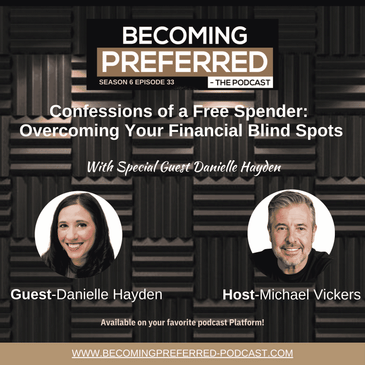
SEASON: 6 EPISODE: 33
Episode Overview:
Welcome back to Becoming Preferred, the podcast designed to help you become the best version of you.
Let’s be honest: most entrepreneurs start a business out of a deep passion for a craft, not a love for spreadsheets. But as your business scales, relying on gut instinct or simply checking your bank balance to see if you're successful becomes a dangerous game. If you’re only looking at your numbers once a year at tax time, you aren't driving your business—you’re just reacting to it.
Our guest today is here to take the fear out of finance. Danielle Hayden went from working behind a salon chair to earning her CPA and stepping into the corporate boardroom as a CFO. Today, she is the founder of Kickstart Accounting Inc., where her team of nearly 50 professionals has helped thousands of small business owners transition from emotional guessing to data-driven confidence.
Whether you are trying to price your services for true profit, looking to make your next big hire, or ready to step into your true power as a CEO, today’s conversation is an essential roadmap for turning financial clarity into a massive competitive advantage. Please join me for my conversation with Danielle Hayden
Guest Bio:
Danielle Hayden started her career behind the salon chair. Working as a hairdresser, she discovered she had a knack for using numbers to help herself and the people around her hit their goals. That instinct sent her back to school, through a CPA and a master’s in accounting, and into the corporate boardroom as a CFO. After more than a decade there, she left to build Kickstart Accounting Inc., where her team is nearly 50 now and has served thousands of small business owners through bookkeeping, CFO services, and tax preparation.
Danielle’s approach starts with the foundation: clean books, the right systems, and a clear picture of cash and profit. From there, she teaches business owners to use their numbers every month, not just at tax time. For owners who have been avoiding their finances or running on gut instinct, she gives them the tools to lead with data.
Resource Links:
- Website: https://kickstartaccountinginc.com/
- Product Link: https://envisioncfo.org/
Insight Gold Timestamps:
02:38 I left high school with no interest in math or numbers or accounting
05:00 I keep on using the words tool in our toolbox, and I do that very intentionally
07:19 I think you call it 'tax time only accounting'
08:58 My mission is that every single business owner looks at their numbers every single month
10:42 A lot of the bad habits that we have in business, they're probably because we have bad habits personally
12:10 Four key performance indicators that you're looking at every single month
13:59 So I have a confession that I am guilty as well, okay? I am what I call a free spender
15:14 Answer these three questions: What just happened? Why did it happen, and what am I going to do about it?
23:10 Make sure that your bookkeeping is accurate first, and then go play in AI with those accurate financial statements instead of doing it the other direction
24:40 Do not go dump a product line just because it's not profitable
27:29 Why did you make the choices that you made?
29:58 We need to understand what we're spending and why, and then use that same data to properly price ourselves
31:33 Bookkeeping is looking backwards, and CFO is looking forward
34:50 The website is kickstartaccountinginc.com and from there you can get over to the envisioncfo.org.
Connect Socially:
LinkedIn: https://www.linkedin.com/in/danielle-hayden-kickstartaccounting/
Facebook: https://www.facebook.com/kickstartaccountinginc/
X: https://x.com/kickstartacct
CEO Numbers Network Podcast: https://podcasts.apple.com/us/podcast/ceo-numbers-network-with-danielle-hayden/id1574515604
Instagram: https://www.instagram.com/kickstartaccounting/
Email: danielle@kickstartaccountinginc.com
Sponsors:
Rainmaker LeadGen Platform Demo: https://calendar.summit-learning.com/widget/booking/JKItVP7WErmCBjU2cCIx
Rainmaker Digital Solutions: https://www.rainmakerdigitalsolutions.com/
In 3, 2, 1.
Speaker BWelcome back to Becoming Preferred, the podcast designed to help you become the best version of you.
Speaker BLet's be honest, most entrepreneurs start a business out of a deep passion for a craft, not a love for spreadsheets.
Speaker BBut as your business scales, relying on gut instinct or simply checking your bank balance to see if you're successful becomes a dangerous game.
Speaker BIf you're only looking at your numbers once a year at tax time, you aren't driving your business business, you're just reacting to it.
Speaker BOur guest today is here to take the fear out of finance.
Speaker BDanielle Hayden went from working behind the salon chair to earning her CPA and stepping into the corporate boardroom as a cfo.
Speaker BToday she is the founder of Kickstart Accounting, Inc. Where her team of nearly 50 professionals has helped thousands of small business owners transition from emotional guessing to data driven confidence.
Speaker BSo whether you're trying to price your services for true profit, looking to make your next big hire, or ready to step into your true power as a CEO, today's conversation is an essential roadmap for turning financial clarity into a massive competitive advantage.
Speaker BPlease join me for my conversation with Danielle Hayden.
Speaker BWell, hi, Danielle.
Speaker BWelcome to the program.
Speaker BWe're delighted to have you.
Speaker AThank you so much for having me here.
Speaker BNow, where are we speaking to you from?
Speaker BWhere's home?
Speaker ACleveland, Ohio.
Speaker BCleveland.
Speaker BOh, Rock and Roll hall of Fame.
Speaker BI've been to it.
Speaker AYes.
Speaker AYeah.
Speaker AYou know, people usually say rock and roll hall of Fame.
Speaker AI've been like, but I'll go downtown because I like the water and I'm a foodie, so.
Speaker BWell.
Speaker BAnd you've got a great theater district as well.
Speaker AWe do.
Speaker BOne of the best.
Speaker BPeople don't realize that about Cleveland.
Speaker BAnd I always, you know, I'm always chuckling with Cleveland because you've got the east side and the west side and Rockefeller was from there.
Speaker BThere's a lot of famous people there.
Speaker BWe've got the Rockefeller hall of Fame.
Speaker BBut no, it's a great city and it's a great state in the union.
Speaker BSo lots of good things going on there.
Speaker BSo I always encourage people to go visit Cleveland.
Speaker BWell, thanks for doing this.
Speaker BI'm excited about our topic.
Speaker BWe have a lot of entrepreneurs, business professionals, and we're going to be talking about financial issues, empowering entrepreneurs, and you've developed some systems and some processes on it.
Speaker BBut what I think is really interesting is how you got here.
Speaker BSo let's go back to high school.
Speaker BSo you're in high school.
Speaker BDid you grow up in the Cleveland area?
Speaker AI Did originally from California, but predominantly grew up here in Ohio, So.
Speaker BAnd, okay, you're in school, and you're deciding what you want to be when you grow up.
Speaker BLet's go back there.
Speaker BAnd what's going on in your head.
Speaker AYeah, so I actually did cosmetology school in high school.
Speaker AI left high school with no interest in math or numbers or accounting.
Speaker AI left to do.
Speaker ATo do hair.
Speaker AI was behind the chair.
Speaker AAnd if you would have asked me then what I would be doing in 10 years, it would always be that I wanted to open up my own hair salon.
Speaker AI loved what I did.
Speaker BYeah, it's an interesting transition, because you don't typically see that.
Speaker BYou'll see school, teachers, and everything, but you chose that.
Speaker BWe were talking before we started showing, and we have a daughter that does that and loves doing that and now specializes in weddings, everything.
Speaker BSo it's a great stepping stone because you're dealing with people.
Speaker BAt the end of the day, you're almost like a therapist, too, aren't you?
Speaker ASo you're dealing with people, you're learning sales, and you're learning numbers.
Speaker ASo that's the part when people say, like, how did you get from A to B in this trajectory?
Speaker AI was using the numbers to hit my goals.
Speaker AI use numbers as a tool to be able to understand what was happening in my business, because it really is a business for yourself.
Speaker AI used the numbers to understand what was happening in my business and how to hit my goals financially.
Speaker AAnd then this interesting moment happened where I realized that I actually understood it, and I really.
Speaker AI was good at understanding it.
Speaker AAnd so I started teaching the other girls in the salon how to do the same thing.
Speaker AAnd in most salons, at least here at that time, had, like, a commission structure.
Speaker AAnd so if you hit these certain numbers, you got more money from your employer.
Speaker AAnd so I was teaching all of the girls how to do this.
Speaker ALooking back, they were probably like, get this girl out of here.
Speaker ABut we did really well together as a salon.
Speaker AWe had a ton of goals.
Speaker ABut I realized in that moment that we can use numbers as a tool in our toolbox.
Speaker AThey don't have to be something that's scary or confusing or that we need to put our head in the sand around.
Speaker AWe can use them to feel empowered and confident.
Speaker BWell, it's just kind of like one of your razors or clippers or thinning shears or they're just tools in your drawer to learn it.
Speaker BBut I think it's something every entrepreneur can learn.
Speaker BAnd now, Danielle, your journey is very fascinating.
Speaker BYou went from working behind the cilantro to earning a cpa, a master's in accounting, and then stepping into corporate as a cfo.
Speaker BSo what did you notice about how everyday business owners view numbers during your time in the salon?
Speaker BAnd why do so many entrepreneurs develop a fear of their own financials?
Speaker AYou know, I keep on using the word tool in our toolbox, and I do that very intentionally.
Speaker AWhat I find is that most people and business owners put their head in their sand around financials.
Speaker AIt feels like something, ooh, I've never been good at math.
Speaker AOr that time that I went into a whole bunch of debt and I don't know how to get out of it, or I just don't understand.
Speaker AThis just doesn't come natural to me.
Speaker AI'm a creative, and therefore this is difficult.
Speaker AAnd so there's just a lot of confusion.
Speaker AAnd when it doesn't feel empowering, when we don't feel confident, we tend to shy away from it or put our head in the sand altogether and completely ignore it.
Speaker AAnd it was interesting because I saw it in the salon.
Speaker ALike I said, I was really working hard to help educate the girls around me, but I saw it with the people who I worked for and then with the people who I worked with, and I went into corporate, and it was a very different.
Speaker ALike 180 people use numbers to make business decisions.
Speaker AIt wasn't emotional.
Speaker AIt was data driven.
Speaker AIt was factual.
Speaker AI worked with the private equity firms, the investors, the management team, to say, okay, here's what is factually happening in the business, here's why it happened, and then here's what we're going to do about it as a company in order to achieve our future goals.
Speaker AHere's where we're going.
Speaker AAnd I learned that the structure that this framework and how we use the framework to get the numbers to where we want to go was something that most business owners didn't have.
Speaker AAnd so my kind of second mission in life was to do the same thing again.
Speaker AI'm going to take everything that I learned from corporate.
Speaker AI wasn't one of those people who ran away from corporate because I hated it.
Speaker AI actually really appreciated what I learned there.
Speaker AAnd I said, I'm going to take what I learned and I'm going to build the framework so that every single business owner has access to this framework that works so that they never have to feel lost or confused or afraid again.
Speaker BYeah.
Speaker BBecause there's a lot of shame and anxiety, I think, with some people because they started they're successful, and they just don't realize, hey, it's not that tough, and it's learning.
Speaker BSo it's not just about understanding the jargon.
Speaker BThey stick their head in the sand because they don't want to learn it, and then they miss out on things, and businesses go bankrupt.
Speaker BWe know a lot of them don't succeed, which leads me to a lot of them.
Speaker BI think you call it tax time only accounting.
Speaker BSo a massive trap for small business owners is only looking at their financial data once a year when they hand a shoebox of receipts to their accountant in the spring.
Speaker BSo why is running a business this way a recipe for stagnation?
Speaker BAnd how should an entrepreneur actually be interacting with their data?
Speaker ASo I make my way into the entrepreneurship world, and I start having conversations with business owners.
Speaker AAnd, you know, I was a cfo, so I wanted to come in and create budgets and talk strategy.
Speaker AAnd I would meet with these business owners.
Speaker AI'm like, all right, let's build the budget.
Speaker AI'm like, show me your quickbook.
Speaker AShow me your bookkeeping.
Speaker AWe'll use that as a map for where we're going.
Speaker BAnd they're like, what budget?
Speaker AYeah, well, Danielle, I don't have any bookkeeping.
Speaker AI don't have any number.
Speaker AI don't have QuickBooks.
Speaker AI don't have any numbers.
Speaker AOkay, I paused right there.
Speaker AI mean, I'm like, six months into this business, I'm like, we can't do this.
Speaker AI cannot build a strategy or a budget without knowing where we've been.
Speaker AAnd so I completely pivoted the business to start with bookkeeping first.
Speaker AI don't come from the industry of tax, so I look at it differently.
Speaker ANumbers are here for us to use them to make business decisions first.
Speaker AThat is the goal, is to use our numbers to make business decisions.
Speaker AAnd then bonus is that we get to use them for tax as well.
Speaker AEvery single business owner I would talk to was using their numbers for tax.
Speaker AI want to pay as little in taxes as possible.
Speaker AI'm not looking at it until tax time.
Speaker AI mean, I.
Speaker AFor the first, I don't know, six, seven years of my business just banging my head against the wall trying to get people to listen to me say there's a better way, and there really is.
Speaker ASo my mission is that every single business owner looks at their numbers every single month, that you have accurate financials delivered to you in a reporting format that actually makes sense.
Speaker ASo all of our clients receive what we call the snapshot CEO dashboard, and that you are then Able to use those numbers to pay yourself to hire, to sign up for the conference, the subscription, the coaching.
Speaker AYou are using those numbers to make real, actual decisions.
Speaker AAnd then when we get to tax season, it feels like a non event.
Speaker AIt's just another Tuesday because we've been using those numbers all year long.
Speaker BYeah, going along.
Speaker BA lot of people don't realize too they, they click the but.
Speaker BAnd I've been guilty of this in my past because it works on a personal level as well.
Speaker BSo whether you're an entrepreneur and you have a business, I think personally we also fall short of this.
Speaker BWe keep the receipts, we pile it up in at the last minute and we're doing the same thing and not knowing our financials.
Speaker BAnd I think what a lot of people don't realize is the use of a good CPA or a bookkeeping firm usually has an ROI to it.
Speaker BIt pays for itself.
Speaker BThere's I think 68,000 lines of code, tax code.
Speaker BAnd you're aware of the deductions, the write offs, the things not too aggressive, but where people are maybe missing the boat and there's opportunity can more than pay for their fees on their bookkeeping fees and some of their accounting fees as well.
Speaker BSo a good CPA for that.
Speaker BDo you find that there's a, a commonality with businesses you've worked with literally, you know, hundreds of them, do you see the same kind of, let's call them, bad habits across the board?
Speaker AYes, of course.
Speaker AAnd I'll say we, we added on personal bookkeeping several years ago, so we do personal bookkeeping as well.
Speaker ABecause a lot of the bad habits that we have in business, they're probably because we have bad habits personally.
Speaker AAnd so if we are overspending or not looking at our financials in our business, we're probably doing the same behavior personally.
Speaker AAnd I want you to know both your business financials as well as your personal financials.
Speaker ASo when we work with our clients as part of our CFO services, we're looking at where do we want to be.
Speaker AAnd I want to be clear, one of the bad habits that I see is not knowing where we want to go.
Speaker AWe're just existing in this life.
Speaker AAnd I would imagine that if you're listening to a podcast like this, you probably want a little bit more than, than just an average.
Speaker ALike you're, you're here listening and learning because you, you want to grow as a person so understanding where you want to be.
Speaker AAnd so with our CFO services, what we're doing is we're looking at 10 years.
Speaker AWhat is our North Star, both for personal and our business?
Speaker AWhere are we trying to go in 10 years?
Speaker AReally feeling that moment in 10 years and then coming back.
Speaker AAll right, what's the three year plan?
Speaker AIf we're going to get there in 10 years, we have to know where we're going to go in three others.
Speaker AOtherwise we're completely missed.
Speaker AThe North Star.
Speaker ASo building that three year plan and we got to come back and do the one year budget, which is great.
Speaker AAnd most people do a budget and then they just, you know, throw it in the.
Speaker AAnd don't look at it.
Speaker AYeah, yeah.
Speaker AIn the box.
Speaker AAnd that's where accountability comes in.
Speaker AI want every single person to have four key performance indicators that you're looking at every single month, you're reforecasting every quarter so that you're looking at the budget and you have true accountability.
Speaker AAnd I would love for every single person who's listening to have a human being who can call you on your BS and help hold you accountable to your goals.
Speaker BRight,.
Speaker AFinancial coach.
Speaker BHold you accountable.
Speaker BExactly.
Speaker AYes.
Speaker AYeah.
Speaker AAnd so that's the mistake that we're making.
Speaker AWe're not creating that 10 year North Star.
Speaker AWe don't have a three year plan, we don't have a budget.
Speaker APutting our head in the sand and hoping that we get there.
Speaker BYeah, I've kind of been guilty of that one on occasion myself.
Speaker BWell, and what's interesting, and you've said it, is tax accounting is kind of historical.
Speaker BIt looks backward, as we've already did, and it's there really to satisfy the government.
Speaker BBut driving your business using only tax returns is kind of like driving a car but looking in the rearview mirror.
Speaker BSo to scale safely, you need managerial accounting.
Speaker BSo you need to look at your numbers, as you say, monthly, if not weekly, to make these real time decisions about hiring, pricing, inventory and spending before it's too late to even pivot.
Speaker BRight.
Speaker AYeah.
Speaker AYou nailed it.
Speaker AI love that summary right there.
Speaker AThank you.
Speaker BOh, you betcha.
Speaker BWell, let's talk about building the financial foundation.
Speaker BSo moving from that chaotic gut feeling finances to a clean systematic structure.
Speaker BWe want to move past what you, I think you call it bank balance accounting.
Speaker BSo let's talk about bank balance accounting.
Speaker BSo many entrepreneurs log into their phone, they see a healthy checking account balance and think, hey, I got some money, we're doing great, let's spend some money.
Speaker BAnd I'm guilty of this one myself.
Speaker BSo I'll see something and I look at it and I go, oh, without maybe Looking at all the potential obligations that are.
Speaker BAnd I get the bigger picture depending on the number of transactions.
Speaker BSo why is this gut instinct approach so dangerous?
Speaker BAnd what metric should they be looking at instead?
Speaker AAll right, so I have a confession that I am guilty as well.
Speaker AOkay.
Speaker AI am what I call a free spender.
Speaker AAnd so when I get, I'm like, you're true.
Speaker BI feel better about myself already.
Speaker BJust, good.
Speaker AAnd I hope anybody listening feels better too, because I am a true visionary and I have 1 million 5 ideas all the time and I want to implement them all right now.
Speaker AAnd what's really important is that my team knows how to ring that back in.
Speaker AAnd they'll say, okay, Danielle, this is our ten year North Star, this is our three year plan, and this is the one year budget.
Speaker AAnd so how does that new idea, that investment and that strategy, how does that actually come into play with this plan that we set?
Speaker AAnd is it going to derail the plan?
Speaker AAnd that's okay, we can say, yes, it's going to derail the plan and we're okay with that.
Speaker ABut having a team of people having that, that money coach, money team, to be able to say, hold on, let's think about this and let's make this decision together to me has been one of the most important things that I've ever had as an entrepreneur.
Speaker ABookkeeping.
Speaker AAnd the act of pausing at the end of each month allows you to answer these three questions.
Speaker AWhat just happened?
Speaker AWhy did it happen?
Speaker AAnd what am I going to do about it?
Speaker AWhen you look at your bank balance, you can't answer any of those questions.
Speaker AYou don't know if there's an invoice that's coming up, if there's somebody that needs to be paid.
Speaker APayroll just hasn't hit yet.
Speaker AYou don't know what you have in your business, your estimated tax payments.
Speaker AYou don't know what else is going on in your business.
Speaker AAnd so I do get a fancy little text message from my bank every morning.
Speaker AAnd I know that is just one little itty bitty piece of my picture.
Speaker AIt allows me to make sure, okay, we're going to hit payroll, or we have enough cash to sustain the business this week.
Speaker ABut that's a weekly tactical metric we're looking at.
Speaker AThe whole month allows us to say, okay, here's what's happened, and then what am I as a CEO going to do about it?
Speaker BNo, that makes sense.
Speaker BWell, I think what you're saying is it's really an illusion because it doesn't account for timing and that healthy balance might not show the credit card bill that's due next week.
Speaker BI'll, I'm guilty of that one.
Speaker BThrow it on the American Express payroll.
Speaker BIt clears in a couple of days.
Speaker BOr the deferred revenue for a project we haven't even delivered yet.
Speaker BSo instead of looking at, you know, at the bank account, we need to look at their net profit margin, their accounts receivable aging.
Speaker BDo you find a lot of clients don't pay attention to those things and they start getting 30, 60, 90 days, the money is there.
Speaker BAnd now they're spending their time so generating revenue, they're paying collection.
Speaker BSo now they've stopped the revenue process coming in again, they're not paying attention to those details.
Speaker ALook, when you don't have a methodology for tuning in, this just feels like one of the million.
Speaker ALike there's so much for us to do in 2026.
Speaker ARight?
Speaker AWe have a million different tasks and if this just feels like a task that you have to do, it's easy to put it off and never actually like a chore.
Speaker AYes, yes.
Speaker ANot everybody gets as excited as I do.
Speaker AI.
Speaker AAnd if you're not, if you're not taking care of eats you right?
Speaker ALike when you don't know if you have enough money, if you don't know if you have enough in savings to pay your taxes or enough operating expenses in your rainy day fund, or if your spouse is like, hey, like are you gonna help pay some bills around here or are we gonna be able to afford that vacation this year?
Speaker ALike, those are all things that we need to understand to have a big full life.
Speaker AI want every single business owner to have enough cash to pay yourself and to pay yourself regular commingling business and personal.
Speaker AJust because it's a tax strategy or you're writing off your vacation, I want you to build a valuable business that creates real wealth.
Speaker AAnd having that time to say, okay, I'm going to allow myself to not be really great at this.
Speaker AI maybe don't understand every line item on this income statement, but I'm going to do it anyway.
Speaker AAnd then I'm going to make the steps forward so that I can have this big full life.
Speaker AI think is where like the real CEO work starts.
Speaker CAre you tired of chasing leads and ready to start effortlessly attracting more high value clients?
Speaker CIntroducing Rainmaker Lead Gen, the ultimate sales, engagement and client acquisition platform that takes the stress out of outreach.
Speaker CWith Rainmaker Lead Gen, you can easily identify, engage, educate and convert your ideal prospects into loyal clients.
Speaker COur industry leading automation and email sequencing empowers you to reach more ideal clients, accelerate the sales cycle and close more business.
Speaker CImagine authentically engaging with your prospects while the platform handles the heavy lifting.
Speaker CSay goodbye to the endless hustle and embrace a more efficient, effective approach to business development.
Speaker CReady to witness the Master magic?
Speaker CBook a 20 minute demo today and see how Rainmaker Lead Gen can revolutionize and level up your client acquisition game.
Speaker CThere's nothing to lose and everything to gain.
Speaker CDon't miss out on this opportunity to supercharge your client acquisition process.
Speaker CVisit rainmakerdigitalsolutions.com or check out the link in the Show Notes to book your demo.
Speaker CRainmaker Lead Gen Spend less time hunting for your ideal client clients and more time having high value sales conversations with your ideal clients.
Speaker BAnd now back to my conversation with Daniel Hayden.
Speaker BNow it's interesting how and where and where you're spending the money.
Speaker BLike I was in springtime.
Speaker BI always go through every single expense just everything and go do I need this and was the last time I used it and I call it cleaning house and it always surprises me how much money is wasted on subscriptions on different it's painful now curious I'm curious in our world of AI and things changing so I'm curious how that can help augment things.
Speaker BNow we have an account and we have Bookkeeper so we do that where we send in everything on a monthly basis and they do that reconciling and all the stuff I definitely don't want to do.
Speaker BBut I used an AI tool over the last couple of months and all I did was download my bank statements in a closed system so it wasn't a freebie and I just called it and I just where am I spending the money?
Speaker BWhere's the money going?
Speaker BWhat's going categorize it for me and get it in the Excel spreadsheet so I can send it to my bookkeeper which makes life easy for her because she can import it into the accounting software and spend time more on strategic initiatives on where we're spending, how we're spending and what's going on.
Speaker BHow are you seeing and we've always had AI functionality in the accounting programs since we've had accounting software.
Speaker BSo it's kind of there it's just focus there are is it are there some quick steps that we can do to help prepare ourselves or AI tools to help us that at least get us to that first base so that we can hand it to you so it isn't such a bother but is helpful to our bookkeepers and help our accountants.
Speaker AThat's an interesting question.
Speaker AI would say no.
Speaker AAnd let me explain why often times we have clients who are really well intentioned and I, I do love them for it.
Speaker AAnd so I'd be curious to hear if your bookkeeper use that document because usually what happens is that clients will spend a ton of time on some Google sheet that they're tracking something and we spend a lot of time trying to tie back to their numbers and they're usually not correct.
Speaker ASo what we use is a very, it's a proven framework.
Speaker AAccounting has been around for a very long time and so we use the proven methods and framework where we take every single transaction from your bank feed.
Speaker ASo what we really need from you is the download from your bank feed, from your point of sale system, from your payroll reports so that we might use an AI tool within QuickBooks but we are then using that to make sure everything is reconciled and accurate.
Speaker AFrom there, if you want to use some AI tools to better understand your financial statements, you can use your accurate financial statements to go then play in Claude or ChatGPT paid version to help you as a business owner understand them, ask more questions.
Speaker AYou don't have to either though.
Speaker AI think that I want to be clear, I'm a daily user of AI, so this isn't coming from somebody who's like scared of AI or I'm daily user and I want, I want AI.
Speaker AHowever, I think we are relying on AI before we're ready, meaning that the bookkeeping has to be correct first.
Speaker ASo in QuickBooks and I don't know why QuickBooks doesn't do this, but there's nothing in QuickBooks, right?
Speaker AThere's not glaring red noises or big alarm bells that says what you just did was wrong.
Speaker AYour books don't reconcile.
Speaker AAnd so I want everyone just to hear, in summary, make sure that your bookkeeping is accurate first and then go play in AI with those accurate financial statements instead of doing it the other direction.
Speaker BYeah, no, I agree with, for me, when I think of it now, it wasn't on the corporate because there's too many, you know, we have our invoicing systems or POS systems and everything that goes into it I did on a personal level with one bank account and it gave me a good clear picture.
Speaker BSo to your point that it does make a good point.
Speaker BAnd so I think the key is interact with it, exchange, get ideas.
Speaker BWhat are some strategies?
Speaker BLet's talk about the.
Speaker BAnd I think this is important and again, this is something that we could also benefit from, we have different revenue streams and some of those revenue streams are really profitable and very little time to maintain that profitability.
Speaker BBut then we have other revenue streams, let's call them products or SKUs, that take a lot of support, a lot of manpower, a lot of effort and support resources and are only a small fraction of what we do.
Speaker BAnd I'm assuming you probably see that, like which ones are profitable?
Speaker BShould we be dumping those lines and just going, hey, yeah, we can make money with it, but it's not our core, it's not where we focus.
Speaker BShould we be focused more on our core?
Speaker BIf we allocated that time, would it make a difference?
Speaker BAnd I'm assuming you probably see that with other business clients as well.
Speaker AOf course, we see that all the time.
Speaker AAnd what I'll say my answer is is that it depends on your strategy of your business.
Speaker ASo I want to go back to what I said earlier.
Speaker AWhere do you want your business to be in 10 years, 3 years and 1 year?
Speaker ADo not go dump a product line just because it's not profitable.
Speaker AIt could be a product line that actually has a ton volume and it's, it's your loss leader.
Speaker ASo it's bringing in the volume and from that product you're cherry picking the clients or the product for your higher tier service.
Speaker ASo don't go terminate anything until you understand your bigger strategy and the role that each product line plays within that strategy.
Speaker AI'll tell you what I see more often than not.
Speaker AI shared earlier.
Speaker AVisionary, right?
Speaker AI am a visionary and I have all these ideas and I get really bored, okay?
Speaker ASo like I want to mess things up just, just to rile things up because I'm sure the object.
Speaker BLet's go.
Speaker BHey, this looks like it'd be fun.
Speaker AYeah, Let me just like tinker with this and blow everybody's world up.
Speaker ABecause I'm bored today, okay?
Speaker AAnd this is what I see entrepreneurs doing with their business every day.
Speaker AThey are bored, they don't want to do that anymore and they call it burned out and they go and they explode their whole business just so that they can go do a new revenue stream.
Speaker AAnd they'll call it and they'll say, well, it's not profitable anymore.
Speaker AOr I was really spending a ton of time on that.
Speaker AI just want to, I just want to call it what it is.
Speaker ALet's just question it first to say, hey, am I bored?
Speaker AAnd then who can I talk to about it?
Speaker AMaybe I should talk to my CFO team to say, hey, where's this product line?
Speaker AWhere's the service line as part of my strategy?
Speaker AAnd if I make a pivot right now, what is going to be the impact on my revenue, my payroll, on my profit before I make a strategy switch?
Speaker BYeah, no, it makes sense.
Speaker BLet's talk about identifying the unprofitable success.
Speaker BSo you've helped thousands of business owners.
Speaker BHave you ever encountered a business that looked incredibly successful from the outside?
Speaker BMassive revenue, tons of clients, but when you looked under the hood, they were actually in serious trouble.
Speaker BAnd what is usually the root cause of that disconnect?
Speaker AYes, we've seen this quite often, and it's actually really hard to.
Speaker AIt's hard to see.
Speaker AYou know, you really feel for these business owners because they'll come in and they'll say, I'm doing all the right things.
Speaker ALike, I'm so busy.
Speaker AMy team is so busy.
Speaker AI've got a million clients, a million things to do.
Speaker AWhere is all of my freaking cash?
Speaker ALike, where did my cash go in my business?
Speaker AAnd I think the first step that anybody who's in this position can take is to understand it.
Speaker AWhat happened?
Speaker AWhy did it happen?
Speaker AAnd then what's one thing you can do about not a million things?
Speaker ABecause we can't fix everything all at one time, but we can fix one thing.
Speaker ASo we have to understand where we went first.
Speaker ALooking at your.
Speaker AYour income statement by month for the last 12 to 18 months, and really understand where the money is going.
Speaker AAnd, like, why did you make the choices that you made?
Speaker AAnd then we can decide together strategically in our budget process, what's the one to two things that we could just adjust?
Speaker AWe're just adjusting the volume.
Speaker AWe're turning it down just a bit to see how we can slowly adjust the profits.
Speaker AWe don't change everything at one time.
Speaker AWe need to understand where we went, why it happened, and then where we're going and you're not alone, I guess, is, like, most important.
Speaker BIt makes sense.
Speaker BNo, I feel like you're speaking to me.
Speaker BLet's talk about strategic growth and CFO leadership because it's.
Speaker BIt's transitioning.
Speaker BAnd let's talk about, first of all, pricing for profit, not competitor approval.
Speaker BSo pricing is one of the hardest things for entrepreneurs to nail down.
Speaker BThey often look at what the competitors are charging and price themselves just a little lower to win the client.
Speaker BHow do you teach business owners to price their products or services based on raw data rather than emotion or market fear?
Speaker AYeah, when we first started our businesses, I think most of us don't know you know, we don't know how long it's going to take us.
Speaker AThere's usually a lot of self.
Speaker ASelf evaluation that we need to do.
Speaker AAm I worthy of these Pricing syndrome for corporate.
Speaker AYeah.
Speaker ASo we start low and, and there's a piece of that that's okay, right?
Speaker ABecause we're testing our systems, we're testing our processes, we're building our frameworks.
Speaker AI will always thank my clients who trusted me those first few years.
Speaker ALike, thank you for going through that time with me because we were building our processes, we, our frameworks.
Speaker AAnd the value that we give clients 11 years later today is not the value I gave in those first few years.
Speaker AAnd so it's okay.
Speaker AIt's okay, I guess is what I'm saying.
Speaker AWhat you're doing is a fine place to start.
Speaker ABut having a money team that can help you understand how much time is actually going into each service delivery or product.
Speaker AWhat is your cost of goods sold, how much of your product is going into that?
Speaker AWhere does your facility cost come in?
Speaker ALike how much of your operating expenses go into each client that is being served so that you can price yourself correctly.
Speaker ANow, if you are mismanaging your finances like we were talking about before, if you're overspending because you have 25 different subscriptions and you haven't evaluated them in two years.
Speaker BRight.
Speaker AWe can't charge our clients more money.
Speaker AWe can't go, you know, two times what our competitors are charging just to fix your spending problem.
Speaker ASo it's a both and conversation.
Speaker AWe need to understand what we're spending and why and then use that same data to properly price ourselves and we don't have to.
Speaker AAlso, you know, there's like in the coaching world, charge, charge what you're worth as much as I want you to charge what you're worth.
Speaker AWhat I really want you to do is form the confidence.
Speaker AThis is how much it costs me to deliver this product and service.
Speaker AAnd so it allows you to charge what you're worth because you understand data behind that.
Speaker BYeah, no, that makes sense.
Speaker BSo as entrepreneurs are building their businesses, they say they get their bookkeeping straight.
Speaker BAnd you've discovered this by, instead of starting off as a cfo, even though you had your cpa, you started bringing in the bookkeeping because that was foundational to successful being a successful CFO or creating good financials which impacts the value of a business.
Speaker BYou're going to get more multiples if you have strong financials.
Speaker BAnd if you might get a 1 times, 2 times, but now you might get 8 or 10 times.
Speaker BSo if you follow the same standards that bigger companies are doing or public companies are doing, the compliance is there, but also there's a value in there, there's investment.
Speaker BSo when is the time to move from bookkeeper to say CFO or fractional cfo?
Speaker BNow that's a new, new role in our economy, which is good.
Speaker BSo your business, you've offer everything from basic bookkeeping to high level CFO services through Envision cfo.
Speaker BSo for an entrepreneur listening right now, how do they distinguish between what a bookkeeper does versus what a CFO does and how do they know they're ready to graduate to CFO level guidance?
Speaker AYou nailed it.
Speaker ABookkeeping is looking backwards and CFO is looking forward.
Speaker AI don't care how long you've been in business, I don't care how long you've had bookkeeping, I don't really care what your revenue is.
Speaker AThe one metric that we use to decide when somebody's ready to go to into our CFO services is are you ready to step into your visionary seat?
Speaker ASo if you're ready to be the CEO of your business and set the vision for your business.
Speaker ASo you are spending your time not just looking backwards at what just happened, but planning the future.
Speaker ATalked about it a few times today.
Speaker AThe 10 year North Star, the three year plan, the one year budget, quarterly key performance indicators, understanding the strategy behind every single business decision that you make, that's when you're ready.
Speaker AIt's not like, oh, I've been in business for five years and I've hit $500,000 in revenue.
Speaker AI don't care about any of that.
Speaker AYou're ready to be a visionary.
Speaker AYou're ready to set the future of your business.
Speaker BThat makes sense.
Speaker BAnd so from an expense perspective, they usually pay for themselves or an roi.
Speaker BWhen you're looking at that strategic part and how does this a fractional CFO work and how does that role differ from say a full time cfo?
Speaker AYeah, I think that every financial person you have and on your team pays for themselves.
Speaker AThe bookkeeper is strategically organizing every single transaction in your business so that you can look at an accurate picture.
Speaker AYour CFO team, they're holding you accountable and calling you on your bs.
Speaker AAnd we need that level of accountability and support and strategy in this.
Speaker AI'm going to call it day and age, but it make it, I think that makes me sound kind of old.
Speaker AAnd so we, we need that level of strategy.
Speaker AAnd so the ROI is that if you're ready for Someone to hold you accountable at the deepest levels, then that role pays for itself because you're going to do what you said you were going to do.
Speaker AYou're going to paint the vision for your team.
Speaker AYou're going to hold the energy for your clients and your team, and you're going to be able to do that as the CEO and with that level of support.
Speaker BMakes sense.
Speaker BWell, Danielle, to wrap things up, what does true financial clarity and freedom mean to you personally now that you've been at it for a while?
Speaker BAnd what is your ultimate wish for every entrepreneur who listens to the show today thing?
Speaker AYeah.
Speaker AI used to think that because I came from a world where we built businesses to.
Speaker ATo sell them, it there's a certain level of adrenaline that that comes from that.
Speaker AThere is a certain level of, like, wow, I just built something that's so valuable that people want to come and pay for this business that we created.
Speaker AAnd at my heart, like, that's what I'm doing at Kickstart.
Speaker AI'm helping business owners understand their numbers, to make stronger business decisions so that they can build something that's so valuable and so meaningful.
Speaker AAnd then in part of that is that they feel so confident, like, we are transforming people's lives by helping them feel empowered and confident.
Speaker AAnd I wake up so excited to do that every day.
Speaker AAnd so I used to think financial freedom meant, like, not having to spend all my time in these four walls.
Speaker AAnd now I get really excited to come to work every day and.
Speaker AAnd, you know, I want to keep doing this.
Speaker BLiving the dream.
Speaker BHey, Danielle.
Speaker BThis was awesome.
Speaker BThe website is kickstartacounting inc.com from there, you can get over to the envision cfo.org so everything is linked and you can find out more information.
Speaker BI'm assuming if they want to call and contact you and we'll have all of your data and information in the show notes, they can call you for an executive briefing, see if that's the right service for them and explore that.
Speaker BGreat insights.
Speaker BI think there are things that we could all sharpen up on.
Speaker BI know I could hear my bell ringing there a few times.
Speaker AOkay, good.
Speaker BSo, yeah, me too.
Speaker BAnd it's kind of like, you know, that, you know these things.
Speaker BI've always attacked it from, hey, just go get more revenue, because it fixes everything.
Speaker BIf I get more revenue, I can fix my bad habits.
Speaker BBut I can see where the financial structure comes into play here, and we could all be mindful of that.
Speaker BSo to take our businesses to the next level become preferred in our markets.
Speaker BI think this is good advice.
Speaker BWe'll have all of that data in there.
Speaker BDanielle, thanks for being our guest today.
Speaker AOh, thank you for having me.
Speaker AThis was great.
Speaker BAs you're listening to this episode, what is one idea that you've heard that has caught your attention and why does it matter so much to you?
Speaker BAnd who is one person who you can share that with, either sharing this episode or just sharing that insight that occurred to you while you were listening?
Speaker BPerhaps it is that a healthy checking account balance is often an illusion that fails to account for upcoming obligations.
Speaker BOr maybe it is that you should never abandon a product line or pivot your revenue stream out of boredom without first consulting data to understand its strategic impact.
Speaker BThank you for listening, for learning, and for investing in yourself so that you can become the best version of you.
Speaker BIf you found value in this episode, please write a review on Apple Podcasts.
Speaker BIf you haven't subscribed yet, please do so so you can get a new episode and start your week off right every Monday.
Speaker BUntil next time.
Speaker BThis podcast is created and associated with Summit Media.
Speaker BMy Executive producer is Beth Smith and Director of Research Tori Smith.
Speaker BThe fee for the show is that you share it with friends when you find something useful or interesting.
Speaker BThis podcast is subject to copyright by Summit Media.
Speaker AGoodbye.