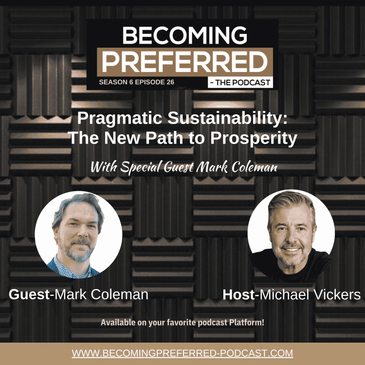
SEASON: 6 EPISODE: 26
Episode Overview:
Welcome to another episode of Becoming Preferred, where we examine the traits, strategies, and mindsets that will help you become the best version of you.
Today, we are looking into a topic that is often misunderstood: the intersection of high-stakes business growth and global responsibility. Our guest today is a master of navigating that nexus. Mark Coleman is an award-winning author, a strategic advisor with over 25 years of experience, and a leading voice in sustainable change management.
Mark works at the front lines of the energy transition, helping organizations navigate a world that is becoming rapidly decarbonized, digital, and decentralized. His latest book, Planet Pragmatism: The New Path to Prosperity, challenges us to move beyond the rhetoric and build enterprises founded on dignity, trust, and accountability. Whether you are an entrepreneur looking for the next economic edge or a corporate leader managing complex environmental risks, Mark is here to show us how principled leadership is the ultimate competitive advantage. Join me for my conversation with Mark Coleman.
Guest Bio:
Mark C. Coleman is an award-winning author and recognized voice as a business and leadership advisor, entrepreneur, and educator on sustainable change management and enterprise development. He is inspiring the “now and next generations” to discover, develop, and deploy principled leadership through dignity, trust, and accountability. As a practitioner with more than 25 years’ experience, he has served as a strategic advisor to leading academic, industry, emerging enterprises, and government-based organizations on the convergence of societal change, environmental risk, and sustainable innovation.
Mark currently serves as Director of Advisory and Innovation within TRC’s Advanced Energy (AE) business segment where he works with leaders across the organization and with partners and clients, to strategically advance best-in-class integrated solutions to complex energy challenges. Through intentional design and delivery of transdisciplinary teams, Mark works at the nexus of energy and environmental innovation and the emergent sustainable economy, marked by solutions which are decarbonized, digital, decentralized, and which also embody social impact, environmental justice, and economic equity at their foundation.
Mark’s 4th book, Planet Pragmatism: The New Path to Prosperity, was published in July 2025. He also serves as an adjunct instructor of Entrepreneurship and Emerging Enterprise at the Whitman School of Management at Syracuse University where he teaches undergraduate and graduate level courses in Sustainable Enterprise. He resides in the Finger Lakes region of New York with his wife and two sons.
Resource Links:
- Website: https://www.markcolemaninsights.com/
- Business Website: https://www.cmm-insights.com/
- Product Link: https://www.amazon.com/Planet-Pragmatism-New-Path-Prosperity/dp/1958233439
Insight Gold Timestamps:
03:35 Probably like most graduating seniors, I had no idea what I wanted to do with my life
06:30 I work hard, I think, to try to bring that sense of unbiased, independent perspective
07:21 Think about the lens by which they bring to the world
08:19 Your latest book is titled Planet Pragmatism
10:45 What's near and dear to the customer?
12:03 My premise of this book is that prosperity broadly is under assault
14:06 Right now people feel as if they don't have that high quality of life
15:19 It's not about compromise, it's about, as you say, realistic innovation
20:54 Let's not repeat the mistakes of the past
24:50 This idea that we need to have a Preventive, Predictive and Proactive Posture towards how we're living in the moment and how we're focused on the future
26:23 No business exists without some foundation and grounded principles in their why, as Simon Sinek would say it
28:31 I think that we have to lean into the humanity that exists within how we design, engineer, and bring enterprise together for the world
32:27 I think we're at a place where no idea necessarily is bad...conceivably
34:40 It also has to be the type of leadership that says, "That's a great idea. Go build it. Go take that on!"
35:24 The latest book is called Planet Pregnatism: The New Path to Prosperity by Mark C. Coleman
35:30 The website is markcolemaninsights.com
Connect Socially:
LinkedIn: https://www.linkedin.com/in/markcolemannow/
Instagram: https://www.instagram.com/MarkColemanInsights/
Email: mark@cmm-insights.com
Sponsors:
Rainmaker LeadGen Platform Demo: https://calendar.summit-learning.com/widget/booking/JKItVP7WErmCBjU2cCIx
Rainmaker Digital Solutions: https://www.rainmakerdigitalsolutions.com/
In 3, 2, 1.
Speaker BWelcome back to another episode of Becoming Preferred where we examine the traits, strategies and mindsets that will help you become the best version of you.
Speaker BToday we were looking into a topic that is often misunderstood, the intersection of high stakes business growth and global responsibility.
Speaker BOur guest today is a master of navigating that nexus.
Speaker BMark Coleman is an award winning author, a strategic Advisor with over 25 years of experience and a leading voice in sustainable change management.
Speaker BMark works at the front lines of energy transition, helping organizations navigate a world that is becoming rapidly decarbonized, digital and decentralized.
Speaker BHis latest book, Planet New Path to Prosperity, challenges us to move beyond the rhetoric and build enterprises founded on dignity, trust and accountability.
Speaker BSo whether you're an entrepreneur looking for the next economic edge or a corporate leader managing complex environmental risks, Mark is here to show us how principled leadership is the ultimate competitive advantage.
Speaker BJoin me now for my conversation with Mark Coleman.
Speaker BWell, hi Mark.
Speaker BWelcome to the program.
Speaker BWe're delighted to have you.
Speaker CThank you, Michael.
Speaker CIt's my pleasure and delighted to have a conversation with you.
Speaker BYeah, I'm really excited about this topic.
Speaker BWe've never covered this and we're on season six and we've just never covered this topic.
Speaker BAnd I think it's appropriate and there's a couple of directions we can definitely go.
Speaker BBut we're going to be talking about your latest book and I'm excited about it, Planet Pragmatism.
Speaker BAnd there's just lots of different areas that we can go down.
Speaker BSo we'll start at the very top.
Speaker BBut before we get there, let's go back into you're in high school.
Speaker BActually, you're in college.
Speaker BYou're going to college way back in the 2000s and you're a geography major.
Speaker BAll right, so trying to decide what do I want to be when I grow up?
Speaker BHow did Mark Coleman get to be Mark Coleman?
Speaker BLet's walk us through that or listeners always like to know that evolution of your development.
Speaker CThank you for the question.
Speaker CAnd I would love to even begin earlier in many ways.
Speaker CBut we can begin in college because it still touches on a phase of my life where I was still working as a line cook within a local restaurant.
Speaker CAnd I bringing that up, Michael, because from an entrepreneurial perspective or other aspects of my business and professional life, I've often looked back and thought, what were those inflection points?
Speaker CWhat were those moments that kind of continue to build who you are and provide you with the grit or the substance or the desire to keep pushing forward?
Speaker CAnd ironically, I Go back to my first job, which was like when I was 14, almost 15, starting as a dishwasher in a local restaurant.
Speaker CAnd then I went on to be a prep cook.
Speaker CThen I went on to become a line cook, and even dabbled with the idea of going to culinary school for a brief moment, only to realize that I didn't really want to spend all my waking hours working within the restaurant and late at night and all that good stuff.
Speaker CAnd I bring that up because I did work through college in the restaurant industry.
Speaker CAnd it was a formative background experience, those first jobs and kind of shaping, you know, what you thought you wanted to do with your life, who you thought you were, plus the kind of social and behavioral network that kind of taught you those early skills and what to do, what not to do.
Speaker CAnd they're just formative kind of experiences that begin to shape that muscle inside you.
Speaker CBut it did also make me realize I do want a formal education.
Speaker CSo my first two years of college, I actually spent at community college before I could figure out exactly where I wanted to go and what I wanted to do.
Speaker CThen I went on to four year formally and as you pointed out, did a bachelor's degree in geography.
Speaker CI did a bachelor's degree in environmental studies.
Speaker CAnd quite frankly, probably like most graduating seniors, I had no idea what I wanted to do with my life.
Speaker CHere I was with two bachelor's degrees, thought I had a plan.
Speaker CI had the opportunity at the university, Binghamton University is where I was doing my undergraduate at the time, to stay on and do a master's in Geographic Information Systems.
Speaker CIt just didn't feel like the best fit, although I did love it.
Speaker CBut I had come across another master's program opportunity at that time.
Speaker CIt was with Rensselaer Polytechnic Institute, and it was a Master of Science in Environmental Management and Policy.
Speaker CAnd I decided to go that route, and for a few reasons.
Speaker COne was I wasn't exactly sure what I wanted to go out and do, and I didn't necessarily feel like I was fully prepared to go into the job market.
Speaker CI did have an academic slant at that time where I wanted to pursue additional education.
Speaker CBut there was something with the program that stood out to me, and this was this bridge between formal education on management training with science training, engineering training, and classic kind of humanities.
Speaker CAnd my mind at the time was I feel like there's a gap between those that are out there doing these formal career functions like engineering, or just people with an MBA doing business related activities, or those that are just attorneys and doing legal and all of them doing amazing things in their own right.
Speaker CAnd I thought there's this gap between how do you communicate in between these professional factions in a way that's productive and can help kind of bring this cohesiveness or this integration between professions and particularly with a focus on environmental and sustainability related endeavors.
Speaker CAnd so, lo and behold, I ended up being able to go to rpi.
Speaker CI did my Master's of science, I worked hard in that program and that degree and that experience and all the trimmings around it, whether they were internships or working with entrepreneurs or all kinds of things I could talk about, really began to provide a solid foundation for my Entire going on 30 year career.
Speaker CFinding that void and being able to speak the language of these other professions, not necessarily being the expert in them, but being able to understand their point of view, be able to dissect what they are getting at and bring that into more of a common sense solution in terms of problem solving and communication and articulation and establishing a business plan or a roadmap and being able to work within teams to bring all these different points of view together towards something that can provide a value.
Speaker CThat ended up being the entire roadmap for my career.
Speaker CAnd I'm incredibly grateful that I found that path.
Speaker BIt when I look at what you've written and what you talk about, it seems like you've actually approached it from not a left or right side, but from a reporter's perspective.
Speaker BIn other words, bring all the information to the table and then look for ways to combine those and get those different viewpoints or mindsets through those different lenses so something can move forward so we actually have some progress.
Speaker BIs that a fair assessment?
Speaker CFirst of all, thank you.
Speaker CI will take that assessment because it brings me joy to hear that somebody is discovering that.
Speaker CI work hard, I think, to try to bring that sense of unbiased, independent perspective to the research and writing that I do.
Speaker CI'm not the author who's out there who's trying to take a one sided approach and hit one side against the other just for likes or sales or divisivenessiveness just to do it, just to draw greater attention to my work.
Speaker CI'm really trying to in a sense illuminate the challenge, as you pointed out, bring all points of view together the best that I can, be as holistic and systems oriented in terms of deconstructing the problem, but then also building it back up towards something that can be understood in a way that others see those different points of view through A new perspective.
Speaker CYou mentioned the word lenses.
Speaker CI think that's excellent.
Speaker CAs a practitioner and somebody who also teaches at the collegiate level, now an adjunct role, I always challenge my student audience to, when we begin our classes, think about the lens by which they bring to the world.
Speaker CRight.
Speaker CWe all have a sense of bias, a sense of background, environment, culture, things that make us who we are.
Speaker CThere's good and bad in that.
Speaker CBut once we begin to understand the lens and see that filter that we bring to our daily decisions and who we are, we begin to see that there is areas to perhaps work on.
Speaker COr the idea that the aperture of the lens can actually widen and we can see the world in a different way is something that we should, I believe, be open minded to.
Speaker CSo through my writing, and I'm so glad that you pointed that out, I really do work hard to try and bring a balanced, as balanced perspective I can bring to it.
Speaker BYeah, yeah, no, and I understand that.
Speaker BI'm a sales marketing guy, and so I know that's my biases.
Speaker BSo every time I'm looking at it to fix a problem, I'm looking at it from that perspective.
Speaker BBut I'm aware that it's my perspective and not the only perspective.
Speaker BSo I've had to mature into that, I must say.
Speaker BIt's not how I always felt about it, but debris, by the way, as we get older.
Speaker BHey.
Speaker BWell, your latest book is titled Planet Pragmatism.
Speaker BSo in a world where conversation often swings between extreme environmental alarmism and total denial, what does the pragmatic path look like for a business owner trying to navigate the next decade?
Speaker CThank you for the question.
Speaker CAnd you just hit the nail on the head, in my opinion.
Speaker CIt's exactly that.
Speaker CIt's the ability to take stock of where we are, acknowledge the fact that there's been a political, an economic, a social, cultural, even a spiritual, and name anything else that you want in their pendulum that's been swinging more rapidly between a far left, a far right perspective, and there's this mantra or culture that's been working hard to create division in.
Speaker CIn society in many different ways.
Speaker CIt's not just political, it's all these other elements too.
Speaker CAnd it feels as if it's really bombarding society and weighing us down in many different ways right now.
Speaker CWe're distracted, we're fearful, we have anxiety, we have economic and other stressors.
Speaker CAnd that's keeping us distant from not only our truest sense of self and the trust that we have with us individually, but also with those that need to be putting their trust in us.
Speaker CLikewise those that we need to be putting our trust into others in terms of our family unit, our friends unit, our collegial professional unit and other elements.
Speaker CRight.
Speaker CSo the sense of pragmatism really stood out to me in the past year and a half from this perspective that as a sustainability practitioner I feel as if I have done.
Speaker CI'll be self effacing and just point at myself.
Speaker CBut I would also like to cascade this out to many of my peers within the profession too.
Speaker CWe've done ourselves a disservice in some ways.
Speaker CWe did a yeoman's job of being able to bring sustainability into the forefront.
Speaker CFrom a business perspective, what is the business case?
Speaker CHow can businesses begin to look at objectively bringing sustainability indicators into the forefront of the work that they do through innovation, create value, demonstrate that value to customers, maybe derive new products and services, clean up our operations, offer a more sustainable offering from a business context to society.
Speaker CBut we haven't fully addressed this question in the eyes of humanity, in the eyes of the consumer and others.
Speaker CSo it's been low hanging fruit for political voices and others to say hey, wait a minute, it's too difficult or costs more or you're hurting the environment in other ways.
Speaker CSo what I like to say is there's this notion of this big S sustainability and what we haven't properly done is really demonstrate what's the value that's been created.
Speaker CIt's not just about sustainability broadly, but it's about other elements like what's near and dear to the customer.
Speaker CPerhaps it's the sense of resiliency, perhaps it's the ability to have affordable energy, perhaps it's ability to have other options, not just a fossil based energy option, but maybe a renewable option or other things they can look at, right?
Speaker CAnd oftentimes we look at that system and say sustainability is good or bad.
Speaker CBut I think there's a more pragmatic approach.
Speaker CWe think it takes all the way from big systems infrastructure challenges.
Speaker CThink of a federal energy policy versus states rights versus what's happening in the marketplace and the kind of political backswing that's happening through incentives and other things versus the idea of pragmatism where just our daily decisions as citizens and consumers we may want just simple alternatives and a very basic way to demystify sustainability in our life because our life is full of complexity and we don't want to have another indicator that we have to now address.
Speaker CAs I like to say, my belief is most citizens don't want their mandated, dictated, over, regulated in the context of whom they are.
Speaker CThey want to have autonomy, they want to have some free agency in terms of the decisions that they make.
Speaker CBusinesses are no different.
Speaker CBut sometimes we also have to understand that the role of government, the role of nonprofit NGO organizations, institutions, is necessary to help kind of complete the picture.
Speaker CMy premise of this book is that prosperity broadly is underestimated.
Speaker CWe tend to have a Americanized view, particularly in the United States, of what the American dream is, was, or should be.
Speaker CBut living in the past and having an idealism around what our current state is, kind of a false sense of reality.
Speaker CWe have to calibrate new our sense of prosperity in the moment, acknowledging the challenges that are facing the world, geopolitically and otherwise, as well as where this incredible experiment, America is going into the future, right?
Speaker CIn some ways, productively, in some ways, in a very cautious and dangerous way.
Speaker CAnd so for everyday citizens and consumers, we don't want to necessarily be confounded with that.
Speaker CWhen I talk with folks, a lot of what people say is, I just want to live my life right?
Speaker CI want to live my life on my own terms.
Speaker CI don't want to be enraptured in all this divisive debate or culture wars or concerns over what's happening in the Middle east or other parts of the world.
Speaker CBut the reality is, in many ways, those entanglements are real.
Speaker CThere are small things that we could do.
Speaker COf course, there's the political element that people can serve as well.
Speaker CBut where I come back on this is that we have to get back to the sense of pragmatism in terms of where prosperity is moving.
Speaker CIn a sense, we all have a unique role to serve in terms of defining what that next step might be and the role that we play as citizens and consumers to attain that.
Speaker CAnd I think that's something that the book is really trying to unravel, which is, where were we?
Speaker CThat's important.
Speaker CWhere are we now and where are we going?
Speaker CAnd as I like to say, sustainability and prosperity aren't something that's a past tense or a future state.
Speaker CThey're in a sense, one in the moment.
Speaker CSo the decisions that we're making right now, the conversations that we're having right now, they are critical to addressing our state of prosperity.
Speaker CAnd then the other thing I'll just add in here real quick, Michael, on this context is when I think about prosperity, it's not just wealth generation for wealth generation, or the idea of profitability and the haves and haves, nots that's an important indicator we need to solve for.
Speaker CWhat I'm talking about is this quotient for quality of life.
Speaker CBecause right now people feel as if they don't have that high quality of life.
Speaker CWhen we look at services in healthcare, education, when we look at the advance of new technologies and the more technocratic society and even the inequity that's beginning to unravel there, or concerns over privacy, when we look at obviously natural resource consumption and the more widely notioned context of sustainability through that perspective, environmentalism, you know, that's also waging its own war that we're party to.
Speaker CSo all these different elements of both human right as well as quality of life, I think are now converging in a way that most consumers are dealing very intimately with.
Speaker CAnd I think that's where we have to begin to redefine this notion of what does prosperity mean to us?
Speaker CHow can we bring forward more of a common sense for common good understanding amongst all of us so that we can put this more in the wheelhouse of us being able to control it?
Speaker CBecause I do feel like we've lost control in many ways of what that means for most people.
Speaker BYeah, I think too in the.
Speaker BAnd the book is good, it's really defining the term pragmatism because if you talk to the average and say, what does this mean?
Speaker BI think it's getting a definition that we can even all agree on what that means.
Speaker BTo me, it's not about compromise, it's about, as you say, realistic innovation.
Speaker BIt's the recognition that as you talk about economic prosperity and environmental stewardship are not at odds, they're interdependent.
Speaker BSo this new role, this new path for us involves finding that overlap where sustainable practices actually drive operational efficiency and where we just lose that efficiency.
Speaker BIs that, is that a fair assessment of it?
Speaker CThat's right on.
Speaker CThank you so much for saying it that way because that's exactly the intent.
Speaker CIt's not about.
Speaker CYeah, there's, you know, our are long shot, moonshot opportunities, right?
Speaker CYes.
Speaker CThere's also these prior challenges that we've seen that society has had that, you know, let's just not go down that path anymore.
Speaker CIt's getting to that point where we have those technology, we have the financial capacity, we have the natural resource utilization.
Speaker CWe just have to find a way to wield it more in the image of where our values, principles and goals are today.
Speaker CSo right now it's not optimized across what I would call that quality of life indicator and A clear example for me in the moment is when we look at the proliferation of artificial intelligence and the build out of the infrastructure required to bring AI into society today in a productive way.
Speaker CA lot of people who are intimately knowledgeable about this understand that a lot of energy, a lot of water, a lot of land use is required to build these data centers and hyperscalers.
Speaker CAnd that's playing out a lot of cost.
Speaker CThat at the same time some of that AI is getting put into the public domain in ways that we could arguably say what is the true intention or point of that?
Speaker CRight.
Speaker CI love doing cute videos or images or seeing the work of others.
Speaker CIt's great.
Speaker CAnd all that good stuff.
Speaker CRight.
Speaker CBut then if you step away from that for a moment and say how much energy, how much water requirement, how much land use, how much not in my backyard happened just to create that for somebody that was doing something fun queue interesting versus actually solving for X, which could be cancer or autoimmune disease or something more prominent in terms of how we might develop AI into really enhancing our infrastructure in a way that really.
Speaker CSo it becomes more resilient to wildfires or begins to reduce our resource consumption leaps and bounds compared to what we understand today.
Speaker CThere are customers all around the United States in the world that are suffering from higher energy costs in so many ways.
Speaker CRight?
Speaker BYep.
Speaker CI am a firm believer that we have the tools, the technology, the know how.
Speaker CWe're just not necessarily optimizing it and prioritizing it towards the problem set as efficiently as possible.
Speaker CThat's not to say it's not happening.
Speaker CI know it is because I work with many of those companies, organizations, and they're doing amazing things.
Speaker CBut it's also to say when we're given the opportunity with these amazing tools and capacity as a species to deal with these technologies, I think we have to take a hard look at how we're leveraging these resources overall and for the benefit of all.
Speaker CRight, so now some will say free market economy, capitalism will solve for much of this.
Speaker CAnd I believe there's reason to believe that that's true.
Speaker CI've seen that play out.
Speaker CAnd maybe there's a mechanism there, but I think the world is also fundamentally different than it was 50, 100 years ago as well.
Speaker CSo we have to, as stewards of not just the planet, but of our quality of life and where we go into the future for our next generation, our children, you know, our sons, our daughters, we have to take a hard look at what happening in the moment and really ask ourselves Is that the best decision?
Speaker CCould it be optimized?
Speaker CAnd is there a way, like you said, through, through this lens of pragmatism, come to a solution that makes more sense in the moment than currently?
Speaker CWhat's playing out?
Speaker BYeah, and there's so much division on it.
Speaker BEverything becomes political and it doesn't have to be.
Speaker BIf we put our minds to something, it's kind of like the moonshot back when you know.
Speaker CExactly.
Speaker BSaid hey, we all got there and we made that happen and it was amazing.
Speaker BAnd now we've got all this diverse and different special interests.
Speaker BSo it is a little on the frustrating side.
Speaker AAre you tired of chasing leads and ready to start effortlessly attracting more high value clients?
Speaker AIntroducing Rainmaker Lead Gen, the ultimate sales, engagement and client acquisition platform that takes the stress out of outreach.
Speaker AWith Rainmaker Lead Gen, you can easily identify, engage, educate and convert your ideal prospects into loyal clients.
Speaker AOur industry leading automation and email sequencing empowers you to reach more ideal clients, accelerate the sales cycle and close more business.
Speaker AImagine authentically engaging with your prospects while the platform handles the heavy lifting.
Speaker ASay goodbye to the endless hustle and immediately embrace a more efficient, effective approach to business development.
Speaker AReady to witness the magic?
Speaker ABook a 20 minute demo today and see how Rainmaker Lead Gen can revolutionize and level up your client acquisition game.
Speaker AThere's nothing to lose and everything to gain.
Speaker ADon't miss out on this opportunity to supercharge your client acquisition process.
Speaker AVisit rainmakerdigitalsolutions.com or check out the link in the show Notes to book your demo Rainmaker Lead Gen Spend less time hunting for your ideal clients and more time having high value sales conversations with your ideal clients.
Speaker BAnd now back to my conversation with Mark Coleman.
Speaker BYou talk about the nexus of energy, environmental innovation and the emergent economy for small mid sized business leaders and big enterprises as well.
Speaker BWhat is the most overlooked environmental risk that could actually disrupt their business model in the next, say, three to five years?
Speaker CThat's a great question.
Speaker CI think it's There's a couple things that come to my mind.
Speaker CLet's not repeat the mistakes of the past and what I mean here and in the book I reference it as a dragon that gets his head cut off, but he still has capacity to still be a dragon or grow a body again, that kind of thing.
Speaker CBecause.
Speaker CYeah, because in the environmental space, for example environmental liabilities, environmental toxicology, where I've spent some time formerly in my career, sometimes these mistakes repeat themselves.
Speaker CAnd what I mean is we promulgate new chemicals, we have A toxicology to them.
Speaker CWe understand their kind of fate within the open environment.
Speaker CAnd yet there's many industries that are promulgating that are bringing forth new advanced technology, using new chemicals in ways that maybe we don't fully understand what that will mean for the world that we live in.
Speaker CRight.
Speaker CSo how do we take those lessons from the past and make sure that we don't repeat them in the future?
Speaker CAnd even for small medium sized businesses.
Speaker CBut that's an important factor to consider, I think.
Speaker CThe other thing I think first and foremost is affordability.
Speaker CAnd not in the sense of the political notion that's getting played out, but I think true cost of doing business, surrounding those inputs into the business.
Speaker CAnd even for a digital company, power consumption and utility rates are an important factor.
Speaker CIf you're a small medium business that's operating on other fuels and other inputs, including water, or if you're a manufacturing based enterprise and other consumables in terms of chemicals and air gases and other things, these are significant costs of doing business.
Speaker CAnd just see what's playing out even for retail outlets.
Speaker CI just saw on the evening news yesterday, you know, these small boutique shops that are really struggling with the passing the not only inflation but the cost of energy onto their customers because if they were buying a product from overseas markets or even domestically, that they're suffering much higher costs and are very concerned whether or not their customer clientele will continue to come in and purchase from them right now during this moment that we're facing with higher escalating prices and price volatility.
Speaker CSo I think energy is a key indicator.
Speaker CIt's not going anywhere.
Speaker CIt always needs to be not just managed within the enterprise, but also from the supply side, demand side, the efficiency side.
Speaker CAnd there's so much that a ball media business can do in that regard.
Speaker CSo anywhere there's resource inputs, but I think also the positioning of the enterprise, I would argue with any industry right now, and it's not getting back to the ESG sense of what I think politically has panned out over the past few years.
Speaker CBut it's really in terms of a competitive context.
Speaker CWhat social, economic, environmental good are you doing?
Speaker CHow are you differentiating yourself?
Speaker CAre there opportunities for you to attract new customers, to innovate, to find ways to have an impact within your community that isn't impact for impact's sake, but truly getting to the elemental DNA of who you are as an enterprise so that you can differentiate yourself and be in business multiple cycles into the future.
Speaker CI think that's an opportunity for any enterprise to really self devalue and decept.
Speaker BYeah, no.
Speaker BAnd I think with our generation, got five generations out there and as a baby boomer we look at it from one perspective where the Gen X, Gen Y is looking at at from a different perspective.
Speaker BBut we know it's not just about climate change.
Speaker BIt's supply change, regulatory transition.
Speaker BSo as the world, as the plant moves toward a decarbonized and digital system, businesses in my mind based on what you talk about, haven't really mapped their energy dependencies, are going to face higher costs as you're talking about and less status or preferred status as we like to solid among those eco conscious consumers and partners.
Speaker BSo it's getting on the same page and where people see and we, we tend not to get there until it is a disaster, we're facing an imminent disaster of some sort, then we kind of all jump on the same page which is unfortunate.
Speaker BRight.
Speaker CI was going to say the same.
Speaker CI've been studying this a long time and for some reason that tends to be human nature which is, and I like, you know, I brought up Michael a long time ago.
Speaker CThis, the alliteration around these four P's, I call them, this idea that we need to have a preventive, predictive and proactive posture towards how we're living in the moment and how we're focused on the future.
Speaker CAnd this idea that the past, this predictive sense, we have data, we have information, we have knowledge, but we don't necessarily put it to that productive use that we can shape it immediately where we are.
Speaker CAnd the sense of being proactive is something, as you pointed out, we tend to overestimate our ability to react in any given moment.
Speaker CAnd yet right now we need to be more proactive in our stance of how we think about the future.
Speaker CIt feels like it's long away.
Speaker CPeople don't want to make investments.
Speaker CCompanies sometimes don't want to make investments.
Speaker CBut the reality is those that do tend to have greater resilience and greater options for adapting when the time is there.
Speaker BYeah.
Speaker BIn your book the Dignity Doctrine and Time to Trust, you talk about dignity and trust, which I think are excellent topics.
Speaker BYou advocate for leadership founded on dignity, trust and accountability.
Speaker BAnd these can often feel like, you know, soft terms in a hard driving corporate world.
Speaker BHow do these values tangibly impact the bottom line of an organization?
Speaker CI think they tangibly impact, I think it's been proven many times over.
Speaker CI think businesses struggle to integrate them because we are globally, definitely domestically on a quarterly monthly earnings profitability EBITDA timetable where it's really checks and balances and making sure that the fiscal responsibility of the enterprise is always prominent.
Speaker CYou know, capitalism would argue that's what gets bundled back in and allows the enterprise to sustain.
Speaker CAnd that is a core element of sustainability in its own right.
Speaker CNo business exists without some foundation and grounded principles in their why, as Simon Sinek would say it, or within their kind of guided path of how they create value, what's their mission, what is their vision when they lose sight of that, when they lose sense of their proverbial door star in terms of how they're growing and approaching their customers, Even if they're the most transactional business in the world on paper, they still need to have that alignment with whom they are, what they do and for whom.
Speaker CAnd when you bring those together, even in the world of AI and even in a world of mass digitization, there's still a human element to the enterprise that operates the world today.
Speaker CAnd so my premise is getting back to those sound principles that make business human and allow human endeavors to intersect the business where they need to and appropriately is also something that we need to recalibrate.
Speaker CWe're losing sight in many ways, through many industries and many individual businesses of that core premise.
Speaker CWhen you look at disasters of the past, I'll speak of it from a environmental or sustainability disasters of the past.
Speaker CWhether it's a large oil company with a mega spill in the Gulf of Mexico or a massive chemical explosion in India, or other elements that have happened within our lifetimes, oftentimes when you look at the foundation of why those things existed, could they have been prevented?
Speaker CAnd you take an investigative approach to root cause, you find that the principles and foundation of the enterprise often are carried through every element of its operations in terms of design, manufacturing, engineering, operational controls, risk and responsibility, security elements and other factors.
Speaker CRight.
Speaker CAnytime you have an incident response and you do kind of a backward look at that root cause element, you may discover that there's a breakdown somehow in culture and communications or these human values.
Speaker CThere's a faction out there that wants to bring a technocratic perspective to say, well, maybe we need to take humans out of the equation.
Speaker CThat's the reason why these things occur.
Speaker CAnd I think for certain line of sight operational things, that may be true, but overarching.
Speaker CI think that we have to lean into the humanity that exists within how we design, engineer and bring enterprise together for the world.
Speaker CI don't think that's going away anytime soon.
Speaker CI actually think it's going to be More of a leadership requirement going forward, which is this idea of humanistic leaders that understand their obligation to financial metrics, but also understand that company, enterprise, industry, sector, et cetera, is only as effective as the people who show up and do the incredible work day in and day out.
Speaker CAnd so purposely building sense of culture, and not just in the fickle sense of the word of culture, but actually what are our values, what are our principles?
Speaker CHow do we bring not only our best selves to work, but also in the context of those principles, but also challenge those principles when they need to be challenged, just much like a democracy and find ways to continually innovate.
Speaker CRight.
Speaker CSo these are opportunities that I think are somewhat lost in modern enterprise.
Speaker CNot exclusively, but I think that common ground of ingenuity, solving for problems, not accepting the status quo, looking at agent wisdom in terms of our moral obligation and right and wrong, and this idea that pragmatism can be an incredible tooling force to kind of ground that conversation in productive ways.
Speaker CThese are things that we have to reinstil into the vigor of modern enterprise so that it can not just survive, but thrive and really have an opportunity to lead us into a future that is incredibly brilliant, something that we couldn't even imagine because we've now allowed it to breathe with all the wisdom and opportunity that individuals can bring to that equation.
Speaker BLet's talk about for a few minutes on that forward thinking, the educator's perspective.
Speaker BYou teach entrepreneurship at Syracuse University.
Speaker BWhat is the now generation of leaders getting right that the previous generation might have missed, or and vice versa?
Speaker CI think that's a mixed bag question.
Speaker CI think it's a great question.
Speaker CWhat I mean is the response is a mixed bag, because when I see it through the lens of students, I think that they feel as if there's a lot of work to be done.
Speaker CWhen I view it through the lens of practitioners that are in the moment, there's both what I would call the old guard that's kind of hanging on desperately to the past and just trying to keep things moving the best that they know how, because it's the only methods they've had.
Speaker CAnd then there's the emergent leaders and the innovators who are working with the best tools and the knowledge that they have to kind of expedite and move things forward.
Speaker CAnd they don't always fit together.
Speaker COne's a large bureaucracy of the past and kind of formulated on command and control.
Speaker CAnd this notion that maybe the next generation of students says, I'm not sure that's work that's not necessarily what I align with.
Speaker CI'm not sure I fit in that type of place.
Speaker CAnd then the other side of these innovators and those that are moving fast, they're kind of looking at this, say, yeah, but I'd like to go a little slower.
Speaker CWhere do I fit into this equation?
Speaker CI'm not just somebody who's just going to go do because you say do.
Speaker CAnd I have to believe in your sense of, you know, what comes next.
Speaker CSo I think we're at this point where, and I wrote about this in my first book, the sustainability generation in 2012, about this confluence of generations that you pointed out.
Speaker CFive generations living in the now.
Speaker CRight.
Speaker CAnd I often say now, couple that with eight and a half billion people that live worldwide.
Speaker CPlus it's amazing we all get up every day and we don't have more challenges in the world than we already do.
Speaker CI actually take that as a sense of optimism because there's a lot of differentiating points of view, there's a lot of different backgrounds and perspectives on all this.
Speaker CI think what we have to acknowledge though is that leadership wisdom and this idea of moral conviction, they're not necessarily grounded exclusively in generational context alone or ageism or other things.
Speaker CWhat I mean is there's just as much wisdom sometime in a 18 to 20 year old youth who has incredible ideas on the future and their knowledge base and what they've experienced in life.
Speaker CThen there is a 65 year old chairman of the board who seemingly has gone through a great deal in their individual life as well.
Speaker CRight.
Speaker CSo we have to find that common ground to listen to all.
Speaker CI think we're at a place where no idea necessarily is bad.
Speaker CConceivably there are multiple ways to solve for X.
Speaker CThere's acknowledgement that the ways of the past don't necessarily beget a great future.
Speaker CAnd there's also acknowledgement that innovation and technology alone aren't going to solve for everything that we have.
Speaker CSo I think when we get back to a place that we all have a role to serve and it's not just about the ascension of title or power, that leadership comes in many different forms and we have to value that at many different points in our career.
Speaker CAnd I've seen that by the way contextually here in organizations I've worked for large and small, where you have middle managers or mid career people or even later career people struggling with the advance of technology, know how insight that's coming from a younger generation.
Speaker CBut they're holding on desperately to tried and true methods that they've been taught.
Speaker COr we have to get beyond that and discover that we're all growing and learning and there's opportunity for us to collaborate in ways that maybe we just never even self discovered yet.
Speaker CPartly because of the foundation of economic models and professional pathways that have potentially been built into our system right now, generationally, we're going through a massive change.
Speaker CMassive turnover, wealth, massive advance of technology, massive shifts in the perception of education, the value of education, et cetera.
Speaker CAnd that's now wielding a new way in which we all have to find to communicate with each other constructively and in a way that's productive.
Speaker CSo my answer to your question is not necessarily an answer in so much.
Speaker CIt is, it is of an observation that I don't know what the exact answer will be.
Speaker CI do know it's something that we all have to lean into and intentionally work toward.
Speaker CI do see the struggles that our youth are facing in this regard.
Speaker CAnd what I would say is across all aspects of what I've just described, we're starved for principled leadership.
Speaker CNot leadership that's command and control or top down and just kind of force it down everybody just to do it.
Speaker CBecause that's how it's always been done and that's what needs to be done in the moment.
Speaker CBut I think leadership that is compassionate, courageous, understanding and listen to others and take that on the stock and provide direction when it needs to, but it also has to be the type of leadership that says that's a great idea, go build it, go take that on and come back to me and let's discover how we can work this together.
Speaker BWell, I think the subtitle and well said of your sustainability generation that you wrote back in 2012, the Politics of change and why Personal accountability is essential now should be amplified.
Speaker BAnd I try and encourage people to read and I think your approach in your books is well balanced.
Speaker BI think we as a society, I write about this in my new book coming out.
Speaker BI think we too much intellectual laziness.
Speaker BWe scroll four to six hours a day, we entertain, we numb ourselves with, you know, social media.
Speaker BOur attention spans that of a gnat three to seven minutes.
Speaker BYou know, we just.
Speaker BSo the works are out there.
Speaker BThe latest book is called Planet the New Path to Prosperity by Mark C. Coleman.
Speaker BThe website is markcoleman insights.com I'm assuming they can get the books anywhere they can find their books and where they like to.
Speaker CAbsolutely.
Speaker BExcellent.
Speaker CAmazon, Barnes and Noble or.
Speaker CRight.
Speaker BThat's fantastic.
Speaker BI love your work, Love your approach to it.
Speaker BAnd I think it's time we start educating on the things that really do matter.
Speaker BAnd it's actually a nice life.
Speaker BMy wife and I, we raised a large family and I, I was really happy to see in your LinkedIn profile you lead with husband, father, author and advisor.
Speaker BSo you definitely have your priorities right.
Speaker BMine weren't always that way and so I kind of adopt that approach to it.
Speaker BBut we want to leave that next generation.
Speaker BYou know, my wife and I, we have eight, eight and a half grandchildren now.
Speaker BAnd what kind of planet.
Speaker CWow, congrats.
Speaker BI know.
Speaker BAnd so.
Speaker BBut what kind of planet do we want to leave for them?
Speaker BAnd it's the reason I even wrote the latest book, which is entitled Staying Relevant.
Speaker BThere's a cheap plug there, but it's how do we stay relevant in today's world?
Speaker BBut you know what, we downsized.
Speaker BWe had the multiple homes, we had different locations, planes, trains and automobiles.
Speaker BWe had all the extra toys and did we really need those things?
Speaker BAnd so they were just our carbon footprint was huge.
Speaker BAnd we've made a commitment ourselves to downsize that right, size that, and get rid of those things which are actually not creating that sustainability.
Speaker BAnd it's actually a nice life.
Speaker BIt's freeing.
Speaker BIt's.
Speaker BIt feels good and you're doing our little part.
Speaker BSo it starts with the individual and then our organizations as well.
Speaker BMark, thanks for being our guest today.
Speaker CMichael, thank you so much.
Speaker CIt's been a pleasure.
Speaker CCongrats on your work and all that you're doing as well.
Speaker CAnd I really appreciate the opportunity to.
Speaker BConnect as you are listening to this episode, what is one idea that you've heard that's got your attention?
Speaker BAnd why does it matter so much to you?
Speaker BAnd who is one person who you can share that with?
Speaker BEither sharing this episode or just sharing that insight that occurred to you while you were listening.
Speaker BPerhaps it is true prosperity requires a shift forward common sense for common good, prioritizing quality of life and human dignity alongside wealth generation.
Speaker BOr maybe it's that in an era of rapid technological change, organizations must adopt a preventative, predictive and proactive posture to build long term resilience.
Speaker BThank you for listening, for learning, and for investing in yourself so that you can become the best version of you.
Speaker BIf you found value in this episode, please write a review on Apple Podcasts.
Speaker BIf you haven't subscribed yet, please do so so you can get a new episode and start your week off right every Monday.
Speaker BUntil next time.
Speaker BThis podcast is created and associated with Summit Media.
Speaker BMy executive producer is Beth Smith and director of research, Tori Smith.
Speaker BThe fee for the show is that you share it with friends when you find something useful or interesting.
Speaker BThis podcast is subject to copyright by Summit Media.
Speaker CGoodbye.