
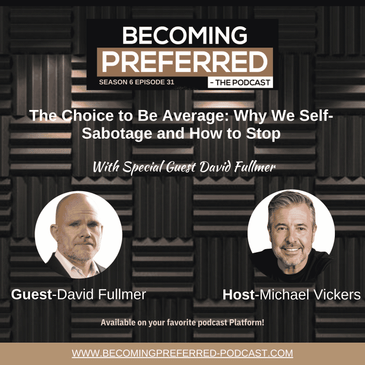
SEASON: 6 EPISODE: 31
Episode Overview:
Welcome back to Becoming Preferred, the podcast where we help you level up your game and become the best version of you.
Most people spend their lives reacting to the calendar, trapped in a grind that never seems to end. But what if you could rewire your internal rhythm to unlock your potential, not just in business, but in every dimension of your humanity?
My guest today, David Fullmer, has moved beyond the "empire-building" phase of entrepreneurship to solve a much bigger problem: the human one. As the creator of Becoming Seven—or B7—David has cracked the code on a life cadence that aligns our modern existence with a 4,000-year-old psychological blueprint. He isn’t just teaching personal development; he’s leading a movement to transform millions of lives by helping ordinary people step into the extraordinary, authentic selves they were created to be.
If you’ve been feeling maxed out, stuck in the daily grind, or wondering how to scale your business without sacrificing your life, your health, or your purpose—this episode is for you. Join me for my conversation with David Fullmer.
Guest Bio:
David Fullmer is a husband, father, businessman, author, public speaker, and superhuman problem solver. He operates multimillion dollar businesses from his location in Hawaii, with branches in 19 U.S. States in the commercial roofing side. He’s led a life of service in his community by putting on no less than two free roofs a year over the past five years for needy families. David is a cofounder of the nutrition company Ox Superfoods. He is also an avid investor, and entrepreneur consultant for many companies striving to reach new heights. He has trained thousands of sales professionals, and assisted thousands of individuals in the pursuit of their dreams. Additionally, David has spent years helping the youth of America set goals and strive for excellence. Recreationally, David is a surfer, motocross rider, and holds a brown belt in Brazilian jiu jitsu.
Finally, David is the founder and developer of the B7 superhuman rhythm detailed in his new book, Becoming 7. It is a life cadence that changes the trajectory of every human being who practices it. David is committed to personally changing the course of the lives of over 5 million people by 2030.
Resource Links:
- Website: https://www.becomingseven.com/
- Product Link: https://www.amazon.com/dp/B0GX2ZGQ42
Insight Gold Timestamps:
03:31 I went to four different youth incarceration programs
06:05 Every time I was in a youth program, I excelled
08:05 When I was about 7 years old, 8 years old, I was listening to Jim Rohn tapes in my dad's cherry drop-top convertible sports car
10:32 As parents, we say things to our kids repetitively and we just think, "Oh, they're not getting it. They're not getting it." I'm telling you, they're getting it.
15:10 She (my mom) worked very, very hard and taught me principles of forgiveness, sacrifice, and love
18:55 Service is so universal and it doesn't matter what faith, what religion, it doesn't matter
19:36 I was 28 years old, and I was a millionaire, and I was racing motocross almost full time
21:26 One thing I've learned is that everyone wants to talk about their successes, and they don't talk about failures
22:53 Superhumans come to a point when they see a problem, they see an opportunity
24:40 This year I did a challenge, 100 days, 5:30 AM, for everyone on my socials
28:22 When I found out that more people had heart attacks on Monday morning from 8AM to noon than any other day, my brain just blew up
31:41 Our brains can't distinguish between what's fiction and what's real
33:10 the book again is called Becoming Seven: The Superhuman Rhythm by David Fullmer
Connect Socially:
Facebook: https://www.facebook.com/profile.php?id=61568176791201
TikTok: https://www.tiktok.com/@becomingseven
YouTube: https://www.youtube.com/@becomesevenofficial
Instagram: https://www.instagram.com/davidfullmerofficial/
Email: becomeseven808@gmail.com
Sponsors:
Rainmaker LeadGen Platform Demo: https://calendar.summit-learning.com/widget/booking/JKItVP7WErmCBjU2cCIx
Rainmaker Digital Solutions: https://www.rainmakerdigitalsolutions.com/
In 3, 2, 1.
Speaker BWelcome back to Becoming Preferred, the podcast where we help you level up your game and become the best version of you.
Speaker BMost people spend their lives reacting to the calendar, trapped in a grind that never seems to end.
Speaker BBut what if you could rewire your internal rhythm to unlock your potential, not just in business, but in every dimension of your humanity?
Speaker BMy guest today, David Fulmer, has moved beyond the empire building phase of entrepreneurship to solve a much bigger problem, the human one.
Speaker BAs the creator of Becoming Seven or Be Seven, David has cracked the code on a life cadence that aligns our modern existence with the 4,000 year old psychological blueprint.
Speaker BHe isn't just teaching personal development.
Speaker BHe's leading a movement to transform millions of lives by helping ordinary people step into the extraordinary, authentic selves that they were created to be.
Speaker BIf you've been feeling maxed out, stuck in the daily grind, or wondering how to scale your business without sacrificing your life, your health, or your purpose, this episode is for you.
Speaker BJoin me for my conversation with David Fulmer.
Speaker BWell, hi, Dave.
Speaker BWelcome to the program.
Speaker BWe're delighted to have you.
Speaker AThank you so much.
Speaker AMichael.
Speaker AHow you doing, brother?
Speaker BWell, I'm excited about this.
Speaker BYou've got a new book out called Becoming 7 and we're going to talk about that.
Speaker BAnd I'm really excited about taking a look at your background and what you've been teaching and the principles.
Speaker BSo I'd like to unpack that.
Speaker BBut before we get started, first of all, where are we speaking to you from and where are you at today?
Speaker AI'm here on the beautiful North Shore of Oahu and Sunset Beach, Sunset Hills, right above the cliffs, right above the Pacific Ocean.
Speaker ABeautiful.
Speaker AMost beautiful place on earth for me and my family.
Speaker BHow are the waves this time of year?
Speaker AThey're not too big right now.
Speaker AIt's beautiful.
Speaker AWe've had a few swells, but yeah, four months out of the year, it's the, the Mecca of the surf industry.
Speaker AIt's an amazing place.
Speaker BWell, it's usually November, December, January, I think, isn't it?
Speaker AYeah.
Speaker AAnd into February.
Speaker ASo, yeah, those four months you really get some big waves, waves you can fit trucks into.
Speaker AIt's pretty cool.
Speaker BI've seen, I've seen some big ones.
Speaker BWell, again, we're delighted to have you.
Speaker BBefore we get into it, our audience always likes to know where you came from, what was the genesis of how you arrived, where you are.
Speaker BSo let's go back to high school.
Speaker BYou're back in high school, you're deciding what you want to be when you grow up where yet tell us what's happening at this time.
Speaker AWell, high school.
Speaker ASo I went to four different high schools.
Speaker ASo if we go back that far, I kind of moved a lot.
Speaker AWas kind of like gypsy family.
Speaker AThere's 13 children in our family, and I was the fourth oldest, and I moved 20, probably like 27 times by the time I was 17.
Speaker ASo we moved a lot.
Speaker AMy dad did some seminar things and.
Speaker AAnd did a lot of sales and so the sales positions and just moved around a lot and.
Speaker BAnd at any rate, he was with Stephen Covey group.
Speaker AYeah, yeah, he was for a little while.
Speaker AHe was one of his first handful of employees.
Speaker AAnd then he worked for a company called Inside out in Southern California Edison.
Speaker AHe worked for a little.
Speaker AA lot of different companies in regards to corporate training and.
Speaker ABut at any rate, at a young age, growing up by the beach, and then we moved to Utah and it was just really hard for me as culture shock.
Speaker AAnd so I met up with a. I became friends.
Speaker AWas my first real best friend that I had was a Tongan boy from the islands.
Speaker AAnd me being a surfer, we kind of got along and just gotten a bunch of trips and ended up locked up.
Speaker AWent to four different youth incarceration programs, went to the youth detention center around 12 times, and a bunch of charges on my juvenile record.
Speaker AMy parents.
Speaker AMy mom had nine kids running around at home, so there wasn't much she could do.
Speaker AAnd my dad was out doing his sales thing, and so I was kind of.
Speaker ABack then, you're kind of left on your own to.
Speaker ATo survive.
Speaker BLittle rebellious latchkey child.
Speaker AYeah, I was the black sheep.
Speaker AEveryone's always, Dave, Dave's in trouble.
Speaker ABut ended up getting to the point where they took me from my family.
Speaker ASo I was warden of the state of Utah, and I went to a wilderness program as well, and group homes and foster homes and all this stuff.
Speaker AAnd then finally, When I was 17, my best friend JJ moved back.
Speaker ABack to Hawaii.
Speaker AAnd my PO.
Speaker AMy dad and their parents, they agreed to adopt me.
Speaker ASo that was my big win.
Speaker AIt was the first really huge win in years that I was able to get away from Utah, get to the islands, get back to the Pacific Ocean, which was one of my healers, and start to really evaluate my life.
Speaker AAnd that's what happened.
Speaker ASo my best friend's dad adopted me for the final seven months of my.
Speaker AOf my juvenile years.
Speaker AAnd then the court system in Utah said, yeah, we'll let him go.
Speaker ASo that happened.
Speaker AAnd it was an amazing experience because I was able to come here and kind of reflect, start surfing again and getting healed by the ocean and work on trying to get sober.
Speaker BWell, and good for you recognizing it at that age before it became a more of a permanent issue.
Speaker BI think that's huge.
Speaker BLessons are learned, though, and we always learn from things, good things and bad things.
Speaker BWhat was the big lesson from that before we evolve into your work career that you pulled from that?
Speaker BWhat was the.
Speaker BBecause you could have gone either way, right?
Speaker BYou could have gone, hey, I'm going into heavy duty.
Speaker BThis.
Speaker BBecause when you're in the system, you're in a system.
Speaker BWas there a transformation moment for you?
Speaker AYeah, I.
Speaker ATwo weeks after I moved to Hawaii, like a bunch of.
Speaker AA handful of my friends that I would cruise around with got wrapped up in some fight and someone got shot and killed in Orem, Utah.
Speaker AAnd I think four of them were just there as accomplices and they ended up going to jail for four or five years.
Speaker AAnd one of them had an incredible football career and he would have ended up NFL star.
Speaker AI mean, this guy was incredible.
Speaker AAnd it was done.
Speaker AAnd it was a huge wake up call to me.
Speaker ALike, wow, you know, like, that's not something I would have done.
Speaker ABut being with those people, it wouldn't have mattered.
Speaker AI would have went with them.
Speaker AAnd another big thing is I just really wasn't happy.
Speaker AI was taught true principles by my parents.
Speaker ANot like, I was like, I knew what was right and wrong.
Speaker AAnd it's like every time I was in a youth program, I excelled.
Speaker AI was the fastest kids to exit youth programs because I was intelligent enough and I knew how to communicate.
Speaker AAnd I was like, I don't want to be here.
Speaker AI don't like this.
Speaker ASo what do I got to do?
Speaker AYou know, there'd be kids that would fight with the counselors.
Speaker AIt was like I was the counselor's teacher's pet.
Speaker AI was the lead hiker in the wilderness.
Speaker AI was teaching everyone how to do bow drill fires.
Speaker AIt was like I was a counselor with the kids.
Speaker AAnd I was the most trusted kid in all the.
Speaker AEvery time I was in a group home or a program, I was always the most trusted student because I. I excelled in any environment that I was in.
Speaker AAnd when it came to selling drugs and drinking, I excelled in that I went pro.
Speaker AAnd so I was like.
Speaker AAnd anything I was doing, I wanted to do the best.
Speaker AAnd so.
Speaker ABut yeah, but I wasn't happy.
Speaker AAnd I knew.
Speaker AI knew 100 that going kept keeping down the road that I was on I was intelligent to know if I stay on this road, I'm going to end up in prison and I don't want to be there.
Speaker AI don't.
Speaker ASo I need to change.
Speaker BWhat is it?
Speaker BYou said something that was interesting and because I'm sure you've had a chance to reflect on it over the, you know, next 25, 30 years is you knew it was wrong and yet we do it anyway.
Speaker BWhy do you suppose we sabotage?
Speaker BBecause we all do that.
Speaker BI think whether it's criminal or whatever.
Speaker BIt might be over drinking might be overindulging, it might be whatever.
Speaker BWe know some behavior is not good for us and yet we sometimes still choose it.
Speaker BWere you able to come to some understanding of why that occurred or what you were?
Speaker AI mean, over the.
Speaker AYeah, over the years I have.
Speaker AAt the time I just, I, I had real problem with alcohol and drugs and I lost a lot of friends to addiction.
Speaker AI, like seven of my friends ended up ODing and passing away and at a young age too.
Speaker AIt was pretty heavy.
Speaker ABut I don't know, the one thing that's always perplexed me and this, what I was taught at a young age, one huge blessing of my dad was being able to list like Jim Rohn and Earl Show, Napoleon Hill and I mean, when I was what, seven years old, eight years old, I was listening to Jim Rome tapes and my dad's cherry drop top convertible sports car going up the coast PCH and not knowing that subconsciously I was listening and I was going to these Fortune 500 seminars and listening to 7 Habits of Highly effective people and all these different things and the principles of it.
Speaker AAnd I, I didn't know.
Speaker ANo one could have said, yeah, that's going to rub off.
Speaker ABut that was in my head.
Speaker AAnd so I knew, I was like, well, I got to make sure that I use this life wisely.
Speaker AAnd so what intrigued me, what I learned from listening to those things is what always intrigued me, even at that time is I would sit back and think how come some people can bust through this?
Speaker AHow come you can have a family and one sibling is super hyper successful and one is a total dude and doesn't do anything with their life.
Speaker AAnd I'm like, it drove me crazy.
Speaker AAnd it always go back to.
Speaker AMy dad would always say to me, he's David, did you know that the human experience, human beings are the only species that God made that will willfully just not be successful, that will actually choose to be alcoholics, that will choose to not live up to their true potential.
Speaker ABecause only like 7% of human beings will even reach 80% of their full potential.
Speaker AAnd it's like this amazing talents.
Speaker ALike Vitzel Barty said, I'll take consistency over raw talent.
Speaker ASo you have all these talented humans everywhere have these amazing talents, and they bury them in the earth.
Speaker AAnd it was just crazy because we are literally not even bugs.
Speaker ABugs will multiply and replenish and build in this perspective elements into which they grow.
Speaker ASame with a tree.
Speaker AA tree will always grow as high and wide and as deep as the sunlight, water and environment gives it.
Speaker AAnd no, no lion says, you know what?
Speaker AI'm good with four kids.
Speaker AI'm not gonna, you know, I'm not nothing.
Speaker AWe.
Speaker AWe are the only ones that raise our hand and say, you know what?
Speaker AI'm gonna sleep in today, I'll do it tomorrow.
Speaker AWe're the only ones that procrastinate.
Speaker AAnd that has just irked me.
Speaker AAnd so that's where I, you know, got.
Speaker AGot on it.
Speaker AAnd, like, you know, that I don't want to be that my choice.
Speaker AAnd our agency is so powerful.
Speaker AAnd so I'm just grateful that at a young age I was listening and putting into the back of my subconscious mind the power of personal development, because it really shaped me in the later years.
Speaker AAnd I think a lot of times as parents, we say things to our kids repetitively and we just think, oh, they're not getting it.
Speaker AThey're not getting it.
Speaker AOh, I'm telling you, they're getting it.
Speaker AKeep repeating it.
Speaker AKeep telling them you love them.
Speaker AKeep telling them the principles that you were taught that are the best principles that you want them to know and learn.
Speaker AAnd believe me, when they're in their darkest hour like I was, that's the only thing I had to hold on to.
Speaker BThat's interesting you say that.
Speaker BDid you see some mindsets, though, or commonality?
Speaker BSo when you were going back there, like, what's in our programming and where does it come from that chooses where, you know, have 14 kids or five or four and, you know, to take a positive route and two might choose a more challenging route.
Speaker BWhat's in it, in our psyche that makes us choose those things?
Speaker BDid you have any insights that when you were.
Speaker BBecause you met with other kids who.
Speaker AWere, you know, that.
Speaker AThat is interesting because I saw a lot of kids that just.
Speaker ALike, my wife has a real dear friend that just OD'd and passed away, and her whole family's, like, active in their church, and the whole family was good.
Speaker AAnd then this one kid just, just couldn't get out of it.
Speaker AAnd I, I don't know, I don't have a specific understanding of all of that other than agency is a very, very beautiful thing, but it's also a thing that can be used.
Speaker AIt can be our greatest strength and it can also be our greatest weakness.
Speaker AAnd but it has to be.
Speaker AYou have to have that virtue and vice to, to be able to make it worth it and record.
Speaker BAnd kudos to you.
Speaker BYou recognize it and went, hey, this path isn't for me.
Speaker BSo you had some foresight.
Speaker AAre you tired of chasing leads and ready to start effortlessly attracting more high value clients?
Speaker AIntroducing Rainmaker, the ultimate sales, engagement and client acquisition platform that takes the stress out of outreach.
Speaker AWith Rainmaker Lead Gen, you can easily identify, engage, educate and convert your ideal prospects into loyal clients.
Speaker AOur industry leading automation and email sequencing empowers you to reach more ideal clients, accelerate the sales cycle and close more business.
Speaker AImagine authentically engaging with your prospects while the platform handles the heavy lifting.
Speaker ASay goodbye to the endless hustle and embrace a more efficient, effective approach to business development.
Speaker AReady to witness the magic?
Speaker ABook a 20 minute demo today and see how Rainmaker Lead Gen can revolutionize and level up your client acquisition game.
Speaker AThere's nothing to lose and everything to gain.
Speaker ADon't miss out on this opportunity to supercharge your client acquisition process.
Speaker AVisit rainmakerdigitalsolutions.com or check out the link in the show notes to book your demo.
Speaker ARainmaker Lead Gen.
Speaker ASpend less time hunting for your ideal clients and more time having high value sales conversations with your ideal clients.
Speaker BAnd now back to my conversation with David Fulmer.
Speaker BLet's evolve that now.
Speaker BSo now you're looking to get into business.
Speaker BYou started a very successful roofing company, so you're also an entrepreneur.
Speaker BWhat made you pick that?
Speaker BBecause I think you're operating in like 19 states.
Speaker BYou've built up a good multimillion dollar organization.
Speaker BSo as an entrepreneur, what led you down that path?
Speaker AWell, when I got sober, it was amazing.
Speaker AI, I was actually living in Hawaii to go back a little bit and I came back to Utah to visit.
Speaker AI was about 21, 22 years old.
Speaker ASo I just was teetering and getting real sober and was getting back active in my church and kind of trying to find my own way in life.
Speaker AAnd my mom brought us all of us kids in and said I'm divorcing your dad.
Speaker AAnd I was like what?
Speaker AYou know, and it was heavy.
Speaker AIt was the heaviest thing I'd ever.
Speaker AAnd I was like, what are you talking about?
Speaker AYou know, my mom still had eight kids at home at this time, and I'm just getting a foothold, and all the siblings above me are all married.
Speaker AAnd then I'm just like, what's going on?
Speaker AAnd she's.
Speaker AYeah.
Speaker AAnd unfortunately, my dad, like all men, we all make mistakes, and unfortunately, he made some mistakes, and they were worthy of being given the boot.
Speaker AAnd it was heavy because it was really hard on me, on my testimony about just life in general and.
Speaker BYeah.
Speaker AAnd principles of everything around me kind of was shattered.
Speaker AAnd my oldest brother was like, hey, you're the oldest that isn't married.
Speaker AYou got to help Mom.
Speaker ASo I stayed with my mom, and she worked two jobs, and I worked a job.
Speaker AMy dad kind of disappeared.
Speaker AI think he had a.
Speaker AFor a few years, just.
Speaker AHe had an emotional breakdown.
Speaker AI don't think he emotionally could handle it.
Speaker AEveryone's remarried now, and we all can all hang out together, but at the time, it was pretty heavy.
Speaker AMy mom.
Speaker AMy mom took the brunt of it and just worked and never had a bad attitude.
Speaker AShe worked very, very hard and taught me principles of forgiveness, sacrifice, and love that I would have never, ever had.
Speaker AI not went through that experience, and it was pretty heavy.
Speaker AI remember my mom.
Speaker AI came to my mom, and I was like, hey, mom, did you know that the state will give you 350 bucks per kid?
Speaker AThat's eight.
Speaker AI'm running the numbers.
Speaker AI'm like, that's 350 times eight.
Speaker AI'm like, you're built.
Speaker AAnd back then, it was like, your bills are paid, Mom.
Speaker AYou don't have to work.
Speaker ABut what I didn't know is, you know, she came to me and gave me a big hug, and I remember grabbing my face, clasping my face, and she's, oh, David, I love you so much.
Speaker AShe's.
Speaker ABut we need to remember that there's a chance that if your dad isn't able to pay that money that they give me, they could put him in jail.
Speaker AAnd I.
Speaker AAnd she said, it's better that we work than these little siblings and my children and don't see a father in jail.
Speaker AYeah.
Speaker AIt was just this amazing sacrifice.
Speaker AAnd then she just wouldn't go to the church for money like all these other people.
Speaker AAnd she very seldom got help from the church, which to me was like.
Speaker AI was a little angry at the church, like, dude.
Speaker ALike my mom.
Speaker AAnyway, so she could use that.
Speaker AYeah, she needed the help, and she didn't think she needed it.
Speaker AShe's no that goes to people that really need it.
Speaker AI'm like, no, mom, you really need it.
Speaker AShe's no, we can work.
Speaker AI can work two jobs.
Speaker ASo she was working the graveyard shift and all this stuff.
Speaker AAnd I was a very angry, angry kid.
Speaker ALike, I. I wanted to smash my dad.
Speaker AAnd I was just so pissed.
Speaker AI didn't.
Speaker AI just got my.
Speaker AA hold of my life.
Speaker AAnd now that all this stuff is happening.
Speaker AAnd one day I knew my mom had my.
Speaker AThis particular event.
Speaker AMy mom hadn't had a day off in three months.
Speaker AAnd she was like.
Speaker AI said, she's working the graveyard shift.
Speaker AShe was waiting tables at Wingers and IHOP and working the night shift at Stouffer's in a factory.
Speaker AAnd I'm just like.
Speaker AAnd I'm framing houses, and I'm bent out of shape.
Speaker ALike, where?
Speaker AWhat the hell?
Speaker AYou know?
Speaker ASo I'm cruising down Temp View Drive by where we live.
Speaker AIt's a Saturday.
Speaker AI worked Saturday.
Speaker AWe framed like, a half day.
Speaker AI was working for a framing contractor, and I'm bumping my music.
Speaker AAnd I believe it was Dr. Dre back then.
Speaker AThat's what was popular.
Speaker AAnd I look over.
Speaker AI glance over at the.
Speaker AOur steak center, and in the dirt is my mom on her knees planting flowers with six of my siblings.
Speaker AAnd Mike.
Speaker AI broke.
Speaker ASorry.
Speaker BNo worries.
Speaker AI just remember, like, trying to rip the steering wheel off.
Speaker AGuy.
Speaker AI hate telling the story, but anyway, I was so angry.
Speaker AI remember screaming at God because I had never done that, never yelled at God.
Speaker AAnd I was like, my mom's.
Speaker AShe's the last one.
Speaker AYou know, the little clipboard goes around the church, and you sign up, who wants to plant flowers?
Speaker AThis.
Speaker AYeah.
Speaker AAnd she's boring.
Speaker BShe's doing her thing, and then.
Speaker AYeah.
Speaker ASo here she is.
Speaker AAnd I'm thinking, God, she's the last one in the whole state, the whole entire universe that should be planning flowers right now.
Speaker AWe should be planning flowers for her, you know, And.
Speaker AAnd.
Speaker AAnd that's when I had my.
Speaker AMy connection with my savior is there was a little whisper that said, you know, your mom's the last one that should have been, but the only one that could have been there to show you true sacrifice.
Speaker AAnd though it was just the planting of a flower, it meant so much more to me.
Speaker AAnd it gave me an understanding that.
Speaker AThat my savior, Jesus Christ, was the last one that should have been in the garden of Gethsemane, but he's the only one that could have to atone for the sins of all mankind.
Speaker BSure.
Speaker BAnd that inspirational moment for sure.
Speaker BAnd has that been foundational for you as far as you started building your.
Speaker AYeah, that no matter, no matter your circumstance, you serve others.
Speaker ALike, like service is so universal.
Speaker AAnd it doesn't matter what faith, what religion, it doesn't matter when times are hard, serve someone else.
Speaker AWhen things suck, do something for someone else.
Speaker AThat principle that I was taught that day was so heavy.
Speaker AAnd yeah, it was pretty powerful because it sent me on a whole different trajectory, like in my mind's eye.
Speaker AAnd so after going through all that and my mom ended up getting married and then I ended up meeting my wife out there and getting married.
Speaker AAnd then I started a masonry business because I was a stone mason and did really well.
Speaker AMy wife and I bought two houses in Hawaii.
Speaker AWe had a couple houses in the mainland and we were just riding high.
Speaker AIt was amazing.
Speaker AI was 28 years old and I was a millionaire.
Speaker AAnd I was racing motocross almost full time desert racing.
Speaker AAnd I raced in the Baja 1000, 2007.
Speaker AAnd we traveled.
Speaker AI went to Russia and rode dirt bikes all over Russia.
Speaker AAnd life just was.
Speaker ANothing bad could happen.
Speaker AI was just like.
Speaker AMy mom got remarried, my dad was like getting remarried.
Speaker AThe whole family was kind of healing.
Speaker AAnd then people started talking about a recession.
Speaker AI was like, what's that?
Speaker AI don't know what a recession is.
Speaker AAnd then boom.
Speaker AIt just.
Speaker AOne bad phone call after another just spiraled and I just started losing properties and two development, large scale developments that we had going completely failed and people were suing each other and it was just a mess.
Speaker AAnd so we, unfortunately, my wife and I ended up having to file bankruptcy.
Speaker AMy business, my, my, my personal.
Speaker AThe.
Speaker AFor the personal, my business was okay.
Speaker AMy mainstream business.
Speaker AI.
Speaker ABut we had to make a decision on where to live, what house, because we could only pick one during the bankruptcy.
Speaker ASo we just said, you know, we're going to the North Shore.
Speaker ASo we moved to Laie Hawaii, to Laie Point and took our whole family, our kids.
Speaker AMy youngest son was just barely born.
Speaker AAnd we moved, but we lost everything.
Speaker AAnd I went.
Speaker AI spiraled into a pretty deep depression.
Speaker AIt was hard to even get out of bed.
Speaker BI was going to ask you about that because I believe you're also in Brazil.
Speaker BYou're a brown belt and hold a brown belt in Brazilian jiu jitsu.
Speaker AYes.
Speaker AYeah.
Speaker BSo they, you know, overcoming the B day, the blue belt blues, and I've been through those.
Speaker BYeah, you've survived years of grueling mats and likely the.
Speaker BYou've experienced the Blue belt blues, where people tend to quit.
Speaker BSo in entrepreneurship, there's a similar plateau where initial excitement, phase and reality sets in.
Speaker BHow did that overcoming that and those blues help you in your business world and overcome some of those challenges?
Speaker AWell, one thing I've learned is that everyone wants to talk about their successes and they don't talk about failures.
Speaker AAnd in my studies, what I found is that for every one real success story, there's about 50 to 75 complete failures of ideas or moments.
Speaker AThere's so much more failures to successes than we realize in the learning process.
Speaker ASo we want to see the football star holding the trophy and standing on the podium, but we don't see him getting up and sacrificing early in the morning and failing forward.
Speaker AAnd so I learned at a young age that failure was a part of the process and that nothing happened to me.
Speaker AIt happened for me.
Speaker AAnd it is a cliche thing to say, but if you really dig deep into it, if you can meditate on it and really realize, look, I don't know what I need to learn from this, but this is perfectly happening to me to make me better, stronger and smarter, then you start to equip yourself with the things that are around you that you can use to make yourself better and get through it.
Speaker AWhen I learned that attitude determines everything, you know, and I talk about this in my book that, you know, a army of lions led by a sheep will always be defeated by an army of sheep led by a lion.
Speaker AAnd when we have an attitude of gratitude that anything's possible, then you're in the right space and you'll come to a point in your life.
Speaker AWhen superhumans come to a point, when they see a problem, they see an opportunity.
Speaker AOpportunity, yeah.
Speaker AThat's the high, super high level entrepreneurs.
Speaker AYeah, I don't care what you do.
Speaker APeople that really are on it in life and in a flow state, they see a problem, they start to unwind how to solve it.
Speaker AThey don't sulk, they don't cry, they don't.
Speaker BIt's just a problem.
Speaker AIt's just a problem.
Speaker AExactly.
Speaker AIt's nothing special.
Speaker AYou're on it.
Speaker BAnd what you've got a good segue into the book.
Speaker BSo.
Speaker BBecoming seven the Superhuman rhythm.
Speaker BI wanted to cover a couple of details with our remaining time, but you start off with the laser focus, intention on winning.
Speaker BYou call it the AM PM game.
Speaker BUnpack that just a little bit for us.
Speaker BAnd then I want to talk to you about some of the days and days of the week because I think Your background, your history, all the things that you've shared with us.
Speaker BI can see where that flows consistently through your books with you know, Monday, Tuesday, Wednesday through, all the way through Sunday.
Speaker BSo we'll pick a couple of those to chat about as well.
Speaker BBut let's talk about the AMPM game that you to start that process.
Speaker AWell, in my pursuit of trying to figure out this whole life game because it is a game that we're all playing.
Speaker BYeah.
Speaker AI found out that the most successful people have an incredible morning routine.
Speaker AAnd it's that simple.
Speaker APeople want to complicate things and this and that.
Speaker ANo, there's no difference from you or an Elon Musk or some high level achiever.
Speaker AThe difference between them is you sleep in, you over, indulge yourself with food and entertainment, you don't work out.
Speaker AThere's all these little teeny non negotiations negotiable habits that you refuse to pick up.
Speaker AAnd that's the only difference.
Speaker AWe all have a head on our shoulders.
Speaker AWe got two legs to walk, most of us.
Speaker ABut I started to in my darkest hour when I started sleeping in and just sulking and all this stuff.
Speaker AWhat turned it around was I remember setting this year I did a challenge 100 days, 5:30am for everyone on my social and it was really, really fun.
Speaker AI went, I'm still going.
Speaker ABut at any rate it turned my whole life around.
Speaker ABut then in studying a dead mentor of mine, Marcus Aurelius, I noticed that he would take an account in the evening of his day.
Speaker ANot just for a journal entry, but for a set of accountability.
Speaker AAnd so he would hold himself accountable in the evening to write down how did you spend these moments, did the things you do, were they necessary or unnecessary?
Speaker AAnd that is so powerful.
Speaker AAnd so what the AM PM game is for me is a reckoning in the evening, is a holding myself accountable.
Speaker AWhat did I do that day and what is the plan for tomorrow?
Speaker AAnd then you wake up early and you create this environment of massive success and people time travel.
Speaker AI mean I've seen people one decision away from a massive change, massive breakthrough and they're like blah blah, blah.
Speaker ABut these things happen when you're not taking this life for granted and everyone thinks they have all this time.
Speaker AYou don't have any time.
Speaker AThe time is today.
Speaker AThis stuck and before we went on the show you were telling me about, you remember 20, 30 years ago, events in your life, I mean how fast has that passed?
Speaker BRight, yeah, it's.
Speaker BI have more time behind me now than ahead of me.
Speaker BAnd what's interesting about that is I look at time so everything's well structured.
Speaker BEvery week I look at my time on Sunday for instance, to go, what's the perfect week?
Speaker BHow could I design the perfect week?
Speaker BAnd I'm constantly re, you know, changing it and innovating it.
Speaker BAnd now I've taken off.
Speaker BSo Friday, Saturday, Sunday, because we have grandkids.
Speaker BI want to spend my Fridays with the grandkids.
Speaker BI'm not going to do what I did when I was a dad and be on the road traveling, trying to build an ever.
Speaker BThis is the priority for me.
Speaker BSo it's hard because I love working, I love what we do.
Speaker BBut Mondays was my content creation day.
Speaker BTuesday, Wednesday, Thursday, run the business part of it.
Speaker BAnd then I'm a 5:00am guy, like 4:35, usually in bed by 9:30, 10:00 clock and then the gym by 5:15 and that sets up my day.
Speaker BAnd I like what you say and that's why I love what you wrote in there about that is with that intention.
Speaker BI own the morning by 9 o'.
Speaker BClock.
Speaker BI've done more than what most people do by looking.
Speaker AYeah, and your brain's firing.
Speaker AIt's more clear.
Speaker BYeah, 100%.
Speaker BCoffee does help a little bit for me, but that's with the clarity.
Speaker BLet's talk about a couple of the dates in our remaining minutes here.
Speaker BAnd I, like I said, I love that you talk about motivation Monday, you talk about tracking on Tuesday.
Speaker BChapter three is Whisper Wednesday.
Speaker BI was curious about that.
Speaker BI love Thankful Thursday because gratitude to me spirals us up in a good way.
Speaker BAnd people can get more details from the book and we'll have all of that in there.
Speaker BAnd then you've got Satisfaction Saturday and Supplication Sunday, which is a day of reflection as well.
Speaker BAnd like I say, it's not linked to anything of particular faith, but it's something we can use.
Speaker BTell me about Whisper Wednesday or Tracking Tuesday.
Speaker AOkay, so well, and before we get into that, Michael, I'm going to explain why this B7 is so powerful.
Speaker AYeah, is I listen to a lot.
Speaker AI've listened to a lot of books, hundreds of self help books.
Speaker ABut they're always four steps to this.
Speaker ASeven steps to that.
Speaker ALike you have the seven habits of highly effective people and they're great.
Speaker ADon't get me wrong, these are amazing attributes.
Speaker AThe problem is we don't have brain tracks that help us memorize those things.
Speaker ASo they're harder to.
Speaker AWhen you really want to memorize something, what you do is you grab Something that you already have tattooed in your brain, and you attach what you want to memorize to it.
Speaker ASo we have thousands of your brain tracks of Monday, Tuesday, Wednesday, Thursday, Friday, Saturday, Sunday, Monday, Tuesday.
Speaker AWe're on a hamster wheel.
Speaker AWe're not getting off it.
Speaker ANo one's getting off the Monday through Sunday grind.
Speaker BNo.
Speaker ASo when I found out that more people had heart attacks on Monday morning from 8am to noon than any other day, my brain just blew up.
Speaker AI was like, this is heavy, dude.
Speaker AMy dad used to always tell me, you got to go to church on Sunday.
Speaker AAnd I hated it.
Speaker AAnd I was like, no, I don't want to go to church.
Speaker AAnd then I was like, what about all the other days?
Speaker AWhy is Sunday so special?
Speaker AAnd then when I found out about Monday, I was like, wait a minute.
Speaker AWhat's the human connection here?
Speaker AWhy are.
Speaker AAnd it doesn't matter their ethnicity, their blood, their cholesterol and their blood pressure.
Speaker ANothing.
Speaker AThis has to do with Monday morning.
Speaker AThey don't know why they're on the planet Earth.
Speaker AThat's it.
Speaker AAnd I was like, heavy.
Speaker ASo that's what started this journey.
Speaker ASo what I've done is I've taken seven superhuman attributes, okay?
Speaker AI've studied what are the seven most powerful superhuman attributes, okay?
Speaker AAnd then I studied the days of the week and what are the emotional and historical vibration in the human experience throughout those seven days each day, because this is generational for years, Fridays, everyone's pumped.
Speaker AOn Friday, they get a dollar, you get the ice cream from elementary school adults going to the nobody's got to work tomorrow.
Speaker AEveryone's so pumped, everyone's so happy.
Speaker AThe hardest human emotion, forgiveness.
Speaker AYou're not getting off free.
Speaker AIt's forgiveness Friday, baby.
Speaker AYou got to let it go.
Speaker AAnd so that's what kind of started this whole thing.
Speaker AAnd then I realized that midway through the week, in the middle of the week, on.
Speaker AOn Whisper Wednesday, I will like, we needed a day of balance to unplug.
Speaker AAnd that was the day that I went on an eight mile in the wilderness whisper walk is what I did.
Speaker AYou put the social media down and you just listen to your heart and this still small voice that's inside all of us, it'll tell us if you were to interview airline pilots, first responders, doctors, all of them, and say, hey, you ever had a hunch you made a decision and saved lives?
Speaker AI might as well just get some popcorn and kick back because they're going to tell you story upon story upon story, okay?
Speaker ABut us as the average human Walking around is so inundated with all this just crazy commotion and the social media and the dad and the news and that people don't tune out and tune into themselves.
Speaker AAnd what is the universe telling you?
Speaker AYou have a great gift and you need to understand to exercise it.
Speaker ASo that was Whisper Wednesday.
Speaker AAnd it's just like, no one gives me meetings on Wednesday.
Speaker AIt's just, I'm a feather in the wind.
Speaker AI go where the spirit dictates and where the whisper dictates.
Speaker AIt's really, really cool.
Speaker AAnd so that's what B7 was, is.
Speaker AI was like, wow.
Speaker AAnd so that's why I believe this is, this is going to be one of the most powerful personal development tools because you can't forget it.
Speaker AOnce you live it for a week or two weeks, you're like, okay, I'm not forgetting this.
Speaker AMy intention, I know it is Tracking Tuesday.
Speaker AYou know, I, I was always intrigued learning on how many thoughts we have.
Speaker AAnd we went over why some human beings will just choose to not be successful.
Speaker ARight?
Speaker AAnd I think a lot of the reason is since your little children, you have grandchildren and children, when they grow up, they're walking in the street, hey, don't do that.
Speaker AStop that.
Speaker AThey're going to touch a stove.
Speaker AStop that.
Speaker ADon't do that.
Speaker AYou're trying to grab candy at the store.
Speaker BProtect them.
Speaker BYeah.
Speaker AYou want to protect them.
Speaker ABut instead of getting on their eye level and saying, this is why we don't run into the street, because our, our brains can't distinguish between what's fiction and what's real.
Speaker ARight?
Speaker BYeah.
Speaker AAnd so when you're told 10,000 times, as a little dreamer, you dream of that candy.
Speaker AYou dream of playing with the buddy across the street.
Speaker AYou dream of climbing up onto that and cool looking ledge.
Speaker AWhat do we hear in our brain track, stop that.
Speaker AKnow that you can't do that.
Speaker ASo then you become an adult and you're like, I want to build this company.
Speaker AI want to do this.
Speaker AI can do this.
Speaker AYou have thousands of messages in the back of your head saying, don't do that.
Speaker AStop that.
Speaker AYou can't do that.
Speaker ASo our subconscious mind is one of the most powerful movers.
Speaker AAnd that's where tracking Tuesday came in.
Speaker AIt's the day of the Avatar where I listen and watch myself and talk less.
Speaker AAnd I live on this rhythm of, okay, I have 60,000 thoughts today.
Speaker A80% Of them are negative on average.
Speaker A90% Are the same the day before, the day before, the day before.
Speaker AYou see what I'm saying?
Speaker ASo it real superhumans, people who are creators like yourself, they have the ability to tune out the 80% negative and say, what are our options?
Speaker AWhere are we going?
Speaker ALet's build.
Speaker ALet's problem solve.
Speaker ALet's build.
Speaker AThis is fun.
Speaker AI have a problem.
Speaker AGreat.
Speaker AI want to solve it.
Speaker AThis is fun.
Speaker AAnd so those are Whisper Wednesday tracking Tuesday.
Speaker AAnd the reason why I came up with B7, it's.
Speaker AIt was just the universe was pushing me right into it.
Speaker BOh, it makes sense.
Speaker BAnd the like I say, it's easy to remember.
Speaker BAnd they're good principles.
Speaker BThey apply to everything.
Speaker BThe book again is called Becoming seven the Superhuman Rhythm by David Fulmer.
Speaker BAnd they can buy it anywhere.
Speaker BThey buy their books on Amazon.
Speaker BYou got all the different formats on there.
Speaker BDavid, this was truly insightful.
Speaker BYou're obviously living a life on purpose, with purpose, and I know you want to reach as many souls as you can over the next five to 10 years, that you've got some pretty lofty goals and sharing with them some of these insights and just having a chance to go through and read in preparation for this.
Speaker BOur episode today was very insightful.
Speaker BAnd so thanks so much for being our guest today.
Speaker AYeah, thank you, Michael.
Speaker AThanks for having me, brother.
Speaker BAs you are listening to this episode, what is one idea that you've heard that's caught your attention and why does it matter so much to you?
Speaker BAnd who is one person who you can share that with, either sharing this episode or just sharing that insight that occurred to you while you were listening?
Speaker BPerhaps it is that average human beings are the only species that will willfully choose not to live up to their true full potential.
Speaker BOr maybe it is that superhumans and high level entrepreneurs do not sulk or cry when they see a problem.
Speaker BInstead, they immediately see it as an opportunity and begin working to solve it.
Speaker BThank you for listening, for learning, and for investing in yourself so that you can become the best version of you.
Speaker BIf you found value in this episode, please write a review on Apple Podcasts.
Speaker BIf you haven't subscribed yet, please do so so that you can get a new episode and start your week off right every Monday.
Speaker BUntil next time.
Speaker BThis podcast is created and associated with Summit Media.
Speaker BMy executive producer is Beth Smith and Director of Research Tori Smith.
Speaker BThe fee for the show is that you share it with friends when you find something useful or interesting.
Speaker BThis podcast is subject to copyright by Summit Media.
Speaker AGoodbye.