SEASON: 7 EPISODE: 2
Episode Overview:
Welcome back to Becoming Preferred, the podcast designed to help you level up your game and become the best version of you.
If your income or revenue personally or professionally looks strong on paper, but your bank account at the end of the month tells a completely different story, you are definitely not alone. Too many brilliant entrepreneurs and professionals, find themselves trapped on a cash-flow roller coaster, driving top-line growth while quietly sacrificing their peace of mind, their sleep, and their freedom outside of work.
Because financial stress doesn't stay at the office. When your finances are reactive and unpredictable, it bleeds into your personal life, robbing you of the energy you should be spending on your family, your health, and the things that truly matter.
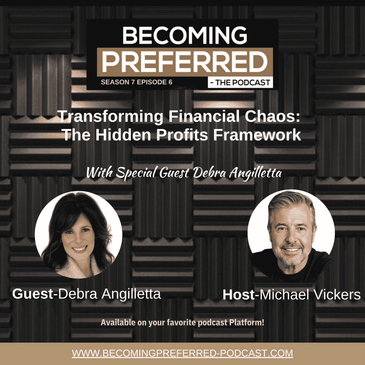
Our guest today is a master at turning financial chaos into predictable momentum. With over 30 years of finance experience, she is a powerhouse Fractional CFO, business strategist, and the author of Hidden Profits. She specializes in helping entrepreneurs uncover silent profit leaks, improve cash flow, and finally build the financial stability needed to pay themselves consistently and reclaim their lives. Please join me for my powerful conversation with Debra Angilletta.
Guest Bio:
Debra Angilletta is a former Wall Street trader, Fractional CFO, and Master Certified Profit First Professional with more than 30 years of experience helping business owners turn revenue into real profit. As the author of Hidden Profits: Stop Chasing Cash–Predictable Profit in 90 Days, Debra helps answer the question, "Where did all my money go?"
Debra uncovers the hidden money leaks draining cash, helps owners create predictable profit, and shows them how to build financially healthy businesses that generate more cash without simply working harder or selling more.
Resource Links:
- Website: findmyhiddenprofits.com
- Product Link: https://www.amazon.com/Six-Figure-Schedule-Streamline-Skyrocket-ebook/dp/B00PMKZZSA?ref_=ast_author_mpb
- Product Liink: https://www.amazon.com/Hidden-Profits-Chasing-Predictable-Profit-ebook/dp/B0GRRNXWVY/ref=sr_1_1?crid=2GSPXOX3YE87O&dib=eyJ2IjoiMSJ9.52U2iz0_Uqn5afS6AInqhg.4K6mExhPPZil55I0iyvjk2u72m7gbwEXLy1JImrOY58&dib_tag=se&keywords=hidden+profits+debra+angilletta&qid=1782742975&s=digital-text&sprefix=hidden+profits+debra+angilletta%2Cdigital-text%2C179&sr=1-1
Insight Gold Timestamps:
02:09 When I was a child, my favorite toy was the cash register
03:03 Money equaled freedom
06:10 Are you seeing common mindset issues?
07:51 When it comes to money, it's something that people feel like they're a math person or they're not a math person
10:51 A lot of times they don't have time to work on the business
13:12 Start making money, expenses keep going up
16:48 I like to revisit the SaaS subscriptions, make sure we're using everything in the business to the ability that we can
20:39 That can really increase your revenues just by making that one little tweak
22:38 We call it the Goldilocks pricing
25:34 What is it that you love that your accountant does for you? And what is it that you wish they did more of?
27:47 It all depends on what the business owner is looking for
30:53 She wound up 10X'ing her profits and then reducing her expenses by about half
34:11 CAC is the customer acquisition cost, and LTV, lifetime value of the client, and most people don't go there
36:22 If your revenue resets to zero on the first of every month, you don't have a scalable business, you just have a high-stress job
37:02 I always like to say the money's in your time
39:42 If I was to design things in an ideal manner, what would my life and my business look like?
42:45 Your book, Hidden Profits, is an incredible roadmap
42:54 You can find it at findmyhiddenprofits.com
Connect Socially:
LinkedIn: https://www.linkedin.com/in/debraangilletta/
Email: debra@debraangilletta.com
Sponsors:
Rainmaker LeadGen Platform Demo: https://calendar.summit-learning.com/widget/booking/JKItVP7WErmCBjU2cCIx
Rainmaker Digital Solutions: https://www.rainmakerdigitalsolutions.com/
In 3, 2, 1.
Speaker BWelcome back to Becoming Preferred, the podcast designed to help you level up your game and become the best version of you.
Speaker BIf your income or revenue, personally or professionally, looks strong on paper, but your bank account at the end of the month tells a completely different story, you're definitely not alone.
Speaker BToo many brilliant entrepreneurs and professionals find themselves trapped on a cash flow roller coaster, driving top line growth while quietly sacrificing their peace of mind, their sleep, and their freedom outside of work.
Speaker BBecause financial stress doesn't stay at the office.
Speaker BWhen your finances are reactive and unpredictable, it bleeds into your personal life, robbing you of the energy you should be spending on your family, your health, and the things that truly matter.
Speaker BOur guest today is a master at turning financial chaos into predictable momentum.
Speaker BWith over 30 years of finance experience, she is a powerhouse fractional CFO, business strategist, and the author of Hidden Profits.
Speaker BShe specializes in helping entrepreneurs uncover silent profit leaks, improve cash flow, and finally build the financial stability needed to pay themselves consistently and reclaim their lives.
Speaker BPlease join me for my powerful conversation with Deborah Angeletta.
Speaker BWell, hi, Deborah.
Speaker BWelcome to the program.
Speaker BWe're delighted to have you.
Speaker AHey, Michael, how are you?
Speaker ASo great to be here with you today.
Speaker BWell, thanks so much.
Speaker BNow, where are we speaking to you from today?
Speaker AI am right outside of New York City.
Speaker ASo it is nice sunny today.
Speaker AOf course, it's sunny after a wa.
Speaker ARainy weekend, right?
Speaker AJust in time.
Speaker ABut the weather's nice here today.
Speaker BWell, I'm excited about the topic.
Speaker BI'm excited to talk about your book called Hidden Profits.
Speaker BWe're going to talk about that.
Speaker BYou have your own business.
Speaker BYou're a fractional cfo.
Speaker BYou work with all kinds of services and companies and businesses.
Speaker BAnd I want to delve into that before we get into the, the fundamentals of that and how it can help our clients in their businesses or in their professional lives.
Speaker BLet's go back to your Deborah's in high school, you're deciding what you want to be when you grow up.
Speaker BTake us there.
Speaker AYeah.
Speaker ASo I could probably take it back even further, which really dictated my decisions in high school.
Speaker AWhen I was a child, my, my favorite toy was the cash register.
Speaker BOh, so you were born is genetic then?
Speaker AIt was, I think I was programmed from birth somehow, some way, I don't know.
Speaker ABut, and funny enough, nobody was a business owner in my family, which was interesting.
Speaker ASo both my parents had had jobs and were employed.
Speaker AAnd where I grew up, the state and the, and the hospital system and the education system were big employers in the area.
Speaker ASo people weren't even operating outside of that.
Speaker ASo.
Speaker ABut I can take it back to that.
Speaker AAnd in high school, really.
Speaker AYeah, that's, that's really something.
Speaker AAnd I think that theme continued in high school just because of the circumstances that were going on at the time.
Speaker AAnd so honestly, when I was in high school, I wanted to make money and not just for the sake of making money.
Speaker AIt wasn't just about the money, which we'll probably talk a little bit more about.
Speaker ABut to me, for what was going on at the time, money equaled freedom.
Speaker AThat's really important.
Speaker BOh, we're on the same page.
Speaker BI was saying, were your parents immigrants at all?
Speaker AMy parents weren't a couple generations back, but you know, back in, back in the 80s, I'm going to date myself.
Speaker BRight.
Speaker AIt was one of those things where I think a lot of families struggled in this way.
Speaker AAnd I remember.
Speaker ASo my parents were divorced and my parents got divorced when I was probably just the early teenage years.
Speaker AAnd that's a really tough time, especially because you're trying to find yourself.
Speaker AYou're not quite an adult, you're not quite a kid, but you're also trying to navigate some waters.
Speaker AAnd then all of a sudden, when you go from an upper middle class family to just barely middle class.
Speaker ARight.
Speaker ASo you've got a single mom now.
Speaker AAnd I also had a younger brother.
Speaker AAnd the way that she had to make things work, our lives were really turned upside down.
Speaker ASo that's why I saw it from a perspective of, hey, if I can make sure I make it on my own before I take a partner on as a husband, and if I can create that freedom for myself, then I won't have to be in the situation that my mom was if anything was to ever happen.
Speaker BYeah, that's what clued me into that one.
Speaker BMy parents were immigrants from England and when they came over, they landed with a nickel.
Speaker BThey had jobs to come to, but they literally just had a nickel.
Speaker BAnd my mom worked in a bank.
Speaker BMy dad was in the service, he was a musician as well, so.
Speaker BAnd they always had two jobs.
Speaker BI always had two jobs and they worked hard.
Speaker BAnd so I saw that work ethic.
Speaker BAnd my parents, we never went without.
Speaker BWe had what we needed.
Speaker BWe always had what we needed.
Speaker BBut then once I learned, hey, you know, 10, 11, 12 for boys that time it was paper routes.
Speaker BSo I remember getting a paper out and my guess is I'm not sure if you had a paper out or not, but you know, if you were a Boy, you probably would have in that time period or get your job or the lemonade stand or starting to earn money.
Speaker BAnd once you earn that money, you realize, hey, you had the freedom to do things, you could always do something.
Speaker BAnd so that stuck with me.
Speaker BAnd you have that work ethic where you just work hard versus if it was just handed to you.
Speaker BNow, I'm not saying we shouldn't help our kids up or help them out a little bit, but it's a matter of teaching them the work ethic.
Speaker BSo you probably learned that from your mom.
Speaker AAbsolutely.
Speaker AAnd yeah, because my mom, she had a full time job and did some odds and ends kind of things as well.
Speaker ABut I also saw that freedom.
Speaker AI started to babysit.
Speaker ASo that was where I started to earn money.
Speaker AAnd I was like, let me see if I can babysit more and get a job at the mall and do this and any, anything I could do to fill my time to make more money, that's what I did.
Speaker BYeah, well, that's good.
Speaker BI think that's foundational and I think that's an important characteristic as well.
Speaker BSo people who.
Speaker BI have the same value.
Speaker BIt's freedom for me and it took me a while to figure that out.
Speaker BBut I want to do what I want, I want.
Speaker BAnd if I don't want to do that, I want to have the freedom not to choose to do that.
Speaker BAnd I've made some financial mistakes.
Speaker BWe're going to talk about that as a business owner, I have and as a professional and we do.
Speaker BSo let's talk about the money in general, whether individuals and people.
Speaker BAs you work with organizations, you're also working with people and the people with that.
Speaker BAnd you're looking at entrepreneurs and solopreneurs and people who are scaling businesses.
Speaker BSo you've got a good diverse track record of working with people with.
Speaker BWhat's the mindset that you see where when you come across that mindset, you're going, I know I can help here.
Speaker BThere's an issue or a problem and are you seeing common mindset issues, if you will.
Speaker ASo I'll tell you, there's a.
Speaker AIt runs on the spectrum.
Speaker AThere's mindset issues that are actually positive, that actually helps fuel the success of the relationship.
Speaker AAnd then there's the more challenging ones.
Speaker ASo I might share a bit of both with you here today, Michael.
Speaker ABut one of the first ones that I see is for the business owners that I work with.
Speaker AThey come to me because they don't settle for mediocre to be the best of the best.
Speaker AAnd if they've got a challenge with money, maybe there's just some things that they don't know because it's.
Speaker AMoney is really funny in a way.
Speaker AIt's one of those things.
Speaker AAnd even when it happens more.
Speaker ASo now I think there's more education around money.
Speaker AIt still could fill in some gaps, but much better than it was when we were younger.
Speaker ALike, we had home economics, we learned how to write checks out of a checkbook, but we didn't really know or learn how to handle money, how to save, how to invest, none of that stuff.
Speaker ASo the people that just want to get really good at this get sick.
Speaker ASick of being the business owner, that they make good money, and at the end of the month they say, where did all my money go?
Speaker ASo they're just driven to, like, I know that there's a better system.
Speaker AI know that there's a way to do this, and I want in.
Speaker ARight.
Speaker ASo that's one of the positive mindsets I can.
Speaker AThat work really, really well.
Speaker BNo, it makes sense.
Speaker BAnd I think what's interesting is you went through school and called.
Speaker BWe're not taught the things that we should learn on a personal and a professional level to run a business.
Speaker BI mean, these are the most important things.
Speaker BAnd America is that land of opportunity.
Speaker BIt's still got the American dream.
Speaker BIf you want to come and open a business, we.
Speaker BWhy don't we teach in our education systems?
Speaker BBecause you've seen that full spectrum financial accountability.
Speaker BPardon me.
Speaker BFinancial.
Speaker BUnderstanding the financial issues.
Speaker BWhy don't.
Speaker BWhat do you suppose that isn't taught?
Speaker AYou know, that's a really great question, Michael.
Speaker AI think that when it comes to money, it's something that people feel like they're a math person or they're not a math person, and they think that's kind of where it starts.
Speaker AAnd money isn't really about math.
Speaker AIt's more about energy, believe it or not.
Speaker AAnd I know some people out there believe it, some people don't.
Speaker AYes.
Speaker AAnd so I think that's where people get stopped, where they're like, I really need to be a math person.
Speaker AAnd I hear this all the time from business owners.
Speaker AThey're like, ted, make sure you keep it.
Speaker AReally just, you know, I don't want to see a spreadsheet.
Speaker AI'm not a math person.
Speaker APlease just keep it really simple.
Speaker AAnd that's what we're able to do.
Speaker ABut I think that's where it starts.
Speaker ASo people are just like, oh, man, I can't do this.
Speaker AOr I Don't want to deal with it, let somebody else deal with it.
Speaker ASo that's my perception of where it starts.
Speaker AAnd once again, there just isn't a heavy emphasis on it.
Speaker AThere's other things that are emphasized more in school where they're trying to teach you a skill set so you can earn the money, but then they don't tell you what to do with it.
Speaker BNo, you're either.
Speaker BIn my day, it was either vocational.
Speaker BYou were math, science, you went on doctor, lawyer, engineer, you kind of had one path, or you went to a shop and you learned how to build things, fix things, or you went that route, or somebody told you you weren't good in math and which not necessarily accurate.
Speaker BI like how you said it's an.
Speaker BI believe it's an exchange of energy as well.
Speaker BI said, I'm going to get your.
Speaker BThat's what real money is.
Speaker BAnd it allows that freedom.
Speaker BSo when you understand that energy equation and then value and bringing value to the marketplace, I think it matters.
Speaker BYou talk a lot about helping business owners stop reacting to their numbers and start leading with them.
Speaker BFor the entrepreneur listening who dreads opening their profit and loss statement at the end of the month, what's the very first shift they need to make to go from financial anxiety to absolute confidence?
Speaker AWell, I think having someone by their side to be able to explain it to them and give them the why behind why they want to know these numbers and show them the other side of it.
Speaker AAnd I think that's really key.
Speaker AI think that a lot of business owners have two resources in their business when it comes to finances.
Speaker AEspecially here in the small business realm, we typically have maybe a bookkeeper that helps us with our books and make sure everything is tidy, neat and tidy.
Speaker AAnd from a compliance standpoint, the numbers are organized in our business.
Speaker AAnd then we also have number two, typically a CPA or someone that prepares our taxes.
Speaker ASo those are the two financial partners we tend to have in business.
Speaker AAnd a lot of times those are outsourced resources, which is completely fine on the small business level.
Speaker ATypically don't have somebody in house that you're hiring for that.
Speaker ABut I think where the gap is is that these two people are what their function really is.
Speaker AIt's compliance, meaning that they just keep the numbers tidy and they keep your taxes filed and they keep you out of tax jail.
Speaker ARight.
Speaker ASo it's all.
Speaker AEverything nice and tidy.
Speaker ABut what's lacking here is someone else that can look at the numbers and, and say, hey, you want to know what I'm seeing something here.
Speaker AMaybe we can use what's happened in the past to be able to look forward and say, how can we change some decisions in the business?
Speaker AWhere are the opportunities?
Speaker AWhat can we shift?
Speaker AAnd listen, business owners are steeped in their day to day, right.
Speaker AA lot of times they don't have time to work on the business.
Speaker AAnd once again, for those people who are like, ah, the numbers make me a little queasy, I don't blame you.
Speaker ARight.
Speaker AIt gets complicated sometimes.
Speaker ABut I think having someone else with a set of eyes that can interpret what's going on with your business and partnering with someone like that, that's your best ally.
Speaker AAnd helping you with the why you want to understand and showing you those opportunities.
Speaker ASo as a business owner, you have choice of how you want to drive your business forward versus just being in the default mode of just seeing.
Speaker ALet's see what happens.
Speaker BWell, and I know you talk about the, you know, you've talked about accounting is kind of that rear view mirror.
Speaker BSo we're looking at what's already happened.
Speaker BAnd it's not fun.
Speaker BI've already been there, done that.
Speaker BBut to lead, I know you talk about treating it as the financials, as a windshield, you know, how are we moving from static bookkeeping to active cash flow forecasting?
Speaker BHow can we project our numbers a quarter out into the future?
Speaker BAnd that's when I think the anxiety vanishes, disappears.
Speaker BBecause you, you can see the obstacles before you even hit them.
Speaker BThey're kind of, you know, deer in the headlight.
Speaker BYou see that ahead of you.
Speaker BSo it's interesting.
Speaker BIs there a right time for a sale?
Speaker BBecause you know, small business owners, they get into business, they start and then it's always that first hire, then it's the next hire.
Speaker BWhen's the right time?
Speaker BWhat should I be looking for in our businesses for a progressive CEO that can help us lead with the numbers, not just provide the financial rear view mirror for us, if you are, or the compliance numbers.
Speaker AI mean, ideally, when you're starting in business, it's always great to have somebody alongside you with your business plan and help you move forward.
Speaker AA lot of times that's not realistic.
Speaker ATotally get it.
Speaker ASo what I would say is, yes, start making money.
Speaker AAnd once you start making money, that's when you definitely want to have somebody come in and start looking at things with you.
Speaker ABecause a funny phenomenon happens is as you make more money, it's kind of like this thing, this little graph, just picture a graph, right thing, money goes up, right?
Speaker ABut guess what happens in tandem to revenue going up?
Speaker BExpenses.
Speaker AYeah, expenses go up at the same rate and same level.
Speaker AAnd so it.
Speaker AAnd that's something that happens all the time in business.
Speaker AAnd it doesn't matter whether you're just starting out or you're a seasoned business owner.
Speaker AIt happens at different points in time in our business, as we make more money, same thing happens until you get your eyes on it.
Speaker AYou're like, oh, now this is where this financial planning comes in.
Speaker ASo that's really the point.
Speaker AStart making money.
Speaker AExpenses keep going up.
Speaker AYou don't know where your money's going.
Speaker AThat's the time.
Speaker AThat's the red flag and the red light saying, oh, make sure you're looking at this.
Speaker AThere's opportunity here.
Speaker BI think this happens on a personal level as well.
Speaker BYou make.
Speaker BSay you make your $100,000 a year, you're spending 110.
Speaker BIf you're in 50, you're spending 60.
Speaker BIf you spend 200, it goes up.
Speaker BThe expenses go up, even on a personal level.
Speaker BSo I don't think there's really much of a difference.
Speaker BI personally believe, and I know you do as well, that our own personal cfo, just for our own personal business and looking at the principles are the same, we can look at, here's what I've done, here's how I've tracked it.
Speaker BWhere do I want to go in the future?
Speaker BHow do I plan for my future?
Speaker BAnd a lot of people need that windshield.
Speaker BI saw one stat that showed something like 70% of the population only has about $75,000 in their retirement accounts.
Speaker BAnd it's like, that's just.
Speaker BThat's just bad planning because it doesn't take much.
Speaker BIt's knowing where your numbers are, knowing where the bills are.
Speaker BThey don't have five $600 for an emergency.
Speaker BWell, we need to own that.
Speaker BIf that's you, we need to own that, and you can turn everything around.
Speaker BWe start to look at things a little bit and going, hey, and I know things are going up.
Speaker BCosts are going up constantly.
Speaker BSo we have to monitor those things.
Speaker BSo I think personally and professionally, I think it's personal.
Speaker BCFO yourself, your principles are still the same.
Speaker BSo let's talk about those hidden profits or the hidden money even within our personal and professional lives.
Speaker BThe title of your book is Hidden Profits.
Speaker BIn your experience working with growing companies, where are those profits usually hiding?
Speaker BWhat are the top one or two blind spots that entrepreneurs completely miss?
Speaker AYeah.
Speaker AOh, my gosh.
Speaker AAnd so where there's a lot of places you could go with that.
Speaker ABut the one place I always start with clients is looking at their profit and loss statements, but more specifically, not so much the revenue.
Speaker AMost of the time my clients have really good revenue, but it's a matter of where's the money going?
Speaker AThey don't know where it is.
Speaker ASo I'm like, you know what I'm gonna tell you.
Speaker ASo I do a deep dive into their expenses and looking at that.
Speaker ASo let's look at a couple of expense areas where money really gets caught up and also affects the business owner.
Speaker ASo you kind of have to think about it like a thief in the night.
Speaker AThat thief is coming in 3 o' clock in the morning, reaching into your pocket, taking your money and running off with it.
Speaker ABecause that's exactly what's happening in your business.
Speaker ASo one of the big places that I see, money leaks.
Speaker ALet's talk about money leaks.
Speaker AThis is money that doesn't have a chance to come back to you in your business.
Speaker AIt's just purely out the window.
Speaker ASaaS products.
Speaker ANow, SaaS products can be great, right?
Speaker AWe're talking about AI, automation and all of that.
Speaker AThat's great.
Speaker AYes, we want to be investing in that, but here's where it gets caught up when we invest in some higher level products.
Speaker AWhat gets really costly is that when we start buying multiple seats in a product.
Speaker AAnd I see this all the time and that's why I'm giving you the inside scoop of where I see and I can capture a lot of money.
Speaker AFirst of all, SaaS products that you may not longer pay, may no longer be using.
Speaker ASo it's kind of like legacy products that you just have around.
Speaker ABut guess what, you haven't used in two years.
Speaker ASo why do you have it?
Speaker ALet's make sure we get rid of that, right?
Speaker AWe only want to invest in things that have an opportunity to come back and serve our business.
Speaker ASo that's a big thing.
Speaker ASo as I was saying, these heavy SaaS products, they're great.
Speaker ABut once you start buying multiple seats, just say you have some turnover in your company.
Speaker AGuess what?
Speaker AIf you're not watching, you're paying for some old seats for people that used to be with the company that aren't there anymore.
Speaker ASo that racks up a lot of money.
Speaker BAll those zombie expenses.
Speaker AYes, there is that.
Speaker AMicrosoft, they have some funky expenses that are always hidden, right?
Speaker AOur good friends at Google, same thing.
Speaker AA lot of hidden stuff going on there.
Speaker ASo.
Speaker ASo really I like to revisit the SaaS subscriptions, make sure we're using everything in the business to the ability that we can.
Speaker AAnd sometimes there's a way to negotiate some rates which most people don't know.
Speaker ABut since I see this all the time, I'm like, you want it?
Speaker AYou could do better on that product.
Speaker ALet's have a phone call.
Speaker ASo it's, it's a little bit of horse training, but it's good, it works in the end.
Speaker BYou say that.
Speaker BI've actually done that too.
Speaker BI've gone in and said, hey, we'd love to stay with your product, but is there.
Speaker BWell, we, they, they want an excuse to keep that monthly recurring revenue so they don't want to hurt that.
Speaker BWe actually just went through a major negotiation with a developer and we cut it in half and.
Speaker BBut we gave them a guaranteed minimum.
Speaker AYes.
Speaker BIn other words, we said, if you can do this, we can do this.
Speaker BAnd it was.
Speaker BWell, that was the reverse of that.
Speaker BBut, but bottom line, we cut that expense in half just by looking at it.
Speaker BSo it's taking a look at that and identifying that that makes sense.
Speaker CAre you tired of chasing leads and ready to start effortlessly attracting more high value clients?
Speaker CIntroducing Rainmaker Lead Gen, the ultimate sales, engagement and client acquisition platform that takes the stress out of outreach.
Speaker CWith Rainmaker Lead Gen, you can easily identify, engage, educate and convert your ideal prospects into loyal clients.
Speaker COur industry leading automation and email sequencing empowers you to reach more ideal clients, accelerate the sales cycle and close more business.
Speaker CImagine authentically engaging with your prospects while the platform handles the heavy lifting.
Speaker CSay goodbye to the endless hustle and embrace a more efficient, effective approach to business development.
Speaker CReady to witness the magic?
Speaker CBook a 20 minute demo today and see how Rainmaker Lead Gen can revolutionize and level up your client acquisition game.
Speaker CThere's nothing to lose and everything to gain.
Speaker CDon't miss out on this opportunity to supercharge your client acquisition process.
Speaker CVisit rainmakerdigitalsolutions.com or check out the link in the show notes to book your demo.
Speaker CRainmaker Lead Gen.
Speaker CSpend less time hunting for your ideal clients and more time having high value sales conversations with your ideal clients.
Speaker BAnd now back to my conversation with Deborah Angeletta.
Speaker BThe other area that I know you've talked about is business owners often over deliver and keep clients happy without charging for that extra value.
Speaker BIn other words, we get things.
Speaker BUnpack that one a little bit for us.
Speaker AYeah, so what I always like to say is make sure you're revisiting your rates and whatever you're charging clients every six months.
Speaker AAnd here's why?
Speaker AAnd I'm sure everybody's feeling this.
Speaker AYou know, you're getting notices with your vendors that are increasing rates.
Speaker ASo if they're increasing rates on means that your margins are probably getting smaller.
Speaker ASo you have to do the same thing and you have to really look at.
Speaker AIt's not so much what it is that you're charging, but what is the value that you're delivering, what is your audience want, what your clients want more of and maybe less of.
Speaker ASo it's always good to keep in touch with your current clients, seeing what's working, what's not working, doing more of what works versus what doesn't work.
Speaker ATake that out, and then you can go ahead and reprice and package as well.
Speaker AI always like to tell people, people get nervous about this, but once again, you have to make sure that money coming in is the right level for you and you're not shrinking what you're keeping because of other operating expenses increasing.
Speaker ASo I think people make this a bigger deal than it needs to because it's happening across the board.
Speaker AI always say, make sure you're looking at those numbers and if it's a modest increase for your clients or maybe increase for your new clients, right?
Speaker ASo you can go ahead and put that stop in and be like, okay, my old clients aren't going to get the increase, but here's what I'm going to do and go forward with new clients.
Speaker ABut with old clients, I find that if there's a maybe 2 or 3% increase, it's really, if you don't make it a big deal, they don't make it a big deal.
Speaker AAnd that can really increase your revenues just by making that one little tweak.
Speaker AI see it all the time.
Speaker BWell, I look at margin.
Speaker BI've always been a margin guy, and I remember we teach our clients when you salespeople are notorious for dropping the margin pants, and it's like, let's say you have a million dollars, you're doing a business, and let's say your cost of operations are $900,000.
Speaker BBy simply just improving your margin 10%, you're getting another hundred thousand without building or selling or distributing another widget.
Speaker BSo the key is protect those margins.
Speaker BI'm curious about, you know, one of the areas of which I've always believed in.
Speaker BAnd we do it ourselves.
Speaker BSo we practice this.
Speaker BWhat we preach is we create three models or three pricing models.
Speaker BSo let's call it good, better, best.
Speaker BBut for businesses where it's, I call it the Starbucks model, tall, grande, Vente, Right, whatever.
Speaker BIt works.
Speaker BAnd I just want a tall.
Speaker BI want a grande or I want a Vente.
Speaker BIf you go to Apple, it's you buy 256, 512, one gig.
Speaker BThere's always everything's offered in three.
Speaker BMadison Avenue, where you live, spends a billion dollars a year teaching the client to buy that way.
Speaker BSo why don't we do it that way?
Speaker BAnd what I find is that's what serves as a market barometer.
Speaker BSo, for instance, I'll do a proposal because a lot of people guess and a lot of people here have their own businesses.
Speaker BThey do a proposal and they guess and they rack their brain.
Speaker BThey get anxiety over what should I price this at?
Speaker BAnd they don't.
Speaker BThey need the money, they need the business.
Speaker BBut if I'm too high, I'm going to lose it.
Speaker BAnd then what I can tell them is, and I want your perspective on this, is if the client says yes to you on your first proposal, and you're only doing one, you just left money on the table, you just left margin, and you just left profit on the table.
Speaker BAll right?
Speaker BBy preparing three solutions.
Speaker BHey, here's your gotta have, here's what's nice to have, and here's the full meal deal.
Speaker BYour call.
Speaker BAll three are great and valuable and will work for you.
Speaker BYour choice, you leave it up to that individual, and then that's your market barometer.
Speaker BDoes that work in your mind?
Speaker AIt absolutely does.
Speaker AAnd Michael, you're the expert in this area, right?
Speaker AWhen it comes to sales.
Speaker AAbsolutely.
Speaker AAnd I believe so on this end, we call it the Goldilocks pricing.
Speaker ARight, but not too hot, not to cold, just right.
Speaker ASame thing, same concept.
Speaker AAnd what I think I approach it a little differently.
Speaker AI typically put the creme de la creme at the bottom, and that seems to probably be a little bigger for bigger companies.
Speaker ARight.
Speaker AEverybody usually winds up in the middle, but I always like.
Speaker AAnd listen, you also have to look at yourself like.
Speaker AI like to look at myself like as a physician, but not just a generalist.
Speaker ARight.
Speaker AI want to look at myself as a specialist.
Speaker ASo if I say, what is it that I would charge people?
Speaker AI want to make sure I look at everything holistically and really kind of write this prescription like a doctor.
Speaker AIt's got to make sense.
Speaker AIf I'm going to say, hey, I would suggest you go in at this middle level, then I'm going to have some data to back that up for everything that they need and why that would correspond.
Speaker AAnd so I never go below the middle I only have that other amount ready to go because it's my downsell.
Speaker ASo.
Speaker ABut once again, you know what, everybody does it differently.
Speaker ABut that's just something that I found.
Speaker AAnd to tell you the truth, if you price it right and you go ahead and make sure you're pairing value with whatever it is at level that you want to be charging them, and that makes sense for both of you as long as you're pairing that value with it.
Speaker AIt most time clients say yes, they trust you, come from that know, like trust factor.
Speaker AThey're going to trust what you say and to tell you the truth, within 30 days, they're going to know if you're worth it or not anyway.
Speaker BAnd you said the magic words has to make sense.
Speaker BIf it doesn't make sense, they're going to know it, you know it.
Speaker BSo if it makes sense to you and you've expressed it well, laid it out well, ask the right questions, it should make sense to your client as well.
Speaker BI guess that.
Speaker BLet's talk about the fractional CFO advantage.
Speaker BMany business owners know they need financial help, but they're not sure whether they need a bookkeeper, a CPA, or a fractional cfo.
Speaker BSo how do you define the distinct role of a fractional cfo and at what inflection point should a founder make that investment?
Speaker AYeah, so really a fractional CFO brings something that's a little different than the bookkeeper and the cpa, and as I had said a little bit earlier, is that these two functions are really about compliance.
Speaker AIt's just keeping everything neat and tidy.
Speaker ABut it really doesn't mean much to the business owner.
Speaker ANow, probably you as a business owner, if you have either one of those people in your business, you're getting reports every month.
Speaker AAnd reports are great, aren't they?
Speaker BLove them, love them.
Speaker ASo I always tell, and it's so funny because I love, I work with multiple bookkeepers and accountants.
Speaker AThey're like, yes, I do this.
Speaker AAnd they get so excited that what they do and they generate the reports and I say, God love you.
Speaker AYes, absolutely.
Speaker ABut here's the thing.
Speaker AThey're not reading your report at all.
Speaker BNo.
Speaker AAt all.
Speaker AI'm sorry to break it to you.
Speaker AExactly.
Speaker ASo to tell you the truth, truth, I mean, they're doing the right thing, but the missing piece is strategy.
Speaker AAnd that's what I hear from business owners all the time.
Speaker AAnd honestly, Michael, that's how I wound up writing the book.
Speaker AI wound up going out and interviewing 100 business owners.
Speaker AAnd what came out the other end, I was so surprised.
Speaker AAnd what they talked about is I really asked, what is it that you love that your accountant does for you and what is it that you wish they did more of?
Speaker AThey said, I love that they keep everything in order.
Speaker AThey give me reports.
Speaker ABut the one thing that I wish they did more of was give me some strategic advice.
Speaker AWhat do I do with these numbers?
Speaker AI don't know what to do with them.
Speaker ASo really that's where the fractional CFO sits.
Speaker ASo I sit between these two and I'm working with them all the time.
Speaker AAnd honestly, sometimes I'm also translating something that maybe the CPA wants to kind of make sure that the business owner understands.
Speaker ABut sometimes, listen, I love my CPA as the big brain.
Speaker AI want him to be the big brain coming up with the strategies for me and everything else.
Speaker AElse.
Speaker ABut sometimes what they're talking about, the business owner doesn't understand.
Speaker AAnd I get it, I get it.
Speaker ASo sometimes I have to translate that as well to be like, all right, here's what's going on.
Speaker AHere's what we want to do.
Speaker AHere's how you action this.
Speaker AAnd this is the data.
Speaker AYou want to get your CPA so you can get that result of maybe saving some more on taxes, putting more money in your pocket.
Speaker ABut sometimes there's a little translation amiss going on.
Speaker BYeah, you don't see the insights.
Speaker BThey're not known for their insights.
Speaker BI've never met a cpa.
Speaker BEven our own cpa, they keep us in compliance.
Speaker BWe get those data.
Speaker BBut how should we be investing?
Speaker BWhat's the right direction?
Speaker BWhat are our most profitable SKUs?
Speaker BWhat's our best products?
Speaker BWhat about.
Speaker BWe don't.
Speaker BWe just get the total numbers.
Speaker BLike I say, it's a rear view mirror.
Speaker BAnd I think companies, the, I think the benefit of a fractional CFO is it's a nice next step because you're instead of jumping to a 200k plus year professional, all right, you're bringing in somebody who's going to come in for the right amount of time for your business and you get to rent a 200,000 plus year CFO to help you with your business and go to the next level.
Speaker BI'm assuming there's an roi.
Speaker BCan you always.
Speaker BThere must be a demonstration.
Speaker BTalk about that.
Speaker BTalk about.
Speaker BBecause to me, I'm, every time, like you said, a SaaS product, there's an ROI to it.
Speaker BWe use AI tools because I, and there was an ROI to it.
Speaker BI was able to cut some job functions that were costing us or we were able to analyze things different and reduce costs.
Speaker BSo I'm still spending money, but I'm spending less money.
Speaker BAnd every year it seems like we're able to do that in our overhead.
Speaker BHow does a CFO or fractional CFO justify them?
Speaker BSo talk about that ROI and what are, what's possible.
Speaker ASure.
Speaker AAnd it all depends on what the business owner is looking for.
Speaker ARight.
Speaker ASo maybe they're looking to hire, maybe they're looking to expand or grow or just going back to the original, like, where's my money going?
Speaker BRight.
Speaker AAnd I just want to make sure that, you know what, what's coming at the top line is just not, not siphoning down to the bottom line, like there's nothing left.
Speaker ASo it depends on the outcomes that they want.
Speaker ABut then also what we're able to do is be able to go in and one of these things that we do that's complimentary, we do go in and look at the books.
Speaker AWe put an NDA in place and we'll take a little bit of a look for you just to see what's going on.
Speaker AAnd that's the one thing I can tell you myself and most CFOs, we don't want to go ahead and make an offer to anybody if we can't move the needle for you.
Speaker AAnd I have no interest in becoming a light item expense.
Speaker AI want to be a profit center for you.
Speaker AAnd just because we've looked at so many financials and worked with so many companies, I'm able to take the information I gleaned from the business owner as well as the financials and say, yes, I can help you, and here's why.
Speaker AAnd looking at those opportunities and just those small tweaks that we know how to make, but the business owner may not necessarily know how to do.
Speaker AAnd we can do it typically rather quickly, like I said in the book, 90 days.
Speaker ASo anywhere from 90 days to six months.
Speaker AMonths.
Speaker AIt's pretty quick.
Speaker AAnd so why?
Speaker ABecause we see it and we do it all day long.
Speaker BHave you got a, without naming a company or a client, have you got a transformational story or two where this is the business, the maybe the industry.
Speaker BWe went in our 60, 90 days, 120 days, and here was our outcome and here's the kind of dollars that were found or what we were able to value, we were able to create?
Speaker AYeah, absolutely.
Speaker AWe worked with Jennifer.
Speaker AAnd that's actually in, in my book.
Speaker AIt's one of the chapters, the book that we shaped around this, this case study.
Speaker AAnd so is she's an attorney, she's a partner in a practice, but she.
Speaker AWhat she also did is she opened up a title insurance company.
Speaker ASo she does a lot of closings and she's in a major metropolitan area.
Speaker ASo she was one of those high achievers.
Speaker AShe's like, deb, I know I needed to find you.
Speaker AI know I'm making good money.
Speaker AThis is a business that I know I can just make work better, but I can't figure it out on my own.
Speaker ACan you help me?
Speaker ASo I wound up looking at.
Speaker AI'm like, oh, my gosh, we can do so much with this, right?
Speaker ASo after I looked over there, I was like, jennifer, absolutely.
Speaker ALet's see.
Speaker ALet's go ahead and start.
Speaker ASo what we wound up doing is we pivoted and so she basically had very, very little profits to make.
Speaker AOh, gosh, how much?
Speaker AI think we 10xed her profits in within 6 months it took.
Speaker ASo there's just a lot of every single thing that I talk about in the book.
Speaker AWe employed all of those strategies to be able to do that.
Speaker AFrom looking at all the SaaS products, looking at her staffing, and seeing where she was over overstepped.
Speaker AThat's a big one we didn't talk about.
Speaker ASo we were able to rearrange some things.
Speaker AOn that end, she was able to renegotiate with some vendors.
Speaker AThat was big for her because there's a lot of fees in the title insurance business.
Speaker AAnd because she gives business to certain people a lot, she was able to say, huh, you want to know what?
Speaker ALet's talk about this relationship and how we're going to move it forward.
Speaker ASo she was willing to take the steps, go out on a limb on a couple of those items.
Speaker AAnd so she's able to now make sure she's paying herself out of the business.
Speaker AShe was paying everybody else but herself.
Speaker AShe wound up 10xing her profits and then reducing her expenses by about half.
Speaker ASo I get on the phone with her every month because we do a monthly check in, make sure everything's on track.
Speaker AAnd I say to her, I say, jennifer, you know how jealous I am of you?
Speaker AShe says, why?
Speaker AI said, because you've got one big, repeatable, boring, profitable business.
Speaker AAnd I love it.
Speaker AYeah, she does, too.
Speaker AShe does, too.
Speaker BAnd that's.
Speaker BI think we all have blind spots.
Speaker BWe all do.
Speaker BYou and I both do.
Speaker BAs professionals even.
Speaker BI'm assuming you probably have a coach, too.
Speaker BYes.
Speaker BAnd because we need it, we all need those and so it's kind of like having that financial coach for your business.
Speaker BIn hidden profits, you break down a framework for creating predictable momentum, which I thought was interesting for an entrepreneur trying to break out of the cash flow roller coaster or where one month's a windfall, the next month's a drought.
Speaker BWhat are the structural pillars of a predictable financial model?
Speaker AYeah, it's a great question.
Speaker ASo, you know, it is looking at your numbers, and I like to take a time frame of three months.
Speaker ARight.
Speaker AIt's typically a quarter.
Speaker AAnd so it really gives you a good snapshot of what's happening in the business and really diving deep into what are those revenues look like, what do those expenses look like, looking at staffing and any of those big boulders.
Speaker ARight.
Speaker AAny of those big things that's affecting the business or what's going to be happening in the next six months.
Speaker ASo we take a combination of all of that and we say, all right, what is the business trying to tell us?
Speaker AWhat's the story?
Speaker AIt's presenting right now as it is.
Speaker AAnd then really asking the business owner.
Speaker AAnd I can see in the financials, because I want to understand the perception versus reality.
Speaker ASo I asked the business owner, I say, what would you say the number one constraint in your business is right now?
Speaker AAnd the reason why I asked that question is because I want to see what is it in their eyes.
Speaker ABecause the financials might be saying something different.
Speaker ABut here's the rub.
Speaker AIf I try to solve the thing that I see, it's not as important to the business owner.
Speaker AI have to make sure I'm solving the problem that they see first before I can go here.
Speaker AAnd that's where they're probably all connected.
Speaker BTo in a holistic way as well.
Speaker BYes, the hip bones connected to the.
Speaker BAnd right.
Speaker BYeah, I'll be dating myself with that.
Speaker BYeah, yeah.
Speaker ANo, I'm right there with you.
Speaker BOne of the areas that I struggle with, and I talked to other entrepreneurs as well and solopreneurs and people building business businesses.
Speaker BAnd I know you can address this as our cac, our customer Acquisition costs relative to lifetime value.
Speaker BSo it's having enough money how to value.
Speaker BIs this a good customer for me or a bad customer for me?
Speaker BSo, for instance, as a speaker, we have a fee that we get.
Speaker BWe charge for speaker, and you do too.
Speaker BAnd say we're using an agent.
Speaker BThe agents are going to take a percentage of that, and that has to be factored into it.
Speaker BThat kind of gives you a number that you could kind of work with.
Speaker BSo if you can lower your cost of acquisition, might be a merchant cert, might be an online business.
Speaker BHow do you, what do you see when you're working with your clients from, you know, acquisition costs?
Speaker BYou probably see them all over the map versus the actual lifetime value.
Speaker BHow should we be looking at those and the relationship between those two?
Speaker ASo what's really funny is I'm going to tell you this and answer this very simply.
Speaker AThey're not looking at either.
Speaker ASo I think the first step is make sure you're looking at it right.
Speaker AAnd a lot of people don't even understand what those two numbers mean.
Speaker ALike CAC is the customer acquisition cost and LTV lifetime value of the client.
Speaker AAnd most people don't go there.
Speaker AWhy?
Speaker ABecause they weren't ever taught to do so, especially if they've never owned a business before.
Speaker ASo really it starts out with what is this?
Speaker AWhy is it important?
Speaker AAnd let's look at the reports that we need to look at in order to gain what is the knowledge we can see with regards to this, this and man, it sheds so much light.
Speaker ASo looking at it from that perspective is just starting out and making sure you're understanding what it is and start to look at it, look at it with someone else because you're, it's very hard to get in the beginning.
Speaker ABut when you start tweaking those two numbers, that's where the magic happens.
Speaker ABecause business owners, here's the great thing, business owners have that gut feel that something's not right.
Speaker AThey can't put their finger on it.
Speaker ASo what they wind up doing is they start tweaking this or fixing that.
Speaker ASo start doing a lot of things all over the place.
Speaker ABut once again you're backing into these certain metrics that you can look at.
Speaker AWhat does it cost to acquire a customer?
Speaker AAnd if we just made one small tweak, could we just.
Speaker AIt's kind of like a domino effect.
Speaker ACan we affect everything else from then on?
Speaker AAnd then that affects, can we keep a customer at what's the length of time we can keep a customer.
Speaker ASo now we're looking at the lifetime value is what is the value of this one customer?
Speaker AHow do we get more of them versus just, I call them the one hit wonders, right, that just come in and then bounce out.
Speaker ACome in and just bounce out.
Speaker AHow can we keep them longer?
Speaker AAnd what is it that we need to do that?
Speaker ABut yeah, just looking at those metrics and have somebody look at them with you, because if you're new to it or if you've never done it before or if you have your business changes.
Speaker ASo you always want to have a second set of eyes on that.
Speaker BYeah, that one was tough for me too, even on a personal level.
Speaker BAnd it's embarrassing that it took me so long to figure that one out.
Speaker BI paid 25% to agents, typically for speaking engagement.
Speaker BAnd that's how they, this is how they make their.
Speaker BAnd you and I have talked about this and I'm thinking beforehand, if you told me, hey, it costs $300 to get a good lead or a good.
Speaker BI'm going, that's a bargain.
Speaker BAnd so different.
Speaker BI have clients who are willing to pay 3, 4, $500 just for one good lead.
Speaker BI think why would you pay so much?
Speaker BThat's expensive.
Speaker BNot when the acquisition cost or the lifetime value.
Speaker BSo I think as you say, if your revenue resets to zero on the 1st of every month, you don't have a scalable business.
Speaker BYou just have a high stress job.
Speaker BRight.
Speaker BSo now you know, well said.
Speaker BLet's talk about time systems and the six figure schedule, because I think there's financial health is connected to operational capacity.
Speaker BYou've also written the six figure schedule, which I thought was really interesting.
Speaker BSo how does an entrepreneur's daily calendar directly impact their profit margins?
Speaker BAnd what is the hidden financial tax of a disorganized schedule schedule?
Speaker AThat's a great one.
Speaker AAnd you know what, seriously, Tony Robbins talks a lot about this.
Speaker AAnd I know the way he schedules his life, obviously very extreme, right?
Speaker AAnd it works.
Speaker ABut I always like to say the money's in your time, right?
Speaker AAnd as you, as you get older, you want to make sure.
Speaker ALike when we were talking about back in high school, like I worked 50,000 jobs to make the money.
Speaker AAnd you know, that's what we do when we're younger, right?
Speaker AWe're just trying to make the money and we're not doing it very smartly.
Speaker AWe're just doing it just to do it because that's all.
Speaker AWe don't have the skill set yet.
Speaker ABut as you get older, you get skills.
Speaker AYou want to really manage your time, right?
Speaker AAnd your time management really converts to how much money you can make.
Speaker ASo I like to look at this especially with my consultants and I say, okay, if you're doing one on one work, let's look at the calendar.
Speaker AHow many people could you possibly see?
Speaker ASo if you got your marketing so dialed in, how many people could you possibly see?
Speaker AHow much money could you possibly make every month?
Speaker AAnd it's really amazing because then you can see you get capped at a certain point in time because there's only so much capacity.
Speaker ASo when we're talking about the six figure schedule, I do encourage people to just start putting together some sort of a calendar of the times you're going to see clients, the times you're going to do sales and marketing, the times you're going to do admin work and the times you're going to take care of yourself.
Speaker ASo it's really those four areas.
Speaker ABut how do you make that all work?
Speaker AAnd quite frankly, you just got to start somewhere.
Speaker AYou start with the first iteration of what your ideal week will look like and making sure all those client times are going to add up to, to start right to what you, what your goals are as far as the revenue you want to be making every month.
Speaker AAnd then we can scale from there and start managing time better so you can make more money.
Speaker BWell, it's interesting to say I love how you think I say the same every, every month I look at what's the perfect week and I try and redesign it and it moves.
Speaker BIt doesn't move as much anymore because I kind of know how that works.
Speaker BWorks.
Speaker BMondays are production day.
Speaker BThat's where we do all our podcast interviews, we do all our content.
Speaker BBecause I'm really not customer focused on Monday.
Speaker BI just had a good weekend.
Speaker BTuesday, Wednesday, Thursday.
Speaker BThat's where a lot of our sales activities and revenue generation and revenue enablement occur.
Speaker BRight?
Speaker BAnd then Fridays, you know, I'm a papa these days and so Nana Papa, we spend our time with our grandchildren on Fridays and that's been.
Speaker BAnd it's challenging.
Speaker BSometimes I need the Friday to do other work.
Speaker BBut I and strict to that.
Speaker BAnd then weekends we use that for rejuvenation and cleanup projects.
Speaker BStuff that we're not dealing with clients so so we can rejuvenate.
Speaker BSo I think I love that.
Speaker BAnd to treat your schedule like an asset because it really is an asset, we've got to look out and self care.
Speaker BI think that becomes important exercise, take the time.
Speaker BBecause if you build something and you're not there to enjoy it, what, what difference does it make?
Speaker BBoy, time moves fast when we're chatting.
Speaker BIf our listeners take away just one financial filter or question that they should ask themselves before making any major business investment or hiring decision this week, what should that question be?
Speaker AThere's so many good ones.
Speaker ALet me choose one.
Speaker AIf I was to design things in an ideal manner, what would my life and my business look like?
Speaker AAnd it's simple, but it's actually hard to put pen to paper with that one.
Speaker BYeah.
Speaker ABut when you do and you take the time when you've got no disturbances, people come in, maybe have some little ones or grandchildren that are coming in and out.
Speaker ARight.
Speaker AOr something like that up.
Speaker ABut there's so many disruptions we have in our lives.
Speaker AIf you can just take time and just to think and write that down and what that would look like, it's kind of scary.
Speaker ABut once you do, wow, that, that's the one that gets me all the time.
Speaker AAnd I have to bring myself back to that one all the time.
Speaker AAnd I say that because when I do it, whoa, that lights me on fire.
Speaker BWell, that's exciting.
Speaker BI like to ask this of our guests every once in a while if.
Speaker BAnd this time you get to brag here, Deborah.
Speaker BSo if you have a superpower, and I think we kind of know what it is, but maybe something the our audience doesn't know, what would you say?
Speaker BYour superpowers, what are.
Speaker BYou know what?
Speaker BI'm really good at this.
Speaker AYeah.
Speaker AI think I'm really good at finding money for people.
Speaker AAnd there are so many different places to find it.
Speaker AAnd once again, why is it that we're doing that?
Speaker AIt's not just for the sake of having money.
Speaker AIt's once again to be able to create freedom.
Speaker AWhether it's freedom to do what you want in life, whether it's money to, to buy back your time.
Speaker ARight.
Speaker AOr to contribute to bigger causes.
Speaker AMaybe there's a foundation.
Speaker AMy girlfriend just started a non profit.
Speaker AI'm so proud of her.
Speaker ABut because she has the money to do so.
Speaker ASo having the money is able to create more opportunities for you.
Speaker ASo that's what I would say.
Speaker BThat's a great superpower and I rings true.
Speaker BIf you were to have an Achilles Hill Kryptonite, what would yours be?
Speaker BMine, for me, it's organization.
Speaker BI have to have great people.
Speaker BI've got great 30,000 foot perspectives, but I gotta have people look after the details for me.
Speaker BSo that's things.
Speaker BSo if we had an area that if you're okay sharing, what's that Achilles, what's the thing you struggle with?
Speaker AOh, I struggle sometimes.
Speaker AAnd here's what I struggle with, honestly.
Speaker ASo in your business you're trained to scale things, right?
Speaker ATo make sure that you're.
Speaker AIf people want to talk to you, you're going through and you're.
Speaker AYou have this questionnaire and you only you make sure that you're talking to the right people and to tell you the truth.
Speaker AI've always struggled with with not talking to everybody.
Speaker ASo sometimes I blow up my time because I schedule too many people.
Speaker ABut I like to talk to everybody because I like to understand, because even if I'm not able to work with them, I feel that it's my give.
Speaker ASo I want to make sure that I'm talking with people and I can give them one nugget that they can go ahead and run with and have success.
Speaker AThat's great.
Speaker AI'm happy as a clam at high tide.
Speaker ASo I think that's probably one of the things I have to work with is especially with my team.
Speaker AThey're like, deb, you're scheduled out a month.
Speaker AAnd I'm like, I know, but I want to talk to this person.
Speaker ASo I have a little problem with my time sometimes because I just want to talk to everybody.
Speaker ASo.
Speaker ABut that's probably one of the things that I am challenged.
Speaker BThanks.
Speaker BAnd that's always fun.
Speaker BWe're not perfect.
Speaker BWe're all working.
Speaker ANot perfect at all.
Speaker BAnd we just do it.
Speaker BDeborah, thank you for bringing so much clarity to a topic that keeps many founders and business professionals awake at night.
Speaker BYour book Hidden Profits is an incredible roadmap for this.
Speaker BWhere can the audience go to connect with you, grab your free resources and take control of their financial destiny?
Speaker AYeah, it's great.
Speaker AYou can find it@findmyhiddenprofits.com awesome.
Speaker BStop chasing cash.
Speaker BGet predictable revenue in 90 days.
Speaker BDeborah Angeletta will have all that information.
Speaker BYour contact.
Speaker BI know they can reach out to you for consults and see if that's a nice fit for you.
Speaker BDeborah, thanks so much for sharing your insights and lots of value bombs in there and for being our guest today.
Speaker AThanks so much.
Speaker BMichael, as you're listening to this episode, what is one idea that you've heard that's caught your attention and why does it matter so much to you?
Speaker BAnd who is one person you can share that with?
Speaker BEither sharing this episode or just sharing that insight that occurred to you while you were listening?
Speaker BPerhaps it is if your revenue resets to zero on the 1st of every month, you don't have a scalable business, you just have a high stress job.
Speaker BOr maybe it's that shifting from reactive bookkeeping to forward looking cash flow forecasting gives you the windshield view needed to anticipate obstacles and lead your business with confidence.
Speaker BThank you for listening, for learning, and for investing in yourself so that you can become the best version of you.
Speaker BIf you found value in this episode, please write a review on Apple Podcasts.
Speaker BIf you haven't subscribed yet, please do so so you can get a new episode and start your week off right every Monday.
Speaker BUntil next time.
Speaker BThis podcast is created and associated with Summit Media.
Speaker BMy Executive producer is Beth Smith and Director of Research Tori Smith.
Speaker BThe fee for the show is that you share it with friends when you find something useful or interesting.
Speaker BThis podcast is subject to copyright by Summit Media.
Speaker AGoodbye.