
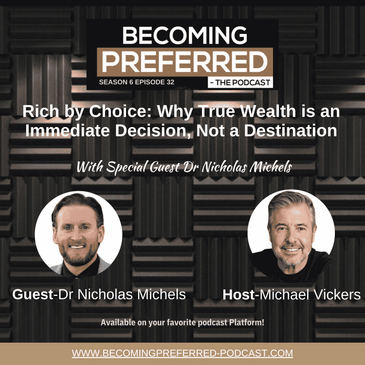
SEASON: 6 EPISODE: 32
Episode Overview:
Welcome back to Becoming Preferred, the podcast where help you become the best version of you.
If you are an entrepreneur or a business professional, you know that scaling a company often comes with a massive cost. Too many high-performers find themselves financially successful but time-poor, stress-ridden, and completely disconnected from the life they originally set out to build.
Well, today’s guest is here to change that script. He is an elite wealth strategist, founder of Michels Family Financial, and author of the powerhouse new book, Rich by Choice. Nick has a fascinating story that spans from childhood financial hardship and working on a Texas golf course, to playing professional basketball overseas, and turning down a massive $8.1 million corporate signing bonus just to ensure his advice remained entirely independent, transparent, and focused on his clients' best interests.
Today, we are discussing how to align your revenue with your deepest values, protect your hard-earned assets from advanced tax leaks, and use the 'Rocking Chair Test' to design a life of radical generosity and freedom. Get ready to take back control—please welcome to the show, Dr. Nicholas Michels!
Guest Bio:
Nick’s journey began in both abundance and hardship, an experience that taught him early on the profound influence money has on life and relationships. Outside his work, Nick is a devoted husband to his wife, Chelsea, and a proud father to their four children, Daegen, Kinsley, Brooks, and Everly. Together, Nick and Chelsea are deeply committed to giving back through the Michels Corporation, their charitable foundation that supports youth education, families in need, global missions and causes close to their hearts.
Resource Links:
- Website: https://michelsfamilyfinancial.com/
- Product Link: https://richbychoicebook.com/
Insight Gold Timestamps:
03:05 Coming from humble beginnings, there was no college fund waiting for me
03:48 I encourage all kids to get internships, because you learn so much
05:50 One thing that I love about this work is because I get a backstage pass into people's lives
07:24 Your book is titled Rich by Choice
09:50 Most people are financially busy, but they're emotionally broke
11:50 It finally boiled down for me it was really about freedom
14:33 When you stop for a second and say, "Okay, where are things going?"
18:56 You talk about money first being a blessing and a curse
19:41 I had pretty quick success, and it had nothing to do with me
21:02 If you're an entrepreneur, you've got to understand who you're helping, how you are helping them, and how many times you can get in front of them and say, "Hey, I'm so and so. This is how I can benefit your life."
22:53 All my clients are wonderfully different
23:05 We have 6 key areas that we help people
25:14 You utilize this concept called the rocking chair test
28:03 What could be a great answer for you could be a terrible answer for someone else
29:15 I think this is so important, is who do you become?
32:22 I had a chance to play professional basketball in Europe
33:52 AI is not the issue, irrelevance is
34:56 Your goal is to be an expert in your field
37:57 I call it outwardly successful, inwardly stressed
39:25 I say the juice has to be worth the squeeze
40:30 Rich by Choice: Take Back Control, Master Your Money, and Design the Life of Your Dreams
42:31 There's so many areas where luck can come into play
43:49 Once you understand and have confidence and clarity on the direction you're going- that's when there's joy
45:49 If you don't have purpose, I believe the soul dies and we die pretty quickly
Connect Socially:
LinkedIn: https://www.linkedin.com/company/michelsfamilyfinancial
Facebook: Michels Family Financial https://www.facebook.com/michelsfamilyfinancial
Instagram: https://www.instagram.com/michelsfamilyfinancial/
Email: nick@richbychoicebook.com
Sponsors:
Rainmaker LeadGen Platform Demo: https://calendar.summit-learning.com/widget/booking/JKItVP7WErmCBjU2cCIx
Rainmaker Digital Solutions: https://www.rainmakerdigitalsolutions.com/
In 3, 2, 1.
Speaker BWelcome back to Becoming Preferred, a podcast where we help you become the best version of you.
Speaker BIf you're an entrepreneur or a business professional, you know that scaling a company often comes with a massive cost.
Speaker BToo many high performers find themselves financially successful but time poor, stress ridden and completely disconnected from the life they originally set out to build.
Speaker BWell, today's guest is here to change that script.
Speaker BHe's an elite wealth strategist, founder of Michael's Family Financial and author of the powerhouse new book, Rich by Choice.
Speaker BNick has a fascinating story that spans from childhood financial hardship and working on a Texas golf course to playing professional basketball overseas and turning down a massive 8.1 million corporate signing bonus just to ensure his advice remained entirely independent, transparent and focused on his client's best interests.
Speaker BToday we are discussing how to align your revenue with your deepest values, protect your hard earned assets from advanced tax leaks, and use the rocking chair test to design a life of radical generosity and freedom.
Speaker BGet ready to take back control.
Speaker BPlease welcome to the show, Dr. Nicholas Michaels.
Speaker BWell, hi, Nick.
Speaker BWelcome to the program.
Speaker BWe're delighted to have you.
Speaker AHey, Michael, I'm happy to be here.
Speaker AThank you.
Speaker BI'm excited about this.
Speaker BWe haven't really covered this topic in six seasons and we've addressed it and it's one of the things which I think people think about all the time and how to maybe rich by choice.
Speaker BAnd we're going to talk about money, the functions of money, how we create it, why it's such a big important thing in our lives.
Speaker BBut actually maybe get some clarity around it and maybe look at putting some functionality into it and going, hey, what does it mean for us?
Speaker BAnd so that you've got some exciting things to share with our audience.
Speaker BBut let's talk about where you came from.
Speaker BFirst of all, you're back in high school.
Speaker BYou're living in, I think you're in Dallas, Fort Worth area today.
Speaker AThat's correct.
Speaker BSo are you a Texas boy?
Speaker BYou're living in W and you're going to school.
Speaker BWhere'd you go?
Speaker BLike Richardson or Richardson, where'd you go to school?
Speaker AI went to school at Granbury High School, the small town outside of Fort Worth.
Speaker BAnd now you're deciding what you want to be in life.
Speaker BYou're sports.
Speaker BWhat led you down the path that you're on right now?
Speaker AAbsolutely.
Speaker AIt's actually my childhood.
Speaker AI mean, I came from a well to do family.
Speaker AMy father was an entrepreneur.
Speaker AI mean, we weren't rich, but we were comfortable four boys.
Speaker AI was the Middle youngest of four wild boys, as you can imagine, Michael.
Speaker ABut it changed.
Speaker AMy parents got divorced and essentially overnight, my mom went from a stay at home mom of four boys, pretty comfortable life.
Speaker ATo my mom's now a single mom of four boys working three jobs just to keep things going.
Speaker AAnd you can probably imagine that, man, I saw two sides of the world very quickly of a comfortable lifestyle to oh my gosh, no, we're barely going to make it.
Speaker AAnd that shaped me.
Speaker AThat really did.
Speaker AAnd it kind of led me down the path to where I am now.
Speaker BAll right, so college, was that an experience for you or did you jump right into the corporate world?
Speaker ANo, actually I played basketball.
Speaker ABasketball is my way out.
Speaker AComing from a humble beginnings, there's no college fund waiting for me, no rich family member wanting to pay for my college.
Speaker ASo it's either going to be the military because they would pay for my college, or a basketball scholarship.
Speaker AAnd so I was very fortunate to go down that road and very blessed.
Speaker BA point guard, I'm assuming that's it.
Speaker AActually, I'm called a combo guard because I shoot too much to be a natural point guard.
Speaker AMy buddies give me a hard time.
Speaker BAwesome.
Speaker BHey, well, so you got into the financial world.
Speaker BYou started working for a financial firm.
Speaker BFirst of all, I did the evolution of that.
Speaker AAbsolutely.
Speaker AYeah.
Speaker AI actually got an internship at the end of college.
Speaker AJust need an internship.
Speaker ABut it was a family friend was a financial advisor.
Speaker ASo I was junior broker, intern.
Speaker AAnd I fell in love with it.
Speaker AI did.
Speaker AI encourage all kids to get internships because you learn so much.
Speaker AIt doesn't matter what you get paid or even get paid at all.
Speaker ABut two things will happen.
Speaker AOne is you're going to learn about the business, you're going to learn about the life.
Speaker ABut then also, if you don't really just mess it up, probably have a job offer.
Speaker AAnd so I fell in love with it.
Speaker AI fell in love with the work.
Speaker AAnd I just knew that, hey, basketball and finance were my two favorite passions.
Speaker AAnd away I went.
Speaker BFantastic.
Speaker BNow you started working in the firm.
Speaker BYou were there for a number of years.
Speaker BAnd then what I was interested in was you actually turned down a major offer to come work for a corporation.
Speaker BLet's talk about that.
Speaker BBecause it was quite significant.
Speaker BI think it was like 8.1 million in order to come to unpack that for us.
Speaker AAbsolutely.
Speaker AI mean, that's life changing money.
Speaker AMichael, think about it.
Speaker AMy age, very young, I hit the corporate world as a rising financial advisor and things were just going great.
Speaker ABut I started to see cracks in the industry.
Speaker ANot all financial advisors, not all financial firms, but I started to see corporate greed, bottom dollar thinking, doing what's best for the company, not what's best for the client.
Speaker ALike a lot of things that you might hear about.
Speaker AAnd it was true.
Speaker ASo I get this offer and I shockingly, because I thought the day would be better.
Speaker ABecause you, when you're young, growing up, you think you get an offer like this, like your life's set.
Speaker ABut I went home and I do.
Speaker AI remember this.
Speaker AI told my wife I couldn't do it, and I had to make a change.
Speaker AAnd I said, let's start our own firm.
Speaker AAnd she didn't bat an eye.
Speaker AThat's how great my wife is.
Speaker AShe said, okay, let's do it.
Speaker AAnd so we turned down the offer and started our own firm.
Speaker ABecause I started to see things in the industry, like kickbacks, revenue sharing, spreads, things like that that most people don't even know about.
Speaker AAnd so it just changed my philosophy that we wanted to do things our way.
Speaker BNo, I think that's smart.
Speaker BYou have.
Speaker BIt's interesting because you get to work with lots of different type of companies and individuals and families.
Speaker BSo I'm assuming you work with family offices all the way down to independent entrepreneurs.
Speaker BAre there commonalities that you see, regardless of what someone's starting point is or wealth, whether they inherited it?
Speaker BAre there things that you see that are just common denominators amongst across that spectrum of demographic?
Speaker AAbsolutely, Michael.
Speaker AIt's one of the things I talk about a lot because.
Speaker AAnd one thing that I love about this work is because I get a backstage pass into people's lives.
Speaker AI mean, when you're working with someone's finances, the families, it's a very intimate situation.
Speaker AYou understand everything, all the dynamics within their family, what they want, where they're going.
Speaker ABut you hit the nail on the head, you start to see common traits, common values, a lot of people.
Speaker AAnd that's what's great about America.
Speaker AIn the world we live in today, you can make money doing many things.
Speaker AWonderful.
Speaker ABut all these individuals who find success with money, but also success in life in general, they do.
Speaker AThey have certain traits, characteristics, values, and it's fascinating and it's powerful.
Speaker BWhat are some of those characteristics?
Speaker BWhat are some of those traits that you see?
Speaker AAbsolutely.
Speaker AThey have a passion for what they do.
Speaker AThey have a passion for the people, their lives, all the ones you read about, integrity, work ethic, grit.
Speaker AWe call it my family, Michael's grit.
Speaker AWe use it a lot because My last name is Michaels, and I teach my kids Michael grit.
Speaker AMichael's grit, because it's perseverance, work ethic.
Speaker ABecause life is going to throw you curveballs all the time.
Speaker AIt's going to happen.
Speaker AI remember when we first launched our company, I planned for years and years, you know, things to get, to learn, how to do it, to transition.
Speaker AAnd right as we launched our company, we dealt with some pretty major curve balls that completely changed everything.
Speaker AWe worked so hard to plan, and we had to pivot and move.
Speaker ASo it just lets you know that no matter what, you're going to get some curveballs.
Speaker ABut it's not what happens to you.
Speaker AIt's, you know, this.
Speaker AIt's how you handle what happens to you.
Speaker AThat's what creates success or failure down the road.
Speaker BOh, I love that grit and resilience.
Speaker BMy wife's a McLean, she's Scottish, and they call it the McLean grit.
Speaker BSo I understand.
Speaker AOkay.
Speaker BI. I'm well indoctrinated in that one.
Speaker BIt's interesting.
Speaker BYour book is titled Rich by Choice, which is interesting.
Speaker BSo for many entrepreneurs, rich is treated as a.
Speaker BAnd professionals, it's treated as a distant destination or a specific dollar amount in the bank.
Speaker BYou argue that it's an immediate decision.
Speaker BWhat does it actually mean to be rich by choice?
Speaker BAnd how should a busy business professional shift their mindset in today's world?
Speaker AYeah, and so that's what I think what the book has had so much success is because it's the mindset that, yes, it's going to help you become rich with money, but it's also going to help you become rich with life.
Speaker ABecause you talked about a certain dollar amount.
Speaker AHow many people do we know that say, hey, I'll be happy when.
Speaker AAnd it's where I get a million dollars, $100 million, whatever it is.
Speaker ABut they're not.
Speaker AIt's not what they thought.
Speaker AIt's not nirvana.
Speaker ASo what it does is it takes a reader on a journey to where you need to understand, hey, who's important to you, what's important to you?
Speaker AWhat's the exact life that you want to live, the joys you want to experience, the pain that you need or want to overcome.
Speaker AAnd yes, there is a dollar amount associated with that, but it's all aligned.
Speaker AIt's not just one or the other.
Speaker ABecause, Michael, how many people do you know that have tons of money but would trade just about all of it to go back and maybe have a better relationship with so and so or missed out on this life experience?
Speaker BOh, I just read an article the other day, brought tears to my eyes actually, because it's like I've come to this conclusion in a healthy environment.
Speaker BBut it was a gentleman that he was, he's famous.
Speaker BHis name slips me.
Speaker BBut it was just on in the news the other day.
Speaker BHe was, he was, he's famous because he paid 650,000 for lunch with Warren Buffett and just for lunch.
Speaker BAnd he started his own hedge fund and his own.
Speaker BBased on value investing.
Speaker BWell, you know, which we're talking, I'm sure you're a believer in.
Speaker BHe's coming back from a ski trip with his family and got a nice young family and you know, teenagers and they're older and he has a mal seizure.
Speaker BSo get to the hospital, check him out.
Speaker BWell, he's got an inoperable tumor.
Speaker BThey can do some things to it, but basically affects four out of a hundred thousand people.
Speaker BAnd you're, you're done, you're done in 15 months.
Speaker BAnd he's halfway through that process and, and so he unwound his fund.
Speaker BHe gave all the investors back their money.
Speaker BEverybody is whole.
Speaker BNot a problem that, that.
Speaker BBut he said, you know what I would give up?
Speaker BHe says, I'm not going to see my kids get married and I'm not going to see my grandchildren or meet them.
Speaker BAnd he goes, I would give up everything, every last dime to start over, to be able to have just another 10 or 15 years.
Speaker BYeah.
Speaker BSo.
Speaker BAnd I've seen this time and time again and I'm sure you have to.
Speaker BIt's way most people, it's a tool.
Speaker BAnd I think it's about, you know, in your book touches on.
Speaker BThis is about clarity.
Speaker BIt's about purpose and control.
Speaker BMost people are financially busy, but they're emotionally broke because they chase wealth without defining what they want that money to actually do for them.
Speaker BRight.
Speaker BSo how do you help them find that clarity?
Speaker AAbsolutely.
Speaker AI mean, it's a process.
Speaker AIt's a step by step process.
Speaker ABut the first thing is you just said it.
Speaker APeople are so busy.
Speaker AI mean, I am too.
Speaker AI've got four kids, I'm coaching T ball.
Speaker AI'm doing this.
Speaker AI'm involved in a lot of stuff.
Speaker AI'm just as busy as everyone else.
Speaker ASo I get it.
Speaker ABut not many of us take the time to really sit down and go, okay, where am I going?
Speaker AIs it gonna make me happy?
Speaker AAnd most people set goals such as, hey, whatever, a numeric, a million in revenue, 5 million in revenue, whatever that is.
Speaker ABut they don't Understand?
Speaker AHey, what's that life look like?
Speaker AIt's Tuesday afternoon at 3 o'.
Speaker AClock.
Speaker AWhat am I doing?
Speaker AWho am I with?
Speaker AI have four kids.
Speaker AWhat happens if one lives out of state?
Speaker AOkay.
Speaker AAnd you know, I hope they don't.
Speaker AHope they all stay in Texas, real close to mom and dad.
Speaker ABut what happens if they do them?
Speaker AAre we, what does that relationship look like?
Speaker AAre we just going there on Thanksgiving and Christmas or are we buying a second home there?
Speaker AThere's no right or wrong answer.
Speaker ABut these are huge decisions that most people don't take the time to think about and it needs some planning.
Speaker ANot many people, Michael can just go write a check, you know, once the son daughter decides to move out of state and start having grandkids, it just takes time.
Speaker ABut if you have time and understand what you're going to want to do and what things look like and you can't predict exactly but you see, you understand what I'm saying?
Speaker AIf you just take that time and understand, hey, this is what we want, this is the life that we're going to live and it's going to bring us most joy.
Speaker AWell, great, let's start planning for that.
Speaker BYeah.
Speaker BI have a friend of mine, he's written about five books when he works with high net worth families offices.
Speaker BSo a lot of billionaires and the dysfunction that goes with that and succession planning and affluenza and the kids being spoiled and ruined and I want to kind of get into that a little bit as well because sure, an important element to it.
Speaker BAnd he asked me, I went through his process to see what he did and he asked me what does money mean to you?
Speaker BAnd so you know, I give him the answer and he goes okay, what does that mean to you and why is that important and why does that mean to you?
Speaker BAnd I keep drilling down to it finally boiled down for me it was really about freedom and that's the ultimate thing.
Speaker BI want to be able to do what I want when I want.
Speaker BEnd of story, just that's it.
Speaker BAnd not be restricted to it obviously within boundaries and I, you know, I've achieved that.
Speaker BIt's been tough sometimes, but it's still nice.
Speaker BIf I don't feel like working, you know, we talked earlier, I can take the afternoon off and just shut.
Speaker BAnd we're going where if you take someone and we look at others and we think oh I would love their lifestyle.
Speaker BTake the, you know, the President of the United States, well, are they free?
Speaker BThey can't go just anywhere.
Speaker BThere's a Whole process.
Speaker BYou know, half the people don't like you, no matter what side of the fence you're on.
Speaker AGood point.
Speaker BIt's just awful.
Speaker BLike, who wants that?
Speaker BLike, you can't just go down the street and hold hands with your partner.
Speaker BYou can't just go sit at a park and do that.
Speaker BYou've got handcuffs.
Speaker BYou're surrounded.
Speaker BIs that worth it?
Speaker BI work for some of Warren Buffett's companies over the years, so I've seen how he operates and what he values and how he values things.
Speaker BWell, you know what?
Speaker BHe's got all the money in the world, but a normal house in a normal cul de sac drives a normal vehicle.
Speaker BYou gotta love that bill now.
Speaker BYeah.
Speaker BAnd you know the stories with him.
Speaker BHe hits McDonald's every day.
Speaker AOld.
Speaker BSo I watched T. Boone Pickens.
Speaker BI saw half a dozen of these billionaires on a panel one time, and they're all arguing on how cheaply they could buy their suits for and how old they were and versus buying that $5,000 suit that's custom tailored.
Speaker BAnd we buy things sometimes where we want things because we want to show people we're really successful.
Speaker BBut I don't think money really does it because I met many miserable people who have all types of money or they earn their money and then their kids are having troubles and problems and they're spoiled because if they don't know how to make it, they don't know how to keep it.
Speaker BDo you see that in your work as far as succession planning, where somebody's built up a small fortune, they've got some money to pass on to their family, but the kids, they've never had to do it or work hard in their life.
Speaker BAnd so do they keep it?
Speaker BOr does this get just spent over the next couple of generations?
Speaker AYeah, great question.
Speaker AAnd I've seen both sides of it.
Speaker AI've seen some families that have gained success, and guess what?
Speaker AThe success went down.
Speaker AThe core values and traits went down to the next generation, where they built on that.
Speaker AAnd then, yes, I've seen it too, where the next generation comes along, there's a little bit more entitlement and that the family fortunes squandered.
Speaker ABut then I've also seen the other side too.
Speaker AWhere did they set trust and things like that up to where they couldn't, but they would if they didn't have those parameters set in place.
Speaker AYou know, I think it's so important because you hit it right on the head, Michael.
Speaker AI could probably become a billionaire.
Speaker AI really could.
Speaker AAnd I'm not bragging.
Speaker AI think most people can.
Speaker AThat human mind is a powerful thing.
Speaker ABut for me to do that, I would have to.
Speaker AI'd probably be divorced so many times, my kids wouldn't know me.
Speaker AIt just wouldn't be worth it.
Speaker ANow, I'm not saying all billionaires are like that.
Speaker AI'm just talking about my particular situation.
Speaker ABut when you stop for a second and say, okay, where are things going?
Speaker ABecause everything's about trajectory.
Speaker AYou know, where's my life going?
Speaker AWhere are my relationships heading, what influences that, like you talked about earlier, that.
Speaker AWhen you become very clear on what it is, why you're here, what you want, all the decisions, you just talk about T. Bone Pickens, what suits to buy, Warren Buffett, where he lives.
Speaker AYou have so many decisions that you make every day.
Speaker ABut if you're clear about this, every decision is going to start leading this way subconsciously and consciously.
Speaker AAnd so that's what's so important.
Speaker ABut you have to be.
Speaker AThat's what I love about these exercises.
Speaker AIt's not just, hey, I want to retire, or, hey, I want that.
Speaker ANo, it's exactly so many different details of that life.
Speaker AAnd you can always change your mind.
Speaker ABut every decision then from when you wake up and to go to sleep is geared towards what's getting me there.
Speaker AAnd it's not tough.
Speaker AIt's not work, because it's exciting.
Speaker AYou're building something.
Speaker AI mean, how exciting?
Speaker AThat's not the drag of, oh, I got to do this until I'm 65.
Speaker ANo, you're building something, the life that you want.
Speaker AThat's inspiring.
Speaker BYeah.
Speaker BI think it's understanding why you want the money, what's the purpose for the money, and go from there.
Speaker BYou know, I'm not a big tattoo guy, but it's on my arm for a reason.
Speaker BIt's from Marcus Aurelius from 2000 years ago.
Speaker AOkay.
Speaker BEgo is the enemy.
Speaker BAnd whenever I've made a major mistake on a financial basis, whatever.
Speaker BSo let's say I want to go buy a new motorcycle, or my wife will say, read your right arm.
Speaker BI actually woke up one morning and it was tattooed.
Speaker BI think she roofied me.
Speaker BWhen I've made mistakes, it's always been about, I'm going to buy this new car, this BMW 5 Series, because people are going to think I'm cool or I get to park it there.
Speaker BIt's not money in itself.
Speaker BIt's what we do with it.
Speaker BAnd some of these billionaires is.
Speaker BIt doesn't mean anything to them.
Speaker BWarren Buffett's giving away over 99% of it.
Speaker BHis grandchildren, all right, his grandchildren, he could give them 100 million each and they wouldn't, he wouldn't even bat an eye.
Speaker BBut they get a four year ride scholarship and room and board and that's it.
Speaker BAnd he's got the best line ever.
Speaker BFood always tastes best when you're hungry.
Speaker BAnd that just stuck with me.
Speaker BIt's like when you were building your practice and you went, decided you turned on the big paycheck and you started building.
Speaker BWhen you landed that first client, you're taking your wife out for dinner and you're maybe having a glass of wine and you're going, hey, we're doing it.
Speaker BWe're on our way.
Speaker BThose are the accomplishments, right?
Speaker BBut that's not your identity.
Speaker BIt's not who Nicholas is.
Speaker BAll right?
Speaker BIt's that.
Speaker BIt's what we do.
Speaker BAnd one of the best lines I hear, I saw that somebody say to a billionaire was I have something you can never have.
Speaker BAnd the billionaire said what?
Speaker BHe said, I have enough.
Speaker BAnd I thought it's a good point.
Speaker BYeah, brilliant.
Speaker CAre you tired of chasing leads and ready to start effortlessly attracting more high value clients?
Speaker CIntroducing Rainmaker Lead Gen, the ultimate sales, engagement and client acquisition platform that takes the stress out of outreach.
Speaker CWith Rainmaker Lead Gen, you can easily identify, engage, educate and convert your ideal prospects into loyal clients.
Speaker COur industry leading automation and email sequencing empowers you to reach more ideal clients, accelerate the sales cycle and close more business.
Speaker CImagine authentically engaging with your prospects once while the platform handles the heavy lifting.
Speaker CSay goodbye to the endless hustle and embrace a more efficient, effective approach to business development.
Speaker CReady to witness the magic?
Speaker CBook a 20 minute demo today and see how Rainmaker Lead Gen can revolutionize and level up your client acquisition game.
Speaker CThere's nothing to lose and everything to gain.
Speaker CDon't miss out on this opportunity to supercharge your client acquisition process.
Speaker CVisit rainmakerdigitalsolutions.com or check out the link in the show notes to book your demo.
Speaker CRainmaker Lead Gen.
Speaker CSpend less time hunting for your ideal clients and more time having high value sales conversations with your ideal clients.
Speaker BAnd now back to my conversation with Nicholas Michaels.
Speaker BLet me ask you this question in your work.
Speaker BNow I want to talk about the financial curse of business growth.
Speaker BThat money can either be an incredible blessing or a stress ridden curse that strains relationships and marriages.
Speaker BSo entrepreneurs often put everything on the line which can create massive pressure at home.
Speaker BSo how can business owners insure or professionals Ensure that professional success doesn't become a personal curse for their families.
Speaker AAbsolutely.
Speaker ASo I'll do two things there.
Speaker AYou talk about money first being a blessing and a curse.
Speaker ALet's address that and unpack that, because I think it's a blessing when you understand money.
Speaker AYou said tool.
Speaker AIt absolutely is a tool.
Speaker AYou can use a tool to build amazing things in your life, or it can also be something that tears things down.
Speaker AThe difference is, is do you educate yourself and do you know how to use it?
Speaker AIt is.
Speaker AJust think about it.
Speaker AIf I inherited $5 million and I squandered it, just made terrible investment decisions, lost it, whatever it might be, I would beat myself up and just the agony, the pain to go along with it.
Speaker ABut if I took it and used as a springboard to elevate my life, it didn't even be $5 million you're starting.
Speaker ASo that's what I mean by it.
Speaker AWhen now answering the second part of your question.
Speaker AHow you know, entrepreneurs being overflowing from, hey, business stress to affecting home life.
Speaker ACorrect.
Speaker AWhen I first started out in the corporate world, I had pretty quick success.
Speaker AAnd it had nothing to do with me, Michael.
Speaker ANothing to do with me.
Speaker AI was so blessed.
Speaker AI went to.
Speaker AI had five individuals and I went down there.
Speaker AThey're senior financial advisors in the corporate world.
Speaker AAnd I went down and sat down with all of them, and I essentially said, hey, I know nothing.
Speaker AI'm awful.
Speaker AYou know, tell me what to do and I'll go do it.
Speaker AAnd I listened to what they said, how they talked, how they dressed, what, you know, what are their financial principles that they follow.
Speaker AAnd I just, I copycat them.
Speaker AThey were obviously much smarter.
Speaker AAnd then things took off for me.
Speaker ABut here's the thing, why I'm getting to what I did.
Speaker AI had certain daily activities that I just focused on if I do these.
Speaker ABecause think about the financial world is very tough.
Speaker AFrom getting hired by a firm to passing your test, to building a successful business, it's one in so many make it, it's not in your favor.
Speaker ABut it never bothered me because I was told that, hey, if you just do these activities every day, whether it be make so many phone calls, meet so many people and just say, hey, I'm Nick.
Speaker AI want to help you out.
Speaker AOnce I did that, I went home and checked out in the sense that, hey, I did what I was supposed to do today.
Speaker AI called my hamburger at the end of the day that I got up, I did my daily activities, went home, completely checked out, hung out.
Speaker ADid the things that I wanted to do and wake up next day, do it all over again.
Speaker AAnd so I just found those and I was blessed again because people helped me and told me exactly what to do and I just did it.
Speaker ASo to answer your question is how can you do it?
Speaker APut it all on the line.
Speaker ABut if you're an entrepreneur, you got to understand who you're helping, how you're helping them, and how many times you can get in front of them and say, hey, I'm so and so this is how I can benefit your life.
Speaker ABut it's a little more complicated that.
Speaker ABut once you find those activities, you just do them.
Speaker AAnd guess what?
Speaker ABecause you are going to get to where you need to be.
Speaker AAnd there's joy and peace in that, just knowing that, hey, I just got to do this and then this is going to take care of itself down the road.
Speaker BWell, you said it.
Speaker BYou know, even as your experience as a basketball player, it's a play, I think that you got to learn the play by a coach who understands the different plays, different situations.
Speaker BIf you're down, you're going to have a set of offensive plays that are going to work.
Speaker BIf you're, what are the defensive plays?
Speaker BAnd I think it works the same way.
Speaker BIt's a perfect metaphor for what I think you do.
Speaker BAssuming that is that if somebody's already got a bunch, how do I keep it?
Speaker BLike when I was younger and starting a family, my wife and I raised seven.
Speaker BIt was creating an estate.
Speaker BI was young, I didn't have an estate.
Speaker BIt was about creating that estate.
Speaker BSo as we're traveling, anything could happen.
Speaker BI needed something to happen.
Speaker BSo there were financial instruments that helped me creating a state.
Speaker BIf I didn't make it on my journey now at this stage in life, it's about insurance, products, etc, now it's about protecting the estate.
Speaker BSo.
Speaker BAnd it's a different mindset.
Speaker BAnd so now I'm protecting home court because stuff can happen once you get there, once you know how to get there again.
Speaker BSo been able to execute that play.
Speaker BSo I think it's having a healthy attitude towards that and it's finding that clarity and what that really means to you.
Speaker BAnd I say creating those plays and I think you create those plays based on individuals.
Speaker BWhen you meet with clients yourselves, is it a standard?
Speaker BYou take them through a process, but how do, how do you address it to the goals?
Speaker BBecause everyone's got different goals.
Speaker BWhat are some of the goals that you see and how might you change.
Speaker AYour approach to that oh, completely.
Speaker ABecause.
Speaker AAnd that's one thing I love about my job, Michael, is that all my clients are wonderfully different.
Speaker AAnd different can be taken as a bad word today.
Speaker AAnd I don't think so different.
Speaker AThey're just different.
Speaker AWhat they want, what they like, what they're looking for, what they're looking to grow upon, what they're looking to protect, how they're looking to protect it.
Speaker ASo we have six key areas that we help people.
Speaker ANumber one, investment consulting.
Speaker AHelp them make smart decision with your money.
Speaker AThe typical stuff.
Speaker AInvestments, roi, all those different things.
Speaker AThen we help with taxes.
Speaker AHuge, huge into taxes.
Speaker AVery important.
Speaker AAnd no one's doing this.
Speaker AAnd not many people are talking about it.
Speaker AAnd there's so many tax codes out there that can help people.
Speaker ABut I get it.
Speaker AIt's confusing.
Speaker AAnd a lot of our clients, even our clients worth hundreds of millions of dollars, they weren't getting calls saying, hey, let's talk about this tax strategy.
Speaker AThat tax rate, what taxes look like down the road.
Speaker AVery important.
Speaker AIncrease cash flow.
Speaker ANumber three, wealth protection.
Speaker AMaking sure our assets are protected, but also our way of life is protected.
Speaker ATwo flip sides that are very important.
Speaker AWealth transfer.
Speaker AYes.
Speaker AWe're all going to die one day.
Speaker AAnd then charitable giving.
Speaker ASo those are the things that we do.
Speaker ABut how has it changed everyone?
Speaker AWe're going to help in those areas, and we're going to go deep.
Speaker ABut I had this client walk in, this couple, and they were getting ready to sell their business.
Speaker AOkay.
Speaker AThey spent all the time entrepreneur.
Speaker AEvery entrepreneur dreams about this.
Speaker AThe exit.
Speaker AI'm looking for this.
Speaker AIt could be a dollar amount, could be a day.
Speaker ABut they started telling me all the data and all the business evaluations, which is wonderful.
Speaker ABut I stopped them.
Speaker AI said, hey, hang on one second.
Speaker AYou know, I care more about you and your family than I do your money.
Speaker AWhat I mean by that is the first several meetings, we spend hours talking about seven key areas of our life, and we have 66 different questions that we go into.
Speaker AWe're going to help them in those six key areas.
Speaker ABut those.
Speaker AThe answer to those questions are going to dictate how we help them and where their roadmap is going to go.
Speaker ABecause it's all them.
Speaker ASo it's all.
Speaker AIt's all completely different.
Speaker AAnd it should be.
Speaker ABecause where you want to end up, Michael, and where I want to end up is not better or worse.
Speaker AIt's just, hey, what's going to make us happy?
Speaker AJoyful.
Speaker AYeah.
Speaker BWell, that's.
Speaker BThat's where I think the clarity Comes you're diagnosing before you're going to prescribe.
Speaker BJust a cookie cutter solution where if they're going to somebody just at their local branch somewhere, they're going through a very formulaic process by someone who's never done it.
Speaker BRight.
Speaker BTypically.
Speaker BAnd I think it's just a different game altogether.
Speaker AYeah.
Speaker AI mean, imagine if you walked in the doctor's office and he just started giving you prescription drugs before even talking.
Speaker AI mean, that's worrisome.
Speaker ASo you're exactly right.
Speaker AYeah.
Speaker BPractice.
Speaker BYeah.
Speaker BPrescription before diagnosis.
Speaker BMalpractice.
Speaker BRight.
Speaker BLet's talk about the rocking chair test for decision making.
Speaker BYou utilize this concept called the rocking chair test to help your clients design their dream lives, which I think is great.
Speaker BHow does this framework apply to an entrepreneur or professional who's currently caught up in the daily grind of scaling a business?
Speaker AYeah, absolutely.
Speaker AI mean, so the rocking chair test is you pretend like you're 110 years old and you're on a rocking chair on a front porch and a beautiful cabin.
Speaker AYou're about to pass away and you're looking back over your life.
Speaker AWhat specifically has to happen for you to be in that rocking chair and just go, michael, I did it.
Speaker AI lived it.
Speaker AWhat a wonderful journey.
Speaker AI was able to do all the things I wanted to do.
Speaker AYou know, I actually was on an interview here recently, and a gentleman told me the other side.
Speaker AHey, imagine you're a kid on a kid's eyes, you know, so about the world and what do you want to do?
Speaker ASame thing.
Speaker AIt's just, hey, what has to happen?
Speaker AAnd you talked about the grind of an entrepreneur.
Speaker AI've been there.
Speaker AI've done it.
Speaker AActually, I've done it twice when I started in the corporate world.
Speaker AThen we relaunched our company.
Speaker AIt's tough, but when you get really focused on where you're going and what you want to do, you don't lose sight of that then, I mean, it just.
Speaker AIt's an inspiration that it's not a grind because there's a means to the end.
Speaker AAnd what you want to do is you want to focus on, hey, yes, yourself.
Speaker ABut the daily grind of who are you helping?
Speaker AWhat are you passionate about?
Speaker AWhat's your purpose in life?
Speaker ASo when you start to get all these things aligned, it is still hard work.
Speaker AI'm not saying that.
Speaker ABut it's not necessarily a grind grind anymore because it's step by step.
Speaker AYou're building and you're growing.
Speaker AIt becomes exciting.
Speaker BYeah, no, that makes sense.
Speaker BWe've been successful in Our businesses.
Speaker BSo it's easy for me to take a perspective as your habit.
Speaker BThings have gone well.
Speaker BI've been lucky, you know, definitely lucky early in life, which goes a long way, you know, through it started businesses that just took off.
Speaker BTiming was right.
Speaker BIt's a good stock picker.
Speaker BI'm still a good stock picker.
Speaker BMy problem is I sell too soon.
Speaker BOkay, but.
Speaker BBut I'm great at picking them.
Speaker BI'm awesome at picking them.
Speaker BAll right, say it's like I.
Speaker BIf I just held on to everything, we probably wouldn't be talking.
Speaker BBut people, you know, if you're making a certain amount of income, you're in the top 4 or 5% globally worldwide and.
Speaker BBut there's a lot of people who are struggling from day to day.
Speaker BWhat can someone do who.
Speaker BMaybe they're just starting out.
Speaker BMaybe it's a young couple, they're just starting out and they're looking, they're chasing returns instead of trying to get clarity about where they're going.
Speaker BWhat should they be focused on?
Speaker BAnd maybe it's somebody who's maybe getting on.
Speaker BOn life.
Speaker BWe've got a lot of people.
Speaker BI was reading one stat that showed, and you would know this better than I would, but something like 60, 70% of the retirement community have less than 80 or $90,000 in the bank.
Speaker BAnd it's like that's staggering.
Speaker BThey relying on Social Security and can't go do anything.
Speaker BIs it.
Speaker BIs it too late for them?
Speaker BBecause we need time if we're investing.
Speaker BBut what can these people do in all those generations?
Speaker BGot five generations out there now that are working and communicating.
Speaker BWhat can they do?
Speaker BWhat's a good place to start?
Speaker AAbsolutely.
Speaker AFirst of all, there's lots of places you can start.
Speaker AThat's a tough thing when you start talking about money because what could be a great answer for you could be a terrible answer for someone else.
Speaker ASo.
Speaker AAnd there's so many different things that you can do, but the first time is it's mindset.
Speaker AKnow that, hey, life can be better and it will be better.
Speaker AYou just got to first believe it.
Speaker ABut in my book, I, there's a chapter called the earnings power.
Speaker AYour earnings power.
Speaker AAnd it's unique because a lot of financial books don't talk about that.
Speaker AIt.
Speaker AIt teaches you ways.
Speaker AWe call it the growth grid that you can become better.
Speaker AYou know, my wife and I, we have a nonprofit and we go to high schools and we talk to high school kids, seniors about to go out into the world.
Speaker AAnd the reason why Michael is someone did this for me.
Speaker AI had a golf course owner.
Speaker AI worked at a golf course.
Speaker AHis name was Rex.
Speaker AAnd he taught me about compound interest.
Speaker ABut he didn't just tell me about compound interest.
Speaker AHe actually took some of my paycheck, the raw numbers, and showed me if I put it back.
Speaker AAnd I don't remember the exact details, but Michael, I remember that I was like, oh, my gosh, I could be rich.
Speaker AYou know, it seemed like a ton of money to me, but it was the first time after going through what I did through as a child that I go, hey, my future could be brighter than my past.
Speaker AI was empowered.
Speaker ABut the thing we tell high school kids when we teach them these things, we talk about the growth grid.
Speaker ABecause if you think about a ladder, everyone on this side of the ladder talks about the things they want.
Speaker AYou talked about a motorcycle earlier.
Speaker AThey live on a beach.
Speaker ANothing wrong with those things.
Speaker AIt's nice to have nice things, right?
Speaker AIt's okay.
Speaker AAnd then they think about action plan, because you need to take action.
Speaker ABut what most people don't think about is over here, and I think this is so important, is who do you become?
Speaker AThe greatest ROI is you as an individual becoming smarter, learning different traits, learning different.
Speaker AI call my kids this.
Speaker AI say pretend like you're Batman, and Batman has all these cool tools around his belt.
Speaker AAnd I just say that those are skills, those are traits, those are values.
Speaker ABecause my kids and every person in this world is going to wake up one day and you're going to know exactly what you want to do in the life you want to live.
Speaker AOkay, how then are you going to go from point A, where you're at now, to point B, what your purpose is and what life that you want?
Speaker AIt's going to be that Batman belt that I talk about.
Speaker ABut there's little daily activities you can do that.
Speaker AWe talk about that.
Speaker AOh, hey, Warren Buffett says 1% better.
Speaker AThink about that compound.
Speaker AAs an individual, how I grow as a human being, my value will grow.
Speaker AAnd value does not mean that you worthiest person, everyone's worthy.
Speaker ABut you see what I'm saying, The value that I bring to the table, the value I could be compensated for, Very, very important.
Speaker BI think that's absolutely huge.
Speaker BYou know, I learned very early in life, like I said, I was starting a career early, and it was, how do I create an estate?
Speaker BAnd I know what, three, $4,000 a year put away.
Speaker BYou know, a few hundred dollars, that Starbucks money I've run.
Speaker BYou can always find money, whether it's for education or learning and 15, $20 a day and it disappears.
Speaker BOr you got to have that car and you're in a hurry for that car and you want all of those things because we want to be cool, we want the nice things, we want the image of success, that we're successful where two, $3,000 over 30 years and 40 years, all of a sudden you're a millionaire, whether you like it or not.
Speaker BAnd a million isn't a million anymore.
Speaker BA million, like really it doesn't get you that far.
Speaker BLike, yeah, I mean it's still significant if you got a good return.
Speaker BBut I think the compounding and I think it'd be a great commercial for the.
Speaker BWe were chatting about the my new book coming out in this month and I talk about compounding education, compounding learning, what 1% does every day.
Speaker BAnd it's like atomic habits.
Speaker BYou're 37 times better at the end of the year.
Speaker BAnd so even if you don't have anything, start with something again, you're just using tools and it's learning how to use that tool for that right application.
Speaker BBut why do I want.
Speaker BAnd I think if you get to the why of it, why it's important.
Speaker BDo you see some common aspects when you're working with entrepreneurs, successful business professionals?
Speaker BDo you see the why of why they're wanting to create the wealth?
Speaker BLike, is there commonalities there as well?
Speaker AYeah, absolutely.
Speaker AAnd there's actually two things in this why.
Speaker AAnd it's very interesting.
Speaker ANumber one is yeah, most of the wise are very similar.
Speaker AI want freedom.
Speaker AI, I want freedom to do what I want, but also freedom to do what I want when I want.
Speaker ABut there's a cost associated that like the lifestyle, the freedom to have the lifestyle.
Speaker AThe interesting thing I see in common too is a lot of entrepreneurs become entrepreneurs to have freedom and spend more time doing this family life, travel, da da da.
Speaker ABut they don't.
Speaker AThey kind of lose track of that, that the entrepreneurship, it just gets in the way.
Speaker AI say in a way that's a bad term, but just it takes up so much time and it becomes a grind and they stay in that hamster wheel grind.
Speaker ASo those are two things.
Speaker AAnd I think I've been very fortunate that I've had people again.
Speaker AYou're starting to see a common trend here, Michael.
Speaker AI've been lucky.
Speaker AI've had so many smart people come across my life, my path that have helped me.
Speaker AI started receiving coaching just like you talked about sports earlier.
Speaker AJust think if I played for a Better coach and I had better trainers and da, da, da.
Speaker AWhat's going to naturally happen to me.
Speaker AI surround myself with better players.
Speaker AI was playing, I had a chance to play professional basketball in Europe and I'd come home and I'd work out in doubt.
Speaker AAnd we had some of the mavericks there that work out with us.
Speaker AIt's a pretty unique experience.
Speaker ALike, I. I never thought I'd have that, but I got an inside look at that world.
Speaker AAnd Jason Terry played at Arizona, played for the, you know, one NBA championship with the Mavs.
Speaker AAnd he was, he would work out there and I would see him work out.
Speaker AAnd the things they were doing that, it was just unbelievable.
Speaker AThe dude, the net barely moved when he shot.
Speaker AIt went so it went straight through the rim.
Speaker AI mean, he was so good.
Speaker ABut you start to see that, that, yes, these individuals, they're very genetically gifted.
Speaker AThey are.
Speaker ABut the work ethic, how they work, it's amazing.
Speaker AAnd so same thing in business.
Speaker AI've been part of mastermind group.
Speaker AI pay lots of money to learn, to grow, to be masterminds because I learned so much.
Speaker AA you learn what can be done, that you meet an individual and it's not knocking them.
Speaker ALike, if I. I meet Rick over here and Rick has got all this success, but I meet Rick and I go, you know what?
Speaker AThere's no difference between Rick and I.
Speaker ALike, he's just a human being.
Speaker AHe made mistake.
Speaker ABut Rick's figured out certain things that, guess what?
Speaker AI can learn those things.
Speaker AAnd so that's so important.
Speaker ALike, you talked about growing, continue to do it.
Speaker AYou want to be the best at what you do.
Speaker BI believe it is a continuous learning process, as we've discussed, and you can learn whatever you want.
Speaker BMost people are.
Speaker BIt's like, I don't want to transition into how AI is impacting all of this and how we can use those tools.
Speaker BYou know, people are worried.
Speaker BPeople are scared.
Speaker BThey're like, what is it going to replace my job?
Speaker BWell, it's.
Speaker BTo me, AI is not the issue.
Speaker BIrrelevant is.
Speaker BAll right.
Speaker BIt's the not learning.
Speaker BIt's the not putting into it.
Speaker BSo you're not going to lose your job to AI, but you will lose your job to someone who knows how to employ AI.
Speaker BAnd so like a calculator, it was.
Speaker BYou know, I grew up with the slide rule, and then calculators came a thing, instruments, right.
Speaker BAnd you had to do it by long form.
Speaker BWhen you went and did your test, you couldn't even use a calculator.
Speaker BWell, Then the calculators came.
Speaker BSo we've had these disruptions and people are concerned now, am I going to lose my job, my livelihood?
Speaker BTheir identity is tied up in what they do.
Speaker BI am a doctor, I am a lawyer, I am an engineer, and there's, I'm a teacher.
Speaker BThere's these things that are going on that are going to transform their world.
Speaker BSo we're living in this era where artificial intelligence can instantly generate a budget, it can analyze a stock portfolio, it can draft a basic financial plan.
Speaker BSo an increasingly automated world.
Speaker BHow does a human financial advisor, someone like yourself or any professional provider stay irreplaceable and truly relevant and preferred by their clients?
Speaker AAbsolutely.
Speaker AYou could say the word financial advisor, I think like you say, it applies to everyone.
Speaker AWhat I'm about to say.
Speaker AIt doesn't matter what category.
Speaker AYour goal is to be an expert in your field.
Speaker AWhatever it is, your goal is to be an expert.
Speaker ABecause what it's going to replace in a huge percentage is the task stewards, just people that just operate, push a button, things like that.
Speaker ABut you can't replace an expert in a field.
Speaker AAnd I'm not saying I'm the smartest person in the world, but in any industry, any career or category, if you're an expert, AI still makes mistakes, but it takes an expert to know, okay, this works, this doesn't.
Speaker AThat's right, that's wrong.
Speaker AThis is an efficient model.
Speaker AThat's not efficient model.
Speaker AThis is good advice, but it won't apply to this situation because let me tell you where they could go wrong three years down the road.
Speaker ASo people, you need to be an expert in using AI because if you combine an expert like yourself, Michael, and the power of AI, and you bring those together, that's where magic happens.
Speaker AIt's not just one or the other, it's the combination.
Speaker ABecause you need each other.
Speaker AI mean, AI is not a person.
Speaker AIt's the greatest, greatest team member that you can have and to lean on.
Speaker ABut you've got to take time to use it, but you still continue to work on yourself, become smarter in your area.
Speaker ASecond thing too is people still like dealing with people, especially individual United States right Now that are 40, 50 and older, they still want to deal with a human being.
Speaker ANow, I don't know what 40 years down the road looks like, but generations now, especially in my field, people with wealth, they don't want to talk to AI now they want, they're smart to know that AI can help their situation.
Speaker AAbsolutely.
Speaker ABut they still want to deal with an Individual now also in finance, too.
Speaker ABehavior Finance Behavior Finance 101.
Speaker AThere's a lot of people out there that know money, but they still make terrible decisions with money because it's the psychology of money.
Speaker AAnd so you need help with that.
Speaker AAnd talking to another human beings, I don't worry at all.
Speaker AIn fact, I embrace AI.
Speaker AI love it.
Speaker AI don't think it's going to replace me or the benefit, the value that we add to people's lives.
Speaker AAnd if your goal, if you're listening right now, continue to grow, Michael said, read, go, go to seminars, become an expert in your area, embrace ar and you have nothing to worry.
Speaker AIn fact, it's going to be the opposite.
Speaker AYou're going to have so much success, you're not going to know what to do.
Speaker BYeah, I agree 100%.
Speaker BAnd what would you say to people, though, they like the.
Speaker BYour dad of four.
Speaker BWe're teaching our kids and it's avoiding that entitlement.
Speaker BSometimes.
Speaker AYes.
Speaker BWe look at the different generations and, oh, that's an entitled generation.
Speaker BThink that of the next one.
Speaker BAnd we created that.
Speaker BThat's a monster we created for sure.
Speaker BAnd our society is kind of.
Speaker BIt's like today a younger generation.
Speaker BThat's where I would tell my kids to go pick a trade if you want something that's got a sure thing.
Speaker BBecause in my mind, like, and we talked about AI, they're saying, how can I make these tools help me get there faster and quicker?
Speaker BAnd what do you say to those young people who are.
Speaker BBecause I'm sure you meet them or they want to.
Speaker BThey want to be millionaires at 25.
Speaker BAnd so they can have the nice cars, the nice houses.
Speaker BWhat would you say to them?
Speaker AYeah, absolutely.
Speaker AYou know, first thing I'd say, usually it's your poor is like, why?
Speaker AYou know, when I talk to the high school kids, I talk about the why too.
Speaker AI said, listen, if you need a fancy car or fancy watch or fancy this to impress someone, one of the opposite sex that you're interested in or friends or I'm telling you that those are not family but significant others and friends, those aren't people that you want to be in a relationship with or people you want to hang around, that's the first thing that that is because you are enough.
Speaker AAnd if you're in, that's a rabbit hole.
Speaker AOnce you start going down that hole, it's.
Speaker AI call it outwardly successful, inwardly stressed, because that's what that rabbit hole is.
Speaker AYou keep wanting more and keep having to impress and you appear successful.
Speaker AYes, but inside the walls of your home.
Speaker BHome.
Speaker AIt's a nightmare.
Speaker AIt is.
Speaker AIn fact, I was there, Michael.
Speaker AI was there because.
Speaker AAll right, I call it the roller coaster of life.
Speaker ARemember, I was a wealthy kid.
Speaker AWell, to do.
Speaker ANot rich, but comfortable.
Speaker AI was a super poor kid, all right.
Speaker AAnd I thought, woe is me.
Speaker AOh, this is terrible.
Speaker ABut come to find out, guess what?
Speaker AMy life was probably similar to 90 of other Americans at the time because 9% of Americans right now are stressed.
Speaker ABut I just thought money was the key indicator.
Speaker AHad money, lost money, wanted it back.
Speaker AExperience freedom, joy, Experience pain, hardship.
Speaker ASo when my life started going up and income, monetary from playing professional basketball and rising in the corporate world, my happiness didn't go along with it.
Speaker AAnd reason why is it was just one area of my life.
Speaker AThere's other.
Speaker AI started having issues with my wife and not, not on the brink of divorce, but we were butting heads about money.
Speaker AI was young and I was dumb.
Speaker AI didn't understand how to do it together.
Speaker AHey, how do we start building this together?
Speaker AWhat is that?
Speaker AMy wife wants these keys open conversations we talked about earlier.
Speaker ALife was coming at us fast.
Speaker AI mean, every young kid, I fell into that.
Speaker AYeah, but so that's the thing is you want to be rich in all areas.
Speaker ASo number one thing I tell them young players is, hey, take.
Speaker AUnderstand what you want, where you're going to be and are you on track to get there.
Speaker AHow, Michael, how many people do you know that went from rags to riches overnight?
Speaker AReally?
Speaker AReally.
Speaker AFrom.
Speaker AI'm talking zero to a million.
Speaker AZero to ten million in inside six months.
Speaker AHow many do you know?
Speaker ANo, it just doesn't happen.
Speaker ASo it has to.
Speaker AI say the juice has to be worth the squeeze.
Speaker ASo if you want this high life, if you want it, and then, Michael, there's nothing wrong with wanting nice things.
Speaker AThere's nothing wrong with what.
Speaker ABut the key is why do you want it?
Speaker B100.
Speaker BNo.
Speaker BYeah, it is.
Speaker BI think it's getting those values.
Speaker BAnd it's hard because they're bombarded with here's what it should be, here's what it should look like.
Speaker BAnd it's like you.
Speaker BAnd people start panicking.
Speaker BThey start worried because they see their livelihood.
Speaker BIf they work hard, they're working 40, 50 hours a week, they see their livelihood disappearing.
Speaker BWe have new technologies that are merging, new disruption.
Speaker BBack to the AI story.
Speaker BI was thinking as you were talking about it, I would lean into what AI can't do and it's the more humanistic Skills.
Speaker BIt can't be responsible, it can't be accountable.
Speaker BIt can't be.
Speaker BIt's not going to take response if you use AI to do the investment portfolio and allocate the tanks because of where somebody's got to be responsible for that.
Speaker BAI is not going to take that job.
Speaker BIt doesn't have wisdom.
Speaker BAll right.
Speaker BIt's not empathetic.
Speaker BSo I think we have to lean into.
Speaker BI think EQ is the new MBA and we need to focus on those things and what's important.
Speaker BYou said why rich by choice.
Speaker BTake back control, master your money and design the life of your dreams.
Speaker BLet's talk about the taking back control and mastering the money.
Speaker BSo for someone who's.
Speaker BThey're moving along, they're working, they've done okay.
Speaker BThey're.
Speaker BLet's call it middle class because the middle class, that standards a little bit.
Speaker BBut again, if your needs change like one thing I found is generationally speaking thinking we're getting older.
Speaker BMy wife and I, you know, I spent the first 50 years accumulating and planes, trains and automobile.
Speaker BAnd then I've spent the last 15 years getting rid of everything as you can.
Speaker BAnd every time I.
Speaker BMy wife calls it, we're going to Marie Kondo our lives and we're, we're, we're getting rid of.
Speaker BBecause it brings us joy.
Speaker BRight.
Speaker BAnd getting things that occupy space and because I already know it's not coming so I want to use it for good things.
Speaker BRight.
Speaker BOur values change as we get older.
Speaker BNot, not trying to build so much anymore as I am trying to.
Speaker BHey, what makes my life better?
Speaker BBecause I got more time behind me than ahead of me.
Speaker BHow do we take back control and how do we master that money and design the life of our dreams?
Speaker AYeah.
Speaker AAnd so it depends on what phase and chapter of life you're in.
Speaker AJust think about right there.
Speaker AYou just talked about yourself.
Speaker AYou spent so much time accumulating, accumulating blood, sweat and tears.
Speaker ARight?
Speaker AWonderful.
Speaker ABut now you're more in hey, capital preservation.
Speaker AHow do I protect it and use it to bring more joy?
Speaker ASo you're looking at more risk metrics.
Speaker AAnd so understanding risk metrics.
Speaker AI mean for.
Speaker AHere's for example, Michael, just use.
Speaker AI use simple math because I'm a kid from Granbury, Texas.
Speaker AI like easy math.
Speaker AIf you have a million dollars and just the 5% rule, take out $50,000 a year.
Speaker AThat's Warren Buffett philosophy.
Speaker ALive off $50,000 a year.
Speaker AIf you did that for seven years, at the end of seven years and you retired in 1995, 1.6, 1.7 million there and continue to take out that 50,000.
Speaker ASo you start taking out more and you're home free.
Speaker AIf I same million dollars, same 5% rule, take out $50,000 a year.
Speaker ABut I retired in 2007, I probably have $600,000 and my math might be a little long but you're getting, getting the point $600,000 of principal and I'm in trouble now what was the difference between us same investment, same dollar amounts, the luck of when I retired and this is just one example.
Speaker AThere's so many areas where luck can come into play.
Speaker AWell you want to take out that, that's just one example.
Speaker ASo they call it sequence of return risk.
Speaker AThere's two to three year period before you retire and two to three year period after you retire that there's a lot of luck.
Speaker AAnd what the economy does in your investments.
Speaker AI'm just using the stock market as one but there's so many different types of investments.
Speaker AOil and gas, real estate, business businesses.
Speaker ABut they're all cyclical.
Speaker ASo these are things that we want to look at and protect.
Speaker AAnd number two number thing is taxes.
Speaker AMichael.
Speaker ATaxes is huge.
Speaker AName one time in the United States where people when they became wealthier, taxes became less.
Speaker ANow the taxes didn't become less, they were smarter and used the tax code to advantage.
Speaker AWhy they paid less.
Speaker AAnd I always say don't get mad at someone now if someone's breaking the law they need to go to jail and they need to be Rep. We talk about that consequences.
Speaker AI'm not saying that, I'm just saying you see a lot of people that are very wealthy and they use the tax code.
Speaker AThe United States Constitution is very clear.
Speaker AIt's our job to pay our fair share, no more, no less.
Speaker AAnd I love the United States.
Speaker AI have no problem paying taxes but I am going to use the code that's there for my favor and my clients benefit.
Speaker ASo those are two areas for you that you want to take back control.
Speaker ABecause here's the thing, people fear the unknown.
Speaker AIf you don't know what's going to happen or how it's going to happen with confidence.
Speaker AThere's not a lot of joy and peace in your life as you go into this next chapter.
Speaker ASo there's certain things that people go into each chapters of their lives that they need to understand.
Speaker ABut once you understand and have confidence and clarity on the direction you're going, that's when there's joy.
Speaker AThat's when there's more peace, confidence.
Speaker AAnd so I mean that's just one example for you.
Speaker ABut it's different from person.
Speaker BI think you're right.
Speaker BIt's avoidance, not evasion.
Speaker BAnd there's like 78 or 68,000 lines of code, tax code.
Speaker BSo we need help navigating that code.
Speaker BAnd that's where professionals like yourself come in, where business succession planning is.
Speaker BYou, you're our Obi Wan Kenobi, our Yoda.
Speaker BYou're guiding us, right?
Speaker BRegarding us to here's the landmines.
Speaker BHey, go this direction and you're on that same journey.
Speaker BWhat's interesting, there's a product called Freedom 55 Financial Planning Company and it's a product freedom.
Speaker BPeople are always working because they're on that treadmill.
Speaker BThey want to work and get off and retire.
Speaker BI've always held the value, always like always never retire.
Speaker BSo I work with some insurance companies and I want, I want to address this because I think it's important the average executive is that you've seen the actuary tables for actuary.
Speaker BThe average retirement retiree is professional, is dead 36 months after retirement unless they have something they're transitioning to.
Speaker BWe could be charity foundation, profit, another business, something that they're giving back that keeps their mind active.
Speaker BAnd so do you address that or do you see that yourself?
Speaker AThat's the whole part of the vision statement is it's not like when we get there, there was this, I was watching this show and there's this legendary musician and I can't remember was it was an 80s rock band and his main goal was to go gold platinum.
Speaker AAnd he thought once he did that that his life would be set.
Speaker AAnd he said it was one of the worst days that once he won it because he wasn't flushed with these amazing feelings like he thought it would be.
Speaker AHe's actually kind of down and in the dumps.
Speaker AThe reason why I say that is don't necessarily think about the destination, but think about the life and the journey along with it.
Speaker ABecause we do, we spend tons of time of okay, hey, we sell your company for 100 million.
Speaker AHey, you retired and you have X dollars in, you know, okay, what does that give you?
Speaker AWhat does your life look like?
Speaker ASo all the things you just mentioned, I'd sum up up into one.
Speaker AOne, where is purpose?
Speaker AYou need to have purpose.
Speaker AYeah.
Speaker ATo go home and purpose could be, you know what, hey, I want to have a garden and hang out in the backyard and be a part of my grandkids lives.
Speaker APurpose.
Speaker AThat's fine, that's your purpose.
Speaker ABut you need to be aware of that.
Speaker ASo it absolutely is.
Speaker ABecause if you don't have purpose, I believe the soul dies and we die pretty quickly.
Speaker AWhat you just said.
Speaker BYeah, no, I think you're right.
Speaker BWell, the book is called Rich by Choice.
Speaker BIt's available everywhere.
Speaker BYou can find your book, Barnes and Noble bestseller, Amazon bestseller by Dr. Nicholas Michaels and they can find it there.
Speaker BWe'll also have that information and links on our show Notes.
Speaker BAre you looking to take back control, master your money and design the life of your dreams?
Speaker BIt's a good thing.
Speaker BThink of it as a success manual backed by real stories, deep psychology and elite level financial freedom strategies.
Speaker BThank you Nick for sharing your insights with us.
Speaker BTruly valuable.
Speaker BWe could do this again and again because I know the game's changing constantly and at least by way the the game and I don't think it's ever too late and I think that's come across great.
Speaker BSo thank you so much for being our guest today.
Speaker AHey, I'm happy to be here.
Speaker AI wish everyone nothing but the best of luck.
Speaker AThank you.
Speaker BMichael, as you are listening to this episode, what is one idea that you've heard that's caught your attention and why does it matter so much to you and who is one person who you can share that with, either sharing this episode or just sharing that insight that occurred to you while you were listening?
Speaker BPerhaps it is that true wealth isn't just a distant destination or a dollar amount.
Speaker BIt's an immediate mindset decision to align your money with the specific life and relationships that bring you the most joy.
Speaker BOr maybe it is that the greatest return on investment you will ever achieve isn't in the markets, but in compounding your own personal growth skills and values.
Speaker BThank you for listening, for learning, and for investing in yourself so that you can become the best version of you.
Speaker BIf you found value in this episode, please write a review on Apple Podcast.
Speaker BIf you haven't subscribed yet, please do so so you can get a new episode and start your week off right every Monday.
Speaker BUntil next time.
Speaker BThis podcast is created and associated with Summit Media.
Speaker BMy Executive producer is Beth Smith and Director of Research, Tori Smith.
Speaker BThe fee for the show is that you share it with friends when you find something useful or interesting.
Speaker BThis podcast is subject to copyright by Summit Media.
Speaker AGoodbye.