
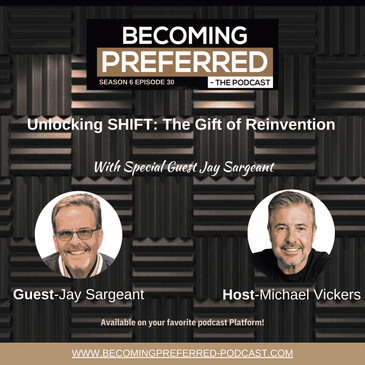
SEASON: 6 EPISODE: 30
Episode Overview:
Welcome back to Becoming Preferred, the podcast that helps you become the best version of you. Throughout our careers, we often talk about the importance of business pivots, but we rarely discuss the profound skill of personal reinvention.
Today’s guest is Coach Jay Sargeant—entrepreneur, teacher, reinvention coach, and author of SHIFT: The Gift of Reinvention. Across seven careers—from community organizer to tennis pro to business builder and coach—Jay has spent a lifetime studying how people transform themselves.
At 78 years young, Jay is the creator of The Shift Project, and he believes that life’s second half can truly become your masterpiece. He helps high-achievers recognize the hidden patterns in their lives, proving that staying relevant isn't about the credentials on your wall—it’s about your hunger, your adaptability, and your willingness to begin again. Jay is here to show us that most major transformations change one conversation and one uncomfortable moment at a time. Please join me for my conversation with Coach Jay Sargeant.
Guest Bio:
Coach Jay is the author of Shift: The Gift of Reinvention and the creator of The Shift Project. Across 78 years and seven careers, he has learned that reinvention is not a one-time event-it is a skill developed through courage, adaptability, persistence and the willingness to begin again. Through his stories and insights, Coach Jay helps audiences recognize hidden patterns in their lives and understand that it is never too late to shift into a new chapter.
Resource Links:
- Website: https://www.theshiftproject.academy/
- Product Link: https://www.theshiftproject.academy/thecohort
Insight Gold Timestamps:
01:46 We're going to talk about your book
04:57 Got me in trouble all the time, but set me up for everything I have ever done in this lifetime
06:37 When I was 16, I went and bought a 1958 Oldsmobile, black, red leather seats and white convertible top
08:00 I didn't write the book for anybody to read other than my great-grandchildren
10:43 My mom and dad were serial entrepreneurs; they were dreamers
12:58 Credentials are overrated
18:22 I don't want to stay in franchising, I've already done it
19:43 The name of the book was Frogs Into Princes, the seminal work of Richard Bandler and John Grinder
20:37 I took the chance that I suggest entrepreneurs do, you've got to see the signs before they're vivid, before it's real
21:55 Confidence is often rented before it's owned
25:08 If you want someone to give a speech that gets people to do something, I am your man, and I can prove it
26:45 I start people off with, "What are your assets?"
29:22 You can't make your next fortune in your living room
34:35 It all began because I took a bad meeting, and I spoke up for myself
36:36 I understood it was about building a relationship
38:43 My mantra is: sell one thing to somebody tomorrow
42:51 My counsel is move, don't get stuck on credentials, move like crazy, and it is never, ever, ever too late
43:30 Take nothing for granted, find what you love, find what you're good at
45:38 The book is called Shift: The Gift of Reinvention by Jay Sargeant
Connect:
Email: TheShiftJay@gmail.com
Sponsors:
Rainmaker LeadGen Platform Demo: https://calendar.summit-learning.com/widget/booking/JKItVP7WErmCBjU2cCIx
Rainmaker Digital Solutions: https://www.rainmakerdigitalsolutions.com/
In 3, 2, 1.
Speaker BWelcome back to Becoming Preferred, the podcast that helps you become the best version of you.
Speaker BThroughout our careers, we often talk about the importance of business pivots, but we rarely discuss the profound skill of personal reinvention.
Speaker BToday's guest is Coach Jay Sargent, entrepreneur, teacher, reinvention coach, and author of Shift the Gift of Reinvention.
Speaker BAcross seven careers, from community organizer to tennis pro to business builder and coach, Jay has spent a lifetime studying how people transform themselves.
Speaker BAt 78 years young, Jay is the creator of the Shift project, and he believes that life's second half can truly become your masterpiece.
Speaker BHe helps high achievers recognize the hidden patterns in their lives, proving that staying relevant isn't about the credentials on your wall, but it's about your hunger, your adaptability, and your willingness to begin again.
Speaker BJay is here to show us that most major transformations change one conversation and one uncomfortable moment at a time.
Speaker BPlease join me for my conversation with Coach Jay Sargent.
Speaker CWell, hey, Coach Jay.
Speaker CWelcome to the program.
Speaker CWe're delighted to have you.
Speaker AIt's great to be here, certainly.
Speaker CWhere are we speaking to you from today?
Speaker AI am in Woodland Hills in the San Fernando Valley outside of downtown Los Angeles.
Speaker ABut formally, I need to say this.
Speaker AAlthough I've been here a long, long time, my roots are still in Boston, Massachusetts.
Speaker ASo Red Sox, Patriots, Bruins and Celtics go.
Speaker COh, they're good team.
Speaker CWell, actually a couple of my favorite teams, too.
Speaker CSo I've been to the games there with Boston's seen the green monster.
Speaker CWell, listen, I'm really excited about our project.
Speaker CWe're going to talk about your book, the Shift Project.
Speaker CReinvent the life that you want.
Speaker CAnd it's so relevant.
Speaker CAnd I'm really excited about talking about just the process of that because a lot of people were living longer and there was a day where we.
Speaker CIf you travel to Europe and you look in the graveyards, you'll see no one lived past 50.
Speaker C86.
Speaker C87 Is kind of really the new number if you're pretty healthy.
Speaker C77 Is our national benchmark, but that's including everybody that's overdoses, obesity, all the diseases.
Speaker CSo it's the road 86.
Speaker CSo we got a lot of time still ahead of us.
Speaker CAnd the key is to stay relevant.
Speaker CYou don't have to hang up your cleats, so to speak, you know, just because you hit a certain age.
Speaker CSo delighted to talk about this subject.
Speaker CIt's near and dear to my heart as well.
Speaker CBut hey, before we get started, let's.
Speaker CLet's go back in history.
Speaker CA little bit of time you're back in high school.
Speaker CSo you're back in Massachusetts, you're in Boston, I'm assuming, going to school.
Speaker CWhat does Jay want to be when he grows up?
Speaker AYou know, many people understood immediately my friend in my neighborhood, I grew up in Brighton, Massachusetts, a working class neighborhood, in an apartment house, not a house.
Speaker AAnd my best friend was Harold Freeman.
Speaker AAnd Harold and I would lay on a little patch of grass that we found in front of a convalescent home, look up at the sky as 10 or 11 year old, and Harold would tell me, jay, I'm going to be a doctor.
Speaker AAnd he gave me the whole life path, right at age 11.
Speaker AI have not figured that out yet.
Speaker AAt age 78, he was clearer at 11 than I've been throughout my entire life.
Speaker AAnd you're right, I went to school.
Speaker AI went to Boston Latin School, the oldest public high school in, in the United states, formed in 1626, one year before Harvard University.
Speaker AAnd on the very first day when you get to Boston, land school as a seventh grader.
Speaker AAnd they didn't call you a seventh grader, Michael, they called you class six.
Speaker AIt was classical.
Speaker AYour teachers were masters.
Speaker AWe were Class 6, 5, 4, 3, 2, 1.
Speaker AAs a sixie.
Speaker AClass 6, you're this little tadpole.
Speaker AYou're marched into an auditorium and all the pictures above you are Ben Franklin, the Adams family, all the founders of the country went to Boston Latin School.
Speaker AAnd they're up there on the wall staring down at you.
Speaker AThe headmaster gets in front of the audience and says, look to the left and look to the right because only one of you will be here.
Speaker AThousand of you in the auditorium, only 300 will graduate.
Speaker AWe will flunk 700 of you out.
Speaker AAnd here's the requirement.
Speaker AThree hours minimally of homework a night or you won't get through this.
Speaker AMichael.
Speaker AI don't know if this is good news or bad news, but I immediately thought, not me.
Speaker AI'm so bright, I'm so intelligent, I've done so well in grammar school.
Speaker AI'm going to get through this veil of tears with virtually no homework being done.
Speaker AAnd I did.
Speaker AAnd I did.
Speaker AAnd the reason I tell you this story is everything I learned by not doing my homework and having to explain it six years in a row times six courses every year give a dramatic, poignant, intelligently designed speech.
Speaker AGot me in trouble all the time, but set me up for everything I have ever done in this lifetime.
Speaker ASo that's my origin story.
Speaker CNo, I love it.
Speaker CI totally get it.
Speaker CBack in our day, the homework was kind of like ooh, and, and I, I always, I learned very early that the doctor in medical school who finishes last in his class, you know what they call him?
Speaker CDoctor.
Speaker CSo I thought, hey, wait a minute, this GPA thing, I know you can't go achieve and if you get 4.0 is great.
Speaker CYou mentioned Harvard.
Speaker CHarvard last year turned down over 3,000 4.0 students.
Speaker CSo it's a commodity being a 4.0.
Speaker CSo there's, you got to have a lot more to it.
Speaker CI think the biggest thing is learning how to learn.
Speaker CAnd you started to evaluate those things.
Speaker CYou probably were bored in school, were you?
Speaker AI was preoccupied.
Speaker AFell in love with two things.
Speaker ABasketball first.
Speaker ASo I was a student of Bob Cousy, I taught at his camp.
Speaker AI was being positioned to be a two guard, a shooting guard when he went to Boston College.
Speaker AThat never happened because the second thing, I wish I could say that I was bored.
Speaker AI was preoccupied with the thought of having a good looking girlfriend.
Speaker AAnd that's all I thought about.
Speaker AIn order to have a good looking girlfriend in my neighborhood, you needed to have a car and you needed to have a really nice car.
Speaker AAnd my folks were broke.
Speaker AMy father made $7,000 a year working two full time jobs.
Speaker AThere wasn't going to be any money when I turned 16 for a nice car.
Speaker ASo from the time I was eight years old on, I worked constantly to have the money on day.
Speaker AWhen I was 16, I went and bought a 1958 Oldsmobile.
Speaker ABlack, red leather seats and white convertible top.
Speaker COh, did you have a paper route?
Speaker AWere you a. Oh, for sure.
Speaker AI had it all.
Speaker AI shoveled snow, I had paper rides, I delivered drugs for pharmacies, I was a soda jerk.
Speaker AAnd you know I've, I've had seven careers but 700 jobs, I've never stopped working.
Speaker CAnd that with entrepreneurs, those who were successful.
Speaker CI was asked, you have a paper out?
Speaker CAnd most did because you learned how to deliver the papers, customer experience, you had to go collect and knock on the doors and get your 250 a week.
Speaker CYeah, Johnson.
Speaker CAnd go back and go back and go back and you pull your papers in the wagon or on your bicycle and have one of those bags, do whatever.
Speaker CSo I think those are all good training grounds compared to, you know, what we see today.
Speaker CWell and it's interesting because you've been a community organizer, you've been a tennis pro, you're a pickleball coach, franchise developer, entrepreneur, communication, it can go on and on.
Speaker CAnd that's the point, and I think is that primary reason, like you wrote the book shift, the gift of reinvention.
Speaker CWhat was the impetus for that?
Speaker CBecause you've been going along.
Speaker CYou've obviously had successful careers.
Speaker CYou're 78.
Speaker CAnd I'm putting that out for a reason.
Speaker CI hope you don't mind.
Speaker CYou look fantastic.
Speaker CGreat.
Speaker CYou're in great shape.
Speaker CYou're coaching.
Speaker CWhen did that idea of the germination of the book first come to you, and who is it for?
Speaker AYou know, I didn't write the book for anybody to read other than my great grandchildren.
Speaker AI'm acutely aware after having lost my parents at my age.
Speaker AOf course, they're gone now, and there are many holes in what I know about their life.
Speaker AAnd I wish I could call up my mom one more time and say, talk to me about Papa Boney the day that he got a horse and he went down the park street station and yada.
Speaker AI mean, there's all that family lore, and it's gone.
Speaker ASo my kids.
Speaker AI have three kids.
Speaker AI have three daughters.
Speaker AThree great daughters.
Speaker A54, 37 And 34.
Speaker AAnd they for years have said, dad, when you die, when you go to heaven, the stories go with you.
Speaker AWould you please record them in any way you can?
Speaker ABecause we want our kids and our kids kids to know.
Speaker ASo it started off just simply doing that.
Speaker AAnd then, honestly, it was such a joy.
Speaker AAnd there are painful moments.
Speaker AI mean, you know, I lost a wife of 28 years during the course of writing the book.
Speaker AIt's chapter 23 and 24.
Speaker AAnd there are spiritual lessons in there that are just amazing.
Speaker ABut the key is I wrote it for the kids.
Speaker AAnd then all of a sudden, I realized two things started to emerge that I wasn't anticipating.
Speaker ANumber one, and this is kind of a goofy memory, but I'm going to share it with you.
Speaker AWhen I went to Boston College in 1966, I got invited at Christmas to Long island to the Belfort house for Christmas.
Speaker ANow, remember, I'm a Brighton, Massachusetts, living in an apartment.
Speaker AMy father delivers newspapers at night and.
Speaker AAnd my mother sells haberdashery at Filene's basement.
Speaker AI'm invited to Long island to the Belford house for Christmas.
Speaker AI'm Jewish, so I've heard.
Speaker AHad noisy meals my whole life.
Speaker ARelatives screaming and yelling.
Speaker AWoody Allen was right.
Speaker AScreaming and yelling.
Speaker AAnd now I go to the Belford mansion on Long island during the Christmas break of my first year at Boston College, and they start talking around.
Speaker ANumber one, it's quiet, which is Amazing.
Speaker APeople are polite, passing food very nicely.
Speaker ABut most importantly, they're talking about the stock market and investment strategies.
Speaker AAnd as a little boy, I was only 18.
Speaker AI'm sitting there thinking, oh, my God, I'm screwed.
Speaker AThese guys got such an advantage over me.
Speaker AThey're learning things.
Speaker AMy folks have never had an investment strategy.
Speaker AThey don't own any stock.
Speaker AWe never had these conversations over Russia, Shana, dinner, that's for sure.
Speaker AAnd so at the end of the day, what I realized in writing the book, my folks gave me a bigger blessing.
Speaker AMy folks gave me a bigger blessing than the Belfort family because my mom and dad were serial entrepreneurs.
Speaker AThey were dreamers.
Speaker AThey had nothing.
Speaker ABut they always believed they could create more, that they could be rich.
Speaker AThey could move from Brighton, Massachusetts, to Brookline, which is only one street over.
Speaker ABut the real estate is completely different.
Speaker AThey were dreamers.
Speaker AAnd here comes the key.
Speaker ANo matter how crushed they were.
Speaker AAnd I was part of every campaign because I had a little boy and we had failure after failure.
Speaker AMy mother wanted to sell shoes in the living room, cooking classes, Chinese cooking classes in the kitchen, dancing, mambo, and cha cha in the living room.
Speaker AThey bought the rights to these Clowns, Tragedy and comedy, spent a fortune on reproductions, put a $500 ad in the New Yorker.
Speaker AMy father was making 7,000 a year and two jobs.
Speaker AThat $500 for that ad in New Yorker was everything we had.
Speaker AAnd we came running home from work and from school to look at the slot.
Speaker AWe thought we would have thousands of envelopes buying that Comedy and tragedy clowns 3.
Speaker AAnd that was our best day.
Speaker ANow, the reason I tell you this story is the day after or the week after the defeat, my folks are dreaming again.
Speaker AThey never got defeated, and they eventually found.
Speaker AMy mother, found a glass business, an art glass business that put my brother through Harvard, paid all four years of Harvard University with a business she created just by walking into a store and saying, I love this glass.
Speaker AI can represent you.
Speaker ALet me take it on consignment to Boston.
Speaker AI'll resell it.
Speaker AAnd that glass money put my kid brother through Harvard.
Speaker AMy father sold ties to real estate offices and insurance agents to the day he died.
Speaker AHe loved ties.
Speaker AHe was a very natty dresser.
Speaker AAnd they taught me the spirit of entrepreneurship, and it's lasted my whole life.
Speaker AIt's just an amazing lesson.
Speaker ASo while writing the book, it sort of honors my folks in that spirit, and then it comes up with three patterns.
Speaker AMichael.
Speaker AMichael.
Speaker AHere's the punchline.
Speaker ACredentials are overrated.
Speaker AThese are the stops.
Speaker AThese are the stops for reinvention.
Speaker APeople don't reinvent their life because, a they think they don't deserve it, they don't have the credentials.
Speaker AB they don't understand and appreciate small moments can lead to big moments.
Speaker ABut you got to do something, for God's sakes.
Speaker ANo one ever made any money sitting still.
Speaker AAnd last but not least, it's never too late to reinvent yourself.
Speaker ANever too late.
Speaker ASo those are the three principles of the book.
Speaker AAnd you know, I got stories around each one of them.
Speaker CMike well, and you were taught resiliency as well.
Speaker CAnd so at the end of the day, and you've lived long enough to know it, to me it feels like Monopoly.
Speaker CThere's times you land on free parking, there's times you go to jail, there's times you get on boardwalk, there's times you own a railroad.
Speaker CIt's the there's one thing, it's just constant change.
Speaker CAnd so we got to be comfortable with the change and evolution, not revolution.
Speaker CSo I think it's always moving, improving.
Speaker DOurselves Are you tired of chasing leads and ready to start effortlessly attracting more high value clients?
Speaker DIntroducing Rainmaker Lead Gen, the ultimate sales, engagement and client acquisition platform that takes the stress out of outreach.
Speaker DWith Rainmaker Lead Gen, you can easily identify, engage, educate and convert.
Speaker DConvert your ideal prospects into loyal clients.
Speaker DOur industry leading automation and email sequencing empowers you to reach more ideal clients, accelerate the sales cycle and close more business.
Speaker DImagine authentically engaging with your prospects while the platform handles the heavy lifting.
Speaker DSay goodbye to the endless hustle and embrace a more efficient, effective approach to business development.
Speaker DReady to witness the magic?
Speaker DBook a 20 minute demo today and see how Rainmaker Lead Gen can revolutionize and level up your client acquisition game.
Speaker DThere's nothing to lose and everything to gain.
Speaker DDon't miss out on this opportunity to supercharge your client acquisition process.
Speaker DVisit rainmakerdigitalsolutions.com or check out the link in the show Notes to book your demo.
Speaker DRainmaker Lead Gen Spend less time hunting for your ideal clients and more time having high value sales conversations with your ideal clients.
Speaker BAnd now back to my conversation with Jay Sargent.
Speaker CLet's talk about reinvention just as a skill and as a business skill as well.
Speaker CWe have a lot of business professionals that listen to the podcast as well as professionals, so Jay Mini entrepreneurs view reinvention as something you do when you fail, but you suggest it's actually a skill to be developed.
Speaker CHow does a business professional shift from seeing reinvention As a last resort to seeing it as a competitive advantage.
Speaker AYou know, I'm gonna.
Speaker AI had a sequence, but you just changed it.
Speaker ASo I love it.
Speaker AI'm gonna ask.
Speaker AAnswer that very specific question.
Speaker AI developed from scratch a franchise chain from one unit on Pico Boulevard in West Los Angeles to 154 units in 18 months.
Speaker AAnd on the heels of that extraordinary victory, somebody took over the business.
Speaker ASomebody bought the business and disbanded my division at the heels of one of my greatest successes.
Speaker AAnd at that moment, I was crushed.
Speaker AI felt really bad about that because I had equity.
Speaker AWe were taking it public through Alex Brown.
Speaker AYou remember them back in the day, they were doing tech things.
Speaker AIt was the first.
Speaker AI had developed the first chain of software retail stores in the United States.
Speaker AThen it disappeared.
Speaker ANow I had some money.
Speaker AI had.
Speaker AYou know, I didn't spend it all.
Speaker AI had some money, but I had to make some choices.
Speaker ASo I called up a mentor of mine in franchise development, George Nanoff, arguably one of the great minds in franchise development.
Speaker AAnd I called him up and I told him about this sad reversal of fortune.
Speaker AI was fishing.
Speaker AI was fishing.
Speaker AI'm in Los Angeles.
Speaker AHe's still back in Boston.
Speaker AAnd he says, kid, because he had told me when I left them to compete with him, the light will always be on.
Speaker AI rented you.
Speaker AI known you.
Speaker AIf you ever want to come back, give me a call.
Speaker ASo I gave him that call.
Speaker AMany years later, he says, oh, my God.
Speaker AI am developing a brand new franchise of chicken empire called Boston Chicken.
Speaker AAnd you called right now.
Speaker AI want you to be the president.
Speaker AI want you to develop it.
Speaker AI'll give you chicken, $10,000 a wire, wherever you want it.
Speaker AThis is a long time ago.
Speaker AI'm going to fly you and your bride across the country.
Speaker AI'll put you up in midtown Manhattan.
Speaker AI will set you up, I'll move your furniture.
Speaker AI now remember I'm a guy who's never had that kind of stability.
Speaker AAnd I've just taken a punch.
Speaker AI've just taken a punch.
Speaker AI'm reeling a little bit.
Speaker AI got some dough in the bank.
Speaker AI got a Porsche 911 that I should sell.
Speaker ABut at the end of the day, this is very enticing.
Speaker ASo I go to the bride, who was only 22 at the time, and I say, george Nanoff wants us to go to New York.
Speaker AMost exciting city in the United States.
Speaker AI'm an opera buff.
Speaker AI'm a theater guy.
Speaker AI'm thinking, we're going to be cultured.
Speaker AWe're going to oh my God, we're going to have money.
Speaker CWe're arriving.
Speaker AYeah, we're arriving two days later.
Speaker AI am just suffering because I don't want to build a chicken empire.
Speaker AI don't see myself as the king of a chicken empire.
Speaker AI don't want to stay in franchising.
Speaker AI've already done it, I've done it at the highest level, but I don't know what to do.
Speaker ASo I go to the swimming pool.
Speaker AWe're in a transition.
Speaker AWe're at the Oakwood Garden apartment, monthly rentals.
Speaker AAnd there's this massive Olympic swimming pool with 250 chaise lounge around it, chaise cherleons around it, and the bride goes to bed and I'm watching the water and I'm looking up at the sky and I'm having deep thoughts in between trapezes.
Speaker AAnd a bald headed Jewish guy in Bermuda shorts with a baseball cap sits down next to me.
Speaker AThere's 250 empty chairs.
Speaker AThis guy at 11 o' clock at night sits down next to me and he says, a penny for your thoughts.
Speaker AAnd I said, oh my God, you don't really mean that.
Speaker AI'm the most chatty, loquacious guy you ever met.
Speaker ADo you really want me to tell you what's on my.
Speaker AHe says, go, I got nothing to do, Go.
Speaker ASo I tell him the story 15, 20 minutes and he leaves and I go, I bored him to death.
Speaker ABut he comes back almost immediately and he's holding a book, which Michael, you may know he's holding, but remember this is a long time ago.
Speaker AHe's holding a book that's obviously been read to death.
Speaker AIt's got notes, the binder is broken.
Speaker AAnd he hands it to me and he says, read this book right now while I'm with you.
Speaker AAnd the name of the book was Frogs into Princes, the seminal work of Richard Bandler and John Grinder.
Speaker AThe beginning way back when of neuro linguistic programming.
Speaker AI read the first 11 pages like I'm 12 years old reading Harold Robbins the Carpetbaggers.
Speaker ATo me it is one of the most exciting 11 pages of my life.
Speaker AI'm sitting there, I look to say thank you and he is gone.
Speaker ANow I go up to the apartment, I wake up Lee and I say, sweetie, we're not going to New York.
Speaker AWe're sending the money back.
Speaker AWe're not going to be in midtown Manhattan.
Speaker AWe're staying right here in gorgeous Southern California.
Speaker AAnd I am going to be an nlp.
Speaker AI don't even know an NLP teacher Counselor, coach, whatever it is, I'm going to teach this book.
Speaker AIt's had that kind of impact on me.
Speaker AAnd I sent back the money, and I turned down the job, and I took the chance that I suggest entrepreneurs.
Speaker ASo you got to see the signs before they're vivid, before it's real.
Speaker AYou've got to make it real by getting that sense.
Speaker AAnd people often ask me, where does the motivation come from?
Speaker AMichael, I have no tolerance for emotional pain.
Speaker AThe moment I'm out, I'm out.
Speaker AI can take a punch.
Speaker AI've been in, you know.
Speaker AYou're a hockey guy, I'm a hockey guy.
Speaker AI've been in some fairly serious fistfights.
Speaker AI used to fight like crazy under the boards for a basket.
Speaker AI'd knock my mother's teeth out to get a rebound.
Speaker AAt the end of the day, I can take a punch.
Speaker ABut emotionally, when I'm bored, unsatisfied, something bubbles up in me.
Speaker AIt says, I gotta do what I want to do.
Speaker AI gotta do what turns me on.
Speaker ABecause if it turns me on, I'll be very good at it and I won't feel like I'm working.
Speaker CYeah, well, that's such a classic statement, too.
Speaker CAnd if you love what you're doing, you'll never work it in your life.
Speaker CAnd I think people get on that treadmill and they just get stuck in that rut, or they get the golden handcuffs on them and they're not willing to take the leap.
Speaker CRight.
Speaker CBecause it does take a leap to go and change careers or to take something and leave something that's really good and try something different.
Speaker CSo it does take some guts, if you will.
Speaker CYou have a wonderful line.
Speaker CYou call it renting confidence.
Speaker CConfidence is often rented before it's owned by.
Speaker CSo for an entrepreneur stepping into a new industry or a larger room, how do they rent that confidence until it becomes theirs?
Speaker AWell, we say in nlp, and you'll get a kick out of it.
Speaker AVery often people will say, I didn't succeed, or I'm not succeeding because my parents didn't give me enough.
Speaker AEnough love, enough intellectual property, enough support.
Speaker AAnd we say in the NLP community, if you don't have resourceful parents, rent a pair.
Speaker AGo take mine.
Speaker AUse my model.
Speaker AIt doesn't really matter.
Speaker AI tell people, number one, first and foremost, if you don't know your value, you can't reinvent.
Speaker AIt starts with a real serious appreciation and inventory of your value.
Speaker AWhat do I know, Michael?
Speaker AI know that if I'm standing up, speaking, I can move a Crowd.
Speaker AI'll give you an example.
Speaker AWhen I got sick and tired of being a tennis professional and I was at the top of the trade, 34 pros working for me.
Speaker AI had my own stringing operation, the pro shop.
Speaker AI had an academy, a summer camp, the Mount Auburn traveling summer camp.
Speaker AI had it all.
Speaker AI was making more than $100,000 a year in 1977.
Speaker AIt was like glorious and I look cute and I wore my outfit and every from the outside.
Speaker ABut I was bored out of my mind.
Speaker ASo I went to wealthy people who I taught.
Speaker AI taught.
Speaker AFortunately, the owner of the Patriots craft, I taught little Jonathan, the president when he was in my 4 to 6 year old tiny tot program.
Speaker ASo I went to very wealthy powerful people and I said to them, you know me, what do I do next?
Speaker AI don't want to do this anymore.
Speaker AWhat do I do next?
Speaker AAnd one of the people Mark Roberts set me up with, George Nadaff.
Speaker AAnd we go back to George and he said, Jay, you should sell something big.
Speaker AYou, you're a salesman, but you need to sell something epic, large.
Speaker AMy buddy is selling quarter of a million dollar franchises.
Speaker AYou would be great.
Speaker AAnd they're doing it the way you would probably want to do it.
Speaker AStanding in front of fancy, in fancy hotels, in front of audiences of 50 to 100 while you be great at it.
Speaker AI go take the meeting with George, Nana.
Speaker AHe's in an office so gorgeous, he looks like the Pope.
Speaker AHe's at the end, he, I mean it's so.
Speaker AHe looked like a warlord meets Pope Leo.
Speaker AAnd I'm intimidated a little bit.
Speaker AI had to get over myself.
Speaker AAnd I walk and I sit down in front of him and George says, mark Roberts says great things about you, says you're an amazing talent.
Speaker AFirst I need to see your resume, please.
Speaker AAnd I said, I don't have a resume.
Speaker AHe said, wait a minute, you don't have any resume?
Speaker AI said, none.
Speaker AHe said, okay, so you don't have a physical resume.
Speaker ATalk me through who you are and why you qualify for a franchise development job.
Speaker AHe said, what's your talking resume?
Speaker AGive me your business background.
Speaker AI said, well, I hate business.
Speaker AI would never read a Fortune magazine in a thousand years.
Speaker AI mean, I have no interest whatsoever.
Speaker AHe said, well, what are you doing here?
Speaker AI said, hey, here's what I've heard.
Speaker AYou sell high end things to powerful, wealthy, intelligent people in beautiful hotel rooms all over the country by giving a speech.
Speaker AAnd if you want someone to give a speech that gets people to do something, I Am your man and I can prove it.
Speaker AGive me your brochure.
Speaker ASo he gives me a three trifold brochure.
Speaker AI say, here it is.
Speaker AI'm going to go in the lobby, get your whole management team and the people I'm going to be competing with your franchise sales department.
Speaker AGet them in this big beautiful office.
Speaker AI'll come back in 15 minutes and give a presentation of your franchise opportunity.
Speaker AIf it's good, hire me.
Speaker AGive me a commission, whatever will set it up.
Speaker AAnd if it's not, throw me out.
Speaker AI went into the lobby at that brochure and I went, now I knew nothing.
Speaker ADo you understand?
Speaker ASo the content, I realized I'm not going to wow them on the content, but I'm going to use what I learned at Boston Latin School by not doing my homework.
Speaker AThat's the inventory.
Speaker AI know where my value is.
Speaker AI walk in that room, move my hands, tell stories, flounce around, get dramatic.
Speaker AHe throws everybody out.
Speaker ANow, by the way, people want to kill me.
Speaker ADo you understand?
Speaker AThe group watching me wanted to assassinate me.
Speaker AThis I guarantee.
Speaker AI deleted them.
Speaker AI teach this.
Speaker AI deleted them.
Speaker AThey were gone.
Speaker AI had an audience of one.
Speaker AGeorge Nanna, he intelligently throws them the heck out of the room.
Speaker AAnd he sits down, he says, kid, you didn't say one thing that was right, but you said it really well.
Speaker AAnd you're very good at speechifying.
Speaker AAnd I could clean you up and put you on the road and you could do this.
Speaker AAnd so I took a commission gig.
Speaker AAt the end of the day, I had no credentials.
Speaker AThis is what I teach.
Speaker AI had no credentials, but I knew who I was.
Speaker ASo I start people off with what is your assets?
Speaker AI mean, I believe that the second half of your life can be the big half of your life because you've had 40 years, 45 years of great experiences.
Speaker AIf you can extract that, if you can understand that, if you can take what you know about yourself, the value proposition, and put it someplace where you fill a hole.
Speaker ABut you got to not believe that you're being held back.
Speaker AI mean, listen, I became an nlp.
Speaker AI became a pickleball coach.
Speaker AThere are now more pickleball coaches than Carter has little liver pills.
Speaker AAnd they all go spend 500 to $1,000 for credentials.
Speaker AI didn't get any credential.
Speaker AI just can create value.
Speaker AAnd when I did, the word got out in a whole seventh career.
Speaker AEmerged at age 76.
Speaker ASo that's what I teach.
Speaker CWell, I know it's interesting.
Speaker CAnd you know when you talk about nlp, you know, I've got a lot of friends in the business and a lot of successful people obviously practice and use it.
Speaker CAnd for those who don't know, it's the Neuro linguistic programming.
Speaker CWe're all programmed.
Speaker CWe are completely matter of fact, if you look at our traditional programming, our school systems that came out of the Soviet Union way back in the 30s and 40s where we wanted factory workers, so the industrial age, we wanted somebody up the front of the room with number two pencil and you get your three Rs and if you could do that, you could get a factory job and get a job.
Speaker CWe don't teach the things that matter.
Speaker CWe don't teach the things that are important.
Speaker CWe don't teach finances, we don't teach independence.
Speaker CAnd so you're, let's call it a rebellion because I share that with you.
Speaker COf that system you recognize very early, hey, there's something wrong with this process.
Speaker CAll right?
Speaker CAnd like I say, majority of my learning, my PhD came from post work.
Speaker CI went through traditional school, went to college and got a degree.
Speaker CBut let's talk about that because I call that the credentials trap.
Speaker CAnd then I'd like you to address some people have some hesitancy around NLP or if they're very strong, say in a Christian faith, they sometimes question it like oh, is this voodoo or is this not a good thing?
Speaker CAnd I know you've heard that argument before many times, I'd love for you to address that.
Speaker CBut in our world of degrees and certifications you argue that credentials are often overrated and you've addressed it.
Speaker CWhat should entrepreneurs be focusing on instead of to try to prove their value to high level clients, what should they focus on?
Speaker ANumber one, I counsel a lot of people one on one over a very long lifetime.
Speaker AThe trap is credentials.
Speaker AThey think they're not worthy.
Speaker AThey've got when I, when I do.
Speaker AYeah, unbelievable.
Speaker AThe second piece is that people get stuck.
Speaker AAnd I always say you can't make your next fortune in your living room.
Speaker AYou gotta go take a bad gig, take a bad meeting, do something ridiculous, but move, do something.
Speaker ABecause there's no small moments.
Speaker AThere's no small moments.
Speaker AReal quickly, I take a meeting many, many, many years ago.
Speaker AI don't want to leave the house, I don't want to smell good.
Speaker AI don't want to have to put a suit and tie on.
Speaker AIt was back in the day, all wore suit and ties.
Speaker AI had to go to a bad meeting with idiots.
Speaker ABut I said to the wife at the time I got to get out.
Speaker AI got to meet someone new.
Speaker ASomething's waiting for me somewhere in the world.
Speaker AI go to the meeting and they were schmucks.
Speaker AThey were just as bad as I thought.
Speaker AThe meeting was worse than I thought it was.
Speaker AAnd I hear some guy as we're leaving, grousing two seats over from me, a Canadian, by the way, two seats over from me, saying, I got this new consulting contract.
Speaker AThey're unfixable and he's got a problem he can't solve.
Speaker AI say, I don't know.
Speaker AI say, excuse me, I don't mean to be impertinent or rude, but I overheard what you said.
Speaker AI can fix that.
Speaker ANow that's the moment where we all.
Speaker AThat's the great divide in entrepreneurship, in reinvention.
Speaker AI had.
Speaker AAnd I couldn't say, maybe I can fix that.
Speaker AI had to say, I can fix that beyond a shadow of a doubt.
Speaker AThat led to a contract.
Speaker AThat led to a trip to Florida.
Speaker AThat led to me getting in front of an angry mob.
Speaker AThey wanted to tear the company apart.
Speaker AAnd I basically be quieted them.
Speaker AI turned a lynch mob into Woodstock Nation, into Kumbaya.
Speaker AOkay, lovely moment.
Speaker AI didn't save that company.
Speaker AI didn't save that company.
Speaker AI earned my money.
Speaker AI be quieted that crowd and I moved on.
Speaker AOne year later, I get a phone call on a Tuesday morning at 10 o' clock in the morning, and someone says, you don't know me, but I was in that crowd in Florida.
Speaker AI watched you do something I could not believe happened.
Speaker AI'm in the same position here.
Speaker AI need you to do something for me.
Speaker ACan you come to Vancouver?
Speaker AI said, vancouver is one of my favorite cities in the world.
Speaker AOf course.
Speaker ALet me look at my calendar and see if I.
Speaker ALet's just sync this up.
Speaker AWhen do you want me?
Speaker ATonight at seven o'.
Speaker AClock.
Speaker AI said, oh, my goodness, somebody reneged.
Speaker ASomebody's not coming.
Speaker AShe said, the representative from the company won't come because they heard that.
Speaker AYou're going to love this.
Speaker A200 Calgary Cowboys with big biceps, cowboy hats and boots are caravanning towards British Columbia to beat the living daylights out of whoever's not paying them what they deserve.
Speaker AAnd we're scared to death.
Speaker AWill you come and give that speech?
Speaker AI go downstairs, I say to the wife, I'm going to Vancouver.
Speaker AShe said, I didn't see that on the calendar.
Speaker AIt wasn't.
Speaker AAre they paying you good money?
Speaker AThey're paying me bupkis, nothing.
Speaker ABut they're in trouble and I know I can go do that job.
Speaker AAnd I don't know where I'm going, but I'm going.
Speaker AI get up there and I'm not going to talk.
Speaker AI did the deal.
Speaker AI turned the big muscled guys who were so irritated into photo opportunities, handshakes and hugs at the end of the event.
Speaker AThe three principles of what I didn't even know was a company at that time.
Speaker ASay, we want to show you something.
Speaker AMichael.
Speaker AWhen you're in a strange hotel, it's late at night and someone wants to show you something, it's invariably an opportunity or they're trying to make get cash.
Speaker ASo I tried to avoid that late night meeting like it was the bubonic plague.
Speaker AI said, can we do it in the lobby?
Speaker ACan we do it tomorrow morning?
Speaker ACan we do it in the lobby?
Speaker ANo, it's got to be now.
Speaker AAnd in your room.
Speaker AThey then show me.
Speaker AYou're going to get a kick out of this network marketing which I'm not experienced in at that moment in time.
Speaker AThey're showing me wellness products for which I have zero background.
Speaker AAt the time I was a cigar aficionado.
Speaker ARemember those days?
Speaker AYou know.
Speaker AYeah.
Speaker AAnd so I'm not a wellness guy at that moment.
Speaker AThey have a brown grocery bag of 30 products, none of which have the same labels on them.
Speaker ALooks like they fell off of a turn up truck and everything is cleaning something.
Speaker ABy the time the woman got through the 8th or the 10th product, I'm thinking, which orifice of the body have we not cleaned at this moment in time?
Speaker AThis is ridiculous.
Speaker AShe then pulls out a product which you would know and I won't mention, but it's.
Speaker AShe says, this one's a nighttime collagen formula, describes it.
Speaker AAnd I say, could you accurately say if you took a tablespoon of that at night before you go to sleep, you wake up smaller?
Speaker AShe said, yeah, you could say that.
Speaker AI said, good, I'm now your partner.
Speaker AYou don't have any Money.
Speaker AYou have 56 distributors in all of Canada, none in the United States.
Speaker AYou can't afford me, but you gotta right now before I leave this room.
Speaker ACall up your partners and I need 20% of the company and I'll go home and build this at the end of the day.
Speaker AThat turned out to be 675,000 distributors domestically.
Speaker AA billion dollars in worldwide sales.
Speaker AAnd in the United States and Canada, we created 70 millionaires on a shoestring.
Speaker ADo you understand?
Speaker AI came back to Los Angeles and just did it all alone with one bottle of the Product.
Speaker ANow, it all began because I took a bad meeting and I spoke up for myself and I took a bad contract, and then that led one year later.
Speaker ASo I teach no small moments.
Speaker AIf you know who you are and you know the hole that you can fill, if you uniquely understand your value and you fill a hole, the world will pay for it.
Speaker AYou'll get compensated for that.
Speaker ASo that's what I teach.
Speaker CNo.
Speaker CWell, and you talk about it.
Speaker CClients don't buy your degree.
Speaker CThey buy your hunger, your communication, and your ability to persist through their specific problem.
Speaker CYou know, credentials tell people what you studied, but your shift stories tell people who you are.
Speaker CAnd as you've just said, mastery is proven in the moments when the playbook fails and you have to adapt.
Speaker CAnd you obviously demonstrated that and take care of it.
Speaker ANo, no, Michael, let me cover the NLP thing.
Speaker AI'll just do it real quick.
Speaker AI don't like the question hanging out there.
Speaker AI know that you asked that.
Speaker ANLP has nothing to do with spirit.
Speaker AI don't care.
Speaker AObviously, both of us, we.
Speaker AI respect all religious, spiritual paths.
Speaker AI think God is in everything.
Speaker AThe key to nlp, which changed my life because my father sold life insurance as one of his iterations.
Speaker AAnd we lived in this little apartment.
Speaker AAnd I heard him every night through a thin wall, going, Mrs. Kelly, if Mr. Kelly dies in the middle of the night, how do you take care of the rest of your life?
Speaker AIf I heard my father ask that control question once when I was a little boy, heard it every night, five times a night, as he was making appointments, clawing his way out of being a teamster.
Speaker AAnd when I heard that, I said, I am never going to go into sales.
Speaker AI don't like it.
Speaker AIt sounds manipulative.
Speaker AIt's horrible.
Speaker AI don't want to hear, Mrs. Sullivan, we have a lot of Irish in Boston, as you know.
Speaker AAnd so I heard that line when I discovered that book, Frogs into Princes, just so everyone understands this.
Speaker AWhat changed me in that moment, that's why a book can have tremendous impact, is I understood it was about building a relationship.
Speaker AI understood it was making a friend and then having a friend understand what's the appropriate choice.
Speaker AAnd so everyone had emphasized in my very early development in sales, closing skills.
Speaker AClosing skills.
Speaker AAnd then I realized it ain't about closing.
Speaker AIt's about opening.
Speaker AIt's about.
Speaker AAnd the techniques developed by Bandler and Grinder early on, many, many decades ago, were really therapeutic techniques.
Speaker AThey were ways to meet someone who was suffering in a clinical setting.
Speaker AAnd instead of Fighting with them, joining them in, maybe even their hallucination, discovering what's their model of the world?
Speaker AHow are they seeing it, feeling it, hearing it?
Speaker AWhat are their metaprograms?
Speaker ADo they need little information chunked down or chunked up?
Speaker ASo when I saw that sales and persuasion could be gentle, could be kind, could be pinpointed.
Speaker AI hate scripting, I hate memorizing.
Speaker AI mean, when I used to do big companies and I go into human resource departments, the first thing that I hated the most was, people go home tonight and memorize this.
Speaker AThat's not the way the world is.
Speaker AYou got to make a friend, you got to gather information, listen carefully, watch carefully, and then customize your remarks so that fits the other individual.
Speaker AThat's the NLP model.
Speaker AThere's nothing mystical, there's nothing anti Christian about it.
Speaker AIt's not.
Speaker ASo I just wanted to make that clear.
Speaker CNo, it's changed.
Speaker CAnd great, great definition of that as well.
Speaker CLet's talk about patterns and recognizing those hidden patterns.
Speaker CSo your work at the SHIFT project focuses on recognizing hidden patterns.
Speaker CWhat is one common pattern you see in professionals that keeps them stuck in a chapter that they should have ended years ago?
Speaker AWell, number one, we already talked about it.
Speaker AThey're worried about do they have enough credential?
Speaker BRight.
Speaker ANumber two is they're not recognizing that in small.
Speaker AYou know, sometimes people, especially in certain distribution channels, talk about million dollar sales.
Speaker AMy mantra is sell one thing to somebody tomorrow.
Speaker ALearn the lesson of that transaction and then move on.
Speaker AIf you get spreadsheet excel rich, you've done absolutely nothing.
Speaker AGet engaged.
Speaker AI took a buddy of mine, I relocated a kid from Boston to LA for the big franchise development campaign.
Speaker AHe was a young Italian kid from east Boston named Mike Massetti.
Speaker AI brought him on.
Speaker AHe killed.
Speaker AHe and I and another two guys, we just had a great moment in time.
Speaker AAnd then when it got bought out and we were destroyed in a moment, I had the most amount of money.
Speaker ASo I suffered a little less.
Speaker AMike was spending money like it was never going to stop.
Speaker ASo he was suffering.
Speaker AAnd one night I saw on a post, on a telephone post, a handmade sign that said, guru giving prosperity lesson tonight at a YMCA in the hippie version of Venice, California.
Speaker AI see the sign and I say, this is perfect for Mike.
Speaker AHe's depressed, he's not shaving.
Speaker AI can't get him to come out.
Speaker AI'm going to get him dressed up and clean and I'm going to fake them into this prosperity thing.
Speaker AI go pick him up and he looks like he just walked out of Harvard Square, the bookstore at Harvard Square.
Speaker AHe's wearing a blue blazer, a striped red tie, an oxford cloth button down blue shirt, a pair of 10 slacks, and tassels on his shoes.
Speaker AHe comes out and he's a little bit Mussolini, like, you know, that J.
Speaker AHe's a very proud, smaller guy.
Speaker AAnd I go, oh, my God, is he going to be incongruous at this thing at a YMCA in Venice with a guru?
Speaker AWe walk into the room and it's all hippies.
Speaker AThis is a long time ago.
Speaker AIn a semicircle around a guy with a dot on his forehead, in a gossamer gown, in a.
Speaker ASorry.
Speaker AAnd I don't even look at Mike.
Speaker AYou know what?
Speaker AI don't want him.
Speaker AI don't want to give him permission to leave.
Speaker ADo you understand?
Speaker ASo we sit in the middle of the semicircle and it becomes clear that he's going to give business advice starting at once.
Speaker AEnd of the business circle.
Speaker ANow I'm going to tell you something funny.
Speaker AHis name was Wami Sawami.
Speaker AYou know, who knows what he was?
Speaker AHe was a great guy.
Speaker ABut I hear the first two interventions and I go, this is as smart as anybody at Harvard Business School.
Speaker AThis is genius information.
Speaker AMike is to the right of me, so it's going to be him before me.
Speaker AI don't look at him.
Speaker AI continue not to look at him.
Speaker AAnd then I'm wondering, when it gets to Mike, is he going to be confrontive, Is he going to be passive?
Speaker AHe stands up and the guru says to him, please, your name and where you're from and what you do.
Speaker AAnd Mike says, I'm Michael Macedi from Boston, Massachusetts.
Speaker AI now live in West Los Angeles and I am the greatest salesman who ever lived.
Speaker AAnd the guru, God bless him, says, oh, my God.
Speaker AWith no irony.
Speaker ADo you understand?
Speaker ANo irony.
Speaker AOh, my God, what a privilege it is to be in front of the world's greatest salesperson.
Speaker AI am so eager to hear, what are you selling right now?
Speaker AAnd Mike says, well, nothing.
Speaker AOur campaign just.
Speaker AAnd he tells the beginning of a sad story.
Speaker AHe gets busted by the guru.
Speaker AThe guru, stop, stop, stop.
Speaker AIf you're going to break this pattern and you're the greatest salesman that ever lived, go home tonight.
Speaker AFind anything in your house and sell it tomorrow.
Speaker AGive yourself a job tomorrow.
Speaker AI go, wow, that's a beautiful pattern.
Speaker AInterrupt.
Speaker AThat's a great piece of counsel.
Speaker AYou start when you want to start, right?
Speaker AHe disappears.
Speaker AI got the car.
Speaker AMike leaves.
Speaker AOne week later, he went Home sold a compact computer.
Speaker AYou remember compact?
Speaker AI do.
Speaker CThey were giant.
Speaker CAbsolutely.
Speaker AHe had a busted compact in the bottom of a closet.
Speaker AHe calls up a retail store and says, you want to buy this off of me?
Speaker AHe said, are you kidding?
Speaker AI got 10 of them.
Speaker ACan you sell mine?
Speaker AHe puts himself in the middle and creates a brokerage business that created a million dollars in volume by the sixth month.
Speaker ASo my counsel is, move.
Speaker ADon't get stuck on credentials.
Speaker AMove like crazy.
Speaker AAnd it is never, ever, ever too late.
Speaker CThat's my key call that movement before mastery rule.
Speaker CSo it's brilliant.
Speaker CThe world rewards movement before mastery.
Speaker CSo that's why we need to work on that.
Speaker CTime runs out quickly, and I wanted to get this question in for you.
Speaker CYou've had seven careers and you're still launching new projects at 78.
Speaker CWhat can the younger generation of entrepreneurs.
Speaker CWe've got five generations out there now.
Speaker CYou and I are the baby boomers.
Speaker CAll right, we're on that.
Speaker CI think you're on the front end of it, and I'm kind of on the back end of it.
Speaker CSo we're in there.
Speaker CWell, what can they learn from the long game approach to work and life?
Speaker AYou know, take nothing for granted.
Speaker AFind what you love, find what you're good at, and then find opportunities.
Speaker ANetwork around what you're good at, because at the end of the day, you're going to be doing something.
Speaker AAn entrepreneur has to do something.
Speaker AI'll give you a quick example.
Speaker AMy brother's credential I already referred to as Harvard education.
Speaker AI mean, he's done really well in this lifetime, but he's different than me.
Speaker AAnd I need to make this difference clear.
Speaker AMy brother couldn't work one day without an office, one day without an administrative assistant, one day without a parking space, one day without an executive lounge.
Speaker AHe's tried it.
Speaker AI've tried to help him, but it's just not who he is.
Speaker AHe needs that structure.
Speaker AIf you're going to invent your life or reinvent your life, and if it's at the beginning of your life, the key is, can you operate?
Speaker ACan you motivate yourself?
Speaker ACan you deeply appreciate who you are, what you offer?
Speaker AAgain, value, and then stick with it.
Speaker ATake meetings, take bad gigs.
Speaker AAll my kids were interns.
Speaker AAll my kids were interns.
Speaker AThey created great careers in different areas, in therapy and public relations, in marketing.
Speaker ABut in the beginning, they basically gave themselves away while they could in order to get the kind of experiences that taught them how good they were at anything.
Speaker ASo to me, the Youngsters really need to do that, especially now.
Speaker AAnd I love that.
Speaker AYou and I, before we got on, we talked about AI.
Speaker AAI will never replace what you and I are doing right now.
Speaker ANow it can replace.
Speaker AI don't make a flyer anymore.
Speaker AI don't know about you, Michael.
Speaker AI. I talked to ChatGPT.
Speaker AI say I get, I brainstorm, I say make me a flyer.
Speaker AAnd it's incredible.
Speaker ASo I don't need the same marketing department I needed way back when, but my ability to talk and teach and coach and counsel and get into somebody's heart and it's irreplaceable.
Speaker ADon't worry about that.
Speaker CYeah, no, I think the key is to use it as a tool.
Speaker CIt's an amplification tool.
Speaker CTakes already your wisdom, your insights and can amplify you.
Speaker CThe book is called Shift the Gift of Reinvention by Jay Sargent.
Speaker CYou can order it at Amazon or where you buy your books and great place to get it instantly.
Speaker CSo after 78 years of seven reinventions, you put it all down.
Speaker CWhat works, what doesn't, what it really takes to start again.
Speaker CSo never too late.
Speaker CCredentials are overrated and there are no small moments and reinventions of skill.
Speaker CAnd I think you approach that subject just beautifully and you articulate it just as well.
Speaker CJay Sargent, Coach Jay, thanks for being our guest today.
Speaker CThis was amazing.
Speaker AThank you very much, Michael.
Speaker AThank you for having me.
Speaker ABye everyone.
Speaker BAs you are listening to this episode, what is one idea that you've heard that's caught your attention and why does it matter so much to you?
Speaker BAnd who is one person who you can share that with?
Speaker BEither sharing this episode or just sharing that insight that occurred to you while you were listening.
Speaker BPerhaps it is understanding that there are no small moments, only moments we don't understand yet.
Speaker BOr maybe it's that in business you must break your patterns, move constantly, and see the signs before they are vivid.
Speaker BThank you for listening, for learning, and for investing in yourself so that you can become the best version of you.
Speaker BIf you found value in this episode, please write a review on Apple Podcasts.
Speaker BIf you haven't subscribed yet, please do so so you can get a new episode and start your week off right every Monday.
Speaker BUntil next time.
Speaker BThis podcast is created and associated with Summit Media.
Speaker BMy executive producer is Beth Spruce and Director of Research Tori Smith.
Speaker BThe fee for the show is that you share it with friends when you find something useful or interesting.
Speaker BThis podcast is subject to copyright by Summit Media.
Speaker AGoodbye.