
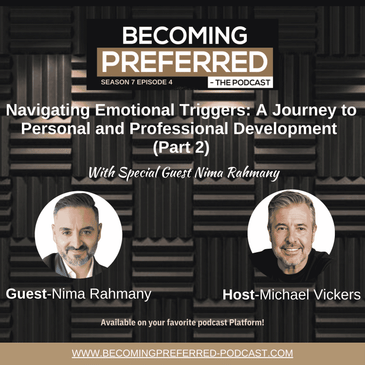
SEASON: 7 EPISODE: 4
Episode Overview:
Welcome back to Becoming Preferred! Last week, in part one of our conversation with Nima Rahmany, we laid the groundwork by looking inward—focusing on personal development, emotional regulation, and what it truly takes to become 'trigger-proof'.
If you missed that episode, I highly encourage you to go back and give it a listen. But today, we are diving into part two, where we translate those personal insights directly into professional development.
We’re taking a hard look at the 'paradox of the decorated wreck'—why so many high-achieving leaders and entrepreneurs master business execution, yet find themselves unequipped when personal dynamics or workplace stress spill over. We’ll explore how drive can sometimes be a coping mechanism, how to move from intellectual insight to real embodiment, and practical tools to regulate your nervous system under high stakes. Please join me for part two of my conversation with Nima Rahmany.
Guest Bio:
Nima Rhamany helps high-performing individuals, couples, and families heal relational wounds, regulate their nervous systems, and become trigger-proof in love, leadership, and connection.
Formerly a chiropractor, Nima now guides clients through somatic and shadow integration to interrupt unconscious relational patterns and create emotionally safe, co-regulated relationships. Nima's work blends neuroscience, polyvagal theory, attachment theory, and transformational coaching to help people build more secure, authentic connections.
Resource Links:
- Website: https://becometriggerproof.com/
- Product Link: https://becometriggerproof.com/shop/
Insight Gold Timestamps:
01:34 I want to talk about the paradox of the "decorated wreck"
02:08 The thing that makes us successful in business, it actually hurts us in intimate relationships
04:31 Most entrepreneurship and success-driven behavior is a trauma response
06:21 The wound will show up, and your children are designed to bring that up for you, your partner is designed to bring that up for you
09:24 Trauma is not just what happens to us, it's what's happening inside of us
12:48 How do we know then if our drive is coming from a place of inspiration or a place of running away?
15:35 Addictions in the child become the solution to receive the connection that they're not receiving from parents
19:08 Insight alone is not enough
20:55 It needs to be practiced and addressed the same way that you can't become a good dancer from reading a book or listening to a podcast
24:22 If you're living in an identity of a victimhood...
26:44 Their egos stop them from actually admitting the truth that there is a vulnerable part of them
28:51 What was the nervous system of the parents that got downloaded onto your nervous system
34:38 You can still have the same type of pain in losing a client
36:56 Disrespect is not a feeling; disrespect is a story
45:36 When you apply the skills, the methodology, regulate, integrate, communicate, you just come back home sooner
48:51 The first step is to repair with yourself
Connect Socially:
Facebook: facebook.com/nimarahmanyofficial
Instagram: instagram.com/nimarahmanyofficial
YouTube: youtube.com/@NimaRahmanyOfficial
Email: support@becometriggerproof.com
Sponsors:
Rainmaker LeadGen Platform Demo: https://calendar.summit-learning.com/widget/booking/JKItVP7WErmCBjU2cCIx
Rainmaker Digital Solutions: https://www.rainmakerdigitalsolutions.com/
[00:00:00] In 3, 2, 1
[00:00:06] Welcome back to Becoming Preferred. Last week in Part 1 of our conversation with Nima Rahmany, we laid the groundwork by looking inward, focusing on personal development, emotional regulation, and what it truly takes to become trigger-proof. If you missed that episode, I highly encourage you to go back and give it a listen. But today we are diving into Part 2, where we translate those personal insights directly into professional development.
[00:00:32] We are taking a hard look at the paradox of the decorated wreck, why so many high achieving leaders and entrepreneurs master business execution, yet find themselves unequipped when personal dynamics or workplace stress spill over. We will explore how drive can sometimes be a coping mechanism, how to move from intellectual insight to real embodiment, and practical tools to regulate your nervous system under high stakes. Please join me for Part 2 of my conversation with Nima Rahmany.
[00:01:03] Well, hey, Nima, welcome back to the program. I am so glad to be here. Had such a great time. I feel like I just made a new friend. Yeah. You know, I'm excited about this. We did. We actually started off in our last episode where we taught Part 1 and we got onto the personal aspect of what you're doing, becoming trigger-proof. And I wanted to create another part because it was so much content, so many insights. We want to do it from a professional level now and how it applies to us professionally and how we can do it. So let's dive right in.
[00:01:31] So again, welcome back to the program and thanks for doing this again. I want to talk about the paradox of the decorated wreck. So in your work, you use that term that I know it's going to hit home for a lot of our listeners at the decorated wreck. And these are professionals who are highly decorated. They're successful. They're capable on the outside. But inside, they're quietly struggling or spiraling in their relationships.
[00:01:52] Why is it so common for high achieving entrepreneurs to master business execution but feel completely unequipped when a partner or a personal relationship or a child pushes back? Wow. Well, the short answer to this question is the thing that makes us successful in business actually hurts us in intimate relationships. You think about what makes you successful is your ability to separate yourself from your emotions.
[00:02:22] Your ability to take whatever hurt you're going through, whatever vulnerability you have and stuff it away and put on a performance. Performers, high performers crush it in performance at work. Your children see past the performance. Your partner sees past the performance. Right? You can't fake it with your kids. They see through it.
[00:02:48] And the gap between who you are as a performer out there with who you truly are, the wider that gap, the more stress that you're going to feel at the home front. You're going to feel not seen, not heard. Why is it that everybody thinks I'm so amazing out there, but then at home I'm not getting the respect?
[00:03:10] And it's because they see the shadow part of you and they don't feel that same level of connection at home as the performing you does. And so there's a gap there and that's why it's so difficult. Well, that's an interesting insight. And even if they're not really seeing that professional on a day-to-day basis, there's actually two different personalities. Because it is a constructed persona.
[00:03:38] I think our professional lives are constructed, right? If you're working in corporate, you are. Yeah, and we all wear that mask. So it's really how do we take off that mask and how do we show that vulnerability? Well, that's interesting. Let's talk about when business success is a coping mechanism. So many entrepreneurs use their drive, their work ethic, and obsession with control to build empires.
[00:03:59] So in your experience, how often is high achievement actually a trauma response or a brilliant strategy to avoid dealing with deeper, unresolved relationships with pain or anxiety? How often? Well, I would say 87.93%. No, most of it is. Great, great percent. As I'm reading the question, I thought, oh boy. You're like, when is it not? When is it not?
[00:04:23] Most entrepreneurship, most success is running on a very unclean engine where there's a most entrepreneurship and success-driven behavior is a trauma response, is to protect ourselves from that vulnerability. Remember you said, how do you take off the mask and the vulnerability?
[00:04:44] Most of the drive is to protect ourselves from that vulnerable, painful little boy or girl inside that felt like when dad left that she vowed to never be dependent on a man again. Or the man that felt humiliated by an authoritarian father and was like, I'm going to prove something to him. And so that energy of proving is kind of stays in your physiology and shows up in your nervous system posture.
[00:05:13] And it shows up as grinding. It shows up as bracing. It shows up as checking out or withdrawing or freezing, going numb and then collapsing. So your physiology, your biology is an exact kind of imprint from childhood that you use to engine this drive, this ambition that maybe if I get another million, maybe if I get this much, then I'll finally be worthy.
[00:05:41] So now you've tied a sense of worth and value based on those painful experiences of those vulnerable parts of you from childhood. You've now assigned a value to yourself that I'm not worthy unless and until so-and-so happens. And so now underneath this growth, underneath this success, this financial success is a wound. And so that wound can be faked on the stage as you've met those people.
[00:06:11] It can be faked from the stage, but then underneath it is the way that we react when we're under distress. The wound will show up and your children are designed to bring that up for you. Your partner is designed to bring that up for you. Without the skills, you're not going to be able to, without the skills, now your family and your kid is in the way of your success.
[00:06:38] They become an obstacle instead of your relationship with those vulnerable parts of you that are the obstacle. And successful people don't want to look at that. So they'll divorce and they'll lose their success and they'll rebuild and then they'll go through it again. Or their health problems will happen. So most people who are like nine-figure entrepreneurs, a friend of mine did an interview with like 10 of them.
[00:07:01] And all 10 of them, all 10 of them with their nine-figure portfolios had epic relationship and health collapse. So why? Because it's being driven on a wound. It's interesting you say that now because when I start to look at some of the successful people, so for instance, let's, and I won't name names, but the guy who went around in Washington with a chainsaw, who invented electric cars, who invented, you know, it was brilliant.
[00:07:29] Take guys like Elon Musk, right? And we might as well drop his name. Perfect example. Yeah. Perfect example. I mean, he's, and we see other leadership. He's driven. The guy's brilliant. Like academically intelligent as an engineer. He's probably one of the most brilliant guys on the planet. Visionary. He's got, I think, 15 kids out in Courant County. He doesn't live with them all. He's built a big compound. He doesn't seem very, it's on the personal level, relational level. He doesn't seem very strong in that department.
[00:07:58] He just wants to create his own little village, you know. Yeah. So would you suspect at that time that someone. Suspect? Well, yeah. Yes, yes, yes. I'm trying to be kind of it. I would suspect. You're trying to be kind. Well, no, we see it. It's kind of like, you know, I'm not a big fan of what's going on in the U.S. right now. Yeah. And without getting political, I don't like some of the behavior of some of the leaders. But for instance, when I read their books from relatives who have written about them
[00:08:27] and growing up in the hard lives that they grew up with. So you take even the current president. Some people would argue and say, hey, he's not very nice to people. He's not very, he's very aggressive. He's got a mean streak to him. And I think arguably he does. He's angry. He responds. And I don't mean to joke whether you voted for him or not. That's fine. That's all cool. But he responds sometimes like a five to six-year-old. Yeah, that's a reaction. As a reaction. And so I read his niece's book. And he grew up. And he really had a tough life.
[00:08:57] His mom was saying. He was in and out of things. His dad was a tyrant. It was. A lot of trauma. He's still responsible. But I believe he had a lot of trauma. And so, again, without picking teams inside, I'm not talking about the individual themselves. And I know I'm not a clinical psychologist, but this is behavior I see. And I think we've all been guilty of it. But you would suspect. Well, you would know that there was trauma at those early ages. Yeah. Yeah. And anything that we're carrying, trauma is not just what happens to us.
[00:09:26] It's what's happening inside of us. And if we don't have an empathetic witness present to help us discharge that energy, that's all it is. If we don't have that, then the trauma remains in our body and it shapeshifts who we are and who we believe we are. And that causes us to form kind of like this charge, this constriction, which is where the drive comes. You're the clenching. You're driving. You're pushing. You're withdrawing.
[00:09:55] These are all in the body, physiological, nervous system postures that we are building a company with, that we are getting into relationship with, that we are getting into parenting with. And if we don't work through them, they get passed down to the next generation. Our children will reflect them back to us. Children are mirrors. Yeah. It's interesting to say that. I went to an alternative therapy at one time.
[00:10:20] I've always been into yoga, all different ones, just to test the different modalities and try it. And I went to a program called Body Talk. And the therapist was working with just my body, with energy and talking about those things. And some might call that quackery. Some would call it. We understand how energy works. But whether you're pro or con, doesn't matter. But she said to me, something happened to you three months in utero. Okay. And I went, well, how would I know?
[00:10:48] Like, yeah, I can't remember a thing. So she says, is your parents still alive? I said, yeah. So go talk to your mom. And so I called my mom. I couldn't wait to get home. I said, hey, mom. I said, you know, I had to chit chat. I said, listen, I got to ask you a question. I said, during the pregnancy when you were pregnant with me, was there anything that happened within that pregnancy that you would consider traumatic or that you would consider a major issue or just anything? I didn't want to give her or feed her too much.
[00:11:16] And there was a long silence on the thing. And then she started crying. And I said, what was the matter? She goes, at month number three, she said, I had a nervous breakdown. There you go. Yeah. And I just went, well, and that became my starting point for doing repair work when it was in utero. And I thought, wow, does that make sense to you? 100%. Yeah.
[00:11:39] You are, you know, it goes so far back as if you even had an invitation to exist, if you were adopted, if you were a whoopsie daisy and you didn't have, or there was a product of a rape, for example. Yeah. And that's in your DNA. The conditions of your parents throughout your time in utero shapes and formulates essentially who it is that you are. And so we don't know it.
[00:12:08] It's unconscious. But then this kind of like it creates this global sense of activation in our nervous system where we're constantly feeling like there's a threat, but we don't really know why. It's there often before we had the language to describe it. That's why talk therapy doesn't address it. And that's why I had to learn how to go after my last relationship blew up. I had to figure out that, oh, I was in my cognition.
[00:12:35] I had to learn how to get into the physiological, biological level in order to heal. So, well, it boils down to the cellular level as you're talking about. So that's interesting. So how do we know then if our drive is coming from a place of inspiration or a place of running away? Oh, I love that question. Oh, thank you. I just want to pause and appreciate the question itself. It's all about the question. How do we know?
[00:13:03] We know when I'm talking to you in that moment of whatever it is that you're doing, the question you want to ask is what's happening in my body? What's happening in my body? And when I'm speaking or when I'm writing those emails or when I'm on the call with my client or when I'm doing this interview, podcast interview with my new friend, Michael, what's happening in my body? Do I have a gripping, grinding, clenching, constricting?
[00:13:33] There's a protective part of me that I'm trying. There's a vulnerable part of me I'm trying to protect. Am I shut down or am I just collapsed or just kind of like dissociated while I'm trying to do this launch? Then I'm doing it from a trauma response. Am I pushing? Am I just grinding, grinding to the point where I can't even rest until I collapse?
[00:13:59] Does rest feel restful or are you still activated during rest? Your body will let you know if you're operating from a clean engine or you're doing it from like an unhealthy engine. And this is the telltale sign right there. It's almost like, and I want to borrow this term from your past life as a chiropractor. It's almost like we have these psychological subluxations that we need. Is that a good way to frame that? I've used that a lot.
[00:14:28] I call it the subluxation above atlas. So atlas is the first vertebrae. Yeah. So subluxation above atlas. It's the disconnect above your neck, which is your perception, your embodiment, what's happening in your body. Without an awareness in the body, we are operating our businesses and trying to parent our children.
[00:14:53] My five-year-old feels when my nervous system is clenching when I'm around him and I'm playing. It's felt, right? So these things are felt even though I might be able to provide him with all the things. If when I'm around him, my nervous system is dysregulated. I'm checked out to the point where I've folded. I'm like collapsed. He's not receiving emotional attunement. The child does not say, oh, wow.
[00:15:20] You know, my parent is really dysregulated and it's, he's going through a trauma response and that's on him. No, that's not what the child thinks. The child thinks it must be because I'm not good enough. So addictions aren't the problem. Addictions and the child become the solution to receive the connection that they're not receiving from parents.
[00:15:42] Even when you drink, you know, spirits, smoke, weed, whatever you just feel or substances, heroin, especially that when they talk about why do you do heroin? And it feels like this warm blanket of love, like, yeah, the love that your parents didn't give you. So the way that you needed it, of course, they gave it to you the way that they perceive, which is I'm just going to provide a really great, you know, home for them. And I'm going to give them, you know, tennis lessons and all this stuff.
[00:16:12] And that's love, right? Yes, that's love according to your perspective. But the way that children receive love is different. It's about time and presence and presence feels scary to somebody whose nervous system is operating from a trauma response because presence means to be able to sit still and be with all of this constriction in my nervous system right now. I don't want to do that.
[00:16:39] I want to just keep going back and forth, past and future. Dopamine, dopamine, dopamine addiction to work, work, work. And so the children match the work addiction or money addiction or whatever addiction that the parents have. The child becomes a mirror. So instead of centering the children as the problem, which is unfortunate when we send the kids to therapists or all of those addictions places.
[00:17:04] If the parents just did their own work and learned how to connect with them, they wouldn't need those therapists and all of that thing. If they learned how to heal those wounds within themselves, how to look at the child and see, oh, wow, this child, what is he bringing up in me? Ooh, I'm going to deal with that. I'm going to work on what frame this relationship as he's here to teach me just as much as I'm here to teach him. And as the triggers come up, I work through them.
[00:17:32] That's why I created the trigger-proof methodology. You work through that. Now you can communicate with your son or daughter as the adult rather than the rejected, victimized parent that many parents find themselves falling into when they see their kids and center the child as the problem. That's interesting. I've always thought that people who, alcoholics, drug addictions, what they're really craving or just internally is what you're saying is it's that presence. Love. They're not worried about the future.
[00:18:02] They're not worried. Like people I know who are alcoholics, most of them I've talked to, they're living over past issues. Correct. All of those past issues. Or we're worried about the future. And when you're using weed, if you're drinking, it brings you present. It brings you present. We are right here in the moment. You're not thinking about other things. Certain hobbies do that. You know, fly fishing. You've got to be present. Riding a motorcycle. Flying an airplane. You've got to be present. Maybe choosing hobbies where you can be present and you're right here in that moment.
[00:18:32] But it's interesting. That's why healing is a spiritual path. Yeah. But that's really interesting. This is a spiritual path. Let's talk about our audience loves data. They love books. They love masterminds. They love frameworks. They're highly intelligent. Can probably intellectually analyze their own flaws perfectly. In their own mind. How are their relationships though, Michael? Yeah, exactly. That's what I'm saying. In their own mind. But you talk about moving from cognitive insight to embodied change.
[00:19:00] Why is reading another book or knowing why you are triggered not enough to stop you from exploding or shutting down during a heated conversation? Beautiful. Insight alone is not enough because you know the pattern. You can name it. You see it coming. The difference is that what needs to shift is the embodiment. Insight doesn't change the nervous system, the posture of the nervous system. What changes it is a presence with the biology, which nobody's going to want to hear.
[00:19:29] What changes it is, okay, go to a moment, Michael, right now where you got triggered, you got activated and notice the clenched tension in your body that came up with a recent conflict. And as you take a deep inhale and bring your awareness to it, you might even want to shut your eyes and put your hand over that part. And as you do, simply stay with it for a moment. Release the tension. Notice the characterization of the tension.
[00:19:58] Notice the texture of it. And simply by becoming aware of the constriction. And you're seeing this as a vulnerable part of you that's scared, that's embarrassed, it's afraid of being rejected and alone. And you start to uncover that this is a younger part of you. There's a child in there. And you bring your presence to that child as though with the same love, as though it was
[00:20:25] your own, was feeling the same way, feeling their unworthiness. As you bring that presence to them within the body, making a slow, deep breath with an exhale longer than the inhale, you're now addressing it from the biological level. And you can't get that from talk therapy. And you can't get that from a podcast or a book. It must be practiced again and again and again, each time you get triggered to find your way back home. You're literally finding your way back home.
[00:20:54] So it needs to be practiced and addressed the same way that you can't become a good dancer from reading a book or listening to a podcast. That makes sense. It's a muscle that needs practicing, in other words. Correct. And this is a somatic practice. That's interesting. How do you close that gap? Like I get the theory. I've read all the theories. I understand all of that. But what I've noticed is if I'm triggered on something, there's the moment and then there's the trigger and the reaction.
[00:21:22] And a lot of times that reaction is almost split second. It's an instant. Yeah. I'm here. It's unconscious. And I know there's exactly. And I know there's supposed to be a gap there where I can pause. There's supposed to be this pause. Do this thing where I can put my hand over it in theory and go take a breath and do that. And I find if you're well-rested, if you're well-nourished, but if you're under stress, if you're under the stress, it feels like that gap, I'm going to call it the gap filter, is off.
[00:21:52] And you're instantly in it. Is there a way to make that mental? Because I know we're dealing with amygdala prefrontal cortex when that happens. And what we want to do is get it into prefrontal cortex as fast as possible because we can't be both places at the same time. So for me, I've learned to ask myself questions. So if I ask myself a question, is this intentional? A lot of times it gets me back into the front part of my brain. But how can we shorten that gap? Because you've experienced, and I'm sure it still can happen, where we fell off that wagon
[00:22:22] and we reacted poorly to a situation, a given situation where it's mostly on a personal level probably and not on a professional level, which I'm going to get to in a minute. How do we shorten that gap? How do we close that gap? Dude, this is the question. Becoming trigger-proof is a, there's a macro and a micro to it. You're asking, okay, in that moment, what do I say and what are the steps, right? This is kind of the choreography to be able to do that.
[00:22:50] And we can talk about that. But if we ignore the macro, which is that week, are you in a sleep debt? How much water have you drank? Have you been getting out and exercising? What frictions, other frictions have you been carrying in your nervous system for years? So if you have a mother wound, if you are holding onto abandonment. So this macro, the question about how do we shorten that gap?
[00:23:16] When I'm working with a client, we're really looking at all of the shit that you're carrying in terms of emotional baggage. All of the, what is your identity? What do you believe to be true about life? Where are the shoulds in your life? So if all of the shoulds that dad should have hugged me more when he didn't, and you're still carrying arguments with reality, your body is accumulating them. And there's more constriction. And so you're walking around clenched as it is.
[00:23:44] So when your daughter will say something to you, you'll react to it, or your coworker or client will say something to you, or Donald Trump will, and then you'll fly off the handle because your body is already in a kind of a guarded, protected posture, right? So in that moment, we can work through that easily. But what's more important is to go deeper and to, instead of hacking it, tips and tricks,
[00:24:13] going at a fundamental nervous system level is an identity level of going out of an identity of victimhood in and of itself. Because if you're living in an identity of a victimhood, in victimhood, which we all are to some degree, there's stories that we're carrying about life where we are not the powerful creator. It happened to us. And we're the, yes, we all have that. Okay. It's unconscious. You want to make it conscious and you want to make an active practice, which is why the
[00:24:41] methodology I created is to, to really be committed with warrior, like with warrior, like determination to uncover any disempowering victim story that I have about my life, not to blame myself for it, but to learn how to shift it to becoming a powerful creator that in and of itself calms me down and makes me feel more powerful and at cause in my life. That's a very important piece. And of course the sleep and then the nutrients, let's put that aside.
[00:25:11] But in that moment, in that moment of activation, you're going to fuck this up many times before it becomes a new dance. You've had this one dance is trigger, react, trigger, react. So at first we start the conversation and then now you're unconscious. Now you're consciously incompetent. You're going to trigger and react and go, there, I did it again. Oh dang. There, I did it again. I same reaction, the same stimulus.
[00:25:39] Ah, I can now see how much power this has over me. Then you start to pause. And the question that I do is to get out of your head and get into your body with awareness and put your hand over that area and really let yourself feel what's underneath the anger. And usually there's some fear or embarrassment. There's fear and shame. I'm afraid you're going to leave me and I'm embarrassed about how I'm being perceived by you. Something like that.
[00:26:08] And it's really to get present with it. Again, presence. So you got to get present with the truth underneath that there's a vulnerable part of you that feels scared and ashamed. And this is the part that really kind of trips up high performers that I work with because they built an identity in gaslighting and pushing down and invalidating and shutting down and trying to kill that part of them. And they realize it doesn't go away.
[00:26:37] So when I'm pointing them to that vulnerable part, they're like, I don't feel scared. I'm not embarrassed. I'm not ashamed. And their egos stop them from actually admitting the truth that there is a vulnerable part of them. So becoming trigger-proof is really about developing a relationship with this really vulnerable part of you that you're so ashamed of, that you're so embarrassed about, that's carrying so much kind of like abandonment wounding or rejection.
[00:27:05] And you're learning how to embrace and love that part of you energetically in your heart, in your body, in your body. And that creates a little bit of a pause. That's where the pause happens through practice over time. And the more understanding and containment that you provide that vulnerable part of you, the less people can with you, the less people will trigger you because the second the trigger
[00:27:35] happens, you've now abandoned that part of you. Becoming trigger-proof is about bringing them back home. And if I've got him, whatever you say about me, whatever you do, I don't register it as I'm not enough because I already know I'm enough. I can separate my pain from your pain. So this is a practice and it's a skill. It's a high level relational skill that has literally changed my relationship that we get into conflict. We argue, we clean it up right away.
[00:28:05] With my son, we clean it up right away. There's no accumulation of resentment and charge gets discharged. And then we can communicate as adults. What's interesting, you've got that. I can see the correlation now between chiropractic and how it was a natural evolution for you. Because from my understanding of chiropractic, and please correct me if I'm wrong, is it's, you know, a surgeon will look at an issue or a doctor and go, their motto is when in doubt, cut it out. And they go after that one specific thing.
[00:28:32] But what's going on in all the other areas and systems in the body that are actually contributing to that? So in chiropractic, we believe things come to the spine and the central nervous system and they spawn out from there. It's all part of it. And everything's connected. So I can see how this works in that environment. It makes sense to me. Because what was the nervous system of the parents that got downloaded onto your nervous system? Right? So this is an intergenerational conversation. Go ahead with your next one.
[00:29:00] When I was a little boy, when we hurt ourselves, our grownups, oh, you're okay. Don't cry. Don't cry. Boys don't cry. Girls, it was okay to cry. And is that, does that start pushing that down and changing? What you're doing is the boy has tears and don't cry or I'll give you something to cry about causes this vulnerable part of you that's vulnerable to be met with, this is unacceptable.
[00:29:29] So what it does is it teaches the child that this part of me is unacceptable. So in order for me to belong, I'm going to have to suppress it, my vulnerability. But it doesn't go away. It just gets locked up. And that vulnerability of this little boy that really wants to be seen and heard and validated turns into the overachiever to get all of this validation with the many and becomes obsessed with being seen by the many.
[00:29:57] And then in effort to be seen by the many, his family is sitting there going, what about us? They're like, he's like, nevermind. I'm too busy working to try to get seen and heard and validated because of this little boy that was told that who he is and what he was experiencing is not enough. And that's why he becomes super successful out there and then gets the divorce and his family doesn't want to see him. And then, and he's like, but there it is again.
[00:30:22] I wasn't seen my, my, my experience is not valid, just like in childhood. So the cycle just repeats and he feels that same vulnerability that he's been trying to avoid. He can't avoid it. He's met with it. It's the little boy is burning everything down so that it can be seen by you. So if you don't turn towards it, it's going to fall apart. It's not sustainable. There's a trend right now that's hot with young men and it's around this manosphere concept
[00:30:53] and which is just as a dad, it's appalling how we treat women success. You got to have the nice car. You got to have the nice job. You got to have the nice body. You got, here's how you're supposed to be an act as a man. And I'm going, I'm just, I'm shocked actually. And we're not really, but because we look at our leaders and that macho misogynistic old school thinking in my mind and having five daughters, I look at differently.
[00:31:17] Does that all stem from that, that theory, that thinking still from their own traumas? It's, it's a victimhood story, right? So we have the ultra feminists on one side who are hurt by men and the patriarchy and it's that victimhood around that. And then, so they become really hostile towards the opposite sex is go and there's a gradient towards it. Well, the manosphere red pill type of thing, same thing.
[00:31:43] They are little boys that were hurt by women, especially their mothers carrying deep mother wound. And it's like this deep need to be seen and loved wasn't met. So they create this grandiose character to try to achieve many women, whatever it is to find finally validate that little boy. That wasn't really met the way that he needed to be. So it's an unresolved victim story.
[00:32:09] Once you integrate that, once you heal that, that you are able to validate that little boy, you stop, you stop assigning your sense of worth to material things, to attention, to validation, because you're able to sound kind of hokey, but you're able to really meet those vulnerable parts and give it to them. So the more I give it to me, the less I need to extract it from women, from success, from money, from whatever it is.
[00:32:38] So it's all unresolved wounding. That's interesting. Are you tired of chasing leads and ready to start effortlessly attracting more high-value clients? Introducing Rainmaker LeadGen, the ultimate sales engagement and client acquisition platform that takes the stress out of outreach. With Rainmaker LeadGen, you can easily identify, engage, educate, and convert your ideal prospects into loyal clients.
[00:33:04] Our industry-leading automation and email sequencing empowers you to reach more ideal clients, accelerate the sales cycle, and close more business. Imagine authentically engaging with your prospects while the platform handles the heavy lifting. Say goodbye to the endless hustle and embrace a more efficient, effective approach to business development. Ready to witness the magic? Book a 20-minute demo today and see how Rainmaker LeadGen can revolutionize and love the
[00:33:34] client acquisition game. There's nothing to lose and everything to gain. Don't miss out on this opportunity to supercharge your client acquisition process. Visit RainmakerDigitalSolutions.com or check out the link in the show notes to book your demo. Rainmaker LeadGen. Spend less time hunting for your ideal clients and more time having high-value sales conversations with your ideal clients.
[00:34:01] And now back to my conversation with Nima Romani. Let's talk about, you know, as a former chiropractor, you look at things through a physiological lens. So when an entrepreneur faces a massive business crisis like losing a client, they often activate a structured tactical response. But when they face a relationship conflict, they might collapse, blame, or completely withdraw. What happens to the entrepreneur's nervous system in that specific pivot from leader to triggered partner? Yeah.
[00:34:30] Sometimes entrepreneurs will see a loss of a client the same way, depending on how kind of like codependent you are with them. You can still have like the same type of pain in losing a client. So it crosses over very easily, Michael. But why does it happen more within a relational dynamic? Because hopefully you're not having sex with all of your clients. Hopefully you're not, you know, there's no, there's, there's not, there's not a level of
[00:34:59] intimacy that you have with a romantic partner where the attachment hooks are in. And once the attachment hooks are in, this person now is not your partner. They become the surrogate parent that's supposed to, they become the person who is to surrogate for the love that your parent wasn't giving you. So they become there to solve the problem the parent presented you with.
[00:35:27] And so we then parentify our partners. So I worked with a surgeon, you know, just like he's a surgeon, like it doesn't get more high status in terms of careers than a surgeon, does it? But guess what? In his relation, he was like, why is it that I'm a surgeon? I'm a leader. I've got a huge portfolio. But with my wife, if she goes into her avoidance, I just feel so rejected.
[00:35:56] And I lose my on her because, because you don't see her as your wife in that moment. You see her as your mother that wasn't meeting your needs. And so in that moment, you become that little boy. And that's what intimacy does. You become vulnerable. There's vulnerability with intimacy. So these activations are going to happen. They're more pronounced with those closest to us. Yeah. I wonder, because in a professional basis, you could almost say anything. I can never get trades.
[00:36:23] It's you can say anything you want and I just blow it off like a water off a duck's back. But if it's someone personal or in my inner circle, whatever, that's when it hurts. And the feeling, if I was going to describe the feeling, it often feels for me anyway, like disrespect. Correct. Yeah. That's what it feels like. And probably because as a child, when I look back at it, there was times I was disrespected or felt disrespected by the language coming at me, by the actions coming at me or whatever the case is. Does that make sense? Yeah.
[00:36:53] Are you open to a reflection on that? Sure. Disrespect is not a feeling. Disrespect is a story. So if you go underneath the feeling of the story of you disrespected me, what's the feeling underneath? It's anger. It's frustration. It's anger and anger is a protector. Are you open to going a little deeper with this? This is everybody's kind of reflection. I'll be the guy. You be the guy. Yeah. We'll throw you under the bus for this. Okay.
[00:37:22] So under underneath your anger, what's underneath the anger in that moment? Could you have to use a specific example? It can't be hypothetical where you felt disrespected and you got angry. And what's underneath the anger? Not good enough. Probably. For me, it was not good enough. It was my parents were immigrants and it was always, they always compared me, you know, and said, come on, you can do better. Even if I got, if I got B's, why wasn't I getting A's? If I didn't get, if I got one A, why didn't I get five A's?
[00:37:51] So here it is. So here it is. You interpreted their behavior as unworthy. And let me ask you this question, by the way, because it's just a story. Whenever your kid brought home something, have you ever, do you remember communicating when you see them doing this and you tell them that they can go like this? Do you remember ever doing that? Yeah. Lots of time. Okay.
[00:38:17] In that moment where you were doing that, is it because they were not good enough? Yeah. How do I make it better? How to color between the lines and not color outside the line? No, no, no. But were you telling them that they, who they are was not good enough? No. What were you saying? I was just, oh, that looks really nice or, and maybe showing an alternative, but I would be complimentary to them. No, but when you were like, you could do a little bit better. Was it because they were not good enough or is it because they had potential to do even better?
[00:38:46] Yes, definitely. Yeah. So it wasn't that they weren't, it's not that they weren't good enough. It's that you saw them as even more capable. That's right. Okay. Let's pause there, dad. Now let's go to the son version of you. And when they were telling you, oh, you have five B's or you have a B, what happened? Why don't you have an A? Can you see that eight-year-old version of Michael registered that as I'm unworthy and that that's not what they were saying to you at all? No, but it could be interpreted.
[00:39:16] That way for sure. But that's the interpreted. This is the key. That's the interpretation. And the interpretation is a form of self-abandonment because they weren't saying you're not good enough. You were. Yeah. So it was you that said it. It was you that abandoned yourself. And because that pain is so harsh, you then create this angry exterior to block it. And now this unworthy wound with an angry protector walks around.
[00:39:43] And if anybody says anything, anybody shares their displeasure or shares what they like or not like or preference. And that kind of triggers that little unworthy wound. It's going to activate Michael's angry protectors. And they're going to react to that, which they probably weren't saying you're not good enough. You were saying you're not good enough. Yeah.
[00:40:09] And so now your reaction to their expression of a preference is now all labeled. And the story becomes you're being disrespectful to me instead of what actually happened, which is I have an unworthiness wound. And your communication activated it for me. Help me understand what you were like, what it is that you really need with your communication.
[00:40:38] What is it when you were criticizing or saying or making giving me feedback? What was the hidden need underneath? Oh, I want usually. And think of the thing you were talking about disrespect, Michael. Yeah. What was the need underneath their feedback for you? I think it was just to be, hey, good job. Nice job. Excellent. What? Their need was to be validated. Yeah. Perfect. So that wasn't disrespecting you. That was them in whatever way that they didn't know how to do it properly.
[00:41:08] They didn't know. Communicating that they want to be appreciated. That wasn't any conversation about disrespecting you. You're the one who took that experience and made that interpretation. And they do it the reverse of that. They do it. Like when my accomplishments were good, they were proud parents and look at what our son did. Of course. Of course. Same issue, the other side of the coin. Yeah. Exactly. Exactly.
[00:41:33] And so what I'm doing here, Michael, is demonstrating to you that, oh, when you're disrespecting me, what the truth is, I believe you that it feels that way. The truth is, it's not a feeling. That's a story underneath that feeling of unworthiness that happened a long time ago that we had an angry protector for that causes us to not listen and hear what people are saying because we're so wounded underneath and so defensive around it.
[00:42:01] And that's why I love teaching this. Yeah. I wonder why. And you do it so well. I wonder why in our little children's minds, my wife is always saying, never give a problem to a child that can't solve. And I grew up with problems. And I'm talking about adult problems. So if there's an adult problem. So I saw my adult problems with my parents. Right. Tried to fix it. Always tried to fix it. And it was always like, hey, let me try and solve this for you. I was the peacemaker.
[00:42:30] How can I bring two sides together and handle the negotiation? Because they were very volatile. It was their wartime, came out of World War II. It was a different time. The prefrontal cortex, they didn't even know that thing existed. Right. And so I was always trying to fix, always trying to fix this. And that was my natural tendency. And my wife always says, don't ever give the kids a problem, an adult problem that they can't control or fix because they shouldn't see those trauma, those dramas, those types of
[00:43:00] things. And I'm wondering if just because our little computers just aren't developed yet and they just don't know how to because we they seem to be always childhood issues. Rarely does it come back and go, OK, well, that's a 60 year old issues because you just got that. It's childhood trauma that is that foundation that we can all work on that create those triggers in the first place. When the child is presented this problem like you were when you had to kind of fix it, the child then takes on the role of the caretaker.
[00:43:29] It's called parentification. When the child is now in this position where, oh, my gosh, they're having a problem and I got to fix it so that I can be safe. You develop an identity of being a rescuer where you got to abandon your own needs at that time and then try to hyper vigilantly scan what's going on there and then fix. Now, most doctors, most teachers, people in our professions, we go into these types of work
[00:43:58] because it's so familiar and that's what we were trained for. It's our therapy. It's our way of expressing our genius, which was implanted back then. So it does have a positive to it. The shadow side of it is that we then develop an identity and a shape and a posture of leaving ourselves and scanning there to find safety and that if other people are not OK, we can't be OK.
[00:44:24] So we end up getting what's called enmeshed with them where we fuse with their emotions. We fuse with their experience and lose ourselves. Contagion. Exactly. And so it creates codependency. It creates an inability to understand the other person's pain separate from yours. It becomes a complete shit show. And this is what toxic relationships are made of. Yeah, it's I think I owe a bunch of apologies. Always working on that.
[00:44:52] Let's get a couple of questions because time's running out. Your upcoming book is entitled Becoming Triggerproof. So to a room full of type A perfectionists, that title might sound like the goal is to become unshakable robot. Yeah. Never, never gets upset. But you argue otherwise. What does being triggerproof actually mean? And why is self abandonment the real danger when we get triggered? Yeah. Amazing. People start this work because with the type A perfectionistic type thing, I'm going to become triggerproof.
[00:45:21] I'm never going to react to anything. And that's not how this works. We have to rewire. This is why it takes time and practice is to rewire your relationship with your triggers themselves, because you're going to forget. I tell people, my clients, you're going to forget this tomorrow. The difference is when you apply the skills, the methodology, regulate, integrate, communicate, you just come back home sooner. And what I mean by coming back home, remember my example with you is I'm disrespected because
[00:45:50] whatever that they said, I'm not worthy is self abandonment. Every time we get triggered, we underneath the angry outburst is a vulnerable part that makes all of this mean and interprets it as I'm bad. I'm not enough. That didn't come from your kid. Your kid is wanting more connection. Your wife, your partner is wanting more affection. They just want more because they don't feel enough.
[00:46:17] But you're at the hands of this wound. You're making it mean I'm not enough, which that's your self abandonment. And so when you stop playing the victim and choose to become a powerful creator, you delve deep into that vulnerable wound. You are able to hold that part of you with curiosity, with compassion, and then take that self abandonment and turn it into deeper self-worth.
[00:46:43] From that place, your prefrontal cortex comes back online and now you can have a repair conversation. So my son triggers me almost every day around five o'clock if I'm cooking after I've been working with clients. My nervous system is pretty activated. And so afterwards, I'm doing my practices to bring myself back into that openness because it's a day-to-day practice. And when he's jumping and screaming and the dog is, I'm looking at my wife going, babe, I'm overstimulated right now. And I just got to go to my office.
[00:47:13] I come in here and I do my practices. It takes a few minutes. But then I just am able to find my center, able to come back home to myself much faster. And you become faster and it's slow work and it's not sexy. And you notice it over time slowly. And that's the magic of the work. You don't notice it until then the kid triggers you again or the car cuts you off. And now you're noticing, oh, I just totally responded differently. I'm not in defensive mode.
[00:47:42] I'm not in victimhood. I'm able to shift through it. And because you've gone beneath the story and you're now into the posture of your nervous system. No, it's interesting. Just a sidebar on that. I've always thought that the real culprit is glass. I think glass is part of the enabler. I said, for instance, if I'm walking down the street and I accidentally bump into you, what do I do? I'm in Vancouver or Victoria. I bump into you. I go, oh, excuse me. I'm sorry. And we were politely and we move on.
[00:48:09] But if I'm in behind my car and I got a big piece of glass right in front of me and you cut me off, you might get the bird or get screamed at. And I'm kind of joking with that. Let's talk two quick questions for you. And they're not quick answers, I know. But let's talk about repair and the willingness to repair and the ROI of the willingness to repair. So in your book, you mentioned that the most important skills for secure relationships are nervous system regulation and a willingness to repair in business.
[00:48:35] So if an agreement breaks down, we look at the contract or we try and fix the system. What does repair actually look like in a marriage or with our kids after a blowout? And why is it a non-negotiable metric for successful living? Beautiful question. Repair. Why? It's important. The first step is to repair with yourself. Because the premise in this book and the premise in all my work is every time I get triggered, I end up abandoning myself.
[00:49:02] There's a part of me that's angry, that's protecting this vulnerable part of me that feels like I'm not worthy. So the I'm not worthy self-abandonment, the first step is to repair with that, is to really get reconnected with the vulnerable part of me that needs to be held. You know, they call it inner child work. There's parts work involved. There's some, it's a blend of what I do as inner child, parts work, somatic work, and shadow work all together.
[00:49:30] Those are the modalities that I kind of picked from and really integrated. And so that's the most important part because once you take care of that part, your nervous system actually feels safe. Because when we're arguing for the other person, what we're actually doing to the other person, we're trying to get them to let us off the hook from our own self-judgment. So when I take care of the self-judgment first, now I can go, hey, what's going on their end of the street? Where are they scared?
[00:50:00] Where are they embarrassed? What expectations did they have that weren't met? What needs do they have? Right? And so these curiosities, sorry, regulating myself and dealing with that self-abandonment, repairing from that first, can then help me repair with the other person, which is all about making the effort to understand. What is it that they're scared or afraid of? What are you embarrassed about? What do you need?
[00:50:30] What expectations were there? So now when you communicate those, the repair becomes even stronger than had you not had the argument in the first place. With the process, the trigger-proof process, integrate, regulate, and then communicate, you now have a stronger relationship because you've had rupture and repair. Look back on all of your best relationships. Guaranteed, it's the ones who you argued and then you were able to come to understanding, causing you to be stronger.
[00:51:00] Causing you to be stronger on the other side of it. Well, my relationship with my wife is stronger today than it was six years ago when we met because of all the ruptures that we've repaired from. You got through the issues. And let's talk about, and last question for you because our time is running out. We call it the 60-second reset for high-stakes moments. So let's leave our listeners with something that they can use today. So there's lots in here. But imagine an entrepreneur or business professional. They're sitting in their car.
[00:51:26] They just arrived home after an incredibly stressful day at the office or at work. They're vibrating with stress, but they want to walk through the front door as an emotionally safe present partner and parent. What's a quick somatic or nervous system tool they can use right there in the driver's seat to transition states? You're in the driver's seat. Yeah. You're right there. You're in the driver's seat. Yeah. You're sitting there. You had a really shitty day. You're about to go inside.
[00:51:53] And what you're going to do, and this is a good one for entrepreneurs, and it's big for successful ones. That's why the wound is there. And this is one I just noticed like last week within myself. As you go in there and what you do is you put your hand over the part of you that's bracing, that's numb, or that's clenched. Okay? And so when you do that, you're going to ask, you're going to take a pause. Your exhale is going to be longer than your inhale. You always have to go into breath and into body.
[00:52:23] And you're going to go into the sensation of it. Because the story is, oh my gosh, this happened. I got to tell this. I got my side of the story. Da, da, da, da. And just go into the sensation. It's all story, man. It's all the story to protect you from the really uncomfortable sensation. So you go right there and you become a witness to it. Take a deep inhale. And you're going to ask the question, what am I making all this mean about me? And if you're willing, you're going to, when I did it, I was like, I'm a failure.
[00:52:51] And so what you're going to do is you're going to make the space. It's going to sound very counterintuitive. You're going to make the space to feel the emotion for only three minutes fully without the story of I'm a failure or I'm not good enough or yours last was I'm not going to. You just sit with it for about three minutes and relax your body around it and let yourself connect and put your hand over that part.
[00:53:18] And you're now going to meet a younger part of you and you're now going to start to develop a sense of understanding as though if this was your own child, the awareness with love and compassion starts to now cool that nervous system down, bring your prefrontal cortex back online. And at least now you can be more present because you were present with the vulnerable part of you that felt like a failure. Makes sense.
[00:53:45] So this is, this is a deep practice and training and I'm just literally giving you the service 60 second thing, but it's powerful. Well, it's enough to check you out. Their website is becoming trigger proof.com. Nima Romani will have all of your contact information. This is great. We've got two amazing episodes, you know, as professionals, as parents, I know it's been valuable for me personally. So Nima, thank you for sharing your insights, your time. And I think many of our audience are going to benefit from that as well. This is real stuff.
[00:54:14] And so thank you so much for your insights and your time today. Really appreciate it. Thanks, Mike. As you're listening to this episode, what is one idea that you've heard that's caught your attention? And why does it matter so much to you? And who is one person who can share that with either sharing this episode or just sharing that insight that occurred to you while you were listening? Perhaps it is that behind high achieving professional drive is often an unhealed childhood wound that we accidentally project onto our relationships.
[00:54:41] Or that true emotional regulation requires moving beyond intellectual insight into somatic awareness by staying present with our physical body. Thank you for listening, for learning, and for investing in yourself so that you can become the best version of you. If you found value in this episode, please write a review on Apple Podcasts. If you haven't subscribed yet, please do so so you can get a new episode and start your week off right every Monday. Until next time.
[00:55:09] This podcast is created and associated with Summit Media. My executive producer is Beth Smith and director of research, Tori Smith. The fee for the show is that you share it with friends when you find something useful or interesting. This podcast is subject to copyright by Summit Media. Goodbye.