
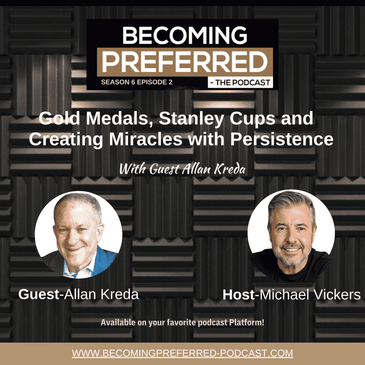
SEASON: 6 EPISODE: 2
Episode Overview:
Welcome back to Becoming Preferred, the podcast dedicated to uncovering the strategies that make entrepreneurs and professionals the emotional favorite in the markets they serve.
Today, we’re shifting our focus from the boardroom to the hockey rink, but the lessons remain intensely relevant. Our guest today is Allan Kreda, a seasoned journalist with nearly two decades covering finance and the NHL for giants like the Associated Press, the New York Times and Bloomberg News. Allan has mastered the art of extracting the core truth, whether from a quarterly earnings report or a locker room.
He’s here to talk about his latest project: the book, Ken Morrow: Miracle Gold, Four Stanley Cups, and a Lifetime of Islanders Hockey. Morrow is one of the most uniquely accomplished athletes in history, winning the Olympic 'Miracle on Ice' gold, and the Stanley Cup in the same year.
We aren't here just for hockey stories, though. Allan's journey from investigative journalist to co-author provides a blueprint for every professional. Join me for my conversation with Allan Kreda.
Guest Bio:
Allan is a storyteller, author, and speaker who deeply values empathy and connection. Specializing in biographical storytelling, he seeks to ask the right questions and attentively listen to his subjects in order to craft accurate and heartfelt stories that honor their experiences.
Growing up in Brooklyn in the 70s, Allan developed a strong passion for hockey. He fondly recalls attending New York Rangers games with his father and brother, witnessing legendary players like Jean Ratelle, Vic Hadfield, and Rod Gilbert taking the ice. This formative experience instilled in him a lifelong love for the sport and a commitment to sharing the stories of those who have dedicated their lives to the game.
Resource Links:
- Website: https://www.allankreda.com/
- Product Link: https://www.amazon.com/Ken-Morrow-Miracle-Lifetime-Islanders/dp/1637276435
Insight Gold Timestamps:
03:27 The professor at the time said, well, you've got to do something in the real world
04:51 I've always been about the long game, like long process, practice and process and incremental progress
07:58 What was the core compelling narrative gap that you identified that made this book a necessary project?
10:50 All he did is work at it, and quietly excel
11:22 That was 1980 with the Miracle on Ice
13:55 Memories vary
16:45 You can get involved with that story and then the lessons are learned
18:39 They might not always like it, but they can trust it
21:03 There's no limit to research
22:42 You started by listening, not interviewing
26:50 You kind of know when you have it, and you know when you don't quite have it
29:32 She was going through it with a different eye
31:30 If you're working with someone at a publishing house that's working with you, you're 80% there
32:06 It's like the endless term paper that never ends
34:44 Playing through pain, uncomplaining, and for the team
36:07 Always turning the page, always looking to the next game, thinking long term, not fearing losing
40:24 The perseverance sort of creates moments of happenstance
40:38 True success is really defined by compound persistence and consistency
41:17 The book is called Ken Morrow: Miracle Gold, Four Stanley Cups and a Lifetime of Islander Hockey
Connect Socially:
LinkedIn: https://www.linkedin.com/in/allan-kreda-6a73942/
Instagram: https://www.instagram.com/ajkreda
Email: akreda@gmail.com
Sponsors:
Rainmaker LeadGen Platform Demo: https://bookme.michaelvickers.com/lite/rainmaker-leadgen-platform-demo
Rainmaker Digital Solutions: https://www.rainmakerdigitalsolutions.com/
In 3, 2, 1.
Speaker BWelcome back to Becoming Preferred, the podcast dedicated to uncovering the strategies that make entrepreneurs and professionals the emotional favorite in the markets they serve.
Speaker BToday we are shifting our focus from the boardroom to the hockey rink, but the lessons remain intensely relevant.
Speaker BOur guest today is Alan Craita, a seasoned journalist with nearly two decades covering finance and the NHL for giants like the Associated Press, the New York Times, and Bloomberg News.
Speaker BAlan has mastered the art of extracting the core truth, whether from a quarterly earnings report or a locker room.
Speaker BHe's here to talk about his latest project, the book Ken Miracle Gold, Four Stanley Cups, and a Lifetime of Islander Hockey.
Speaker BMorrow is one of the most uniquely accomplished athletes in history, winning the Olympic Miracle on Ice Gold and the Stanley cup in the same year.
Speaker BWe aren't here just for hockey stories, though.
Speaker BAlan's journey from investigative journalist to co author provides a blueprint for every professional.
Speaker BJoin me now for my conversation with Alan Crada.
Speaker BWell, hi, Alan.
Speaker BWelcome to the program.
Speaker BWe're delighted to have you.
Speaker CHappy to be here.
Speaker CThank you.
Speaker BHey, I'm excited about this.
Speaker BYou and I have known each other and our wives for about 20 years.
Speaker BWe met on vacation.
Speaker CYes.
Speaker BAnd we've been in contact ever since.
Speaker BAnd I think it was around hockey, which was the part of this object we're going to talk about.
Speaker BAnd what does hockey have to do with business?
Speaker BAnd what are the lessons we learned from hockey?
Speaker BAnd what did we learn from your experience of writing the book?
Speaker BAnd what does it have to do with entrepreneurship and with business itself?
Speaker BAnd I think there's some excellent parallels that I can't wait to get into.
Speaker BBut we've gone back and forth and we talk about hockey.
Speaker BBut before we get there and unravel that a little bit and unpack it, let's talk about how we got here.
Speaker BYou're in high school and you're back in the 80s.
Speaker BI think you were just right around where the subject matter of this book actually took place.
Speaker BYou were probably in high school.
Speaker BAnd then I know you went to Brooklyn College and you went to Northwestern University, got a degree, and I believe you got your journalism degree.
Speaker BAnd that's where we started talking.
Speaker BSo hockey was the foundation of our relationship.
Speaker BAnd we've kind of.
Speaker BWe make sure we hit on that every time.
Speaker BAnd when we come to your great city in New York, we do have a chance to get together with you.
Speaker BSo that's always exciting.
Speaker BSo it's nice to have a friend and a specialist who can talk about this subject.
Speaker BSo welcome to the Program.
Speaker CThank you so much.
Speaker BNow, how do we get here?
Speaker BLet's go back to those high school days.
Speaker BYou're deciding what you want to be.
Speaker BYour mom and dad are going, hey, you, you're get out of the house and go do something.
Speaker BWhat did you pick?
Speaker BThe path you picked.
Speaker COh, wow.
Speaker CWell, in my case, I was a science and math major.
Speaker CI was all focused on numbers and pre med life.
Speaker CI went to a specialized high school in Manhattan.
Speaker CThere everyone was Pre Med.
Speaker CAt 14 years old, it was supersonic brain power.
Speaker CBut on the side, I was always watching the Rangers and the Islanders and all the hockey games I could while I was studying calculus and physics and organic chemistry.
Speaker CSo the hockey was driving me.
Speaker CMy brother, who's nine years older, was a Ranger fan, going back, way back to the early 70s.
Speaker CSo I. I became part of that world with him and wanted to follow him.
Speaker CBut I liked it for myself too.
Speaker CI liked the personalities, the people.
Speaker CYou go to a game back then, no helmets.
Speaker CYou got to see these guys playing.
Speaker CThe hair, the speed, the colors, everything about it got to me young age.
Speaker CSo it was entrenched in my brain and I never could have imagined I could turn this into a writing life.
Speaker CBut while I was at Brooklyn College, I took a news writing class and liked it, and then took a second class and liked it, feature writing.
Speaker CAnd then the professor at the time said, well, you got to do something in the real world.
Speaker CGo.
Speaker CThere's one internship we have that's sports related.
Speaker CThe hockey maven Stan Fischler has written more books than anyone in North America.
Speaker COver a hundred.
Speaker CHe always had interns coming and going from his uptown Manhattan office.
Speaker CSo there I was, 19 years old, part of the scene with him.
Speaker CHe's writing books, columns, magazine articles, you name it.
Speaker CAnd he's covering the Islanders for Sports Channel.
Speaker CSo at that young age, I was thrust into experiencing it firsthand in the locker room, getting quotes, talking to the players.
Speaker CTail end of the dynasty, the Islander dynasty, that time zone.
Speaker CI met Ken Morrow very shyly.
Speaker CI'm sure he was very quiet, so he probably traded nine words.
Speaker CBut it did happen somewhere in the 80s, mid-80s.
Speaker CAnd commensurate with that, of course, was what happened in 1980, Lake Placid, when the US hockey team shocked the world in one gold super underdog.
Speaker CAnd they beat the Soviets and they beat Finland.
Speaker CThey win the gold medal a thousand to one at best.
Speaker C14 years old watching this happen on a basically almost black and white, maybe early color TV in my parents living room.
Speaker CAnd magical occurrence Never in a thousand years would I have imagined that I could become part of the legacy story decades later.
Speaker CBut it had such an impact on me that I immersed in the background of these players and their stories and the people.
Speaker CSo to sort of double it up way down the road in my career, pretty amazing.
Speaker CBut I've always been about the long game, like long process, practice and process and incremental progress.
Speaker CAnd I think I was setting the seeds for it way back then in 1980, 81, 82, when I was secretly listening and watching every single hockey game on the side, preparing for this, because the research is in my head.
Speaker CIt's always been in my head.
Speaker CI love the 80s.
Speaker CIt was a simpler time in the world.
Speaker CAnd the games were magical.
Speaker CYou saw them once.
Speaker CThere was no VCR.
Speaker CThere was no way to rewatch things on YouTube.
Speaker CYou had to really study and analyze and know things and.
Speaker CYeah, old school, but younger old school.
Speaker CAnd so a lot of the amalgamation of this book is my education by immersion way back then.
Speaker CAnd.
Speaker CAnd then I shifted gears.
Speaker CI decided, no, with the medical career, I'm going to throw my head into the journalism ring all the way.
Speaker CAnd I'm passionate about it.
Speaker CI like it.
Speaker CI'm going to learn to be the best writer, communicator, listener, interviewer I can be and just take it from there.
Speaker CSo the hockey was the vehicle.
Speaker CThe hockey is what got me into it.
Speaker CI've had a long career writing, business, some politics, some legal, some features, some entertainment, but the sports was always the linchpin.
Speaker CHockey is where it started for me way back then, and hockey is where I am now.
Speaker CLast 10, 15 years have been totally concentrated on the game, running for the New York Times, running for the Associated Press now, where I started my career in the early 90s, and I'm still with them as a contracted writer today.
Speaker CSo full circle.
Speaker CBut it's almost like the circle started and never ended in a lot of ways.
Speaker BWell, you know, you start going back 45 years, you know, think, where did the time fly when I grew up with the original six.
Speaker BSo I was born in Montreal and then we moved to Toronto, so I was a Leafs fan more than I was the Habs fan.
Speaker BAnd of course, there's only six teams, but I had all the cards, had all the players.
Speaker BDave Keon, Norm Allman, Daryl Sitler used to watch the Canada Russia games.
Speaker BAnd I'm up in the Calgary studios up in Canada as we speak.
Speaker CRight.
Speaker BJust love the game and never really had a talent.
Speaker BSo put skates on and it was, that was, it was an embarrassment.
Speaker BSo I got to enjoy the game from a visual point of view.
Speaker BDid you play the game yourself?
Speaker CA little bit.
Speaker CThere was one rink in Manhattan, Sky Rink, which was on the highest floor of a office building in midtown Manhattan, a block down from Madison Square Garden.
Speaker CSo that was the place we played.
Speaker CThere was a midnight Sunday media game back in the day.
Speaker CSo somehow he'd play these games and 12 to 2am and get up and go to school or work the next day.
Speaker CI don't know how, but when you're 21, you can do these things.
Speaker CSo that was the extent of it.
Speaker CBut all the media guys from that era were playing.
Speaker CA lot of them were.
Speaker CI was one of the youngest and I always looked up to the veterans and to see them on the ice, it was neat.
Speaker BIt was amazing.
Speaker BThey always look like older guys and now I look at them, they look like young kids.
Speaker BRemember those days, the goalies, Terry Sage, they didn't wear masks.
Speaker BSome of them helmets weren't a thing.
Speaker BAnd they came to training camp and they were always.
Speaker BThat's when they got into shape.
Speaker BSo they were usually out of shape and smoking and drinking.
Speaker CExactly.
Speaker BCamp.
Speaker BAnd now you got to come in game shape to camp.
Speaker BSo it's changing.
Speaker BWe'll get into that.
Speaker BSo first question I have for you, you chose to write about Ken Morrow, a man whose achievements basically span the historic Miracle on Ice and the Islanders dynasty.
Speaker BFor our entrepreneurial audience, every great product or business starts with a clear why.
Speaker BSo what was the core compelling narrative gap that you identified that made this book a necessary project?
Speaker CI always had it in mind because I always knew of his double achieve achievement.
Speaker CTo win the gold medal is singular in its own right.
Speaker CAll the players from that team have had a life based on that moment, rightfully so.
Speaker CBut to follow it up with the Stanley cup in three months later and then win three more of them, basically, Ken Maher didn't lose between somewhere in the summer, spring of 1979 in college at Bowling Green, lost to Edmonton in 1984 Stanley cup finals.
Speaker CSo unbelievable five year run of winning.
Speaker CAnd to put the two together was always in my mind somewhere.
Speaker CI knew Ken through the years, through the Islander alumni.
Speaker CHe's been a scout forever for 30 plus years for them in the Midwest.
Speaker CSo I knew him, but didn't know him.
Speaker CAnd almost three years ago, the Islanders were going through their 50th anniversary season and the Hockey News asked me to write a feature just on as many guys as I could get to of the 16 who won all four cups, imagine that 16 players were part of all four, almost five cups.
Speaker CAnd in the course of the research for that, I reached out to Ken.
Speaker CI saw him.
Speaker CThe Islanders had a gathering of all the alumni at a game weekend, a weekend for the fans.
Speaker CAnd I said, hey, your story's amazing.
Speaker CThere's a book there.
Speaker CWhat do you think?
Speaker CHe's.
Speaker CMy kids have told me to do this already.
Speaker CIf you think it's a book, let's talk some more.
Speaker CI don't know.
Speaker CAll I really did was play my game hard.
Speaker CI was fortunate to have great teammates and great teams and great coaches, and we kept winning.
Speaker CBut I just did my job.
Speaker CThat's all I did.
Speaker CIf it's a book, that'd be great, but I don't know.
Speaker CAnd I said, I think it is.
Speaker CAnd I pitched it to a publisher that I had worked with, Triumph Books, and they loved the idea that said of marrying those two concepts in one person is amazing.
Speaker CNo one else can do it.
Speaker CAnd we went from there.
Speaker CI said to Ken, look, let's just start.
Speaker CWe'll tell stories about major games, events, winning moments.
Speaker CYeah, let's pick one cup run and just let's talk about it from the first game of the playoffs till the cup was raised.
Speaker CSo we picked 1983, fourth cup.
Speaker CAnd I said, you'll see.
Speaker CAs you start telling stories, you'll see critical mass in the interview is becoming pages, becoming longer, longer chapters.
Speaker CAnd it just goes from there, and we'll just build on each story.
Speaker CAnd that's what happened.
Speaker CThat just.
Speaker CI said, let's just treat each winning year as a chapter, each experience leading into the winning as a chapter.
Speaker CThe people, the teammates, the opponents.
Speaker CAnd then, yeah, I just had an idea and went with it and felt from the beginning it would work because I could tell the way he told the story, and it was compelling.
Speaker CAnd it's a singular focus that he had as a player that really comes across in his telling.
Speaker CAnd to me, like, we can all learn from his experiences because it's way beyond the game.
Speaker CHe's a winner.
Speaker CHe's a dedicated professional player.
Speaker CBut he played through pain, he played through adversity that all athletes face.
Speaker CHe had to find ways to get better.
Speaker CHe had to live up to the coach he was playing for.
Speaker CLike, there were a lot of challenges, but all he did is work at it and quietly excel to the point that I thought his story really matters because he won playing the game the right way, so to speak.
Speaker CAnd he had the respect of his teammates up and down the line.
Speaker CSo I knew that going in too.
Speaker CAnd I thought once we get telling the stories, it'll turn into something.
Speaker CSo I believe that it's before it existed.
Speaker BYeah, it's a perfect metaphor for life and business and people don't maybe if they remember those who were hockey fans.
Speaker BHe was one of the first players in hockey history to win an Olympic gold medal and the Stanley cup in the same year.
Speaker BThat was 1980 with the Miracle on Ice.
Speaker BAnd we've all seen the movie, just awesome movie.
Speaker BTheir dynasty, they won four consecutive cups, 80 through 83.
Speaker BTen years he played in the game, which is pretty good for a defenseman.
Speaker BHe wasn't a big scorer.
Speaker BI know he played 550 regular season games, but he only scored like 17 or 18 goals.
Speaker BI think he had just under 188 assists or something like that.
Speaker BBut his plus minus rating was good 142.
Speaker BAnd we can chat about that.
Speaker BBut basically he was just a quiet soldier, showed up all the time and did his job and a great team player.
Speaker BAnd I think there's lots.
Speaker BYou said a key word there.
Speaker BIt's about the focus and that it's the persistence and that consistency that makes great things happen.
Speaker BSo I think that there's powerful lessons there.
Speaker BLet's talk about Investigative journalism and book writing are exercises that require due diligence for sure.
Speaker BSo what systems did you put in place to verify those decades of anecdotes and ensure complete historical accuracy?
Speaker BAnd how does this process parallel the need for thorough risk assessment in launching any new venture?
Speaker CGreat question.
Speaker CI'm very meticulous with facts, figures, dates, numbers, goal scoring times.
Speaker CSo as we interviewed and talked out each game, I went over each box score myself.
Speaker CI went back and looked at them all.
Speaker CThey're all out there somehow, somewhere.
Speaker CSo I went right down to the the goal scorers in every one of the seven Olympic games that the US Team played.
Speaker CI went through all those Stanley cup final games the five years making sure that when it got to the fact checkers who were going to edit and read through everything, the numbers were already there.
Speaker CAnd try not to over number fight as well, not go crazy, but find enough key numbers and stats that could resonate tell the story as we went along.
Speaker CYeah, very meticulously making sure everything is right every time.
Speaker COf every goal I mentioned, every name was spelled correctly.
Speaker CYou know, moments in time that readers may have seen just the one time if they watched the 1980 US versus Czechoslovakia game.
Speaker CNo one's remembering who scored those goals.
Speaker CBut when you can find the game on YouTube, and there it is.
Speaker CSo with the research tools, you can easily get to.
Speaker CAnd then the literal hockey reference.com There are the box goes of every Stanley cup game, game by game.
Speaker CAnd I relied on memories of moments to elucidate further.
Speaker CIf there was a goal or a play, Ken talked about it, went back and got more details about that, looked up old newspaper clips, you know, research the old fashioned way, what was written about it, when it happened, what was some of the quotes that I could use and attribute at that time.
Speaker CI know I talked to his teammates about key moments, too.
Speaker CAnd memories vary.
Speaker CSome guys remember minute, moment, detail.
Speaker CJust remember they won the game by a certain score.
Speaker CYou know, the games blurred together, so it became a puzzle piece.
Speaker CBut I went in with, okay, I remember these games myself.
Speaker CI'm gonna go back and study the nuances.
Speaker CI'm gonna go back and look at the really small parts of the play that we can really flesh out into pages.
Speaker CYou know, what happened at the very end of the 1983 game four when the Islanders were trying to ice it with an empty neck goal.
Speaker CThe Oilers had the goalie pulled, and Gretzky almost scores, almost this, almost that.
Speaker CDennis Potvin tells me a story of how he overstated the puck, like, just a bit, just enough to be off balance.
Speaker CAnd there's Gretzky waiting.
Speaker CHe said, I still remember the fear of, oh, my, Gretzky's behind me.
Speaker CI'm not getting back.
Speaker CHe's gonna get the puck.
Speaker CAnd, like, he remembered the fear.
Speaker CAnd that.
Speaker CThat got me right away.
Speaker CLike, I'm putting that in.
Speaker CWe can all relate to that oh, moment.
Speaker CWhen that did happen, Ken Mara was backing up, and the puck wound up on his stick, and then in the empty net where Andy Moog was.
Speaker CSo I built it out.
Speaker CI built it out as I went through this.
Speaker BYou know, you get to live it, which.
Speaker CAnd I get to relive.
Speaker CAnd I remember watching these games.
Speaker COf course, you don't remember.
Speaker CYou see the moment.
Speaker CBut now I got to go in the weeds.
Speaker CAnd I did that over and over again with epic games.
Speaker CAnd it was just fun to the people I got to speak to.
Speaker CIn relation to Ken's story was the super bonus, because my editor at Triumph book said, sure, go ahead and build concentric circles as much as you can.
Speaker CTalk to everyone you can that played with him, against him, coaches, coaches, families.
Speaker CLike, people knew him, remembered him.
Speaker CLike, memories of things came rolling in, and I had to Stop at a certain point.
Speaker CI was close to 50 interviews beyond Ken Morrow, one way or another, either by phone, text, email, in person, the stories, random things would pop and that would lead me to three more ideas.
Speaker CSo it was great.
Speaker CSome of these Ranger players who could not beat the Islanders in the 80s, they lost every year.
Speaker CWhen Herb Brooks, the coach, Olympic coach, was coaching the Rangers, there was Ken Maher in their way.
Speaker C1982, 83, 84.
Speaker CAnd he scores in overtime in 1984.
Speaker CThere's a whole chapter on the epic game five, one of the most intense games you'll ever see in any cup run.
Speaker CAnd Ken Maura, incidentally, has the most overtime goals in the five years the Islanders went to the Stanley cup final.
Speaker CHe has three overtime goals in that five year span.
Speaker CMore than any other Islander, more than Bossy, more than Trache, more than Dennis Botvin.
Speaker CAmazing.
Speaker BAnd it's the stories.
Speaker BAnd people don't realize.
Speaker BThey see the book on a bookshelf and they go, oh, it's a hockey book.
Speaker BIt's all about this thing.
Speaker BAnd they think, hey, it doesn't work for them.
Speaker BThe business audience, though, entrepreneurs, people listening on the podcast.
Speaker BIt's a metaphor.
Speaker BLook at it as the metaphor of what?
Speaker BBecause we all go through it and you're actually getting instead of just a boring business book, you know, I won't say I write, but yeah, maybe it's a story.
Speaker BYou can get involved with that story and then the lessons are learned.
Speaker BIt's inspiring.
Speaker BSo I encourage people to read those and use it as the metaphor because they go through all the same things that we do as business professionals, entrepreneurs, whether we work for a corporation or we own our own?
Speaker BNow, you spent significant time interviewing Ken and others in a circle.
Speaker BYou mentioned about 50 of them.
Speaker BHow do you, as a journalist, establish that deep trust that's required to get an authentic, vulnerable narrative?
Speaker BAnd what lessons can our listeners apply to managing relationships with high value clients or strategic partners?
Speaker BSo you built trust quickly.
Speaker BHow did you get there?
Speaker CThat's a career long quest.
Speaker CI feel it's really important to establish yourself credibly, honestly.
Speaker CGenuine approach.
Speaker CI've done that all the way through and I feel like it comes across.
Speaker CThese guys can spot someone may not be as trustworthy as they'd hope and they know right away.
Speaker CAnd I know with the Olympians, I went out of my way to reach out to someone that does all the marketing and social media for the 1980 guys, because they're a different generation.
Speaker CThey're not social media crazy like Today's players.
Speaker CAnd I felt like I had to come at them very quietly, but honestly.
Speaker CSo she reached out on my behalf.
Speaker CI said, look, I want to call, talk about 1980, talk about Kenmar.
Speaker CI don't want them to get surprised with a call out of the blue.
Speaker CSo this is coming from.
Speaker CHere's some of my writing.
Speaker CThis is my approach.
Speaker CThis is going to be a very positive feel good story.
Speaker CBut I want to establish trust before I even speak to these guys.
Speaker CAnd yeah, I knew Mike Ruzzi through the years.
Speaker CI've written about him through time, reached out to him.
Speaker CSo I had something going in factor.
Speaker CAnd then I felt, once I get these guys in the phone and they know who I am and I start talking, they'll see where I'm coming from.
Speaker CAnd that's pretty much what happened over and over again.
Speaker CThey know I'm genuine and I'm.
Speaker BYou have some street credit.
Speaker CYes, exactly.
Speaker BWell, this will play off of that one.
Speaker BThat works.
Speaker BIt goes a long way.
Speaker BYou've got the credibility and authority.
Speaker CYeah.
Speaker BAnd you're telling it like it is.
Speaker BAnd when you report on the games, they might not always like it, but they can trust.
Speaker BIn other words, it's fair.
Speaker BYou're fair and trustworthy.
Speaker BI think that goes a long way, don't you?
Speaker CIt does.
Speaker CAnd if you listen well and these guys read something you write and respect it, they will talk to you after a tough loss.
Speaker CThey'll talk to you when things aren't great.
Speaker CThey'll.
Speaker CThey'll reach out to you if you reach out to them.
Speaker CSo I didn't get any pushback at all, but I wanted to establish right away, this is the storm.
Speaker CThis is a player you guys loved playing with.
Speaker CI'm trying to help him tell his legacy story.
Speaker CYeah, not a hit job.
Speaker CIt's.
Speaker CI'm not looking for negative stories.
Speaker CI don't need that.
Speaker CNo controversy necessarily.
Speaker CLike, this is all what it's supposed to be about.
Speaker CA winner.
Speaker CLife lessons.
Speaker CWhat really happened up to a point in the room before some games.
Speaker CWhat were you thinking?
Speaker CWhat were you thinking about something he did.
Speaker CSo, you know, there's some humor in there.
Speaker CThere's no need for the negative and there's no need to take advantage of someone's, you know, what happened 40 years ago in print today, like, what's to be gained by that?
Speaker CSo that's.
Speaker CI think that came across as well.
Speaker CAnd I knew these guys would be honest with me if I was honest with them.
Speaker CAnd to a man, they all were.
Speaker CIt was great.
Speaker CAnd I had fair questions I was curious about as a teenage fan back then and what was really happening.
Speaker CI've always been fascinated by Herb Brooks and what he brought to both the Olympic team and then the Rangers.
Speaker CI was in high school when he coached the Rangers and thought that was the greatest hire.
Speaker CAnd he was this brilliant coach.
Speaker CHe's gonna.
Speaker CThe Rangers are going to win the cup with this new age European or Soviet style and creativity.
Speaker CThey probably would have if not for the Islanders.
Speaker CBut fascinating intellectual coach.
Speaker CSo I had heard through the grapevine that some of the books written about the Olympic team, the Brooks family, wasn't really included or wasn't included enough or wasn't included accurately.
Speaker CAnd Herb, of course, died tragically in a car accident in 2003 at just age 66.
Speaker CSo I made it a point to reach out to his wife, his daughter and son.
Speaker CThose conversations were meaningful, and I wanted to hear what they were thinking in 1980 at Lake Placid, watching this unfold, and what they were also thinking when he coached in New York.
Speaker CSo I had two angles on that.
Speaker CI had Craig Patrick, who was the GM of the Rangers, who was the assistant GM in Lake Placid, two angles there.
Speaker CI had these players that played for Herb in New York, who were playing against him for Team Finland in Lake Placid, all these doubles.
Speaker CAnd only this story could put that all together in.
Speaker CIn the way I envisioned.
Speaker CSo I went deep.
Speaker CAnd I feel like there's no limit to research.
Speaker CLike, you can keep going and if you have too much, you pull it back a little bit.
Speaker CBut the more the merrier.
Speaker CAnd I just felt every nugget I can uncover is something a read might not know or might say, that's cool.
Speaker CLike, I Learned something about 1982 final with Vancouver Islanders.
Speaker CI didn't know before, and I didn't know that Game 3 in 1981 when the Islanders won 75 at the Met center, that the fans had these Dino Cicarelli dinosaur dolls, 30,000 of them or something.
Speaker CThe place was going bonkers.
Speaker CAnd Ken said it was the loudest road game I may have ever played.
Speaker CAnd if we had lost that game to them, who knows what happens?
Speaker CLike, they had the momentum if they won Game three and they didn't and we won in five.
Speaker CBut if they had won Game three, it would have been two one North Stars.
Speaker CAnd nobody remembers that series and was a pretty good series, but it got lost in the bigness of what they did.
Speaker CThe fans really remember in 1980 when they beat the Flyers on Bobby Nystrom's overtime goal at Nassau Coliseum.
Speaker CAnd they remember in 83 when they won the fourth one also at Nassau Coliseum to cement that on Ken Mara's empty net goal.
Speaker CActually, when we started talking about 83, the story that I knew we had the book, I knew it would work right then and there.
Speaker CThat chapter he told me when he scored in the empty net and he group hugged with Bob Nystrom, Tanelli, then Dennis Puffin joined, everyone joined, he said, I said I love you guys three or four times.
Speaker CThree or four times he's repeating it.
Speaker CAnd if you watch the YouTube, that's what you can see him saying it.
Speaker CAnd I relay that to the guys.
Speaker CThey all remembered it.
Speaker CThey're like, yep, yep, all true.
Speaker CLike, how can you beat that?
Speaker CThat's what we call the chapter I love you guys.
Speaker CAnd that's a life lesson right there.
Speaker BGreat job.
Speaker BWell, you know, and the big lesson that you said there, and it came through loud and clear, is you started by listening, not interviewing.
Speaker BAnd I think that's a lesson for business professionals, for sales professionals.
Speaker BWe get in there and we interview.
Speaker BWe interview our kids.
Speaker BHey, how was your day today?
Speaker BGood.
Speaker BWhat'd you do?
Speaker BNothing.
Speaker BInstead of listening to them and listening to people.
Speaker BSo that act of listening, it showed, first of all, you were invested in his legacy, not just a sensational headline.
Speaker BAnd that shows in business we can do that.
Speaker BShowing our partners to value their success as much as their own.
Speaker BWe want to deliver consistency, protect people's reputation fiercely and always follow through.
Speaker BAnd trust isn't given.
Speaker BIt's earned through repeated, reliable actions.
Speaker BAnd you obviously demonstrated that.
Speaker BNo, it's fabulous.
Speaker AAre you tired of chasing leads and ready to start effortlessly attracting more high value clients?
Speaker AIntroducing Rainmaker Lead Gen.
Speaker AThe ultimate sales, engagement and client acquisition platform that takes takes the stress out of outreach.
Speaker AWith Rainmaker Lead Gen, you can easily identify, engage, educate and convert your ideal prospects into loyal clients.
Speaker AOur industry leading automation and email sequencing empowers you to reach more ideal clients, accelerate the sales cycle and close more business.
Speaker AImagine authentically engaging with your prospects while the platform handles the heavy lifting.
Speaker ASay goodbye to the endless hustle and embrace a more efficient, effective approach to business development.
Speaker AReady to witness the magic?
Speaker ABook a 20 minute demo today and see how Rainmaker Lead Gen can revolutionize and level up your client acquisition game.
Speaker AThere's nothing to lose and everything to gain.
Speaker ADon't miss out on this opportunity to supercharge your client acquisition process.
Speaker AVisit rainmakerdigitalsolutions.com or check out the link in the show notes to book your demo Rainmaker Lead Gen Spend less time hunting for your ideal clients and more time having high value sales conversations with your ideal clients.
Speaker BAnd now back to my conversation with Alan Craita.
Speaker BEvery creative project hits a wall.
Speaker BA chapter that just doesn't flow, a source that won't talk.
Speaker BWhen facing writer's block or editorial setbacks, what specific strategy or ritual did you use to maintain forward momentum and treat maybe failure or hitting that wall as simply a temporary data point?
Speaker CGood, good question Again, usually when that happens, I'll put what I'm writing aside, come back to it later.
Speaker CDepends on how it's feeling at the time.
Speaker CWhen I wrote a lot of magazine articles, you hit small walls sometimes looking for the perfect segue or the perfect beginning or ending or not perfect but is what like you feel like you have to hit the mark.
Speaker CAnd sometimes I knew my ending or beginning when I started.
Speaker CI would almost write the ending first so I'd fill in the middles.
Speaker CBut writer's block's never really been something that's paralyzed me creatively.
Speaker CIt's more of.
Speaker CIt's not quite what I had in mind yet.
Speaker CSo it's more of reworking it but that putting it aside with some of the chapters here, I waited the game stories were easy enough to get to the heart of.
Speaker CIt's not non emotional basically it's relaying physical memory.
Speaker CBut when Ken got into some of his family background I felt like that needed more time, that needed more of a listening.
Speaker CLet's review this.
Speaker CIt should be exactly as you want to tell the story.
Speaker CHe lost his dad very young.
Speaker CLike I knew that would be an emotional retelling.
Speaker CAnd when we did that interview it was in person and I really took my time with that.
Speaker CSo it was more like careful, careful layering, making sure as he talked we'd get to more and also making sure he's rereading it back and in this case it's a co authored book.
Speaker CI told him right at the beginning is what you want it to be.
Speaker CIs what I want it to be.
Speaker CThis isn't what I think your story should be, it's what you think it should be.
Speaker BYou captured his voice and you helped him capture the.
Speaker CWhen I was got his voice I was able to yeah hook that pretty quickly and the pacing of his words and I felt like it's got to be in his words.
Speaker CBut so yeah, we'll rewrite and write this as many times as you feel necessary.
Speaker CSo in terms of the creative blocks, putting it aside, waiting, coming back to it, thinking of something else, maybe someone else's input, interviewing on the same topic again.
Speaker CEven you kind of know when you have it and you know when you don't quite have it.
Speaker CAnd I felt like most of this book, the chapters were, were getting there, but there was a lot of going back and going back and clarifying.
Speaker CTry not for repetition.
Speaker CIt's easy to get caught in that trap in a sports memoir because the stories really meld together.
Speaker CA lot of times they keep coming back to the same game or the same.
Speaker CSo even if we mentioned something three or four times, it was a different perspective.
Speaker CWe might have mentioned Mike Bossi's 50 goals and 50 games in three different places, but it had a different context.
Speaker CSo I was aware of that as we went through it.
Speaker CBut yeah, there are a lot of mini traps that aren't necessarily blocks, but they're more like you don't want the reader to say, oh, I heard that already.
Speaker CYou want them to flow through and not feel like they're being bombarded.
Speaker CSo I felt like my whole style as a writer, through my whole career though, has been easy to read clear.
Speaker CIt's my wire service training.
Speaker CI have from the beginning part of my career.
Speaker CGet to the point quickly, use good words, don't overdo it.
Speaker CTelling the story cleanly matters.
Speaker CIn a pre Twitter world.
Speaker CI'm doing it in a thousand or two thousand or three thousand words.
Speaker CBut you're building it out.
Speaker CIt's a painting, it's a puzzle.
Speaker CIt should come back to the theme you started with.
Speaker CIt's musical in a way, almost as a rhythm to the writing.
Speaker CSo I kept all that in mind.
Speaker BThere are times, because you got your day job and you're doing what you do to, you know, pay the bills.
Speaker CRight.
Speaker BAre there times in the day that you feel most creative?
Speaker BSo interviews you can do all day long, in the evenings, whatever, because you're recording them, capturing what you need to capture.
Speaker BBut when you're actually putting that down on paper and writing or there are times of the day where you personally, hey, it's your best time, you know you're going to get your best work at.
Speaker BLike, for me, it's early in the morning, I'm a 5am guy.
Speaker BBy 6 o', clock, I'm doing it for now, two hours tops, 90 minutes and then I'm done.
Speaker BMy brain's.
Speaker BI want to move on to something else.
Speaker BHow's that work for you?
Speaker BWhat's your process?
Speaker CI'm more Of a night owl late at night when it's quiet.
Speaker CIf I'm going through transcriptions, which is the hardest part of any brook project, is the transcribing.
Speaker CEven though you have otter and these New age things, they're great.
Speaker CBut I still did a lot of hands on listening back.
Speaker BThat wouldn't have been it.
Speaker CYeah.
Speaker CRe repeating.
Speaker CSo in terms of getting that all together late at night, a lot, believe it or not, before games, when I'm at an arena, have an hour here, an hour there.
Speaker CThat's when I feel most.
Speaker BYou're in the venue.
Speaker CLike I have some time.
Speaker CYeah, a lot of piecemeal hours.
Speaker CSummer is, like, harder because it's warmer.
Speaker CIt's not hockey season, you know, it's like the deadline's looming.
Speaker CThe big key part of this book, the huge key, was that my wife Claudia, was the editor for me, reading it separately for my reads, because after the third or fourth read, you just can't keep going over it.
Speaker BBlinded me out.
Speaker CShe was going through it with a different eye.
Speaker CShe didn't remember these games.
Speaker CShe remembered it much more vaguely than I did.
Speaker CShe was learning as she went.
Speaker CShe did know about the Olympic glory, but not on the extreme detail we were getting into.
Speaker CSo educational for her.
Speaker CSo she was interested enough to read it line by line.
Speaker CShe was great, really great with asking other questions, questions that I didn't even think of at times.
Speaker CSo she had a different perspective that, like, we teamed up really well.
Speaker CI had that bonus help.
Speaker BYeah.
Speaker CAnd she had great questions for Ken, too, that also once we would ask him one, would there be three more?
Speaker CSo between the two of us, the separate eyes major, because you get lost in it.
Speaker BWell.
Speaker BAnd your perspective is interesting, too.
Speaker BI know you from time to time when you're playing one of our teams where you'll send us pictures from the press box and that perspective, or if you're coming to our town and you're covering the team over the case, you've got a different look at it that most people wouldn't even know to look at or ask that question.
Speaker BSo I think that makes good sense.
Speaker BLet's talk about the publishing journey, because it's really about market strategy and distribution.
Speaker BTaking a manuscript to a published book requires a whole different skill set.
Speaker BYou're dealing with agents, publishers, marketing.
Speaker BHow did you structure your approach to the publishing world, and what parallel advice would you give an entrepreneur seeking investment or, say, a distribution deal?
Speaker CI had an idea that they wanted, so that was a huge, huge plus.
Speaker CThey gave me the freedom to structure it as I wish.
Speaker CBut we collaborated on the thought of it before we started.
Speaker CI really started putting it together.
Speaker CSo it was collaborative in the idea.
Speaker CThey liked it from the beginning.
Speaker CI had written a short outline, chapter outline, et cetera, synopsis.
Speaker CAnd we basically came up with the idea of like 15 to 20 chapter breakdowns.
Speaker CChronological.
Speaker CWorking in family, working in Olympics, working in islanders, working in post cups.
Speaker CSo the publisher was really helpful in terms of setting me up with an editor there who was outstanding copy editor and idea person.
Speaker CSo she helped the process immensely.
Speaker CThat's the best.
Speaker CA huge deciding factor.
Speaker CIf you're working with someone at a publishing house that's working with you, you're 80% there because it's a dialogue.
Speaker CI sent her a few chapters as we were working on it.
Speaker CIt's just what you had in mind.
Speaker CI felt like you can't just send 70, 000 word draft and say here it is.
Speaker CThere's got to be progression with the deadlines looming.
Speaker CAnd I'm really good with deadlines.
Speaker CBut it gets harder as you get down to it.
Speaker CBeing that this book was a collaboration, it was me writing, Ken, reading us editing together.
Speaker CThere was a lot of back and forth before.
Speaker CSo we.
Speaker CChapter at a time, chapter at a time, chapter at a time to build it to the draft, when you finally hit the button is a lot.
Speaker CIt's like the endless term paper that never ends.
Speaker BYeah, yeah, exactly.
Speaker BAnd I'm always doing my homework the night before guy.
Speaker BSo dead are terrible for me.
Speaker BBut I've had to learn to develop the habit of going the other way.
Speaker BYou know, Ken Morrow was known for his quite consistent approach to the game.
Speaker BHow did this style of leadership, you know, one based on performance, not, let's call it volume, contribute to his team's long term success?
Speaker BAnd what could a CEO or a leader learn from that approach?
Speaker BI mean, he embodied substance over sizzle, Right.
Speaker BSo his leadership was really defined by reliability.
Speaker BHe wasn't allowed his voice, but he was always the first to execute a difficult play.
Speaker CRight.
Speaker BHow can we adapt that into the business world?
Speaker CDoing a job the right way, not complaining, just team first.
Speaker CHe listened to his teammates.
Speaker CHis goalies loved him because as big as he was, he didn't screen them.
Speaker CHe just pushed forwards to the outside.
Speaker CHe didn't let them get in the lanes at all.
Speaker CLike Billy Smith, who would say something if defenseman was giving him problems.
Speaker CLoved Ken Mara because most every shot was he could see it.
Speaker CAnd Ken knew that.
Speaker CHe knew the people around him.
Speaker CHe played he didn't take bad penalties.
Speaker CHe used his huge reach cleanly.
Speaker CA lot of guys said it was like playing against the grapevine because he was just doing anything and he didn't.
Speaker CBut he didn't take the penalties.
Speaker CSo frustrating as could be for his opponents who never quite figured out.
Speaker CGuys on the Olympic team said they hated going against him in practice because it was impossible.
Speaker CAnd he just.
Speaker CThis is what Herb Brooks saw when he saw this huge defenseman playing for Bowling Green who he had to have on his team.
Speaker CSo there's a lesson in just being that sort of indispensable, important defensive defenseman which every winning team needs.
Speaker CPlayed it smart.
Speaker CHe allowed an offensive partner to do his thing, if that were possible.
Speaker CHe made goalies lives easier.
Speaker CHe didn't have to physically dominate, but he was big enough to clear space, clear the middle of the ice, clear the crease.
Speaker CAnd then on top of all that, he scored big goals at key times.
Speaker CFound him.
Speaker CHe's out there on the power play randomly in the playoffs.
Speaker CHe's out there scoring overtime goals with Pot Van Gillies, Nystrom, Trache Basia, on the ice with Kamara.
Speaker CSo he found ways to be important beyond the theoretical defensive defenseman.
Speaker CAnd he just said, all I did is play my game.
Speaker CI didn't feel like I was doing anything super special.
Speaker CI think there's a lot to be said for that.
Speaker BI think a lot of leaders learn from that as well.
Speaker CWork hard and do the right thing every day.
Speaker CHe played hurt.
Speaker CHe got hurt early in the playoff run in 1980.
Speaker CHis knees had multiple knee operations.
Speaker CNever, never complained.
Speaker CAnd later in his career, he had to have his knee drained before games.
Speaker CNeedles in the locker room, never complained.
Speaker CThe guys marveled at this.
Speaker CHear about it, it hurts.
Speaker CSo I mean, playing through pain, uncomplaining.
Speaker CAnd for the team, for the team.
Speaker CIt was always for the team.
Speaker CHe also learned from his coaches.
Speaker CHe had three tremendous coaches in his life.
Speaker CRon Mason, Bowling Green, one of the winningest U.S. college coaches, the great Herb Brooks.
Speaker CAnd then Al Arbour with the Islanders.
Speaker CTeacher, mentor, father figure, respected him immensely.
Speaker CIt was a two way street.
Speaker CBoth Herb Brooks and Al Arbour let Kenmar keep his beard, which was super sign of respect because no one else did.
Speaker CAnd the line with the joke was that Kenny came, joined Olympic team with the beard and her books said, okay, you can keep it if you started out with it.
Speaker CAnd Al Arbour something similar.
Speaker CHe called Kenny Moses with the beard.
Speaker CAs an Islander, his teammates called him Wolfman.
Speaker CAnd the beard became A lucky charm, a rallying point.
Speaker CAnd it was right around that time that the Islanders started growing the beard as a team.
Speaker CIn the 80s.
Speaker CThat's what led to today's trend of playoff beard.
Speaker BDid a lot of beards irritating because it makes you a little cranky and stuff, so that makes you irritable, and that goes a long way in hockey.
Speaker BLet's talk about the resilience and learning from failure in sports and business, because it's all about resilience.
Speaker BSo the world of professional kids defined by setbacks, missed shots, tough losses.
Speaker BWhat did Ken's experiences teach you?
Speaker BAbout how high achievers mentally process and quickly recover from defeat, which is a vital skill for entrepreneurs who face inevitable failures.
Speaker CAlways turning the page, always looking to the next game, thinking long term, not fearing losing.
Speaker CIt came across in his case, there were these moments where the dynasty could have been upended easily.
Speaker CGame here, game there, bounce here, bounce there.
Speaker CAnd he was marveling at how, wow, we were just fortunate.
Speaker CWe won big games at big times and.
Speaker CBut we never thought about losing.
Speaker CThe Stanley cup was ours until someone took it from us.
Speaker CIt was a possession game for them.
Speaker CAnd as hard as it was to win the first one, they weren't giving it up so quickly.
Speaker CSo the losing, you know, the long season, the pacing through the 80 games every year and getting back to the playoffs and defending and.
Speaker CYeah, it was the same with the Olympic team.
Speaker CThey faced adversity.
Speaker CThey fell behind in six of the seven games at Lake Placid.
Speaker CThey had to find ways to win these games under extreme pressure.
Speaker CAnd they had been through the ringer.
Speaker CPlaying 61 games as a US national team before the Olympics.
Speaker CUnprecedented.
Speaker CYou would never have that in today's world, have a team play that a whole season, basically, for stipends for their country, risking injury.
Speaker CRisking.
Speaker BExactly.
Speaker BWell, he definitely had an unwavering focus on process over outcome.
Speaker BAnd they always had impossible situations, but they never lost faith in their system.
Speaker CRight.
Speaker BTheir commitment to that next shift, the next game.
Speaker BSo that means, you know, things fail for us.
Speaker BBut keep focusing on the process if you've got a winning process, because it kind of works out.
Speaker BKen Morrow's story is framed as a lifetime of hockey for our listeners who are building their own preferred legacy.
Speaker BWhat's the single most important lesson from Ken Morrow's journey about what truly defines a successful, enduring career in your mind?
Speaker CIt's the perseverance.
Speaker CIt's the perseverance that he employed and has continued to employ professionally.
Speaker CHe's not only played for the islanders for those 10 years, not only won the gold medal and played four years of college hockey before that.
Speaker CHe was drafted by The Islanders in 1976.
Speaker CHe has been a scout for them since the early 90s.
Speaker CSo it's 30 plus years of dedicated service to the organization.
Speaker CSince his playing career ended in 2026, it'll be 50 years that he's an Islander, essentially.
Speaker CSo talk about perseverance.
Speaker CThat is a monument to that, that anyone can respect.
Speaker C50 years, basically with the same organization, essentially four years of college and then he signed with them in 1980, but he's been part of them since.
Speaker CJimmy Dano, the super scout, discovered him in the winter of 1975 as a college player because he randomly went to a game in Toronto to see a college player that he'd heard about playing at Toronto school, sees this guy, notice him, writes his name down as drafts in fourth round in 76.
Speaker CSo moments that are connected, like the randomness, the random atoms of our lives that come together and even can learn stories about that, that draft legacy, how it all came together, he didn't even know.
Speaker CSo the perseverance is what's most impressive.
Speaker CI did ask him early in the process, is that when you were playing for the Olympic team, when you were going to Lake Placid, were you ever worried about getting hurt or something going wrong?
Speaker CYou would never have a professional career.
Speaker CIt's like it never entered my mind.
Speaker CI was going to graduate from college, get my degree, four years.
Speaker CI was going to play for my country, give my all, get to the Olympics, dream come true, and then worry about the pro career.
Speaker CSo amazing that, yeah, that's the focus.
Speaker CAnd then he joins this team that needed a jolt.
Speaker CThe Islanders needed something special in the latter stage of 79, 80, the year before the Rangers had upset them in the playoffs was an epic moment when you're 14 in New York City.
Speaker CAnd the Rangers beat them when they had the best record.
Speaker CShocking.
Speaker CBut the Islanders found a way.
Speaker CThey had multiple disappointments in the late 70s playoff year after year.
Speaker CThey needed something.
Speaker CThey had.
Speaker CThey got Kenmar.
Speaker CThey were able to then trade for Butch Goring.
Speaker CAnd Butch Goring became the catalyst that helped them to that first and four Cups.
Speaker CThey also acquired Gord Lane during that that season.
Speaker CSo they made these moves, but if they didn't have Ken Mara in to inject, the second move wouldn't have happened.
Speaker CIf the second doesn't happen, maybe they don't win.
Speaker CAnd then he scores an overtime goal in game three in Los Angeles in the opening round of a very tight short best of five again.
Speaker CTied one one.
Speaker CThey a crazy game.
Speaker CThey won four three at the Forum, the Kings had the Triple Crown line with Dion Simmer and Dave Taylor.
Speaker CIf they found a way, they might have won that series in four.
Speaker CThere's no dynasty.
Speaker CThe honors maybe break it up.
Speaker CSo the perseverance sort of creates moments of happenstance that aren't accidents.
Speaker CMaybe that's what comes through with his.
Speaker BTelling loud and clear.
Speaker BI think that's one of really the key takeaways of the book, you know, for me and going through doing our research for our episode, is that the true success is really defined by compound persistence and consistency.
Speaker BAnd Ken Morrow, he just wasn't a sudden superstar, but he was consistent, a reliable force over two decades of playing the game, 10 years professionally.
Speaker BHis legacy isn't one particular spectacular moment, but it's that compounding effect of showing up, doing the work, maintaining integrity every day.
Speaker BAnd for entrepreneurs, our legacy isn't going to be one deal.
Speaker BFor business people, it's not going to be one thing.
Speaker BIt will be the sum total of our daily habits, our ethical decisions, and the consistent persistent value that we deliver to the people we serve.
Speaker BSo I think that comes loud and clear and I think you capture it well.
Speaker BAnd the story is excellent.
Speaker BThe book is called Ken Morrow Miracle Gold, Four Stanley Cups and a Lifetime of Islander Hockey.
Speaker BSo whether you're a hockey fan or not, but if you're a fan of business and you're a fan of taking your game to the next level, lots of good gems in there.
Speaker CThen the paperbacks on Amazon and now it's some updates about the draft lottery that the Islanders one thanks to Ken Mara in May, early May now bringing Matthew Schaefer to their ranks.
Speaker CAnd we also did go to Lake Placid to sign some books where it happened on Main Street.
Speaker CFabulous.
Speaker CAnd we were reminded.
Speaker CHe reminded me.
Speaker CAnd then you hear it as they play the clip of the countdown.
Speaker CMara to silk.
Speaker CYou've got 10 seconds.
Speaker CHis name is in every clip of the countdown.
Speaker CSo here's his quiet, unassuming defenseman whose name pops up in the consciousness of, of everyone watching and hearing about this.
Speaker CAnd then of course, the movie Miracle in 2004 with Kurt Russell as Herb Brooks, brought it to a whole new generation.
Speaker CSo we've learned that in the course of the book, the events and the signings that young fans really respond to his story because they know it from the movie.
Speaker CAnd it's a thrill through 20 something great movie.
Speaker BAn Olympian well done Alan.
Speaker BGreat job.
Speaker BThanks for sharing the story with us and thanks on our show.
Speaker CYou're welcome.
Speaker BLook forward to next time we get to catch up.
Speaker CAbsolutely.
Speaker CThank you so much.
Speaker BAs you are listening to this episode, what is one idea that you've heard that's caught your attention and why does it matter so much to you?
Speaker BAnd who is one person who you can share that with, either sharing this episode or just sharing that insight that occurred to you while you were listening?
Speaker BPerhaps it is how high achievers mentally process and quickly recover from defeat, which is a vital skill for any entrepreneur.
Speaker BOr how your legacy won't be the one major deal, it will be the sum total of your daily habits, ethical decisions, and a consistent value you deliver to your network.
Speaker BThank you for listening, for learning, and for investing in yourself so that you can become the best version of you.
Speaker BIf you found value in this episode, please write a review on Apple Podcasts.
Speaker BIf you haven't subscribed yet, please do so so that you can get a new episode and start your week off right every Monday.
Speaker BUntil next time.
Speaker BThis podcast is created and associated with Summit Media.
Speaker BMy Executive producer is Beth Smith and Director of Research Tori Smith.
Speaker BThe fee for the show is that you share it with friends when you find something useful or interesting.
Speaker BThis podcast is subject to copyright by Summit Media.
Speaker BGoodbye.