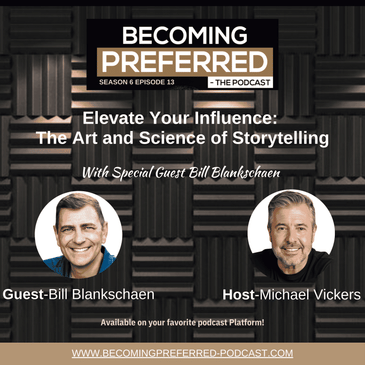
SEASON: 6 EPISODE: 13
Episode Overview:
Welcome back to Becoming Preferred, the podcast dedicated to helping you move from being an option to being the preferred choice in your industry.
If you’re an entrepreneur, a leader, or a professional, you know the market is saturated. The only thing that truly differentiates you isn't your product; it’s your story. How clearly you tell it determines your entire ceiling for growth. That’s why I am thrilled to welcome a man who is the master architect behind some of the world's most influential narratives. Our guest today is Bill Blankschaen, the founder and Chief Story Architect of StoryBuilders.
Bill is a New York Times Bestselling writer, and his work impacts millions. His client roster reads like a masterclass in influence: we’re talking John C. Maxwell, Kevin Harrington from Shark Tank, Michael Hyatt, Zig Ziglar's family, and countless corporate leaders and successful business coaches. They all go to Bill to refine the single most valuable asset they have: their narrative.
Bill and his team craft books and learning experiences that turn ideas into greater impact, greater influence, and significantly greater income.
He’s here today to discuss the roadmap laid out in his new book, Your Story Advantage: A Proven Path to Maximize Your Impact, Influence, & Income. Join me for my conversation with Bill Blankschaen.
Guest Bio:
Bill is the founder and Chief Story Architect of StoryBuilders, a creative team of storytellers who share his passion for helping people live a story worth telling and serving them with excellence in genuine, high-trust relationships.
StoryBuilders tells stories that make the world a better place by creating compelling books and learning experiences that turn ideas into greater impact, influence, and income.
A New York Times Bestselling writer, Bill and his team work with a variety of influencers like John C. Maxwell and Maxwell Leadership, Kevin Harrington from Shark Tank, Lewis Howes, Michael Hyatt (Full Focus), Rory and AJ Vaden, Zig Ziglar and family, Jeff Allen, Stu McLaren, entrepreneurs, corporate leaders, business coaches and consultants, political figures, cultural voices, athletes, comedians, fitness gurus, psychologists, and even faith leaders at some of the largest churches in America.
The books, resources, and experiences they have created have already impacted millions of people—and they’re just getting started!
Resource Links:
- Website: https://mystorybuilders.com/
- Product Link: https://amzn.to/47JMfiy
Insight Gold Timestamps:
02:27 I can sit down and blow through a book in a matter of hours
04:49 Your breakthrough begins when you start with your story
07:02 That's why I like to lean into what I created called the storytelling structure
08:45 Your message, whatever it is that you're sharing, is about you, but it is not for you
10:10 We like to say that we tell stories that make the world a better place
10:40 As I like to say, if you want to elevate, you have to collaborate
12:59 I call it the confidence trap
16:48 Once you get clarity, then develop it out, and then monetize it from there
18:21 The amount of information in the world is doubling every day now
20:44 What's a typical, average process?
22:23 We believe every story matters, and every story is different and unique
23:41 The very first question I ask any of these people that we work with when it comes to creating a book...
26:11 We have 6 book starter questions
30:37 Every story is unique, every story is different
33:04 Is it the beginning of an idea or has it actually been fully developed?
36:10 mystorybuilders.com/story
36:25 The book is called Your Story Advantage
37:46 I'm strategically at my best when I'm creatively, questioning, connecting and then communicating in the context of my beliefs
LinkedIn: https://www.linkedin.com/in/billblankschaen/
Facebook: https://www.facebook.com/thestorybuilders/
YouTube: https://www.youtube.com/@mystorybuilder
Instagram: https://www.instagram.com/my_storybuilders/
Email: bill@mystorybuilders.com
Sponsors:
Rainmaker LeadGen Platform Demo: https://calendar.summit-learning.com/widget/booking/JKItVP7WErmCBjU2cCIx
Rainmaker Digital Solutions: https://www.rainmakerdigitalsolutions.com/
In 3, 2, 1.
Speaker BWelcome back to Becoming Preferred, the podcast dedicated to helping you move from being an option to being the preferred choice in your industry.
Speaker BIf you're an entrepreneur, a leader, or a professional, you know the market is saturated.
Speaker BThe only thing that truly differentiates you isn't your product, it's your story.
Speaker BHow clearly you tell it determines your entire ceiling for growth.
Speaker BThat's why I'm thrilled to welcome a man who is a master architect behind some of the world's most influential narratives.
Speaker BOur guest today is Bill Blankshin, the founder and chief story architect of Story Builders.
Speaker BBill is a New York Times best selling writer and his work impacts millions.
Speaker BHis client roster reads like a master class in influence.
Speaker BWe're talking John C. Maxwell, Kevin Harrington from Shark Tank, Michael Hyatt, Zig Ziglar's family, and countless corporate leaders and successful business coaches.
Speaker BThey all go to Bill to refine the single most valuable asset they have, their narrative.
Speaker BBill and his team craft books and learning experiences that turn ideas into greater impact, greater influence, and significantly greater income.
Speaker BHe's here today to discuss the roadmap laid out in his new book, you, Story A Proven Path to Maximize youe Impact, Influence and Income.
Speaker BJoin me now for my conversation with Bill Blankschen.
Speaker BWell, hi, Bill.
Speaker BWelcome to the program.
Speaker BWe're delighted to have you.
Speaker AGlad to be here, Michael.
Speaker ALooking forward to talking to you about story and all the power that comes with that.
Speaker BI'm excited about that because at the end of the day, I think that's what it is.
Speaker BI think the best product or service doesn't win the day.
Speaker BI think it's the best story that wins and too often we lose sight of that.
Speaker BSo we're going to dive right into that and get into all those basic.
Speaker BBecause there's lots I need to learn on here and I know our listeners as well.
Speaker BHey, before we get there, our audience always likes to know, first of all, where you at?
Speaker BWhere's home right now?
Speaker BAnd then how did Bill become Bill?
Speaker BSo you're back in high school.
Speaker BI think you were living, you know, close to the Canadian border or the Great Lakes somewhere.
Speaker AExactly.
Speaker BLet's start there and where you ended up and how you chose.
Speaker AWell, if I'm starting back at high school, you know, when I was a teenager, I always loved stories.
Speaker AI love telling stories.
Speaker AI love reading stories.
Speaker AI was the kid who like soaked up everything on the cereal box as I ate my breakfast every morning, spinning it around, reading it non stop.
Speaker AAnd then I realized as I got older that I was the Kid that soaked up book.
Speaker AYou know, you and I were talking before the show about some book series that we love.
Speaker AI mean, I can sit down and blow through a book in a matter of hours and it's done right.
Speaker AAnd I always thought that was normal for everybody, but I didn't realize I was kind of tapping into a bit of my own superpowers when I was doing that.
Speaker AAnd over the years, I ended up helping to start a private school up in Northeast Ohio on Lake Erie and led that for a dozen years.
Speaker ABut inside I always felt like there was this deeper calling around story for me of.
Speaker ABecause I always thought of myself as a writer, but I realized I wasn't writing.
Speaker AAnd I thought of myself as a storyteller, but I wasn't really telling stories.
Speaker AAnd so eventually there came a time where even though I was doing good work at the school and helping people, I felt like somebody else could do that.
Speaker AOnly I could fulfill that sense of calling within my own life.
Speaker ASo we stepped out away from the school, left that in other capable hands and stepped out in this direction to really become a storyteller, to become a writer.
Speaker AAnd Michael, I gotta tell you, I never worked harder in my life at that time.
Speaker AWe had six kids at the time when we did that, that.
Speaker ASo it's not the path I recommend everyone take.
Speaker BLet's just say I think I actually took that path.
Speaker BWe have seven.
Speaker AOh, okay.
Speaker AThere you go.
Speaker BThe same club?
Speaker AYeah.
Speaker AOh, absolutely.
Speaker AWell, I mean, I dove into it.
Speaker AI just became a student of the art and science of storytelling.
Speaker AJust that was my full time job, talking to everybody in the publishing space and the book space and creating book proposals, shopping them to publishers, getting feedback, all that whole thing.
Speaker ABut as it wasn't easy, I remember a day, I was sitting out in the backyard one day, Ohio, spring weather, beautiful day, sun shining, birds chirping.
Speaker AIt's just, you know, me and my pen and my paper trying to write.
Speaker ABut on the inside I was just wrestling with the deepest fears of what if this doesn't work?
Speaker AWhat if we end up sleeping under cardboard box under a freeway somewhere, all that stuff.
Speaker ABut I kept moving forward.
Speaker AAnd actually the book I was working on that day ended up being picked up by a publisher.
Speaker AAnd I wrote the book.
Speaker AAnd I realized I'm actually really good at this.
Speaker AAnd then other people began to ask me, hey, can you help me with my book?
Speaker ACan you help create this book?
Speaker AAnd began to help others and realized that this kind of team coalesced around this.
Speaker AAnd out of that came Our company, Storybook Builders, where that's what we do.
Speaker AWe tell stories, we build stories that make the world a better place.
Speaker AAnd so we've had the privilege of going on to help people like John Maxwell and Zig Ziglar and Michael Hyatt and Lewis Howes and all these others.
Speaker AAt the same time, hundreds of other people you haven't heard of yet who are building things and putting things together.
Speaker ABut here's my big takeaway that I learned from all that.
Speaker AQuite frankly, Michael, it was your breakthrough begins when you start with your story.
Speaker AWhen you get intentional about leaning into your story and living that out in an intentional way that's authentic to you.
Speaker AThat' where a lot of the power comes from to do what you've been specially gifted to do on this earth.
Speaker AAnd so that was certainly true for me, and I've seen that true for so many others, whether entrepreneurs or thought leaders or people who are trying to build something, have a meaningful message that they want to share with the world.
Speaker AThat's where it begins, starting with your story.
Speaker BSo you mentioned that it's both art and science.
Speaker BUnpack that little bit, because I agree with you.
Speaker BI think it is the art part.
Speaker BWhat does that look like?
Speaker BAnd then about the science and why storytelling is so effective.
Speaker BCan you address both of those issues?
Speaker AYeah, let me start with the last one first.
Speaker AWhy it's so effective.
Speaker AI think we're wired into kind of our DNA of humanity to gravitate toward or be drawn towards stories, like, throughout our history.
Speaker AI mean, most of our history comes from storytelling.
Speaker AThat way, you know, anything that took place.
Speaker AAnd so that's really where it is.
Speaker AWe're kind of wired to lean into that.
Speaker AAnd so when you think about the art and the science, what I mean by that, you know, if you think about the Walt Disney films, classics like Snow White or Pinocchio or more recent ones, even like Beauty and the Beast or Moana or Frozen or things like that.
Speaker AEach one of those.
Speaker AWhat Walt Disney did there was.
Speaker AHe understood there's both an art and a science.
Speaker AAnd what he did was he found stories that were already proven to resonate with people and then modified them, adjusted them to feel fresh to people.
Speaker ASo it was this combination of familiar and fresh.
Speaker AAnd that was where the art came in.
Speaker ABut the proven process was in the storytelling technique.
Speaker AAnd so he took that proven process, adapted it a bit to make it his own, freshened it up for people.
Speaker ABecause what I have found is that people want to see that a story feels a sense of Familiarity with it, but also isn't just the same.
Speaker AI call it the connection continuum.
Speaker AThat is just like this.
Speaker AThere's this scale that we look at.
Speaker AIf it's too fresh, it feels disconnected.
Speaker ALike we can't even connect with that.
Speaker AIt's just so out there.
Speaker ABut if it's too familiar, it feels like duplication.
Speaker AI've heard that story so many times that I'm not interested.
Speaker ABut somewhere in the middle, right?
Speaker AA mix of both of those is where it comes together.
Speaker AAnd so that's why I like to lean into what I created called the storytelling structure that just taps into these really deep currents and trends and storytelling techniques and just simplifies it in a way that we can all apply it and make a use of it.
Speaker ABecause I remember somebody gave me a book at one point, it was like a 250, 300 page book.
Speaker AIt was big, it was eight and a half by 11.
Speaker AIt was massive.
Speaker AIt was like, here's how to tell stories.
Speaker AAnd I got to tell you, I'm a reader and I never read that book.
Speaker AI started, I tried.
Speaker AIt's like, this is just way too complicated to put this together.
Speaker AWhy can't we just.
Speaker AAnd over time, I kind of developed that, that simplified way of telling stories that anybody can tap into.
Speaker BWell, it's interesting you say that when, you know, raising large families, like is, hey guys, go get your pajamas on.
Speaker BDaddy's going to tell you a story.
Speaker BThey go do it.
Speaker BOr if I walk into an office, guys, I got to tell you, this story happened today.
Speaker BPeople stop, they want to listen to it.
Speaker ATune in.
Speaker BYeah, that up.
Speaker BRight.
Speaker BAnd with the story, what's interesting is if you look at a lot of TV shows, a lot of movies, there seems to be that same.
Speaker BThis hero's journey, a lot of them are just based on that journey.
Speaker ASure.
Speaker BI think it looks like it appears to me through your process that really you've brought that hero's journey into your framework.
Speaker BSo that when I'm telling my story that we start with our problem that you've got all those characters.
Speaker BIs that an accurate.
Speaker AYeah, I think anybody that is going to give a good rendition of how do you tell a good story, it's going to feel very familiar.
Speaker ARight.
Speaker ABut you also have to have a fresh approach, which is literally what we just talked about.
Speaker ARight.
Speaker ASo that's what I've really done, is tap into that.
Speaker AAnd it's a five part structure that certainly includes the problem.
Speaker ABut here's at the heart of it, the heart of this structure is really about this.
Speaker AIt's about turning around the storytelling and realizing that your story, your message, whatever it is that you're sharing is about you, but it is not for you.
Speaker AAnd so flipping that around and thinking, who is my audience?
Speaker AWhat do they want?
Speaker AWhat are the challenges that they're facing?
Speaker AHow do I connect with them?
Speaker AAnd then I can share what I want to share.
Speaker BHere's how this might help transform you.
Speaker AExactly, exactly.
Speaker AAnd most people, you know, most leaders, like, say they walk in the office and say, I have a message to share.
Speaker AI'm just going to blurt out my message and let it fall where it falls.
Speaker BRight.
Speaker AAnd so even in a book, I've seen that before, where people do the same thing, where they're trying to create a book, that this is what I want to say and I'm just going to dump it all out on paper without giving any thought to what's the reader's experience?
Speaker AWhere are they coming from?
Speaker AWhat do they need?
Speaker AWho am I talking to?
Speaker AYou know, I, I once worked with a US Congressperson who told me at the outset, I, I said, who's this book for?
Speaker AAnd he said, oh, this book is for every American.
Speaker AEvery American needs to read this.
Speaker AWell, that's a problem because, you know, especially if a congressman is telling you this is for everybody, most people are going to back slowly away.
Speaker BWhatever they're saying, whatever they're saying, it's pretty much okay.
Speaker BI, I, I'm sure it'll make a great fiction.
Speaker BWhatever it, yeah, no, I get that would make sense.
Speaker BYour company is called Story Builders, and your mission seems to center on really helping people live a story worth telling.
Speaker BSo for our business and professional entrepreneurial audience, how do you define a story worth telling in the context of a professional's brand and business strategy?
Speaker AYeah, we like to say that we tell stories that make the world a better place.
Speaker BYeah.
Speaker AAnd so when you think about that, it really is about, you know, can to the weed.
Speaker AWe don't work with everybody.
Speaker AWe're looking to work with people who have some level of vision for how is what I'm doing helping other people that have that kind of service mindset or making that the world better as a result of it.
Speaker ABecause the big issue is alignment.
Speaker AYou want to work with people with whom you align, whether it's values and approach to the world and all those kind of things.
Speaker AAt the same time, you have to work with people because as I like to say, if you want to elevate, you have to collaborate.
Speaker ASo if you want to break through to the next level, you've got to work with people, you got to make sure those people are aligned with you.
Speaker AOtherwise you're going to get frustrated, you're going to lose all sorts of resources and time and energy trying to make all that happen.
Speaker AAnd you're ultimately going to end up with an inferior service or product, whatever that is, because those people are just not as passionate about it as you are.
Speaker ASo you got to make sure all those things align.
Speaker ABut when they do, then it really is about, you know, I think each of us has been given what I call a meaningful message.
Speaker ASome of us, many meaningful messages that we can share with the world.
Speaker AAnd when we do it well, we can maximize that impact, that we have, the influence we have, the income that we make as a result of it.
Speaker AI think it really begins with, actually it sounds altruistic, but at the same time, I think it's necessary to fuel, to sustain the drive that we have as entrepreneurs in order to do something.
Speaker AAnd that is, we're actually making a positive difference.
Speaker BWell, and I think your talk about this is that the story isn't centered on you.
Speaker BSo you've clearly defined that you're facilitating it for that particular client.
Speaker BIt's got to be authentic, it's got to be clear, it's got to be compelling enough to build this high trust relationship.
Speaker BRight.
Speaker BLike I know as a speaker, you know, when I remember starting out, I, you never want to show the faults.
Speaker BI, you know, I'm this great machine.
Speaker BHere's all the wonderful.
Speaker BAnd you've worked with some of the friends and speakers over the last 20, 30 years.
Speaker BRight?
Speaker B20 years for you, but 30 years for me.
Speaker BAnd once I brought in authenticity, which is scary to be vulnerable, sure.
Speaker BScary to bring into it, but that's what they seem to gravit gravity to do.
Speaker BAnd they can absolutely audience.
Speaker BWhether we're reading it.
Speaker AYeah.
Speaker BThey're listening to it, whatever, you can just smell it.
Speaker BAnd if it's not authentic, it shows up clear as a bell.
Speaker BAnd a lot of people want to be, they see books and I know you help people write their books and it's like, sure, I'm the best thing since sliced bread, but when you, you get authors and you're working with them and you're helping develop their story, is that a threshold for them sometimes to get over, to be vulnerable, to be open, to share, Are they usually coming to the table going, I'm an open book, I'm willing to, no, I'll tell the good stuff.
Speaker AWell, it really depends on the person.
Speaker AI see both extremes.
Speaker ASome people struggle to be vulnerable because they've built a perception of themselves and now they're hitting a ceiling.
Speaker AI see even more people on the other side who are willing to be vulnerable, but they aren't really confident that it matters.
Speaker AThey aren't really confident that what they do have to say is that good, that will make a difference.
Speaker AI call it the confidence trap.
Speaker AAnd that is this tendency we have to deify others and diminish ourselves.
Speaker AI see even more people that kind of second guessing.
Speaker AIs this really valuable?
Speaker AIs this really helpful?
Speaker AI don't know.
Speaker AI'm happy to share, but I don't know that it will make a difference.
Speaker ABut you're right, a lot of people do struggle to share the vulnerabilities because of both of those reasons because they think it won't have value.
Speaker AAnd what I have found is that we tend to undervalue what we know well.
Speaker ARight?
Speaker ASo it's my life, it's my happening.
Speaker AOh yeah, I made that mistake or I learned something from that, but hopefully I won't repeat that again.
Speaker BRight?
Speaker ABut, but they fail to realize that that's an opportunity.
Speaker AThat failure, that lesson learned, those things learned from that experience.
Speaker AYou can help a lot of other people avoid making that same mistake.
Speaker AAnd there are people who are willing and able to pay for you to do that if you can communicate that well.
Speaker CAre you tired of chasing leads and ready to start effortlessly attracting more high value clients?
Speaker CIntroducing Rainmaker Lead Gen, the ultimate sales, engagement and client acquisition platform that takes the stress out of outreach.
Speaker CWith Rainmaker Lead Gen, you can easily identify, engage, educate and convert your ideal prospects into loyal clients.
Speaker COur industry leading automation and email sequencing empowers you to reach more ideal clients, accelerate the sales cycle and close more business.
Speaker CImagine authentically engaging with your prospects while the platform handles the heavy lifting.
Speaker CSay goodbye to the endless hustle and embrace a more efficient, effective approach to business development.
Speaker CReady to witness the magic?
Speaker CBook a 20 minute demo today and see how Rainmaker Lead Gen can revolutionize and level up your client acquisition game.
Speaker CThere's nothing to lose and everything to gain.
Speaker CDon't miss out on this opportunity to supercharge your client acquisition process.
Speaker CVisit rainmakerdigitalsolutions.com or check out the link in the Show Notes to book your demo.
Speaker CRainmaker Lead Gen Spend less time hunting for your ideal clients and more time having high value sales conversations with your ideal clients.
Speaker CScience.
Speaker BAnd now back to my conversation with Bill Blanchon in your book Your story advantage.
Speaker BCan you break down the core thesis for the audience here?
Speaker BWhat exactly is the story advantage?
Speaker BWhy is it the single most critical asset for an entrepreneur looking to maximize their impact, their influence, and their income?
Speaker BHow do they use it?
Speaker AYeah, I mean, the central idea of your story advantage is that each of us has the secret advantage within us, and it is our story.
Speaker AAnd again, by story, I don't mean what's happened to you.
Speaker AI mean the events of your life, certainly, but what you've learned from it, the lessons you've learned, the experience you've had, the credentials, the failures, this body of wisdom that has accumulated, or expertise that has accumulated.
Speaker AAnd each of us has that.
Speaker AAnd yet often we normalize it.
Speaker AWe don't have the confidence to act on it, and we fail to see the value of it.
Speaker ABut when we do, that's when that breakthrough begins.
Speaker AThat's when we really get to, you know, everything, kind of firing on all cylinders as we come into alignment with who we are and what the needs in the rest of the world are.
Speaker AAnd so when we do that, from that, we then can build out what I call your story ecosystem.
Speaker AAnd I talk about this in the book and lay it out, really try to make it super practical for people to actually engage it, put it to use, and apply it to begin with, getting clear on your meaningful message.
Speaker AWhat is that?
Speaker AMessage maker.
Speaker AI call it your brand story.
Speaker AHow do you put your brand story together, present yourself to the world?
Speaker AThen how do you multiply that message through a book?
Speaker AAnd so we have several chapters devoted to how do you actually create a book that follows proven storytelling techniques and that resonates with the audience.
Speaker AAnd then finally, how do you monetize that message further with other things like courses and workshops and trainings and coaching programs and keynotes, all the many things you can do with it once you get clarity, then develop it out and then monetize it from there.
Speaker AThat's really how that proven plan takes place.
Speaker AI mean, this is not rocket science, frankly.
Speaker AIt's following classic storytelling technique applied to our settings and being intentional about it.
Speaker BYeah, no great segue to my next question.
Speaker BSo many in our audience focus on concrete metrics like roi.
Speaker BThey're looking for that.
Speaker BSo how does something seemingly abstract like story directly translate into tangible business results like higher income, shorten sales cycle.
Speaker BI know how I use it.
Speaker BI want your perspective, and then I'll share with you how I've used it.
Speaker BBut you've already started to touch on it.
Speaker AYeah, yeah.
Speaker AI mean, well, a Number of different ways.
Speaker AFirst of all, storytelling itself.
Speaker AWhen you tell a story well, you are attracting the people that you want to work with.
Speaker ARight.
Speaker ASo you are positioning yourself, first of all, as someone who is open to receiving those people that you want to work with.
Speaker AFirst of all, I think a lot of times we underestimate how much friction is often in the way with other people that a story can tear down that friction, create trust, can build trust quickly.
Speaker AAnd we all know that business follows that, it follows, relationship follows, trust follows that whole cycle.
Speaker AAnd when we use the same stories and we're telling the story for our organization or our brand, all the time we're using the same story, we're escalating that trust, whether it's in person, social media, on the stage, whatever the case may be, when people are hearing the same story, hearing the same words, hearing that all the time, it reinforces to them who you are, what you do, how you go about it as unique.
Speaker AAnd I think that's one of the keys.
Speaker AIt gives you a competitive advantage because no one else can have your story.
Speaker AYou know, in an age of AI and content, I mean, my latest reading, I found that the amount of information in the world is doubling every day now.
Speaker AI mean, it's just mind boggling.
Speaker AAll the information is out there, but not your story.
Speaker AYour story is the window through which people can see that and give it some framework.
Speaker AThey're looking for a story with which to understand things.
Speaker ABy giving them that story, you create that.
Speaker ABut another thought on return, on investment, I think story is one of those things that you often don't see.
Speaker AIt's not a transactional return.
Speaker AOften it can result in transactions as we monetize it and so forth.
Speaker ABut even if you're an author, if you create a book, that book opens the door for all kinds of other things that do produce transactions.
Speaker ASpeaking from stages or coaching or all these other things that come with that, or developing a whole business around it as well.
Speaker ARight.
Speaker ASo it's very much a door opener and an opportunity creator.
Speaker AAnd as an authority, credential position, someone in that space.
Speaker AAgain, when it's done well, when it's not done well, it can have the opposite effect.
Speaker BYeah, I think I'll just anchor on that.
Speaker BI started my speaking career and I'm not.
Speaker BI don't view myself as a writer.
Speaker BWriting is very challenging for me.
Speaker BMeaning I just have lots of good ideas.
Speaker BBut my English teachers, when I send them copies of my book, which did really well commercially, sure rolled over, like literally rolled over.
Speaker BBecause they're like, what?
Speaker BBut it takes me two years to write a book.
Speaker BTwo years.
Speaker AYeah, yeah.
Speaker BAnd.
Speaker BBut it really only takes 90 days to 120 days.
Speaker BBut it takes me two years because I'd rather poke pins in my eyes and pour salt in the holes than sit down and write.
Speaker ASure.
Speaker BNow I've developed a habit after 20 years, but what it did is it opened up my speaking career.
Speaker BI was able to double my fee.
Speaker BAnd I've been working that when we were talking pre show.
Speaker BI've turned that into literally millions of dollars over the last 20 years.
Speaker BIt's 20 years old and I probably made over millions off of that book.
Speaker BSpeaking fees, consulting contracts.
Speaker BBecause when I go up against another competitor, I deliver two books to him.
Speaker BAnd if you show up and you have none, I win if everything is equal.
Speaker BSo you can do that and it becomes the.
Speaker BIt's kind of like all the peripheral is really the name of the game.
Speaker BBecause at the end of the day, it seems like the book is really about building trust.
Speaker BIt's a trust builder.
Speaker BPeople say, okay, you're credible, it works.
Speaker BSo I can't say enough to it.
Speaker BDo you accelerate that process?
Speaker BSo I told you it takes two years.
Speaker BAnd now I have systems in place to speed that up a little bit.
Speaker BBut I have accountability.
Speaker BSo I have deadlines, I have things I have to do.
Speaker BWhat do you find working with somebody?
Speaker BSomebody comes to you and says, hey, I've got a book, I've got a story I want to tell from beginning to end.
Speaker BWhat's a typical average process?
Speaker BWhat holds it up, what accelerates it.
Speaker AWhat connects absolutely well.
Speaker AI mean, there's kind of three popular pathways when people work with us.
Speaker AOne, they come to us and they say, I've already written it, I've got it done.
Speaker AIt needs a good edit, it needs all that needs to be created, turned up and up and out into the world.
Speaker ARight?
Speaker AThat's our story activation.
Speaker AThat's one thing.
Speaker ABut for people who haven't created it yet, we actually offer two.
Speaker AOne is story creation, and that is we work with someone and capture their words and we do the writing.
Speaker AAnd I want to be clear, it isn't just we take transcripts and make them grammatically correct and print them on a page.
Speaker AWe always seek to elevate the message.
Speaker AAgain, it's brand defining storytelling.
Speaker ASo when we work with somebody, they come in with something good, they leave with something incredibly great.
Speaker AThat's our aim every single time.
Speaker AAnd capturing their voice in that process too.
Speaker AIt's what we do so well.
Speaker AIt's what we do with the.
Speaker AWith, you know, Lewis Howes and Dean Grazioski and all these others.
Speaker ABut story coaching is another very popular one where somebody like, maybe like you says, hey, I actually want to do the writing.
Speaker AMaybe I enjoy it, maybe I don't, but I want to do it.
Speaker ABut I need help figuring out the foundation and the blueprint and then the accountability that goes with that and keep me on track and then the editing and then all the other stuff that goes with it.
Speaker AAll of those are good options, and all of them are just as good options, really.
Speaker AIt really does depend on the person.
Speaker ASo we don't try to diagnose anybody before we actually talk to them and figure out what is it you actually need.
Speaker ALet's look at your writing.
Speaker ALet's evaluate the situation, not try to put you in a box.
Speaker AThe story creation service typically 9 to 10 months, so figure takes about that much to bring a baby into the world.
Speaker AWe can bring a book into the.
Speaker BWorld in that time.
Speaker AYeah.
Speaker AThe other ones are shorter.
Speaker AIt doesn't take that long to do some of these other ones.
Speaker ABut.
Speaker AAnd somewhat.
Speaker ASome of it kind of depends on the author.
Speaker ASomeone says, hey, I need to take a year to work on this.
Speaker AThat's my schedule.
Speaker AWe'll work with them on that schedule because we believe every story matters and every story is different and unique.
Speaker AAnd so we have a system, we have a process, and yet we're also flexible for what actually works for people.
Speaker BYeah, no, it's good.
Speaker BAnd I think that's why you work with some of the titans of the business, like John Maxwell, Kevin Harrington, Shark Tank, one of the original Sharks, you've got a bunch of them.
Speaker BFor business owners who feel like they don't have a big story like some of those authors do, what is the first practical exercise or question that they should ask themselves to begin uncovering their unique story advantage?
Speaker BSo if they get the book and probably question number one in your framework.
Speaker ASure.
Speaker BWhat should they be asking themselves?
Speaker AYeah, I think first of all, you have to realize all those big names at one point didn't have a great story to tell.
Speaker BRight.
Speaker AAt one point, nobody knew their story.
Speaker AAt one point, no one had any idea.
Speaker AI think of Lewis Howes, for example, Great example of a guy who.
Speaker AHe wanted to be a pro football player.
Speaker AThat was his dream.
Speaker AAnd then he injured his arm, and so he was out.
Speaker AHe didn't know what to do.
Speaker AYou know, months on his sister's couch trying to figure that out.
Speaker AAt that point, if you just said, wow, Lewis must have an amazing story.
Speaker AWell, not yet, right?
Speaker AHe had to go through that process to figure out that story, figure out his strengths and put that in motion.
Speaker ASo I think remember that everybody, wherever you are right now, whatever your story is, your story isn't over yet.
Speaker AAnd in some cases it may just beginning to elevate.
Speaker ABut to answer your question, the very first question I ask any of these people that we work with when it comes to creating a book, I call it the Story Focus Question.
Speaker AI just asked one of our new story partners this the other day, and again, it was so helpful.
Speaker AAnd that is this picture.
Speaker AIf someone's reading your book, the book is done, it's in their hands, they're reading it, they read the whole thing, cover to cover, front to back.
Speaker AThey finish it, they close it, they put it down and immediately forget 99% of everything they just read.
Speaker BCommon problem.
Speaker AVery, very likely that's quite possibly going to happen.
Speaker AWhat is the one thing that you would say, man, if you forget everything else, please, please, please don't forget this.
Speaker AAnd I have found when you ask yourself that question, often authors we work with, an answer immediately comes to mind.
Speaker AOh, this is the thing.
Speaker AIf you forget everything, if I leave this earth tomorrow and you don't remember anything about it, but one thing, this is the one thing I really want you to get.
Speaker AThat one thing becomes the seed of the book, of the message, the core message of the book, the meaningful message behind it.
Speaker AAnd then everything else gets built around that to support that one thing.
Speaker AAnd that's, I think, what makes books sticky.
Speaker AYou just mentioned earlier.
Speaker AAnd a story partner we work with helped create his book Life of youf Dreams with my friend Mark Pentecost was maybe on a recent episode with you.
Speaker AAnd that's a great example.
Speaker ALike we went through that whole process to figure out what is that core message.
Speaker AAnd it came down to that idea of dreams, that everyone has a dream.
Speaker AAnd if you follow your dreams, you can have the life of your dreams by using this process to get it.
Speaker AFor him, it was very tangible.
Speaker AA former high school math teacher, and he went from there to a billion dollar company, got cancer, got cancer, treating.
Speaker BCancer for eight years, the whole bet, all of it.
Speaker AHe's just making such an impact, incredible story.
Speaker AAnd, and it really came down to, though, figuring out what's the one thing I want people to realizes.
Speaker AThey can follow their dreams, they can pursue their dreams, they can bring them to life, and I want to show them how.
Speaker ASo once you get clear on that core message that really clarifies a lot of the direction going forward.
Speaker BYeah, the details.
Speaker BIt's like when we watch movies, my wife and I, so we went and saw this movie song Sung Blue.
Speaker BIt's a story of Neil Diamond.
Speaker BIt's a tribute band, and it's based on a true story.
Speaker BAnd it follows the thought.
Speaker BYou can follow it along.
Speaker BThere's a couple of twists along the way.
Speaker BAnd you kind of know what's going to happen.
Speaker BHappen.
Speaker BYou kind of unveil and you want to see it.
Speaker BIt's the details that we want to see.
Speaker BOnce we even understand the theme.
Speaker BIf it's a romantic comedy, if it's a mystery, if it's John Wick, we, you know, we know how it ends.
Speaker BRight.
Speaker BSo it's those details, those in between.
Speaker BIs that the same in the book?
Speaker BOnce you've got your framework of that main store, that core message, like, hey, dare to dream, live your dream, and now here's the nuances of it and things to understand.
Speaker BIs that how that unfolds?
Speaker AYeah, for the most part.
Speaker AWe have six bookstarter questions that I give in the book that I think are really helpful for people.
Speaker ABut then you can use the storytel structure, that five part structure.
Speaker AWe use that to actually build out the book.
Speaker ASo you take that big message of the book and then you break that down into the main message of each chapter.
Speaker AAnd then you use the structure to even figure out, how am I going to lay out the chapter, how am I going to lay out the book, how is that going to work?
Speaker AAnd then even down componentizing it even more in each subcomponent, I can use that storytelling structure and apply it and build that out.
Speaker ARight.
Speaker ABut I think it's important to remember that again, it's art and science.
Speaker ASo even the storytelling structure, the guidelines that I give, that's the science part.
Speaker ABut there's always the art part.
Speaker ARight.
Speaker AAnd when you have the science part, you know, that's solid, that actually frees you to be creative, to do something a little different.
Speaker AAgain, fresh but familiar.
Speaker ARight.
Speaker AFinding that right mix.
Speaker AAnd I think authors often err on the side of, I want to do something totally new and totally fresh and out of the box, or I'm just gonna follow the formula that I was given to do.
Speaker ARight.
Speaker AAnd the answer to that is both.
Speaker AYou need some proven process in there, and that frees you to become creative and imaginative and how you're presenting it and do things a little differently, deviate too much on either side of that is when readers will tend to get off the bus and go elsewhere.
Speaker BWell, what's nice is you've got this nice framework in your book, but then people are doing it themselves.
Speaker BBut sometimes having that guide, just like in a regular story, the real hero is the guide, and that's our job.
Speaker BOr make the client the hero or the reader the hero of the story.
Speaker BWhat's the single most common storytelling mistake that you see otherwise really brilliant professionals and authors make?
Speaker BAnd what's the quick fix to remedy it?
Speaker AWell, I really think it is.
Speaker AThis is coming from many years of people coming to us with, hey, my manuscript's in trouble, my book's in trouble.
Speaker ACan you help?
Speaker ACan you help me?
Speaker AAnd I've seen it my own life too.
Speaker AAnd that is, I'll go back to what I said before.
Speaker AIf you want to elevate, you have to collaborate.
Speaker AAnd so many people think, or if I'm going to do a book, I have to do it on my own.
Speaker AI have to, it has to be me.
Speaker AI have to push through it, I have to make it happen.
Speaker AAnd they don't realize that a lot of the books that are out there in the world were not written by the author, meaning the author wasn't the one putting the words together and wrestling with this particular phrase and all that, it's ideas.
Speaker ABut then they said, I want to collaborate with people who really excel at putting those ideas together and will wrestle with those words and who know those words, right?
Speaker ASo it's their ideas, it's their voice, it's all that kind of stuff.
Speaker ABut they've realized my time is not best invested in that.
Speaker ASo John Maxwell has been very public about that.
Speaker AHe does his book writing with Charlie Wetzel and has for 30 plus years now.
Speaker ABut John realized his first book, which I read it, wasn't that good.
Speaker AAnd John admitted it wasn't that good.
Speaker AAnd so he thought, I need to find somebody who can actually take my ideas and make them better.
Speaker AAnd he's worked with Charlie over the years to do that.
Speaker AAnd then we've come alongside and we created all the content for his company, all his leadership materials, content, all that kind of stuff.
Speaker ABut he understood the value of, hey, I can only take this so far.
Speaker AMy strengths lie in the thought arena, in organizing that.
Speaker AAnd so I think that common mistake is people thinking, I can do this on my own or I need to do this on my own and just not realizing that there are other, other options.
Speaker AI hear people disparage that sometimes.
Speaker AIf you don't do it on your own.
Speaker AIt's not really authentic, it's not really real.
Speaker BYeah.
Speaker AAnd I can't think of any other area of life where that logic applies.
Speaker ALike we all understand.
Speaker AI can't even change the windshield on my car alone.
Speaker AI've got to get somebody who knows what they're doing.
Speaker BMovies.
Speaker BMovies.
Speaker BWe've got collaboration, music.
Speaker BDo you.
Speaker BYou know, I was talking to a singer last night.
Speaker BWe have some friends and she's a professional singer.
Speaker BAnd so I said, do you see the words?
Speaker BShe writes songs, dude.
Speaker BI say, do you see the music or do you see the words?
Speaker AWords.
Speaker BAnd first, like Elton John, I think he does the music.
Speaker BSomeone else who does the words.
Speaker BSo it's collaboration and yet we know it's a song by Elton John.
Speaker BAnd I asked her, in her case, she says, I see the words.
Speaker BSo she gets the words and then she has to have someone put music to the words.
Speaker BSo what you say makes sense.
Speaker BIt's that clever.
Speaker BIt's building that team.
Speaker AYeah.
Speaker BAnd a lot of times we think we can do it ourselves or tell.
Speaker BYeah, I agree with you.
Speaker BI think it takes a team.
Speaker BAnd you've got copywriters.
Speaker BYeah.
Speaker BTo produce the book.
Speaker BYou've got all this, you've got your line editing, you've got your copy editing, you got your layout and design, you've got got covered is all of that has to be synergistically aligned.
Speaker AYeah.
Speaker BAnd that's something you do with your clients as well.
Speaker BYou'll take them, right?
Speaker AAbsolutely.
Speaker BProcess, hold their hand, help them make the right decisions.
Speaker AYeah, we help them figure out the best path for them.
Speaker AWhether it's our own hybrid publishing process, whether it's finding a traditional publisher for some that's a fit, for others it's not really professional self publishing.
Speaker AWhatever.
Speaker AAgain, we don't diagnose that until we can actually speak to someone and figure out what their goals are and what fits best for them.
Speaker ABut yeah, that's really what it comes down to is every story is unique, every story is different.
Speaker BDifferent.
Speaker AAnd so whenever you encounter someone who says, oh, I know the solution for you, I haven't even talked to you yet, don't even know what's going on.
Speaker ABut I.
Speaker AHere's the box you fit in.
Speaker AI would back away slowly from that conversation.
Speaker BWell, you want your point?
Speaker BYou want to diagnose the situation before you prescribe a remedy.
Speaker BOtherwise it's malpractice, right?
Speaker BSure.
Speaker AExactly.
Speaker AExactly.
Speaker BWhen you're working with these world class thought leaders, what's the key difference between a good idea and an idea that's ready to be scaled into a New York Times best selling book or maybe a massive learning experience.
Speaker AExperience.
Speaker BYeah.
Speaker AI think the thing to look for is has it been fully baked, if you will.
Speaker AHave we really thought through the implications of it?
Speaker AHave we thought through how it's going to be lived out and applied?
Speaker AHave we thought through even the tools and the frameworks that will help people do that, help people visualize it, help them bring it to life, help make it sticky in their lives to be able to apply that.
Speaker AYou know, John Maxwell has been so good at that, at creating things that are sticky that people can take and run with with.
Speaker ALewis Howes is another great example.
Speaker AThinking of his last book, we did Make Money Easy.
Speaker ATremendous book by the way, if you haven't read it, on healing our relationship with money and then getting practical on that.
Speaker AAnd as we went through that like we created an assessment, first of all, a money style assessment that he used.
Speaker AHe actually still uses it as a lead generator and maximized to bring people into that book funnel process.
Speaker ABut then also developing out at each step of the way, whatever that message is, Lewis comes to the table with ideas and then we take those and elevate them in massive ways so that things that he hadn't even envisioned, but when we collaborate on that, suddenly something really incredible comes out of that that's even far better.
Speaker ASo, you know, developing the frameworks, the tools, all that, giving it a depth, giving a content depth for that intellectual property that can really have legs, that can then be transferred into other venues.
Speaker AWhen you have that depth, I think of one of John Maxwell's early books I think was developing the people around you.
Speaker AAnd I think it was that one in which somewhere in there he dropped something called the five levels of leadership.
Speaker AJust like a little thing that he put in there.
Speaker AWell, that got sticky, right?
Speaker AAnd he realized, all right, that's something, I got to build that out, the five levels of leadership.
Speaker AAnd that's really been at the heart of so much of his content for many years.
Speaker ABut it's because he built that out in the first place that he realized, oh, there's a lot of depth there and people are gravitating that, let's build more depth around that.
Speaker AAnd we've worked with this company, developed multiple workshops off of that, that inspired it and now we've done other things with that.
Speaker ASo I think that's one of the keys.
Speaker AIs it just an idea?
Speaker AIs it the beginning of an idea or has it actually been fully developed?
Speaker AOr is it half baked?
Speaker AOr is it fully baked?
Speaker AI think that's distinguishing.
Speaker BKind of like sequel Part two, you know, it's.
Speaker BWhere can we go with that?
Speaker BWhere are the new characters?
Speaker BHow does that work?
Speaker BBoy, time goes fast.
Speaker BAnd you're sharing some great insights with this.
Speaker BIf you could give every listener 1 specific 5 minute action item that they could execute today to begin leveraging their story advantage, what would it be?
Speaker AI've just given people one thing to do.
Speaker AI would say spend some time focusing on that question that I gave you earlier to help figure out that story focused question.
Speaker AWhat's your meaningful message?
Speaker ALike, what's really at the heart?
Speaker AWhat do you want to stick?
Speaker AAnd this isn't just for the book.
Speaker AThink about this applies to life.
Speaker AWhat's the one thing you want people to be thinking about you once your time on earth is done?
Speaker ABut in whatever your setting is, everything from a conversation to a lifetime, what's that one thing?
Speaker AWhat's the one takeaway that I want to, you know, before you go into a conversation or you record a podcast episode, you know what, what's the one thing that I want people to remember from this?
Speaker AAnd for me, often that one thing is, is every story matters.
Speaker AI believe that strongly.
Speaker AAnd so when I approach that, I'm interacting with somebody who has a story and that story matters.
Speaker AAnd how can I help make that story better?
Speaker AHow can I help that story even have more meaning, more impact in the world?
Speaker AAnd whether it's through a book or just a conversation, whatever that is, or connection, who knows what it is?
Speaker ABut how can I help make the world a better place through this interaction?
Speaker ABecause I do believe every story matters.
Speaker AAnd when we take that approach, we can then live that story that becomes much more worth telling.
Speaker BYeah, that makes sense.
Speaker BAnd it's really, you know, get that phrase down, get that sound bite, that here's what it's about, that pitch, if you will.
Speaker ASure.
Speaker BAnd what is the, the advantage?
Speaker BAnd then how do we leave that with them?
Speaker BAnd authentically, what's the transformation?
Speaker ABut even that, yeah, even that, you're doing those people a service by making it sticky, by making it sound bite, you know, available, by making it memorable.
Speaker AIt's not that people don't want to remember you or your business or your brand.
Speaker AIt's just you haven't made it easy for them to do that.
Speaker ASo like when we talk about that, we like saying we tell stories that make the world a better place, you know, and so when People think of, oh, that's a good story.
Speaker AOh, they should connect with story builders because they help people tell stories, make the world a better place.
Speaker BWell, speaking of connecting story builders.
Speaker BNo, you're exactly right.
Speaker BWho's the ideal wheelhouse?
Speaker BSo out of the listeners that are out there, who is.
Speaker BThey're listening, they're thinking about this.
Speaker BThey're driving in their cars and they're going, you know, maybe I should do this.
Speaker BWho's absolutely ideal and when should they be reaching out to you?
Speaker ASure.
Speaker AThe absolute ideal person is probably somebody who's had some success already with a message.
Speaker AThey put a message out there.
Speaker AThey're a speaker, they're an entrepreneur, they're a coach, consultant, whatever the case may be.
Speaker AThey the a thought leader.
Speaker AYeah, they've got something out there.
Speaker AThey've had that.
Speaker ABut they feel like they could be more, maybe even should be more impact, influence.
Speaker ABut they're already spread thin.
Speaker AAnd so thinking about how can I leverage my story to multiply my impact and so forth, that's probably the primary person.
Speaker ABut also people who are like, hey, I'm trying to build toward that point and put that together.
Speaker AWe work with people like that all the time also in both of those situations.
Speaker AAnd if they're like, hey, I don't know if I'm a right fit or not, I would say just reach out to us mystorybuilders.com story and just schedule a call with us.
Speaker AAnd we.
Speaker AThere's no pressure, obligation.
Speaker AWe just love hearing stories and chatting in that direction.
Speaker AAnd if we can help, great.
Speaker AIf not, we'll get out of the way and let you keep living your story.
Speaker BI highly encourage it.
Speaker BBill, this has just been great.
Speaker BThe book is called your story Advantage, available on your website or where they find their favorite books, wherever.
Speaker AWherever good books are sold.
Speaker AAnd YourStoryAdvantage.com has a bunch of bonuses, too.
Speaker BI was actually noticing that there's like about $1,300 of additional bonuses and things that you provide for them.
Speaker BWhat's in some of the bonuses?
Speaker BLet's sweat their appetite.
Speaker AYeah, there's a bestseller bonus.
Speaker AWe kind of pull back the curtain.
Speaker AIf you want a book that becomes a best seller.
Speaker AHere's the strategy behind all that.
Speaker AIf you're thinking, hey, I think I might want to collaborate with somebody to make this happen.
Speaker AWe give the whole blueprint of how do you do that?
Speaker AHow's the process you go through?
Speaker AAnd this is a whole bunch of other stuff in there.
Speaker ABut yeah, your storyadvantage.com, you can just see all of it.
Speaker AWe're trying to make it a no brainer for people to move the story forward.
Speaker BIt's a no brainer.
Speaker BI'm going, why would I want to do you know you offered to send me a copy of the book?
Speaker AYeah, yeah.
Speaker BWe've already read the pre.
Speaker BExcerpts and things.
Speaker BAll, you know, what I've seen online.
Speaker BYeah, it's not.
Speaker BNo, I'm taking advantage of the offer, if you don't mind.
Speaker BToo many good things in here.
Speaker BBill, this was absolutely a treat.
Speaker BI'd like to ask this of our guests sometimes.
Speaker BSuperpower.
Speaker BSo you got a superpower.
Speaker BYou can brag here.
Speaker BThis is something.
Speaker BAnd he kind of touched on it already.
Speaker BBut if you were going to describe your superpower.
Speaker BI'm really good at this.
Speaker BAnd here's.
Speaker BWhat would you tell us?
Speaker AYeah, I think it would be, you know, Marcus Buckingham calls it input.
Speaker AAnd as a strength theme, and certainly mine is I'm able to absorb vast amounts of information quickly and assess them and connect them and reconnect them.
Speaker AI like to say I'm strategically at my best when I'm creatively questioning connecting and then communicating in the context of my beliefs.
Speaker AThat's really my total sweet spot.
Speaker ABut that question, connect and communicate.
Speaker AWhen I'm able to do that, I'm actually very good at it.
Speaker BWell, you're.
Speaker BYou're very clear about it.
Speaker BSo I got to ask the follow up to that.
Speaker BWhen you're kryptonite, the thing that.
Speaker BWell, I'm never going to be good at this.
Speaker BFor me, it's detail.
Speaker BI have people to help me with the detail and organization because I'm just never going to be an expert on that, nor I will ever write a book on that.
Speaker BBut I have systems in place because of it.
Speaker BWhat's your kryptonite?
Speaker AYeah, I don't know that mine's detail as much.
Speaker ACertainly not my favorite, but it's not my least favorite.
Speaker AI think some of it is actually like physical, mechanical things.
Speaker AMy family knows if there's a car to be fixed or something like that, I am not the one to do it.
Speaker AYou want somebody else, somebody else to change the oil on that or whatever.
Speaker AIf I do it, I will find a way to do it wrong without even having to try.
Speaker BAwesome.
Speaker BBill, this has been a real treat.
Speaker BThanks so much for sharing your insights, your wisdom.
Speaker BLots of value bombs in there and we'll have everything in the show notes so people can get hold of you.
Speaker BThanks for being here.
Speaker AAwesome.
Speaker AThank you Michael.
Speaker BAppreciate it as you are listening to this episode.
Speaker BWhat is one idea that you've heard that has caught your attention and why does it matter so much to you?
Speaker BYou and who is one person who you can share that with, either sharing this episode or just sharing that insight that occurred to you while you were listening?
Speaker BPerhaps it is understanding that your breakthrough begins the moment you intentionally embrace and share your authentic story, unlocking the unique power and trust that sets you apart.
Speaker BOr by making your customer the hero of your narrative and position yourself as their trusted guide, transforming your story into a catalyst for lasting influence and preferred status.
Speaker BThank you for listening, for learning, and for investing in yourself so that you can become the best version of you.
Speaker BIf you found value in this episode, please write a review on Apple Podcasts.
Speaker BIf you haven't subscribed yet, please do so so that you can get a new episode and start your week off right every Monday.
Speaker BUntil next time.
Speaker BThis podcast is created and associated with Summit Media.
Speaker BMy Executive producer is Beth Smith and Director of Research Tori Smith.
Speaker BThe fee for the show is that you share it with friends when you find something useful or interesting.
Speaker BThis podcast is subject to copyright by Summit Media.
Speaker AGoodbye.