
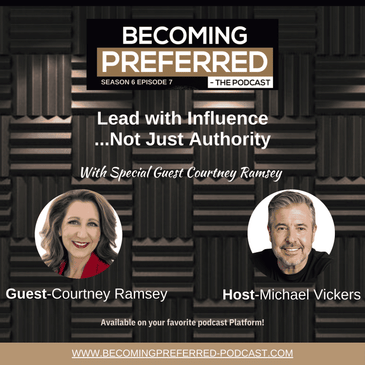
SEASON: 6 EPISODE: 7
Episode Overview:
Welcome back to Becoming Preferred, the podcast where we equip you to lead with influence, not just authority. If you’re an entrepreneur or business professional whose growth is stalled by employee turnover, poor communication, or the sheer struggle of transitioning from a high-performing doer to an effective leader, then you're going to enjoy this episode.
Today, we are happy to welcome Courtney Ramsey, a renowned leadership development expert, speaker, and consultant who has spent two decades transforming companies.
Courtney's mission is simple: to stop the bleeding caused by low engagement and high turnover by giving leaders the concrete communication and people skills they desperately need. She doesn't just talk theory; she delivers tangible, behavioral shifts that save companies millions. Get ready to learn how to master the art of tough feedback, delegate strategically, and truly lead the team that's destined to become your dream team. Join me for my conversation with Courtney Ramsey.
Guest Bio:
Courtney Ramsey is a seasoned professional with over 20 years of experience in the Learning & Development and Human Resources fields. Courtney brings a wealth of knowledge to audiences with her experiential programs that have a real impact on business results and inspire change.
Over the years, she has successfully trained tens of thousands of associates in various areas such as leadership, business management, conflict resolution, communication skills, and operations helping companies like JCPenney, Toyota, Populus Financial Group, and Zales Corporation save millions of dollars.
Courtney is the author of the book, Share Your Genius: 35 Tips to Create Training That Transforms. In it, she provides trainers with the tools they need to create engaging and effective training sessions.
Resource Links:
- Website: https://courtneyramseyspeaks.com/
- Product Link: https://courtneyramseyspeaks.com/services/
Insight Gold Timestamps:
03:48 Professional development, helping people be better, that's what I love
05:50 No one's brave enough to have the tough conversation
10:32 I still think there's a pretty big bias out there in terms of promoting women up
12:21 There's really no defining line anymore of what is personal, what is work, it's so blended
13:47 You call this taking off the cape moment
15:57 Many leaders struggle to delegate because their fear of failure or inefficiency
18:17 That inverted pyramid approach to where the leader is essentially at the bottom...
19:58 You've got a popular TEDx talk called Why We Hit the Snooze on the Conversations that Matter
22:30 Is there a distance that leaders ought to maybe maintain and keep in order to be able to have that firewall
25:16 I call that setting your intention and saying your intention out loud
27:01 We do still see those people who don't quite get that things have changed in the last 20, 30 years
29:26 ChatGPT and the other AIs are pretty decent at being leadership coaches
30:37 So, every generation has its own learning style
32:30 You speak on the need to speak up and say it
33:47 Call the elephant out in the room
35:10 The one thing I would encourage people to start doing today to make a huge impact on your leadership is to stop avoiding the uncomfortable
36:34 The website is courtneyramseyspeaks.com
Connect Socially:
LinkedIn: https://www.linkedin.com/in/clramsey/
Facebook: https://www.facebook.com/CourtneyRamseySpeaks/?modal=admin_todo_tour
Instagram: https://www.instagram.com/_cramsey/
Email: Courtney@CourtneyRamseySpeaks.com
Sponsors:
Rainmaker LeadGen Platform Demo: https://bookme.michaelvickers.com/lite/rainmaker-leadgen-platform-demo
Rainmaker Digital Solutions: https://www.rainmakerdigitalsolutions.com/
In 3, 2, 1.
Speaker BWelcome back to Becoming Preferred, the podcast where we equip you to lead with influence, not just authority.
Speaker BIf you're an entrepreneur or business professional whose growth is stalled by employee turnover, poor communication, or the sheer struggle of transitioning from a high performing doer to an effective leader, then you're going to enjoy this episode.
Speaker BToday we are happy to welcome Courtney Ramsey, a renowned leadership development expert, expert speaker, and consultant who has spent two decades transforming companies.
Speaker BCourtney's mission is simple.
Speaker BTo stop the bleeding caused by low engagement and high turnover by giving leaders the concrete communication and people skills they desperately need.
Speaker BShe doesn't just talk theory.
Speaker BShe delivers tangible behavioral shifts that save companies millions.
Speaker BGet ready to learn how to master the art of tough feedback.
Speaker BDelegate strategically and truly lead the team that's destined to become your dream team.
Speaker BJoin me now for my conversation with Courtney Ramsey.
Speaker BWell, hey, Courtney, welcome to the program.
Speaker BWe're delighted to have you.
Speaker AThank you so much.
Speaker ASo happy to be here.
Speaker BOh, me too.
Speaker BI am excited.
Speaker BWe had you on the calendar earlier in the year and I know your travel schedule and speaking schedule.
Speaker BWe had to make some adjustments.
Speaker BSo we are delighted to have you here.
Speaker BThank you for making time for us.
Speaker BAnd where are we speaking to you from today?
Speaker BWhere's home?
Speaker AI am located in Dallas, Texas.
Speaker ASo right there in the middle.
Speaker BYeah.
Speaker BGood spot.
Speaker BI used to live there myself.
Speaker BWe're chatting about that earlier.
Speaker BGood sports.
Speaker BTeam town.
Speaker BSo lots of good sports.
Speaker AIt can be.
Speaker AYeah.
Speaker BVery attributed here.
Speaker ARight.
Speaker BTexas has got its own economy.
Speaker BI remember in 08 and 09 when we had the financial meltdown.
Speaker AYes.
Speaker BIt's like Texas didn't even know there was one.
Speaker BIt was like it's its own economy.
Speaker BYou could work just in Texas and it's its own country.
Speaker AIt's true.
Speaker AAnd I think a lot of Texans like to think of it that way.
Speaker AWe're very independent, if you will.
Speaker ASo.
Speaker ASo.
Speaker BWell, it goes with the territory.
Speaker BNow we're going to talk about leadership and all things around leadership and what that looks like in today's world and how we can make ourselves more effective because the world's changing and the market conditions are changing and leadership styles are changing as well.
Speaker BAnd I know you have a fresh approach to that.
Speaker BLet's talk to listeners, though, Courtney, let's go back to high school.
Speaker BYou're back in school.
Speaker BYou're on your way to college.
Speaker BWhat do you want to be when you grow up?
Speaker AYou know what's so funny?
Speaker ABack in high school, I don't really know That I had a clue.
Speaker AI remember very specifically thinking I was going to stay in school for Texas School.
Speaker AI wasn't really interested in going out of state.
Speaker AI had visited Texas A and M University a couple times for like, drill team conferences and things like that.
Speaker AAnd that's where my parents went.
Speaker ASo I probably knew I was going to A and M. I didn't really know what major I wanted, but I ended up settling with business school and specifically choosing marketing.
Speaker ABut what's interesting is something I did in high school that I should have had top of mind really went out the window.
Speaker AAnd I was in speech, drama and debate in high school.
Speaker ASo I was that nerdy girl every Friday night hopping on a yellow school bus to go to some other school to do debate tournaments on a Friday night.
Speaker ABut I loved it from a very early age.
Speaker APublic speaking was just something that surprisingly I like doing and I found fun.
Speaker ASo I put that kind of on the side burner, back burner.
Speaker AWhen I went to school, graduated with marketing, got an emphasis in retail, like working in retail.
Speaker AAnd my first job out of college was actually at Neiman Marcus in their buying offices.
Speaker BLovely.
Speaker AAnd that was fun.
Speaker AIt sounds super glamorous.
Speaker AIt is not.
Speaker AIt is Excel spreadsheets.
Speaker AJust so you all know, I was.
Speaker AThere was no Gucci Runway shows, drinking champagne.
Speaker AIt was Microsoft Excel.
Speaker AAnd me, I.
Speaker ASo I actually ended up going back to MBA school at Texas A and M. Came out with more of an emphasis in hr.
Speaker AAnd that's where I started going into recruiting and training after that.
Speaker ASo that's kind of how I got here.
Speaker AWhen I fell into training, blessed enough to have someone at the company I was with, to realize I had a background in speaking and gave me a shot, I knew I had found my home.
Speaker AProfessional development, helping people be better, that's what I love.
Speaker BWell, now I know.
Speaker BYou do speaking, you do training, you do coaching.
Speaker BWhat made you pick leadership as your topic?
Speaker BI mean, as speakers, a lot of people come out and go, hey, I. I'm going to be a speaker.
Speaker BBut they don't have a topic.
Speaker BAnd they're always, how did you choose your topic?
Speaker BAnd I think usually the topic chooses you.
Speaker BI think what happens is by our experience.
Speaker BWhat was your experience with that?
Speaker AWell, I'm kind of lucky in that before I decided to do this on my own, I had almost 15 years in leadership development in the professional setting, so corporate leadership development.
Speaker ASo I knew that that was my home.
Speaker ABut I think what really made me stick with it.
Speaker AAnd first of all, I love It.
Speaker ABut when I was promoted to be a leader of a team, even though, get this, I had been teaching the classes for at least 10 years, I bombed.
Speaker AI was a horrible leader because as you know, because you do a lot of the same things that I do, knowing is not doing.
Speaker AThey are two very different animals.
Speaker ASo you can have all the book knowledge, you can have the theory behind you, but if you have not put in the reps, if you have not tried those skills on in real life, totally different ball game.
Speaker ASo that is actually what made me stick with it and become even more focused on the communication and the relationships and the tough conversation side of leadership.
Speaker ABecause I was always the girl who kicked butt and took names doing the work and turning out the product and getting the results.
Speaker ABut I backburnered relationships.
Speaker AThey were nice to have, they were not a must have.
Speaker ASo then when I became a leader of people, I didn't have those relationships already built in and I still thought that they weren't that important, didn't really focus on it until my world basically came crumbling down and I had to really take a close look at myself in the mirror and figure out what I was doing differently and wrong.
Speaker AAnd that was it.
Speaker BI wasn't developing what was the crumbling down.
Speaker BJust the fact that you felt that, hey, the self reflection, I'm not a good leader.
Speaker AIt was both.
Speaker AYou know how you know in your gut this is not going well.
Speaker BYeah, I suck.
Speaker AAnd you were just crossing your fingers and you're praying that no one else also realizes that.
Speaker AYeah, everyone else was realizing it and they were talking, weren't telling me because again, no one's brave enough to have the tough conversation.
Speaker ARight.
Speaker ANo one was giving me feedback specifically, but they were talking behind my back.
Speaker AThey went to my boss and she had to be the one to bring me into a room.
Speaker AAnd I will never forget it because in my corporate development leadership career, leadership development career, I can think of one or two instances where I got some minor constructive criticism.
Speaker ABut I remember her basically telling me, you're failing badly.
Speaker AAnd it was like the old school twilight Zone.
Speaker ALike the room started spinning.
Speaker AI was like, is this real?
Speaker AAm I dreaming this?
Speaker AWhat's going on?
Speaker AOh, it was very real.
Speaker AAnd I had to really figure out quickly what I was going to do about it.
Speaker BIt's interesting when you do get that kind of feedback.
Speaker BAnd I remember I was telling the story, actually working on a new book and I've told the story in the book.
Speaker BI remember I was in sales, I was doing, I thought, great I went to go with the premier sales training company, and I met with the director, and I thought, I'm going to slam Doug this one.
Speaker BThis is going to be great.
Speaker BAnd after 30 minutes, he says to me, you're the worst sales professional I've ever met.
Speaker BI wouldn't even call yourself professional.
Speaker BAnd he just goes, all you did was talk about you.
Speaker BYou didn't ask me a single question.
Speaker BIt was great feedback.
Speaker BAnd he was exactly right.
Speaker BAnd it bugged me.
Speaker BIt hurt.
Speaker BYou know, you want to go in the car and cry your eyes out and go, here.
Speaker BI thought I was good at this stuff.
Speaker BBut then it can motivate you, too.
Speaker BAnd so it becomes a motivational issue where you go, I want it just the opposite.
Speaker BWhat do I need to learn?
Speaker BSo it's a good, humbling experience, but I totally get that.
Speaker BLet's talk about leadership, because you had two years of corporate 14, 15 years there, then you kind of chose it as a topic to speak on and do your workshops and training on.
Speaker BHow have you seen it evol over from your adulthood stage, from the adults and leaders you followed?
Speaker BHow's it evolved?
Speaker BHave we gone backwards?
Speaker BIt seems like there's lack of accountability.
Speaker BIt seems with leadership, you know, I'm looking at our political environment, just whatever side of the fence people are on, but just leaders in general.
Speaker BWe've got character.
Speaker BDoes character stand for anything anymore?
Speaker BHow have you seen it evolve?
Speaker BAnd where do you think the issues are?
Speaker AIt's so hard because we've been in this a long time.
Speaker AAnd when you think back, you know, back at the last 30 years or so, you definitely have seen that evolution.
Speaker ABecause when I first started work out of college, I was primarily working for boomers.
Speaker AIn terms of generational differences, I'm strong Gen X.
Speaker AWe came in, the boomers who were successful, showed us the way it was done, and we basically said, okay, this is the game we have to play.
Speaker AAll right.
Speaker ASo I remember my first job back at Neiman's.
Speaker AI came in as early as my boss did, if not earlier.
Speaker AShe worked through lunch.
Speaker AI worked through lunch.
Speaker AHalf the time she would ask me to go get her lunch, which I happily did.
Speaker AShe stayed till 5, 6, 7.
Speaker AI stayed till 5, 6, 7.
Speaker AIt was like what you did, what was modeled for you, and you really didn't question it.
Speaker AAnd I think the biggest evolution we've seen over the last 20, 30 years is especially with our millennials, but certainly going into our Gen Z as well, is people are raising their hand and saying, no, I don't like that.
Speaker AI don't want to do that.
Speaker AI don't think that's the best way to do things.
Speaker AI'm going to push back, and that is just something that I feel like we didn't do back in the day.
Speaker AYour boss said jump.
Speaker AYou said how it was.
Speaker BOh, that it was command and control.
Speaker BI'm on that baby boomer side of it, and I look at leadership and, you know, when I talk to audiences, I'll ask millennials, how many of you heard that you're entitled?
Speaker BI heard that expression, of course, all hands go up.
Speaker BAnd I go, well, first of all, I'm a baby boomer, and I think you should be entitled.
Speaker BYou should be entitled to go to college, come out and get a good job and not be in massive debt.
Speaker BYou should be able to walk down the street in Dallas, Texas, with your family or go to a park and not worry about getting shot.
Speaker BYou should be entitled to clean water, clean air.
Speaker BYou should be entitled to good work, life balance.
Speaker BThose are good entitlements.
Speaker BAnd they usually get all excited about that one.
Speaker BBut the point is, every generation is different.
Speaker BAnd I look at my generation from the baby boomer point of view.
Speaker BWe had presidents acting inappropriately in the White house.
Speaker BWe had CEOs of major corporations bankrupting them, embezzling them.
Speaker BAnd we still get some of that, but the values didn't seem to be there.
Speaker BAnd we looked at people as being strong.
Speaker BAnd I'm curious about that from a perspective, because you came up as a female.
Speaker BAnd when we think of leadership, we always think of that strong, macho type leader.
Speaker BOh, he's such a good leader.
Speaker BVer.
Speaker BWhen we have a woman coming forward, we go, well, hey, there's other issues.
Speaker BWe got to look at this.
Speaker BWhat are you actually saying in the marketplace, male versus female from a gender point of view?
Speaker BBecause in my mind, I'm seeing it almost the opposite.
Speaker BI'm seeing where we're seeing women doing some phenomenal things from a leadership role point of view, and they're bringing something to the table that men just don't bring.
Speaker BWhat do you see?
Speaker AWell, I think the good news is the research behind what you just said is very true.
Speaker AYou can find the stats that say having women leaders at that executive level and above or even at the more the foundational level brings good things to teams in terms of retention and engagement and productivity.
Speaker AI still think there's a pretty big bias out there in terms of promoting women up.
Speaker AI still think you have women who are strong Leaders who maybe are more direct and they're labeled one way, while a man can be that very strong and direct, and he's labeled a very different way.
Speaker AAnd that's unfortunate, to say the least.
Speaker ASo I think that is still out there.
Speaker AI do think it's evolving and we're coming along.
Speaker AI just wish we'd evolve at a faster pace, for sure.
Speaker BStill slow.
Speaker BAnd it's the old white guy holding onto his power.
Speaker BWe're seeing it in lots of different initiatives from whether it's ESG or DI or whatever the political flavor is.
Speaker BThey were seeing that.
Speaker BAnd so let's talk about the principles of leadership themselves.
Speaker BHow have they evolved in the last couple of decades?
Speaker BWhen we think of leaders, we're thinking, and I think it's misplaced.
Speaker BWe think of somebody who's strong as somebody who's powerful.
Speaker BAnd that's really not always the case because we've got other great leaders.
Speaker BYou had Steve Jobs, you had Michael Dallas.
Speaker BYou've got other leaders who are.
Speaker BBill Gates.
Speaker BThey're all leaders of their organizations and had different.
Speaker BYou had Oprah, you know, great organization.
Speaker BSo there's lots of good role models.
Speaker BHow have you seen it evolved and what were the key major changes that you think of are here to stay and what maybe needs to be changed?
Speaker AI think one of the biggest evolutions I've seen is that we are expected to leave our personal lives at the door.
Speaker A20, 30 years ago, you didn't bring your whole self to work.
Speaker AYou kept certain parts of your whole self hidden.
Speaker AYou didn't talk much about your family at work.
Speaker AYou certainly didn't get personal phone calls at work.
Speaker ARemember when, like back in the day, my very first job, I waited tables, and I remember there was only one main phone.
Speaker AWe didn't really have a lot of cell phones out there at that point.
Speaker AEven if you did, you wouldn't use it when you're waiting tables, right?
Speaker AI remember being appalled if I got a personal phone call at work.
Speaker AIt's like, what does that say about me?
Speaker ADoes this make me look bad?
Speaker AOh, my gosh.
Speaker ANow it is nothing for all of us to be taking texts from that we know during meetings, you know, whenever it is.
Speaker ASo your whole self is brought to work.
Speaker AThere's really no defining line anymore of what is personal, what is work.
Speaker AIt's so blended, and I think this is a big part of it.
Speaker AI think our cell phone is a big part of that, too.
Speaker ASo that's the first evolution, is that it's unrealistic nowadays for as a boss, to say, I want you to leave your personal life at the door.
Speaker ALike many of us were told back in the day.
Speaker AThe other thing I think we're seeing is that the people we're leading expect us to know them and respect them and value them.
Speaker AHuman beings, they want you to know about them, they want to know about you, and they want to have a relationship with you.
Speaker AWhich means we're seeing more of a push towards a more empathetic form of leadership.
Speaker APeople do build relationships, do have open and honest communication, do have an understanding that life starts lifing sometimes and it gets hard.
Speaker AI think there is more of a pull for that from the workforce now.
Speaker BInteresting.
Speaker BWhen it comes to leadership, a lot of times within organizations, at least in my experience, we always took the top performers.
Speaker BFor instance, I'm in sales and marketing world, we would take the top performer and hey, he wants to earn more money.
Speaker BWe're already paying.
Speaker BHe's earning good commissions, he's brilliant.
Speaker BLet's promote him to manager so we can afford to pay him or her more.
Speaker BAnd then they get up there and they're terrible leaders.
Speaker BThey don't have the skill sets.
Speaker BSo we've taken those best doers, and I know you talk about this, and many of our listeners are entrepreneurs who promoted their best doer, their superstar sales rep or their technician into a manager role.
Speaker BYou call this taking off the cape moment?
Speaker BWhat's the single biggest mindset shift a new leader must make to transition from, say, a high performing individual contributor to a successful people leader?
Speaker BCan they make that move?
Speaker BWhat should we be looking for?
Speaker AYeah, good call.
Speaker AAnd you're right, I do call that taking off the cape because we often promote what I call our team superheroes.
Speaker ALike they're the ones who, if you're the boss, I was this person, this was me.
Speaker AWhen I was on the training team, not leading the team, there was a big presentation.
Speaker ACall Courtney, you need to go in front of the board, board of directors or the vp.
Speaker APut Courtney up for that.
Speaker ASomething else fell through because they didn't do their job right.
Speaker AGive it to Courtney, she'll fix it.
Speaker ASo I was used to swooping in, saving the day, fixing it, usually by myself, because that was my gift and I would just pull through it.
Speaker ABut you can't keep doing that.
Speaker AWhen you get promoted to a leadership role, I like to say you are now the Nick Fury and everyone else is the adventures.
Speaker ARight?
Speaker ALike you're kind of behind the scenes.
Speaker AYou're the one pulling some strings and making People feel supported helping them do their jobs.
Speaker ABut you're not Captain America, you're not the Black Widow.
Speaker ASo it's to you to realize you've got to take off the cape, teach other people to be the superhero and make that shift to where maybe you're not getting all the glory anymore and all the kudos, but the work is happening and people are better because of you, because you're there to lift them up and support them.
Speaker ABut that is a huge mindset shift for someone who's used to being the superhero to shift into oftentimes because they don't know how.
Speaker AThey were never set up to be good delegators or coaches or givers of feedback.
Speaker AAnd quite frankly, from just a human psychology point of view, you kind of don't want to like we want to keep being the go to save the day gal or guy.
Speaker AIt's nice, really good.
Speaker BYeah, it's interesting and I see it in the sales and marketing world all the time.
Speaker BThey're always promoting that individual.
Speaker BBut it also goes to if you're trying to scale your business or to grow and build leadership, you've got to build with the right tools.
Speaker BAnd companies have to train those people in order to do those tools.
Speaker BI know delegating is a tough process for some people.
Speaker BFor me, that's a tough one.
Speaker BNo one does it quite like I do it, but there's lots of people who can do it, 70 or 80% like I do it.
Speaker BAnd that's good enough.
Speaker BAnd I think it's being okay with good enough.
Speaker BMany leaders struggle to delegate because their fear of failure or inefficiency.
Speaker BWhat's your framework for?
Speaker BYou call it strategic delegation, I think.
Speaker BHow can a leader let go of control while simultaneously using the process of delegation to help develop their team?
Speaker AYeah, this is something I learned a long time ago.
Speaker AAnd it goes back to what I was saying about you can know the thing, but until you do the thing, really you can't implement right.
Speaker ASo one of the best ways you can develop up your people to become better in their current role or even for their next role is to start slowly but surely delegating things that will help them gain those skills and competencies that they will need.
Speaker ASo for example, when I was a trainer on my training team, I wish I would have had my boss basically coach someone more or delegate.
Speaker ADelegate some things that I had teach other people how to do it, but also delegate and hold people accountable almost to give me like the training wheels approach to where I could get some practice but it wasn't full circle serious yet.
Speaker AAnd then when I got to be the true leader, I would have a bit more of that practice behind me.
Speaker ABut what we don't realize and what I like to tell people all the time is development of your team does not have to be expensive.
Speaker ABecause yes, you could hire someone like me to come in and do a full training program for you, right?
Speaker AYou could hire yourself.
Speaker AMichael, you do all this stuff too, but you really get the biggest bang for your buck when you start to think through what this person is really good at.
Speaker AWhat do they need help in and what development in and what can I give them as a task or a project or even to some degree exposure to that would help them gain those skills.
Speaker AAnd oftentimes it's free.
Speaker AI'm not saying send them to a conference, send them to a $5,000 training program.
Speaker AWhat can you do daily to take off your plate to free up your time, but also do them the service of developing them for their promoted the.
Speaker BBest examples I ever saw and which made sense was if you think of a pyramid, the typical hierarchy within an organization, you got the top dog, you know who's ever up at the top there, that top leader, and you got the rest of the organization and they're supporting the leader where what I believe a better approach is to invert the pyramid so the leaders at the bottom, just to your point, and bring in all the support mechanisms, support the rest of the team in the organization so they're actually serving the organization.
Speaker BIs that how you see it as well?
Speaker AI completely agree.
Speaker AThat inverted pyramid approach to where the leader is essentially at the bottom and supporting the others to help them do their job.
Speaker AThat's exactly the approach I prefer to take and that's the approach I prefer to teach as well.
Speaker CAre you tired of chasing leads and ready to start effortlessly attracting more high value clients?
Speaker CIntroducing Rainmaker Lead Gen, the ultimate sales, engagement, engagement and client acquisition platform that takes the stress out of outreach.
Speaker CWith Rainmaker Lead Gen, you can easily identify, engage, educate and convert your ideal prospects into loyal clients.
Speaker COur industry leading automation and email sequencing empowers you to reach more ideal clients, accelerate the sales cycle and close more business.
Speaker CImagine authentically engaging with your prospects while the platform handles the heavy lifting.
Speaker CSay goodbye to the endless hustle and embrace a more efficient, effective approach to business development.
Speaker CReady to witness the magic?
Speaker CBook a 20 minute demo today and see how Rainmaker Lead Gen can revolutionize and level up your client acquisition game.
Speaker CThere's nothing to lose and everything to gain.
Speaker CDon't miss out on this opportunity to supercharge your client acquisition process.
Speaker CVisit rainmakerdigitalsolutions.com or check out the link in the show Notes to book your demo.
Speaker CRainmaker Lead Gen Spend less time hunting for your ideal clients and more time having high value sales conversations with your ideal clients.
Speaker BAnd now back to my conversation with Courtney Ramsey.
Speaker BLet's move into high stakes communication because I know that's part of a leadership role.
Speaker BYou've got a popular TEDx talk called quitting the Snooze Button, basically on tough conversations for entrepreneurs who are losing sleep over say a non performing employee or a crucial client negotiation.
Speaker BAnd we run into those all the time.
Speaker BWhat's the high cost of hitting that snooze button in business?
Speaker AAbsolutely.
Speaker AWell, you already named one of them, which is the simple stress it does to your body.
Speaker ARight.
Speaker ALike how many times have you woken up at three in the morning ruminating over a conversation you need to have?
Speaker AYou keep putting it off, it keeps waking you up.
Speaker AMaybe now you're even dreading going to work the next day or having to deal with this person.
Speaker AThat resentment starts building.
Speaker ASo when you think about that, just the toll it's taking on your physical body and your mental health is a huge cost.
Speaker AAnd you can look online and see all kinds of stats around like 90% of illnesses can be related back to stress.
Speaker ARight.
Speaker ASo that's a big part.
Speaker AI think the other thing though is we don't always think about there is a truly financial implication to avoiding these conversations.
Speaker ASome of the research I like to lean on because I really love the book is the people who wrote Crucial Conversations.
Speaker AIf you look at Crucial Learning's approach to everything, and I'm not quoting this specifically, so please, if you're listening to this, go out and look at it.
Speaker ABut most people, I think around 50% of people can say a conversation they've avoided at work has probably cost their company at least $10,000.
Speaker BInteresting.
Speaker ANow when you think about that, that sounds interesting, right?
Speaker AExactly.
Speaker AIt sounds like really 10,000.
Speaker ABut you start thinking about missed deadlines, rework, people calling out sick because they just don't want to deal with it that day.
Speaker AThey are taking a mental health day, people quitting, and the amount it cost to rehire someone because this person was fed up and done right.
Speaker AI think even at a frontline level that's around $5,000 US so it's crazy.
Speaker AIt's crazy how when you start thinking about all that goes into it.
Speaker AYeah, I can See how on the lower end, a missed conversation that we keep putting off can cost a lot of money for each corporation.
Speaker BLack of presence, lack of focus.
Speaker BThere's so many variables to it.
Speaker BWhat about having.
Speaker BAnd I get this, I, I've had the same middle of the night thing.
Speaker BWhat should I say?
Speaker BAnd have the conversation play out in my head or, you know, if you're a people person and leadership, and this is always a challenge as you're building an organization or a team within an organization.
Speaker BSometimes we want to be friends with the people that are our report.
Speaker BSo we want to go have a lunch with them or a coffee with them, or we socialize with them and we become friends and we trust them, they trust us.
Speaker BBut then there might be a reason that we need to have a difficult conversation.
Speaker BHow do you bridge that?
Speaker BIs that, is there a danger there, Is there a distance that leaders ought to maybe maintain and keep in order to be able to have that firewall, if you will.
Speaker AThat's a tough question.
Speaker AAnd if I'm keeping it real with you, I don't know that there is one hardcore definitive answer.
Speaker ABecause going back to how we're all so connected nowadays, it's really easy to kind of blur that line between boss and friend and peer kind of thing.
Speaker AI think what we have to remember if we zoom, zoom out a bit is at the core of being a leader, at this being your job.
Speaker AIt is your job to do a good job of developing your people, giving them feedback, holding them accountable and really setting very clear expectations.
Speaker ASo if your friendship is getting in the way of that, that's a pretty big red flag for sure.
Speaker BYeah.
Speaker ASo I'm not necessarily saying we have to hold back, but I think at the very early on and probably even bring it up occasionally.
Speaker AYou have to make sure this relationship, each party knows at the core this is a leadership subordinate relationship.
Speaker AAnd it is this person's job to give me the feedback I need, the coaching I need, hold me accountable.
Speaker AAnd quite frankly, if they're not doing those things, they're not doing their job.
Speaker AAnd I always like to say too, if you're doing those things, it usually shows you truly, genuinely care.
Speaker ALike if I've written you off and I really couldn't care less about you, I'm not going to take my time to give you the feedback, especially if it's hard to deliver.
Speaker AI'm usually giving you that feedback because I genuinely believe in you.
Speaker AI see potential for improvement and I want to help you.
Speaker BI think it's changing Hats you know, I've worked with my wife, and she has her department, I have my department, and she's phenomenal production editor, and she does her programming and looks after.
Speaker BI kind of stay out of that department.
Speaker BBut if I have a business issue that I need to address, I can't come in as, you know, husband or boyfriend.
Speaker BHow I always say I'm her boyfriend, but I can't come in wearing that hat.
Speaker BWhat I'll do is I'll say, hey, I'm putting on my business owner hat now to talk to you about this particular issue.
Speaker BAnd then I'll talk to her.
Speaker BAnd I have to get her to change gears a little bit.
Speaker BSo by framing it and putting it in, or if I'm talking to one of my daughters, I'm going, hey, I'm going to put my dad hat on for a minute.
Speaker BYeah, all right.
Speaker BAnd just give you a pair as dad.
Speaker BAnd then we go back to being buddies and friends because they're all adult children.
Speaker BOr if they're not asking for advice, then I probably shouldn't give it anyway unless they are asking for it.
Speaker BBut I think it's learning how to adapt and have those difficult conversations.
Speaker BAnd when it comes to miscommunication and communication styles, miscommunication is definitely a cancer in growing companies.
Speaker BWe see it all the time.
Speaker BYou work a lot with communication styles.
Speaker BFor our listeners who feel constantly frustrated by, say, a team member they just can't get through to, what's the quickest way to identify their style and maybe flex their own to be a little more influential.
Speaker AGotcha.
Speaker ASo much good stuff you just said there.
Speaker AFirst of all, I want to go back to what you said about taking off the hat and actually saying those words out loud.
Speaker AI call that setting your intention and saying your intention out loud.
Speaker ASo that's actually my conversation formula.
Speaker AThat's the very first thing I teach, which is if you've got to frame this conversation the right way.
Speaker ASo I love that you are inherently saying, hey, this is not Michael, your husband, talking to you right now.
Speaker AThis is your business partner, and we have need to have a business conversation.
Speaker ABecause what you're essentially telling your wife at that point is my intent is not to come at you.
Speaker AThis is not personal.
Speaker AThis is a business decision.
Speaker ALet's talk about this as two business partners right now.
Speaker BSo when I'm open to feedback and feedback and it goes back.
Speaker BAnd I guess you could do it with employees, too.
Speaker BLike, for me, it's more with employees.
Speaker BYou want to be nice to the people but it's framing it and going, hey, as a business owner, having gone through the experience, here's how I see improvement.
Speaker BHere's what's working great, here's what's not working so good.
Speaker BBut in an interest, if we want to keep working with you because we just love having you in our family, here's what we need to do moving forward and then get their thoughts on it as well.
Speaker BSo it's.
Speaker BAnd it's being direct but not mean.
Speaker BIt was being kind about it, isn't it?
Speaker BIt's really.
Speaker AIt is.
Speaker BThat's where EQ kind of comes into the picture.
Speaker BAnd then how are you training that?
Speaker BBecause that is again.
Speaker BAnd I think we do it, but I don't want to genderize this, but I.
Speaker BThat's why we saw a lot of HR directors are female because they tend to be the heart of the organizations versus.
Speaker BAnd like I said, I have five daughters, so I'm a little biased myself.
Speaker BBut, you know, I see how the daughters deal with issues.
Speaker BRight.
Speaker BThey're very communicative and stuff.
Speaker BIs it still a problem?
Speaker BDo you run into this in the corporate world sometimes where you still got the.
Speaker BWhat's the word I want to use?
Speaker BThe.
Speaker BThe male dominant approach to things, or are you starting to see it get more balanced?
Speaker BA little bit.
Speaker BHow's it working?
Speaker AWorking?
Speaker AI see both in terms of EQ in general.
Speaker AI mean, we're so all over the board nowadays.
Speaker ASo you do see the most.
Speaker AThe stereotypical kind of thing, right.
Speaker AWhere you have the dominant person.
Speaker ATypically when I'm coaching, it typically is male, but that doesn't mean that's a hardcore role, that's for sure.
Speaker ABut yeah, we do still see those people who don't quite get that things have changed in the last 20, 30 years and it's no longer okay to come in as this authoritarian.
Speaker ANo, when I say jump, you say, how high?
Speaker AI don't care about feelings.
Speaker ALeave your feelings at home.
Speaker AYou get a few people who don't quite get that yet, but I do think the majority understand you.
Speaker AYou can't really lead that way anymore.
Speaker ASo I think that's really good.
Speaker ASome evolution.
Speaker AAnd you're right, we do typically stereotype women as having the ego.
Speaker ABut the good news is EQ is something you can grow no matter who you are or how old you are.
Speaker BYeah, I think so.
Speaker BI've got daughters that are helping me with that evolution and personal evolving.
Speaker BSo it does make a difference.
Speaker BSpeaking of evolving, let's talk about AI and how AI works for Leaders.
Speaker BIt's always about improving efficiency, retention, getting people working.
Speaker BHow can an overwhelmed entrepreneur or mid level manager leverage tools like ChatGPT and some of the AI tools for high level tasks, not just for writing copy, but to truly save time and enhance their leadership and communication.
Speaker BHow can they apply it?
Speaker AYou know what's so funny is you can use it actually for the question you asked earlier that we didn't quite.
Speaker ATo get to where you're talking about reading someone and connecting better with someone who may be a different personality type than you are.
Speaker BYeah, different style.
Speaker AOne thing I've heard of is potentially going into, let's say you're using ChatGPT or whatever AI tool you like.
Speaker ALike if you're using the version where you can set up projects or groupings of conversations, you can actually set up a whole project on your team members.
Speaker ASo if I was working for you, Michael, you could set up a Courtney file and you could say, based on what I've seen Courtney, this is what I know about her.
Speaker AYou know, she told me she is an enneagram 9/5.
Speaker AShe told me that on the disc scale she's a high S. When I speak with her, she's very relationship driven.
Speaker AShe's very is expressive.
Speaker AShe's pretty animated.
Speaker AI know that she's a hard worker, right?
Speaker ASo you give all this stuff, right?
Speaker AMaybe even plug in a few emails that I give into you.
Speaker AOf course with not personal data, things like that, but just the way I communicate.
Speaker BRight.
Speaker AAnd I could go back into that file and say, listen, I need to have a tough conversation with Courtney.
Speaker AWe need to talk about xyz.
Speaker AHow do I approach Courtney in a way that works for her but is still authentic to my style?
Speaker AGive me some tips.
Speaker BInteresting.
Speaker AAnd now it can come in and be like, this is what I recommend.
Speaker ASo what I would love for people to start thinking of, first of all, even if you don't go to that extent, even if you just say in your regular old everyday chat prompt, this is what I know about this person.
Speaker AThis is my dilemma.
Speaker AWhat do you recommend?
Speaker AYou will get so much value.
Speaker AChat, GPT and the other AIs are pretty decent at being leadership coaches.
Speaker ANow please.
Speaker AThe disclaimer here is don't follow up for legal advice.
Speaker AAlways seek real legal counsel, things like that.
Speaker ABut if you're just looking for recommendations on maybe how to give some feedback that you're a little worried won't land appropriately or this person's going to get defensive, how could you handle it if this person starts Crying in the middle of the feedback conversation.
Speaker AI think it's a great tool for that.
Speaker BThat's an interesting angle on using it employment.
Speaker BAnd it makes sense because every day we can keep learning new tools, things to help us.
Speaker BSo you can focus on the empathy part.
Speaker BBecause the one thing AI can't do is it doesn't feel, it doesn't have that experience.
Speaker BIt can tell you a poem that'll make you cry, but it's never experienced it itself.
Speaker BAnd that's why I think our own personal experiences go a long way that way.
Speaker BLet's talk about the generations that are out there.
Speaker BSo we've got obviously new generations of technology, but you've also got five generations of workers.
Speaker BStill got some baby boomers out there.
Speaker BHow is an effective leader?
Speaker BHow do we approach the different styles?
Speaker BBecause they're all different.
Speaker BIt's like learning.
Speaker BI'll sit and watch a 45 minute video, a Gen X or won't.
Speaker BIt's nine minutes, seven minutes.
Speaker BWe've had to redesign things because ding, ding, ding, it's too much time.
Speaker BRight.
Speaker BSo every generation has its own learning style.
Speaker BAre we seeing different leadership styles and how they recognize that leadership or how they react to that type of leadership and communication channels?
Speaker BAre you seeing that amongst the different generations?
Speaker AYes.
Speaker AAnd kind of thing.
Speaker AIt's.
Speaker AI definitely think you still see the different styles.
Speaker AI love more than anything those Tick Tock videos where they actually show like how a boomer would react to it.
Speaker AHow an Xer, how millennial.
Speaker ARight.
Speaker AAnd I think to some degree that's a, you know, blown up and exaggerated form of it.
Speaker ABut to some degree it's true.
Speaker ATo some degree it's true.
Speaker AI think boomers are still pretty, you know, there's high expectations.
Speaker AIt's like, I'm working this hard.
Speaker AWhy aren't you working this hard?
Speaker AXers is kind of like, you need to figure this out.
Speaker ALike I was a latchkey kid, I did my own thing.
Speaker AI figured out how to make the Mac and cheese when I was in fifth grade.
Speaker AWhy can't you, you know?
Speaker BRight, right.
Speaker ASo there's still that kind of approach there.
Speaker AI think millennials are still kind of coming across as more that understanding cool boss.
Speaker ALike they want to be your buddy and understand, but also tell you what's up.
Speaker ASo it's like, yeah, I understand this is really stupid over here and here's why I still need you to do it kind of thing.
Speaker AAnd we're not seeing a lot of Gen Z yet, but it's gonna be really interesting to see what Gen Z does in terms of how they evolve to be leaders.
Speaker BYeah, it is good because look at their examples.
Speaker BAnd so it will be interesting when.
Speaker BAnd people sometimes come up and ask us, hey, I want to be a speaker.
Speaker BWhat can I do to get a speaker?
Speaker BAnd I know you ran the Texas chapter there in Dallas, I think North Dallas chapter for National Speakers association for a couple years.
Speaker BYou know, a few of my friends that are there as well and I do, I.
Speaker BYou do.
Speaker BAnd good strong chapter.
Speaker BAnd so people come up and they always ask me, well, what about the speaking career?
Speaker BAnd I said, well, if you can look at as speakers and in the back of your head go, I can do that.
Speaker BThat's something I can do.
Speaker BI just.
Speaker BMaybe not the way they do it.
Speaker BThen you can.
Speaker BThat's your qualifier.
Speaker BHow is it for leaders when you're in an organization where you call it, I think the power of asking, but for a business professional looking to grow their influence, climb that ladder, you speak on the need to speak up and say it.
Speaker BWhat's the secret to articulating our worth confidently?
Speaker BSo whether it's asking for a raise, a promotion or opportunity, without feeling like you're bragging or being demanding.
Speaker AYeah, yeah.
Speaker AYou know, I think we feel like my friend used to call this Bragasaurus rex, like, because you're like a Tyrannosaurus rex.
Speaker AWhile like no one wants to be the one walking in.
Speaker ALike, look at me, I'm so amazing and this is what I did today.
Speaker ABut at the same time, gone are the days where someone has enough time to really sit back and observe and be like, wow, did you see Michael?
Speaker ABlah, blah, blah, blah, blah.
Speaker AHe is killing it.
Speaker AWe're going to tap him on the shoulder and ask him if he wants to be promoted.
Speaker ALike, that just doesn't happen anymore.
Speaker AWe are all such busy people.
Speaker ASo to me, we have to start getting into the habit of essentially bringing up our accomplishments more in the course of everyday conversation without it feeling icky and oogy and kind of ugh.
Speaker ARight.
Speaker ASo one of the best things I think you can do if you're on a team and you want to start promoting either your team more with your boss or maybe you don't yet lead a team when you have one on one conversations, when you have career conversations, and if you're not having them, by the way, raise your hand and ask for that because that should be happening monthly, if not at least quarterly.
Speaker AStart getting in the habit of bringing up a few accomplishments that you're really proud of.
Speaker AAnd I would even, I like to say, call the elephant out in the room.
Speaker ARoom meaning if you're my boss, Michael, I might say, Michael, this feels weird.
Speaker AI don't like bragging on myself and that's exactly how this feels right now.
Speaker ABut I also know you're busy and there's a couple of things that I'm really proud of that me and the team accomplished that you might not be aware of.
Speaker AAnd I want to make sure I call those things out so they don't get lost in the shuffle.
Speaker ABy the way, that's an intent statement.
Speaker AWe just talked about framing it and setting an intent statement.
Speaker AThat's what that is.
Speaker AThat can be a weird conversation.
Speaker ANot all conversations are conflict.
Speaker ASometimes they're just uncomfortable because you don't want to feel like you're tooting your own horn.
Speaker ASo look for those everyday opportunities.
Speaker AStart making a file.
Speaker AOpen up notes on your computer, whatever it might be.
Speaker AHave an email inbox where you throw things into.
Speaker ABecause if you're like me too, you remember a hundred percent of everything bad.
Speaker ABut the good stuff will go in one ear and out the other.
Speaker ANever does it stick.
Speaker ASo start really making notes.
Speaker ASo when you are thinking about what are some things that I'm particularly proud of that I could talk about in my touch base meetings, you have a list of things to pull from.
Speaker BIt's moving from I deserve this to hey, I've earned this and I can deliver.
Speaker BAnd here's my portfolio work.
Speaker AHere's my proof.
Speaker BYeah, here's what I've done and I love doing it.
Speaker BIt's being that assertive and it's tough always because some companies are ready for it, some aren't.
Speaker BBut it's having that conversation and you talk about it.
Speaker BBoy, time moves quick here.
Speaker BBut as we wrap up, what's one final single action for our listeners?
Speaker BThe entrepreneurs and business professionals striving to become the preferred leader in their industry.
Speaker BWhat can they implement today to start their journey to better leadership?
Speaker ASo the one thing I would encourage people to start doing today to make make a huge impact on your leadership is to stop avoiding the uncomfortable.
Speaker ASo basically, quit hitting snooze, as I like to call it.
Speaker AYeah, quit hitting snooze on those things that you know you should be doing, should be saying, should be talking about.
Speaker ABut you're holding yourself back because you're scared of the person's reaction or hurting their feelings or making things worse.
Speaker AZoom out for a second.
Speaker AThink about what not having those conversations is truly costing you.
Speaker AAnd figure out a way to start having the conversation with that person.
Speaker ABecause I promise you, if you stop putting off these tough conversations and you start facing those problems and minor conflicts early on.
Speaker AI like to say when they're like a little baby weed before they grow into a big old tree, a weed that's a baby.
Speaker AYou can pluck it up by hand really easy.
Speaker AIf it's a tree, you need a chainsaw, right?
Speaker ASo stop avoiding it, stop letting the problem grow and start having the conversation as soon as you see it.
Speaker AAnd you're going to find it has a huge impact on your leadership ability and your productivity as as well.
Speaker AAlone.
Speaker BNo, that makes sense.
Speaker BStart being more intentional about the relationships.
Speaker BAnd I know you say leadership's a contact sport, which sounds like it is, and it all boils down to trust, consistency and self awareness.
Speaker BSo have those conversations.
Speaker BBe prepared to listen to feedback as well.
Speaker BAnd it sounds like it's still evolving and there's lots of work for us all to do.
Speaker BSo Courtney, this was great.
Speaker BThanks for coming, sharing some insights with us.
Speaker BThe website is courtneyramseyspeaks.com we'll have everything in the show notes so they can find you, they can find your book, they go to your website.
Speaker BYou got lots of great resources there that they can go with.
Speaker BSo you've got your blog.
Speaker BWhether you're meeting, professional services, speaking, workshops, it's all there.
Speaker BThanks for being our guest today.
Speaker AThanks for having me.
Speaker AI enjoyed it.
Speaker BAs you are listening to this episode, what is one idea that you've heard that has caught your attention and why does it matter so much to you and who is one person who you can share that with?
Speaker BEither share this episode or just share that insight that occurred to you while you were listening.
Speaker BPerhaps it is improving the four areas of emotional intelligence so you can interact with your team more effectively, or learning a new approach to bridging the generational gaps.
Speaker BThank you for listening, for learning, and for investing in yourself so that you can become the best version of you.
Speaker BIf you found value in this episode, please write a review on Apple Podcasts.
Speaker BIf you haven't subscribed yet, please do so so you can get a new episode and start your week off right every Monday.
Speaker BUntil next time.
Speaker BThis podcast is created and associated with Summit Media.
Speaker BMy Executive producer is Beth Sports Smith and Director of Research Tori Smith.
Speaker BThe fee for the show is that you share it with friends when you find something useful or interesting.
Speaker BThis podcast is subject to copyright by Summit Media.
Speaker AGoodbye.