
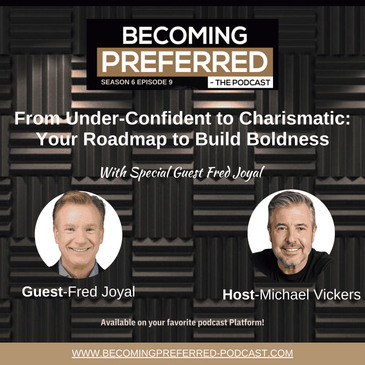
SEASON: 6 EPISODE: 9
Episode Overview:
Welcome back to Becoming Preferred, the podcast where we focus on the mindset and strategies that help you become preferred in the markets you serve.
Our guest today has built a legacy on that very concept. For over 30 years, he co-founded and grew 1-800-DENTIST, a company that generated over one billion dollars in revenue by solving a simple, painful customer problem. He's an expert in making a brand remarkable.
But here's the kicker: He’s spent the last decade distilling that business success into a personal superpower that anyone can learn.
Fred Joyal is the Wall Street Journal bestselling author of Superbold: From Under-Confident to Charismatic in 90 Days.
Fred has the rare experience of both conquering a niche industry and teaching the mindset to repeat that process. Get ready to learn how to inject boldness into your business, your team, and your life. Join me for my conversation with Fred Joyal.
Guest Bio:
Fred Joyal is the co-founder of Futuredontics, the parent company of 1-800-DENTIST, which, over 30 years, generated over $1 billion in revenue. He is currently a business advisor and keynote speaker. His latest book, Superbold: From Under-Confident to Charismatic in 90 Days, is an Amazon and Wall Street Journal bestseller. He is also the author of two books for the dental industry, Everything is Marketing: The Ultimate Strategy for Dental Practice Growth, and Becoming Remarkable: How to Create a Dental Practice Everyone Talks About.
Fred has been a keynote speaker for his industry for over 15 years, and now speaks on the power of boldness and how anyone can harness it to radically increase their success and fulfillment in life. His humble brags are he once beat Sir Richard Branson in chess and was also a question on Jeopardy.
Resource Links:
- Website: https://www.fredjoyal.com
- Product Link: https://www.amazon.com/Superbold-Under-Confident-Charismatic-90-Days/dp/1544523076
Insight Gold Timestamps:
02:25 I got introduced to the advertising world by a friend of mine who was a storyboard artist
05:49 When you create a great culture, the employees sustain it
08:27 We were smart about the advertising, but the marketing side was to create that first impression
09:26 With any business, you've got to identify the problem
09:37 That's why the title of my first book was Everything is Marketing
11:08 The more senses you can employ in the experience, the better the experience
11:16 Let's talk about your latest book, your bestseller, SuperBold
13:44 We fear making mistakes, we fear failure, we fear embarrassment, we fear rejection
15:08 The bolder you are, the more you discover unexpected things
18:01 When do you know you've really gotten as bold as as you want to be?
19:17 I was with a group of business people and we had rented one of Richard Branson's islands
26:15 When you're building your boldness muscle, you have to control the intensity of it
28:15 Human connection is going to become your most powerful future proofing tool
30:55 Boldness is such an essential component of it (social media)
33:42 Website is fredjoyal.com
33:45 The Boldness Quiz
Connect Socially:
LinkedIn: https://www.linkedin.com/in/fredjoyal/
Facebook: https://www.facebook.com/realfredjoyal
YouTube: https://www.youtube.com/@FredJoyal
Instagram: https://www.instagram.com/fredjoyal/
Podcast: https://www.fredjoyal.com/podcast
Email: fredjoyal@gmail.com
Sponsors:
Rainmaker LeadGen Platform Demo: https://bookme.michaelvickers.com/lite/rainmaker-leadgen-platform-demo
Rainmaker Digital Solutions: https://www.rainmakerdigitalsolutions.com/
In 3, 2, 1.
Speaker BWelcome back to Becoming Preferred, the podcast where we focus on the mindset and strategies that help you become preferred in the markets you serve.
Speaker BOur guest today has built a legacy on that very concept.
Speaker BFor over 30 years.
Speaker BHe co founded and grew 1-800-doistist, a company that generated over $1 billion in revenue generated by solving a simple, painful customer problem.
Speaker BHe's an expert in making a brand remarkable.
Speaker BBut here's the kicker.
Speaker BHe spent the last decade distilling that business success into a personal superpower that anyone can learn.
Speaker BFred Joyel is the Wall Street Journal best selling author of Super Bold.
Speaker BFrom Underconfident to charismatic in 90 days.
Speaker BFred has the rare experience of both conquering a niche industry and teaching the mindset to repeat that process.
Speaker BGet ready to learn how to inject boldness into your business, your team and your life.
Speaker BJoin me now for my conversation with Fred Joyell.
Speaker CWell, hey Fred, welcome to the program.
Speaker CWe're delighted to have you, Mike.
Speaker AI'm excited to be here and looking forward to plumbing the idea of boldness with you.
Speaker CI'm excited about that.
Speaker CI've been doing professional selling and training and coaching and speaking for over 30 years and I've never really identified that character trait.
Speaker CAnd as one that's really essential and particularly in today's world, more than ever.
Speaker CAnd about being bold, I just thought, yeah, you just be bold.
Speaker CYou have to do that.
Speaker CBut I didn't realize there was obstacles to that.
Speaker CPeople have a hard time getting there, particularly if you're maybe on the introverted side.
Speaker CSo we're going to explore and unpack all of that.
Speaker CI'm really excited about that.
Speaker CI know you've got some great insights to share, but Fred, our listeners always like to go back and say, how did Fred become Fred?
Speaker CYou're back in high school.
Speaker CYou're deciding what you want to be when you grow up.
Speaker CLet's start there and work our way up to where we are today.
Speaker ASo I didn't really know what I wanted to do.
Speaker AI just knew I liked writing and so that's where I ended up.
Speaker AIt took me eight years to finish college.
Speaker AI had to have my vagabond gap years of like about four years in between two different colleges.
Speaker AAnd then I went into creative writing when I went back to college and that's when I found the draw was that.
Speaker ABut I couldn't figure out how to make money.
Speaker AAnd so I ended up moving to California, got some low end job.
Speaker ABut I got introduced to the advertising world by a friend of Mine, who was a storyboard artist.
Speaker AI walked in the agency, I went, oh, these are my people.
Speaker AThis is what I've been looking for.
Speaker AI could do this.
Speaker AI wasn't a particularly good employee because I wasn't passionate about what I was doing.
Speaker AAnd I met the general manager and he said, well, I'm not going to give you a job because you don't know how to write advertising.
Speaker AYou know how to write, but you don't know how to write this.
Speaker AAnd so there was a night school that was taught by creative directors, working creative directors.
Speaker AAnd I went to that for six months, and that's where I learned the specifics of advertising writing.
Speaker AAnd that changed everything.
Speaker AI went in a job interview, got the first interview, I went on and became a copywriter and worked my way up fairly quickly to creative director, mostly because I had so many ridiculous jobs over the years that I understood all different businesses and I understood that the advertising was supposed to get them customers, not just be funny or entertaining.
Speaker AIt had to connect with a cash register at some point.
Speaker ARight.
Speaker AAnd that led to starting my own business because I loved advertising.
Speaker ADidn't like the career arc too much, which falls off a cliff at 50 in most careers.
Speaker AYeah, yeah.
Speaker AAnd I was seeing that happen to guys, you know, this is in the 80s, and they were making 250, 300 grand.
Speaker AThey get laid off, they couldn't get a job, they couldn't get 80 grand.
Speaker AAnd meanwhile, two kids in college in a big house, and, you know, and they're in trouble.
Speaker ASo I thought, I can't do this to myself.
Speaker ASo a friend of mine had this phone number, 800 dentists.
Speaker AAnd he just hooked it up to his house because he wasn't particularly ambitious.
Speaker ABut he saw me working in advertising.
Speaker AHe said, I think you could turn this into a business.
Speaker ASo I got together with another friend of mine and we just beat the streets, literally door to door.
Speaker AIt's hilarious to think about.
Speaker ANow, we had radio spots that I had written and recorded, and we would go to these dentist's office and I would play the radio spots on this cassette player and say, this is what we're going to do.
Speaker AWe'll give you all the patients that come in into your zip code.
Speaker AAnd it took six months just to find the first 20 guys in LA, but we got 50 phone calls the first day.
Speaker AIt was that, holy crap moment.
Speaker ALike, this might actually work.
Speaker AWhat we're saying to doctors might actually be true and surprise.
Speaker AAnd because you want that when you're pitching something to actually be True.
Speaker AAnd, and then we just kept adding doctors and eventually adding cities.
Speaker AAnd it became the largest dentist referral service in the country.
Speaker AWe were getting, you know, five, six thousand calls a day.
Speaker AWe ramped the business to almost $50 million in revenue a year.
Speaker AIn aggregate, over a billion dollars in revenue.
Speaker AIt's over the 27 years I ran it and we just, we had a great culture because my partner and I, we wanted a place where we wanted to go every day.
Speaker AAnd the greatest indicator of that was my last month at work.
Speaker ASo we eventually sold the business.
Speaker AWe celebrated three 25 year employees.
Speaker AAnd so these.
Speaker AWe had only been in business 28 years at that point.
Speaker AThese people had given me their entire adult lives.
Speaker AAnd that made me so proud.
Speaker ABecause when you create a great culture, the employees sustain it, they defend it.
Speaker CYeah, well, 30 years, 1, 800 dentists, he generated over a billion dollars in revenue.
Speaker CSo a lot of our listeners are entrepreneurs who learn and they dream of that kind of scale.
Speaker CWhat was the single most critical marketing decision that you made that allowed you to dominate that niche and achieve that remarkable long term growth?
Speaker AIt went to television advertising.
Speaker AAnd the profitability of the business was because we placed the advertising ourselves.
Speaker ABecause I had worked in an ad agency and I saw how they waste the client's money because the client, we had Miller beer, the client didn't care, they just spend my money.
Speaker AThat was what they were.
Speaker ASo it was whoever gave the best perks to the media buyers.
Speaker ASo I knew I had to make the phone ring.
Speaker ASo we had all of these tracking systems that we created because of the 800 number.
Speaker AIt wasn't like we could have individual numbers that say, oh, this ad works better than that ad and this city's generating better leads.
Speaker AAnd that there were a lot more challenges, but I had smart people figuring their way around it.
Speaker ABut we created what was essentially like an algorithm that would say this new ad is doing like 7% better than the old ad or 6% worse.
Speaker AAnd we knew that we had a 90 day trail on the effectiveness of the ad, which was the beauty of this phone number.
Speaker AWe had a number that was completely memorable.
Speaker AThat was exactly what we did.
Speaker AAnd that was just the.
Speaker ASo the best thing about it was that.
Speaker AAnd then we coupled it with a live call center.
Speaker AWe gave this empathetic voice on the phone to people who were calling about something.
Speaker AThey weren't calling to get phone service or something like that.
Speaker APeople had a tremendous apprehension about choosing a dentist.
Speaker AAnd so that was the emotional niche that we fit into.
Speaker AAnd the problem we solved was that a lot of people have as much or more anxiety about picking a dentist than actually going.
Speaker ANow, you wouldn't conclude that you go, everybody doesn't want to go to the dentist.
Speaker AThey hate that idea and they are anxious about it.
Speaker ABut when you have to pick somebody and you have no idea how to evaluate them, there's a lot of anxiety in that.
Speaker AAnd we solved it because we were like Yelp and Google before they existed.
Speaker ABut we had a real human being that would reassure the people.
Speaker AWe were the first impression of the practice.
Speaker ASo that was the real marketing power.
Speaker AWe were smart about the advertising, but the marketing side was to create that first impression.
Speaker CYeah.
Speaker CInteresting.
Speaker CSo you go from there to tastes great, less filling, and then of course, evolve from there.
Speaker CI remember those ads.
Speaker CLet's talk about and shift just for a little bit about your book, Everything is Marketing because you speak and you just mentioned it to the fundamental truth that marketing goes beyond advertising.
Speaker CHow do you advise business owners today to shift their focus from transactional marketing, say getting the sale, to actually creating a remarkable experience that generates that organic long term preference?
Speaker AAnd so that's what I realized from working with so many dentists.
Speaker AAnd I saw all degrees of success.
Speaker AI saw guys making $2 million a year and guys hanging by their fingernails.
Speaker AAnd a lot of times the guys who were barely getting by were tremendous practitioners clinically, but they didn't know how to create a patient experience.
Speaker AAnd again, with any business, you gotta identify the problem.
Speaker AThe problem dentists have is people have no way of assessing their clinical skills.
Speaker ASo they go by everything else.
Speaker AAnd that's why the title of my first book was Everything is Marketing.
Speaker AIs that everything that the patient experiences, everything they taste, tasted, touched, heard, smell, saw.
Speaker AYeah.
Speaker AEither increased or decreased the trust that they had in the dentist.
Speaker ABecause trust is very subjective for people.
Speaker CYeah.
Speaker AAnd how they valued what they were getting from the dentist.
Speaker AAnd that's these principles apply to everything, especially now.
Speaker AAnd so what were all of these subliminal subjective cues that you create to make the person feel safe, feel valued, feel cared for?
Speaker ABecause a lot of healthcare, they make you feel not valued at all.
Speaker AYou're an insurance card.
Speaker CYeah.
Speaker CPrior to our program, we were talking about an experience I had with my dentist.
Speaker CAnd what was interesting was when I remember when I was getting my wisdom teeth taken out, we ended up becoming lifelong buddies.
Speaker CIs as I'm leaning back in the chair, he's got all pictures of his kids and family photos up on the roof.
Speaker CAnd of course then they all have TVs things, but it really personalized that experience.
Speaker CYou know, when you talk about the experience is more important than ever.
Speaker CI think so too.
Speaker CI talk about Starbucks.
Speaker CStarbucks, you know, they employ all five senses in their offering.
Speaker CSight, sound, smell, feel, taste.
Speaker CYou walk into a Starbucks, lighting looks good, smells good, whether you like coffee.
Speaker CI wish it actually tasted like it smells, but it tastes good.
Speaker CWhatever you're having.
Speaker CThat macchiato feels good, right?
Speaker CSounds good.
Speaker CYou can buy the music that's playing.
Speaker CSo the, the lesson for us and as business owners, the more senses you can employ in the experience, the better the experience.
Speaker CAnd it, it sounds like you were a forerunner to that.
Speaker CSo you were kind of that leading edge.
Speaker CWell, let's talk about your latest bestseller, Super Bold.
Speaker CSo for our listeners may be technically brilliant, but they struggle with pitching, networking, delegating.
Speaker CWhat's the core misconception they hold about boldness and what is the first practical step they can take to embrace the super bold mindset?
Speaker ASo people think, oh, they'll say this all the time, well, I would be bolder if I were more confident.
Speaker AAnd they have that wrong.
Speaker AIt's actually because they think that it takes confidence to be bold.
Speaker AWhat it takes to be bold is willingness to be uncomfortable and to fail and to act when you're not confident.
Speaker AWhat builds your confidence is actually doing bold things when you're not confident, when you're uncomfortable.
Speaker AAnd you can build boldness just like a muscle by sort of call it titrating to tolerance, to use a medical term.
Speaker AYeah, you do something that's uncomfortable, but the stakes are really low.
Speaker ASo like smiling at strangers.
Speaker AOne of the things I tell people, because my book is full of exercise that are boldness exercises when the outcome doesn't matter that much.
Speaker AAnd you say, wow, that went really well.
Speaker AI smiled at 10 people today and seven smiled back.
Speaker AAnd you don't worry about the three that didn't because you stop taking it on.
Speaker AIt's like it's not a personal rejection.
Speaker AYou have no idea what that person's days.
Speaker AMaybe they don't smile at anybody.
Speaker CYeah.
Speaker AYou know, so it's when you understand that you can build your boldness and that's what expands your confidence so that you are bold when it does matter.
Speaker AIt becomes your reflex to be bold, to step up, to speak up, to dial the phone, to walk up to that person and introduce yourself, to make a real human connection without having to dive into sales or prospecting mode.
Speaker ABecause that's the way to really prospect is to lose the agenda completely.
Speaker CYeah.
Speaker AAnd just make a huge connection.
Speaker CWe've always been told you build your confidence and fake it till you make it.
Speaker CSo is that kind of this true?
Speaker CIt seems like that might be the same process for when it comes to boldness is.
Speaker CJust do it.
Speaker CWhat's the worst possible outcome?
Speaker CWhy do we have that resistance in the first place?
Speaker CIs that an ego thing in your mind?
Speaker CIs it just fear of failure?
Speaker CWhy is it entrenched?
Speaker CBecause it's.
Speaker CEveryone really faces it.
Speaker AYeah.
Speaker AWe fear making mistakes.
Speaker AWe fear failure.
Speaker AWe fear embarrassment.
Speaker AWe fear rejection.
Speaker AAnd what bold people have learned is that most of the time, other people's opinion of you is meaningless and a waste of your energy and an impediment to your success.
Speaker AThey limit the number of people whose opinions really matter.
Speaker AThey don't worry about being judged by people.
Speaker AThey don't register embarrassment as a bad thing.
Speaker AThey say, embarrassment, That's a choice.
Speaker AI could choose to be embarrassed or laugh it off, because we're all trying to be perfect, which is a physical and human impossibility.
Speaker AYeah.
Speaker ABut we don't want to look imperfect, which is.
Speaker AIt's just ridiculous.
Speaker ABut this is the socialization, you know, particularly that happens, I think, in high school.
Speaker AI think, like, you care about what everybody.
Speaker AYou think they're all thinking about you.
Speaker AThey all see that pimple on your forehead.
Speaker ANo, they don't.
Speaker AYou're the only one thinking about that pimple all day, you know, or what that bully just said to you or whatever.
Speaker AAnd so the sooner you let go of that and realize rejection's a choice, embarrassment's a choice.
Speaker ABeing judged or critiqued by somebody, how you take that on, how you process that, is entirely optional.
Speaker AYou don't have to take it on.
Speaker AAnd once you stop taking it on, life gets better.
Speaker AGood things come to you.
Speaker AAnd the bolder you are, the more you discover unexpected things.
Speaker AI mean, the perfect example is I'm trying to help my nephew, who is just turning 18, to become bolder.
Speaker AAnd I just took him to a concert that he really wanted to go to, and we were sitting in our seats, and I start to see that people are just going down the aisle and going up to the stage.
Speaker ASo he would have never done that on his own.
Speaker ASo I just nudge him, and I say, let's go.
Speaker AWe're going up front.
Speaker ANot only do we get all the way up front at the end, the performer fist bumps everybody in the front row who.
Speaker AAligning the stage.
Speaker ASo my nephew went from watching up in, you know, Row J.
Speaker ATo seeing the guy perform so close he could touch him, and then fist bumping this guy that he really admires as all these unexpectedly wonderful things happen because you just said, yes, I'll go down.
Speaker ABecause he could have been shy enough to say, no, no, no, no, I'm not going up there for no reason at all.
Speaker AHe would have stopped himself.
Speaker ABecause that's what we do.
Speaker AWe stop ourselves from enjoying it.
Speaker CWhat's funny is, as you say this, I'm bold in most areas of my life, but I still know areas, and I want to address this because I'm curious about for yourself, that I still am, let's just say chicken about it.
Speaker CIn other words, it's still.
Speaker AYou want to sing karaoke?
Speaker AThat's it.
Speaker AI'm trying to.
Speaker AYou need my help so that you can sing karaoke?
Speaker AIs that it?
Speaker CYeah, it's.
Speaker CWhile you did stand up comedy.
Speaker CSee that, that sounds brutal to me, right?
Speaker CAnd just to do it.
Speaker CAnd yet I use humor in my programs and my keynotes and I know I can get an audience to laugh, but just that, that scares me.
Speaker CEven books.
Speaker CYears ago, we started a publishing company over 25 years ago.
Speaker CMy mother was an author.
Speaker CAnd, you know, I didn't want to face the rejection.
Speaker CI didn't want to see my books in the remainder bin.
Speaker CSo we created our own publishing company and did quite well.
Speaker CI was very successful with it, but I've always been scared to subject it to that critique, if you will.
Speaker CAnd so I already know people are gonna like it, some are gonna hate it, some think it's garbage.
Speaker CYou know, I have a new project coming out in a few months and it's like, you know, I'm a little nervous about it, but I still wrestle with that boldness.
Speaker CAre there things where you have to remind yourself of your own formulas?
Speaker CBecause when it comes to confidence, you, you know, you've cracked the code.
Speaker CYou've got a formula, you've got a process for whether it's cold calling, whether it's.
Speaker CWhatever it is, singing karaoke and publicly.
Speaker CDo you still wrestle with things from time to time because you are self described introvert.
Speaker CBut are there things where I need to coach myself on this one?
Speaker CBecause yeah, I'm chickening myself.
Speaker AOh, if I find myself hesitating on something or saying, I don't know if I want to do that, that's a clue for me now that maybe I want this.
Speaker AAnd this is what people do.
Speaker AThis is the irrational track that they're on, is they want something.
Speaker ASo Badly.
Speaker AThat they don't do it because they don't want to fail.
Speaker AWhich guarantees the failure.
Speaker CYeah, interesting.
Speaker ASo people say, when do you know you've really gotten as bold as you want to be?
Speaker AIt's always going to expand.
Speaker AI said, it's when this happens, the transformation is this.
Speaker AWhen trying and failing feels better than not trying.
Speaker CBrilliant.
Speaker ABecause not trying guarantees a regret.
Speaker AYeah, trying and failing.
Speaker AI tried.
Speaker AIt didn't work out.
Speaker ALike I thought, maybe I just need to learn something or, geez, hey, I took a swing at it, you know, I pitched this crazy big client that was way out of my league, but I had a conversation with him, and then he said, yeah, I'm not really interested, but I tried.
Speaker CYeah.
Speaker AInstead of stop it, because nobody stops us more than we do.
Speaker AThat's when I'm catch myself stopping myself.
Speaker AI go, what's going on, Fred?
Speaker AWhat is it?
Speaker AWhat do you really want?
Speaker AAnd maybe I don't really want anything, but most of the time I start to dig and I go, yeah, you're stopping yourself.
Speaker CIs there something.
Speaker CIs there something you're comfortable sharing with us where you're on the fence there for a little bit?
Speaker CAnd then going, yeah, I did it anyway.
Speaker CI still did what I did.
Speaker CAnd maybe I failed initially, but, hey, here was the outcome.
Speaker AYeah.
Speaker AThe biggest example of it for me was I was with a group of business people, and we had rented one of Richard Branson's islands in the Virgin Islands.
Speaker AAnd sometimes he lives on a different island.
Speaker ASometimes he comes over if his wife is out of town, he comes and he hangs around with the business people.
Speaker ASometimes he doesn't.
Speaker AAnd he happened to be there when we were there on the island.
Speaker AThe first day I rupture my Achilles tendon playing tennis, and I'm just sitting there.
Speaker AA surgeon tells me, you might as well stay the rest of the vacation.
Speaker AIt's not going to heal itself.
Speaker AWe'll fix it when you get back to la.
Speaker ASo I'm sitting there watching other people play tennis with my leg up, and Richard comes over to me and he says, oh, this is such a bother that this has happened to you.
Speaker CDo you play chess just like him?
Speaker CYeah.
Speaker AAnd the cr.
Speaker AI'm going like, oh, crap.
Speaker AI haven't played chess in 40 years.
Speaker AAnd I know he loves it, but he's going to.
Speaker AHe's going to beat me in five moves.
Speaker AIt's going to be humiliating.
Speaker AHe's going to.
Speaker AHe's going to say, I thought you said you could play chess.
Speaker ABut I said yes, and he waves somebody over and brings a chessboard over.
Speaker AAnd so we play.
Speaker AAnd I'm playing such a disorienting game to him because I'm remembering how to play that I've left all these defenses.
Speaker AHe's on full attack, and all of a sudden I go, that's check.
Speaker AActually, it's checkmate.
Speaker AAnd he looks down at the board and he just looks up at me.
Speaker ACalls me the C word.
Speaker CYeah.
Speaker AAnd immediately sets the board up to play again.
Speaker AAnd then the rest of the week he comes looking for me to play so he can berate me for how slow I'm moving.
Speaker ABut we talked about all sorts of stuff.
Speaker AHe loved to talk politics.
Speaker APeople always want to interview him and ask for money and stuff.
Speaker AI just talk to him like a regular person.
Speaker CYeah.
Speaker ABut I had a split second to say yes or no to Richard.
Speaker ARegret that would have been to drag around because you would have been okay and walked away.
Speaker CYeah.
Speaker CYou talk about that as.
Speaker CDon't approach them as a worshiper.
Speaker CApproach them with.
Speaker CAs a respectful peer seeking a unique perspective or a problem that maybe you both care about.
Speaker CAnd when I look back, it's funny because when I was back and so I was never a jock in high school and the guys want to go out with pretty girls and I don't know, I just learned real early and in college that the pretty girls just don't get asked out out because the guys were scared to do that.
Speaker CSo the first thing I did is I started asking the prettiest girls out and they were saying yes.
Speaker CAnd then when pretty girls see with another pretty girl, it's kind of like that George Costanza episode inside Fold where he's got a picture of a model in his wallet.
Speaker CThey oh, he's obviously got something.
Speaker CIf she's going out with them, he must be a good guy.
Speaker CSo I dated pretty girls and today voice swipe like it's embarrassing to be a man in today's world.
Speaker CThey don't have the boldness to actually start a conversation and do that.
Speaker COr if I met celebrities, I never approach them from a word.
Speaker CI just talked to them like human beings.
Speaker CAnd they'll engage with you and they actually appreciate it and respect it.
Speaker CNo.
Speaker CThat's interesting.
Speaker CThat's a good story.
Speaker CYeah.
Speaker CCalled the Power of Humility.
Speaker CThe humble brag.
Speaker CI think it's referred to so excellent.
Speaker DAre you tired of chasing leads and ready to start effortlessly attracting more high value clients?
Speaker DIntroducing Rainmaker Lead Gen, the ultimate sales engagement and client acquisition platform that takes the stress out of outreach.
Speaker DWith Rainmaker Lead Gen, you can easily identify, engage, educate and convert your ideal prospects into loyal clients.
Speaker DOur industry leading automation and email sequencing empowers you to reach more ideal clients, accelerate the sales cycle and close more business.
Speaker DImagine authentically engaging with your prospects while the platform handles the heavy lifting.
Speaker DSay goodbye to the endless hustle and embrace a more efficient, effective approach to business development.
Speaker DReady to witness the magic?
Speaker DBook a 20 minute demo today and see how Rainmaker Lead Gen can revolutionize and level up your client acquisition game.
Speaker DThere's nothing to lose and everything to gain.
Speaker DDon't miss out on this opportunity to supercharge your client acquisition process.
Speaker DVisit rainmakerdigitalsolutions.com or check out the link in the show notes to book your demo Rainmaker Lead Gen Spend less time hunting for your ideal clients and more time having high value sales conversations with your ideal clients.
Speaker BAnd now back to my conversation with Fred Joyel.
Speaker CLet's talk about bringing it into a work environment and confidence.
Speaker CAre there some exercises like you talk about prospecting and when I read that the first story came to my mind is when I started my speaking training career and it was back prior to PCs and computers like they just weren't a thing.
Speaker CAnd we used to use a prospect list where we would use a shoebox with we went through 31 and January through December we'd have 90 days worth.
Speaker CAnd I remember getting everything done.
Speaker CI started my business, I had it all incorporated, I had the business cards, everything was done perfect and I kept procrastinating making the first phone call and then one day I was just done everything and I'm sitting in my office and I'm just looking at the phone and it's not ringing.
Speaker CAnd we had yellow pages back then young audience, you'll have to google what that looks like and casset recorders just to get a frame of reference here and just teasing but I remember looking at this phone, nothing.
Speaker CAnd so I finally after two hours literally I opened up the phone book and I just started making phone calls.
Speaker CBy the end of the day I had six meetings.
Speaker CI've never looked back and that once I got past that hurdle so it's really making that attempt and being okay to fail.
Speaker CRead recently of one gentleman wrote a book on just that mindset and it goes hand in hand with what you're talking about.
Speaker CDo a hundred times, do a hundred of them and then judge it.
Speaker CIn other words if you do 10 and you make 10, nobody's getting, you know, no meetings, 20, 30, 40 do 100 and then judge it.
Speaker CAnd he maintains basically in his, his model.
Speaker CHey, if you do 100 of these, make 100 of these requests, 100 bold attempts, you're going to get something and then that will start that whole process because we're building the boldness, we're building the confidence.
Speaker AAre there any other old boldness reps?
Speaker AYou're doing the reps because at 5 or 10 you can still have all this reluctance and apprehension and Jesus, what if they curse at me or they hang up on me by 100 you say, yeah, you inured to it?
Speaker AYou like, you go, yeah, they hung up on me.
Speaker AI'm going to dial again.
Speaker CYeah, yeah, I'm closer.
Speaker CIt's the one.
Speaker AEven remember your name?
Speaker CYeah, yeah, they won't even remember your name.
Speaker BNow.
Speaker CYou're transitioning in your career now.
Speaker CSo you've gone from writer, you put your writing out there, you've done your marketing, you're transitioning now into public speaking.
Speaker CAnd I know you've done a lot of that already, but you're kind of moving that back into.
Speaker CBecause just when you think you're out of the consulting world, I know companies bring you back in again.
Speaker CFor many entrepreneurs, though, public speaking's a terrifying necessity for sales and scaling.
Speaker CBut it's essential and it's getting even more essential, I think.
Speaker CIn the world of AI.
Speaker CWhat's your best piece of advice for turning that fear of speaking into a super bold asset that drives business growth?
Speaker ASo one of the principles that I talk about in my book is the principle of dosage.
Speaker AWhen you're building your boldness muscle, you have to control the intensity of it.
Speaker ASo you have to say, oh, well, if I want to be good at speaking.
Speaker APart one, expect to suck.
Speaker AI wasn't great the first time I was up.
Speaker AYou weren't great the first time you were up.
Speaker CYeah.
Speaker AAnd I've done stand up comedy and improv comedy.
Speaker AGuess what?
Speaker AI didn't kill my first stand up set.
Speaker ABut my book is all about the principles of how you learn to do improv comedy.
Speaker ABecause people say, how does somebody walk up on stage and create a scene from a suggestion with nothing?
Speaker AAnd I'd say they didn't start that way.
Speaker AImprov comedy starts non verbally in the training.
Speaker AYou just move and you make expressions.
Speaker ASo it's like just where if you're going to learn to do public speaking, do those things where there's no stakes involved.
Speaker AGo sing karaoke, go do an open mic, write some dumb jokes and go do an Open mic somewhere, expecting to suck.
Speaker AIf you go, I am not going to do well at this.
Speaker AThat's my expectation.
Speaker AIt changes it for you.
Speaker AThen you go to Toastmasters, which is the most supportive thing you could possibly get to train you to get better.
Speaker AWe worry about being in front of people because we think, oh, I'm going to be nervous.
Speaker AMy memory is going to go, yep.
Speaker AAnd what happens is if you do it right, you just go, I've completely lost where I am in this talk.
Speaker ADoes anybody know where I was going with this?
Speaker AAs soon as you do that, you become a human being and somebody in the audience knows exactly where you were and they yell it out and you go, oh, yeah, yeah, now I know.
Speaker AThank you.
Speaker AAnd away you go.
Speaker ABecause you chose not to.
Speaker AOh, I'm so humiliated because I didn't remember.
Speaker AWe all have lapses of memory.
Speaker AAnd you talked about.
Speaker AYou just said this.
Speaker AWe need to get better and better at being in front of people because AI is going to do everything else.
Speaker AHuman connection is going to become your most powerful future proofing tool.
Speaker AAnd here's the other thing.
Speaker AGet in front of a friendly audience, a small audience, and what happens, you work with 10 or 15 people, they're supportive of you.
Speaker AI did stand, end up in a room so small, like I could take a drink from the person in the front rows.
Speaker ADrink.
Speaker AYou know, there's like nine people sitting in this little bar inside a restaurant, but you're having a conversation and then you just all of a sudden say, wow, it's the same thing.
Speaker AWhen I'm in front of a thousand people, I'm just having a conversation.
Speaker AYou can flip it, but you got to start small, you got to expand it.
Speaker AAnd please don't expect to be perfect.
Speaker AExpect to be the opposite.
Speaker ASay, look, I'm going to go up and blow this.
Speaker AWalk on stage with your fly down on purpose and just look down and go, hmm, in normal situations, this would be embarrassing.
Speaker AAnd then you turn around and zip up and all of a sudden the people are like, look at this guy, he's crazy.
Speaker AHe didn't bother him that his fly was down.
Speaker CYes.
Speaker CAnd as you would say from an improv point of view, realize that the fear comes from an obsession with perfection and self image.
Speaker CSo we got to shift from thinking, how will I look?
Speaker CAnd start thinking, what solution am I delivering?
Speaker CWhat's our focus?
Speaker CStart delivering.
Speaker CJust be authentically honest.
Speaker CAnd most people can see through and do the authenticity and see whether you're being authentic or not.
Speaker CI like what you were saying about AI, I've got a new book coming out called Staying Relevant in the Age of AI and I talk about you versus iq and yeah, the AI can out think us for sure, but it can't out feel us.
Speaker CIt doesn't know those nuances as humans.
Speaker CAnd that's where we need to focus on our strengths.
Speaker CAnd so I think you've capped captured it and I think the younger generations like in our.
Speaker CDid you have a paper route?
Speaker CWhen you were starting off, did you have a paper.
Speaker CYeah, it's interesting.
Speaker CI interview a lot of entrepreneurs and a lot of very successful ones had paper routes and we had to go knock on the door, deliver the paper.
Speaker CThen we had to go collect.
Speaker CPeople don't realize this.
Speaker CWe had to go collect $2 and 60 cents from Mrs. Johnson and knock on her door three times because she'd never be home and Christmas time and everything else.
Speaker CBut it's that I think helped with the boldness.
Speaker CI think that's what forced us.
Speaker CYeah.
Speaker ABecause we had to run the whole business.
Speaker CYeah.
Speaker CAnd I learned at a really early age.
Speaker CSo that works.
Speaker CLet's move back into marketing.
Speaker CLet's look at where marketing is today.
Speaker CAnd you've built a national market brand in the pre digital error.
Speaker CHow do you see those principles of marketing evolving today?
Speaker CAnd is there any core principles that you would like 1,800dentists in the playbook that is more relevant than ever in our fragmented social media and content landscape?
Speaker AI think now, and I'm not the first person to introduce this, but boldness is such an essential component of it.
Speaker AYeah.
Speaker AYou have to focus on building your personal brand.
Speaker AYou have to authentically decide who you are and what you want to present the world and then boldly present that consistently in all different media and know who your target audience is.
Speaker ASo if your Target audience isn't LinkedIn, don't worry about TikTok.
Speaker AIf it's TikTok, go all in for the right business model for the right career.
Speaker CRight.
Speaker AIt's an incredible marketplace.
Speaker ASo is Instagram, so is Facebook.
Speaker AMaybe X is too.
Speaker AI'm not a strong believer in X, but there are people who just.
Speaker AThey post like 7 to 10 times a day on X and it works for them.
Speaker AThey've built their brand.
Speaker ASo you're gonna have to do those things because the tiny backstory.
Speaker AI stopped by my old college after 25 years and walked the campus and just started talking to students.
Speaker AEvery one of them asked me what my major was because they can't figure out what to study.
Speaker AAnd they're not wrong because they don't know how to create a career with their four years of college education.
Speaker ABecause it's.
Speaker AIt probably won't look like that or even exist.
Speaker AThey're going to have 10 or 15 career terms in their life, if not more.
Speaker ASo all you've got is your brand that you're going to take with you and you're going to evolve and enhance and expand.
Speaker AYou have to be bold enough to put that out there fully and develop it and learn and grow that.
Speaker AWhich means most of the time it's going to be communication skills.
Speaker AThat's what I would tell on all of them.
Speaker AI was like, study communication because that will always be important and be really good if there's a chance to get up in front of that class.
Speaker AGet up in front of that class every chance you get.
Speaker AGet good at being in front of people.
Speaker CYeah.
Speaker CSaid great insight, too.
Speaker CI think you're right.
Speaker CI think there the question will never be, where'd you go to school?
Speaker CIt'd be, what have you built?
Speaker CWhat have you done lately?
Speaker CAnd that's where we need to focus on.
Speaker CI think the old model's dead.
Speaker CIf you have a PhD from years back, from the early 2000s, to me, all that means is at one time in time, you used to know a lot about something, but it's evolved and it's a change.
Speaker AWhich I can find out on this thing.
Speaker CYeah, exactly.
Speaker CI was reading one stat.
Speaker CIt's 7 hours and 4 minutes or 6 hours and 12 minutes a day.
Speaker CPeople are scrolling streaming on their devices and where you got all the wisdom of the ages at your fingertips.
Speaker CAnd I said, yeah, we spend our time, you know, 30, 40 hours a week on entertainment instead of making ourselves a little better.
Speaker CSo imagine how.
Speaker CFred, this was just great.
Speaker CHow much imagine if our listeners would feel if your life and career, if you could be 20% more confident.
Speaker CYou want to go on your website.
Speaker CIt's fredjoyle.com you can take the bowl.
Speaker CYou've got a quiz there for people to take.
Speaker CYou can watch yourself in action and they can buy the book.
Speaker CI got podcasts.
Speaker CYou can buy the book.
Speaker CAmazon or wherever they get their books.
Speaker CSuper Bold is the book and strongly shocking.
Speaker CRemind it.
Speaker CWe'll have all of those details in the show notes.
Speaker CFred, this was a treat and good for me too.
Speaker CI learned a lot on this and I've always considered myself bold.
Speaker CSo I feel like I got a nice kick in the butt from one colleague to another.
Speaker CSo I appreciate that.
Speaker CThank you.
Speaker CSo much for your insights and sharing your time and your wisdom with our listeners.
Speaker AThank you very much everybody out there.
Speaker AJust keep getting bolder as you are.
Speaker BListening to this episode.
Speaker BWhat is one idea that you've heard that has caught your attention and why does it matter so much to you?
Speaker BAnd who is one person who you can share that with, either sharing this episode or just sharing that insight that occurred to you while you were listening?
Speaker CPerhaps it is how you can build.
Speaker BYour confidence faster than you imagined possible.
Speaker COr how in 90 days you can.
Speaker BDevelop your boldness muscle which will give you a competitive edge and transform your personal and professional life.
Speaker BThank you for listening, for learning, and for investing in yourself so that you can become the best version of you.
Speaker BIf you found value in this episode, please write a review on Apple Podcasts.
Speaker BIf you haven't subscribed yet, please do.
Speaker CSo so that you can get a.
Speaker BNew episode and start your week off right every Monday.
Speaker CUntil next time.
Speaker BThis podcast is created and associated with Summit Media.
Speaker BMy Executive producer is Beth Smith and Director of Research Tori Smith.
Speaker BThe fee for the show is that you share it with friends when you find something useful or interesting.
Speaker BThis podcast is subject to copyright by Summit Media.
Speaker AGoodbye.