
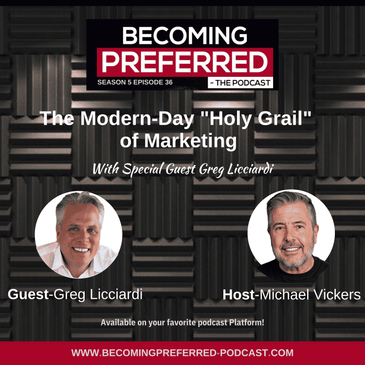
SEASON: 5 EPISODE: 36
Episode Overview:
Welcome back to the Becoming Preferred podcast, where we help you become the emotional favorite in your market. Today we are in for a masterclass on a topic that is the very foundation of all business success: marketing. My guest is someone who has spent his entire career at the intersection of brand strategy, consumer behavior, and marketing innovation.
We have the privilege of sitting down with Greg Licciardi. As the Vice President of Sponsorships and Partner Programs at the Association of National Advertisers, the ANA, he works with some of the most influential brands in the world, helping them elevate their campaigns and connect with their audience. With an MBA from Fordham and over a decade of experience as an Adjunct Professor of Marketing, he’s not just a practitioner; he's an educator who understands the principles behind what works. He’s also the author of the new book, The Holy Grail of Marketing. From American Express to Univision, Greg has consistently delivered award-winning results and today he's here to share his hard-won wisdom with all of us. Get ready to rethink how you approach your marketing efforts. Join me for my conversation with Greg Licciardi.
Guest Bio:
Greg Licciardi received his MBA from Fordham University and his undergraduate degree from Rutgers University. He has been an Adjunct Professor of Marketing at Fordham and Seton Hall universities for the past ten years.
As Vice President of Sponsorships and Partner Programs at the ANA, Association of National Advertisers, he consults with leading brands on how to elevate their marketing campaigns using the ANA's vast resources and events. He has also held senior leadership roles at American Express, Univision and Worth Media Group where he has won numerous awards.
Resource Links:
- Website: https://holygrailofmarketing.com/
- Product Link: https://www.amazon.com/Holy-Grail-Marketing-Greg-Licciardi/dp/B0F8KP9TNK/ref=sr_1_1?crid=4EP267K9ERYG&dib=eyJ2IjoiMSJ9.gylKSSBpgd1EJTYsGOSWvsJ-OmqnSJ8W62eDJe8pD3d7tcz7MXDrpeX9AtE_ziw1KqzF_wMbRCy4EPL2ypRVQq4nYCMnoAOSol0dAEWtqSGlh9vfeJ74nYHuWGWqmlIKw3W-DIs
Insight Gold Timestamps:
03:37 This is a really good question because marketing has changed greatly
06:11 Your book is entitled The Holy Grail of Marketing
07:19 I started researching other companies that were doing it really well
10:06 My goal with the book is to make it the must read modern day marketing book
11:08 I love the whole point of the right message at the right time, with the right individual and in the right environment
12:04 That's the positive side of AI, personalization with authenticity
14:18 How can we stop the customer from burning calories?
16:18 In that chapter I write about how sales and marketing are increasingly converging
21:10 I still teach the four Ps of marketing: Price, Product, Placement, and Promotion
23:30 I write about that in the book. I'm so happy you brought that up...the why
24:24 He calls it, What's your because?
25:30 A lot of today is about storytelling
28:05 Brands can't lose sight of the value of brand purpose
30:26 One campaign doesn't fit all niches
33:02 You also have to be a good networker
35:31 Don't always take the shortcut
36:19 The website is holygrailofmarketing.com
Connect Socially:
LinkedIn: https://www.linkedin.com/in/greglicciardi/
Instagram: https://www.instagram.com/greglicciardi/
Email: greglicciardi@gmail.com
Sponsors:
Rainmaker LeadGen Platform Demo: https://bookme.michaelvickers.com/lite/rainmaker-leadgen-platform-demo
Rainmaker Digital Solutions: https://www.rainmakerdigitalsolutions.com/
In 3, 2, 1.
Speaker BWelcome back to the Becoming Preferred podcast where we help you become the emotional favorite in your market.
Speaker BToday we are in for a masterclass on a topic that is the very foundation of all business success.
Speaker BMarketing.
Speaker CMy guest is someone who spent his.
Speaker BEntire career at the intersection of brand strategy, consumer behavior, and marketing innovation.
Speaker BWe have the privilege of sitting down with Greg Licciardi.
Speaker BAs the vice president of sponsorships and partner programs at the association of National Advertisers, the ana, he works with some of the most influential brands in the.
Speaker CWorld, helping them elevate their campaigns and.
Speaker BConnect with their audience.
Speaker CWith an MBA from Fordham and over.
Speaker BA decade of experience as an adjunct professor of marketing, he's not just a practitioner, he's an educator who understands the principles behind what works.
Speaker BHe's also the author of the new book, the Holy Grail of Marketing.
Speaker BFrom American Express to Univision, Greg has consistently delivered award winning results.
Speaker BAnd today he's here to share his hard won wisdom with all of us.
Speaker BGet ready to rethink how you approach your marketing efforts.
Speaker BJoin me now for my conversation with Greg Licciardi.
Speaker CWell, hi, Greg.
Speaker CWelcome to the program.
Speaker CWe're delighted to have you.
Speaker AThank you for having me, Michael.
Speaker AIt's such an honor to be on your show and to talk with you about the great topics that you've written about and that you share on your podcast.
Speaker CWell, I'm excited to have you.
Speaker CAnd we're going to be talking about the holy grail of marketing.
Speaker CAnd when we think of the term holy grail, we go, you know, what is that?
Speaker CBecause we know what the holy grail is, but of marketing, we're going to get right into it.
Speaker CBefore we get there, Greg, we like to always go with a little bit of background.
Speaker CHow did Greg become Greg?
Speaker CSo you grew up in the New Jersey area.
Speaker CI know you live in Summit, New Jersey.
Speaker AThat's right.
Speaker CBut let's go back to high school days and you're deciding to go to college and what you want to be when you grow up.
Speaker AAnd.
Speaker CAnd how did you get on this path?
Speaker AYeah, so I always studied business and marketing.
Speaker ASo I went to Rutgers University and I started working and realized that one day I'd like to teach.
Speaker ASo I went back to graduate school at Fordham University and got my mba.
Speaker AAnd when I was studying at Fordham, I focused on marketing and product management.
Speaker AAnd in doing that, I developed a great passion and interest for the marketing sector.
Speaker AMy first job out of school was working at a small boutique ad agency and advertising agency in soho and I kind of just dove in and about, you know, five years after getting some work experience, I went back to my marketing chair at Ordem and I said, look, there needs to be a course that really focuses on multi platform advertising that could target not just people who want to go into product management, but into media as well.
Speaker AAnd he gave me a shot.
Speaker ASo I started with a one and a half credit course and that developed over the years into a full course.
Speaker AAnd I've been teaching now 10 years.
Speaker AIt's hard to believe.
Speaker AI teach at Fordham and Seton Hall.
Speaker ASeton Hall's in New Jersey, in South Orange, which isn't too far from where I live, and Fordham, which is in, you know, the Bronx and in Manhattan.
Speaker CI love the whole sales and marketing world.
Speaker CAnd how do we get people to, you know, buy the things we're selling, this product, services.
Speaker CHow have you seen it evolve?
Speaker CSo you've started out, you're teaching it now.
Speaker CSo let's go back a decade or so because you've had 10 years of doing this when you started and where we are today, what does that evolution look like?
Speaker CWhat are you seeing?
Speaker AYeah, so it's, and this is a really good question because marketing has changed greatly and it's changing right now at breakneck speed.
Speaker AAs AI is coming in and new marketing technologies, it's really changing the whole marketing industry and it's causing a lot of upheaval.
Speaker AIn some ways I would say there's positive things as well as challenging aspects to what's happening.
Speaker AAnd so the biggest thing is that marketing gives brands the ability to really focus on short term gains very easily.
Speaker ARight.
Speaker ASo if you have to hit next quarter's numbers, there's a lot of, we call them bottom of the funnel marketing technologies that can help you optimize your performance, track your performance and do it in a way that is cost effective.
Speaker ARight.
Speaker AAnd you can measure every dollar you invest.
Speaker ASo that can seem really great.
Speaker ARight.
Speaker AYou know, and, but it also can cause a lot of things that go away from what I know you focus on, which is that emotional connection that, that brand purpose that you have to be consistent with in growing your brand.
Speaker CI've seen an EV of it and like you say, the technology enables us to do things quicker, faster, better.
Speaker CBut at the end of the day, I remember, let's go back two decades, we used to sit in front of the CFO and say, hey, Mr. CFO or Ms. CFO, here's what we can tell you about your $10 million marketing budget.
Speaker CHalf of it's going down the toilet.
Speaker CThe other half is going.
Speaker CWe just don't know which half.
Speaker CYeah, the toilet.
Speaker AYou know the Wanamacher quote.
Speaker AYeah.
Speaker CYes, exactly.
Speaker CAnd then Al Ray's came, you know, and there's all been this evolution of marketing, but at the end of the day, it's about getting attention, I think, and making people aware about it and then being there when they need us and hey, telling that story.
Speaker CBut it's forming those bonds and those emotional connections.
Speaker CAnd you know, I've seen it to where we used to do the ad buys and then we would take percentages of the ad buy and the budgets, but.
Speaker CBut now it's got down to where we don't always need big agencies.
Speaker CThe tools are accessible.
Speaker CAll of us, we can use the web.
Speaker CWe can actually get right down to the metric.
Speaker CInstead of doing a flyer and Hope something with 2% return or 5% return, we can go right to where did that source come from.
Speaker CWe can find out exactly where it is and we can expand and scale accordingly.
Speaker CSo I think it's got better maybe that authenticity that comes with it.
Speaker CSo it's critical that we have that message and we're going to get into all of that.
Speaker CSo let's actually maybe start this way.
Speaker CYour book is entitled the Holy Grail of Marketing.
Speaker CSo for our listeners, what is exactly the holy Grail and.
Speaker CAnd why is it so elusive for so many businesses?
Speaker AYeah.
Speaker ASo to answer that question, I'd like to share how I came up with writing the Holy Grail of marketing.
Speaker AMaybe that would help.
Speaker ABut coming out of the pandemic, I got hooked on fast food.
Speaker AI got hooked on Wendy's.
Speaker AI love her chicken sandwiches and their fries.
Speaker ASo I would go in and order Wendy's or I would order it online and then get on a zoom call and then go pick it up.
Speaker AAnd I noticed on Friday mornings around 11am I started getting Wendy's ads sent into my social feeds.
Speaker AAnd I was said to myself, this is the holy grail of marketing.
Speaker AThey're reaching the right person.
Speaker AThey know I've been there before and I like Wendy's.
Speaker AThey're reaching the right person with the right message.
Speaker AThey're sending me coupon offers at the right time, right before lunch and in the right environments in my social feeds where I'm engaged and the right outcome is happening because I'm not going to Burger King and I'm not going to McDonald's.
Speaker AI'm going back to Wendy's.
Speaker ASo when that happened, that epiphany I started researching other companies that were doing it really well and those became my case studies.
Speaker ABut there were two other things that happened.
Speaker AOne was we already discussed this a little bit.
Speaker AAs brands were becoming dazzled by AI, they were losing that emotional connection they were having and that was with their consumers and that was what was becoming at risk.
Speaker AThe second thing was that brands as marketing was now moving at breakneck speed, needed a North Star, a framework to really guide them through these complex marketing times that we're in and will continue to be in because it's only going to move faster as AI sets in.
Speaker ASo with that I came across a company called the Weather Company and I don't know if you've heard of them, they were owned by IBM, they were spun off about two years ago.
Speaker AAnd I met the cmo, Randy Stipes, who's amazing and, and I shared with her the framework of my book and what I was planning.
Speaker AShe said, okay, this sounds like it ties into what we do because the Weather company, they provide weather data to brands to help them reach their consumers at the right time.
Speaker ARelated to weather with empathy.
Speaker ARight.
Speaker ASo she gave me three case studies.
Speaker AELF Skincare, which is like one of the fastest growing brands right now in America, Sarah Face Skincare and Toyota.
Speaker AAnd they were just such great examples of how they use technology and data to reach the right person at the right time, at the right message, in the right environments.
Speaker AAnd so I kept going and I met the number three hire at Harry's Razors and yeah, this guy John Gillis.
Speaker AJohn, yeah, John's incredible.
Speaker ASo Harry's, when they launched, they went up against the giant Gillette, which is owned by PNG.
Speaker ASo they had 63% market share at the time and it was very simple.
Speaker AThey, these guys, the two founders saw the white space out there.
Speaker AAn affordable, stylish razor that could be sent to a young dad's home, right.
Speaker AThat would be easy to purchase, affordable, stylish, and they use their early customers as their preachers to go out and share the great product that they have.
Speaker AAnd they use gamification, they use all different aspects.
Speaker ASo the book kind of breaks down the framework to these success stories.
Speaker AAnd we also look at companies not doing the holy grail marketing well.
Speaker ASo it really goes across the spectrum.
Speaker ASo that's how I came up with the book.
Speaker AA long story short, I know I'm kind of answering your question a long way, but it really, my goal with the book is to make it the must read modern day marketing book for anyone who's you know, either they're new to marketing, they're a student right out of school, someone who just got funding to launch a startup and now they have to market their brand.
Speaker AA brand manager at Mars who's launching a new candy product.
Speaker ASo it's really a broad spectrum of readers that I'm targeting with the book.
Speaker ABut.
Speaker CWell, I think it's important to get.
Speaker COnce you have the framework can be adjusted no matter what the technologies are and you can decide where you want.
Speaker AAbsolutely.
Speaker CSo it's interesting because people think you have to have big budgets for this.
Speaker CBut it's like becoming preferred.
Speaker CWe don't spend a dime on advertising.
Speaker CBut if you were to go on Google becoming preferred, the first two pages are all ours and it's all because we have authentic content that we've created so much of it.
Speaker AAuthenticity is.
Speaker CSo is there.
Speaker CAnd two first two pages we just.
Speaker CIt's us.
Speaker CSo nobody's going to get that.
Speaker CWe own that one because nobody's even going to come close.
Speaker CWhich then adds value to the domain.
Speaker CIt adds value to the keyword.
Speaker CIt gives us something to work with.
Speaker COther companies, they require more advertising to get there.
Speaker CBut I love the whole point of the right message at the right time with the right individual and in the right environment.
Speaker CThat's a new one to consider.
Speaker CBut this is where even targeting like when we send out our emails, our systems will determine what are the best times and predict when's the best time that you open your emails.
Speaker CSo it will actually go in and check and the AI will look at that and go so it'll send it to you.
Speaker CIt might be a Thursday afternoon or it could be a post whenever you open your emails.
Speaker CAnd then you know, we're always amazed.
Speaker CWe always think it's with the echo and Amazon we'll be.
Speaker CMy wife might be talking about something and all of a sudden we're getting ads coming across.
Speaker CSo I.
Speaker CSomebody's listening somewhere.
Speaker CEither that or they're good guessers.
Speaker CBut yeah, the technology, it's got the good points and the bad points and I don't mind that.
Speaker CAbsolutely mind having things put that I'm interested in.
Speaker CSo if I'm interested in it, I don't mind it but because at the end of the day I'm not going to buy it unless I'm interested in it and I want it.
Speaker CSo it's kind of like curating for us.
Speaker AAbsolutely.
Speaker CBased on our.
Speaker AAnd that's.
Speaker AAnd that's the positive side of AI.
Speaker CYeah.
Speaker APersonalization with authenticity.
Speaker AThat personalization and authenticity can't happen without the data.
Speaker ARight.
Speaker ASo like, for example, I used to work for this UX firm and one of our clients was Goop.
Speaker AGwyneth Paltrow's.
Speaker AI don't know if you heard of Goop Day.
Speaker AShe's a cosmetic site and lifestyle site.
Speaker AAnd they used at the time, and this is going back about four years, but at the time they were using dynamic web pages.
Speaker AAnd what that means is when an individual went on a site and purchased, let's say if you went on and bought a shirt, you know, the shirt you're wearing, a nice black, stylish shirt.
Speaker ARight.
Speaker AThe next time you went on Goop, a nice stylish black shirt, maybe in a different slight, slightly different style would appear.
Speaker AAnd then a nice watch with a black band, you know, curated to what your interests are.
Speaker CYeah.
Speaker AAnd today that's the ki.
Speaker AIt curates responses, knowing your previous behaviors and purchases and likes and interests behaviors.
Speaker ASo that when it gives you an output, it doesn't just give you the answer, but it goes beyond that.
Speaker AAnd that today is service.
Speaker AThat's what Ritz Carlton, Four Seasons, Jaguar, Mercedes Benz.
Speaker AThat's what they all strive for.
Speaker AHow can they surprise and delight their customers?
Speaker AAnd that's where the, that is the most positive aspect of marketing.
Speaker AYeah, that we're going to see going forward.
Speaker AThat's going to be improved.
Speaker ABut along the way, we're also dealing with a cesspool ecosystem of programmatic and automation that is becoming very detrimental.
Speaker AAnd fake news sites, where all of a sudden your ads on some fake site and it's more detrimental than positive because the environment's not conducive to your brand message and it could create more harm than damage.
Speaker ASo there's a lot of aspects that marketers have to be watching out for.
Speaker CAnd I think if you're staying in that realm, like whether it's a content that you're sending out or education or advisor, people can put it out pretty quickly because people get lazy.
Speaker CI think to your point, the curation of all those key points, how can we stop the customer from burning calories?
Speaker CBecause if they have, if they have to burn calories to go find your product and find the right fit and the right bill.
Speaker CSo let's help them.
Speaker CLike I remember you're talking about, that's.
Speaker AA really good, good analogy.
Speaker CYeah, that's how I reference it.
Speaker CAnd that's going, is your website making burn calories?
Speaker CSo I got to go hunt and find.
Speaker CHow many clicks do I have to get to where do I want to get to?
Speaker CI know in 30 seconds whether I'm staying on your site or not.
Speaker CSo that's right.
Speaker CAnd I think it's 65, 70% of people stay on page one.
Speaker CYou know, they never get there.
Speaker CSo I've got to lead you.
Speaker CAnd keep scrolling.
Speaker COh, okay.
Speaker CKeep scrolling, keep scrolling.
Speaker CRight.
Speaker AAnd that's right.
Speaker CI should be telling you a story, but I know for a fact, you know, let's say I blue is my color and it knows blue is my color.
Speaker CAnd I'm checking out Hondas or BMWs or whatever I'm looking at, I'm going to see a blue one and they're going to show me different shades, midnight blue, sky blue.
Speaker CAnd we can even get those kind of details and data.
Speaker AThat's right.
Speaker CIt can get a little creepy.
Speaker CBut at the same time, I personally don't care because I like to see it.
Speaker CI like to see how they tailor that approach to it because then it gives you some clues.
Speaker CRight.
Speaker CAnd you can.
Speaker AThat's right.
Speaker COh, how are they doing that?
Speaker ASo that's, that's so true.
Speaker CYeah.
Speaker AIt makes the personalization, it's the name of the game so powerful.
Speaker AAnd that's where the engagement comes in.
Speaker AThat's where the trust comes in.
Speaker CAnd that's right.
Speaker CAuthority or trust.
Speaker CAnd well, here's an example.
Speaker CLet's say that you're selling me a widget or marketing services.
Speaker CYou're selling me marketing service.
Speaker CYou're a marketing agency and somebody calls up from your company and tries to set up appointment with me and go, hey, we're a great marketing agency.
Speaker CHere's all the areas that we work at, here's how wonderful we are, blah, blah, blah.
Speaker CLook at all the awards we win.
Speaker CBecause a lot of companies, agencies were very, let's win some awards which didn't generate more sales.
Speaker CThey were more focused on the awards than getting sales.
Speaker CAnd then typically if you have a bad campaign, they blame sales and sales, then blame marketing.
Speaker CSo I've always believed in, instead of two silos, it should report to one executive just because.
Speaker AWell, it's.
Speaker AThat's a really good point.
Speaker AAnd I have a whole chapter on that.
Speaker COh, excellent.
Speaker AHow holy grail marketing translates to increased sales and how in that chapter I write about how sales and marketing are increasingly converging, emerging.
Speaker AAnd as performance based marketing becomes a stronger part of budgets, that there's more transparency, there's the teams that work together because the marketing, now the data is what's coming from marketing.
Speaker AIt's not just a tech team off to the side.
Speaker ARight.
Speaker AAnd the more you can get inbound leads coming to your sales team through these different marketing campaigns, the more successful the sales team will be.
Speaker ABut they can't get that without marketing, and that's a real positive thing as well.
Speaker AAnd you're seeing marketing teams now getting a budget bonus structure built into their compensation based on sales.
Speaker ASo they're now getting compensated for increased performance.
Speaker AThe flip side of that, the average tenure of a CMO today is three and a half years.
Speaker AIf you're not performing as a cmo, you're not going to last too long.
Speaker CYou're going to get voted off the island.
Speaker ASo it's both sides of the coin.
Speaker ABut marketing is now being seen more as a profit center than a cost center, which it's.
Speaker AIt's been for a long time, but it hasn't been recognized for that.
Speaker AAnd now it's finally happening, which is great.
Speaker CWell, and the numbers change.
Speaker CLike back when we started, they always said 2% is a good number of your budget, your revenue to pay.
Speaker COn marketing, I would say now it's probably 5 to 10% and gone up and again by segmenting, by finding your tribe.
Speaker CSo, for instance, if you're selling me those same marketing services, but now you're contacting me and going, hey, we specialize, and it's a vertical initiative with professional speakers and training companies or with podcast hosts.
Speaker CWell, now you're getting my attention because it's about me.
Speaker CSo if you go, hey, it's Greg.
Speaker CWe're marketing agents that we specialize with professional speakers.
Speaker CWe recognize that your needs are different from anyone else's needs.
Speaker CAnd is that true?
Speaker CNo.
Speaker CBut do I think it's true?
Speaker CAnd the answer is yes.
Speaker AYes.
Speaker CWhatever.
Speaker CI'm thinking you should just validate me.
Speaker CI'm going, that's why as speakers, we use keynote instead of PowerPoint.
Speaker CIt's like I have these lozenges I use.
Speaker CThis is a great story, actually, in marketing they're called vocal zones and they're designed for professional speakers and singers.
Speaker CAnd I was with my mom.
Speaker CWe were.
Speaker CShe wanted to go see Tom Jones in Las Vegas.
Speaker CSo I have to admit, it was a fun concert and he did a great job.
Speaker CI enjoyed it, which I hesitate to.
Speaker ASay I've seen him.
Speaker CYeah, he's good.
Speaker CHe's good at what he does.
Speaker AHe still has it.
Speaker CYes.
Speaker CAnd I see him, he's not drinking any water and he's doing two hour concert and I see him put a lozenge in his mouth twice.
Speaker CAnd so I went and inquired what's the story?
Speaker CAnd because I have to have water when I'm speaking, like just to drink water.
Speaker CSo I found out these vocal zones and they little tabs are little lozenge comes in a nice box.
Speaker CBut if you go to their website it's all the speaker endorsements.
Speaker CYou'll know everybody, you'll know all the singers you know.
Speaker CWell, that's my lozenge.
Speaker CNow maybe a Tic Tac does the same job, maybe a Halls does the same job, but it's not designed for professional speakers or podcasts.
Speaker CSo I have my own lozenge and I don't mind paying five bucks for two little packs of it in order to do it because it's for me.
Speaker CRight?
Speaker CIt's for me.
Speaker CSo I think the personalization works Are.
Speaker DYou tired of chasing leads and ready to start effortlessly attracting more high value clients?
Speaker DIntroducing Rainmaker Lead Gen, the ultimate sales engagement and client acquisition platform that takes the stress out of outreach.
Speaker DWith Rainmaker Lead Gen, you can easily identify, engage, educate and convert your ideal prospects into loyal clients.
Speaker DOur industry leading automation and email sequencing empowers you to reach more ideal clients, accelerate the sales cycle and close more business.
Speaker DImagine authentically engaging with your prospects while the platform handles the heavy lifting.
Speaker DSay goodbye to the endless hustle and embrace a more efficient, effective approach to business development.
Speaker DReady to witness the magic?
Speaker DBook a 20 minute demo today and see how Rainmaker Lead Gen can revolutionize and level up your client acquisition game.
Speaker DThere's nothing to lose and everything to gain.
Speaker DDon't miss out on this opportunity to supercharge your client acquisition process.
Speaker DVisit rainmakerdigitalsolutions.com or check out the link in the show Notes to book your demo.
Speaker DRainmaker Lead Gen Spend less time hunting for your ideal clients and more time having high value sales conversations with your ideal clients.
Speaker BAnd now back to my conversation with Greg Licciardi.
Speaker CSo tell me, as a professor and marketing executive, you have a unique perspective on the gap between theory and practice.
Speaker CSo what's one of the biggest misconceptions about marketing that you've seen in the classroom that just doesn't hold up in the real world?
Speaker AYeah.
Speaker CWhat are they teaching?
Speaker CWhat are they teaching in other schools?
Speaker CMaybe because I know you're aware and you're saying so.
Speaker AI still teach the four Ps of marketing price, product placement, promotion, and that's still important.
Speaker ABut marketing has evolved beyond that.
Speaker AThere's so much more that goes into a marketing campaign.
Speaker ASo I think students, the big thing today is upskilling to the latest marketing techniques.
Speaker ASo in my book, one of my contributors is Vera Su from Microsoft.
Speaker AShe's very high up in AI and data.
Speaker AShe's frequently quoted and she talks about the importance of upskilling and the humanization of AI that has to be instilled in organizations.
Speaker ASo that when someone comes into an organization, into a marketing team, they're not just up on AI and AI techniques and AI technologies, but they are skilled at how to curate outputs, how to look at them and make them authentic and make them, you know, have that human element.
Speaker ASo that it's just not a generic message, but it really has a significance, a relatability to the audience they're targeting.
Speaker AAnd that still takes a training.
Speaker AIt takes looking at things differently.
Speaker AAnd that skill set has to be instilled in marketing employees today more than ever.
Speaker ASo people think, oh, you know, you don't need those skill sets anymore.
Speaker AYou absolutely need them even more than ever.
Speaker AAnd so I would say the most important thing with anyone going into marketing or that's coming out of a business school or marketing program is that all those analysis you've done in the papers wrote on case studies and your opinion being shared in those papers will carry through.
Speaker AYour opinion is always going to be needed.
Speaker ASo keep honing in on your ability to be a strong analyst, to have that analysis and really think forward on what messages and what marketing is going to work best against this specific consumer segment.
Speaker CYeah, it seems like the classroom, from my experience from school, it always focused on the what and the how of a campaign.
Speaker CBut business world, it seems obsessed with the why and why did it work?
Speaker AThe why?
Speaker CWhat was the return on the business?
Speaker CThis what was.
Speaker AThat's exactly right.
Speaker AYeah, that's so important.
Speaker AYeah, the why.
Speaker AAnd I write about that in the book.
Speaker AI'm so happy you brought that up.
Speaker AThe why, you know, in my great message chapter, it really is the why doesn't happen without the data and knowing inside and out who your consumer is.
Speaker ABut what keeps them up at night, what makes them click, and where does your product fit into to fulfilling that, that consumer need?
Speaker AYou know, that white space that's out there where your product is filling that whether it's a product or service.
Speaker CWell, that was Simon Sinek's book.
Speaker CStart with why.
Speaker CAnd it's ah, yeah, sense.
Speaker CIt's like he says, you know, Apple doesn't say, hey, we make really amazing computers made out of aluminum and solid integrated parts.
Speaker CWant to buy one?
Speaker CApple that's right.
Speaker CAnd says, hey, we make really amazing computers so that you can create anything you want to create.
Speaker CWant to buy one?
Speaker CAnd to get to that motivation of it, I had another guest on last season.
Speaker CHe calls it what's your Because?
Speaker CI should buy this because.
Speaker CWhat's your Because?
Speaker CWhy should I have this Because.
Speaker ALove it.
Speaker AWhat's your Because?
Speaker ASay that ten times fast.
Speaker CExactly.
Speaker ABut that's really great.
Speaker CIt's where it's there.
Speaker CWith your experience at the association of National Advertises, the ana, you've seen leading brands elevate their campaigns.
Speaker CWhat's a key strategy or secret weapon that large successful companies use that small business or entrepreneurs could adopt?
Speaker AYes.
Speaker ASo.
Speaker AAnd thank you for mentioning.
Speaker ASo I'm Vice president, Partnerships and Sponsorships at the association of National Advertisers, the ana.
Speaker AAnd the whole mission of the ANA is to provide marketers with the ability to do their jobs more effectively and to produce better results.
Speaker AAnd so at our conferences, we have several.
Speaker AOur big one coming up is Masters of Marketing in October in Orlando.
Speaker AWe have a lot of marketing leaders get on the main stage and talk about the successes that they're having and how they're creating success.
Speaker AAnd a lot of today is about storytelling, the ability to tell your story, to educate audiences and to do that cross platform.
Speaker ARight.
Speaker ASo TikTok is one of our big partners.
Speaker AThey're a strategic partner of the ana and they've had incredible growth, as everyone knows.
Speaker ARight.
Speaker AAnd the reason is they have these creators out there, these influencers that are telling brand stories with authenticity.
Speaker AThey have their tribes that are already following them, that they trust, they have built in trust.
Speaker AYeah.
Speaker AAnd they take these influencers and provide them with their brand and the ones that, you know, align with their brand and give them the authority to say, hey, share this with your following.
Speaker AShare this with your audience.
Speaker ATell them, educate them on our product, let them know how special we are.
Speaker AAnd that is really where the rubber is hitting the pavement today, where brands are excelling, you know, and it comes down to storytelling.
Speaker AIt comes down to really being strong at that.
Speaker AThink of you and me being at a bar somewhere and you telling me something, you know, really cool about your business, something that's different about your book and what's happening.
Speaker AAnd you're telling it to me in a very personalized way, very authentic way.
Speaker AAnd nothing can compare to that.
Speaker ANo ad, no 30 second commercial, no print ad, no radio ad, no billboard, nothing can compare to that.
Speaker ASo it's really great.
Speaker CAnd people trust that.
Speaker CThey love the Personal advocacy, they trust it.
Speaker CIf we're, if we were talking about tv, my wife and I like to binge and watch shows.
Speaker CSometimes once or twice a week we'll put on two, three episodes of something, right?
Speaker CSo think Game of Thrones, think Mob Life, whatever.
Speaker AYeah.
Speaker CSo once I know, hey, what are you watching?
Speaker CWhat are you guys watching?
Speaker CAnd I know what you like.
Speaker CGenre, I can give you different genres.
Speaker CSo it might be go see, you know, this one or go see Mobland.
Speaker CWe just watch.
Speaker COh, that's good.
Speaker COr go see Sons of Anarchy, whatever you're into and people check that one out.
Speaker COr what are you watching on Netflix or Paramount or whatever your favorite device is, right?
Speaker CSo it's creating that advocacy and people trust that.
Speaker CAnd advertisers, they don't trust.
Speaker CSo it's way down there like with salespeople, basic and politicians, I think it's the only thing that becomes worse than that.
Speaker CSo when you're looking at something market, so I love the authenticity and the story and make it relevant and personal and what is the story and take care of it.
Speaker CSo that makes sense, you know, from a personal advocacy point of view, what would you say, looking ahead, what's the biggest marketing trend that you believe professionals and entrepreneurs should be paying close attention to right now?
Speaker AI think that brands can't lose sight of the value of brand purpose and the, the ability to really have a strong brand ethos.
Speaker ASo right now everyone's talking about AI, everyone's talking about automation, right.
Speaker AProgrammatic, how to get your brand out there, like we talked about in the beginning of our discussion.
Speaker ABut it's proven that the stronger the brand purpose your brand has and the awareness level of that, as it goes up, the stock value, the value in that company goes up in proportion, direct proportion.
Speaker CThat's interesting.
Speaker AAnd today.
Speaker AWell, one of my contributors talks about this, James Wright, and he talks about this correlation and it's really powerful stuff.
Speaker AAnd today if you look at younger generations and Gen Z, this is really important to them.
Speaker AIf your brand isn't giving purpose driven marketing, if your company isn't giving back, isn't contributing to society in some way and another brand is, they're going to go with that other brand that's doing it.
Speaker ARight?
Speaker ASo and you just, you have to walk the walk, you have to talk to talk and your brand message has to come through and it has to resonate and that's where the automation can't do that.
Speaker ANo, it can't do that.
Speaker ASo it's so important.
Speaker CSo the trick is aligning the purpose with the right audience.
Speaker CSo, for instance, I'm a baby boomer.
Speaker CThat's right.
Speaker CAnd I should be more concerned about.
Speaker CWe're the ones who screwed up the planet.
Speaker CThat CEOs that are robbing them blind.
Speaker CYou can thank us for that.
Speaker AOkay.
Speaker CYou know, it's kind of like when I talk to millennials in the audience, I go, how many are millennials?
Speaker CHands go up.
Speaker CAnd I'll say to them, how many of you ever heard that?
Speaker CMillennials, you guys are entitled.
Speaker CYou have an entitlement mentality.
Speaker CAnd of course, all hands go up.
Speaker CAnd I'm going, I think you ought to be entitled.
Speaker CI said, personally, I think so.
Speaker CI said, you're entitled to a safe city.
Speaker CYou're entitled to clean air, you're entitled to clean water.
Speaker CYou're entitled to walk down the street and not get mugged.
Speaker CYou're entitled.
Speaker AThat's right.
Speaker CTo go to college and rack up a hundred thousand or two hundred and then get a good job when you exit, if that's how you're going to do it.
Speaker CThose are entitlements.
Speaker CAbsolutely.
Speaker AThat's right.
Speaker CWork for it.
Speaker CAnd we created that for you.
Speaker CSo, yeah, I'm good with that.
Speaker CBut it's relating to them and they're going, yeah.
Speaker CAnd then link it to what they value.
Speaker CAnd every generation has its own value system.
Speaker CAnd so that way, one campaign doesn't fit all niches.
Speaker CThis is why we see different.
Speaker CYou know, Apple might show an elderly couple working and talking FaceTime with their kids or grandkids.
Speaker AThat's right.
Speaker CShow me dancing in the street with my ipods going and our AirPods.
Speaker CAnd I'm playing my favorite music from itunes.
Speaker CSo I think it's matching the message to what is the goal?
Speaker CWhat's the motivation so important?
Speaker CYeah, I think so too.
Speaker CSo it kind of goes that way.
Speaker CYou've taught at Fordham and Seton hall and you continue to teach as a professor.
Speaker CWhat's one piece of advice you consistently give to your students that is just as relevant for a business owner or marketing professional?
Speaker AToday, it's just important to be up on the latest trends.
Speaker AOkay, so in every class that I teach, I always do current events and I do something called a dynamic insight presentation.
Speaker AIt's 12 minute presentation.
Speaker AThe students have to relate a current news story to what we're learning in class.
Speaker AOkay.
Speaker ASo, so.
Speaker AAnd it's amazing what they present and what they find.
Speaker ASo it's really great stuff.
Speaker AWhether, you know, it's Nike buying another footwear brand or New things that are happening.
Speaker AAI coming into marketing and how it's changing privacy rights and laws.
Speaker AAnd it's just really fascinating.
Speaker AAnd I say, you go on an interview, you need to be able to talk.
Speaker AYou need to be up on the latest trends.
Speaker AI said everyone should be reading.
Speaker AYou know, in a lot of the universities, they get a free New York Times, they get a free Wall Street Journal.
Speaker AAnd these aren't cheap.
Speaker AEven though a lot of them are digital now, they're still very expensive.
Speaker AYeah.
Speaker AAnd they're free.
Speaker AThey're free for students at a lot of universities take advantage of that.
Speaker CYeah, they don't read.
Speaker ASo.
Speaker ASo you got to be up on the current trends and that that's throughout schooling and when you're a young professor, throughout your career, but especially now, as things are, things are happening so quickly.
Speaker AIt's so important right now, stay relevant.
Speaker AI've been at a long time relevant.
Speaker AExactly.
Speaker CI showed up, it's like we knew this was going somewhere and we figured, okay, is AI going to replace what we do?
Speaker CNo, but someone who knows how to use it well is going to replace what we do.
Speaker CAnd so for us, yes, how do we adapt it so it helps us create content quicker, faster, new ideas, but we still add that organic element to it to relate it for the personalization and the authenticity that comes with the story.
Speaker CSo I think that's critical as well.
Speaker CFor someone who's new to the marketing world, what's the single most important skill they should focus on to develop and build a successful career?
Speaker CStaying relevant.
Speaker CWe just kind of covered one of them for sure, but anything relevant.
Speaker ABut you also have to be a good networker because the marketing field is a very social field.
Speaker ASo you have to be learning from your co workers and from your fellow industry professionals on these trends, but also learning about where are the future opportunities existing and who's doing it right, who's not doing it well.
Speaker ASo it's really a social industry, so you have to be a good networker, but you also, again, you have to be looking to be upskilling yourself.
Speaker AYou know, there's so many courses that outside of an MBA or master's degree, there are so many master classes that you can take on different aspects of marketing technologies and AI.
Speaker AThere are so many AI certificate courses out there.
Speaker AI think every training company is trying to make a buck on this growth.
Speaker ARight.
Speaker ABut look, if you just did a certificate program in AI and marketing and you go in for an interview or go for a promotion and the person next to you hasn't you're going to have that competitive advantage.
Speaker ASo keep that in mind.
Speaker APlus, it's good, it's fun to learn new things.
Speaker AIt's good to think about.
Speaker AIt opens your mind.
Speaker AIt's always good to be well rounded.
Speaker AYeah.
Speaker CYou know, you can see the evolution.
Speaker CIt's not always the one idea.
Speaker CIt's what that makes you think about or how does that work for you?
Speaker CAnd again, I'm a firm believer in niching down and your verticals and then appealing to the vertical versus say, mass market.
Speaker CSo I think I love that.
Speaker CYou know, if I'm working with chiropractors, I'm going to go after chiropractors.
Speaker CYou can interview that group or make some purchase, get the first one.
Speaker CThat's the hardest one to get.
Speaker CAnd once we get the first one, we know we can go get everybody else because we know what those points are.
Speaker CSo we can go from there.
Speaker CWell, to conclude, if you could leave our listeners with one final actionable piece of advice to help them get closer to finding their own holy grail of marketing, what would it be?
Speaker AWell, I would say that the ability to reach the right person at the right time with the right message in the right environment.
Speaker ARight.
Speaker ATo orchestrate that.
Speaker AAnd it is a holistic approach, comes to really knowing your audience, like really immersing yourself in who they are and where they exist.
Speaker ABecause the more you know about them, the more successful you'll be at marketing to them and winning them over.
Speaker ASo there's so much, so much marketing technologies and AI, of course, that's helping brands do this, but don't always take the shortcut, really.
Speaker ASo like for example, do the work.
Speaker AI remember at the ad agency we were launching a barbecue sauce.
Speaker AWe were helping a brand launch.
Speaker AWe had to dive in to barbecue sauce.
Speaker AI tasted almost every type of barbecue sauce that existed.
Speaker ABut we also did these in person focus groups.
Speaker ASo when people tasted the barbecue sauce, we could actually see how they reacted, their facial expressions.
Speaker AWe looked at the color of the bottles and how they reacted with those different colors.
Speaker ALike we immersed ourselves not only in the sector but in those consumers that love barbecue sauce to find out what makes them tick.
Speaker ASo it was really, really great.
Speaker CNo, it's an interesting perspective.
Speaker CWell, this was great, Greg, lots we can talk about.
Speaker CThe book is the Holy Grail of Marketing.
Speaker CThe website.
Speaker AYes.
Speaker CIs Holy grail of marketing dot com.
Speaker AHoly Grail of marketing dot com.
Speaker AIt's sold pretty much anywhere.
Speaker AAmazon, Barnes and Noble.
Speaker AAnd so I feel whoever is watching this will really get A great deal.
Speaker AIt's a very inspirational book covering our discussion and lots of good stories on.
Speaker CWhat'S worked and what hasn't worked.
Speaker CSo it's good.
Speaker AThat's right.
Speaker CI want to ask, I'm just curious, is the pitch dead?
Speaker CLike we see a lot of young people, they're coming out with no marketing experience.
Speaker CThey're coming out with a message.
Speaker CThat 30 second sound bite or elevator pitch where they're blah, blah, blah, like a movie pitch.
Speaker CAnd it's going nowhere because they're just quick pitching.
Speaker CIs the pitch dead or is it still a valid piece of what we do?
Speaker AIt's still a valid piece, but it's changing.
Speaker ASo again, back to storytelling.
Speaker AI don't think that the pitch as far as you watch Mad Men, I'm sure, right?
Speaker CAbsolutely.
Speaker ADon Draper and getting in there.
Speaker AI love the Hilton pitch.
Speaker AGo to the moon.
Speaker CI was old school.
Speaker CSix, seven.
Speaker CYeah.
Speaker AI love that.
Speaker ARight.
Speaker ASo I think that that ability to win a client over.
Speaker ABut you have to listen first.
Speaker AYou have to understand the brief.
Speaker AYou cannot just go in with some splashy creative that may not be on target that you think is good just because it'll have the wow factor.
Speaker ABut you have to really understand what are everyone talks about this KPI's key performance indicators.
Speaker AWhat is it they want to achieve?
Speaker AAnd you need to deliver on that.
Speaker AYou need to show not only results, but how you're going to track the results.
Speaker CYeah.
Speaker AHow are they going to measure success?
Speaker CYeah.
Speaker ABecause that becomes your anthem.
Speaker CYeah.
Speaker CGreg Licciardi, this was fabulous.
Speaker CThank you and thanks for your generosity with your insights.
Speaker CAppreciate you being here.
Speaker AThank you for having me.
Speaker BAs you are listening to this episode, what is one idea that you've heard that's caught your attention and why does it matter so much to you?
Speaker BAnd who is one person who you can share that with?
Speaker BEither sharing this episode or just sharing that insight that occurred to you while you were listening.
Speaker BPerhaps it is learning how to make the buying process a natural part of the content consumption journey or creating a brand purpose that resonates with your audience's values.
Speaker BThank you for listening, for learning, and for investing in yourself so that you can become the best version of you.
Speaker BIf you found value in this episode, please write a review on Apple Podcasts.
Speaker BIf you haven't subscribed yet, please do so so that you can get a new episode and start your week off right every Monday.
Speaker BUntil next time.
Speaker BThis podcast is created and associated with Summit Media.
Speaker BMy executive producer is Ben Smith and director of research Tori Smith.
Speaker BThe fee for the show is that.
Speaker CYou share it with friends when you.
Speaker BFind something useful or interesting.
Speaker BThis podcast is subject to copyright by Summit Media.
Speaker AGoodbye.