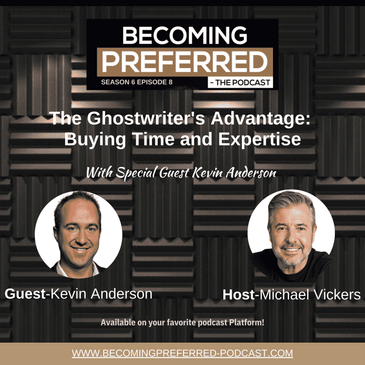
SEASON: 6 EPISODE: 8
Episode Overview:
Welcome back to Becoming Preferred, the podcast dedicated to helping you reach your highest professional potential. Today, we're talking about the ultimate business credential: the high-impact non-fiction book.
Our guest has mastered the art of turning expertise into intellectual property. He's a #1 national bestselling author himself, a Harvard-trained scholar, and the CEO of a firm that helps public figures and top professionals land deals with major publishers. He is the person leading literary agents and corporate leaders call when the message must be perfect.
Kevin Anderson is here to reveal the secrets to leveraging your knowledge. He'll show you why a quality book is the single most effective way to elevate your authority, attract premium clients, and transform your business model.
If you have a powerful message that needs to be heard, Kevin is the bridge between your expertise and the bestseller list. Let's learn how to make your book the foundation of your legacy. Join me for my conversation with Kevin Anderson.
Guest Bio:
Kevin is an accomplished ghostwriter, #1 national-bestselling author, editor, and entrepreneur with a wealth of industry knowledge and professional experience. He has worked with numerous bestselling and award-winning authors, prominent literary agents, Big-5 publishers, and a long list of public figures, successful professionals, and aspiring authors. He is also a contributing author by invitation to Publishers Weekly’s Book Publishing Almanac 2022: A Master Class in the Art of Bringing Books to Readers and the author of the #2 Wall Street Journal, #1 Barnes & Noble, and #1 Amazon bestseller, PhDone: A Professional Dissertation Editor’s Guide to Writing Your Doctoral Thesis and Earning Your PhD.
Both a creative writer and a scholar, Kevin earned his master’s degree at Harvard University with a concentration in literary theory and criticism. While at Harvard, he studied under Poet Laureate and critical theorist, Professor Michael D. Jackson, and honed the literary criticism skills upon which he built his career in the book-writing and editing business.
As CEO and Editor-in-Chief, Kevin oversees all operations at our firm. He enjoys working closely with clients and makes himself readily available by phone and email throughout the planning, ghostwriting, editing, and publishing process. He is an invaluable resource and dedicates his time and expertise generously to ensure our clients receive the best quality service in the industry.
When he’s not collaborating with authors, agents, and publishers, you may find him reading Nabokov, Cormac McCarthy, or Proust; surfing the northeastern shores; composing music; fishing for striped bass; debating philosophy; brewing Belgian-style beer; wakeboarding with his family and neighbors; or enjoying the arts, culture, and food of a faraway place. Of all life’s pleasures, Kevin most enjoys the adventures he shares with his wife and their four children.
Resource Links:
- Website: https://www.ka-writing.com/
- Product Link: https://www.ka-writing.com/book-coaching/
Insight Gold Timestamps:
04:29 The other misconception that a lot of people have with ghost writing...
05:59 We meet authors wherever they're at
07:43 It's not having a bestseller for bestseller's sake
09:09 Authority that comes with being a published author
11:01 From a credibility point of view for consultants, for coaches, entrepreneurs, it's a great lead in for that
13:38 I never advise clients, especially in the nonfiction space, that the goal should be making money on book sales
18:15 Nothing says authority or expertise like a book
21:02 Audio books have become extremely popular
22:34 The most important thing is that you have a really great product in the end and that you've done it the right way
23:13 You're not going to grow if you don't learn to leverage
25:07 Studies that show that 80% of of Americans have thought about writing a book, but less than 1% ever finish one
27:15 There's a lot of legal issues when it comes to using AI to write a book
29:30 In terms of writing good books, it has to have something to say that's meaningful
30:35 You can never edit yourself
33:30 The website's ka-writing.com
34:20 Never being afraid to try something new, never being afraid to fail, I think that's been a guiding principle through my entrepreneurial journeys in general
Connect Socially:
LinkedIn: https://www.linkedin.com/in/ghostwritereditorkevinanderson/
Facebook: https://www.facebook.com/KevinAndersonAssociates
Instagram: https://www.instagram.com/kawriting/
Email: info@ka-writing.com
Sponsors:
Rainmaker LeadGen Platform Demo: https://bookme.michaelvickers.com/lite/rainmaker-leadgen-platform-demo
Rainmaker Digital Solutions: https://www.rainmakerdigitalsolutions.com/
In 3, 2, 1.
Speaker BWelcome back to Becoming Preferred, the podcast dedicated to helping you reach your highest professional potential.
Speaker BToday we're talking about the ultimate business credential, the high impact nonfiction book.
Speaker BOur guest has mastered the art of turning expertise into intellectual property.
Speaker BHe's a number one national best selling author, himself a Harvard trained scholar, and the CEO of a firm that helps public figures and top professionals land deals with major publishers.
Speaker BHe is the person leading literary agents and corporate leaders call when the message must be perfect.
Speaker BKevin Anderson is here to reveal the secrets to leveraging your knowledge.
Speaker BHe'll show you why a quality book is the single most effective way to elevate your authority, attract premium clients, and transform your business model.
Speaker BIf you have a powerful message that needs to be heard, Kevin is the bridge between your expertise and the bestseller list.
Speaker BLet's learn how to make your book the foundation of your legacy.
Speaker BJoin me now for my conversation with Kevin Anderson.
Speaker CWell, hey, Kevin, welcome to the program.
Speaker CWe're delighted to have you.
Speaker DThank you, Michael.
Speaker DHappy to be here.
Speaker CHey, I'm excited about this.
Speaker CThis is a topic we haven't had and we're in season six and we've had writers, we've got lots of authors.
Speaker CBut it's kind of nice to go behind the scenes and share with our audience how some of those things come to be and how people get the books.
Speaker CAnd we're going to talk about ghostwriting and services and to create bestsellers and just all about the industry and inform our listeners how that could work and how it can serve them.
Speaker CBut before we get there, Kevin, let's go back in time.
Speaker CNow.
Speaker CYou and I were talking just prior to starting our show.
Speaker CYou grew up in Alberta, up in Canada for a little while.
Speaker CYou spent a number of years there, went to school before you went over to, I believe it was Harvard.
Speaker CYou went to school and you were teaching English and writing.
Speaker CAnd let's go back in those days.
Speaker CWhat was Kevin trying to be when he grew up?
Speaker DYeah, well, after paleontology wasn't going to work out for me.
Speaker DI like every other kid, you know, I really started, I loved teaching and I really loved that element of academia where, you know, and honestly, at first I thought I was going to be a, an elementary school teacher and I went to school for that at the University of Lethbridge in Alberta.
Speaker DBut what I didn't expect was that I just actually fell in love, even more so with learning.
Speaker DAnd then I loved teaching, but I loved teaching higher level stuff than maybe like a grade six curriculum.
Speaker DSo I Figured I just loved it so much that I wanted to go to grad school.
Speaker DAnd I learned that fair early on in my undergrad.
Speaker DAnd so the trajectory was going to be to be a professor.
Speaker DSo I wanted to be an English or philosophy professor.
Speaker DBut then, yeah, when I was at Harvard, I started my first company and it took off and I had a choice.
Speaker DIt was already kind of earning six figures even while I was a student.
Speaker DBut the choice was to either go out with my master's or I could continue on five more years of academic, rigorous study and become a professor.
Speaker DAnd I'm not sure if you know much about that, but usually that means you're going to have to find some adjunct position in the middle of nowhere to build towards.
Speaker CYeah, yeah.
Speaker DSo it could be a really long process.
Speaker DSo I just thought, you know what?
Speaker DLet's just do this now.
Speaker DI really enjoyed it.
Speaker DI really enjoyed the business was serving.
Speaker DIt was a service company.
Speaker DIt was along the lines of tutoring and writing instruction.
Speaker DAnd so, yeah, I went out with my master's and have been a business person and entrepreneur ever since.
Speaker CWell, it's nice to be able to convert that skill and from maybe from thesis papers and research papers to, you know, where it is today.
Speaker CAll right, so you started to see an opportunity for ghostwriting.
Speaker CAnd a lot of people, they don't quite understand how ghostwriting works.
Speaker CI remember when I started my career early, I was getting about 50 articles a year.
Speaker CI was producing, I was being interviewed by my ghostwriter, and they would get the general concept and then they would write because I was doing an issue every week in a newsletter.
Speaker CSo we use ghostwriters because they were good at doing that and we get the credit for it.
Speaker CPresidents use ghostwriters, prime ministers, top speakers do.
Speaker CIs it still kind of a behind the scenes kind of a thing that people don't understand how much is actually written and what's the process?
Speaker CLet's maybe talk about that, because I think that people have a lot of misconceptions about it.
Speaker DYeah, there are a lot of misconceptions.
Speaker DAnd, you know, today it's a little different than 10, 15 years ago, when we first started into the industry.
Speaker DNow it's very common to see a co author, which is usually the ghostwriter, see their name as like a.
Speaker DWith credit on the COVID It's not always the case.
Speaker DAnd a lot of our clients, it's completely confidential or the name will appear in the acknowledgments as like, you know, thanks to Kevin Anderson and associates for all their help with my book.
Speaker DBut it doesn't say that we actually were ghostwriting it.
Speaker DBut the other misconception that a lot of people have with ghostwriting is they think that the author just says, hey, you know, I've got this great business or this great idea.
Speaker DHere's one or two sentences about it.
Speaker DGo back and bring me back a book, and then I'm going to stamp my name on it and put it out there as my own.
Speaker DWhich is just not the way that we work at all with our clients.
Speaker DWe really believe that the author is the author and all of the information is coming from them.
Speaker DWe're just a very sophisticated pen that helps them deliver that message in a way that's readable and that really targets their audience.
Speaker DAnd the ghostwriting process is really just a matter of getting exactly what's already in their head and getting it out in a way that's articulate.
Speaker DBecause, let's face it, you don't do your own taxes.
Speaker DYou don't do your own dentistry work.
Speaker DIf you're not a professional writer, there's no reason why you should be trying to be one.
Speaker DSome people like, such as yourself, are natural writers, but a lot of business owners and CEOs and thought leaders are not.
Speaker DThey might even be a really great speaker, but they really struggle with writing.
Speaker DSo that's where we come in to just help draw that out of them and make sure that it's really in their authentic voice.
Speaker DBut all the material, all the words, all the ideas, it's all coming from the author.
Speaker DSo none of it is being stolen or plagiarized.
Speaker DIt's really coming from the client.
Speaker CYou've seen a lot of success.
Speaker CI think You've had over 600 bestsellers within your organization, which speaks for itself.
Speaker CIs it formulaic in the process?
Speaker CIt's almost like when you go to your website and you look at that process, there's a good investment.
Speaker CBut is it one of those things where you can make it a bestseller?
Speaker COr, hey, we cross our fingers, we hope it's the best seller.
Speaker COr did you get pretty confident once you start diving into the content?
Speaker DYeah, great question.
Speaker DYou know, we authors, wherever they're at, right?
Speaker DSo some authors come to us with no writing skills.
Speaker DThey want us to handle everything.
Speaker DOthers have a fully written manuscript and they just need it edited or rewritten and help with figuring out how to get it published and hit a bestseller list.
Speaker DOne of your questions there was about whether we know in advance whether it might be a bestseller or not.
Speaker DYou can tell sometimes just by somebody's platform, meaning the number of followers they have, the access they have.
Speaker DIf they're doing a lot of big events that are getting good attendance, we can kind of see how many books they might be able to sell and gauge that.
Speaker DBut you know, a dirty little secret is anyone with the right budget and the right angle can hit a bestseller list, even the legit ones like the USA Today bestseller list, which make you a national bestselling author.
Speaker DWith the right strategy, anyone is able to hit these lists.
Speaker DYou have to do certain things.
Speaker DYou have to have a good quality book.
Speaker DSo it's not something you can just push a button.
Speaker DBut there is a strategy for that, however, hitting like the New York Times bestseller list.
Speaker DThis book here, the Owen Perlman.
Speaker CYeah, I just got that book.
Speaker DYeah, it's a great book.
Speaker DIt's been on the New York Times bestseller list for the last several weeks.
Speaker DThis is one of our clients that we worked with from the very beginning.
Speaker DWe knew, I mean he had a huge audience, he had a great book idea, a lot of application for the reader.
Speaker DWe knew well in advance that had a really great shot of hitting the list.
Speaker DBut even then he did a lot to just, you know, a lot of pre promotion leading up to pub day is really important that you're getting as many pre orders as possible for multiple reasons.
Speaker DFor one, you'll run out of stock if Amazon doesn't realize how much books are going to sell once you publish.
Speaker DBut his book, he did a lot of preparation to make sure that people really knew about the book in advance.
Speaker DAnd the New York Times bestseller list is the most difficult one to hit.
Speaker DAnd it's also the one that gives a lot of the, maybe the most credibility, I suppose.
Speaker CSure.
Speaker CSo what you're saying is if you go through the process and you go through the different process, you can get your book as a bestseller.
Speaker CIt's a means to an end.
Speaker CLike it's not having a bestseller for bestseller sake.
Speaker CIt's what's this book going to serve you?
Speaker CSome of your authors are billionaires, some are millionaires, and some are just guys who are working right date 9 to 5 and they have their book.
Speaker CSo you've got a full range of people there and the investments can be significant.
Speaker CWhat kind of reasons, what kind of outcomes do you see from people who've actually had the book?
Speaker CAnd then typically how long does that process take?
Speaker CIs it like a four to six month window typically to get your book out there on the bookshelves in today's world.
Speaker CWhat about doing it yourself and printing it yourself versus going the traditional.
Speaker CIt's like in music, you've got Taylor Swift who kind of said screw you to the music industry and created her own vertical channels for distribution, concerts, promotion, of course, rewrote the book, so to speak.
Speaker CWhat are you seeing in your world?
Speaker DYeah, and you can do that.
Speaker DWhen you're Taylor Swift and you already have millions and millions of fans, you can start to do your own thing a little bit.
Speaker DA lot of our clients are not, you know, we do have a lot of billionaire clients.
Speaker DI think we're almost at two dozen now.
Speaker DAnd they're in a different category and how they are approaching it and what their goals are.
Speaker DA lot of our clients are just are aspiring business owners.
Speaker DThey've not even made it yet as a business owner or they're looking to do speaking or they're looking to just get some authority around them and their business.
Speaker DAnd so that when people are looking them up online or they're showing up their office, they can show them this book that shows that they have expertise and authority and it's that that's the real ROI for them and it really separates them from the rest.
Speaker DAnd it also is a great asset that they can keep reusing.
Speaker DIf they are doing social media or if they're doing things like that, they can keep drawing from the book and show that authorship and that authority that comes with being a published author.
Speaker DSo yeah, a lot of our clients, when they're looking at the book and trying to invest and thinking about what their ROI is, it's really what it does for their business long term and what it does for them in terms of elevating their speaking fee or elevating their business or their brand compared to their direct competition.
Speaker DAnd with those kinds of projects, sometimes their goal is just that.
Speaker DIt's just they just want to have that book show up.
Speaker DWhen people look them up others, they really want a bestseller status.
Speaker DThey want to be able to put bestselling author or when they're trying to get speaking gigs, they want to be able to say, you know, national best selling author.
Speaker DAnd that has a big value add for them.
Speaker DSo with authors where they really want to target and hit the bestseller list, we will take a little bit of a different strategy than if they just want to have a book.
Speaker DAnd that changes the investment, but it also just changes the timeline.
Speaker DThere's certain publishers in certain ways to publish that are going to elevate your chances of hitting a national bestseller list.
Speaker DWhereas if you really just want to have a book and that's the main goal.
Speaker DAnd you're not really interested in what a best selling label will do for you.
Speaker DYou might want to just self publish or do something that's much smaller scale and not invest quite so much because you can achieve that with much less in terms of monetary investment.
Speaker CWell, like I said, I think there's a means to an end to it.
Speaker CIs it going to be an ego piece?
Speaker CIs it going to be a.
Speaker CIs this about me that I want to help promote the stock of the company and leadership.
Speaker CI can speak to it as a professional speaker.
Speaker CI remember was publisher Parish and some people write forward like they write as it unveils to them.
Speaker CI was right in the past, meaning I've been doing it and talking about it for months and years.
Speaker CThen I'll write about it because I know it works and I got the sound bites down right.
Speaker CSo I can bring those into the book.
Speaker CRight.
Speaker CSo that's my creative process.
Speaker CBut I know when I show up for a meeting with a VP or a CEO and let's say you and I both show up and we're both selling the same service or positioning it, I hand them a couple of copies of my books and you don't have them, I win.
Speaker CAnd if price is equal, I win.
Speaker CSo from a credibility point of view for consultants, for coaches, entrepreneurs, it's a great lead in for that.
Speaker CAnd so I can attest to it.
Speaker CYou talked about ROI and there's obviously different investment levels that can go into it based on the quality of the riders.
Speaker CAnd if you're wanting top shelf versus if you're Branson or Michael Dell and you're wanting a.
Speaker COr Bill Gates and you want your autobiography.
Speaker CIs it, is there so many books where you have to sell this many?
Speaker CWhat's respectable, like 50,000 copies, 20,000 copies, 100,000.
Speaker CWhere does it start to make sense from how many we've sold point of view?
Speaker DYeah, yeah, it's a great question.
Speaker DAnd usually with our clients the book sales is just not even a factor other than making sure that they hit the list if that's part of their goal to kind of have that moniker.
Speaker DActually selling books is not the goal, it's more what it does to leverage them and their visibility of the brand.
Speaker DAnd, and that's really the roi because we don't advise too many clients to write books as investment.
Speaker DYou might as well put your money into an index fund and it's going to be a better bet for sure than writing a Book and trying to get money based off of sales.
Speaker DYeah, but if the return on investment is more what it does for your business and the clients that you're going to get, you know, you think about it in the next 10 years and remember, book lasts a long time.
Speaker DIf you Google somebody, their book might have been 20 years old and that book is still going to come up really high on Google on the ranked search.
Speaker DAnd so a book lasts a very long time.
Speaker DAnd so you got think about if I have this book, if I have a book and I can use that as a marketing asset for the next 20 years, how many clients am I going to get?
Speaker DHow many new deals am I going to be able to get?
Speaker DHow is it going to help me build my business?
Speaker DIs there going to be an roi?
Speaker DAnd of course, the earlier you start, the better.
Speaker DBut to answer your question just in terms of sales, because for some authors, like fiction authors, we did the Five Nights at Freddy's, which was an adaptation of a video game.
Speaker DIt became a number one New York Times bestseller.
Speaker DBut it's a novel in those cases.
Speaker DIt really is about book sales.
Speaker DYou need to have those book sales to make the project worth it because it's not serving a business or any kind of brand, but just in terms of sales on average on the very bottom of the USA Today bestseller list, usually it's about 4,000 books a week is what they're selling.
Speaker DThat could get you on the very bottom of the USA Today best selling list.
Speaker DDepending on who your publisher is, your royalties may be not great or if you sell publisher royalties will be really high, which means the percentage of those sales that are actually like what percentage of the book sticker price are you actually getting?
Speaker DBut most, most of our authors in terms of book sales, where they're making their ROI kicks in once they're selling about five to seven thousand book.
Speaker DUsually you're making some kind of ROI on the service.
Speaker DBut of course it depends on the service too, because sometimes an author just needs a very little.
Speaker DThey just need to kind of elevate what they already got to another level or they're looking for a book coach.
Speaker DWhereas others, they need to invest a lot more.
Speaker DBut like I said, I never advise clients, especially in the nonfiction space, that the goal should be making money on book sales.
Speaker DIt should really be a bigger picture reason for the investment.
Speaker CI think you're right.
Speaker CIt's a catalyst really.
Speaker CI remember when I was getting speaking fees and then once I had the book, it did really well, it sold.
Speaker CSo I always Say there's real writers who are real writers and if I made movies, mine would have a lot of stuff that explodes and blowing up and really pretty beautiful people running around with no redeeming value whatsoever.
Speaker CThink John Wick, you know, but it sells, right?
Speaker CAnd so it's writing to.
Speaker CIf you know your marketplace or you have a captured niche or vertical.
Speaker CIs there a hybrid version of this?
Speaker CSo let's say you're not so concerned about getting on the bestsellers list, but let's say you're a good entrepreneur, you're a smart business guy, you're busy, you've got the cash flow and hey, I'm going to do a book on this to help support my business and then I want to maybe self publish that book and go through that channel.
Speaker CBecause you can go to the same printers that the big guys go, the big publishing houses, whether it's random Penguin, you can go to those houses, you can get them printed.
Speaker CBut you're right.
Speaker CAnd then my fees went and that book, right now if you Google and the topics, the name of the podcast, I'm still getting value out of it 20 years later and all because of that.
Speaker CSo to your point, so if you amortize out your marketing, how much are we spending on doing pieces, blogs, posts and how much time and energy versus putting it into an actual book?
Speaker CSo do you get authors that are that way where maybe they self publish, but they've used your services from a ghostwriting point of view, but then they create their own product that way they control it if they like to look after the control.
Speaker CAnd then have they had success as well?
Speaker DIt's very common.
Speaker DYeah.
Speaker DI mean we're agnostic when it comes to the publishing avenue.
Speaker DWe've placed million dollar deals with Penguin Random House and we've done very, very small scale self pub books and had them out within like a month or two.
Speaker DAnd it really depends on the author's goal for what they want out of the book, whether they want to do a self pub or there's also hybrid publishers which kind of do a little bit of both.
Speaker DThey do some of the services of marketing and design and things that a traditional publisher does, but yet you retain most or if not all of the rights to the book.
Speaker DSo there's a lot of different options for authors.
Speaker DIt also depends a lot on timing when they really want that book out by.
Speaker DYou can get your book out a lot quicker if you self publish, whereas with traditional publishers it can take easily a year and a half from the time you get the deal done with the publisher, never mind the writing.
Speaker DYeah, so there's different reasons you would go different directions.
Speaker DBut yeah, we've had many authors that they have an idea where we get the book together in a very short amount of time.
Speaker DSelf published.
Speaker DThey're in control of everything to do with the book.
Speaker DWe show them how to make sure that it's showing up properly on Amazon, showing up in all the right places and and they get huge value from it and very quickly.
Speaker DAnd we've got authors too that do their first book that way and then the second book, once they get some sales built up or they've built an audience, then they go to a traditional publisher to do their There's a lot of different options for authors depending on what their immediate and long term goals are.
Speaker AAre you tired of chasing leads and ready to start effortlessly attracting more high value clients?
Speaker AIntroducing Rainmaker Lead Gen the ultimate sales, engagement and client acquisition platform that takes the stress out of outreach.
Speaker AWith Rainmaker Lead Gen, you can easily identify, engage, educate and convert your ideal prospects into loyal clients.
Speaker AOur industry leading automation and email sequencing empowers you to reach more ideal clients, accelerate the sales cycle and close more business.
Speaker AImagine authentically engaging with your prospects while the platform handles the heavy lifting.
Speaker ASay goodbye to the endless hustle and embrace a more efficient, effective approach to business development.
Speaker AReady to witness the magic?
Speaker ABook a 20 minute demo today and see how Rainmaker Lead Gen can revolutionize and level up your client acquisition game.
Speaker AThere's nothing to lose and everything to gain.
Speaker ADon't miss out on this opportunity to supercharge your client acquisition process.
Speaker AVisit rainmakerdigitalsolutions.com or check out the link in the show Notes to book your demo.
Speaker ARainmaker Lead Gen Spend less time hunting for your ideal clients and more time having high value sales conversations with your ideal clients.
Speaker BAnd now back to my conversation with Kevin Anderson.
Speaker CLots of our listeners are successful business professionals and entrepreneurs, so why, in a world that's saturated with digital content, is writing and publishing high quality nonfiction book still in your opinion, the most effective way for them to establish themselves as the preferred authority in their industry?
Speaker CAnd you've kind of addressed a little of it, but can you unpack that a little bit more?
Speaker DNothing says authority or expertise like a book, right?
Speaker DThere's all kinds of author, there's all kinds of white papers and articles out there.
Speaker DThere's all kinds of website, I think, and a lot of that's AI generated too.
Speaker DBut a book is something that really has a whole other elevated sense to it in terms of just prestige and authority.
Speaker DThat is really unmatched.
Speaker DAlso, as mentioned before, and it's not just SEO, it's also even like, you know, even like a chat search or a AI search.
Speaker DIt recognizes book authorship as something really significant and worthy of a very high credibility asset.
Speaker DSo when you're looking, if you're searching for, hey, I want the three best divorce lawyers in my immediate area, and they see that one has a book published on divorce law that's going to look good to the AI search bots that this is a credible source that you should be looking at.
Speaker DAnd also the other thing with the book is the permanence element to it.
Speaker DSocial media posts and articles, they're usually very timely and topical and about some kind of recent trend where a book is really seen and perceived as something that's evergreen and something that is coming from expertise that will last years rather than a moment.
Speaker CYeah, I found, like I say, from a personal credibility part that's powerful.
Speaker COne thing, and I don't know if these stats are accurate or not, but when I'm actually talking to an audience, I'll ask them, show of hands, how many.
Speaker CI have a one bit where I talk about, and I'll say, how many of you read books?
Speaker CHow many read books, and how many business books would you read in a year?
Speaker CAnd the answer is usually 1, 2, 0.
Speaker CThey're really honest.
Speaker CNow, if I pressed further and said, can you name them and what did you learn from each one?
Speaker CAll right.
Speaker CAnd most hands disappear.
Speaker CAnd I saw one stat that said people who buy business books, 17% of them finish it.
Speaker CI don't know if that's true or not or if there's challenges with it.
Speaker CIt does give you the credibility.
Speaker CI can't tell you the people we've given books to, and I know they haven't even read it.
Speaker CI'm pretty sure my kids haven't even read them.
Speaker CThe fact that we have them is what's important.
Speaker CAnd that's to your point.
Speaker CIt's the diploma on the wall.
Speaker CIt's that PhD.
Speaker CIt's that master's.
Speaker CIt's, hey, the society has recognized you as an expert on this.
Speaker CI think that seems to be the overall benefit from it.
Speaker CAnd then what that leads to.
Speaker CIs that a fair assessment?
Speaker DYeah, absolutely.
Speaker DNo, that's exactly right.
Speaker CAnd what about the younger generations?
Speaker CLike, we've got five generations of book buyers out there.
Speaker CAre you finding generationally, like, I still like a tactile book.
Speaker CI still like to hold on to one.
Speaker CBut I also, as we were downsized, got rid of boxes and boxes and boxes of them and I've replaced them all in digital, the ones that I want to keep.
Speaker CRight.
Speaker CWhat are you seeing any trends that we're seeing out there or does it matter?
Speaker DYeah, well, I mean, audiobooks are really big, right?
Speaker DThat's been the way the industry five, 10 years ago, they really thought that the digital books were going to take over and that was going to be the way that most people were going to consume books.
Speaker DBut they were wrong.
Speaker DThe digital books, even though they did take a bigger market share, people still prefer tactile books and reading actual physical books.
Speaker DBut what's happened recently is that audiobooks have become extremely popular.
Speaker DAnd this is how the younger generation is often consuming books.
Speaker DThey're used to podcasts, they're used to getting information on the go and full disclosure, audiobooks.
Speaker DThat's how I consume most of my.
Speaker CYep, me too.
Speaker CMe too.
Speaker DI prefer.
Speaker DIf I'm reading something really dense, then I like, like a philosophy text or something like that, I prefer to read it.
Speaker DBut if I'm listening to something that's giving me more general information that's very readable, I prefer to do audiobook.
Speaker DI can do while I'm in the car, while I'm walking, jogging, whatever makes it so that I can actually digest the content.
Speaker DAnd so that's been a big trend recently.
Speaker DAnd some publishers like Blackstone, which were basically only audio, have become very successful by really optimizing audiobooks.
Speaker DSo this is a format that's really important if you want to reach the younger generation.
Speaker CYeah, no, that makes sense.
Speaker CI consume most of mine that way.
Speaker CAnd if I have books, like I might read a fiction once in a while.
Speaker CLike I just finished reading a fiction with John Grisham the Widow, and I listened to it, but that's my R and R time and it's rare.
Speaker COne or two a year, that's it.
Speaker CMost of the time it's non fiction and then I'll put it on.
Speaker CI like my philosophy at night, if I can't sleep at 2 in the morning just because one of those things your brain gets going, I'll throw on the Stoics or something and listen to it because Marcus Ray or a Picatus can put me to sleep really quickly.
Speaker CSo it's usually going.
Speaker CAs a successful ghostwriter, you're obviously an invaluable resource.
Speaker CHow should an entrepreneur who is short of time but rich in ideas weigh the cost and time commitment of hiring a professional Ghostwriter versus writing the book themselves.
Speaker CWhat criteria are non negotiable for a successful ghostwriting partnership?
Speaker DWell, the most important thing is that you have a really great product in the end and that you've done it the right way.
Speaker DSo what we have, what we find a lot is people come to us and they've written half of a book or maybe the whole thing.
Speaker DAnd, and we look at it and we shake our heads because if they would have just come to us in the very beginning, we would have saved them so many mistakes, so many wrong directions.
Speaker DOr the book could just be in such poor shape that just needs a total, you know, redo and, and when you.
Speaker DAnd it hurts to see because there's so much time and energy that's going into that time and energy that you could be spending on your business and building other parts of your brand.
Speaker DSo, you know, you talk to any big business owner and we work with a lot of them and I've started and launched multiple seven and eight figure companies.
Speaker DI can tell you from my own experience as well that you're not going to grow if you don't learn to leverage, right?
Speaker DIf you don't learn to leverage, you're going nowhere.
Speaker DBecause you cannot do everything that needs to be done to launch your business or to grow it.
Speaker DWill you be making the first mistake of building a business if you tried to do the book all on your own?
Speaker DIf it's not something that you're willing and able to do, or if it's something you really are passionate about?
Speaker DAnd even then, even if you are a great writer and you want to do it on your own, having an editor, someone that knows the big picture, that can help you be a sounding board and help you figure out their direction is invaluable, right?
Speaker DEvery single writer, Stephen King, Hemingway, Shakespeare had an editor, right?
Speaker DEveryone has somebody there to help them to formalize their writing and put them in the right direction so they're not wasting time not seeing the forest through the tree.
Speaker DSo our advice to most of our clients is whether you want a writer, a ghostwriter, a book coach, or whatever, just get the professional on board early so they can at least help you with your planning and strategizing and figuring out what the book is about and also what your publishing goal is, because that could dramatically change how you write your book, depending on what your publishing goal is.
Speaker DAnd when you want the book completed by a lot of our clients that come to us too late, they've either wasted a lot of their time or they're gone in the total wrong direction.
Speaker DThat could have been an easy fix early on if we were just advising them from the very beginning.
Speaker DSo that's something to really consider when you're thinking about writing a book.
Speaker DThe first, most important step is to just get a professional on board to help you even figure out what you want.
Speaker DThey might come on board and say, you know what, you're a great writer, you've got some extra time, you don't need a ghostwriter, you just need a book coach to help you along.
Speaker DOr, or you might think you were a great writer.
Speaker DThey look at your writing sample and they say, look, you're not seeing this clearly.
Speaker DYou're actually really terrible writer and you're going to need some professional help if you really want this to be, to be successful.
Speaker DThose are some things to consider.
Speaker DBut a good strategist is invaluable, right?
Speaker DAt least that helps you get on the right direction from the very beginning, helps you save a ton of time and mistakes, and also gives you the confidence to move forward.
Speaker DBut not just the confidence, but also the accountability.
Speaker DThere's some studies that show that 80% of Americans have thought about writing a book, but less than 1% ever finish one.
Speaker DAnd that's because a lot of people get stuck.
Speaker DAnd so having someone that you've hired, even if it's not a big expense, even if you just hired a book coach for a couple thousand bucks, they can help keep you accountable and make sure that you actually finish what you started.
Speaker DSo there's a lot of value in just getting an expert on and getting them on a.
Speaker CNo, that makes sense.
Speaker CAre there certain genres like in your company you do fiction and non fiction?
Speaker CYeah.
Speaker CIs there some that are easier or harder than others?
Speaker CLike with the subject matter expertise obviously, versus somebody who has a story like fiction harder than non fiction or what's your experience?
Speaker DFiction is hard.
Speaker DFiction is really hard.
Speaker DIt's a real creative process and it's so subjective and it's imaginative and you can go any direction you want.
Speaker DRight.
Speaker DThe easiest books to write are non fiction business books where someone has already kind of thought clearly about a lot of their ideas and what they want to say.
Speaker DAnd now it's just a matter of getting those stories, helping string it together into a thematic structure and just getting it all down and written in a really professional style and tone.
Speaker DSo those are definitely the easiest books to write.
Speaker DObviously there's a lot of variation even within that genre depending on what kind of back end research might be required.
Speaker DThe hardest books to Write though, are the ones that the author doesn't really quite know what to say.
Speaker DAnd sometimes a good ghostwriter, that's really what a big part of their job is to draw out what's not necessarily clearly there or known from the author.
Speaker DAnd this is where AI really doesn't come up to the table at all compared to a skilled ghostwriter.
Speaker DA skilled ghostwriter is like a journalist.
Speaker DThey're looking at your eyes, they can tell when you're holding back, they can tell when you're not telling the full story, they can catch you on your dishonesty.
Speaker DAI is a very self padding, echo chamber approach to writing.
Speaker DIt does a really great job with, with base level content that has no personality or edge to it.
Speaker DBut what it doesn't do well is it doesn't interview well and it doesn't know when to jump on a sensitive topic or when to leave alone and wait the next moment.
Speaker DRight, yeah.
Speaker DAnd it also doesn't come up with anything original.
Speaker CYeah.
Speaker DWhich is something that a ghostwriter can help bring out of an author.
Speaker DBut yeah, there's also a bunch of issues.
Speaker DThere's a lot of legal issues when it comes to using AI to write a book.
Speaker DIt's drawing from content that it doesn't necessarily own or have rights to.
Speaker DAnd so in the next couple of years or maybe months, you're going to see a lot of changes when it comes to copyright and just what you can even, you know, what you can even publish.
Speaker DAnd publishers are already very on top of AI detection software and rejecting anything that has AI content just because it's drawing on existing copywritten content often and not giving it credit, which is just a legal issue.
Speaker DApart from the fact that we've not seen AI develop any really great original book level, book length content yet.
Speaker DAnd yeah, on top of all that, how it just like I said, I.
Speaker CThink it's a good aid.
Speaker CI think it's interviewer.
Speaker CYeah, it's a good aid.
Speaker CLike I'm just finishing up another book project and I'll submit it into three or four different AI models and say I want you to evaluate this.
Speaker CDon't be flattering because it likes to go, this is amazing, you're the best ever.
Speaker CAnd I'm like, no, be honest, critical assessments and stuff, give me a 1 to 10.
Speaker CAnd then what's missing?
Speaker CAnd a lot of times it comes back and it goes, there's nothing personal in here.
Speaker CYou've got no personal reference to it.
Speaker CIt's just facts and figures and it doesn't have the experience.
Speaker CIt doesn't think.
Speaker CWe think at the thinks can write a poem that will make you cry, but it's never experienced heartbreak where.
Speaker CIf you have an author who can explain and talk about heartbreak, how to, how can you explain the taste of salt to someone who's never tasted salt?
Speaker CThat's where you need a good ghostwriter.
Speaker CRight.
Speaker CSomebody who can do that.
Speaker CYou know, many of our listeners are skilled at generating short form content.
Speaker CBlog posts, social media, email newsletters, and again, AI I think is good for those low level tiers for just getting content out there and some awareness.
Speaker CBut what is the fundamental difference in structure and strategic thinking between creating effective marketing content and building the cohesive, compelling narrative required for a bestseller?
Speaker DRight, yeah, so yeah, they're quite different.
Speaker DQuite different in approach.
Speaker DA book is real weighty and that's probably what gives it so much credibility.
Speaker DIt's 150 to 250, maybe 300 page piece.
Speaker DSo for it to warrant that kind of length, it has to really say something.
Speaker DIt has to have a lot of layers to it and it has to be important and meaningful for it to warrant that kind of length.
Speaker DYou know, of course there's plenty of books that are written that I'm sure we've all read them that are terrible and they shouldn't probably have been a book that could have been an article.
Speaker DBut perception wise of the reader.
Speaker DAnd also just in terms of writing good books, it has to have something to say that's meaningful and something that has depth to it and permanence and something that warrants that kind of process to put it all together.
Speaker DSo when we're looking at writing a book compared to an article, and we don't, as a company, we don't write articles in isolation.
Speaker DIt's not something that we even do.
Speaker DWe will write articles based on a book narrative, something like that.
Speaker DBut when it comes to short form, we only do those as derivatives from the book.
Speaker DWhich is also another great reason to have a book.
Speaker DYou know, you can spin off articles and chapters and publish them in short form.
Speaker DBut yeah, it's a very different.
Speaker DIt's a very different approach to writing a book.
Speaker DYou really have to think about also just who the reader is.
Speaker DYou have to think about the fact that it's something that's going to last longer than a couple of months of a trending topic.
Speaker DSo there's a.
Speaker DSo it's a different scope in terms of both the size of it as well as what it's going to do for you as an author long term.
Speaker CMakes sense for the entrepreneur who's attempting to write their own book.
Speaker CWhat's the single most common yet critical editing mistake you see?
Speaker CAnd what is one simple technique that they can maybe use to self correct their work?
Speaker DWell, my advice would be never self correct your work because you can never edit yourself.
Speaker DI would not edit myself.
Speaker DYou always have to have an objective outside perspective.
Speaker DActually a good one.
Speaker DA good one that is.
Speaker DThe biggest mistake that I often see is having Uncle Tom or Aunt Lily.
Speaker DI have a friend being your editor.
Speaker DOh, they're an English major.
Speaker DOh, they wrote a couple books.
Speaker DSo I'd rather just have them do it for free than pay an editor.
Speaker DIf you can't afford professional services or have a limited budget.
Speaker DIf there's one thing you can spend money on an editor, someone that is totally objective, that doesn't care what your sister in law might think of her after it, whatever it is, just have an objective editor, that's a professional editor review the book because they will bring things out.
Speaker DEven if they did a good job.
Speaker DThe fact that they know you and have some kind of bias just because of their affiliation with you is going to affect the objectivity of that.
Speaker CYeah.
Speaker DSo it's really important to just make sure that you're getting a professional, objective look.
Speaker DAnd the fact is you're going to have to pay for that.
Speaker DDon't try to get it from some college student or whatever, just do it right.
Speaker DGet a professional editor that's looked at hundreds and hundreds of books and that has a real reputation, that can give you some real honest feedback stuff that you can trust and that could help you elevate your book.
Speaker DBecause once you publish that book book, there's no going back.
Speaker DOnce it's published, someone buys that book, those errors that are in it or the embarrassing story that you said, there's no going back on that.
Speaker DSo it's important to make sure that you're taking care of that before you, before you publish it.
Speaker CDo you still have that happen where like my editor, she'll find errors in everybody's website.
Speaker CDifferent things have you gone through.
Speaker CYou put all the rigor to it.
Speaker CYou got a beautiful book that's out there and all of a sudden you open it up and you see a typo?
Speaker DWell, yeah.
Speaker DSo let's just be clear.
Speaker DEvery single book published has some kind of error or typo in it.
Speaker CThere's no clean good disclaimer.
Speaker DThere is no clean book out there.
Speaker DA little typo that's going to happen in dictionaries there isn't a book out there that is 100% clean and perfectly written.
Speaker DOf course, there's different levels of that.
Speaker DYou shouldn't have too many.
Speaker DBut the bigger question, the bigger issue is whether it's.
Speaker DDo you have a whole repeated section that's essentially saying the same thing and wasting the reader's time.
Speaker DThose are the bigger questions that you really want to make sure you have edited out.
Speaker DYou know what happens with some authors too is they'll.
Speaker DI won't name any names.
Speaker DLet's just say that we had a very famous person that did a foreword for our book.
Speaker DWe wrote the forward and they had their name on the book.
Speaker DAnd this very famous person ended up in some very problematic legal trouble.
Speaker DAnd essentially we didn't want any affiliation with them anymore and neither did the author.
Speaker DAnd so in those cases, you might have to do a reprint of the book just to disassociate yourself.
Speaker DThe Subway guy was a perfect example.
Speaker DRight.
Speaker DA lot of people were.
Speaker DJared from Subway was everybody's favorite.
Speaker DAnd then pretty soon you have to go, go back and take them out of your examples because it's.
Speaker DYeah, would you.
Speaker CSomething gets debunked.
Speaker CIt happens in our world.
Speaker CWe speakers, we tell stories and sometimes it's like, no, that didn't happen or it wasn't quite like that.
Speaker CAnd that's where fact checking and some of the tools like AI can help perplexity or you get onto some of them.
Speaker CNo.
Speaker CThis has been very, very insightful, Kevin.
Speaker CThe website's ka-writing.com Kevin Anderson Associates Ghostwriting Services they got a great website.
Speaker CThey'll recognize a bunch of titles when they get there there if they want to get hold of you or they've got ideas that they want to explore.
Speaker CWe'll have all that information in the content notes.
Speaker CBut I'm assuming they can contact you.
Speaker CThere's a big green button on your website where they can find you and you'll definitely recognize a lot of the titles that are there.
Speaker CCongratulations on building something so exciting.
Speaker CIt's interesting because I know you have a.
Speaker COutside of your professional life, you got a wide range of interests from Belgian style beer to composing music to debating philosophy.
Speaker CSo how did those just as the last question in Rapa, how do those non writing creative pursuits influence your writing and, and does it translate those creative insights?
Speaker DWell, you know, I think creativity in general has been a guiding principle for me.
Speaker DJust exploration, trying everything, not being like never being afraid to try something new, never being afraid to fail.
Speaker DI think that's been a guiding principle through my entrepreneurial journeys in general, and also has helped with a critical eye when it comes to literature.
Speaker DI'm not really a writer.
Speaker DI'm too slow to be a ghostwriter.
Speaker DMy background is more editorial and critique.
Speaker DCritique and just that kind of passion for discovery and also truth.
Speaker DRight?
Speaker DWhat's real, what's accurate, what's not?
Speaker DIs this sentence making sense or not on a base level, but that whole creative energy and that and just, just the drive for knowledge and experience I think is all part of creating this company and making a good service that's really honest about what it does and and just helping people express themselves in the best way they can and empowering them to be an author.
Speaker CWell said, Kevin Anderson.
Speaker CThank you.
Speaker CK-writing.com we'll have everything in the show notes Kevin, thanks so much for being our guest today.
Speaker DMy pleasure.
Speaker DThanks Michael.
Speaker BAs you are listening to this episode, what is one idea that you've heard that has caught your attention and why does it matter so much to you?
Speaker BAnd who is one person who you can share that with, either sharing this episode or just sharing that insight that occurred to you while you were listening?
Speaker BPerhaps it is learning how hiring a professional ghostwriter can accelerate the process of getting your book to market, or what criteria you should use in selecting a ghostwriter for your book project.
Speaker BThank you for listening, for learning, and for investing in yourself so that you can become the best version of you.
Speaker BIf you found value in this episode, please write a review on Apple Podcasts.
Speaker BIf you haven't subscribed yet, please do so so you can get a new episode and start your week off right every Monday.
Speaker BUntil next time.
Speaker BThis podcast is created and associated with Summit Media.
Speaker BMy Executive producer is Beth Smith and Director of Research Tori Smith.
Speaker BThe fee for the show is that you share it with friends when you find something useful or interesting.
Speaker BThis podcast is subject to copyright by Summit Media.
Speaker DGoodbye.