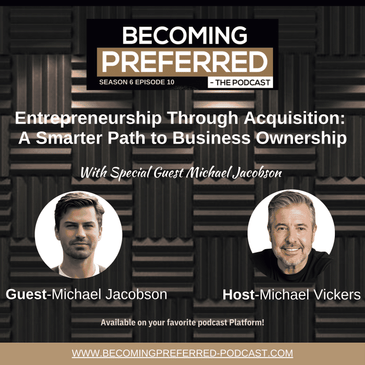
SEASON: 6 EPISODE: 9
Episode Overview:
Welcome back to Becoming Preferred, the podcast where we help you become preferred in the markets you serve. If you thought the flower business was quaint, slow, or low-tech, get ready for a wake-up call. Our guest today is Michael Jacobson, CEO of French Florist. He didn't just take over an old business; he engineered a dramatic transformation. Starting from a struggling $600,000 operation, he built a high-performance franchise model that now generates millions in annual revenue and triples the profitability of traditional flower shops. Michael’s mastery is the fusion of timeless artistry with modern operational technology.
In this episode, Michael is going to share his framework on how to spot a broken business model ready for 10x growth and how to design a high-tech performance franchise that protects quality while maximizing margins.
If you’re ready to learn how to apply disruptive tech and scalable systems to any industry, old or new, you’ve come to the right place. Join me for my conversation with Michael Jacobson.
Guest Bio:
What’s possible in one of the world’s oldest industries. Under Michael Jacobson's leadership, French Florist has transformed the traditional flower shop model by putting technology, innovation, and operational excellence at the heart of its franchise system. The results speak for themselves: French Florist franchise locations generate triple the revenue of standard flower shops—while operating at higher margins.
With a career spanning entrepreneurship, investment, and leadership, Michael is passionate about helping the next generation of business owners succeed through entrepreneurship through acquisition (ETA). He brings a fresh perspective to how small business ownership can be reinvented for the modern age, leveraging digital tools, streamlined operations, and strong brand strategy to unlock sustainable growth.
Michael’s mission is simple: to empower franchise owners with a proven system that blends timeless beauty with cutting-edge innovation. Whether speaking about the future of franchising, how technology reshapes consumer-facing industries, or why flowers are a surprisingly powerful business opportunity, Michael shares candid insights that inspire entrepreneurs to think bigger and build smarter.
Resource Links:
- Website: https://www.frenchflorist.com
- Product Link: https://frenchfloristfranchise.com/
Insight Gold Timestamps:
03:53 I found that intersection between how to live a purposeful life and a life full of intentionality
09:08 We're in the business of love
10:02 You've coined a phrase, entrepreneurship through acquisition and creative playbook
12:27 We want to build something for the world that's kind of fun and cool
19:33 It was really cool, just solving actual real pain points
20:01 The root of everything is how do we enhance the client experience?
25:16 As a franchisor, our primary responsibility is creating a community of owners
26:49 95% of startups fail
27:43 What I look for is what's your why?
29:23 How do you avoid getting distracted by shiny objects?
30:35 Saying no is more important than saying yes
31:39 Tom Peters, who's the management guru, who wrote In Search of Excellence
34:56 What we want to do from a feelings perspective, is just help remind people that no reason is the best reason
36:05 What's the single, most valuable lesson that you learned from scaling French florist?
36:32 My biggest job right now is to ensure that we have the brightest minds in our organization
36:48 The website's frenchflorist.com
Connect Socially:
LinkedIn: https://www.linkedin.com/in/michaelrichardjacobson/
LinkedIn Business: https://www.linkedin.com/company/french-florist/
Facebook: https://www.facebook.com/frenchflorist
Pinterest: https://in.pinterest.com/frenchflorist/
Yelp: https://www.yelp.com/biz/french-florist-los-angeles
Instagram: https://www.instagram.com/frenchflorist/
Email: michael@frenchflorist.com
Sponsors:
Rainmaker LeadGen Platform Demo: https://bookme.michaelvickers.com/lite/rainmaker-leadgen-platform-demo
Rainmaker Digital Solutions: https://www.rainmakerdigitalsolutions.com/
In 3, 2, 1.
Speaker BWelcome back to Becoming Preferred, the podcast where we help you become preferred in the markets you serve.
Speaker BIf you thought the flower business was quaint, slow or low tech, get ready for a wake up call.
Speaker BOur guest today is Michael Jacobsen, CEO of French Florist.
Speaker BHe didn't just take over an old business, he engineered a dramatic transformation.
Speaker BStarting from a struggling six hundred thousand dollar operation, he built a high performance franchise model that now generates millions in annual revenue and triples the profitability of traditional flower shops.
Speaker BMichael's mastery is the fusion of timeless artistry with modern operational technology.
Speaker BIn this episode, Michael is going to share his framework on how to spot a broken business model ready for 10x growth or how to design a high tech performance franchise that protects quality while maximizing margins.
Speaker BIf you're ready to learn how to apply disruptive tech and scalable systems to any industry, old or new, you've come to the right place.
Speaker BJoin me now for my conversation with Michael Jacobson.
Speaker BWell, hey Michael, welcome to the program.
Speaker BWe're delighted to have you, Michael.
Speaker CGreat to be here.
Speaker CThank you so much.
Speaker BHey, I'm excited about this.
Speaker BWhen this came across in the studio, I was looking at your background and I love watching young entrepreneurs and how they build businesses and the ideas that they have in that fresh thinking.
Speaker BSo, so congratulations, first of all, on having the courage to go and do your own thing and.
Speaker BCause it takes guts to do it.
Speaker BAnd in today's world, it takes a little fortitude.
Speaker BBut I want to get into that story of how you got here, but let's go backwards just a little bit.
Speaker BAnd that wasn't too long ago.
Speaker BSo you're back in high school.
Speaker BYou're going to go to college.
Speaker BI know you went to the University of Washington.
Speaker BI think it was school business.
Speaker BAnd what are you going to be when you grow up?
Speaker BAnd how did we get where we are today?
Speaker CYeah, definitely.
Speaker CSo when I asked that question in kindergarten, right.
Speaker CUh, my dad trained me.
Speaker CHe's a doctor, right.
Speaker CSo the kindergarten teacher would ask me and I said, I want to be a neurosurgeon.
Speaker CRight?
Speaker CCause that was the answer that my dad trained me to say.
Speaker CAnd you know, if there's a alternative dimension out there, maybe I am a neurosurgeon.
Speaker CA job sounds kind of fun.
Speaker CBut when I was in middle school, I discovered a little something called sales.
Speaker COur school had just banned soda from the vending machines.
Speaker CAnd I was like, wow, people are really upset about this.
Speaker CEverybody wants soda.
Speaker CAnd so I had the bright idea to Go and buy some sodas, a 12 pack from the grocery store, convince my mom to take me and put it in my locker.
Speaker CShe know what I was doing and.
Speaker CBut I put it in my locker and I started selling them out of my locker and I started making money and I ran out of locker space.
Speaker CEnded up kind of growing that business.
Speaker CAnd so I was like, you know, I had a problem on my hands, a good problem, albeit, but rented my friend's locker next to mine.
Speaker CThen I got really hungry at lunch because I was spending the whole time selling, right.
Speaker CSo I'm like, okay, how am I going to solve this problem?
Speaker CSo got my first business partner.
Speaker CI'm like, hey, you do the first half of lunch, I'll do the second half.
Speaker CSo we could take turns eating lunch and make money together.
Speaker CAnyways, we shut that down before we got caught actually.
Speaker CBut I was like, this is something that this is really cool.
Speaker CAnd I got to do this in a way that is, you know, a sixth grade version of legal, for lack.
Speaker BOf a better term in middle school.
Speaker CThat's cool.
Speaker BThat's awesome.
Speaker CSo when I got a taste of that I was like, wow.
Speaker CThis whole thing of solving a pain point and.
Speaker CAnd you can make money from that and then through time it's.
Speaker CHow do you combine that There's a whole lot of terms like conscious capitalism and how do you do it in an ethical way as you grow up and go through the after college what am I going to do with my life?
Speaker CSpent some time.
Speaker CMy aunt got really lucky.
Speaker CMy aunt runs an orphanage and was able to spend some time volunteering down there.
Speaker CAnd her whole thing is live a life of service.
Speaker CAnd so, you know, the journey has been an interesting one of.
Speaker CBut corporate wasn't a part of that path.
Speaker CI didn't really feel like, you know, big corporations are doing things necessarily in an ethical way.
Speaker CYou can just a cog in the wheel and I'm not really using my business entrepreneurial shops in a big company like that.
Speaker CSo it's been a really fun journey and it's kind of why I'm doing what I'm doing now is I feel like it really does.
Speaker CI found that intersection between how to live a purposeful life and a life full of intentionality.
Speaker CAnd we work in a beautiful industry and my passion working in business as well.
Speaker CUnderstanding the economics of it and providing value to the marketplace.
Speaker CRight.
Speaker BYeah.
Speaker BIt's interesting.
Speaker BAnd you're the CEO, chief executive officer of French florist and even how you got that store.
Speaker BNow let's talk about that because I mean you didn't just run a flower shop, you redesigned the entire operating model.
Speaker BSo at the time I think you got it, it was about 600k a year struggling like a lot of businesses.
Speaker BBut now you've turned it into this almost $10 million plus powerhouse and a national franchise.
Speaker BSo let's go back there.
Speaker BSo you're working in the flower shop and I kind of agree with you.
Speaker BWell, I do agree with you.
Speaker BWhen you see the entrepreneurial, once you start to taste it, when you realize you can make money while you're not working, it ruins you because you're not trading time for money anymore, you're trading value.
Speaker BAs you were telling the story, you give the people what they want.
Speaker BAnd it's really not that tough.
Speaker BAs long as it's in demand and people want it, they'll, they'll line up for hours, days to go buy the latest iPhone.
Speaker BSo build it at what they want.
Speaker BIt made me chuckle.
Speaker BWhen I was in middle school, we had a two floor building and I was always, you know, causing the teachers lots of grief just by my nature.
Speaker BAnd we had a drinking fountain on the whole second floor that didn't have a handle on it like at all.
Speaker BCouldn't use it.
Speaker BYou had to go down to the first floor and we had to do speeches and somebody nominated me for president, school president.
Speaker BAnd of course teachers were advising not.
Speaker BI was probably not a good example to do that.
Speaker BSo in my speech, I got up the speech and all I said, I looked at the audience, I said if, if I'm elected president, I will personally within 24 hours put a handle on the drinking fountain upstairs.
Speaker BAnd so.
Speaker BAnd I got a standing ovation and I want a landslide victory.
Speaker CUnbelievable.
Speaker CIsn't that amazing?
Speaker BThe power of what.
Speaker BAnd you coined it as soon as you were talking about that in middle school, I should have quit right there.
Speaker BBut you're right, it's finding where the opportunities.
Speaker BBut I think you have to have the eyes for that too.
Speaker BAnd you start to see it because a lot of people don't think that.
Speaker BSo you decide you want to get into business.
Speaker BYou went to work for an uncle.
Speaker BWhere did you recognize the opportunity there?
Speaker BSo you start working there.
Speaker BAnd I've seen pictures of before and after and what you've transformed that into.
Speaker BSo tell me what's going through your head at that time.
Speaker CSo I came up through finance in undergrad and had interviewed on Wall street and all that stuff and I'm very happy I didn't take Those jobs, I ended up going into consulting, which I don't know if it's any better or worse, probably along the same lines as Wall street, but anyways, my uncle called me because I have a background in finance and he wanted to sell his flower shop.
Speaker CSo I said, sure, I'm happy, you know, his family, I was happy to help him sell.
Speaker CSo actually that was the original intent.
Speaker CI was going to come in to help him sell the business and it wasn't worth a whole lot, but was just happy to produce a side project because that fire in my belly wasn't being lit by corporate.
Speaker CAnd I was just looking for, you know, something fun to do.
Speaker CSo that's how it started.
Speaker CIt was really unsuspecting.
Speaker CAnd I came in and I looked at a bunch of flower shops.
Speaker CWhen you're going to sell a business, what are the things that you might do?
Speaker CYou might go around to see what other businesses are selling for, what multiples they're going for.
Speaker CWhat are they doing well?
Speaker CWhat are they not doing well?
Speaker CRight.
Speaker CWhat is this shop worth?
Speaker CSo I was just doing a bunch of like, external research and studying my uncle's business.
Speaker CWhat is he doing well and not so well, and where the opportunities to maybe make some refinements, spend two or three or four months cleaning some stuff up to try to maximize the sale price.
Speaker CWhat I saw was amazing.
Speaker CReally opened my eyes to how antiquated the floral space is.
Speaker CBut every single floral shop struggles with the same exact issue, if not the same issue.
Speaker CVery, very similar issues.
Speaker CAnd there's the three, not just one, but there's actually three very systemic issues in the space.
Speaker CYou know, one was there's a lot of intermediaries, folks like 1-800-flower, right.
Speaker CThey take your order online and they syndicate it to a local florist.
Speaker CIt's a fine business model in a sense, but the problem comes in, they take about a 40% commission after all of their fees are considered before profit goes away.
Speaker CYeah.
Speaker CSo that's crushing the florist, that alone.
Speaker CBut on top of that, you have a really antiquated supply chain.
Speaker CAgain, a lot of intermediaries, not a lot of innovation has happened there.
Speaker CSo there's an opportunity on the supply chain side.
Speaker CAnd then lastly, and there's a few, there's other buckets of things that made this industry incredibly antiquated.
Speaker CBut the third big bucket, as the technology in the space is also.
Speaker CI walked in and there's a mix of six between the two printers and fax machines.
Speaker CThere are six of Them and all of them were being used for various means where they were probably spending 13 or $14,000 on printer ink per year.
Speaker CI was like, why don't you just build a really small little iPad application, run all this stuff digitally and like iPad cost a few hundred dollars, like it's going to pay for itself in three months.
Speaker CRight, right.
Speaker CSo I think that I was just able to come in with fresh eyes and understand like I think florists are amazing people.
Speaker CSome of the most creative, passionate, warm hearted people I've ever met.
Speaker CThey're working crazy long hours, typically 50, 60 hour weeks, six days a week.
Speaker CAnd they're like not making money.
Speaker CRight.
Speaker CSo they have to be doing it for some reason.
Speaker CYou know, the livelihood is a part of it, but they're, you could make more hourly somewhere else.
Speaker CThere's another reason that they do that.
Speaker CAnd so I fell in love with it because of like the team and the infrastructure and the bones and the emotion and it's a very, very special industry.
Speaker CBut nobody was doing it right.
Speaker CAnd as a matter of fact, the number one player in our space, 1, 800.
Speaker CAnd again, I don't mean to really call them out.
Speaker CThat's not what I'm here to do at all.
Speaker CBut we're here to make our company the best company we can.
Speaker CBut pragmatically speaking, if that's the market leader, talk about a good company should be creating value for the marketplace.
Speaker CI would go so far as to say that they're destroying value for the marketplace.
Speaker CSo, you know, and again, not to say they weren't innovative at one period of time, but, but especially from the client experience standpoint, really it's not even about the florist if I'm allowed to say that.
Speaker CIt's about ultimately the client experience.
Speaker CAnd when you're giving or receiving flowers to somebody, you're telling them that you care about them, you're thinking about them and that you love them.
Speaker CSo we're in the business of love and we're not necessarily like we're franchising right now.
Speaker CAnd so we have some prospects that come to us and they're marine veterans and I have a friend that's becoming a doctor and works in the emergency room and they're like literally saving lives out there.
Speaker CAnd here we are like playing with flowers.
Speaker CHow do we justify that?
Speaker CI feel like we're creating a more loving world through it.
Speaker CAnd even if it's, you know, call me cheesy, but I do believe that even if we make a 1% difference.
Speaker CIt's a worthwhile mission.
Speaker CAnd so that special of an industry, that's really the root is love the client experience should and could be something a lot more than what it is today.
Speaker CSo that's really what our mission is.
Speaker BNo, it's interesting, your approach to the business, because you're right.
Speaker BWhen you're 10 years old and we say, hey, Michael, what do you want to be when you grow up?
Speaker BYou're not going to go, I want to go run a floral shop.
Speaker BSo we don't think of it as a business model like in today's world.
Speaker BA lot of the younger generation, they all want to become influencers, YouTubers.
Speaker CIsn't that wild?
Speaker BYeah, they see a few.
Speaker BIt's totally wild.
Speaker BAnd yet there's some great business opportunities.
Speaker BAnd you coined a phrase, entrepreneurship through acquisition and creative playbook, which I think is an interesting term.
Speaker BI've never actually thought of it that way.
Speaker BBuying an existing business and then turning it around because it needs disrupting.
Speaker BSo sometimes the least sexiest companies and everybody wants to go tech.
Speaker BBut tech, as you know, can eat your lunch real quick and it gets expensive really, really quickly.
Speaker BBut there's other really amazing businesses where you've got a mom and pop, they started their own business, maybe out of necessity or keep the printing presses going for themselves, whatever.
Speaker BAnd they don't know how to even scale it.
Speaker BThey don't know how to bring the technology to the table.
Speaker BSo for today's generation, we have all the tools in the world.
Speaker BLike in my day, when we started, we didn't have those tools at all.
Speaker BWe didn't have Internet, we didn't have that.
Speaker BWe had yellow Pages and if you remember what those were.
Speaker BAnd so we had to go through that process.
Speaker BWell, now there's no excuse.
Speaker BI've got everything at the tip of my fingers.
Speaker BI can look at it.
Speaker BCompetitors, I've got AI in order.
Speaker BYeah, you've taken something and you've evolved it, which I think is brilliant because you've taken a model.
Speaker BNow you have some principles around this that I think are worth highlighting.
Speaker BIt's not just buying a business that could use a revamp.
Speaker BThere needs to be some intrinsic value to the business in the first place.
Speaker BLike you said, flowers, you know, we have about 12 statutory, I call them statutory holidays a year, Mother's Day, Father, all the.
Speaker BWhere we would buy flowers.
Speaker BBut then there's birthdays and anniversaries and all these other things.
Speaker BSo we love those kind of holidays.
Speaker BIf you're in the flower business, and so what are the things that are the rules there?
Speaker BIn other words, if you're going to go outside the floral industry, you're going to go pick another industry.
Speaker BWhat would be the two or three variables you would look for or recommend to anyone if you were coaching them?
Speaker BHey, make sure it has this and this.
Speaker BWhere would you go with that?
Speaker CYeah, that's such a good question.
Speaker CI'm in the floral industry, so I can speak to that.
Speaker CAnd I'm going to leave it up to you, Michael, to help translate that and how that might work in another industry.
Speaker CI look at coffee shops and I'm like, I have no idea how to make money in coffee shops.
Speaker CI look at bakeries, I have no idea how to make money in bakeries.
Speaker CWe figured it out in floral.
Speaker CSo I can talk about floral.
Speaker CI don't know if it applies to other industries, but I think what has made our industry really special is how, how much pain there is in the space.
Speaker CSo I suppose I can translate in the sense where if you're going to solve problems or solve pain and make sure there's pain, like solve real actual problems, create actual enterprise value.
Speaker CNothing against private equity.
Speaker CLike truly, I think private equity has done a lot of great things.
Speaker CI think they've done not great things too, but the name of the game for them is to buy a company, get a bunch of returns over a 3, 5, 7 year period and then flip it, right?
Speaker CWe take a little bit of a different approach where we want to build something for the world that's kind of fun and cool.
Speaker CIt's not all about the financial returns.
Speaker CFinancials are great and you know, for, as a for profit business, it's the fuel that allows us to keep going.
Speaker CBut I think that like for us having a deeper why, why we exist and a deeper mission and like the financial is just the fuel that gets to power that mission further and further.
Speaker CThat makes it a lot of fun to, as an entrepreneur, for me at least I can speak from my own experience.
Speaker CI don't know if yours is, you know, I've heard other folks say it enough times for me to see that think that it's a pattern that you're going to have ups and downs, certainly have and certainly will continue to, but having that deeper like why of something beyond the financial motivation, it makes it way easier to get through the tough times.
Speaker CAnd, and honestly I think that it kind of goes hand in hand with making money.
Speaker CI think that if you make decisions purely out of profit, you kind of miss opportunities that if you're working on something out of passion, you ended up doing a better job on it and you end up getting somehow end up getting a better financial return on it too.
Speaker CSo again, I came up through finance.
Speaker CI like that game.
Speaker CIt's fun to play, but sometimes it's just like a gut feeling too where I'll make a decision or investment and I'm like, I'm pretty sure this is going to be a positive roi.
Speaker CAnd that's as far as I need to think about it, have to do that in a disciplined way.
Speaker CBut the biggest ROI hits that we've had have been investments, though let out of emotion more than, more than anything else.
Speaker BI think, I think you're right.
Speaker BAs Wall street, as you know, finance itself is about the next quarter.
Speaker BAnd the decisions we make doing on a quarter by quarter basis are definitely different than if we look at a two to three or four or five year play.
Speaker BWe were playing checkers versus chess.
Speaker BAnd you're in it for the long haul.
Speaker BAnd I agree with you.
Speaker BYou build a business that you learn to love.
Speaker BI love our business.
Speaker BPeople ask me all the time, we're going to take it to this now.
Speaker BAnd no, I'm really not interested.
Speaker BI'm really not.
Speaker BI work for four of Warren Buffett's companies and you know, he doesn't even spend all the money.
Speaker B99% of it's going away to charities.
Speaker BBut he's frugal, wears old suits, drives older cars, eats at McDonald's every day.
Speaker BYou know, it's not about that, it's about the game.
Speaker BHe loves playing the game.
Speaker BAnd if you find something that's admirable and long lasting and like you said with flowers, they always put a smile on people's faces, typically, or let them know how we feel about them.
Speaker BSo it's an emotional purchase.
Speaker BThere's nothing logical about flowers.
Speaker BAnd people buy first with emotion, back it up with reason and logic second, you have to do that map.
Speaker BBut at the end of the day, it's an emotional purchase, right?
Speaker BHappy occasion, a sad occasion.
Speaker BIt's designed to convey a message.
Speaker BSo it's an interesting business.
Speaker BWhat I'm always interested in though is spotting the disruptions.
Speaker BAnd if you look at there and there's some really good books out there on this, on the subject, but you start to look at things and go, how could I build this better?
Speaker BHow's the mousetrap?
Speaker BAnd you saw Uber, did it with rideshare and Airbnb.
Speaker BAnd these companies grow so fast.
Speaker BYou're seeing it with AI, you're seeing it with all the tools.
Speaker BWell, let's kind of move into fusing artistry with analytics.
Speaker BBecause you took a very traditional business, but now you brought some technology into it.
Speaker CThat's right.
Speaker BAnd I'm curious about that.
Speaker BSo how do you use tech data, proprietary software?
Speaker BAnd you talked about the iPad when creating it there.
Speaker BWhat did you end up bringing to the floral industry into your business that makes you different from, say, everyone else?
Speaker CYeah, we created a ton of tech.
Speaker CWe have a lot of folks approaching us here and there that want us to slice out the tech and license it, become a tech company.
Speaker CWe're not a tech company.
Speaker CWe happen to have built the best tech that exists in our space.
Speaker CWe're not a tech company.
Speaker CWe're a plural company.
Speaker CRight.
Speaker CIt goes back to that original principle of solving pain is one way to create value.
Speaker CRight.
Speaker CAnd now we've solved enough pain where our company is running pretty well, and now we can work on like, innovation.
Speaker CAnd how do you take the high moments of ordering flowers?
Speaker CBecause it's an incredible thing.
Speaker CReally, truly.
Speaker CI think people have forgotten, but when you do order flowers, that's my soft pitch is order flowers and order flowers for no reason at all.
Speaker CYour mom deserves flowers on more than just Mother's Day.
Speaker CBuy it on a random Tuesday.
Speaker CI promise you it's even more impactful than buying it over on Mother's Day.
Speaker CSo anyways, my.
Speaker CMy soft pitch there.
Speaker CBut so I'll answer your question on tech like one thing.
Speaker CHow do you buy flowers?
Speaker CSupply chain is a difficult thing for us traditionally, for our industry, traditionally.
Speaker CAnd so that's a really important pain point.
Speaker CHow do we solve that?
Speaker CThe old way is the FL flowers are grown on a farm.
Speaker CAnd again, just as a point of reference in orchid, they might see at a grocery store somewhere.
Speaker CIt actually can take six or seven years to grow an orchid.
Speaker CSo it's an incredible amount of work just to grow it on the farm.
Speaker CA lot of the times and years of planning to do that, the flower gets cut at the farm, then it goes to a processor, then from the processor to a consolidator to a logistics agency in the country of origin.
Speaker CRight.
Speaker CWhere best roses come from Ecuador.
Speaker CBest hydrangea lilies come from Colombia.
Speaker CWe have tulips coming from Holland all over the world.
Speaker CRight.
Speaker CThailand, Mexico, Canada, some local in the States as well.
Speaker CAnd so it goes to logistics agency in the country of origin, gets on a flight and lands in the US Goes to another kind of logistics receiving agency, gets trucked to a wholesaler, to the retailer.
Speaker CKind of we do what we do and process it the flowers again and design them and put the work in that we do.
Speaker CAnd then finally it gets sold to the end consumer.
Speaker CSo it's a remarkable amount of people involved in that supply chain.
Speaker CNot only that, but people are writing invoices on paper and pen and you know, so how do you like as a retailer, how do you buy flowers?
Speaker BYou make sure they're fresh, how do you make sure they're going to last?
Speaker BBecause you only air to out of them.
Speaker BYou got to have a week or so out of those things.
Speaker BYeah, yeah.
Speaker CSo anyways, this is just one really niche example of how we utilize technology.
Speaker CBut one thing that we've done is we created a predictive analytics for every single one of our locations, has an AI associated with it.
Speaker CAnd we can forecast based on the patterns of even if it's raining outside that dampens floral sales, what time of year it is, what year over year growth is, what week over week growth is.
Speaker CRight.
Speaker CAll of these external data sources sources and internal data sources, zero party data that allows us to forecast what customers are going to order.
Speaker CAll of the inventory or all of the products that we have have recipes to them.
Speaker CSo we have all the raw materials for it and we can forecast.
Speaker CAnd essentially a flower buyer report gets spit out and it says, okay, if you're going to buy your flowers for Tuesday through Thursday, here's the list of flowers that it forecasts that you need.
Speaker CAnd right now it's about up to a 92% accuracy.
Speaker CSo we're continuing to evolve that.
Speaker CBut it's a heck of a tool to get you really a lot, a lot closer than just literally doing it by the seat of your pants.
Speaker CAnd so doing that allows us to limit waste, it allows us to buy more appropriately.
Speaker CWe're not tempted to use older flowers because our flowers are just in time inventory.
Speaker CRight.
Speaker CAnd so folks are getting the freshest stuff.
Speaker CAnd so that's just one niche example.
Speaker CBut there's just been this flywheel where like we've, we're solving pain point after pain point, whether it's marketing, whether it's ops and supply chain, whether it's like any finance and automating.
Speaker CSome of our bookkeeping, some of this stuff is relatively basic, but it creates this flywheel where we've been able to grow from 600k revenue to 2.7 million the next year to 4.8 million the next year, to 9.6 million the next year.
Speaker CAnd that was at a one location, 11 3,000 square foot place.
Speaker CRight.
Speaker CSo we opened a second store, did really well over a million in sales in the first year or third store.
Speaker CAnd so we're like, wow, we have something really cool here.
Speaker CAnd we started to do a lot of revenue where we can buy.
Speaker CHere's where like the flywheel starts, right.
Speaker CAs our revenue goes up, our buying power goes up.
Speaker CSo now we can start to cut out those intermediaries.
Speaker CAnd instead of buying from consolidators or wholesalers, we go straight from the farm and can import directly and charter our own planes.
Speaker CWe've been able to get not only a way fresher product, cutting out many days, if sometimes up to a week in the supply chain.
Speaker CSo that translates to a week longer in the client space at home.
Speaker CBut we're also getting it for a way lower price too.
Speaker CAnd so.
Speaker CAnd we can pass it.
Speaker BYou're getting advantage of scale too.
Speaker BSo you got.
Speaker CExactly, yeah.
Speaker CSo that allows us to invest heavier into the client experience, offer more competitive pricing.
Speaker CSo it was really cool just solving actual real pain points.
Speaker CSo tech is one example of that.
Speaker CAnd hopefully that one example kind of showcases one of the ways that we utilize tech to.
Speaker CBut again, like all of the decisions that we've made are how do we enhance the client experience?
Speaker CAnd putting that technology solution in place allows the person that's running that flower shop, the manager or the owner in the case of a franchise, it makes their job way easier to run that flower shop.
Speaker CAnd so they can buy their time back and allocate that to way more higher uses of time, which is focusing on the client experience.
Speaker CRight.
Speaker CUltimately, like the root of everything is how do we enhance the client experience.
Speaker BYou know, I'm reminded FedEx was a client of ours.
Speaker BAnd I know the FedEx story.
Speaker BAnd when you were back in school, it was just kind of coming to be.
Speaker BRight.
Speaker BAnd they had the spoken hub concept for delivery and they brought technology for delivery delivering which who should have invented FedEx was the postal system.
Speaker BRight.
Speaker BBut they were always behind the eight ball.
Speaker BSo a lot of times people get entrenched in their businesses and they don't evolve them.
Speaker BAnd when you're adding technology to it, same in my business, we're adding technology to.
Speaker BSo for instance, we had the pandemic, Zoom comes along, go to meetings.
Speaker BWell, it now gave us a tool to where it's my preference for doing zoom meetings.
Speaker BNormally we would have you come into studio, you're going to lose a day or two and kind of go from there.
Speaker AAre you tired of chasing leads and ready to start effortlessly attracting more high value clients?
Speaker AIntroducing Rainmaker Lead Gen, the ultimate sales, engagement and client acquisition platform that takes the stress out of outreach.
Speaker AWith Rainmaker Lead Gen, you can easily identify, engage, educate and convert your ideal prospects into loyal clients.
Speaker AOur industry leading automation and email sequencing empowers you to reach more ideal clients, accelerate the sales cycle and close more business.
Speaker AImagine authentically engaging with your prospects while the platform handles the heavy lifting.
Speaker ASay goodbye to the endless hustle and embrace a more efficient, effective approach to business development.
Speaker AReady to witness the magic?
Speaker ABook a 20 minute demo today and see how Rainmaker Lead Gen can revelation revolutionize and level up your client acquisition game.
Speaker AThere's nothing to lose and everything to gain.
Speaker ADon't miss out on this opportunity to supercharge your client acquisition process.
Speaker AVisit rainmakerdigitalsolutions.com or check out the link in the show notes to book your demo.
Speaker ARainmaker Lead Gen.
Speaker ASpend less time hunting for your ideal clients and more time having high value sales conversations with your ideal clients.
Speaker BAnd now back to my conversation with Michael Jacobson.
Speaker BYou know you mentioned Holland and what I'm reminded back in the 16th century you had the big tulip bust, right?
Speaker BSo the flower industry went, but they didn't have the technology back then to monitor to know what was going on.
Speaker BSo what you're doing in your supply chain is you're identifying all the key points and I'm assuming you even have producers who go, hey, we got an oversupply of these.
Speaker BDo you want them?
Speaker BHere's a better deal.
Speaker BIn which case you can now create different things with it and take advantage of opportunity as well.
Speaker BIs that right?
Speaker CYeah, that's right.
Speaker CI think the percentage changes, but the last I looked a few months ago is about like 17% of our orders a custom where meaning somebody will call in, right, and say hey yeah, I have a hundred bucks and I just want something really beautiful.
Speaker CSo we'll ask them a few questions to get the general gist of what they're looking for.
Speaker CWhat would they want to create?
Speaker CAnd our designers have so much fun with that because when you give a creative that that ability to flex, they get to use whatever flowers they want.
Speaker CSo we do buy whatever's in season is typically lower price and the producers are producing a lot of.
Speaker CSo just because it's cheap doesn't mean it's bad quality.
Speaker CAs a matter of fact, it's actually sometimes better quality because they're producing a lot of it because it's in season and so they get to use that.
Speaker CThey put their soul into the design and like, you really see the end product and it's very special.
Speaker CSo, yeah, I mean, a lot of the supply chain actually is a lot more flexible than you might think.
Speaker CPeople think that we have very high waste.
Speaker CI think traditionally the industry has had a high waste, but we've gotten our ways down pretty decent.
Speaker CEven with buying good deals, stuff that's in season, stuff that's not necessarily on the product catalog, we do have those folks that are calling us saying they want something custom.
Speaker BLet's talk about buying a franchise or investing, going the franchise route versus starting your own or buying something that's already exist.
Speaker CYeah, definitely.
Speaker CYeah.
Speaker BAnd the acquisition, it's something, you know, I remember I've looked at it as an entrepreneur.
Speaker BI still keep my eyes open.
Speaker BThere's, you know, donut shop, whatever.
Speaker BThere's a franchise for it.
Speaker BIt seems like there's a franchise for it.
Speaker BLike, who's perfect for a franchise?
Speaker BWhen should we be just, hey, I'm going to go do it myself?
Speaker BI've always taken they'll do it myself approach work with franchise groups.
Speaker BI see the magic.
Speaker BI've seen them develop and evolve.
Speaker BYou know, literally worked with hundreds and hundreds of franchisees and not everyone's designed.
Speaker BSome places will sell a franchise to somebody who should never buy one a thousand percent.
Speaker BThey should never be in business.
Speaker BSo how much screening and how much work do you guys do on that back end versus just, hey, we got another location Versus who's perfect?
Speaker BWho's the perfect candidate?
Speaker BThat, hey, I'm going to look at a franchise option.
Speaker BNot just maybe around Floral, but it could be, but any franchise in general.
Speaker BWhat are the things we should be looking for and when shouldn't we do it?
Speaker CDefinitely.
Speaker CI love so much of what you said.
Speaker CYou know, we've kicked up a lot of dust in the floral industry.
Speaker CWe like to do things different.
Speaker CWe've challenged the status quo.
Speaker CWhen we made the decision to franchise, we did it for ultimately because we think it'll create a better client experience again.
Speaker CEverything really is promise a derivative of that.
Speaker CBut when we made that decision, you know, franchising, I had a really dirty word to it.
Speaker CWhen I first learned about it, I was like, I can't name that many great franchise systems out there.
Speaker CThere are a few.
Speaker CChick Fil A is an interesting example.
Speaker CRight.
Speaker COr Theory Fitness seem to be doing good things.
Speaker CSo there's a few out there.
Speaker CBut most of them similar to the Floral Industry, like most florists suck.
Speaker CSorry.
Speaker CBut most franchises suck too, if I'm allowed to say that.
Speaker CAnd so we are approaching it a little bit differently.
Speaker CWe don't use like outsourced sales, we don't use brokers.
Speaker CIn 2025, we had a 0.3% acceptance rate in terms of how many leads came in versus how many ended up getting awarded.
Speaker CSo our screening process is super robust, to say the least.
Speaker CI think that as a franchisor, our primary responsibility is creating a community of owners and we own a bunch of corporate locations that we own and operate.
Speaker CI feel like we're like, now we're just one owner in the ecosystem and we're marrying other owners in the ecosystem and it's like they're almost like business partners where.
Speaker CYeah.
Speaker CAnd what I've learned too, when I set my pride aside, the only way that we've been able to grow truly is by bringing extraordinary people into the organization and for me to get the heck out of their way.
Speaker CAnd I think franchising can be very powerful.
Speaker CAgain, it depends on the system.
Speaker CBut if we choose franchise owners that have an edge or have a superpower that they can contribute to our system in a meaningful way, I think it's the same thing.
Speaker CI think that we've been able to crack the code and on average or flower shops do triple the amount of revenue than your average flower shop does in the first year alone.
Speaker CWe've been able to unlock the supply chain.
Speaker CWe have an economies of scale, we have better tech.
Speaker CSo we've been able to figure some things out.
Speaker CWe haven't been able to figure everything out right, but we figured out enough things that somebody who wants to lean into that where it's one plus one is greater than two, that's the idea.
Speaker CAnd we take that as like their franchise owners actually doing the more difficult part of running the flower shop, making the hiring, coaching, promoting firing decisions.
Speaker CThey're putting the money on the line, they're building it out, we're helping them through every single step of that.
Speaker CBut they're the ones that are actually going and doing it.
Speaker CAnd ultimately they're the ones that are client facing.
Speaker CSo they have the most important job.
Speaker CFolks that are attracted to like one plus one is greater than two.
Speaker CI think like kind of what you were saying earlier too, if you start it yourself, it's kind of like a sexier idea.
Speaker CI didn't start this business by myself.
Speaker CI took this business over and it was so underrated.
Speaker CI joined a few startups in college too.
Speaker COne out of the four that I was involved with is still around today.
Speaker CThe stats are like 95% of startups fail.
Speaker CSo it was really cool to join a business that had some bones to it.
Speaker CI could leverage that and really help take it to the next level.
Speaker CSo we've had some really, really smart folks join our system.
Speaker CWe've had a president of a hundred plus million dollar private equity firm quit his job and he's opening up six flower shops.
Speaker CWe have a marine veteran I was talking to you about is opening up a couple of units.
Speaker CWe have a lot of kind of ETA entrepreneurship through acquisition research fund folks that are looking to acquire a flower shop and convert it to French florist using our engine.
Speaker CWe have some corporate refugees, right?
Speaker CThey work corporate, they've done really well for themselves but they like want to be their own boss.
Speaker CThey want to live a life after W2 kind of a life, right?
Speaker CY want to go to that 10am yoga class, like whatever you want to do, right?
Speaker CYou can go and do.
Speaker CNo one's going to tell you no.
Speaker CSo you know, the folks come from all over but I give you some of the principles that what we look for is you'll hear different answers from.
Speaker COur ops team will give you an ops answer.
Speaker COur finance team will give you finance answer on what they look for when we talk to candidates.
Speaker CBut what I look for is what's your why I get?
Speaker CYou want to make money.
Speaker CMoney is a great thing, helps enable you to do more things that you want to do in life.
Speaker CBut I'm really curious about what are those more things that you want to go and do?
Speaker CAnd I don't really care what it is.
Speaker CIt's not my place to judge.
Speaker CLike, you want to go and spend more time with the kids, Amazing.
Speaker CI support that.
Speaker CYou want to go on vacation and have a bunch of fun in the world?
Speaker CAmazing.
Speaker CI support that.
Speaker CYou want to go start a charity, Amazing.
Speaker CI support that.
Speaker CBut I just want to know what your why is and I want to help you get there.
Speaker CAnd I want you to love the flower.
Speaker CI didn't come in loving the flower industry.
Speaker CI learned to love it.
Speaker CSo that part can be learned.
Speaker CBut.
Speaker CBut I wanted to see that little spark in your eye that after you talk to our team you're like, oh my God, I get it.
Speaker BYeah.
Speaker BNo, it's interesting.
Speaker BSo people always want to know, should I do this?
Speaker BCan I do this?
Speaker BLike I say, I've always been, hey, I'll go learn the system because you're buying A system.
Speaker BWhat you're doing is you're buying.
Speaker BYou figured out all the bugs, you've figured out all the ways to scale it.
Speaker BYou figure, so if you're looking for a business that you want to scale, something you want to grow, franchise system is great, then it's finding something you can believe in.
Speaker BI think you have to be, I call it being a product of the product.
Speaker BIn other words, if you don't like working with customers, if you don't like that emotional component, this is the wrong kind of a business.
Speaker BRight.
Speaker BDon't do it.
Speaker BThere's other things to go do.
Speaker BAnd in today's world, we're still going to have service business.
Speaker BI think it's a recession proof business.
Speaker BI think it's a pandemic proof business.
Speaker BMine wasn't.
Speaker BMy business wasn't pandemic proof.
Speaker BIt was recession proof, but it wasn't pandemic.
Speaker BNow it is because we've had to develop technology and where we've been able to go to the next level is through technology and add our technologies to it because we can produce.
Speaker BNow we're in season six of the show, we edit, we use AI tools to speed up the editing.
Speaker BThe business has changed, you know, completely.
Speaker BSo it's finding that, that thing.
Speaker BAnd like I say, sometimes it's in the least sexiest place we look.
Speaker BSo you start looking at what are you doing every day, what are you purchasing, what are you consuming every day?
Speaker BAnd look at where those opportunities are.
Speaker BHow do you avoid getting distracted by shiny objects?
Speaker BBecause you're an entrepreneur.
Speaker BAnd as an entrepreneur, if you're like me, I see new ways to make a million dollars every week on a business, maybe every two weeks.
Speaker BBut it's the energy behind it.
Speaker BYou got to find something.
Speaker BHow do you protect yourself, stay focused on task and say that as an entrepreneur?
Speaker CYeah, it's such a good question.
Speaker CSo, you know, in the early days of running the business, there were days where I didn't know if I was going to make payroll or not.
Speaker CRight.
Speaker CI actually had to dip into my savings more than once.
Speaker CFor sure.
Speaker CIt was tough.
Speaker CI slept in the flower shop a few nights and you know, so we had to be scrapping at the end of the year.
Speaker CWe had 20 grand that I could leave in the business.
Speaker CAnd it was like, all right, cool, we have 20 grand to go and invest back into the business.
Speaker CWhere are we going to put it?
Speaker CAnd so we were forced to make an incredibly concentrated bet on.
Speaker CWe could put it in one or maybe two places, but 20 grand isn't that much to play with.
Speaker CAnd so.
Speaker CAnd we had to be right about it too.
Speaker CRight.
Speaker CThere's not a lot of room to mess up.
Speaker BFailure is not an option.
Speaker BYeah.
Speaker CBut as we hit a million, 2 million, 3 million in bottom line profits, it's, oh, shoot.
Speaker CIt's like, hey, we can make 6 or 7 or 8 or 15 or 20 different bets.
Speaker CAnd, you know, we made some mistakes trying to do that early.
Speaker CRight.
Speaker CWhen we really started to be successful.
Speaker CBecause there are a million different ways to make money, but it's a trap.
Speaker CAnd I agree with what you're saying is like, that shiny object thing is a real danger.
Speaker CAnd I don't know what to say other than saying, like, saying no is more important than saying yes.
Speaker CYeah.
Speaker CHaving extraordinary clarity on what you want to go and do.
Speaker CAnd I think just ruthlessly understanding what your North Star is and only making decisions as towards that North Star and those shiny objects are kind of like testing you on whether you're learning that later.
Speaker BBut I am learning it.
Speaker CSo sometimes I'm going to let you know how it goes.
Speaker BIt's hard because entrepreneur, you start going, man, what could I do with that one?
Speaker BOh, I could do this one.
Speaker BOr I see a better way to do this.
Speaker BOr it's just I'm at the stage where I don't have the energy for.
Speaker BI love doing what I do.
Speaker BIt's enough, you know, between kids and grandkids, it makes a difference.
Speaker BYou know, it's interesting.
Speaker BOne thing I think, which is really kind of cool with what you've done here and what makes you unique is you're redefining what's essential, but you're also building a culture with people and how people see flowers.
Speaker BSo you're moving it from, hey, it's a luxury item to it's an essential part of our daily life.
Speaker BKind of like what Europe does.
Speaker BYou go everywhere, you see flowers.
Speaker BSo how are you using that, your marketing and product strategy, to change that behavior?
Speaker BBecause it's old.
Speaker BWe always think, like I say, it's a transaction.
Speaker BOh, geez, it's Valentine's Day.
Speaker BAnd what's interesting with flowers, and this is something, you know, I talk about this, and I got this from Tom Peters, who's the management guru, wrote In Search of Excellence.
Speaker BAnd he said the number one car dealership in the United States is Sewell Cadillac in Dallas, Texas.
Speaker BAnd if you walk into their showroom, you see flowers, and it's flowers, flowers and flowers.
Speaker BAnd Tom Peters talks about this, and he says, they have design bays where you can go and see what.
Speaker BHere's 10 design bays where Mrs. Johnson can go see her new Cadillac.
Speaker BSo that's the real showroom, but it's all around design centers.
Speaker BIt's the feeling that they're creating.
Speaker BYou know, we're talking as guys and we're gonna go get our apartment, we get our condo, we move out of home, we get the big screen, we want the 75 inch TV, the nice couch, barbecue, we're set.
Speaker BYou know, we have what we need.
Speaker BWe're not thinking this table needs flowers, right?
Speaker CYou know, you do say is I need a Rolex.
Speaker CAnd I promise you, you're not buying a Rolex to tell the time, right?
Speaker CYou buy a Timex for a lot cheaper.
Speaker CSo even men, we are very emotional on decision making.
Speaker CYou're going to buy the things that you work because it makes you feel a certain way, right?
Speaker BOtherwise we would all buy the same thing and our kids would all be named the same and everything else.
Speaker BBut in northern climates particularly, and I'm curious how you make that work.
Speaker BDoes your business allow you from a supply chain point of view to go out?
Speaker BBecause you're predominantly Arizona, California, you've got locations, you've got New York work.
Speaker BI know you've got a number of different locations.
Speaker BAre you climate restricted at all in order to get there?
Speaker BBecause I'm assuming things are coming in on FedEx or overnight courier.
Speaker CYou know, that's a great question.
Speaker CYeah, no.
Speaker CSo we actually don't do any FedEx or third party where we have everything is in house.
Speaker CAgain, sorry to beat a dead horse here, but in order to optimize for the client experience, we have in house delivery team that is like a white glove delivery.
Speaker CThe flowers remain cold all the way from the farm.
Speaker COnce they get cut and processed, they go into a cold chain.
Speaker CSo the supply chain stays cold all the way through the delivery experience as well.
Speaker CAnd so we never ship flowers in a box via FedEx.
Speaker CWe're hand delivering them.
Speaker CSo, you know, it's a really nice experience.
Speaker CIf you haven't ordered from French florist before, you can give it a try.
Speaker CAnd what I like to say is if you spend a hundred dollars at French florist versus another local floral shop or the grocery store or 1, 800 flowers, we don't care how much you spend.
Speaker CI mean you can honestly go to grandma's house down the street and get free flowers like it's about the flowers.
Speaker CBut if you are going to buy flowers and you want it to be a special gift.
Speaker CThe money spent with us, we have a really premium positioning, like a luxury feeling of a company.
Speaker CBut.
Speaker CBut really we're a value based company and if you purchase from us, we want to make sure that we stretch those dollars as far as we possibly can.
Speaker CSo it's great.
Speaker CI think that I want to just.
Speaker CYou brought something up that makes me smile a lot that flowers are not a luxury because that's so the opposite of what American culture is right now.
Speaker CLike, people buy for Valentine's Day, they buy for Mother's Day.
Speaker CAnd our name is French florist.
Speaker CAnd so you're right that we are an American brand.
Speaker CWe're not a French brand actually.
Speaker CBut what we're doing is were borrowing from the European heritage and from the French specifically, their way of life and even more specifically.
Speaker CYeah.
Speaker CHow they view flowers and it's a lifestyle and they're not viewed as a luxury, they're viewed as.
Speaker CYeah.
Speaker CAn essential.
Speaker CAnd it goes back to me saying that people wouldn't be buying flowers if they didn't know how special they were because of that extraordinary supply chain that we talked about.
Speaker CYou know, it goes through that crazy many, many years of growing these flowers and the whole process that it goes through, ultimately it gets delivered to your table and it dies like 10 days later.
Speaker CRight.
Speaker CAnd so we wouldn't be doing that if we didn't somehow like really intrinsically know that.
Speaker CHey, these are actually a really.
Speaker CI think they're the most immaterial material gift.
Speaker CYeah.
Speaker CAnd they're supposed to die.
Speaker CThat's what gives them meaning.
Speaker CAnd it's really, when you look at them, it's again, it's such an extraordinary industry.
Speaker CBut what we want to do from a feelings perspective is just help remind people that like, no reason is the best reason.
Speaker CAnd if you were to go and surprise anybody that you love, even if it's a friend, if it's a coach or a mentor, if it's your partner, like whatever it might be, and you go and surprise them on a random Wednesday night with flowers, it's going to be more meaningful than buying flowers for them on their birthday, for the anniversary, for Mother's Day, for the no reason at all.
Speaker CAnd so it's like diamonds are the only other industry that I think have commercialized the word love.
Speaker CFlowers are so much better and they're so much cheaper, you know, so.
Speaker BAnd you get the same impact initially because after a while.
Speaker CExactly.
Speaker BOn your finger.
Speaker CYeah, that's right.
Speaker BSo no, it's a great Business.
Speaker BAnd like I said, I think it attracts, as you said in the very beginning of this episode, attracts the right kind of people that you want to do business or people care more about things, but at the same time, they can have a business that makes money as well.
Speaker BHey, that last question for you, it's really, I call it the Lessons from the Industry Agnostic Entrepreneur.
Speaker BSo your story is an ultimate example of what being agnostic is all about.
Speaker BYou went through school, you got your business skills, you learned the theories, you got all the theories, but then you applied that to an overlooked sector.
Speaker BAll right, so what's the single most valuable lesson that you learned from scaling French florists that you believe is universally applicable to any entrepreneur looking to find a hidden opportunity in a traditional or a seemingly boring industry?
Speaker BWhat would be the thing that you'd look at the most and go, this is something I should be paying attention to?
Speaker CYeah.
Speaker CMy mind goes to one plus one is greater than two.
Speaker CFind the right people to partner with.
Speaker CYou can only do so much on your own and find the right people partner, and you're gonna go so much further.
Speaker CSo my biggest job right now is to ensure that we have the brightest minds in our organization and we hire just the best and then we partner with great franchise owners as well.
Speaker CSo that's taken us further than any individual contribution that I've made.
Speaker CMost of this company has been built by other people.
Speaker BGreat answer.
Speaker BMichael Jacobsen.
Speaker BThis was fantastic.
Speaker BThank you.
Speaker BThe website's frenchflorist.com they can get information, got beautiful displays of all the flowers like your website, good colors.
Speaker BAnd they can get information if they want to look at that from an ownership perspective and take care of it.
Speaker BHey, thanks for doing this.
Speaker BI know there's a lot of budding entrepreneurs out there and listen to the program who are going, you've got them all excited.
Speaker BSo now they're busy looking for things.
Speaker BBut hey, sometimes we have opportunities right in our own backyard.
Speaker BSo, Michael, thanks for doing this and sharing with our audience.
Speaker CThank you.
Speaker BMichael, as you are listening to this episode, what is one idea that you've heard that's caught your attention and why does it matter so much to you?
Speaker BAnd who is one person who you can share that with, either sharing this episode or just sharing that insight that occurred to you while you are listening?
Speaker BPerhaps it is that even in a traditional low tech industry, applying modern technology and questioning how things have always been done can unlock massive growth and opportunity.
Speaker BOr that building a business that lasts requires blending creativity with operational discipline, using systems and innovation to scale quality and the customer experience.
Speaker BThank you for listening, for learning, and for investing in yourself so that you can become the best version of you.
Speaker BIf you found value in this episode, please write a review on Apple Podcasts.
Speaker BIf you haven't subscribed yet, please do so so that you can get a new episode and start your week off right every Monday.
Speaker BUntil next time.
Speaker BThis podcast is created and associated with Summit Media.
Speaker BMy Executive producer is Beth Smith and Director of Research, Tori Smith.
Speaker BThe fee for the show is that you share it with friends when you find something useful or interesting.
Speaker BThis podcast is subject to copyright by Summit Media.
Speaker CGoodby.