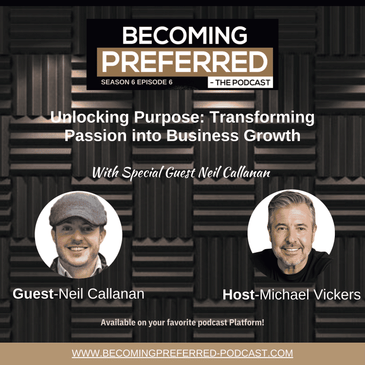
SEASON: 6 EPISODE: 6
Episode Overview:
Welcome back to Becoming Preferred, the podcast where we help you climb the revenue ladder and become the preferred provider in the markets you serve.
Today, we're tackling a challenge every modern business leader faces: You have a passionate purpose, but does it actually move the needle? What if your brand could prove that activism and social impact don't just inspire; they reliably sell, grow market share, and reduce customer churn? Our guest is here to show you exactly how to do it.
Neil Callanan is the founder of LooseGrip and the brilliant mind behind the Grasp Impact Framework. His work sits at the critical intersection of marketing, activism, and analytics. He doesn't just talk about having a mission; he equips you with the tools to measure what truly matters.
Get ready to learn how the most impactful brands are connecting their values to tangible business growth. Join me for my conversation with Neil Callanan.
Guest Bio:
Neil Callanan is the founder of LooseGrip and the creator of the Grasp Impact Framework, a system that helps mission-driven brands connect storytelling with measurable outcomes. Since 2009, he has guided organizations from global giants like Unilever and Ben & Jerry’s to emerging value-focused companies, showing how to align their campaigns with tangible business growth and impact.
Neil’s work sits at the intersection of marketing, activism, and analytics. Where most teams drown in disconnected data or rely on anecdotes, he helps leaders find the middle ground—inspiring teams by turning data into stories, and stories into metrics that stand up in boardrooms.
His goal is simple: equip leaders with tools to measure what truly matters so they can do more of it.
Resource Links:
- Website: https://loosegrip.net
- Website: https://www.graspyourimpact.com/
- Product Link: https://loosegrip.net/services/
Insight Gold Timestamps:
05:03 A little bit of intention and a little bit of luck
06:41 There are stories that need to be told
09:12 When we're figuring out whether a client's a good fit for our framework
10: 56 When people are connected with our brand, they buy more of our stuff
11:48 Most companies get stuck by not starting
14:11 They're kind of topic agnostic
15:20 I know you hate spreadsheets and you kind of pride yourself on hating spreadsheets
15:51 What would the perfect experience be?
19:20 I chair the board of a nonprofit called the I Am Able Foundation
23:22 We love to talk about data in the form of Legos
25:00 If you can turn that data into a story, I think you can connect with your audience a whole lot more
26:37 If I could know anything, what would I want to know?
30:04 Why did I choose Big Brother?
30:56 I think a lot of people are really inherently altruistic and they actually want to help other folks
33:24 If they get the value out of it, and we get to bring our best selves to the project, that's the win
34:44 You talk about writing through grief
34:55 My wife and I lost our son Shea, he was 4 1/2
35:43 I wrote a lot about the journey
42:12 AI has not yet replaced us entirely, but I think it has gotten a lot better at doing the first 60% of the work
43:13 Websites are graspyourimpact and we got loosegrip
Connect Socially:
LinkedIn: https://www.linkedin.com/in/neilcallanan/
Business LinkedIn: https://www.linkedin.com/company/loosegrip/
Email: Neil@LooseGrip.net
Sponsors:
Rainmaker LeadGen Platform Demo: https://bookme.michaelvickers.com/lite/rainmaker-leadgen-platform-demo
Rainmaker Digital Solutions: https://www.rainmakerdigitalsolutions.com/
In 3, 2, 1.
Speaker BWelcome back to Becoming Preferred, the podcast where we help you climb the revenue ladder and become the preferred provider in.
Speaker CThe markets you serve.
Speaker BToday, we're tackling a challenge every modern business leader faces.
Speaker BYou have a passionate purpose, but does it actually move the needle?
Speaker BWhat if your brand could prove that activism and social impact don't just inspire.
Speaker BThey reliably sell, grow market share, and reduce customer churn?
Speaker BOur guest is here to show you exactly how to do it.
Speaker BNeil Callanan is The founder of LooseGrip and the brilliant mind behind the Grasp Impact Framework.
Speaker BHis work sits at the critical intersection of marketing, activism, and analytics.
Speaker BHe doesn't just talk about having a mission.
Speaker BHe equips you with the tools to measure what truly matters.
Speaker BGet ready to learn how the most impactful brands are connecting their values and to tangible business growth.
Speaker BJoin me now for my conversation with Neal Callanan.
Speaker CWell, hi, Neil.
Speaker CWelcome to the program.
Speaker CWe're delighted to have you.
Speaker AYeah, thanks for having me.
Speaker CHey, I'm excited about this one.
Speaker CI've always focused on sales and marketing and in the process of Becoming preferred.
Speaker CAnd one thing I've always not really been able to relate to is bringing purpose to what we do and aligning our brands and the work we do with purpose.
Speaker CI'm excited about the angle that you attack this and niche that you've built for yourself before we get into that framework, because I want to get into one of the frameworks that you've developed that have worked with some amazing companies like Unilever, Ben and Jerry's, and we'll talk about them and what that means and how it impacted the bottom line.
Speaker CAnd so our listeners, I know, are interested in bringing purpose to some of the work that they do, particularly the younger generations.
Speaker CMy generation's a little older.
Speaker CIt was profit first, but I kind of like where you're going with this.
Speaker CWe'll attack that.
Speaker CBut before we dive into it, how.
Speaker CHow did Neil become Neil?
Speaker CLet's go back to high school.
Speaker CYou're.
Speaker CWhere are you living?
Speaker CWhat do you want to be when you grow up?
Speaker AYeah, great question.
Speaker AI grew up in upstate New York in a region called the Finger Lakes, which is pretty rural.
Speaker AAnd I always wanted to be into advertising, marketing.
Speaker AThat was my shtick from the beginning, I think.
Speaker AI.
Speaker AThe story that I told my daughter was basically that I had a teacher who could channel my otherwise fairly mischievous energy into business and marketing and creative.
Speaker AAnd I.
Speaker AShe encouraged me at an early day to do that.
Speaker AAnd I realized it was a place where I Could spend a lot of time.
Speaker AI went to university for advertising.
Speaker ASo I studied, worked at a, ran the advertising department at a college newspaper for three years, did the whole thing that way.
Speaker AAnd then post college, my first job was at a marketing agency.
Speaker AI've always been into the space of communicating and creativity and over time that's evolved as I've gone off on my own and all the stories there.
Speaker ABut also just in terms of the market's changed and now we talk about a lot of data and a lot of numbers and a lot of insights in ways that maybe wouldn't have been so much so in the last 20 years.
Speaker CI want to dive into that now.
Speaker CYou were a Florida Gator, I believe, and great football program, so great place to live as well.
Speaker CSo I know where you are.
Speaker CThe stadium, the swamp.
Speaker CSo lots of good competition.
Speaker CAll right, so you're in marketing, you're attracted to marketing.
Speaker CIt was traditional marketing at the time, I'm assuming.
Speaker CAnd because you've seen it evolve, you've been doing this for I think 16 years now plus.
Speaker CAnd then how have you seen it where.
Speaker CWhen you got into the marketing world to where it's evolved to today?
Speaker CTalk about the evolution of that.
Speaker AYeah, it's been, you know, I think I.
Speaker AMy career kind of spans a pretty interesting evolutionary time when it comes to marketing.
Speaker AWhen I was in college, Internet marketing was starting to be a thing, but not really right.
Speaker ASo we were still learning kerning and letter forms and letting for your newspaper one by ones and how to do a media buy on radio.
Speaker AAnd pretty quickly that knowledge didn't have a ton of value, not the practical skills at all, but just the.
Speaker AThe landscape was changing pretty rapidly.
Speaker AAnd so the agency that I got gig with was primarily a digital shop.
Speaker AA lot of branding, but they were doing kind of old school Digital, like the First Wave Web 2.0, like a brochureware website that had a little bit of interactivity to it for big enterprise companies.
Speaker AAnd we did a fair amount of creative stuff mostly in the B2B side.
Speaker ABut the digital of it all was pretty straightforward, right.
Speaker ALike websites built in flash and really basic Google Ads, that kind of stuff.
Speaker AIn that work, what always sort of appealed to me was the digital stuff.
Speaker ADidn't have a whole lot of owners of it at that point in time.
Speaker ARight.
Speaker ASo what became clear to me was, you know, if I want to advance my career, doubling down on everything digital in 2006 was the quickest path towards having a career that was slightly higher paying.
Speaker CYeah, no, it's an it was an interesting time.
Speaker CAnd the old model changed.
Speaker CYou know, the old ad man model or admin, we'd watch that and it just changed.
Speaker CIt started to evolve.
Speaker CWe started to see more purpose driven marketing as well.
Speaker CAnd I think, how did you get onto that vein in marketing?
Speaker CBecause it's definitely a unique part.
Speaker CPeople talk about it, but you guys actually live it.
Speaker CAnd a lot of your clients that you have execute it.
Speaker CWhat started you down that path?
Speaker AYeah, I would say a little bit of intention and a little bit of luck, you know.
Speaker ASo I started loose grip about 17 years ago, and at the time, I would have done ads for anybody who wanted to pay US$1, and I would have run blimp ads or skywriting or driven the plane with a little, you know, ad behind it.
Speaker AYeah.
Speaker ABut pretty quickly what became clear to me was that there was a growing appetite for sort of insights.
Speaker AAnd that's in an analytic sense.
Speaker ARight.
Speaker ALike how to figure out what's connecting with your audience.
Speaker AAnd the interesting thing about that is that the ability to figure out what's connecting with your audience self selects into working with clients who care if their content is connecting with their audience, which starts to be a lot of mission driven, activism driven brands.
Speaker ARight.
Speaker ASo if you're just selling widgets and your only KPI that you care about is did you sell more widgets today than you sold yesterday?
Speaker AThen you probably don't really value how much time people are spending, consuming your content, spending on your website, diving deep into your video content, learning from your information.
Speaker AAnd then our framework doesn't really work as well.
Speaker ARight.
Speaker ABecause it's not a commoditized cost per transaction.
Speaker ASo I'd love to say I've always been an activist and I've been passionate from birth.
Speaker AThe reality is I sort of lucked into working with some of these brands.
Speaker AAnd you know what's been great about it is we have found that it's not about doing one or the other.
Speaker ARight.
Speaker AIt's about doing both concurrently.
Speaker AAnd I really believe that they both can enhance each other.
Speaker ARight.
Speaker AAnd so it's not as much about picking and saying, oh, we're going to work with activism for brands.
Speaker AWe've done a ton of work with some nonprofits as well.
Speaker ABut even in that sense.
Speaker ARight.
Speaker AWe still think about it like there is stories that need to be told, there's messages that we want to help them deliver, and we also want them to generate donations and petition signups and subscribers.
Speaker AAnd there's a conversion that still happens, but I think the sweet spot for us has always been finding brands who really care about how people engage with their content and that often leads them to be sort of mission driven folks.
Speaker CYeah, I kind of came from the old school where it was transactional.
Speaker CWe didn't really link it to any particular purpose.
Speaker CAnd you've really outlined on your website grassyourimpact.com where you talk about the ROI of purpose and now you work with the Grasp impact framework that you've created.
Speaker CThat's basically starts with a fundamental challenge where many leaders face connecting the company's deep mission to its day to day operations.
Speaker CCan you explain the difference between having a, say, a vague mission statement and having a purpose or preferred purpose and why that distinction is the first step towards some measurable impact?
Speaker AWell, if I want to be a little bit cynical about it, the difference is if you're just posting on Veterans Day, on Black History month and on the 4th of July with your token stock image of your team supporting, quote unquote, an audience, then it's unlikely that you're doing so with a ton of authenticity.
Speaker ARight.
Speaker AAnd I think the brands that do this best are really living and breathing.
Speaker CIt actionability all the time.
Speaker ARight.
Speaker AIt's not something they do once as a means to get their campaign out the door once.
Speaker AIt's not the NFL putting their salute to service out one the year.
Speaker AIt's about having commitment to an idea over time.
Speaker AAnd I think the brands who are doing it really well have that commitment and then that allows them to invest in ensuring that they are connecting with an audience that is both potentially a consumer of their product, but also potential folks who can be activated by their messaging and their mission along the way.
Speaker CYeah, we see that with the younger generations.
Speaker CWith the older generations, it's definitely learned the younger generations have done a great job I think of bringing that to the table.
Speaker CI think the big difference is I see mission statements from CEOs and I'll even it'll be sitting on the wall behind them and I'll say, can you tell me your mission statement?
Speaker CThey can't even really tell me and without looking and they're embarrassed by that.
Speaker CBut you say you have a mission statement says, you know, we aim to make the world a better place, whatever that, what does that do?
Speaker CVersus Ben and Jerry's would be a perfect example that one of your clients, their purpose isn't just to sell ice cream.
Speaker CIt's about using their business to advance social justice and sustainable economics.
Speaker CSo you've got KPIs around the actionable steps.
Speaker CCan you talk about a client like that?
Speaker CBecause we can all relate to good ice cream and they make amazing ice cream.
Speaker AYeah.
Speaker AWell, I would say the answer I task our team with when we're figuring out whether a client's a good fit for our framework is can they answer the next question?
Speaker ARight.
Speaker AIf your mission is to change the world and you say, how are you doing that?
Speaker BYeah.
Speaker ACan you point to what you are doing other than this one post on Mother's Day or on Veterans Day or on Green Energy Day, whatever it might be?
Speaker AAnd so a lot of brands, they can't authentically answer that question because it's mostly a marketing effort more than it is an activism effort.
Speaker ABut I'll say, yeah, we get to work with some really cool brands.
Speaker AAnd I would say the thing they have in common is that today more than ever, there's some sort of society wide.
Speaker AI wouldn't say society of political.
Speaker AJust the kind of nature of things.
Speaker AThere's been a kind of downward pressure on all investments in activism.
Speaker ARight.
Speaker AWhether that's ESG or even just di.
Speaker AAll the things.
Speaker ARight.
Speaker AThere's been a downward pressure.
Speaker AAnd so more than ever, the brands that we work with need to be able to tell the story of how their activism impacts their bottom line.
Speaker ABecause if they can't, they're going to have a hard time rationalizing that investment or the investment in the resources, the investment in putting messages out that aren't always going to land perfectly with 100% of the audience.
Speaker ARight.
Speaker ALike, it's one thing to put out a picture of a beautiful ice cream sandwich and have a pretty high satisfaction rate amongst your audience.
Speaker AIt's a different thing to be asking folks to vote or to advocating for refugee rights in Europe.
Speaker AThere's some folks who aren't going to agree with you.
Speaker AAnd so you have to be able to point to data that says, this is how that might impact our bottom line, or this is how that did impact our bottom line.
Speaker AThis is how that impacted not only the activism, but the conversion that we want to sell things.
Speaker AWe don't work with a ton of brands who just say, nobody wants to hear about how good we do in the world.
Speaker AAs long as, you know, we're just doing it for the sake of doing it.
Speaker AThey want to say, here's what we do and here's why it makes people connected with our brand.
Speaker AAnd when people are connected with our brand, they buy more of our stuff or invest more in, or they're more committed to our, you know, Yeah, I.
Speaker CThink companies have to be a little more strategic.
Speaker CI'm still seeing a lot of the same initiatives, say like esg, dei, they're just disguising it, so they're wrapping around different words and phrases because of the political downward pressure that's always on these things depending on who's running the show.
Speaker CAnd so companies that are still committed to it, I see them still doing it, they're calling it, you know, belonging, working with groups around the country, they just disguise the phraseology of it so they get rid of those labels and the terms that people love to label with.
Speaker CLet's introduce the audience to the Grass Impact framework.
Speaker CThis is really central to Loose Grip.
Speaker CCan you walk our listeners through the core components of the framework?
Speaker CIt's an acronym.
Speaker CAnd just what are the key specifically what are the key stages and where do most companies typically get stuck when trying to implement it on their own?
Speaker ASure.
Speaker ASo I would say most companies get stuck by not starting more than by getting stuck along the way.
Speaker ARight.
Speaker ASo I'm a big advocate that this kind of approach can be done internally by a lot of brands, especially small to mid sized brands that can't unnecessarily bring in somebody like us all the time.
Speaker ABut the general idea is that we go out and we set up content objectives for every piece of content and we do that typically in a workshop format.
Speaker ASo we'll bring five or 50 people in a room and we try to start by getting away from computers entirely because when you start talking data and KPIs, you can really end up quickly at moving pieces around on a dashboard that don't really help you move your brand forward.
Speaker ASo we really like to start with we're big fans of big giant post it notes and we get everybody in a room and we start moving things around up and down.
Speaker AAnd typically the way we will approach it is we will say let's look back at your last, you know, 50 pieces of marketing materials that might be social media content, emails, web pages, campaign efforts, commercials, whatever.
Speaker AAnd then we start trying to put each of them into a bucket.
Speaker ARight.
Speaker AAnd typically that bucket is going to be roughly one of three things.
Speaker AOne is going to be what we call discover, which is like content that is designed to reach the most amount of people.
Speaker ASo this is like your brand content.
Speaker AGive me as big a number as you can.
Speaker AHow many people can I reach?
Speaker AAwareness, all that.
Speaker AThe second bucket is typically either engage or educate, depending on whether it's B2B or B2C.
Speaker ABut that's typically Trying to get somebody to take an action that's going to drive them a little bit deeper in their understanding of the brand, the product, the story, the industry, whatever it might be.
Speaker ASo in that case, we're looking at content that we actually care about the quality of the interaction more than the quantity of the interaction.
Speaker AThey're not exclusive, right.
Speaker AThey're not mutually exclusive, but we do care about the quality.
Speaker AAnd then the third piece is typically some type of conversion, right.
Speaker ASo you know, some cases that's getting folks to sign up for a voting rights petition, sometimes it's selling soap, right?
Speaker AIt can be, it can be both.
Speaker AAnd the conversion is still the end goal.
Speaker AAnd when we talk about a conversion, it's a tangible, measurable, specific action.
Speaker AAnd what's cool about the framework is it allows us to take content that seemingly on the surface feel very different.
Speaker ARight?
Speaker ALike get your ice cream delivered and sign this voter rights thing.
Speaker AAnd now I can look at what content actually drives the most.
Speaker AActionability, regardless of the topic of the content.
Speaker ARight?
Speaker ABecause there's a format style.
Speaker AWe know this type of content works best for convert content, this style works best for our engage content and this style works best for discover content.
Speaker AAnd they're kind of topic agnostic.
Speaker ASo it works really good for mission driven brands, activism for brands, because they're creating both.
Speaker ARight.
Speaker AAnd it's otherwise really hard to say.
Speaker AWe did this post about our investment in renewable energy and we did this post about how many megawatts our data center provide.
Speaker AThey seem so different on the surface that it's really hard to weave them into a content calendar and learn from both.
Speaker ABut we really feel like when thought of in tandem but chosen by a specific objective in mind, it creates a framework that allows us to say this kind of content seems to connect best with our audience, regardless of if we're asking them to buy ice cream or fill out a petition or download a white paper or you know, just engage with a story from one of our thought leaders.
Speaker CWell, I guess it's making them feel good when they do make their purchase.
Speaker COr if some things.
Speaker CFor instance, I love Apple products, recycled aluminum product.
Speaker CYou know, I try and look at those sustainability aspects.
Speaker CNot everything, but I always make that a priority.
Speaker CFootprints.
Speaker CMy wife and I, you know, shrunk our footprint.
Speaker CWe raised a big family, we had seven children and we had all the multiple things that go along with that.
Speaker CWe brought that down to its basic fundamentals.
Speaker CDo what we can.
Speaker CLet's talk about the analytics because I know you hate spreadsheets.
Speaker CAnd you kind of pride yourself on hating spreadsheets.
Speaker CSo you move past the vanity metrics that most people, you know, the likes and part.
Speaker CHow do you identify the key data points that directly correlate to the purpose and business growth?
Speaker AWell, typically what we do is, rather than by starting with all the data points, what we'll do is we'll take that framework that I talked about for in a workshop format and then we'll say, okay, what are some of the actions?
Speaker AWhat's the number one thing we would want somebody to do right now?
Speaker ARight.
Speaker AAnd we'll kind of play out this experience of what would the perfect experience be?
Speaker AAnd it may be they skip the content quick and go by the thing.
Speaker AIt may be that they actually spend 10 minutes watching this whole story about how the ingredients are sourced sustainably and then turn that into, into action.
Speaker AAnd then they find the flavor or the product that best articulates that specific thing, and then they sign up for our newsletter and then they buy the thing.
Speaker AThere's journeys that can happen in a bunch of different ways, right?
Speaker AAnd so once we determine for each bucket of content what the ideal KPIs might be, we can then start pruning them away.
Speaker AAnd I actually generally recommend the way we do this in a workshop is we say, all right, let's Talk about the 10 best potential user journeys, and then we just start pruning them back and we say, okay, these are two are kind of the same.
Speaker ALet's get rid of that.
Speaker AWe end up with maybe two, maybe three core measurables.
Speaker AThey could be referred to as metrics, but sometimes they're a combination of metrics or we're identifying a buyer journey and we try to make them as condensed as possible.
Speaker AAnd that serves as the framework for which all the reporting is going to be built on.
Speaker ASo when we do quarterly reporting for a brand, we're going to do it based on the framework that basically they built more than we built.
Speaker AThey went through the process.
Speaker AAnd what I'd say kind of lastly to that is that one of the things that's really important about that is that it brings a broad swath of folks to the table and gets their voice heard.
Speaker AAnd that buy in is really important.
Speaker ASo, you know, people will ask what makes these successful.
Speaker AAnd I would say in most cases, getting all the voices heard up front.
Speaker AAnd that typically at a big brand looks like everyone from the content creators to the social media managers, right?
Speaker ALike on the lower scale, all the way up to leadership who has to advocate for why they're posting about something.
Speaker AYou got to build some buy in and some consensus on what the action that they want to take is and or that they want their consumers to take and then get some agreement on what metrics best articulate that.
Speaker ARight.
Speaker ASometimes they're very clear.
Speaker ARight.
Speaker AIt's just a purchase.
Speaker ABut sometimes if you're trying to build a brand, maybe the purchase is more commoditized, but you're trying to build a brand along the way, then maybe you need to look for a more creative metric set that can help talk about that.
Speaker AOne of the examples I love, we had a client who they sell like outdoor gear and really high end, thousand dollar tents, you know, thousand dollars sleeping bags, that kind of thing.
Speaker ABut they're a relatively new brand and when looking to their purchases, they had just rolled out all this kind of branded retail, non technical stuff which is mostly about their fans going out and saying, oh no, I have this thing.
Speaker AIt's like the guy who's going to buy a truck but also wear the Ford T shirt or whatever.
Speaker ARight.
Speaker ALike the T shirt doesn't mean anything to the bottom line, but it does mean something to being indicative of the brand affinity that has been created.
Speaker ABecause the kind of person who's going to not only buy the vehicle but then talk about buying the vehicle, it's a very different interaction.
Speaker ASo then we can start to use some of those purchase behaviors as actual ties to branding rather than ties to revenue.
Speaker AEven though it's a purchase at the end of the day, Ford's not going to change their bottom line by selling T shirts, but they might change their bottom line by creating more people who want to buy T shirts and wear T shirts, that kind of thing.
Speaker CIt's the just do it right.
Speaker CYou got the swoosh and what we add to it and we buy it on all our things.
Speaker CI know people, I know your clients who and who use the Grouse framework.
Speaker CThey get clarity, they get action and they get a proof of impact which at the end of the day it's what you're looking for.
Speaker CDo you ever get.
Speaker CI'm sure you do.
Speaker CDo you get clients that come to you, small, medium and large who go, hey, we don't have any purpose, we're just transactional at this point.
Speaker CHelp us find a purpose that fits our brand that we can explore that will help drive growth?
Speaker AYeah, on occasion, you know, I would say where we've done that is almost in some cases turning that messaging on the nonprofit side.
Speaker ASo I served on the board of I Chaired the board of a nonprofit called the I Am Able Foundation.
Speaker AAnd one of the things we really helped them do as part of their rebranding efforts were identifying, you know, if you go back to the old, like, Ziggler sales stuff, I'm sure you're very familiar with, right?
Speaker COh, yeah, I knew Zig.
Speaker CHe's long gone, but, boy, he kind of started that whole revolution on things.
Speaker AYeah.
Speaker CAnd this idea of existed, for sure.
Speaker ATalking about what buyers are buying more than talking about what you're selling.
Speaker ARight.
Speaker AAnd that can actually apply in a lot of different ways.
Speaker AAnd so in that case, this particular nonprofit helps disabled and adaptive kids get more access to athletics.
Speaker ARight.
Speaker ASometimes that's through buying gear, sometimes that's through classes, sometimes that's through adventures.
Speaker ASometimes that's through scholarships to be in the Boston Marathon, whatever it is.
Speaker ARight.
Speaker AAnd we aren't going to go in and tell them how to change their mission, but we can go in and say, hey, people really seem to relate to these stories about when you teach a class, and this person had an experience.
Speaker ARight.
Speaker ASo kind of bringing it out of the macro sense and into a little bit more tangible example.
Speaker ASo I'd say, you know, what our team is really good at is sort of saying, you have a mission.
Speaker AMaybe you don't know how to articulate it best, but we can help you come in and figure out how that mission is best articulated in a way that will connect with your audience, and your audience will connect with it in this particular way.
Speaker ARight.
Speaker ASo, you know, the example in the nonprofit space is like, a lot of these nonprofits will spend a lot of time thinking of articulating their mission through stories, but not enough time thinking about what do people really want to buy, quote, unquote, buy.
Speaker AAnd the example is people love to buy a piece of equipment because you got to put a whole lot more time into thinking about what's the value of a class, what's the value of a scholarship to do a thing, what's the value of an experience for a kid to get to go skiing for a day.
Speaker AAnd those are much harder to put a monetary amount on.
Speaker ASo you have to kind of over invest in the storytelling to get people to go down that route.
Speaker AAnd ultimately, I think you can get there and you can build through that growth by thinking about what are the KPIs that would be indicative of that storytelling being successful.
Speaker AIt may be that you drew more donors, but it also may just be that now people are more invested in the brand and they're willing to become repeat donors and that's a better indicator rather than a first time donor.
Speaker AThere's a bunch of different ways to think about how the KPIs sort of play out and all that kind of.
Speaker CThing and they start to advocate and that consumer advocacy is really what drives it.
Speaker DAre you tired of chasing leads and ready to start effortlessly attracting more high value clients?
Speaker DIntroducing Rainmaker Lead Gen the ultimate sales, engagement and client acquisition platform that takes the stress out of outreach.
Speaker DWith Rainmaker Lead Gen, you can easily identify, engage, educate and convert your ideal prospects into loyal clients.
Speaker DOur industry leading automation and email sequencing empowers you to reach more ideal clients, accelerate the sales cycle and close more business.
Speaker DImagine authentically engaging with your prospects while the platform handles the heavy lifting.
Speaker DSay goodbye to the endless hustle and embrace a more efficient, effective approach to business development.
Speaker DReady to witness the magic?
Speaker DBook a 20 minute demo today and see how Rainmaker Lead Gen can revolutionize and level up your client acquisition game.
Speaker DThere's nothing to lose and everything to get game.
Speaker DDon't miss out on this opportunity to supercharge your client acquisition process.
Speaker DVisit rainmaker digital solutions.com or check out the link in the show Notes to book your demo.
Speaker DRainmaker Lead Gen Spend less time hunting for your ideal clients and more time having high value sales conversations with your ideal clients.
Speaker BAnd now back to my conversation with Neil Callanan.
Speaker CYou talk about the storytelling.
Speaker CYou emphasize turning data into stories and then stories into metrics.
Speaker CWhy is storytelling the crucial bridge between, you know, boring, dry analytics and boardroom level business growth?
Speaker ABecause nobody wants another spreadsheet.
Speaker ANobody really wants another dashboard.
Speaker AI would say they think they do, but they don't.
Speaker AThe analogy that I use when I'm doing workshops, kind of to an analytics community sometimes, is we love to talk about data in the form of Legos, and there's an instinct to gather as much data as possible without thinking about the story really too much.
Speaker AAnd the way that I articulate that is think of Legos, right?
Speaker AIf I gave you ten, a hundred, or a hundred thousand Legos, every time I give you more Legos, it's going to be harder to figure out what it is you could build from it.
Speaker AThere's more possibilities for sure, there's endless possibilities.
Speaker ABut try to figure out how to build that one car if there's a hundred thousand Legos on your garage floor, right?
Speaker AAnd data is that same problem.
Speaker AWe just get get data obsessed with let me get some more Legos and let me get some more Legos.
Speaker AThe value comes Back to the stories that can be told from it.
Speaker AAnd the example being LEGO can charge a thousand dollars for, you know, a LEGO Millennium Falcon.
Speaker ABut I can go on ebay and buy Legos literally by the pound and they will show up for 40 cents a pound or something.
Speaker ASo like it can be fully commoditized if it doesn't have the story.
Speaker AAnd there may be the pieces to build that Millennium Falcon in that hundred pounds of Legos that I just bought, right?
Speaker ASo I think the example is that like, like more is not always better.
Speaker AAnd we get into this mistake where we say, okay, first thing I should do is get more data.
Speaker AAnd then when I get a bunch, I'll start organizing it, right?
Speaker ABecause it feels good.
Speaker ALet me sort all these Legos by colors, let me put them all into their respective bins and I'll have this very organized LEGO room.
Speaker AAnd then now I've got all this organized stuff and then maybe I'll be able to build something amazing that can influence the people around me, right?
Speaker AAnd it's not the case, right?
Speaker ASo you end up at grabbing a bunch of data, turning the spreadsheets, turning that into a pretty dashboard, which honestly, it feels really good.
Speaker AWhen you see a pretty dashboard, you're going to see all the numbers and it feels great.
Speaker AAnd you probably, probably never going to go look at it again, nor is anybody on your team.
Speaker AThese dashboards, they just don't become useful tools along the way.
Speaker ABut if you can turn that data into a story, I think you can connect with your audience a whole lot more.
Speaker AAnd I mean the audience of, you know, the boardroom, but even the people doing the work, right, the content creators, the people generating your ad campaigns, the people who are putting your SEO on market, whatever it is, right?
Speaker AThey don't want to be given a spreadsheet to tell them what to do.
Speaker ABut if you build it in an engaging fashion, we really do, we set, our goal is that most of our clients, we do quarterly readouts.
Speaker ASo we do, you know, once we get into the day to day flow of reporting.
Speaker AAnd our goal is for that quarterly meeting to be their best meeting of the quarter, right?
Speaker AWe want it to be fun.
Speaker AWe want it to be an engaging storytelling, narrative driven, engaging conversation rather than A Here's a PowerPoint or here's a dashboard, right?
Speaker ASo we try to really drive them into that story.
Speaker CIt's interesting, I just was reading literally an article this morning, early this morning.
Speaker CJeff Bezos in Amazon is famous for doing the narrative memo and he banned in 2024 PowerPoints from showing up in meetings and executives for the first 30 minutes have to read a six page mem.
Speaker CSilence, crickets, no one's talking.
Speaker CAnd then they work from the narrative.
Speaker CWhat's the difference between a narrative and storytelling?
Speaker AIt's a great question.
Speaker AFor me, I would say a narrative is determining for us how the momentum is working towards your goal.
Speaker ARight.
Speaker ASo we know that the narrative is likely established by the business, right?
Speaker AMeaning we want to sell more of these things or we want to reduce the impacts of climate change by doing this or whatever the thing may be.
Speaker ARight.
Speaker AAnd so we know that's the end goal.
Speaker AAnd so the narrative becomes what are the data points along the way to that?
Speaker AChoose your own adventure.
Speaker AWould we need to know that we're getting closer to having that impact?
Speaker ARight.
Speaker AAnd can we deliver those in a way that connect with folks?
Speaker ASo we like to think about these things just in terms of like, well, if I could know anything, what would I want to know?
Speaker AThen go search for it rather than here's all the things I have, what can we do with it?
Speaker AWe try to take the opposite approach.
Speaker ASo that might be looking at saying, how do I spend my media more effectively?
Speaker AHow do I know which content we should do more of, should do less of which agency that we partner with is creating the best stuff?
Speaker ARight.
Speaker ALike there's a bunch of business level decisions and then a narrative can really help do that.
Speaker AI would say storytelling for us is how we get folks to connect to that narrative and we think a lot about it, a lot and hard about it.
Speaker AAnd I would say my favorite example of this that I would say is more about storytelling is that when we are trying to bring numbers to life, we try to recontextualize them.
Speaker AAnd I think it's like the easiest tweak you can make, especially if you're working a data driven field is just take one data point and recontextualize it in a different format.
Speaker ARight.
Speaker ASo we often look at these consumptive behaviors that I've talked about before, right?
Speaker ALike how long do people on average spend on this particular piece of content on this video?
Speaker AWhat's the average watch time on this video?
Speaker ASo a lot of times what we'll do is like in an end of year readout, I'll pull up the num.
Speaker AThe best, their best performing piece of content for the year and maybe it has like a 2 minute and 12 second average engage time, right?
Speaker AYeah.
Speaker AThat those numbers mean nothing.
Speaker AThey mean nothing to any of us.
Speaker AOur brains can't even capture really what that means.
Speaker ABut if I make you sit and be silent in an awkward conference room for 2 minutes and 14 seconds, you will see how long 2 minutes and 14 seconds is.
Speaker AAnd it will help people contextualize the difference between that and the 32nd average engage time.
Speaker AOr the difference between why we don't care as much about views.
Speaker AIf a view can be a half a second, that's such a different brand experience than somebody who sat down and spent two minutes with your content.
Speaker AAnd I think storytelling is what we use to bring those numbers to life in a way that then somebody can be better at their job.
Speaker ALike, it's very hard to make decisions solely based on the programmatic arithmetic.
Speaker ARight.
Speaker AIs the conversion rate better?
Speaker AYes or no?
Speaker ASure.
Speaker AIf all I care about is am I selling the thing for the cheapest amount possible.
Speaker ABut if you're trying to build your brand up over time, you really got to understand better how people are engaging with content and how the sources change and how the platforms change and how those visitors affect the bottom line.
Speaker AOr it can all be part of the narrative.
Speaker ABut I think bringing the story to life in a way that gets people to be like, oh, I'll stop and pay attention to this.
Speaker AEverybody's got so many meetings in their.
Speaker ARight.
Speaker ALike, storytelling, I think for us helps us think about how to bring that performance information to life in a way that people literally just stop at least to pay attention.
Speaker ARight?
Speaker CSo we see billboards, we get an impression, we get something that flashes.
Speaker CWe get an impression.
Speaker CBut if we can get them emotionally involved, like from a sales perspective, which is the one I'm always coming from, we try and embed these emotional triggers in our sales pitches, in our presentations and our conversations level.
Speaker CBecause I believe it's emotion first.
Speaker CFirst justify with reason and logic second.
Speaker CAnd we do that through storytelling.
Speaker CSo we will tell stories of a client.
Speaker CWe try and embed those emotional components into it.
Speaker CDo you find when people are looking for their stories or developing their stories or their purpose that they're going to be aligned to that?
Speaker CIt comes from a lot of their experiences themselves.
Speaker CAnd you say, you talked about aligning everybody because everybody's coming to the table with something that's important to them.
Speaker CFor instance, you, I believe you were Big Brother and worked with the Big Brother organization.
Speaker CYou know, what makes you choose that versus, say, something else are in multiples of that.
Speaker AYeah, I would say that there's two levels.
Speaker ARight.
Speaker AAnd when we go back to the sort of objective based frameworks, I Think it applies, right?
Speaker ASo if you think about.
Speaker AAll right, when the phase where Big Brother is trying to capture my attention, why did I choose Big Brother?
Speaker AI have no idea.
Speaker AI was exposed to the brand and it felt like a program that I was like interested in being involved with.
Speaker ABut the educate fashion, where they were developing content about what that would look like, helping me think about it, helping me envision myself as getting to influence a young person or to feel like I have been contributing in a new way.
Speaker AThat's the kind of content that they were able to educate me with, that me confident that I was ready to pull the trigger.
Speaker ARight.
Speaker ALike you're bringing somebody along this journey, whether you're selling ice cream or Big Brothers, big Sisters, you're bringing somebody along, right.
Speaker AFirst you got to help them have the idea, then you got to help them picture themselves in that idea, and then you got to get them to pull the trigger on signing up for the first consultation or buying the thing or putting their credit card information in.
Speaker ARight.
Speaker AAnd I would say, you know, for me, I think a lot of the altruistic things people kind of decide, I think a lot of people are really inherently altruistic and they actually want to help other folks.
Speaker AI really do believe that.
Speaker AI don't think we always make it really easy for them.
Speaker AAnd so sometimes brands an opportunity they have is to kind of be that avenue.
Speaker ARight.
Speaker ALike, I was just watching a local political race and a friend of mine was running for Supreme Court in New York State and just watching how many folks in the community were excited to get behind and support him and walk in the parades.
Speaker AThese are not people who are super active political folks, right?
Speaker ABut just having a thing to get excited about and feeling especially in today's world, like you can have some agency over the decisions that you make, where you spend your money, how you spend your money, where you volunteer your time.
Speaker AThat agency is one of the things they haven't been able to take away yet.
Speaker ASo I feel like it's our job as marketers to leverage that, find ways to allow people to opt in to being conscious consumers and being smart about how they impact the world at large.
Speaker CA lot of our audience are entrepreneurs, business people.
Speaker CThey're working hard, hard.
Speaker CHow do you achieve as an entrepreneur?
Speaker CBecause you've been doing that for, like you said, about 17 years to balance work, life, balance, or how do you, you know, you've got to look after your family, you've got your children.
Speaker CHow do you bring all of that into.
Speaker CI know it's a Struggle.
Speaker CI struggled with it my early years.
Speaker CI'm a way better papa than I was a dad.
Speaker CYou know, as far as being around, how do you balance your life?
Speaker CBecause when you're working with some of these brands, I know you burn the midnight oil many times, I'm sure.
Speaker CIs that a challenge for you on a personal productivity or as an organizational or how do you bring that to your work and to your business, your company, in your culture, if you will?
Speaker AI would say from a cultural standpoint, we all have to believe in respecting each other and each other's time and working with brands and companies who are going to respect, respect all of us.
Speaker ARight.
Speaker AOn our team, we're a small team and so that's generally good.
Speaker ABut that also means if somebody is not being respectful of everybody else's time on the team or one client is not being respectful of our team, that can really impact morale, mine and theirs.
Speaker ARight.
Speaker AAnd so when I about creating a work life balance, I think about it like designing it around what I've always wanted, which is basically let me prove results and don't worry too much about how much time it took me to get there.
Speaker AAnd I try to keep our team focused on that energy, both as working for loose script, but also for the clients that we work with.
Speaker ARight.
Speaker ALike, we don't do a ton of hourly billable work because I don't want to be incentivized to bill more hours.
Speaker ARight.
Speaker AI want to be incentivized to do better work, period.
Speaker AAnd if they get the value out of it and we get to bring our best selves to the project, that's the win.
Speaker ANot did this thing take X amount of hours?
Speaker ARight.
Speaker ASo I think there's a little bit of just cultural buy in that you need to have internally and then you can go forward with it externally.
Speaker AAnd I would say almost nobody pushes back on us anymore when we say no.
Speaker AWe don't actually report hours.
Speaker AThat's not who we are.
Speaker ABut all those things lead into trying to create a work life balance that's a little bit more sustainable.
Speaker AA couple things we do for that.
Speaker AI would say the last few weeks our team's been really getting their butts kicked because of the end of the year.
Speaker AWe do a ton of reporting.
Speaker AThe kind of quarterly reports I was talking about.
Speaker AA lot of campaigns are wrapping, that kind of thing.
Speaker AYeah.
Speaker AThings will really slow down.
Speaker ARight.
Speaker ADecember 10th onward, not a whole lot going on.
Speaker AIt's a great time to just give everybody some time to breathe and rejuvenate Go take a day.
Speaker AYou know, try to take a Norwegian approach to holiday kind of thing.
Speaker ALike, not the American approach is very ripe for burnout.
Speaker AAnd I try really hard to make sure we aren't contributing to that overall.
Speaker CYeah, absolutely.
Speaker CNo, I. I think that's good to have that work out.
Speaker CAnd I love that generation and your generation because, you know, I. I started with a paper route at 10 and started my own little businesses back in those days.
Speaker CAnd it's just working.
Speaker CIt's finding that balance.
Speaker CAnd then life comes in and there's marriages for people, there's divorces for people.
Speaker COne of the things I noticed in your bio, and I wanted to attack it, and we were okay going there.
Speaker CYou talk about writing through grief and.
Speaker CAnd writing with.
Speaker CCan you.
Speaker CCan you elaborate on what that was?
Speaker CI'm not sure personally.
Speaker CHow did you come up with that?
Speaker CAnd why is that one part of what you talk about?
Speaker ASure.
Speaker AWell, my wife and I lost our son, shay.
Speaker AHe was four and a half, maybe 14 months ago now, 15 months ago.
Speaker AAnd it's not a joke, but the thing I said that is you would have never got me to say previously was, I wish I had a job.
Speaker AI wish I could have been useless on somebody else's dime for six months after that because I just wasn't really good at doing anything, let alone running a company.
Speaker CEverything becomes meaningless.
Speaker AYeah.
Speaker AAnd it's really hard to not let the apathy become contagious when you don't care.
Speaker AIt's hard to get your team to care.
Speaker AIt's hard to get your clients to care.
Speaker AIt's all really hard.
Speaker ARight.
Speaker ASo for me, writing has always been a kind of cathartic approach.
Speaker AYeah.
Speaker AFor me, that has to be.
Speaker AFor whatever reason, I have to publish it for it to have that catharsis.
Speaker ARight.
Speaker ASo I wrote some.
Speaker AI wrote a lot about the journey.
Speaker AStill do, but especially the early stages.
Speaker ASome of the really tough things about losing your kid and the bureaucracy of it all and the.
Speaker AJust the emotions, but also just the realities of it.
Speaker AAnd I've been writing a lot because I think in some ways fathers are a little bit underserved when it comes to grief and grieving.
Speaker AIf you were to find writing about grief, it's likely written by a woman or through the context of a mother who has lost their child.
Speaker AAnd I think that's just.
Speaker AJust because dads don't emote as much, and we just operate a little bit differently.
Speaker AAnd our instinct is to do and put our heads down and put our.
Speaker AKeep trying to Take another step.
Speaker AI realized pretty quickly for me that wasn't reasonable, it wasn't going to work.
Speaker AAnd I was spending a lot of time just searching for anything I could find by dads who had experienced it.
Speaker ABecause you're just searching for any kind of answers you can find.
Speaker AAnd so if I didn't find an answer to a specific thing, I tried to write about it.
Speaker AI think where the things overlap is that by doing so publicly, my team could see it, they could get a vibe on where I was.
Speaker AAnd I think for them and my clients, frankly, you know, I'm good friends with a lot of our long term clients and I think my writing just allowed people to have a window into where I really was so they could understand that not only did I want to talk about Shay, did I want to talk about my grief like I was, I'm here for it.
Speaker AAnd I needed to publicly say it to get my team to be not trying to, you know, awkwardly sidestep around it to get the clients to, you know, I took a fair amount of time off and did nothing.
Speaker ABut I also along the way, I think was trying to bring people into the journey just enough to.
Speaker AYou're just trying to project how you want folks to feel comfortable interacting with you.
Speaker AAnd I think when there's a loss of a child specifically, it's such a heavy thing that everybody's scared of it.
Speaker AIt's really scary for somebody to bring up to address.
Speaker AYou can see it even in podcasts and interviews and that kind of thing.
Speaker ARight.
Speaker AIt's just a big scary animal.
Speaker CIt's a big owie.
Speaker CIt's a big owie.
Speaker CParents should never outlive their children.
Speaker CYou were talking about Lego and as you were talking I'm thinking of my 5 year old grandson Henry.
Speaker CAnd you know, he loved Lego and he loves and he can build.
Speaker CHe's unbelievable and he just incredible builder.
Speaker CHe just watch him work and how fast.
Speaker CLet's honor shape for a minute.
Speaker CTell us about Shay.
Speaker CTell us, give us a minute about.
Speaker CTell our audience about him.
Speaker ASure.
Speaker ASo Shea was.
Speaker AShay was four and a half when he passed and he was a pretty rambunctious little guy.
Speaker AHe was on two wheels from the.
Speaker AAs soon as he could walk, he was on a balance bike.
Speaker AHe was pedaling around a bike without any kind of training wheels, a two wheeler.
Speaker ABy the time he was three, he was just ripping around mountain biking, doing all this stuff and had some.
Speaker ALooked like me, talked like me, had a similar mischievousness to him as a child.
Speaker AAnd yeah, he was really great, really great kid.
Speaker AHe.
Speaker AHe and his sister were really close, but in the kind of closet close that older sisters and younger brothers could be, where he would antagonize her until she flipped out kind of deal.
Speaker AAnd he was just a joyous, energized kid who made everybody smile.
Speaker AAnd he still does.
Speaker AWe still.
Speaker AWe talk about Shay a lot, and I bring him to how I approach business and how I approach my team and how I approach my life and my marriage and my parenting.
Speaker AAnd nothing's gotten easier in the last 15 months, but I do feel a little bit smarter.
Speaker CWell, Neil, thanks for sharing that with us.
Speaker CHey, to bring this full circle and we're under.
Speaker COur time's up.
Speaker CI could talk to you for hours.
Speaker CAnd I appreciate the insight, insights and sharing feelings with us because these are things that are real.
Speaker CWe run into people.
Speaker CI've been in meeting situations where people have lost somebody that day.
Speaker CWe need to bring that human part back to and our nature.
Speaker CAnd I think maybe a good question of that is to maybe talk about the empathy.
Speaker CWe've got AI coming on, and I'd love for you to address for our audience how AI is maybe how you're using the tools, but a lot of people are worried about being replaced.
Speaker CAnd I believe AI is great at recognizing patterns.
Speaker CWe.
Speaker CIt thinks in its own way, but it doesn't provide empathy.
Speaker CIt doesn't that reaction that.
Speaker CThat visceral feeling of it doesn't experience that.
Speaker CIt doesn't have those judgments and understand those values.
Speaker CSo I think that's what makes us human, and that's what we need to bring to the table.
Speaker CHow do you see it fitting in?
Speaker CAnd how's your firm employing it?
Speaker ASure, it's a good question.
Speaker AI think I agree with you in principle that today the empathy is not really part of the technology solution.
Speaker AAnd the empathy is what makes us be able to connect with folks better, whether that's customers, prospects, clients, team members, whatever we use AI to do, I think it can be a really powerful tool to take that big giant floor full of Legos that I talked about for and just help you find some patterns in it that the human brain maybe can't yet.
Speaker AAnd so in the past, when we launched these frameworks, one of the challenges was we would build out a framework and then we would put together this really complex tagging and tracking document, which for the data nerds, they'll very much get it.
Speaker AUTM tags, all the stuff deep in the cms, everything to just make sure everything had a Tagging ID for every piece of content.
Speaker AAnd then we have to.
Speaker ABecause we have to wait for all the results to come in, start to look at it today.
Speaker AWe can go back.
Speaker AWe just did a project for a client earlier in the year that was, we looked back at five years of content and we can very quickly identify what was the intent of this piece of content.
Speaker AContent and AI's pretty good at identifying.
Speaker AWere they trying to sell more of their stuff?
Speaker AWere we trying to get people to check out a recipe?
Speaker AWas this something where we, how what percentage of the product was featured in this piece of creative.
Speaker ARight.
Speaker AWe can start to then look at these trends over time and it gives us a much more powerful tool set to still do the human analysis.
Speaker AI still have to look at my brain and go, I wonder why that piece seemed to work better than this one.
Speaker ARight.
Speaker AOne of the things that AI is really good at is just, just, it's going to get a lot of things wrong.
Speaker ABut if I can go in and I can say, you know those content categories we talked about before, I can retroactively go back now and I can use AI, we have a bunch of custom agents that we use it for that we'll just go back and say, seemed like this was designed to get people to sign up for activism related thing or to get folks to download the newsletter.
Speaker AAll right, now let's look at five years of content.
Speaker AAll that we're targeting the newsletter subscribers, all that were targeted towards activating an audience who was already familiar with the brand.
Speaker ANot gonna look at five, five years of content.
Speaker AEasily, easily get it all together and then use my human brain to figure out why one seemed to work better than the other.
Speaker AYou know, it's, it's sort of using the AI to sort all the Legos on the floor and put them into all the buckets that we talked about so that your brain can go, oh, it looks like there's a lot of wheels here.
Speaker AMaybe we can make something with these wheels.
Speaker AIt looks like there's a lot of plane wings.
Speaker ALooks like there's a plane to be made in here somewhere.
Speaker AIt's just using AI to sort through these masses of data to find the opportunity for a human brain to look at it and go, accidentally.
Speaker AThe insight is here the AI has not yet replaced us entirely, but I think it has gotten a lot better at doing the first 60% of the work.
Speaker ARight.
Speaker AWhere the data engineering and you know, how that gets infused into content that's created in the future is yet to be seen.
Speaker ABut it changes pretty rapidly.
Speaker CI think that's where the interpretation comes in.
Speaker CI think it's great at iq.
Speaker CI don't think it's good at eq.
Speaker CIt can mimic, it can write a poem and make you cry.
Speaker CRight?
Speaker CBut it hasn't happened, had your experience, you know, you're talking about with Shay.
Speaker CIt hasn't had that.
Speaker CIt doesn't know how you really feel.
Speaker CIt can assume how you felt, but it just doesn't do that.
Speaker CSo it needs us.
Speaker CIt needs that human touch.
Speaker CAnd I think going into the future, if we want to insulate ourselves and stay relevant in the age of AI, we need to focus on our EQ and develop those communication skills, interpretation and understand what's the meaning behind this.
Speaker CAnd that's why I love what you do when it comes to perspective, purpose.
Speaker CSo if your organization is mission driven and you're looking to get a grip on your impact on what your brand, your activism and your bottom line, reach out to Neil.
Speaker CAnd the websites are graspyourimpact.com and we got loosegrip.net we'll have all of that in the show notes, Neil, so people can get hold of you.
Speaker CIs that the best way to find.
Speaker AYou there or I'm on LinkedIn as well.
Speaker AYou can put that in the show notes also.
Speaker ABut happy to hear.
Speaker CHey, we're so delighted to have you.
Speaker CThanks for sharing your insights, your personal stories, and I know our audience will get a lot of value from that.
Speaker CSo thanks for being here today, Neil.
Speaker AYeah, thank you.
Speaker BMichael, as you are listening to this episode, what is one idea that you've heard that's caught your attention and why does it matter so much to you and who is one person who you can share that with, either sharing this episode or just sharing that insight that occurred to you while you were listening?
Speaker BPerhaps it is learning that great marketing isn't just about strategy, it's about execution that drives real revenue revenue or how storytelling can resonate and convert.
Speaker BThank you for listening, for learning, and for investing in yourself so that you can become the best version of you.
Speaker BIf you found value in this episode, please write a review on Apple Podcasts.
Speaker BIf you haven't subscribed yet, please do so so you can get a new episode and start your week off right every Monday.
Speaker BUntil next time.
Speaker CThis podcast is created and associated with Summit Media, my executive producer.
Speaker BOur producer is Beth Smith and director.
Speaker COf research Tori Smith.
Speaker CThe fee for the show is that you share it with friends when you find something useful or interesting.
Speaker CThis podcast is subject to copyright by Summit Media.
Speaker AGoodbye.