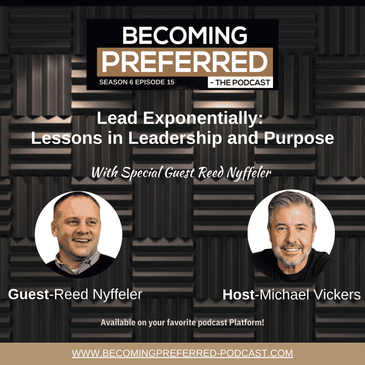
SEASON: 6 EPISODE: 13
Episode Overview:
Welcome back to Becoming Preferred, the podcast for entrepreneurs and professionals who are tired of being an option and are ready to become the preferred provider in the markets they serve.
Our guest today is a man who doesn't just build businesses; he builds ecosystems of opportunity. Reed Nyffeler is the Co-Founder and CEO of Signal, a global security powerhouse that he scaled from a local startup into a massive franchise network spanning hundreds of locations.
But Reed isn't your typical 'grind-until-you-break' CEO. He is a lifelong entrepreneur who believes that a business should serve your life—not consume it. Through his books Lead Exponentially and Transform Through Purpose, he teaches leaders how to step out of the daily whirlwind and into a role of true stewardship.
Today, we’re going to deconstruct how he professionalized a fragmented industry, why he’s obsessed with lowering the barrier of entry for the next generation of leaders, and how you can stop being a 'superhero' in your business so you can finally start being a leader. Join me for my conversation with Reed Nyffeler.
Guest Bio:
Reed Nyffeler is a lifelong entrepreneur with a passion for developing the next generation of leaders, finding solutions, and implementing growth strategies. Reed is the CEO and founder of Signal, a fast-growing, industry-leading security services franchisor with a mission to provide peace of mind to pursue passion in life. Reed also founded Filtergo, a national HVAC filter replacement service designed to simplify air care for businesses and Framebrand, a franchise development company that helps franchise brands scale more effectively. He is the author of Transform through Purpose: Your Path to Living an Authentic and Intentional Life.
Grounded in faith, Reed has learned to identify his priorities and live with purpose in every area of his life. He carefully balances his professional aspirations with time spent enjoying and connecting with his happy, thriving family of six.
Resource Links:
- Website: https://reednyffeler.com/
- Website: https://www.teamsignal.com/
- Product Link: https://reednyffeler.com/#book
Insight Gold Timestamps:
02:10 Always trying to find a better way to solve a problem
03:08 I'm going to find a solution and live with the positive and negative consequences
05:33 Whoever you are blaming owns your decision
06:42 I think if you blame somebody else, you disempower yourself
07:11 That ties back to my book Lead Exponentially actually
09:17 If you don't bring the energy to the business, it will either take energy from you or it won't require any energy
11:48 You talk about the six month test
14:41 Once you're an entrepreneur and you figure out your business, you figure out a way to communicate the vision so it's not lost
15:33 30 minute blocks are an appropriate cadence
19:00 Everything starts with the mindset
21:23 It was designed not working around the problems, but designing the experience around the technology
22:21 In the era of artificial intelligence, authenticity is the currency
25:08 What's the thing that only I can do in this business?
27:13 Everything we fill our time with, it's at the expense of something else, so make sure it's worth that expense
30:48 The purpose is consistent, the application is what changes
33:25 Let's talk about generational impact over revenue
37:19 Baby boomers, they wanted the most amount of income for their time
43:25 What needs to change here, and how can I use technology to do that disruption?
43:30 The book is called Lead Exponentially, Your Path to Developing Authentic and Intentional Leaders
43:56 You have the ability to define your future
Connect Socially:
LinkedIn: https://www.linkedin.com/in/reednyffeler/
LinkedIn Business: http://linkedin.com/company/teamsignal/
Facebook: https://www.facebook.com/TeamSignalFG/
Instagram: https://www.instagram.com/TeamSignalFG/
Podcast: https://open.spotify.com/show/3Vxli8ajETu4LBAezHDwms
Email: rnyffeler@teamsignal.com
Sponsors:
Rainmaker LeadGen Platform Demo: https://calendar.summit-learning.com/widget/booking/JKItVP7WErmCBjU2cCIx
Rainmaker Digital Solutions: https://www.rainmakerdigitalsolutions.com/
In 3, 2, 1.
Speaker BWelcome back to Becoming Preferred, the podcast for entrepreneurs and professionals who are tired of being an option and are ready to become the preferred provider in the markets they serve.
Speaker BOur guest today is a man who doesn't just build businesses.
Speaker BHe builds ecosystems of opportunity.
Speaker BReid Niffler is the co founder and CEO of Signal, a global security powerhouse that he scaled from a local startup into a massive franchise network.
Speaker BHundreds of locations.
Speaker BBut Reid isn't your typical grind until you break CEO.
Speaker BHe's a lifelong entrepreneur who believes that a business should serve your life, not consume it.
Speaker BThrough his books, lead exponentially and transform through purpose, he teaches leaders how to step out of the daily whirlwind and into a role of true stewardship.
Speaker BToday, we're going to deconstruct how he professionalized a fragmented industry, why he's obsessed with lowering the barrier of entry for the next generation of leaders, and how you can stop being a superhero in your business so you can finally start being a leader.
Speaker BJoin me now for my conversation with Reid Niffler.
Speaker CWell, hi, Reid.
Speaker CWelcome to the program.
Speaker CWe're delighted to have you.
Speaker DThanks for having me.
Speaker CI'm excited about this.
Speaker CHad a chance to look at your book Lead Exponentially, and we're going to be talking about that.
Speaker CCreating authentic and integrated intentional leadership.
Speaker CWe're going to talk about business.
Speaker CWe're going to talk about all kinds of things that I know that you can lend insights to because you're an entrepreneur and a businessman.
Speaker CSo, again, welcome to the program.
Speaker DThank you.
Speaker CWhere are we speaking to you from today?
Speaker CWhere are you at?
Speaker DI'm in Omaha, Nebraska.
Speaker DIt's a little warmer now.
Speaker DIt's freezing cold this weekend, but it's nice and living here in Omaha.
Speaker CWell, you're an entrepreneur.
Speaker CBut, Reed, before we get into it, let's go back to high school.
Speaker CYou're back in high school in Lincoln, I believe, and I know you went to college there.
Speaker CYou're deciding what you want to be when you grow up.
Speaker CGive us a little background.
Speaker CWhere did Reed come from, and how did he get where he is today?
Speaker DYeah, so I think, you know, in fact, just this last week, I had an opportunity to speak to an eighth grade class.
Speaker DAnd I remember starting in junior high and high school, and my son is in an eighth grade class.
Speaker DAnd I was there, I said, what's the one thing that stood out to me was always trying to find a better way to solve a problem.
Speaker DRight.
Speaker DAnd I didn't look at the symptom necessarily.
Speaker DI didn't look at the bad grade and blame someone.
Speaker DI looked at what I could change, and I think entrepreneurial journey starts with taking ownership.
Speaker DAnd ultimately, as I reflected back, that's something I did early on.
Speaker DYou know, it was really easy.
Speaker DAnd I remember, in fact, my grandma would say this, and she said, don't point your finger because there's three pointing back at you.
Speaker DAnd I think a lot of people, they're trying to point all five at somebody else every time, and they're just not entrepreneurs.
Speaker DRight?
Speaker DAnd so I think my journey was, if I'm going to take ownership of the outcome, I better take ownership of the decision, because if I'm pointing those fingers back.
Speaker DAnd so that was really early on in my leadership journey.
Speaker DI recognized that, you know what?
Speaker DI have no problem living with the outcome if it's positive, and I don't have a problem actually living with the outcome if it's negative.
Speaker DIf I made that decision, what I don't want is consequences from someone else.
Speaker DAnd that could be a consequence from a boss that made a poor decision.
Speaker DThat could be consequences from, you know, a peer or somebody that told me to do something that was a bad idea.
Speaker DBut then I realized, all right, I'm a leader.
Speaker DI'm an entrepreneur.
Speaker DI'm going to find a solution and live with a positive and negative consequences.
Speaker DAnd obviously, as you make mistakes and you fail forward, you learn quickly.
Speaker DAnd then more decisions are more positive outcome decisions than negative outcome decisions.
Speaker DSo that was really early in my life that I saw that.
Speaker DAnd in as I went to college, then I took that experience and that first my freshman year, I moved in, and I had a construction background, and so I knew how to build things.
Speaker DAnd I saw these dorm lofts, and I thought, okay, that's great.
Speaker DAnd then I quickly realized that university was renting them for $140 a semester.
Speaker DAnd so I thought, I can build this for way less and sell it to them.
Speaker DAnd so I found a solution that I made for 38 bucks, and I sold it for 120 bucks.
Speaker DAnd the reason people wanted lofts was because their dorm rooms are all small and they couldn't fit all the stuff in there.
Speaker DAnd so I found my target audience, which I found was the dads.
Speaker DAnd I know you have kids and five of which are daughters.
Speaker DAnd sure enough, I'm sure your daughters moved in with way more stuff than the two sons did.
Speaker DSo.
Speaker DAnd I'm sure you just like my myself had cash.
Speaker DSo I went to the dads, and I said, hey, you want help carrying that Stuff up, I'll get you a loft and it'll all fit on the floor and you can get out of there and let them decorate.
Speaker DAnd so sure enough, I went and went to the girls dorm, moved these lofts in, built the lofts quickly, made $80 a loft.
Speaker DAnd then if there were two roommates and two dads, I would say, hey, $100 each.
Speaker DAnd they both is kind of a guilt sale.
Speaker DAnd so I saw quickly, there is.
Speaker DWhen you have a product that is better and cheaper, you find a target audience, which in this case was the dads of the daughters that were moving into college, which had cash in their pocket.
Speaker DAnd you made it quick and easy, you could be an entrepreneur.
Speaker DAnd so that was, you know, I made $5,000 cash profit that first two weeks of school doing that.
Speaker DAnd so I thought I got something here.
Speaker DAnd you know, that early business taught me entrepreneurship, of course, salesmanship, it taught me economics.
Speaker DRight.
Speaker DBecause I knew exactly how much it cost me time, managing my time and all the above.
Speaker DAnd it was such a foundational step for me at that st stage of my life and career.
Speaker CWell, that sounds interesting.
Speaker CAnd like I say, timing, it's looking for opportunities, it's how do we fix things, how do we scale things?
Speaker CNow let's go back to your grandma because you have a great analogy.
Speaker CIt's fascinating about great grandma versus grandma as it relates to leadership.
Speaker CUnpack that one for us a little bit.
Speaker DYeah.
Speaker DAnd so my grandmother, you know, she, she was pointing one, I would point one fingers like you, you know, so and so.
Speaker DAnd we were probably pointing at my siblings or brothers.
Speaker DAnd she goes, the problem with placing blame, right.
Speaker DThere's three, you know, back you, what can you change?
Speaker DAnd that was really foundational.
Speaker DRight.
Speaker DAnd I think so many people in this generation, we're trying to find everyone else to blame but ourselves.
Speaker CYeah.
Speaker DAnd the problem with that is, and I always tell people this, whoever you are blaming owns your decision.
Speaker DRight.
Speaker DWhoever you are pointing at, they are now afflicting you.
Speaker CYeah.
Speaker DAnd they may not ever care about you.
Speaker DThey may never talk to you.
Speaker DIf it's somebody you've never met, like a news media or whatever else, they are afflicting your life, you've chosen that because you've accepted them by blaming them into your life as a source of responsibility.
Speaker DInstead, you can conversely say, you know what, I'm not going to listen to that.
Speaker DThat's the choice I can make.
Speaker DThey may say that every day, all day, every way, but if I am not bringing their name to bear, then I can then say, hey, I'm going to make the decision for my life.
Speaker DAnd so that was a clear part.
Speaker DMine is saying, own my outcomes, own the decisions and the outcomes that are there.
Speaker DSaying, I don't have to listen to this content, I don't have to believe this.
Speaker DI can make that choice for myself.
Speaker DAnd that is essentially me saying, no longer pointing the finger, but recognizing what can I do.
Speaker DRight.
Speaker DI don't agree with what they're saying.
Speaker DI don't agree these, but I don't have to listen to it.
Speaker DThat's my choice.
Speaker DI can't change their mind.
Speaker DBut I don't have to get emotionally invested in it either.
Speaker CYeah, you have the right to react to it or not to react to it.
Speaker DThat's right.
Speaker CYou didn't cause it, cure it.
Speaker CIt can't control it.
Speaker CIt's control.
Speaker CI totally get that.
Speaker CWhat a great insight too.
Speaker CIt's really being accountable for your results in life because I think if you blame somebody else, you, you disempower yourself.
Speaker DThat's exactly right.
Speaker CEven if it isn't your fault legitimately.
Speaker CLet's say you work for a company, they go bankrupt.
Speaker CAnd I know you talk about that 20 years, the average business goes bankrupt because why, why do they fail?
Speaker CAnd in your mind, from a leadership perspective, what's your take on that?
Speaker CWhy they typically 15, 20 years, it seems to be a lifespan.
Speaker COr you get, you know, mergers, acquisitions, they get right size capsized, you name it in your mind.
Speaker CWhat's the root cause of that?
Speaker DWell, I think that ties back to my book lead exponentially actually, because many times we build a product.
Speaker DI'll use my dad as an example here.
Speaker DHe, my family was extended farmers all the way through and he was the first one to not be a farmer.
Speaker DAnd so he went to college at University of Nebraska and he became a shop teacher because he knew how to farm, fix things and so he's a shop teacher.
Speaker DAnd then he needed a little more money when we were born and so he started roofing homes.
Speaker DAnd so then as he's roofing homes, they offered him a superintendent role.
Speaker DAnd so from there he built homes and he always built for the baby boomers.
Speaker DAnd he was a baby boomer.
Speaker DAnd so he came as a baby boomer.
Speaker DSo they had their first kids and so they had a small, you know, three bedroom, two bath, bath house.
Speaker DAnd then they got more income and their houses got bigger all the way to the retirement community.
Speaker DAnd I was giving them a hard time because my mom loves to map cemeteries.
Speaker DI said, you're still working on those baby boomers, dad.
Speaker DThey're going to be there eventually, but you got to map their next plot in life.
Speaker CWe're on our way out the door.
Speaker DYeah, yeah.
Speaker DAnyways, but I think that's the key is he was always in that genre, but he never understood the next generation of buyer.
Speaker DRight.
Speaker DHe didn't understand now my age or demographic and ultimately what we wanted.
Speaker DHe was always like, why do the people care about these things?
Speaker DBecause this generation cares about these things.
Speaker DAnd so that I think leans into your concern.
Speaker DWhy do businesses only last for 20 years?
Speaker DBecause an entrepreneur starts and they start a business around a problem that existed when they started.
Speaker DAnd they worked for years to get a system in place to solve that problem.
Speaker DBut over that same 20 years of time, other problems have been started.
Speaker DRight.
Speaker DAnd been resolved.
Speaker DAnd an analogy I like to use is this.
Speaker DSo, you know, there was a company that knew that consumers wanted a product they could see in a picture and they wanted a fair price.
Speaker DThey want to deliver to their home shortly thereafter.
Speaker DRight.
Speaker DWhat they didn't realize was that was the Sears catalog.
Speaker CYeah.
Speaker DI would go at Christmas and I'd go look at the Sears catalog, I'd circle the item, we'd call the phone number, mail it in and come back.
Speaker DWhat changed was actually the Internet.
Speaker DPeople still want that Amazon.
Speaker DRight.
Speaker DThey still get that from Amazon now.
Speaker DBut the business didn't evolve with the way consumer habits evolved.
Speaker DAnd so I think what happens is if it ain't broke, don't fix it.
Speaker DRight.
Speaker DIt's kind of a mentality and the business goes out of business because someone else fixes the problem better.
Speaker DAmazon versus Sears.
Speaker DSo I think that's why you see a 20 year cycle and then you become, now that I've been about 19 years into this business, if you don't bring the energy to the business, it will either take energy from you or it won't require any energy.
Speaker DRight.
Speaker DIt's just status quo.
Speaker DAnd so I know every day I have to bring the energy and I think that's critical.
Speaker DAnd so people get exhausted, they're tired, they're older, they're distracted, they have kids or grandkids like you have and you're all over the place.
Speaker DRight.
Speaker DAnd so then that takes your energy as opposed to bring your energy, and then eventually it fades.
Speaker DAnd then you realize at the end, what am I going to do now?
Speaker DI'm at the age of retirement, I don't have that energy.
Speaker DHow do I approach this Again, and so I think that's part of it.
Speaker DBut in my book, what I talk about is leading exponentially in the final chapters on triplicate.
Speaker DAnd this is the way to effectively do that.
Speaker DSo as a leader, I invest in the second and third generation and the examples that I use there.
Speaker DThere's a one in particular that I think is relevant for this, which is George Washington, because you had Benjamin Franklin, who kind of was a generation earlier, George Washington, who was in the present generation at the time, and then Thomas Jefferson, who was the next generation.
Speaker DAnd so all three of them are in there as they're crafting this Declaration of Independence in the beginning of the US So you have Benjamin Franklin, who was leveraged as a resource that knew history and he had studied, written in newspapers and kind of had the media side of it.
Speaker DGeorge Washington was your military, right.
Speaker DAnd then you had your up and comer, which was Thomas Jefferson, who ultimately became a president as the fourth president.
Speaker DRight.
Speaker DAnd so you had continuity, which, you know, a lot of people don't realize, but between the beginning of the American Revolutionary War until when Thomas Jefferson was president, that was probably 35, 40 years.
Speaker DSo if we were the country, like a business, and Thomas and George Washington, who'd already fought for 12 years in the American Revolutionary War, was the president for eight years and was exhausted and died shortly after exiting the office, where would the country be?
Speaker DBecause we were just getting started, right?
Speaker DAnd it required John Adams, who was there, you know, as his vice president, who became the next president, and then ultimately Thomas Jefferson, who was the fourth president, of course, in that process.
Speaker DAnd so those are all the things that I think are relevant.
Speaker DAnd that's how we build organizations that endure over time.
Speaker CIt's interesting how and the multiple generations.
Speaker CI'm kind of at that stage now.
Speaker CI've been running my company since early 90s and it's.
Speaker CI still got a way to go.
Speaker CI plan on doing it for about another 10 years or so.
Speaker CBut what's that next generation?
Speaker CBecause there's no reason to give it up now.
Speaker CAs a speaker and author, we can't do that.
Speaker CWe have to, right?
Speaker CWhen we're done, we're done.
Speaker CBut it's all those other services and products that you can create.
Speaker CSo as an entrepreneur, one of the things I was interested in in your book, and you talk about it in your.
Speaker CIn some of the things that you produce is that ability to scale.
Speaker CAnd it's a challenge for entrepreneurs.
Speaker CPeople have trouble doing that.
Speaker CHow are you able to bring the scaling technique if you will, you talk about the six month test and as a good test, let's start there and then maybe talk about your formula for scaling.
Speaker CWhat should entrepreneurs do if they got a great idea, a good product, good service and they want to expand it?
Speaker DYeah, I think the first thing is time management and then how to evaluate your time.
Speaker DRight.
Speaker DBecause we have energy and time is the resource we apply that to.
Speaker DAnd so you will not be able to scale if you don't know how to effectively use your time.
Speaker DBecause truly scale is just like a gear on a bike, right.
Speaker DYou're not going to go anywhere if you don't know how to pedal.
Speaker DIt doesn't matter what gears you put on there.
Speaker DRight.
Speaker DYou just aren't leveraging that accelerator right now.
Speaker DYou can go a lot of places if you keep walking and you're going in different directions.
Speaker DBut you don't know how to scale because you don't know where to direct your energy and over what period of time.
Speaker DAnd so that's the first thing is I always go back down and I manage my time.
Speaker DAnd it starts with our vision.
Speaker DWhere do we want to go right.
Speaker DFirst, Then ultimately, what's the next five years look like?
Speaker DThen three years, one year, quarterly, monthly, weekly, daily, hourly, then our minutes and then we stacked it on there.
Speaker DSo then how do I structure my time?
Speaker DAnd I use half hour blocks, or an hour block, in this instance, two half hour blocks.
Speaker DAnd then how do I structure that to leverage that towards my vision?
Speaker DAnd then I'm down to moments.
Speaker DI matter.
Speaker DAnd that's in my first book, Transform Through Purpose.
Speaker DWe talk about moments because in those moments I can use voice inflection, I can use word choice to have a transformational communication that's memorable that would ultimately scale.
Speaker DRight.
Speaker DYou were mentioning as we were onboarding here, Michael, that stories are what sell.
Speaker DRight.
Speaker DEven the best product isn't necessarily going to sell if the story is better for another one.
Speaker DAnd we can see this throughout history.
Speaker DWell, that story sells because of the presenter of that information.
Speaker DRight.
Speaker DWe've all seen adaptations of movies or plays and the best actors are the best storytellers.
Speaker DThat's right.
Speaker DNot the script.
Speaker DYou can have a great script with a terrible actor.
Speaker DRight.
Speaker DAnd likewise you can have a great actor with a terrible script.
Speaker DIt's really that script and that actor together, and that's the story that sells.
Speaker DAnd so that's ultimately what we need to focus on, is saying, okay, if I'm going to scale, I have to quickly and easily communicate the vision in A way that someone can transfer that information from their mind to mine and then run without my direction.
Speaker DRight.
Speaker DAnd so that's a system.
Speaker DRight.
Speaker DAnd so the system then says, okay, then how do they go back to that?
Speaker DAnd so then you have the story that's a system.
Speaker DUnderstanding their part.
Speaker DAnd so acronyms are a good tool for that.
Speaker DRight.
Speaker DI have a lot of acronyms that you can break down that are easily remembered in that process.
Speaker DThat's a system.
Speaker DAnd then the second piece of that is breaking it down in component parts.
Speaker DAnd so you think of what Henry Ford is, that our goal is to build a car.
Speaker DAnd everybody bought into that story, would use his story, everybody in that story of if there's a car on every road and we can make it affordable for every man, the world will open up.
Speaker DRight.
Speaker DPeople start driving.
Speaker DThen in order to do that, he needed to break it down into component parts.
Speaker DAnd so he had people on an assembly line.
Speaker DThe line moved, not the people moved.
Speaker DAnd that's what happened.
Speaker DThe assembly line moved and they just did their part quickly and it was just highly repeatable and they became highly skilled.
Speaker DSo that's what you do next.
Speaker DOnce you're an entrepreneur and you figure out your business, you figure out a way to communicate the vision so it's not lost.
Speaker DThen you break it down in component parts.
Speaker DRight?
Speaker DWe call that our location, the soapbox.
Speaker DSales is S, O is operations, A is administration, P is promised.
Speaker DThat pulls together the acronym so it's not forgettable.
Speaker DSequentially.
Speaker DFirst, nothing starts without selling something.
Speaker DThen you got to operationally deliver and someone's responsible for that.
Speaker DAdministrative, you got to collect the payment and make sure someone gets paid to do it.
Speaker DAnd then promise you got to retain them so they'll come back for another customer.
Speaker DAnd so that's a system.
Speaker DAnd you sequentially break that all the way down.
Speaker DAnd then once you have those categories, you subcategorize them.
Speaker DSo you break that system down all the way down into 30 minute blocks.
Speaker DAnd those 30 minute blocks are important for this reason.
Speaker DAttention spans continue to shrink.
Speaker DIf I go train someone.
Speaker CYeah.
Speaker DOn how to do something for eight hours, they were like, I did the first 30 minutes of stuff, but I can't remember the next seven and a half hours.
Speaker DI just sat around waiting for you.
Speaker DBut that's where 30 minute blocks are.
Speaker DAn appropriate cadence of which, if we can get people to operate in 30 minute blocks, then we can really start to scale.
Speaker DAnd so that's what I encourage people to do.
Speaker DIf you're here and you want to scale your business, Go back, look at last week and do a time audit.
Speaker CYeah.
Speaker DLook at where your 40 hours were and then say, okay, of those 40 hours, how many of those hours?
Speaker DHelp me get closer to that vision.
Speaker DAnd then how many of those were in a sales ops, admin and promise?
Speaker DIf it's too heavily weighted in one category, Ideally you want 10 hours each, you're not going to make any progress.
Speaker DAnd so then you'd say, okay, now of those things, this is what I tell people, how frequently they need to be done.
Speaker DIf they need to be done every day or every hour, hand that off to somebody else.
Speaker DStart scaling now, you've opened up that block.
Speaker DPut in something that you can do with your vision if it needs to be done, maybe you're past that every week or every month, hand that off.
Speaker DI'm at the point now, if it needs to be done every quarter, I hand that off.
Speaker DSo I'm working on annual things.
Speaker DAnd that's how you build a business at scale.
Speaker DYou take those time blocks, you look at those time blocks and you say, how frequently do I need to do this time block?
Speaker DAnd then I can train someone how to do that.
Speaker D30 minutes a day or 30 minutes a week, or 30 minutes a month, or eventually 30 minutes a quarter and you hand it off.
Speaker CWell, it sounds like it's fair to say.
Speaker CAnd you've done this.
Speaker CYou're setting up, for instance, let's say you set up your businesses if you were going to be a franchisor and full of systems.
Speaker CEven if you keep it as an entrepreneur, small business, you own the whole thing.
Speaker CYou have no franchisees that you're going to go to.
Speaker CBut if you set it up, I think that's what you're talking about.
Speaker CBecause when you buy a franchise, you're buying a system.
Speaker CSomebody's already figured, that's right, you've already done that and figured it out.
Speaker CSo I think you could write a whole book just on setting up and scaling.
Speaker AAre you tired of chasing leads and ready to start effortlessly attracting more high value clients?
Speaker AIntroducing Rainmaker Lead Gen, the ultimate sales, engagement and client acquisition platform that takes the stress out of outreach.
Speaker AWith Rainmaker Lead Gen, you can easily identify, engage, educate and convert your ideal prospects into loyal clients.
Speaker AOur industry leading automation and email sequence sequencing empowers you to reach more ideal clients, accelerate the sales cycle and close more business.
Speaker AImagine authentically engaging with your prospects while the platform handles the heavy lifting.
Speaker ASay goodbye to the endless hustle and embrace a more efficient, effective approach to Business development Ready to witness the magic?
Speaker ABook a 20 minute demo today and see how Rainmaker Li Dan can revelation and level up your client acquisition game.
Speaker AThere's nothing to lose and everything to gain.
Speaker ADon't miss out on this opportunity to supercharge your client acquisition process.
Speaker AVisit rainmakerdigitalsolutions.com or check out the link in the show notes to book your demo.
Speaker ARainmaker Lead Gen Spend less time hunting for your ideal clients and more time having high value sales conversations with your ideal clients.
Speaker BAnd now back to my conversation with Reed Niffler.
Speaker CYou talk about scaling through systems and not creating superstars.
Speaker CNow your company Signal, which been around for about 18 to 20 years or so, you use a proprietary Uber like software to manage security.
Speaker CSo in a world where many entrepreneurs feel they got to be the smartest person in the room, how does technology.
Speaker CBecause when you started you weren't about six, seven, eight years into the Internet.
Speaker CIt was just getting annoying.
Speaker CWe didn't have right today couldn't do zoom meetings.
Speaker CHow did you evolve that?
Speaker CHow did it start with it?
Speaker CAnd then how does technology allow the leader to step back and let the business kind of lead itself?
Speaker DYeah, much like we started this conversation, everything starts with a mindset, right?
Speaker DMy mindset was I was going to take ownership at all and I was not going to be victimized by the software that was available out there.
Speaker DThen I took a step back and saying if I was going to design a software and own it, and certainly it's going to be expensive, how would I design it?
Speaker DAnd I use this analogy because it helps people kind of understand technology.
Speaker DFor years, even at the advent of the Internet and maybe even up to some cases present day day, a lot of businesses go and solve a problem with software, much like a taxi cab and a gps.
Speaker DOh, where are cabs?
Speaker DI have no idea.
Speaker DLet me call them.
Speaker DOh no, I got a GPS now, so I at least know where the cab is.
Speaker DNow I can't pass that information along to the writer, but the dispatcher at least knows.
Speaker DAnd that software as a service solving a symptom of a problem, right?
Speaker DAnd so then where did we design?
Speaker DI said if I'm going to design this, I'm going to design it like Uber, right?
Speaker DI'm going to say forget what software is there.
Speaker DWhat's an ideal experience?
Speaker DThat's what they did.
Speaker DWhat's the ideal experience for the driver?
Speaker DWhat's the ideal experience for the rider?
Speaker DWhat's the ideal experience for the corporation that's providing these services?
Speaker DAnd they developed a software that laid that all the way out.
Speaker DIt's nothing like the taxi cabs had before.
Speaker DAnd what it did is it highlighted key touch points that are human in nature and leverage technology when it didn't need to be a human touch point.
Speaker DRight.
Speaker DSo we still have someone drive up, say hi to us, and, you know, enter into a conversation in the car, etcetera, and then ultimately they accept or receive payment on the other side because it's too far.
Speaker DWhen you go to Waymo, and I know you have a place in Arizona, so I assume you know about Waymo, which is.
Speaker DNo.
Speaker DDrive a driverless car and they GPS handles everything, and you can't talk to anybody and you don't have the sense of control.
Speaker DSo that's technology too far.
Speaker DSo I knew I wanted to be in the middle road, right.
Speaker DI wanted to map all our experiences and simplify it, leveraging technology.
Speaker DAnd if you go look at some of the favorite restaurants or places you go, that's exactly the experience we're looking for.
Speaker DRight.
Speaker DAmazon, you still have a driver pulling up to your driveway and he says hi and drops it off or is friendly or courteous, but everything else was automated.
Speaker DRight.
Speaker DBecause you still need that physical interaction to confirm that the right person is there at the right home delivering the right product.
Speaker DRight.
Speaker DAs opposed to a drone dropping a package in your front yard and hitting your petunias or something like that, you know, so it's just all those things that are there.
Speaker DWe need a balance of those things.
Speaker DAnd so that's what we did.
Speaker DWe looked at, okay, what is our user experience map, and whether that's a franchise owner, a customer or an employee.
Speaker DAnd how do all those intertwined?
Speaker DAnd then how does software make that more efficient?
Speaker DJust like Uber with the driver, the writer, and the corporation.
Speaker DAnd so we built the technology stack around that, and it creates scalable efficiency because it was designed not working around the problems, but designing the experience around the technology.
Speaker CAs you develop this technology to support your franchisees and the businesses themselves, new technologies are always emerging.
Speaker CFor instance, to use the example you did, we've got AI now, which is Right.
Speaker CAnd AI has been around forever.
Speaker CI mean, it's been around since the 60s, actually, if you look at.
Speaker DRight, agree.
Speaker CYeah.
Speaker CSo when you're looking at AI, when do you look at it as an entrepreneur and go, okay, we need to bring this in.
Speaker CHere's.
Speaker CWe're going to apply it to the user experience here in the journey.
Speaker CThese are the mapping points where we should use AI gets Rid of some of that because it gets rid of.
Speaker CIt doesn't get rid of the human to human.
Speaker CWhich to your point, you're saying with the Amazon guy and going, hey Hank, how's it going?
Speaker CYou know, whatever, or the team sure that shows up your house delivering it ups or whoever's showing up.
Speaker CHow do you look at that new technology?
Speaker CWhen's the right time to jump into it and how do you evaluate that and how do you see it going with AI?
Speaker DYeah, I think that's a great question.
Speaker DI think many times is we have to understand the power and value of a human.
Speaker DI also say in the era of artificial intelligence, authenticity is the currency 100 and so where do we need to be authentic and where can we be automated?
Speaker DAnd that's a decision, I think that the leaders of the future need to be the ones that can appropriately make that decision intuitively for their organizations is really understanding what can be automated and what can be done.
Speaker DAnd I'll go right back to my time allocation.
Speaker DAI should be those 30 minute blocks we have to do every day, right?
Speaker DSo if there's something that is so routine, 30 minutes every day, for example.
Speaker DI'll give an example.
Speaker DIn our business, so we do reports, right?
Speaker DSo we go on a property and we write a report.
Speaker DAI can scour those reports that were done the night before.
Speaker DAnd many times we take pictures and look for any identifiers that we would otherwise human eyes would be able to see.
Speaker DOh, there's a gun in that photo, right?
Speaker DShould we further investigate that?
Speaker DPull that to a profile, right?
Speaker DAnd so AI can do that.
Speaker DI don't need to have somebody go look at that, but I need somebody to know what to do if there is a gun in there.
Speaker DThat's what I need a human to do.
Speaker DSo this identifies a problem and accelerates that process going forward.
Speaker DRight?
Speaker DBecause just like, you know, growing up I didn't have GPS on me and my dad be like when you could hear the whistle, you had to be within the range to hear the whistle.
Speaker DNow my dad could whistle and I knew downhill how far that was about two to three blocks.
Speaker DSo I could go a long ways according to that whistle.
Speaker DBut he had no idea where I was.
Speaker DHe couldn't see me.
Speaker DRight now I got life360.
Speaker DI said, you can see where my kids are, how fast they're going and where they're going, right?
Speaker DAnd so certainly there was efficiency in the way he whistled.
Speaker DAnd I just had to hustle home because he knew I need to get home.
Speaker DFor dinner, you know, or there's GPS that can track where we're at in the same.
Speaker DIn the end, I still am going to be with my dad.
Speaker DRight.
Speaker DI didn't change the relationship, I just changed the visibility in that relationship.
Speaker DAnd that's where I think AI is.
Speaker DIt doesn't eliminate the relationship, it accelerates it and it doesn't take away the value of it.
Speaker DIt gives you more opportunity for it.
Speaker DRight.
Speaker DI mean, FaceTime's a key part of that.
Speaker DRight.
Speaker DInstead of just calling mom or dad, we can use facetime and see them and that enhances it.
Speaker DAnd then you can put a little, you know, treatment on those images to make it even more entertaining.
Speaker DWe'd like.
Speaker DAnd that's another AI thing, right?
Speaker CAbsolutely.
Speaker CWell, it allows us to elevate ourselves and if we embrace it and you're people ask me all the time, will AI replace our jobs?
Speaker CAnd I said, I don't think so, but I think someone who knows how to employ it.
Speaker CSo it's taking that so we can be more human to human.
Speaker CIf you're getting a procedure in the hospital, you want a nurse holding your hand, talking, that's the human to human.
Speaker CIt's eq.
Speaker CIt's focusing on our ego in our business and going that route.
Speaker CLet's talk about.
Speaker CYou talk about and challenge owners with what you call the six month test.
Speaker CSo for listeners who are currently grinding it out 60 hours a week, the test is simple.
Speaker CI think you talk about if you left your business for a period of time.
Speaker DRight.
Speaker CUnpack that a little bit for us.
Speaker DYeah.
Speaker DSo essentially I think what you're trying to build as a business, that if you left your business.
Speaker DNow, I think there's two sides of that coin.
Speaker DOne, we want to make sure that we're applying things in the business that are valuable to the business every day.
Speaker DRight.
Speaker DThat I always look at my time saying, what's the thing that only I can do in this business?
Speaker DRight.
Speaker DAnd so that is effectively the secret sauce at the same time is can it continue to go if I'm not here?
Speaker DRight.
Speaker DSo what is the routine and what is the secret sauce?
Speaker DRight.
Speaker DAnd so we want to look at that.
Speaker DWhat is the differentiator?
Speaker DRight.
Speaker DAnd so that six month test is saying, if I wasn't here every day, grinding it out and working through that, can the business still sustain itself in my absence?
Speaker DRight.
Speaker DAre the bills they're going to get paid.
Speaker DIs a service still going to be done?
Speaker DNow, in our instance, probably there'd be a lack of Vision.
Speaker DRight.
Speaker DAnd maybe new opportunities are pursuing.
Speaker DBut if I was gone for six months, I can assure you the lights would still be on, everything would be paid and everyone may not have as much fun when I'm gone.
Speaker DRight.
Speaker DI mean, of course that's the case with you, Michael.
Speaker DOr maybe they'd have more fun.
Speaker DSee, I, maybe that's what I want to believe.
Speaker DBut nonetheless, I think in the case, the day to day functions are going on and so that's a six month test.
Speaker DAnd if you're not living in that environment, your business isn't scaled is essentially what I'm saying there.
Speaker DSo if your business isn't there, you don't have scale because it's too dependent upon you as an owner.
Speaker DAnd more importantly, no one will buy that from you because it needs you to be gone.
Speaker DYou haven't set up an asset you can sell because it's dependent upon you and you cannot replace it.
Speaker DAnd you're adding that value in the sale price, but they're going to discount in the buying price because it requires the person that's on that other side.
Speaker DAnd so that's why you want to do that is for your benefit too economically, as you're exiting a business.
Speaker CWell, it goes for us as speakers.
Speaker CThey want you when you rewrite the books, they write you.
Speaker CBut your courses, the, your software, your things you generate, those products are byproducts.
Speaker CThose are all things that can go on into perpetuity and you create a business for yourself or a revenue generating machine.
Speaker CSo I like it.
Speaker CYour book Transformed through Purpose suggests that business success is a byproduct of a purposeful life at home and in the community.
Speaker DYeah.
Speaker CHow do you respond?
Speaker CEntrepreneurs who say, hey, I'll focus on my personal life, you know, once my business is successful.
Speaker CI think you call it the purpose anchor.
Speaker CWe have to develop that and it's a trap.
Speaker CCan you unpack that a little bit for us?
Speaker DYeah.
Speaker DSo essentially I'm a big believer that we were built on purpose, for a purpose.
Speaker DRight.
Speaker DAnd so if we don't know what that is, we're not fulfilling our purpose, basically.
Speaker DAnd so the other thing is we're always going to have competing interests.
Speaker DIf we want to do one thing, there's going to be something we're giving up to do that.
Speaker DI always tell everything, I tell my kids, everything we fill our time with, it's at the expense of something else.
Speaker DMake sure it's worth that expense.
Speaker DAnd so the first four chapters are really about the priority.
Speaker DThe first one for Me is faith, family, then productivity, then fun.
Speaker DSo that means that if I want to do something fun, but I lose my job, my family and my faith, probably not worth it.
Speaker DRight?
Speaker DThat's, you know.
Speaker DSure.
Speaker DYep.
Speaker DI went and I went to Bali for six months.
Speaker DNow I'm homeless, I lost my job, you know, but it was a great six months.
Speaker DRight.
Speaker CMy wife, my wife has a new partner.
Speaker CHe's a nice man.
Speaker DYeah, exactly.
Speaker DSo that's why you prioritize.
Speaker DSo it starts with your priorities.
Speaker BYeah.
Speaker DAnd then once you determine your priorities, your purpose will reside within those and it needs to be transcendent, universally eternal.
Speaker DAnd so that transcendent means it can't be about you.
Speaker DRight.
Speaker DBecause you know, you have seven children and kids, what happens if you're gone is, then it's, they're the generation that carries that forward.
Speaker DSo it has to be transcendent.
Speaker DIt can't be about us.
Speaker DSo many people live a life that's only about them.
Speaker DRight?
Speaker DWell, the world would effectively end if everybody believed that about themselves.
Speaker DYeah.
Speaker DRight.
Speaker DSo then it's transcendent.
Speaker DUniversal means your purpose is everywhere.
Speaker DWhether you're at work, you're at home, you're on vacation, you're in any of those four areas, it's the same.
Speaker DAnd then eternal.
Speaker DYou can do this the rest of your life.
Speaker DSo then your purpose resides there.
Speaker DFor me, it's through intuitive interaction, propel leaders beyond their self imposed barriers to live out their unique purpose.
Speaker DSo just like we're having this conversation, Michael, that's intuitive interaction.
Speaker DI'm listening to you and providing feedback.
Speaker DAnd my objective is to propel leaders, yourself and your listeners so that they're self imposed barriers and those are things they believe about themselves that aren't true or can't be changed.
Speaker DThat which really can be changed, that are holding them back from living out their purpose.
Speaker DAnd so in that book, once you clarify that, it's so freeing to yourself.
Speaker DBut more importantly than others will choose to follow.
Speaker DI believe as followers, we don't choose to follow leaders because they have no idea where they're going.
Speaker DThey don't have a purpose and they don't have a vision.
Speaker DWhy would we follow them?
Speaker DYou want to wander aimlessly, they're fun to be with.
Speaker DIt's one thing to hang out with them, it's another thing to follow them.
Speaker DAnd so again, if you looked around and your listeners looked around and said, okay, who in my life would I consider following?
Speaker DIf they said, hey, come here and what you're going to look at the one continuity that you'd have in there is they have vision and purpose.
Speaker DThose are the two things that people would consider following.
Speaker DWell, they know where they're going and they're going to go there on purpose, you know, I mean, instead of back their way into it.
Speaker DAnd so if you're an entrepreneur, if you're a leader, if you're someone and you don't have vision and purpose, why would someone follow you?
Speaker DThat's a question you should answer for yourself.
Speaker DAnd if you haven't clarified that for yourself, how can someone else.
Speaker DBecause you know yourself best.
Speaker DAnd that's what this book does, helps you understand that for yourself so that others can choose to follow you as you move forward.
Speaker CYeah, it's putting a rudder on your boat.
Speaker CRight.
Speaker CIf you got a direction, you might have.
Speaker CI'm a pilot, been a pilot for 40 plus.
Speaker CCheers.
Speaker CAnd when we go in a destination, I go say from Calgary to Phoenix, the office.
Speaker CI know it's a five, six hour flight.
Speaker CI know I've got to stop and get gas in Salt Lake or Spokane where I'm going to top up again or clear customs.
Speaker CAnd then I have a route.
Speaker CI got a route that I'm going to go to.
Speaker CBut sometimes weather comes in when I don't expect.
Speaker CSometimes there's a mechanical issue I got to deal with and I might have to divert.
Speaker CAnd so like all aircraft, you have an alternative.
Speaker CYou have a, where's my backup plan, My plan B.
Speaker CSo when you're setting up your plan and you got your purpose, do you ever set up plan B or alternates?
Speaker DYeah, for sure.
Speaker DI think your purpose is ultimately inherently who you are.
Speaker DRight.
Speaker DAnd so plan B is.
Speaker DWhere do you apply that?
Speaker DRight.
Speaker DBecause ultimately, I'm sure, Michael, in your case, you largely have been in the same space for 30 years.
Speaker CYeah.
Speaker DBut the world's a change.
Speaker DI mean, you, you started your business in the 90s, that was pre Internet.
Speaker DSo did you abandon your purpose of being a, you know, a speaker and an author?
Speaker DNo, you just evolved it as the Internet came.
Speaker DNow you do podcasts as opposed to live speaking events or.
Speaker DAnd you probably still do those, or maybe there's an e book that you didn't have before when you had to write a physical book.
Speaker DSo I think the purpose is consistent.
Speaker DThe application is what changes.
Speaker CYeah, that makes sense.
Speaker CLet's talk about handling uncertainties of the future.
Speaker CA lot of people get anxiety because of the uncertain future.
Speaker CYou talk about generational and building things on a generational basis.
Speaker CThere's Five generations of buyers.
Speaker CWe have baby boomers all the way down.
Speaker CThere's some even before the baby boomers are still around.
Speaker CMy I was at my father in law's birthday yesterday and 97 years old, still going strong.
Speaker CHe just bought a new car and they tried to sell him a five year extended warranty and he's.
Speaker CI'm 97, like really?
Speaker CI optimistic, right?
Speaker CStill golfs and drives and everything.
Speaker CBut you built a $300 million plus business in an industry, security industry that is constantly changing.
Speaker CSo how does a company stay relevant when the world feels more volatile than ever?
Speaker DYeah, I think the key is, and I always talk about this as a speaker or everything else, a lot of people focus on their content, what they want to say or do.
Speaker DI focus on the audience.
Speaker DRight.
Speaker DAs we were onboarding here, I said, hey, I want to stay within the scope of what your audience wants to hear.
Speaker DWhy?
Speaker DBecause the audience only cares about what's relevant to them, not what the speaker thinks is relevant to the speaker.
Speaker CYeah, exactly.
Speaker DAnd so I'm always studying, in fact, in a couple of weeks here every year I go to about 100 different cities in the United States where franchisees are and I see what's fixed, meaning what's the same of our brand and what's flexible geographically different.
Speaker DRight.
Speaker DObviously, as I mentioned, I've been to Calgary, even last summer, but I also went to Phoenix.
Speaker DThose are two totally different countries and totally different cities and totally different climates and they both need security but in different ways.
Speaker DAnd so ultimately you then say what is fixed, what won't we change about our brand that makes it that tried and true stable brand that everyone is looking for.
Speaker DAnd what is flexible, what is different in the dry heat of Phoenix, that's different in Calgary, right outside of Banff, when you probably have a little bit more of a tech hub that has different challenges as it's going from there.
Speaker DSo those are the things you look at and then you give autonomy within that to the entrepreneur that's operating there saying, hey, here's what's fixed, I need you to stay in this lane.
Speaker DBut here's what's flexible, here's the decisions you could make and it's not completely prescribed and I want to leverage your intellect and intuition to be able to manage that accordingly.
Speaker DAnd so then you can stay relevant because whatever was relevant before will be irrelevant at some time.
Speaker DBut there are some things, like for example, gravity, that's been relevant forever and however, it has different impacts on different people at different stages of life.
Speaker DRight.
Speaker DI mean I seem to weigh more.
Speaker DI think gravity got heavier, I don't know.
Speaker DBut ultimately that's what happens over time.
Speaker DRight.
Speaker DIt changes that and we involve.
Speaker CWell, that's a good point.
Speaker CWhen I see our two year old granddaughter fall down just a little distance, when I see myself fall down or slip on the ice, the results and outcomes are sometimes vastly different.
Speaker DSo.
Speaker DRight.
Speaker CIt's good.
Speaker CLet's talk about generational impact over revenue.
Speaker CI thought this was interesting.
Speaker CYou've said that you measure success by multi generational impact rather than just revenue.
Speaker CSo.
Speaker BSure.
Speaker CAn entrepreneur that's just focused on their Q4 goals, how can they shift their mindset toward 100 year legacy?
Speaker DYeah, I'm going to go back to my family generational story here because I think it's interesting.
Speaker DI, you know, I, as you were pronouncing my last name, you noticed it was German.
Speaker DAnd I told you I grew up in Aurwag in Switzerland.
Speaker DAnd you'd said you'd been there.
Speaker DAnd that's actually where my great great grandfather had immigrated from.
Speaker DAnd he was 18 years old and he left there because he looked around and he saw that there was not enough farmland for him and his three brothers.
Speaker DAnd he was 18, got whatever money my grandfather, great, great great grandfather had his wallet, hopped on a boat, ended in the train in Duncan, Nebraska.
Speaker DThat's how we ended up here.
Speaker DAnd it's because a neighbor back then had gotten a farm off the Land act in the late 1800s and started there.
Speaker DAnd then my great grandfather came and he also got a piece of land and was the first one to start a school and a church and they had a one room schoolhouse.
Speaker DAnd so then my grandfather was the first one to get through grade school.
Speaker DHe got to about seventh or eighth grade and he became a farmer.
Speaker DAnd so then here's a decision my great great great grandfather made that we would have been starving in a small little plot of land in the middle of nowhere.
Speaker DBut he made the risk to come across the ocean to come to Nebraska and plant his family there.
Speaker DAnd you can only look back and see how destitute it would have been.
Speaker DThey didn't have convenience stores, they didn't have restaurants.
Speaker DYour dinner was running around in the field.
Speaker DYou had to go find it after a hard day's farming.
Speaker DAnd you didn't have insurance or crop insurance or all the things we had.
Speaker DNow you didn't have a grocery store.
Speaker DAnd I remember then and these are the values that are still instilled in me.
Speaker DAnd I Saw photos and there's a photo.
Speaker DAnd I went back with my dad and we were touring this area and there was a garden out front.
Speaker DAnd I go, why is there a garden at this farmland?
Speaker DHe said, oh, that was your refrigerator, Reed.
Speaker DYou know, there's a farm.
Speaker DThat was your livelihood.
Speaker DThis was your life.
Speaker DAnd so then I said, interesting.
Speaker DHe said, yep.
Speaker DAnd then I said, what are those vegetables on the front door?
Speaker DHe goes, oh, that's the convenience store.
Speaker DIf you had a bumper crop of pumpkins and you wanted to switch that up for potatoes, you just carried that over to someone else's house and you swapped it out because you got sick of eating the pumpkins.
Speaker DAnd so that's what they would do.
Speaker DAnd to me, that's like, that's community, right?
Speaker DAnd those were legacy items that were there.
Speaker DAnd that's still instilled in my family.
Speaker DAnd it goes back to my grandmother pointing that finger.
Speaker DI knew that was coming from that heart that she says, hey, we knew that our livelihood was a result of that.
Speaker DAnd she's the one that was pointing that finger at me or that I was pointing at myself and says, take ownership.
Speaker DBecause our family took ownership of moving here, you take ownership for your life and, you know, do us proud in that same legacy.
Speaker DSo I now have that obligation for the next generation going forward and saying, okay, because they took a risk at the early stages, I have an obligation to continue to build on that over time so that I can pass that forward, so that the next generations can have an advanced life like I've been able to enjoy because my great great grandparents immigrated from a town where there was no farmland left, no money, and no future.
Speaker CInteresting.
Speaker CLet's talk about the younger generation for a minute.
Speaker CYou and the power of what you would call low cost opportunity you've created, you're launching a new model.
Speaker CI think it's called Filter Go.
Speaker DYeah.
Speaker CNo money down options for young entrepreneurs.
Speaker CSo why is lowering the barrier to entry part of your purpose driven strategy?
Speaker CAnd what advice would you give to young people, you know, in their late 20s and 30s who go, hey, they're tired of the gig economy.
Speaker CThey want to do something that they can build and something purposeful.
Speaker CBecause one thing I love about the younger generation is they tend to be more purpose.
Speaker CI'm baby boomer.
Speaker CIt was very transactional.
Speaker CWe did this.
Speaker DYeah.
Speaker CWhy did I have a paper route?
Speaker CNot because I love delivering papers.
Speaker CIt was because I need to earn some money.
Speaker CRight?
Speaker CSo I always work to develop things to draw revenue.
Speaker CBut the younger folks Seem very purpose driven.
Speaker CIs that, you know, are we saving dolphins?
Speaker CAre we keeping the landfills clean?
Speaker CWhat advice would you give them?
Speaker CAnd talk about the power of low cost opportunity.
Speaker DYeah.
Speaker DSo we'll start first.
Speaker DI think you talked about the gig economy.
Speaker DAnd I look at it this way, study that generation.
Speaker DAnd I said, what are they looking for?
Speaker DAnd it's pretty obvious when you start looking at the decision they're making, that gig economy, they want autonomy and opportunity.
Speaker DWhereas to your point, on the baby boomers, they wanted the most amount of income for their time.
Speaker DI don't care what I'm doing.
Speaker DI don't care about the purpose.
Speaker DI'm just going to go make the most that I can, and at the end I'm gonna get a gold watch and a pension.
Speaker DRight?
Speaker DAnd now they're saying, I want autonomy.
Speaker DSo then I'm saying, okay, what is holding them back from having their autonomy and opportunity?
Speaker DWell, I think society at large has structured because it's this baby boomer oligarchy and, you know, kind of hierarchical thing.
Speaker DSo I said, okay, what are they willing to do?
Speaker DRight.
Speaker DThey want to manage their free, their freedom of time and to maximize opportunity.
Speaker DSo then I'm going to develop concepts that fit that need.
Speaker DAnd it needs to be quick learning.
Speaker DSo this filter go concept is functionally switching out a filter, a commercial air filter in an air conditioning unit every 90 days.
Speaker DSo we leverage technology where you go and you meet Michael and you say, how many filters do you have?
Speaker DWhen do you want it changed?
Speaker DPlease run your credit card.
Speaker DThen just like Uber, it says you need to change it on February 2nd and every 90 days thereafter.
Speaker DAnd it'll remind you to do it.
Speaker DYou go change out the filter, it tells you the size, you take a picture and you get paid.
Speaker DNow you can do that whenever you want to.
Speaker DYou can change it on the 5th if you want.
Speaker DYou can change it a week from now if you want.
Speaker DRight.
Speaker DAnd the customer gets automatically notified.
Speaker DSo now they have autonomy, they work by themselves, for themselves, they have opportunity.
Speaker DHow many places have an air conditioning unit?
Speaker DPretty much everyone, Right?
Speaker CRight.
Speaker DAnd they all have a filter that if you don't change the filter, just like an oil change, the engine blows, the air conditioning unit fails.
Speaker DSo now what does it require?
Speaker DSomebody that's a little bit outgoing.
Speaker DRight.
Speaker DSomebody that is there.
Speaker DBut also I take away the economic barrier because I'm getting the money up front.
Speaker DI charge the client.
Speaker DNow, I don't need to charge them because the client is paying their income before they had the Filter installed.
Speaker DAnd so then it's no investment.
Speaker DRight.
Speaker DThere's no cost, no investment.
Speaker CJust go get the clients, not a big inventory.
Speaker CGo pick up what they need.
Speaker DThat's right.
Speaker DYou pick it up that day.
Speaker CAnd it's almost like the meals people get.
Speaker CNow we go to the grocery store.
Speaker DThat's right.
Speaker CMeals are already done.
Speaker CSalad in a bag.
Speaker CPeople are wanting convenience because they want to buy their time back.
Speaker CSo that's exactly right.
Speaker CAnd if you're not mechanically oriented and as the demographics get older, we got 60, 65% of our population, baby boomers.
Speaker CAnd what are they looking for?
Speaker CThey're not as big consumers as they used to be.
Speaker CBut what's that next generation looking for?
Speaker CWhat would you as far as next or opportunities.
Speaker CHow do you, you know, seek out opportunities?
Speaker CLike do you ever get, you know, there's a shiny object, I think I'm going to go investigate it.
Speaker COr how do you maintain your focus?
Speaker DYeah.
Speaker DSo I think again I have the software platform we've discussed and I look at business to business opportunities because they're just long standing and build over time.
Speaker DThere's 166 services a business owner purchases depending on type of business they're in that are third party services, filter replacement security, you know, fire extinguisher inspection, a series of them, pest control, window cleaning.
Speaker DThat it would all leverage our service of the software but also appeal to a 20 year old to provide that service in blocks of time, less than 30 minutes.
Speaker DAnd so it goes back to exactly what I've been saying the entire time as you see this all come together.
Speaker DIf I can get a franchise owner to do repetitively things that 10 to 15 minutes of time, it's enough change.
Speaker DThey give them enough autonomy but it's enough consistency.
Speaker DThey get performance.
Speaker DAnd you can build a business that you can ultimately leave for six months because you build up your cash flow that someone else can take.
Speaker DYou've really built something of value.
Speaker DSo I'm going to continue to look at these industries and areas because once I have that decision maker that purchases the filter flip, then he's going to purchase these security and all the other services because they're used to the software.
Speaker DThink of it like adding to your Amazon cart.
Speaker CYes.
Speaker DOnce you bought one item, it's so convenient to buy the others because you're used to how it works.
Speaker CYeah, no, no, it's smart boy.
Speaker CTime goes fast when we're having fun.
Speaker CWhat's Reed Superpower?
Speaker CSo you get to brag here.
Speaker CI know you've built Something exciting and good, but something maybe we don't know or think that, hey, you know what?
Speaker CI'm really good at this.
Speaker CWhat would you tell us?
Speaker DYou know, it seems like more and more it's creating analogies.
Speaker DI mean, I think I can pull one out of anywhere.
Speaker DIt seems like anymore I can pull an analogy.
Speaker DAnd I've realized that it's much like a parable, a story that we can tell that others can identify with and then otherwise be able to go forward with understanding.
Speaker CIf you had a.
Speaker CYou got a superpower, but if you had, you know, a kryptonite, what would that be like?
Speaker CFor me, it's detailed, so I have really good people to help me with the detail.
Speaker CThe finer things.
Speaker CI keep 30,000ft and I enjoy it there.
Speaker CIt's a pilot.
Speaker CI like the scenery, I like the view, I like looking at it.
Speaker CAnd there's not too many people bothering me up there, right?
Speaker DYeah, right.
Speaker CLook, things.
Speaker CWhat we did.
Speaker CSo detail for me, patience, right?
Speaker DI always tell my wife that she's using a patient.
Speaker DBy definition, that's a waste of time.
Speaker DI mean, you're wasting your time waiting for something.
Speaker DSo I would say patience is, you know, probably my kryptonite that if I have to wait for something like, how can I accelerate this?
Speaker DThat's just inherently how I think and.
Speaker COperate, which feeds the whole entrepreneurial journey and going to look at opportunities and.
Speaker CAnd it's really about disrupting, right?
Speaker CWhich, you know, brings me to my next point, talking about disruptors.
Speaker CAnd you're going into fields, going into markets, and you look for, how can technology be applied here?
Speaker CAnd if you start to look at it and how AI is some of the, you know, things that are necessary, obsolete workflows, if you will.
Speaker CBecause the mundane things, the boring things, the repetitive things, AI is going to take care of that.
Speaker CWhat about becoming an interrupter?
Speaker CIs there a formula you use for identifying those opportunities?
Speaker CBecause you've already named a couple, which are.
Speaker CIf anyone's listening, you're going, hey, there's some good business opportunities here and they can explore that.
Speaker CHow would you.
Speaker DYeah, so I look at the biggest marketplace, right?
Speaker DI think a lot of people looking at marketplaces that they like or they're passionate about or otherwise, what's the biggest marketplace?
Speaker DSecurity is an enormous, I mean, 270 billion global marketplace.
Speaker DSo that's what needs to be disrupted, right?
Speaker DIf it's big enough that it's viable, how can you disrupt it?
Speaker DAs opposed to creating a new category that wasn't ever Created before.
Speaker DRight.
Speaker DSo my kids like these, you know, new.
Speaker DI don't know if they're healthy soda drinks or whatever, but there's been a whole bunch of them that have come out that are all flavored and different and that's now been disrupted already about 10, 15 years ago.
Speaker DAnd it's just becomes a me too.
Speaker DSo you disrupted the, the soda category with bottled water, among other things.
Speaker DNow it's overly disrupted and there's not enough market to go around.
Speaker DSo don't walk into an industry like that.
Speaker DThat you are just another me too with a slight variation already exist because those become fads.
Speaker DRight.
Speaker DAnd you can see that throughout time.
Speaker DBut go look at the ones that haven't been touched for years, things that have not been disrupted ever or at least in your generation, and then say what needs to change here and how can I use technology to do that disruption?
Speaker DAnd that's where I would start.
Speaker CGreat insights, lots of gold there.
Speaker CThe book is called Lead Exponentially your path to developing Authentic and intentional Leaders.
Speaker CLots of good things.
Speaker CWe'll have your website where they can order the book wherever they find their books.
Speaker CLots of bookstores online, Amazon, great read.
Speaker CAnd they can find both your books.
Speaker CThere's.
Speaker CAnd if they want to reach out to you and get any of the franchise information for any of your businesses, we'll have that in the show notes as well.
Speaker CAny final thoughts for our listeners?
Speaker DNo.
Speaker DThank you for having me, Michael.
Speaker DAnd I guess I would just challenge the listeners to say, you know, you have the ability to define your future, just as my grandmother said, point back at yourself and determine where that will lead and then take ownership of your future in your life and you'll be much better for it.
Speaker DAnd appreciate that I asked you to do it because your future is in your hands, no one else's.
Speaker CReid, this was fantastic.
Speaker CThanks for being our guest today.
Speaker CLook forward to sharing the information with the rest of our audience.
Speaker DAll right, thanks.
Speaker DMichael.
Speaker BAs you are listening to this episode, what is one idea that you've heard that has caught your attention and why does it matter so much to you?
Speaker BAnd who is one person who you.
Speaker CCan share that with?
Speaker BEither sharing this episode or just sharing that insight that occurred to you while you were listening?
Speaker BPerhaps it is taking full ownership of your outcomes by recognizing that when you blame others, you are essentially allowing them to own your decisions and afflict your life.
Speaker BOr maybe it is practicing effective time management by aligning your hourly and daily actions with a long term vision, ensuring that your energy is always directed towards scaling your goals rather than just staying busy.
Speaker BThank you for listening, for learning, and for investing in yourself so that you can become the best version of you.
Speaker BIf you found value in this episode, please write a review on Apple Podcasts.
Speaker BIf you haven't subscribed yet, please do so so you can get a new episode and start your week off right every Monday.
Speaker BUntil next time.
Speaker BThis podcast is created and associated with Summit Media.
Speaker BMy Executive producer is Beth Smith and Director of Research, Tori Smith.
Speaker CThe fee for the show is that.
Speaker BYou share it with friends when you.
Speaker CFind something useful or interesting.
Speaker BThis podcast is subject to copyright by Summit Media.
Speaker DGoodbye.