
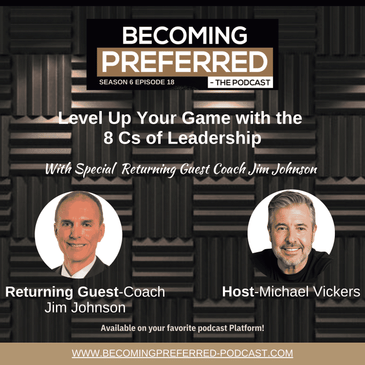
SEASON: 6 EPISODE: 18
Episode Overview:
Welcome back to another episode of Becoming Preferred, the show dedicated to helping you stand out in a crowded marketplace by becoming the provider—and the leader—of choice.
Today we are joined by Coach Jim Johnson, a returning favorite who truly understands what it means to lead under pressure. He’s a hall-of-fame basketball coach, and a world-class speaker, but whether he’s in a locker room or a boardroom, Coach Jim Johnson knows that winning isn't just about the score—it’s about the soul of the team.
Today, we’re breaking down his powerful framework, The 8 Cs of Leadership, to find out how you can earn the right to be followed and how to stay relevant in an ever-changing professional landscape. Join me for my conversation with Coach Jim Johnson.
Guest Bio:
A Legacy of Championship Leadership Coach Johnson is a legendary figure in New York high school basketball, boasting an incredible career record of 428-221. Over two decades, he led the Greece Athena Trojans to 11 divisional titles and a staggering 66-5 record in his final three seasons alone. A multi-time Coach of the Year and recipient of the National Sportsmanship Award, his tenure was defined by consistent excellence, including 22 winning seasons out of 23 and leading his team to the #1 ranking in New York State.
The "Magic" of Teamwork and J-Mac Beyond the win-loss column, Coach Johnson is widely recognized for his unique partnership with Jason "J-Mac" McElwain. From the viral "magic" of J-Mac’s legendary shooting performance to their collaborative coaching years that followed, their story has been featured nationally on CBS Sports. Johnson’s program was built on a foundation of unselfishness, where players celebrated each other's successes as much as their own—a culture that propelled the Trojans to three consecutive Section V Championships.
Inspiring the Next Generation After 33 years as an educator and 20 seasons on the court, Coach Johnson has transitioned his expertise into professional speaking. Through his presentations, “Dreams Really Do Come True” and “Leadership Lessons from Half-Court,” he now travels the country sharing insights on goal setting, teamwork, and leading by example. He brings a lifetime of experience in human potential to businesses and educational organizations, proving that the lessons learned on the hardwood are the keys to success in life.
Resource Links:
- Website: https://coachjimjohnson.com/
- Product Link: https://coachjimjohnson.com/inspirational-motivational-book-products/
Insight Gold Timestamps:
02:15 We want to unite people, not divide them
04:57 The other thing I think is really important with character is being willing to admit when you make a mistake
07:34 Are you a person worth following?
10:52 Do your people know that you care about them?
14:51 Stephen Covey said, seek first to understand before being understood
18:05 Why I say clarity is kindness...
19:12 Confidence versus arrogance
20:48 People want to feel like they're being heard
22:25 As a leader, you have to admit when you're wrong, and that that's a very hard thing to do
25:59 If we don't get better, people are going to pass this right by
28:36 Really sharing that curiosity every day
29:07 You make the distinction between listening to understand versus listening to respond
34:46 My big thing with challenge is that it starts with setting some really high standards that as a leader you've got to be living and sharing
38:20 I do think you have to have some boundaries and some non-negotiables
40:00 Are you the same person of a high level of integrity at home as you are in the marketplace?
42:19 The website is coachjimjohnson.com
42:35 I've actually connected with a few people that are on a kindness movement
Connect Socially:
LinkedIn: https://www.linkedin.com/in/coachjimjohnson/
Facebook: https://www.facebook.com/CoachJimJohnson/
Twitter: https://twitter.com/coachjimjohnson
Blog: https://coachjimjohnson.com/blog/
YouTube: https://www.youtube.com/@CoachJimJohnson1
Email: jjhoops@rochester.rr.com
Sponsors:
Rainmaker LeadGen Platform Demo: https://calendar.summit-learning.com/widget/booking/JKItVP7WErmCBjU2cCIx
Rainmaker Digital Solutions: https://www.rainmakerdigitalsolutions.com/
In 3, 2, 1.
Speaker BWelcome back to another episode of Becoming Preferred, the podcast dedicated to helping you stand out in a crowded marketplace by becoming the preferred provider and the leader of choice.
Speaker BToday we are joined by coach Jim Johnson, a returning favorite who truly understands what it means to lead under pressure.
Speaker BHe's a Hall of Fame basketball coach and a world class speaker.
Speaker BBut whether he's in the locker room or a boardroom, Coach Jim Johnson knows that winning isn't just about the score.
Speaker BIt's about the soul of the team.
Speaker BToday we're breaking down his powerful framework, the eight Cs of leadership, to find out how you can earn the right to be followed and how to stay relevant in a never changing professional landscape.
Speaker BJoin me now for my conversation with coach Jim Johnson.
Speaker BHi, Jim.
Speaker BWelcome back to the program.
Speaker BWe're delighted to have you one more time.
Speaker AWell, thank you, Michael.
Speaker AIt's great to see you and I'm looking forward to having a discussion.
Speaker AIt should be fun.
Speaker BWell, I'm really excited about this topic because I think it's so topical.
Speaker BAnd we're going to talk about leadership and how we earn our roles as leaders.
Speaker BAnd you've created what you call the eight Cs of leadership.
Speaker BAnd we're going to kind of dive and unpack some of those.
Speaker BAnd it seems more than ever, Jim, that leadership is just something we need help with.
Speaker BWe see it in the corporate world, we see it in our political world and everything else.
Speaker BWhat's your general state of the union sense of leadership and where it is in the world today?
Speaker ABoy, that's a loaded question, Michael, because leadership is always in my mind been so essential if you're going to build any kind of team, organization, a country, whatever.
Speaker AAnd right now I see some real void in leadership.
Speaker ASo my focus is trying to help people become better leaders of not only themselves, but how to influence people in a positive way.
Speaker AAnd so there's some things that I try to share ideas every week in my blog, in my posts about the fact of what we need to be effective leader.
Speaker ABecause I think right now we've gotten away from that.
Speaker AAnd so it's part of my job right now to help people become better leaders because we want to unite people, not divide them.
Speaker BYeah.
Speaker BAnd I say the same thing.
Speaker BThere's a lot of corporately we're saying it, we say it with our leaders.
Speaker BWe're just.
Speaker BAnd it's like the pendulum swung to a point where it's even hard to call it leadership just because it's so self serving culture and Our society is that way to compare to other countries.
Speaker BLet's dive into this because you came up with the eight Cs of leadership, which I think are great.
Speaker BNumber one is character.
Speaker BWe're talking about the character of individuals.
Speaker BAnd.
Speaker BAnd you start with character.
Speaker BSo for an entrepreneur, say, building a brand, the office is often everywhere.
Speaker BSo how can a leader ensure that they remain the same person on and off the court?
Speaker BAnd we're using that example because that's your background with basketball and I know you got a good story on that.
Speaker BBut when they're on and off the court, when the pressure to perform is at an all time high, you know,
Speaker AI didn't put in rank order.
Speaker AThere's a lot of Cs I could have added or deleted, but the character was intentional because I think it does start with.
Speaker AAnd you said it very well, is that are you the same person that people can trust in the corporate world or on the court, in my case, as you are off the court, behind closed doors.
Speaker AAnd I believe that's so essential.
Speaker AAnd one of the things I used to tell my family and tell my players is when they think of a person of high integrity, do they think of you?
Speaker AAnd if not, why?
Speaker ABecause you're probably not building trust with them.
Speaker ABecause you're probably saying one thing and not aligning your words and actions.
Speaker ASo that to me is where it all starts.
Speaker AWe used to tell our players almost every day, you are always on stage.
Speaker ALet me give you just a quick story.
Speaker AIt's a simple story, but it shows the power of example.
Speaker AAnd that is, is that I always ask my players to wear something really nice on the road.
Speaker AIn fact, for many years it was a shirt and tie when we would go to another gym.
Speaker AAnd one time I did not wear a shirt and tie.
Speaker AAnd I'll never forget, we got back to the school and one of our parents as we were walking out of the school said, hey, coach, you always talk about you want to be a great example for our sons and yet you insist they wear a shirt and tie.
Speaker AAnd you didn't wear one.
Speaker AWhy not?
Speaker AAnd it really hit me hard, Michael.
Speaker ABut it showed the power of leadership and the fact that people are always watching you.
Speaker AAnd I learned a great lesson and I will say that I corrected it.
Speaker AAnd every game after that I wore a shirt tie, because if I was going to.
Speaker ASo it's just things as simple as that, but modeling the behavior.
Speaker ASo the character that you say consistently and the other thing I think is really important with character is, is being Willing to admit when you make a mistake and apologize and then correct it.
Speaker ALike my situation, I told their parent, you're absolutely right and I'm going to make amends.
Speaker AAnd I did.
Speaker ASo.
Speaker BYeah, well, it's the old do as I say, not as I do, but.
Speaker ARight.
Speaker BIntegrity is what you're saying isn't a part time job.
Speaker AYeah.
Speaker BIt's the consistency between our words and our actions that that's how we earn trust or the team's trust.
Speaker BI think really it's probably an issue of volume.
Speaker BLike when we're at work we might crank the volume up a little bit and when we're back at home, we turn down the volume a little bit or the amplification of that, however that's supposed to be so.
Speaker BAnd character, it's not taught anymore because it really, like, where does it begin?
Speaker BLike, you know, you and I both grew up in the same time in the 60s.
Speaker ARight.
Speaker BAnd character and values were important.
Speaker BPeople's honesty, their integrity, those are the things we actually valued as human beings.
Speaker B70s, 80s.
Speaker BAnd then we started to see this degradation of.
Speaker BWe saw it from our leaders of corporations and businesses.
Speaker BWe've got high salaries, embezzlement, people living large, all just, you name it.
Speaker BWe, you know, there was a.
Speaker BOn and off the court.
Speaker BWe had that leader that I remember there was earlier this year or last year in 2025, at a Coldplay concert, we had a CEO and his HR director caught in an embrace.
Speaker BHe's having.
Speaker BThey're having a fling.
Speaker ARight?
Speaker BCEO, that's, that's off the court.
Speaker BRight?
Speaker BThat's so off the court.
Speaker BHis morals are tanking.
Speaker BRight.
Speaker BHe's not keeping his commitments and I'm not judging him, but I'm just saying, right.
Speaker BHe's our leader, we're going to judge him.
Speaker BAnd now the board kicks him off.
Speaker BHe can't be a leader anymore.
Speaker BWe can't see that.
Speaker BIn other countries.
Speaker BWe've seen issues, you know, with the whole Epstein case, you know how people are on that.
Speaker BWe've seen other countries, people just by mere association are now getting let go and losing their, you know, they're resigning from their opportunity.
Speaker BExcept here, except in America.
Speaker BWe're kind of like, yeah, no, we're still good.
Speaker BAnd so why, what's happened to the teaching of the values and teaching character?
Speaker BHow do we teach our young people that one?
Speaker ANow that's challenge because I do believe it starts in the home.
Speaker AAnd we've had some real issues with family dynamics.
Speaker AYou know, I know you're in between US and Canada.
Speaker ABut I know in the US that find family dynamics, but I do want to challenge all of us as a leader is that you can still help model and be a person of high integrity, of character that people want to follow.
Speaker AAnd that's what I wrote about, is, are you a person worth following?
Speaker AAnd I coached basketball for 35 years, and I had some kids that came from really difficult family situations.
Speaker ABut, you know, I built a bond with them, and I wanted to be the model for them.
Speaker AAnd those are things that with integrity.
Speaker AI'll give you another quick example, is that I got challenged by a mentor in my last 23 years of coaching.
Speaker AHe challenged me, say, Jim, you want to be a great example for your players?
Speaker ATell them you're not going to drink alcohol during the season.
Speaker AAnd I was not a super big partier, but I would go out after a game and have a couple big drinks and.
Speaker AAnd.
Speaker AAnd I decided to do it.
Speaker AAnd fortunately, I kept my word.
Speaker AI did not, because I always give an example and I do a leadership presentation.
Speaker AIf I said to my team and my I the parents night, so all the parents are there as well, and then two weeks later, I got pulled over for a dwr, what would that have done?
Speaker AAnd those are some of the things we're seeing right now, is that, you know, they say one thing and then they completely do the opposite.
Speaker AAnd that.
Speaker AThat crushes that character for sure.
Speaker BYou know, when I look at our leaders, I'm reminded of I.
Speaker BAt the time, I was.
Speaker BI couldn't vote and do anything.
Speaker BBut I remember when Jimmy Carter was in and we could argue whether he was a good president or not.
Speaker BWe had big gas lines, it was economy, 21% interest rates.
Speaker BLike things weren't great, right?
Speaker ANo.
Speaker BAnd he's not responsible for all of that.
Speaker BBut still.
Speaker BBut he had a consistent set of values.
Speaker BAnd even both sides of the aisle trusted him.
Speaker BBecause when he said, was his word right?
Speaker BIf it served him or it didn't serve him, his word was his word.
Speaker BSo I think it's teaching that consistent set of values.
Speaker BAnd we don't see it.
Speaker BAnd it does start in the home.
Speaker BYou know, I remember I was talking to a friend of ours, a police officer, and she was saying that we went to somebody's home with their son, and we're playing an audio tape of him doing a drug deal.
Speaker BAnd the mom and dad go, well, that's not our son.
Speaker BYeah, that's her son.
Speaker BSo they said, well, here's the video.
Speaker BAnd they're going no, you guys have doctored it.
Speaker BOur son wouldn't do that.
Speaker BOur son doesn't do that.
Speaker BAnd it's so it starts in the home, but when the parents are there, well, then what does that child learn?
Speaker BThat we're just our.
Speaker BWhere is the character?
Speaker BSo I think it is a good place to start at home.
Speaker BLet's talk.
Speaker BYou mentioned number two, and I know these aren't in any particular order, but clarity is kindness.
Speaker BBut you also emphasize care.
Speaker BHow do you strike the balance between being a high level challenger and showing your team that you genuinely care about their personal success?
Speaker AI think the first thing that I really share with leaders is that the old adage, but I think that still rings true today, is people don't care how much you know until they know how much you care about them.
Speaker AAnd one of the greatest compliments, the best player I ever coached, he ended up playing a couple years in the NBA.
Speaker AI mean, he came back after his first year in the NBA and he met with my assistant coach, is now the head coach of myself.
Speaker AAnd it touched me very deeply because my assistant was asking Anthony, was his name some different things.
Speaker AAnd he says, coach, I can tell you that what I admired most about Coach Johnson is I knew he cared more about me as a person than he did as a basketball player.
Speaker AAnd that meant a lot to me.
Speaker AAnd why I bring that up, not to brag about me, but the point being is that do your people know that you care about them?
Speaker AAnd I do a presentation on culture and one of the things I talk about is how are you consistently building relationship?
Speaker AAre you recognizing people?
Speaker ADo you get to know them?
Speaker ALike, do you know about their family?
Speaker ADo you know when their birthday is?
Speaker ADo you know if they're married?
Speaker ATheir anniversary is acknowledging those types of things, Are you getting to know them by just asking them questions?
Speaker ALike example, when I had captains meetings at the beginning almost every week for many years I coached.
Speaker ABut I made a dramatic change in the second half where instead of me just coming in about my agenda, I became what I call the cqa, this chief question asker.
Speaker AAnd I would come in and my first question would be to my captains, how's our team chemistry?
Speaker AAnd I would just listen.
Speaker AI'd say, is there anybody on the team that's struggling that we need some extra help with?
Speaker AAny suggestions on what we should do for practice this week?
Speaker AAnd just things like that where I was getting their insights.
Speaker ASo they really felt empowered that they had some say and the fact that that really built some team unity.
Speaker ASo I think showing that you care, one of the things I recommend is I think you got to do one on one meetings with people.
Speaker AAnd you know, if it's in a business, yes, in basketball I would talk about some things to help them to be more successful.
Speaker ABut also I wanted to find out about them and get to know them.
Speaker AAnd I think that's something that you need to start right away.
Speaker AI always say to leaders, when you take over a new situation, you should just do a program where you go around and try to meet as many people as you can and get to know them so that you show that you care.
Speaker AI call it the wandering tour.
Speaker AYou just got to go around and meet as many people and get to know them, because when they know you care, that's a great start.
Speaker BWell, you call this radical empathy and how, you know, I'm having to develop my empathy.
Speaker BSo for me, some people are empaths.
Speaker BThey're just naturally empathetic.
Speaker BI was never that way.
Speaker BNow as I got older, it's like if you blew your knee out and you got a sore knee and you're doing whatever and they're talking to you, I can go, oh yeah, I get that.
Speaker BOr a bad shoulder, I can relate to you.
Speaker BI get all those.
Speaker BOr say you had migraines and I've had migraines, I can go, oh, I totally get it.
Speaker BBut if I don't experience it right, it's very hard for me to develop that empathy.
Speaker BRight.
Speaker AYeah.
Speaker BSo I've had to learn to actively listen, hear what they're talking and try.
Speaker BAnd I guess the word I want to use is, I almost want to say fake the empathy initially until that muscle, kind of, that empathy muscle develops.
Speaker BAnd a lot of times leaders don't appear empathetic because it seems, I want to say, it seems weaker.
Speaker BLike, it's like my wife is very, you know, very empathetic.
Speaker BShe's, you know, she'll start, you start crying, she's in with you, she joins.
Speaker BRight.
Speaker BAnd sometimes that might not be what's needed.
Speaker BSo how do we develop empathy if it's not naturally given to us that way?
Speaker AThat would tend to, you know, go along with that.
Speaker AI don't think I was that empathetic early in my career for sure.
Speaker AAnd it's something that I learned as I was really trying to focus on being a better leader by building relationships.
Speaker AAnd so a couple of things is you talked about questions, but the where I think you really show empathy is when you ask another question.
Speaker ALike even simple things like as they talk to you about something is, wow, can you tell me more about that?
Speaker AYou know, what you're feeling about that?
Speaker ASo you're trying to get them into it.
Speaker ASo I call it asking the extra questions.
Speaker AAnd then, as you said, really being willing to listen and then give them a cycle of feedback so that when they share something, share it back so that, you know that they, you think that Stephen Covey said, seek first to understand before being understood.
Speaker AAnd I think those are things that you're really trying to accomplish in building there.
Speaker ABecause the thing that I think is a struggle because relationships are being built quickly and yet most of us, including myself, want instant gratification.
Speaker AInstant gratification doesn't come that quickly in building relationships.
Speaker ASo.
Speaker ABut, you know, I think one thing is, you know, Simon Sinek wrote a book called the Infinite Game, and I think that's the mindset we got to be, is that, you know, what is our players, in my case, going to talk about me 10 years from now as opposed to all the, you know, well, did we win the next game?
Speaker AType thing.
Speaker BSo, no, I like that.
Speaker BAsk more questions.
Speaker BAnd it's kind of like unlayering that onion.
Speaker BWe do the same thing in sales when we're talking to a client.
Speaker BNot from an empathetic point of view, but to seek understanding.
Speaker ARight.
Speaker BI think that's the fifth habit is first question is the primary and then based on their responses, oh, boy, that must have been hard.
Speaker BTell me about that.
Speaker BHow did you deal with that and follow up?
Speaker BAnd that's why I say sometimes it's the process and go through the process first and then you actually understand and you develop your empathy.
Speaker BBecause I'm more empathetic today than I was 10 years ago and 10 years before that.
Speaker BSo for me it's a, you know, I've still a long way to go, but I always usually get my first reaction sometimes, oh, glad that's not me then it's unless I can relate to it.
Speaker BBut hey, that's a good starting point anyway.
Speaker BSo, yeah, let's talk about the clarity shift.
Speaker BMost leaders think they're being clear when they're communicating.
Speaker BYou challenge us to ask, how can I be more clarity?
Speaker BSo what is the one practical communication habit, say, a busy professional can adopt today to eliminate ambiguity?
Speaker ASo that's a really good question, and I heard this from a leader a number of years ago, is it should be so clear not to you, the communicator, but to the people you're expressing to them.
Speaker ASo that's why you have to check for understanding.
Speaker AWhat I got caught up early in my career, and I think many leaders do, is they assume I said it, so that means they understand it.
Speaker AAnd that's why there's a couple things I always remind leaders.
Speaker AYou're the CRO.
Speaker AI know I'm using a few acronyms, I guess from the education world, but that's Chief Reminding officer.
Speaker ASo that means that you got to be consistently sharing the message that you want to do and shared it in different ways.
Speaker AAnd being a good storyteller and giving them.
Speaker AI like to share with stories of both warnings and examples.
Speaker ASo in my case, my players, your employees or your team or whatever it is giving them examples, but then really checking to make sure that they understand.
Speaker AAnd so, for example, like if you're going over the core values, do they understand what the core values are?
Speaker ABecause you see it up on business as well as I speak to businesses, you know, and some of them know the core values.
Speaker ABut then the thing I dig down deeper is, okay, I see one of your core values is respect.
Speaker AWhat does that mean?
Speaker AWhat does that mean?
Speaker AWhat's that behavior?
Speaker AAnd that's why you got to model that and share that and give them examples.
Speaker AThis is what respect means to us.
Speaker ABecause if they don't understand that, then clarity.
Speaker AAnd why I say clarity is kindness.
Speaker ABecause they have to have clarity of both positive recognizing things, but also correction.
Speaker AAnd as a leader, you got to be clear about what the boundaries are.
Speaker AYou want to empower people, but it doesn't mean that you're going to allow them to spend million dollars on a project.
Speaker ASo.
Speaker ASo really having clarity of what you're going to allow and what you're going to give them some leeway on.
Speaker ASo I think clarity and being consistent with that clarity every day is really important.
Speaker BWell, I think to get respect, you have to give it.
Speaker BAnd as a leader, it starts with you.
Speaker BSo by being respectful.
Speaker BWe see so many examples every day where we see disrespect and we wonder why people are disrespectful.
Speaker BFall.
Speaker BYeah, because we're seeing it.
Speaker BAnd you, I know you've talked about it.
Speaker BMiscommunication is the silent tax on a business.
Speaker BSo reconfirming understanding saves hours and hours of wasted effort.
Speaker BSo it's important to speak with clarity and.
Speaker BAnd we'll get into it.
Speaker BSo I like that.
Speaker BWhich kind of a nice little segue into confidence versus arrogance.
Speaker BSo in a world of business, we often reward the loudest voice.
Speaker BYou define confidence as being vulnerable and welcoming.
Speaker BNew ideas.
Speaker BSo how can a leader pivot from wanting to be right to wanting the right idea?
Speaker AThat was a really tough transition for me because when I got into being a head coach, I thought I knew all the answers.
Speaker AAnd when I realized that the best leaders, I truly believe this, are looking for the best answer.
Speaker AAnd often it doesn't have to be in my case, my answer.
Speaker AAnd that was very hard.
Speaker AI'll give you a quick little story.
Speaker ASo playing in this Christmas tournament in Pennsylvania, and we're playing, there's two very good teams.
Speaker AOur team was good and they were.
Speaker AAnd we played man to man defense the whole game.
Speaker ASo they called timeout with 15 seconds ago and we were up like a couple points.
Speaker AAnd my assistant came to me and he said, coach, go two, three zone.
Speaker AI said, nah, Steve, you know, we don't play that much.
Speaker AHe goes, they will not know what to do.
Speaker AAnd I went with him and he was absolutely right.
Speaker AThey froze like gears in a headlight and we ended up winning the game.
Speaker AAnd afterwards I was interviewed by the local press there, and one of the things I learned I gave my assistant coach because they asked me, you know, why did you go to 2, 3 zone?
Speaker AI said, that was a great suggestion from my assistant.
Speaker ASo I recognized him publicly.
Speaker AAnd I think that's a really powerful thing is to making sure that you're using their ideas.
Speaker AAnd the other thing about communication and clarity, Michael, is that people want to feel like they're being heard.
Speaker ABut that doesn't necessarily mean that every suggestion I was going to use, but what I think is really important is that making sure that you give them clarity of why in this case, I don't think this is a suggestion we can use.
Speaker ANow, they may not agree with that, but at least they know where you're coming from.
Speaker AAnd that, I think is really essential in building that bond and communication.
Speaker BWell, and it depends on how you're building your team.
Speaker BLike, we see examples of good and we see examples of bad.
Speaker BYeah, I, when I'm judging it just from my perspectives, but if I surround myself with a team of people who just say yes to me.
Speaker AYeah.
Speaker BBuilding my board or my team or my cabinet, well, however you want to look at it doesn't matter what.
Speaker BAnd no one's challenging my thinking.
Speaker ARight.
Speaker BYou're going to end up with poor decisions and bad out.
Speaker BAnd I think we're seeing symptoms of that in society.
Speaker BWe see it.
Speaker BSo it's important to have people not always agree with us.
Speaker BAnd truth should withstand scrutiny.
Speaker BSo.
Speaker BAnd right idea we should be able to challenge it.
Speaker BAnd then to your point, go, yeah, oh, you know what, I'm sorry on that one or I took the wrong approach on that one.
Speaker BThis should have been a better approach.
Speaker BYou know, we see what's modeled for us just in our environments and we're going, holy cow.
Speaker BYou know, you can see where that hubris or that arrogance kind of.
Speaker BIt sends everything moving south.
Speaker BReally.
Speaker BIt's not a good thing overall.
Speaker BSo I do get that.
Speaker BI think that's important.
Speaker BSo true.
Speaker AThe other thing I'll say, Michael, just is that I think another very difficult thing and it took me a while to do this, but as a leader, you have to admit when you're wrong.
Speaker AAnd that's a very hard thing to do.
Speaker CAre you tired of chasing leads and ready to start effortlessly attracting more more high value clients?
Speaker CIntroducing Rainmaker Lead Gen, the ultimate sales, engagement and client acquisition platform that takes the stress out of outreach.
Speaker CWith Rainmaker Lead Gen, you can easily identify, engage, educate and convert your ideal prospects into loyal clients.
Speaker COur industry leading automation and email sequencing empowers you to reach more ideal clients, accelerate the sales cycle and and close more business.
Speaker CImagine authentically engaging with your prospects while the platform handles the heavy lifting.
Speaker CSay goodbye to the endless hustle and embrace a more efficient, effective approach to business development.
Speaker CReady to witness the magic?
Speaker CBook a 20 minute demo today and see how Rainmaker Lead Gen can revolutionize and level up your client acquisition game.
Speaker CThere's nothing to lose and everything to gain.
Speaker CDon't miss out on this opportunity to supercharge your client acquisition process.
Speaker CVisit rainmakerdigitalsolutions.com or check out the link in the show notes to book your demo.
Speaker CRainmaker Lead Gen Spend less time hunting for your ideal clients and more time having high value sales conversations with your ideal clients.
Speaker BAnd now back to my conversation with coach Jim Johnson.
Speaker BYou talk about, and I love this about your focus on competence through the C A N E I is it can E or formula and constant never improvement.
Speaker BSo for a professional who feels they've already reached the top of their industry, how do they begin studying leadership as a separate evolving craft?
Speaker ASo that that's something that what I teach leaders is I think you have to have competence to gain confidence in whatever you're teaching.
Speaker AWhether you're ahead of a team that builds a W it or my case, I was coaching a basketball team so I really believed I needed to have expertise on how to teach the game in basketball.
Speaker AFrom the skills to the plays and on and on and on, but it didn't hit me until probably 10 years in.
Speaker AYou know what the other essential thing is as a head coach is I have to learn how to be a better leader.
Speaker AAnd so that's.
Speaker AI started my, really my journey that I studied leadership, I read a lot, I talked to a lot of people, I listened to a lot of audio programs, I listened to a lot podcast.
Speaker ABecause to me, leadership keeps evolving.
Speaker AAnd you got to stay on top of that if you want to be a successful leader is you got to study leadership.
Speaker AAnd with that you pick up good ideas and you're going to look to find ways to implement and you're also going to find some of the ideas you used to believe now you've changed your mind on.
Speaker AAnd I think that's really important is that you got to keep growing.
Speaker ABecause one of the things that I was proud of when we started to win is that the famous music industry, the one hit wonder, right.
Speaker AWhere did that band go?
Speaker AWell, it's probably because they didn't keep growing.
Speaker AIt's the same thing.
Speaker AWe hear that all the time with team.
Speaker AThey won a championship.
Speaker AWhere's that team now?
Speaker AIt's probably because they got very complacent.
Speaker ASo as the leader, you really got to fight that.
Speaker AOne of the things I really encouraged myself first as the person of example and then my players is, hey, you know what?
Speaker AIf we don't get better, people are going to pass this right by.
Speaker AAnd so it starts with me, I'm going to get better for next year and everybody else.
Speaker AAnd then you give them a program of how they can improve.
Speaker BYeah, no, no, it's great advice.
Speaker BMatter of fact, that one rings home to heart.
Speaker BYou know, Jim, I have a book coming out at the end of the month and our audience doesn't know this yet, but we'll send so I'll this.
Speaker BI'm going to put a plug in for that one right now.
Speaker BBut it's.
Speaker AYeah.
Speaker BTo your point though, it's called staying relevant future Proof yourself in the age of AI.
Speaker BAnd I have a chapter where I talk about the one hit wonder and I was guilty of that.
Speaker BI wrote a book that became a bestseller and I rode those coattails 20 years and I talk about that.
Speaker BI became complacent while others were getting better around me.
Speaker BAnd so I had to.
Speaker BI recognize that.
Speaker BThank goodness.
Speaker BAnd what can I put into place so that I can stay relevant in a world that's changing so fast?
Speaker BBecause you know, you're a one hit wonder.
Speaker BWhat have you done for Me lately.
Speaker BAnd it really boils down to continuous improvement and continuous education, which you.
Speaker BSo it's how do I make myself better?
Speaker BAnd we only have to do it in increments.
Speaker BWe only have to be increments.
Speaker BSo, like, for instance, now we live in the world of AI.
Speaker BWell, you know, you're not going to lose your job day I.
Speaker BBut you will lose your job to someone who employs AI and knows how to partner with them.
Speaker ARight.
Speaker BAnd so I think that's going to be important part.
Speaker BYou talk about curiosity, and you talk about becoming the chief question officer or asker in your organization.
Speaker BThis cqa.
Speaker BYou encourage us to be the CQA of our teams.
Speaker BWhat are the power questions that every entrepreneur should be asking their employees or partners right now to foster that kind of curiosity?
Speaker AWell, I do believe, because you want to build relationships.
Speaker ASo I think it just starts with simple things, and you delve deeper.
Speaker ASo it can start as simple as, I want to get to know you.
Speaker ATell me a little bit about how you grew up.
Speaker AAnd then.
Speaker AAnd then you dig a little deeper when they talk about their family.
Speaker AWell, how did.
Speaker AHow did you feel about that?
Speaker AYour mother, you know, tell me more about that.
Speaker AAnd so you're building a little bit of relationship there first.
Speaker AAnd then the second thing is really having the curiosity, because often as the leader, that doesn't necessarily mean that you have the skill set to do every job in your organization.
Speaker ASo just getting in and asking them about, let's say they're working on a printing press and you say, why do you do it that way?
Speaker ATell me more so that I can get a better feel of that.
Speaker AOr when they come to you and say, hey, we really should have this machine instead.
Speaker AAnd then you got to delve into it.
Speaker AOkay, tell me why.
Speaker AHow is that going to benefit you in our business, ultimately the bottom line.
Speaker AAnd so really sharing that curiosity every day, and the curiosity starts with, you know, every day is, how can I get a little bit better?
Speaker AAnd then really trying to get to know your people in a deeper level, both in my case, on the court and off the court.
Speaker AAnd so.
Speaker AAnd even having clarity of when you're teaching something and they say, why do you teach it that way?
Speaker AAnd you should have some background why right now.
Speaker AThis is why it has been working well for us.
Speaker BOh, and saying with curiosity, you make the distinction between listening to understand versus listening to respond.
Speaker BSo how does that shift in mindset change the outcome of a difficult board meeting or a client negotiation?
Speaker AYou really have to understand in negotiation of Any kind of where is the other person coming from?
Speaker ASo trying to dive into their shoes and getting to know what they want, because, you know, it's sometimes in negotiations, you think they want something and it's completely different.
Speaker AAnd the reason that you didn't figure that out is because you didn't ask.
Speaker AYou know, often, like in sales, people think the most important thing is, is the price.
Speaker AOkay?
Speaker AAnd in some cases it is, but in a lot of cases it's not.
Speaker AIt's.
Speaker AThey're willing to pay a price.
Speaker AIf it gets the results that you share, it will.
Speaker ASo.
Speaker ASo trying to figure out in the negotiation what is the other side looking for and what are you looking for and how can you bring that together?
Speaker ASo I think that's really important to understand the other side.
Speaker AAnd the other thing that I think is really important in when you're meeting with people is doing a little research before you can get to know so much about a person today, it' so much easier than any time in history.
Speaker ASo being prepared, you know, like, I talked to a person today and I did my research.
Speaker AI didn't know everything about him, but I knew things and I could start the conversation.
Speaker AThe funny thing is, he was a nice guy, Michael.
Speaker AHe didn't ask me one question about me, you know, So I just thought that was fascinating, and that's helped me immensely again, because I used to be the guy that was doing all the talking instead of being the guy that's really listening.
Speaker BYeah.
Speaker BTwo of these, one of these.
Speaker BThat's the ratio.
Speaker BWe should be using it, right?
Speaker AWell said.
Speaker BI've heard it.
Speaker BI've heard it said.
Speaker BWe should listen three ways.
Speaker BListen to what they're saying, listen to what they need, and listen to what they're feeling and try and listen to those.
Speaker BYou know, I had an interaction with a family member just over a month ago, and we were talking and we got on the subject of politics like we all do, and he's from a fairly conservative perspective and very defensive of.
Speaker BOf existing policies and where we're at, Right?
Speaker BAnd so we were back and forth on that, and it wasn't.
Speaker BThere was no agreement, there was no alignment, There was no.
Speaker BAnd so.
Speaker BAnd I could tell that he was actually getting agitated because I'm asking the questions because now he's having to defend his position.
Speaker BAnd that's not what I was looking for.
Speaker BSo then I started asking a little more, you know, kind of personal questions and then what the underlying issue was.
Speaker BAnd that's when all of a sudden there was A meeting of the minds.
Speaker BAnd it was like his response was.
Speaker BHonestly, he goes.
Speaker BAnd he was almost in tears.
Speaker BHe goes, I'm just scared.
Speaker BI'm just really scared.
Speaker BAnd I don't know what to do.
Speaker BAnd I don't.
Speaker BSo he was adopting a posture.
Speaker BBut his underlying issue was he was just scared.
Speaker BSo it makes sense to, hey, put up the alarm systems, big balls around me.
Speaker BPut all the defensive mix, put all these things.
Speaker BBut at the heart of it, it was fear.
Speaker ARight.
Speaker BOnce we got to the issue of his fear, it kind of melted the conversation.
Speaker BAnd there was good connection.
Speaker AYeah.
Speaker BIt was like, okay, I totally get that.
Speaker ARight.
Speaker BI get you and you.
Speaker BAnd then we had good communication with it.
Speaker BSo I experienced that kind of firsthand in that way.
Speaker BBecause people will adopt a position, they get buried into it, whatever the position is.
Speaker BAnd all of us can relate to this at whatever level.
Speaker BBut it's truly understanding.
Speaker BWhat if we try and understand where they're actually coming from?
Speaker BHow did they get that thought?
Speaker BSo even if you're having conversations around religion or politics, we've all been told not to do that.
Speaker BThat I can have a conversation with you about that.
Speaker BBecause I might say to you, how did you come up with that?
Speaker BHow did you arrive at that thinking?
Speaker BCan you walk me through your thought process of why that's a good idea and have you considered other options and versus getting your point across?
Speaker BAnd here's my opinion.
Speaker BBecause really everyone has one.
Speaker BRight.
Speaker ARight.
Speaker BSo I think you may.
Speaker BThis is where the curiosity comes in.
Speaker BWhy do they think the way that they think and ask versus tell?
Speaker BAnd you can have a little more peaceful conversation.
Speaker AI'll give you one quick example.
Speaker AYou know, I have a friend and we're pretty different on our politics.
Speaker BYeah.
Speaker AAnd I just went to him one day and I said, John, I'm really curious.
Speaker ACan you tell me why when your situation, your beliefs and why.
Speaker BYeah.
Speaker AAnd I just listened and then I would ask more questions and we had such a great conversation where a few times we had really had heated because I believe this and he believes that.
Speaker AThat.
Speaker ABut really delving deeper and asking those extra questions and getting their perspective on that, whether you agree or disagree.
Speaker ABut if you can really have a good conversation that way.
Speaker BAnd we.
Speaker BI think people want understanding more than they want agreement.
Speaker AYeah.
Speaker BI don't care that you agree with me on my opinion.
Speaker ARight.
Speaker BBecause that's just an opinion.
Speaker AYeah.
Speaker BBut I want you to know you took the time to understand.
Speaker BAnd so are you clear?
Speaker BYeah.
Speaker BAnd I could be wrong or Right.
Speaker BAnd the older I get, the more I realize I probably am wrong and that I have that awareness.
Speaker BRight.
Speaker BBut.
Speaker BOr I operate under the assumption that I could be wrong.
Speaker ARight.
Speaker BAnd I'm okay if I'm wrong.
Speaker BIt's fine.
Speaker BI'll change my perspective and apologize if necessary and go.
Speaker BThanks for the insight.
Speaker BSo I don't mind evolving, you know, and too often I think we get stuck and then we get, we stay rigid and we're not flexible.
Speaker BAnd I think we could do that.
Speaker BI think our whole country could, could benefit from that as well.
Speaker ARight.
Speaker BYou talk about embracing the challenge as one of the sea.
Speaker BWhen life hands a leader, say a new challenge, you ask if they're excited or scared.
Speaker BSo for those currently facing maybe a market downturn or they're facing a pivot, how can they reframe the fear into a competitive advantage?
Speaker AMy big thing with challenge is that it starts with setting some really high standards, that as a leader you got to be living and sharing and this is the direction we're looking to go, but also being open to having build that famous psychological safety where people feel like they can share their ideas and not be ridiculed.
Speaker AAnd so building that safety that you are.
Speaker AWe have high standards here.
Speaker AAnd one of the things that you have to do is you have to model and you have to do two things.
Speaker AYou have to praise when you get the behavior you're expecting and with specific praise.
Speaker ALike I always give the example, like in my basketball situation, instead of saying, nice job, Johnny, that was great, he might like that, but he really doesn't have any clue why.
Speaker ABut if I said, Johnny, that was awesome how you dove on the floor for that loose ball.
Speaker AThat's what championship players do on championship teams.
Speaker ASo now it's very specific.
Speaker AAnd then the other thing is going back to the famous relationships because part of the job of a leader is you got to crack.
Speaker AAnd so there's some times where as I got to know an individual player, where I could correct them in front of everybody and they handle it well.
Speaker AAnd it was a great lesson for all of us.
Speaker AThere's other players, as I got to know them, did not handle criticism publicly very well at all.
Speaker ASo that, that's why it's an artist science.
Speaker AI would bring them in a one on one and say, John, your effort is not acceptable here.
Speaker AWe have a very high standard and give them some sharing.
Speaker AAnd in my case it was very easy because we videotaped everything so we could show this is when you were playing really hard and this was when you weren't.
Speaker AAnd I'm seeing too much of the other thing.
Speaker ASo really getting clarity and with that is share that with them and then give them ideas on how they can correct that and then encourage them and when you see them making progress, to make sure that you give them their specific praise.
Speaker BYeah.
Speaker BYou say they're not obstacles, challenges, they're just data points needed to correct the behavior and help them grow.
Speaker AYeah.
Speaker BSo we get our stats.
Speaker BIt's kind of, you know, like I exercise regularly, but I monitor my numbers, I look at my heart rate, how can I keep lowering it, make sure my blood pressure is in good things.
Speaker BHow do.
Speaker BSo I'm looking at all the key data points.
Speaker ARight.
Speaker BUltimately, in order to change them, I have to change my behavior.
Speaker BSo if the engine light comes on, I got to change my behavior.
Speaker BBehavior cholesterol's too high, I gotta lower the behavior that's causing too much cholesterol.
Speaker BSo I like that you talk about the role model standard and around consistency and you say consistency is the glue that holds the eight Cs together.
Speaker BWhy is leading by example more effective than say the best written mission statement or employee handbook?
Speaker AWell, because they see what you do every single day.
Speaker AAnd one of the things that I encourage leaders is that, that because I'll often ask them in a leadership presentation, is trust important in building a great cult culture?
Speaker AAnd it's always 100% hands.
Speaker AI said, well, then I challenge you.
Speaker ADo you have an intentional trust plan on how you're going to build trust?
Speaker AAnd what I talk about is being a model.
Speaker AOne of our keys in our trust plan is aligning your words and actions.
Speaker ASo if I say one thing and do another, like if we're practicing at 6 o' clock in the morning, in my example, if I come in at 6:05, I've sent a poor message.
Speaker AOkay.
Speaker ABut if I'm there at 5:40, then because of one of our non negotiables and one of the things I share with leaders is I do think you have to have some boundaries and some non negotiables.
Speaker ABut it can't be a hundred non negotiables.
Speaker AThere's got to be a couple.
Speaker ASo that you share that by your example day in and day out.
Speaker ALike one of our non negotiables was being on time.
Speaker AIf you couldn't be on time, be early.
Speaker AAnd so but I always modeled that I did not go come late because that is something that I consider a non negotiable.
Speaker AGoing back to my little Tie story.
Speaker AIf it's non negotiable that we got to wear a tie, coach got to wear a tie.
Speaker ASo your modeling is so powerful and I think people have forgotten that because they're always watching you.
Speaker BYeah.
Speaker BAnd I think their employees are watching and we've got to they'll mirror the leader's behavior.
Speaker BAnd this is what we're seeing.
Speaker BWe see it corporately, but we see it in our political world as well.
Speaker BWe're seeing people everywhere model the behavior of our leaders.
Speaker AYes.
Speaker BAnd that's the culture that we live in and just that value.
Speaker BSo it's interesting.
Speaker BBoy, time's running out quickly.
Speaker BBut I did want to ask you, you have a Life tip number 28 actually, which is a good one.
Speaker BIt says when people think of a person with high integrity, are they thinking of you?
Speaker BIf a leader realizes today that they haven't been living up to these eight Cs, what's the first step to maybe rebuilding that reputation?
Speaker AI really think is you got to do some reflection on yourself and say, am I worth following?
Speaker AAnd to me is going back to those eight Cs but is that number one, you know, are you a person of character?
Speaker AAre you a person that they can trust?
Speaker ABecause you align your words and actions, you tell the truth, you find catch people doing right.
Speaker AThose are some of the things we really encourage leaders to do and it builds that character.
Speaker AAnd we've talked about this, but I'm going to say it again.
Speaker AAre you the same person, person of a high level integrity at home as you are in the marketplace?
Speaker AIn my case, the same person that was on the basketball court is when I leave, when I'm in Wegmans or one of our grocery stores, do I still treat people with respect or am I a jerk?
Speaker ABecause that all is going to be built up with people in that you built that reputation, either a positive or a negative.
Speaker ANegative.
Speaker ASo I think you've got to be really cognizant of that.
Speaker AAnd you know, it's comes down to daily habits and what you feed your mind and the right people around you.
Speaker ASo it's just some things to evaluate if you feel like you're going down the wrong path.
Speaker AYou know, let's say you have a drinking habit.
Speaker AOkay, that's probably not good.
Speaker AWhen then study.
Speaker AAre the people around you, are they enhancing that or are they trying to help you overcome that?
Speaker AAnd so I think really being able to think about who are you hanging around with and what are you feeding your mind?
Speaker AI know we talked before we went on here about the fact that we don't watch much news anymore because there's so much negative, you know, and so, yes, I want to be informed.
Speaker ABut if you just sit in front of the TV and listen to all the negative news that affects you, there's no question about it.
Speaker AYou're the keeper of what comes into your mind.
Speaker ASo make sure you're feeding it with good information.
Speaker AI think to be an effective leader, it starts with you being able to lead yourself well.
Speaker AAnd when you do that on a consistent basis, then you got a real good opportunity to lead others.
Speaker BYeah.
Speaker BAnd I think, and you've talked about this, it's never really too late to reset that standard.
Speaker BAnd vulnerability about past mistakes is the first step forward to a new legacy.
Speaker BBut what you're talking about is, hey, own it it, suck it up, change it, ask for help in changing it.
Speaker BAnd there's nothing wrong with that.
Speaker BEven if it was a leader, say, who got pulled over with a dui, or that leader who got busted at the Coldplay concert, you know?
Speaker ARight.
Speaker BHe went back to his people and said, yeah, this is not my normal character.
Speaker BI acted out of character.
Speaker BThis was bad.
Speaker BIt was wrong.
Speaker BMistake.
Speaker BHere's what I've done to correct it.
Speaker BHere's what I've done.
Speaker BWe all make mistakes.
Speaker BWe all make characters, but it's evolving to that, and people are forgiven living.
Speaker BIf you own it.
Speaker BThey're like, okay, it's fine.
Speaker BIt's good.
Speaker BYou know, it's all good.
Speaker BSo, Jim, this is informative as always.
Speaker BThe website is coachjimjohnson.com if you want to think bigger, lead better and win more, reach out to Jim.
Speaker BHe works with organizations, training keynotes.
Speaker BYour podcast, Jim, you're just busy, and so we'll send them to your website.
Speaker BAny final remarks at all?
Speaker AYou know, the last thing I'll say, Michael, is I've actually connected with a few people that are on a kindness movement moment, and it's something I think our world needs.
Speaker ASo I encourage everyone, let's try to be a little bit kinder to each other.
Speaker AAs simple as giving someone a smile or opening a door for them or buying them a coffee, whatever it happens to be.
Speaker ABut let's focus on being kinder to each other.
Speaker BYeah, no, it's great insight and it's not that tough.
Speaker BAnd do it every day and you build that muscle.
Speaker BAnd yes, it's.
Speaker BAt the very least, it's good karma.
Speaker BSo I think we need a kinder, general place, and I think we're ready for the that as a country, we're ready for that.
Speaker BJim, Always a pleasure.
Speaker BLook forward to our next conversation.
Speaker AThank you Michael.
Speaker AAlways a pleasure.
Speaker BAs you are listening to this episode, what is one idea that you've heard that's caught your attention and why does it matter so much to you?
Speaker BAnd who is one person who you can share that with, either sharing this episode or just sharing that insight that occurred to you while you were listening?
Speaker BPerhaps it is the realization that clarity is kindness and that miscommunication acts as a silent tactic on your business and relationships.
Speaker BOr maybe it is the commitment to becoming your team's chief question asker or CQA by listening to understand their needs rather than just listening to respond.
Speaker BThank you for listening, for learning, and for investing in yourself so that you can become the best version of you.
Speaker BIf you found value in this episode, please write a review on Apple Podcasts.
Speaker BIf you haven't subscribed yet, please do so so you can get a new episode and start your week off from every Monday until next time.
Speaker BThis podcast is created and associated with Summit Media.
Speaker BMy Executive producer is Beth Smith and Director of Research Tori Smith.
Speaker BThe fee for the show is that you share it with friends when you find something useful or interesting.
Speaker BThis podcast is subject to copyright by Summit Media.
Speaker AGoodbye.