
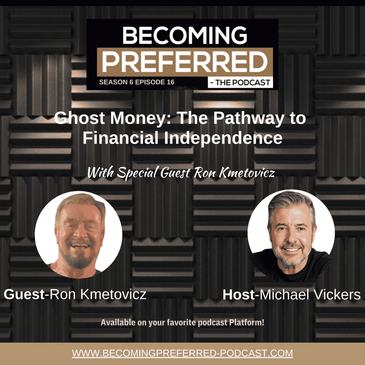
SEASON: 6 EPISODE: 16
Episode Overview:
Welcome to another episode of Becoming Preferred. Today we’re diving into a topic that every entrepreneur and professional eventually grapples with: the difference between building a high-income career and building true, lasting independence.
Our guest today is a master of the systems behind success. Ron Kmetovicz is a seasoned engineer with roots at Hewlett-Packard and Stanford, but he’s also a powerhouse entrepreneur and investor who has spent decades distilling complex financial principles into a blueprint for freedom.
He is the author of Ghost Money: The Pathway to Financial Independence. Today, he’s here to show us how to stop trading time for dollars and start building "Ghost Money"— that invisible, compounding engine that works for you while you sleep. Whether you're looking to scale your first business or you're planning your legacy, Ron’s engineering approach to wealth is exactly what you need to take full control of your financial future. Join me for my conversation with Ron Kmetovicz.
Guest Bio:
Ron Kmetovicz is a seasoned engineer, entrepreneur, investor and financial mentor with a passion for empowering the next generation. Holding a BSEE from The Pennsylvania State University and a MSEE from Santa Clara University, complemented by business training at Hewlett-Packard and Stanford, Ron built a dynamic career at the Ionosphere Research Lab, Goodyear Aerospace, and Hewlett-Packard before launching multiple successful businesses.
A proud husband, father, grandfather, and great-grandfather, he brings decades of real-world experience to Ghost Money: The Pathway to Financial Independence. At 78, Ron remains an avid mountain biker, hiker, and traveler, embodying the energy and independence he inspires in readers. His mission? To guide young people away from waiting for handouts and toward building their own dynamic financial futures.
Resource Links:
- Website: https://ghostmoneythebook.com/
- Product Link: https://ghostmoneythebook.com/
Insight Gold Timestamps:
04:41 I was off to get my engineering degree at Penn State
08:38 You've written a book called Ghost Money and coined the term Ghost Money
09:28 When you build that kind of structure in your life where you're not dependent on a paycheck to paycheck, single revenue stream, you're on your way to financial independence
12:23 Long term investing for me is something I've just personally done for 50 years
17:07 Behavior is the key word
18:51 A couple of failures early on in life are good for you
23:49 It's the exposure to life's circumstance and the ability to see yourself in those circumstance...
24:45 When you grow up in a single revenue stream family you're learning survival tactics
29:18 I think there's a difference between good debt and bad debt
33:19 Health is the foundation, the rest is the enjoyment
36:32 I do believe that there is good money to be made if you know how to do it, and if you're disciplined to do it
40:54 My take on investing is invest in only those things that you understand
44:44 The book is called Ghost Money, the Pathway to Financial Independence
44:55 We've got the website at GhostMoneythebook.com
Connect Socially:
LinkedIn: https://www.linkedin.com/in/ron-k-34218017/
X: https://x.com/GhostMoneyEdu
Email: ron@ghostmoneythebook.com
Sponsors:
Rainmaker LeadGen Platform Demo: https://calendar.summit-learning.com/widget/booking/JKItVP7WErmCBjU2cCIx
Rainmaker Digital Solutions: https://www.rainmakerdigitalsolutions.com/
In 3, 2, 1.
Speaker BWelcome to another episode of Becoming Preferred.
Speaker BToday, we're diving into a topic that every entrepreneur and professional eventually grapples with, the difference between building a high income career and building true, lasting independence.
Speaker BOur guest today is a master of the systems behind success.
Speaker BRon Kimatovic is a seasoned engineer with roots at Hewlett Packard and Stanford, but he's also a powerhouse entrepreneur and investor who has spent decades distilling complex financial principles into a blueprint for freedom.
Speaker BHe is the author of Ghost Money, the Pathway to Financial Independence.
Speaker BToday, he's here to show us how to stop trading time for dollars and start building Ghost money, that invisible compounding engine that works for you while you sleep.
Speaker BWhether you're looking to scale your first business or planning your legacy, Ron's engineering approach to wealth is exactly what you need to take full control of your financial future.
Speaker BJoin me now for my conversation with Ron Kimatovic.
Speaker BWell, hi, Ron.
Speaker BWelcome to the program.
Speaker BWe're delighted to have you.
Speaker CGood to be here, Michael.
Speaker BI'm excited about this.
Speaker BWe're going to be reviewing and talking about some of their insights, strategies and tactics in your book Ghost Money and it's a Pathway to Financial Independence.
Speaker BSo it's a book for teens, young adults, parents, grandparents are on financial education.
Speaker BAnyone wants to learn how to build some wealth.
Speaker BAnd so we got five generations out there that can all use some help.
Speaker BSo I'm really excited about this because I'm one of those generations probably on the top end of it.
Speaker BThey're more joining you, I think.
Speaker BBut for our kids and our grandkids, I think this is going to really give our listeners some great tools and insights that they can take with their families.
Speaker BSo welcome to the program.
Speaker CI've taken a break from our summer that we're having here in Reno, Lake Tahoe.
Speaker CMichael, crazy warm winter thus far.
Speaker CI like to be out there on the snowshoes, on the skis.
Speaker CI'm on my mountain bike.
Speaker BSo no, we're having the same thing.
Speaker BI'm in the Calgary studio up in Canada.
Speaker BWe have Calgary and Phoenix.
Speaker BAnd we were just 4 degrees difference between Florida the other day.
Speaker BAnd yeah, it's kind of nice.
Speaker BIt's, it makes it fun to be able to walk outside.
Speaker BBut again, you enjoy the winter sport, so that makes it a little more challenging.
Speaker BBut Ron, let's go back to you're in high school.
Speaker BI know you had a career in engineering.
Speaker BWe're going to talk about that, how you got there.
Speaker BBut you're back in high school where Are you living, you're deciding what you want to be, what you want to go to school for when you grow up.
Speaker BGive us a little bit of background.
Speaker BOur listeners always like to know where you came from, just the genesis of where you are.
Speaker BLet's go back there and start moving forward.
Speaker CWell, yeah, let's go back to high school.
Speaker CI am in small town Pennsylvania, seven miles out of small town Pennsylvania.
Speaker CI'm a farm boy.
Speaker CI grew up with my grandfather, aunts and uncles on the farm environment.
Speaker CMy dad out of World War II with an electronics background, he got into radio and television.
Speaker CLate forties sales service in a mountainous region of Pennsylvania where there were no TV signals.
Speaker CSo dad, with a little bit of help from some people in Mahanoi City, Pennsylvania and Philadelphia, was a pioneer in the cable TV business.
Speaker CCable systems went in so dad could sell televisions in Pennsylvania.
Speaker CSo I grew up in that environment.
Speaker CI'm a kid that's 10 years old, okay.
Speaker CAnd cable television is around me.
Speaker CAnd engineers from Philadelphia came in.
Speaker CSo I got that.
Speaker COn the other side of the coin, the farm is going on.
Speaker CMy grandfather's farm was not a single entity producer of revenue.
Speaker CHe had sand and gravel, we did logging, we did the truck farming.
Speaker CThere were chickens and eggs.
Speaker CThey did it all.
Speaker CAnd on top of that, he was a general contractor.
Speaker CSo in the small community where I grew up, my grandpa built many of the homes that people lived in there.
Speaker CSo with dad on the electronics side, the other part of the family on the farm side, I grew up in a sea of entrepreneurs.
Speaker CWe were so self sufficient.
Speaker CI didn't know it at the time, but if you needed something, you did it.
Speaker CAnd it was easy for me because I had the exposure to the electrical engineers coming by and my destiny in high school.
Speaker CI graduated high school in 1965. Who likes to think about that?
Speaker CBut I was off to get my engineering degree at Penn State.
Speaker CThat was it.
Speaker CI had no, no question about what I was going to do.
Speaker BOh, that's awesome.
Speaker BAnd then you're.
Speaker BI know you went out to the West Coast.
Speaker BYou know, I remember back in the six.
Speaker BSo I was born in the 60s and I remember watching television, black and white, three channels and television was not much.
Speaker BYou had Ed Sullivan basically, so could watch the Beatles come over and play.
Speaker BThere just wasn't much.
Speaker BWe didn't have cable systems where I grew up.
Speaker BBut I remember getting into electronics and I remember I had an interest in.
Speaker BI had a buddy and we were buying Heath kits.
Speaker BSo if you remember those.
Speaker BOh, I do and that kind of got that started.
Speaker BSo we're learning how to solder down on a board in the 70s and everything.
Speaker BBut when you try to tell people about the technology today, it's really evolved.
Speaker BAll right, so let's fast forward.
Speaker BYou went to work for a major.
Speaker BWhat kind of things did you get to work on?
Speaker CWell, I had a stepping stone.
Speaker CI graduated from college in 69.
Speaker CThe Vietnam era was going on.
Speaker CWhile I was at Penn State, I had the good fortune of working as a research assistant doing ionospheric soundings.
Speaker CIonospher soundings are a version of radar.
Speaker CI so I had a radar background from my undergraduate work.
Speaker CI ended up landing a really good job with a firm called Goodyear Aerospace in Phoenix, Arizona.
Speaker CYou know the place, I had a run of a three year run there working on side looking.
Speaker CRadars are imaging radars.
Speaker CI balance my time between Goodyear, Litchfield park and Edwards Air Force Base.
Speaker CI got to work on the RF4E, the U2, the SR71.
Speaker CSo it was, it was really a great thing.
Speaker CBut at the same time, I'm involved in this military industrial complex.
Speaker CI got really close to the engineers that were out in Silicon Valley.
Speaker CWhen I was out at Edwards, I knew where I wanted to go.
Speaker CI got the job at Hewlett Packard in their R and D organization.
Speaker CI was in heaven.
Speaker CSo I spent three years in aerospace and 17 years with Hewlett Packard in an R and D role.
Speaker CSo what did we work on?
Speaker CWe worked on the Internet.
Speaker CWe worked on gps.
Speaker CMost anything that we're living with today was in its infancy.
Speaker CBack in those days, I knew the people that were making the, the graphical user interfaces on computers.
Speaker CI had the good fortune of working with a space cadet.
Speaker CHis name was Barney Oliver.
Speaker CHe was looking for extraterrestrial intelligence through radio signals with radio telescopes.
Speaker CThere probably wasn't anything in a research development structure that we didn't touch upon in the labs.
Speaker CWe had the resources, we had the instrumentation, and we had the brilliance of the, the engineers coming from all over the country to work there, with the added benefit of continued education at Stanford and other Bay Area schools.
Speaker CIt was just a, just an incredible place to be in the 70s and the 80s.
Speaker CI loved it.
Speaker BYeah, there was a lot of good technology.
Speaker BBut we're going to segue.
Speaker BThat's a good segue to move from that electrical engineering and some of the things you did.
Speaker BWe were talking about Goodyear in Litchfield.
Speaker BI've been out there several times and watching them shoot the chicken guns into Windshields.
Speaker BThey were making windshields for fighter planes.
Speaker BAnd they shoot frozen turkeys and chickens through these long cannons into the windshields to see if they would shatter.
Speaker BAnd so I thought, well, that'd be fun.
Speaker BSo got to do that a few times and pull the trigger.
Speaker BSo lots of fun.
Speaker BBut let's talk about engineering of a different type of.
Speaker BAnd that's engineering around money.
Speaker BAnd because I think it's an engineered solution as well.
Speaker BAnd you've written a book called Ghost Money and coined the term ghost money.
Speaker BSo for our audience of entrepreneurs and business professionals who are used to looking at P and L statements and balance sheets, what is ghost money and why is it the secret sauce to financial independence?
Speaker CWell, the title in entirety is Ghost Money the Pathway to Financial Independence.
Speaker CI define financial independence as multiple revenue streams, minimal debt.
Speaker CThe reason I use the term ghost money, one, well, it might be a little catchy, but when you have multiple revenue streams and minimal debt, those conditions set you apart from other people.
Speaker CYou're a little bit different.
Speaker CThey become your ghost.
Speaker CYou behave differently.
Speaker CYou have a revenue stream or two out there that gives you some freedom.
Speaker CWhen you build that kind of structure in your life where you're not dependent on a paycheck to paycheck, single revenue stream, you're on your way to financial independence.
Speaker CIt doesn't have a number, doesn't have to be a million, half a million.
Speaker CIt has to be sufficient in its value to you to maintain what you like to do.
Speaker CSo multiple revenue streams, minimal debt, that's your ghost money.
Speaker CThat's what keeps you going.
Speaker CAnd what I do with the book is my attempt is to get people that have one revenue stream to two revenue streams.
Speaker CTwo is a very large number if you're living off one.
Speaker CSo ghost Money gives the guidance and the information to go from one revenue stream, a paycheck to paycheck, to two revenue streams in your life.
Speaker COnce you know two, you're likely going to be able to put together three, four, and five.
Speaker CSo it's the stepping stone to multiple revenue streams.
Speaker CMultiple revenue streams are your ghost money.
Speaker BYou have a background and we've talked about in electrical engineering, and you spent lots of time working for some great companies like hp.
Speaker BI think how has that engineering mindset, focusing, which, you know, you focus on systems and efficiency, changed the way you approach wealth building compared to, say, a traditional financial advisor?
Speaker CWell, the wealth building for me is I'm in an environment with Hewlett Packard where we were involved in the business too.
Speaker CIt's not just Engineering.
Speaker CIf you're going to make a product, you're going to try to make a product that's going to do well in the marketplace.
Speaker CThe training that I received was not just technical, it was business.
Speaker CWe had professors from Stanford coming in and working with us on real life problems.
Speaker CSo the MBA aspect of my career was formed through hands on working with business people.
Speaker CI got the best exposure possible doing that.
Speaker CSo I understand business and I understand it reasonably well.
Speaker CAnd I certainly used what I learned when I struck out on my own.
Speaker COn the other side of the coin here, the folks that want to influence you were in my direct presence.
Speaker CSo I learned how to analyze stocks.
Speaker CEarly bottom up numbers, okay.
Speaker CDetailed.
Speaker CWe would build models on stocks that we should invest in and it was a team effort amongst engineers.
Speaker CWe got pretty good at it.
Speaker CSo as a stock picker I developed some skills there.
Speaker COkay.
Speaker CI am not about to tell people how to go out and pick stocks, but I do do significant amount analysis in my own investing work that allows me to pick stocks and be reasonably accurate and long term investing for me is something I've just personally done for 50 years.
Speaker CBut to tell other people no, it's because it's mathematically intensive, it's skill set intensive, it's training intensive.
Speaker CSo when I see things that are going on now in social media about invest here, invest there, do this, do that.
Speaker COkay.
Speaker CIt scares me that I fear that some people are actually going to listen to some of these people and.
Speaker BAnd they do.
Speaker BAnd they.
Speaker CAnd they do.
Speaker CYeah.
Speaker BAnd it's interesting to me you've gone through an education system, so did I.
Speaker BAnd I remember in high school, I remember learning about stocks and I took a class in order to learn it.
Speaker BBack then we looked at a newspaper and you could see it was printed out every day.
Speaker BThey had to print out what the stock was, what the traded was.
Speaker BAnd we're not even talking options, we're just talking stocks and how to track them.
Speaker BI remember buying Disney at $25 a share and doing those types of things when we're going back into the 70s.
Speaker BAnd why don't they teach this in school?
Speaker BLike to me, okay, math and science, we got it.
Speaker BYou've had that English.
Speaker BYeah, that's a fundamental.
Speaker BWe don't teach money or manage money and usually we're taught by people who've never even left school.
Speaker BSo why do you think there's such a. I want to say why isn't it taught?
Speaker BAnd what do you think the issues are there?
Speaker CWell, you made me think Of a fun story.
Speaker CI bought my first share of stock, literally one share, when I was in eighth grade because of my algebra one instructor, Mr. Sheepra.
Speaker CWe pulled about a buck from every class member.
Speaker CI went down to the Berwick bank, where was the only place to buy stocks at the time was at the bank and bought one share of Pennsylvania Railroad.
Speaker COkay.
Speaker CIt was, it was familiar country, but I learned the process.
Speaker CAnd just like you said, we watched the ticker and at the end of the year, we made about 10% on that investment.
Speaker CThat taught Ron a big lesson.
Speaker COkay?
Speaker CBecause mom and dad were, and my grandpa and the family, they were into the bond side of things.
Speaker CThey, they came out of the depression, they were playing it safe.
Speaker COkay?
Speaker CBonds were good, stocks were bad.
Speaker COkay.
Speaker CBut I knew the returns that they were getting on their bonds in high school.
Speaker CAnd I saw this 10% come from Pennsylvania Railroad.
Speaker CI said, ah, okay, this is something to keep an eye on when you get some money.
Speaker CAnd so, so that came a couple of years later.
Speaker CBut then I got into stocks.
Speaker CNow to answ why this is not taught.
Speaker CRole models, mentors.
Speaker CIn my eighth grade, it's junior high school, there was one person in the teaching staff that knew about stocks and bonds who taught the kids.
Speaker CI never heard about them from any other instructor in school.
Speaker CWhen I got to high school, it was never mentioned.
Speaker CSo it's the mentorship, it's the skill set of the people that you're growing up with in the educational environment or in life, life's environment, that makes the difference for the young folks.
Speaker CMy kids and grandkids grew up with me, so they had that, they had the role model, they have the mentor through ghost money.
Speaker CI'm attempting to get this role model mentorship out there in a little 100 page book so that somebody doesn't have it.
Speaker CCould look at this thing, read the stories that are in it, no math, just, just get into it a little bit and, and see a pathway to their second revenue stream after they get their first job.
Speaker BWell, it makes sense.
Speaker BAnd like I say, they're not taught.
Speaker BAnd I have always thought it was, hey, we were training factory workers.
Speaker BOur education system was designed to create factory workers.
Speaker BNumber two pencil, fill it out.
Speaker BCame out of the Soviet Union way back when, as far as our model goes.
Speaker BAnd then we need employees, we need factory workers.
Speaker BAnd the person up at the front is the factory leader.
Speaker BAnd we just keep cranking out workers and people.
Speaker BWe look at America and we look at the people with retirement.
Speaker BI saw one stat, the average retired person only has $75,000 in their account in their retired income, like 70% of the country, which is just how are they surviving?
Speaker BHow are they living?
Speaker BLike it's paycheck to paycheck and it's there.
Speaker BIt's a learned thing.
Speaker BAnd when you're teaching these younger generations, and one thing I love about your mission is it's about empowering the next generation to break free from dependency.
Speaker BSo in a world of instant gratification, what's the first mental shift that a young professional needs to build lasting wealth?
Speaker CBehavior is the key word.
Speaker CI look at the spirituality, the religious side of things, okay, the seven deadly sins.
Speaker CYou can't do any of them, and a lot of people do one or more of them.
Speaker CIf you want a financially independent life, behavior is going to set the tone for you.
Speaker CSo the first chapter I talk about is the behaviors to abandon, and it's based on the seven deadly sins.
Speaker CThen you go to the behaviors to adopt.
Speaker CThat gets really good if people can adopt them.
Speaker CThis is where lining up with a role model, with a mentor, high school kids that I talk to, I really encourage trial and error.
Speaker CGet a job.
Speaker CTry it.
Speaker COkay?
Speaker CYou'll learn things you don't like.
Speaker CGet the second job.
Speaker CTry it.
Speaker CYou'll learn things you don't like.
Speaker CYou bounce around a little bit between the ages of 16 and 18 with mom and dad for you because you're not out there all alone and learning there's a safety net in place.
Speaker CThen, okay, by the time you've been beat up a little bit in employment in high school, you've got a much better calling for what you're going to do post high school.
Speaker CWill you line up with a job that you've picked up in high school with a mentor that's really going to take you places?
Speaker CWill you go to trade school because you found something you really enjoy?
Speaker COr will it be a college or some type of professional pursuit that you get into?
Speaker CBut it all comes from the exposure to failure.
Speaker CA couple of failures early on in life are good for you.
Speaker CThen you learn what you need to do.
Speaker CYou enhance your skill set.
Speaker CThat becomes the behaviors to adopt.
Speaker CPart of what I like to talk about.
Speaker CYou're on your way.
Speaker CThen you have your career.
Speaker CYou start making money.
Speaker CYou're living paycheck to paycheck on that one start.
Speaker CThen you start taking 10, 15, 20, 30% of that paycheck.
Speaker CAnd every month you start putting it into what I call the ghost account.
Speaker CAnd you're building your second revenue stream.
Speaker CWhen you Start doing that.
Speaker CThat can be done in high school with kids.
Speaker CI have a number of them that leave high school with pretty nice chunk of change by the time they're out of high school because they're investing every month.
Speaker COkay.
Speaker CThey're taking 20% of their paycheck.
Speaker COkay.
Speaker CAnd making $10,000 in high school these days is pretty easy.
Speaker CAnd.
Speaker CAnd if you do that for two years, you got 20 to 30,000 by the time you graduate from high school.
Speaker BBuy a house, down payment on a home.
Speaker CYeah, all kinds of things.
Speaker BAnd I appreciate the insight where you were saying about starting early and failing early.
Speaker BI remember my daughter, actually, when she was 16, she went to work for a grocery, Safeway.
Speaker BMost people know Safeway, so national chain.
Speaker BAnd she was making ten dollars an hour.
Speaker BAnd their workforce was unionized.
Speaker BAnd so ten bucks an hour.
Speaker BAnd one day I was having a conversation with her, and she was cashier, just checking out groceries.
Speaker BGreat.
Speaker BShe's working.
Speaker BAnd she came to me at the end of that summer, and she said, I am going to college.
Speaker BI want to go to college.
Speaker BAnd I said, oh, what prompted that?
Speaker BLike, we were glad to hear that.
Speaker BAs a dad, you want to hear that?
Speaker BAnd she said, dad, there's women who have been here for 10 and 15 years, and one was even 20 years, and they make just $1 more an hour than I do.
Speaker CYep.
Speaker BAnd she.
Speaker BThat was it.
Speaker BI didn't even have to say anything.
Speaker BSo as a parent, it was perfect because she got the work experience and went.
Speaker BShe did the math and went, hey, this doesn't end anywhere good.
Speaker BAnd we have to do something.
Speaker BAnd I think part of the problem is most people, they want to look at what's right in front of them.
Speaker BThey can only see this weekend.
Speaker BThey can only see, hey, I want that car.
Speaker BWhen you're a teenager, where's my first car?
Speaker BHow's that going to go?
Speaker BAnd with our kids, we always said, hey, you earn half, we'll give you the other half.
Speaker BBut you got to have half.
Speaker BAnd if you want a $5,000 car, come up with 2500 if you want a 3000.
Speaker BAnd we had, you know, one bought a $3,000 car, she only coughed up 1500 bucks.
Speaker BShe got a junker compared to one that somebody was saving a little more for.
Speaker BSo we taught them to do that and put away the money so they could understand it.
Speaker BNow they all have a good, healthy sense of dollars.
Speaker BBut our system doesn't create that.
Speaker BIt's not built that way.
Speaker BWe don't most of the parents don't know either.
Speaker BThat's why we use financial planners that would go from that one.
Speaker AAre you tired of chasing leads and ready to start effortlessly attracting clients?
Speaker AIntroducing Rainmaker Lead Gen the ultimate sales, engagement and client acquisition platform that takes the stress out of outreach.
Speaker AWith Rainmaker Lead Gen, you can easily identify, engage, educate and convert your ideal prospects into loyal clients.
Speaker AOur industry leading automation and email sequencing empowers you to reach more ideal clients, accelerate the sales cycle and close more business.
Speaker AImagine authentically engaging with your prospects while the platform handles the heavy lifting.
Speaker ASay goodbye to the endless hustle and embrace a more efficient, effective approach to business development.
Speaker AReady to witness the magic?
Speaker ABook a 20 minute demo today and see how Rainmaker Lead Gen can revolutionize and level up your client acquisition game.
Speaker AThere's nothing to lose and everything to gain.
Speaker ADon't miss out on this opportunity to supercharge your client acquisition process.
Speaker AVisit rainmakerdigitalsolutions.com or check out the link in the show notes to book your demo.
Speaker ARainmaker Lead Gen Spend less time hunting for your ideal clients and more time having high value sales conversations with your ideal clients.
Speaker BAnd now back to my conversation with Ron Khemitovic.
Speaker BYou know, one truth stands out when you talk about making money is wealth starts with income and most of us begin at 00 with nothing.
Speaker BWe don't have anything, no trust funds.
Speaker BWe don't have silver spoons in our mouths.
Speaker BAnd what have you seen the difference between those who've made it versus those who maybe were born with silver spoons?
Speaker BYou've seen both.
Speaker BWhat's been your assessment of that when you look back at it?
Speaker CWell, the silver spoon crowd in my life has been very small.
Speaker CI know a couple of people that money came their way while they were very young, but it's far and few between.
Speaker CMost folks that I know started with modest means but comfortable.
Speaker CI came from an environment of people being financially comfortable but not wealthy.
Speaker CSo the key difference, and I think you spelled it out with your daughter, it's the exposure to life's circumstance and the ability to see yourself in those circumstance to make adjustments in what you personally need to do to rise above to achieve the objectives that you want.
Speaker CSo it's the exposure and the support.
Speaker CIf you come from the folks that have the support, then you're on your way.
Speaker CSo what I would say, Michael, in the I wouldn't call it the silver spoon, but I certainly had I know a number of other people who have had the family structure and the network and the Role models and the mentorship as kids to be successful.
Speaker CAnd there are a number of folks out there now who don't have that.
Speaker CWhen you grow up in a single revenue stream family, you're learning survival tactics.
Speaker CYou're not learning strategy on how to develop your life and your financial future.
Speaker CSo getting in there, showing people the alternate path to build their own structure and their own way of achieving financial independence is what I'm trying to do.
Speaker CIf you're trapped where you don't have the role models, you don't have the mentorship, there's at least one book out there that might show you a little
Speaker Bbit of light and an easy read.
Speaker BEasy read too well.
Speaker BAnd you talk about the behavior when it comes to money.
Speaker BYou talk about money in the book doesn't care about your fame.
Speaker BIt doesn't care about your talent, doesn't care about your good intentions.
Speaker BIt amplifies what your choices are so it doesn't vanish due to bad markets or dumb luck.
Speaker BAs you say, it often disappears because of poor behavior.
Speaker BSo in the book, you identify seven behaviors that people should avoid for achieving financial independence.
Speaker BCan you unpack that and share a couple of those with us?
Speaker CWell, let's.
Speaker CLet's start with.
Speaker CWe're talking about youth today.
Speaker CThe one I see most of the behaviors to avoid is the one of pride.
Speaker CPride is a.
Speaker CIt's a real killer of folks that are consumed by it.
Speaker CAnd what's part of that pride thing is you think you know it all.
Speaker CAnd who that's young doesn't know it all.
Speaker COkay.
Speaker CIt's almost like the.
Speaker CThe killer of the goose that lays the golden egg.
Speaker CBut on the other side of the coin, you can develop some humility when you're young.
Speaker CYou can start to look at situations and try to see the other side so that you can more or less work through the truth.
Speaker CThe story about your daughter with someone that sees somebody working for just a dollar more an hour.
Speaker CHer pride didn't get in the way of that.
Speaker CShe saw the situation for what was real.
Speaker CMy grandson, when he went to work part time at ups, came home with the slogan of I have to be smarter than the box.
Speaker CAnd that gave him the incentive to learn how to 3D model the environment of the boxes and the trucks that he was loading the boxes into to optimize.
Speaker CSo it became a challenge.
Speaker CHe let the challenge of the job overcome the paycheck and whatever else could have worked him his way through the environment that he was in.
Speaker CSo he made challenge out of it.
Speaker CSo pride Was swept out of the way.
Speaker CPeople get sucked up in that one.
Speaker CSo boom.
Speaker COkay, so I'll leave pride now.
Speaker COkay.
Speaker CI got a feedback from a co worker.
Speaker CIt was funny.
Speaker CHe said, I have a nephew that's consumed by lust, gluttony and envy.
Speaker CWell, how is that kid going to.
Speaker CHe's 30 years old, by the way, is what I was told.
Speaker COkay, so here you go.
Speaker COkay.
Speaker CIf you're into those three kinds of things and you're living at home with mom and dad, you're not going to make it.
Speaker CYou're not going to achieve financial, financial independence.
Speaker CSo there's a couple of examples there of what I mean by behaviors to abandon.
Speaker COkay.
Speaker CYou aband in these things, they gotta go.
Speaker BYeah.
Speaker BOur organization, we work with marketing and sales, so we're trying to teach our clients and they want to sell things better, but our whole society is consumer driven and they're bombarded.
Speaker BThey got to have this, they got to have this kind of this.
Speaker BAnd with social media, of course, that's amplified that.
Speaker BAnd so we got a lot of people who just, they want more, quicker, they want shortcuts.
Speaker BThey're looking for shortcuts.
Speaker BLike I was reading one stat that if you build houses, for every five people who leave the homebuilding business, just one signs up.
Speaker BThey all try.
Speaker BAnd five of our kids don't even work in the area that they got their degrees in.
Speaker BThey work in different areas.
Speaker BIt was kind of like the new high school diploma.
Speaker BBut it's a matter of learning and they have to learn.
Speaker BAnd we tend to spend more than we make.
Speaker BSo you earn a hundred 'Thousand a year, 50,000 a year, you're spending 60, you earn 100, you're spending 110.
Speaker BAnd I think putting those disciplines in place where you pay yourself first and then, like you said, talk about debt and reduce debt.
Speaker BLet's talk about debt because I think there's a difference between good debt and bad debt.
Speaker COh, absolutely.
Speaker BLet's talk about those.
Speaker BWhat makes debt good and what makes debt bad?
Speaker CWell, yeah, good debt is if you borrow money to buy an appreciating asset.
Speaker CThat's good debt.
Speaker CIf you borrow money to buy a depreciating asset, you've made one heck of a big mistake.
Speaker CSo debt for appreciating assets, positive.
Speaker CDebt for depreciating assets, negative.
Speaker CSo the most common that you find in this structure is the depreciating asset.
Speaker CApparel, cars, consumables.
Speaker CAnd consumables, in my view, is the trip to Starbucks to get the five buck cup of coffee or something like that, that's a depreciating expense.
Speaker COkay.
Speaker BAnd if you borrow money, the latest Android or iPhone.
Speaker CYeah.
Speaker CStill works great.
Speaker BYeah.
Speaker CAnd if you put that on the credit card, okay, big mistake.
Speaker COkay.
Speaker CIf you shop ebay and pick up your next cell phone for 75 or 100 bucks, okay.
Speaker CThat's more or less working.
Speaker CYou quite likely bought an appreciating asset because you'll not only have your cell phone that will serve you well for a year or two, but when it comes time to sell it, you might be able to, to sell it for the same amount of money you paid for it because you bought low and you'll sell low.
Speaker CNo big deal.
Speaker CBut on the appreciating side of things, well, that's the beauty of home ownership.
Speaker CHomes tend to be appreciating assets.
Speaker CSo you can afford to take out a loan and put that money into an appreciating asset.
Speaker CBut on the other side of the coin, okay, there was talk of somebody putting 50 year old loans.
Speaker COkay.
Speaker COn.
Speaker COkay.
Speaker CThat's not the right answer.
Speaker BWell, and I've been guilty of this one.
Speaker BI've learned.
Speaker BBut it took me a while.
Speaker BI buy a car and I wanted that car that you go, whoa, that car, that guy's doing.
Speaker BWell, it was all image oriented.
Speaker BAnd then that car loses 70% of its value over the next five years.
Speaker BWhat I've spent on vehicles, I'm going where the people who bought those used vehicles, drove them for a year or two and sold them for what they paid for them, or close to it to your point, and didn't have to carry a bunch of debt with it and had money for other things that are more important for them.
Speaker CWell, we'll second that, Michael, because I bought one new car in my life.
Speaker CAll my other cars have been used.
Speaker CSo the, the cost of ownership for automobiles these days for me has been pretty low.
Speaker CAnd it's been low through my life.
Speaker CThe other world that we're talking about, autos, but I, I, I entered the world of the electronic car probably five, six years ago, and I'm making money on my cars.
Speaker CI buy used, buy a used Tesla.
Speaker CIt's hard to lose money.
Speaker CYeah, it really is.
Speaker CYou can make a couple of bucks, so.
Speaker BAnd we always want that latest thing.
Speaker BAnd we see that from a social point.
Speaker CYeah.
Speaker BAs well.
Speaker BI want to talk about just your mountain biker philosophy.
Speaker BAnd you're 78, and the only reason I bring up your age is you're still an avid mountain biker and hiker how does physical health and energy management play into your financial mentoring?
Speaker CMy physical being is my driver to do what I do and to stay well.
Speaker CIf I didn't have my physical structure in place, my life, for me, it would probably be close to the end.
Speaker CThat's number one priority with my wife and I right now is take care of our health.
Speaker CSo I'm on a program.
Speaker CI do cardio one day a week.
Speaker CI do weights the other day, alternating.
Speaker CSometimes I take Sunday off.
Speaker CMost times I don't.
Speaker CBut the whole structure of staying healthy to live life is health is the foundation.
Speaker CThe rest is the enjoyment.
Speaker CSo we work on it actively.
Speaker CThe.
Speaker CThe part of writing the book is a part of that structure as well.
Speaker CWe've been around long enough to enjoy the company of our kids and grandkids, and we're really motivated to make it with the.
Speaker CWith the great grandkids too.
Speaker COkay.
Speaker CWe want to be around.
Speaker CSo health is the bedrock.
Speaker CI do the mountain biking, the outdoor activities.
Speaker CIt's a product of a lifetime.
Speaker CI would not, at 78, be able to hop on a mountain bike if I hadn't mountain biked before.
Speaker COkay.
Speaker CNot the kind of things we do.
Speaker CWe do some pretty serious stuff.
Speaker CAnd I have a mountain bike group called the E. Geezers.
Speaker CIt's the E. Geyser Mountain Bike Club.
Speaker BSure.
Speaker CBut we're all of similar age, similar skill sets, and we go out and we're having a good time.
Speaker CSo it's a part of life.
Speaker BWell, it makes sense.
Speaker BI've talked to many billionaires, and I've seen panels where, you know, T. Booms Pickens, Warren Buffett, they're all.
Speaker BAnd they would all trade every dime they had for their health.
Speaker BBecause if you made a bunch of money, but your health is gone.
Speaker BYou missed the whole point.
Speaker BBut they would trade everything for good health.
Speaker BAnd just because if you're sick or you can't do those types because money, we use money, we use things.
Speaker BNone of this is going with us.
Speaker BRight.
Speaker BWhatever your belief is or philosophy you follow, none of it's coming to me.
Speaker BWe borrow it.
Speaker BSo what is it adding to my life?
Speaker BIs it taken away?
Speaker BIs it.
Speaker BIs something that's gonna.
Speaker BCan I do it without.
Speaker BAnd we don't need as much as we think we need.
Speaker BMy wife and I started, oh.
Speaker BA decade ago working on more of an essential.
Speaker BWhat's essential that we need?
Speaker BBecause we had far more than we needed.
Speaker BAnd it was, do we need four cars with just the two of us?
Speaker BDo I need two motorcycles?
Speaker BDo I Need an airplane?
Speaker BDo I need a motor?
Speaker BDo I need a boat?
Speaker BSea.
Speaker BDo you know all the toys that most people.
Speaker BOh, yes, you can't have all these toys.
Speaker BAnd once we started unloading all of those things and then just focusing on the things that were really important, the overhead came down, the obligations came down, the commitments came down.
Speaker BMore time, more freedom became available for me to do exactly what I wanted when I wanted to do it.
Speaker BAnd we still want to be, you know, quote, successful, but not at the expense of that.
Speaker BAnd to me, because it can all be gone just like that.
Speaker BWe talked prior to the show.
Speaker BStarting in the pandemic, things happen, markets collapse, things go wrong.
Speaker BAnd when you learn it now, do you talk about that in your book at all?
Speaker CWhere.
Speaker BSo, for instance, when the market went down in 070809 and we had that issue, well, I went all in when everything was on sale, when everything was really cheap, I believed in the companies.
Speaker BI had a list of them.
Speaker BI bought Apple at $58.
Speaker BRight.
Speaker BI sold it at 144, thinking I'm the genius three, four months later, but it went to 700 and split seven times.
Speaker BSo I'm not that smart.
Speaker BBut do you.
Speaker BDo you cover any of that in the book as far as taking advantage of opportunity, like Warren Buffett says?
Speaker BI think it's Warren.
Speaker BHe says, when the blood is running in the streets, when the market's fearful, be greedy.
Speaker BWhen the market's greedy, be fearful.
Speaker BWhat's your take on that, Michael?
Speaker CI do not.
Speaker COkay.
Speaker CI do not take on the topic of market timing.
Speaker CHowever, I do believe that there is good money to be made if you know how to do it and if you're disciplined, to do it.
Speaker CSo I'm not disagreeing with your approach.
Speaker CWhere I have difficulty is most folks do not have the skill sets to identify a good deal that they should buy.
Speaker CIt's tough for most people out there.
Speaker CSo what I do with Ghost Money in its business base essence is I advise or recommend that folks work with time tested mutual funds.
Speaker CI outlined 10 of them in the book.
Speaker CI just did the research with AI to get the list.
Speaker CThere's one that's been around since 1929.
Speaker CIt's the Vanguard Wellington.
Speaker CIt pays almost 9%.
Speaker COkay.
Speaker CI recommend for people who don't have the training to be stock people, to be bond people, that they just find a mutual fund that's been around for a long time that pays in the vicinity of 10%, which is a really good return.
Speaker CIt's a really Good return and keep putting money into it every month after month.
Speaker CJust keep putting it in.
Speaker CI've played both sides of the, of the fence where I do my own stock picking and my stock picking over my lifetime.
Speaker CI started in my 20s and I have a lifetime average now that's running around a little over 15% on my stock picking returns.
Speaker CSo that's a good number.
Speaker BYeah.
Speaker COkay.
Speaker CBut to do what I do, people don't want to do what I do.
Speaker CI do a lot of analysis.
Speaker CI spend a lot of time with the numbers.
Speaker CIt's a hobby for me that I enjoy doing.
Speaker CSo I get good returns.
Speaker CIf I were a financial advisor, could I tell other people how to make these returns?
Speaker CProbably not.
Speaker COkay.
Speaker CBecause I have a risk tolerance that I understand.
Speaker COther people likely don't have the risk tolerance that I have.
Speaker COkay.
Speaker CI know if I bought something that's a value and the markets go down, I'm not going to sell it.
Speaker CI'm going to wait until it comes back.
Speaker CBut most folks can't do that.
Speaker CSo I strongly encourage people to buy quality, balanced mutual funds that pay about 10%.
Speaker CDo your research on it, personal or with any advisor you work with.
Speaker CFind the ones that work for you and keep putting in 10, 15, 20, 25% of your monthly income into these funds.
Speaker C15, 20 years later, you're going to have a nice second revenue stream and you're going to have a relatively large revenue stream in the process.
Speaker BYeah, no, I think you're bang on.
Speaker BAnd people don't realize that by putting away.
Speaker BIt's like compounding.
Speaker BI've talked to my own kids when they put away at age 21 and put away $3,000 a year and a retirement fund or an IRA or an RSP or whatever.
Speaker BAnd over time, the power of compounding.
Speaker BBut they see $3,000 in year one and then in year two they see 32, 3, $300 and then.
Speaker BAnd it's that continuous.
Speaker BAnd you talk about this in the book and you illustrate, just wait.
Speaker BEven what the power of doubling does.
Speaker CDoubling?
Speaker CYes.
Speaker BYeah.
Speaker BIt becomes.
Speaker BIt's magic and it is magic and it works like magic.
Speaker BBut by the time you're 60, you're going to be a millionaire.
Speaker BYou're going to, if you do just that little bit consistently or that 30, 40 year run.
Speaker BBut people, they want that instant gratification.
Speaker BAnd we talk, like you said, it's probably one of those seven sins.
Speaker BLike we've all been guilty of those things.
Speaker BWe gotta eat at this restaurant.
Speaker BPeople see us in this Vehicle, I need that toy and take care of it.
Speaker BLet's talk about things where they make some mistakes as well.
Speaker BWe see memes, stock memes.
Speaker BLike I remember Gamestop was going up.
Speaker BA lot of the kids are putting their money in that because it's get rich quick or Bitcoin.
Speaker BAnd just in the last month or two, we've seen Bitcoin go from $100,000 into the low 60s.
Speaker BSo it's tanked.
Speaker BAnd again, those things always scared me because there's no value there.
Speaker BI was a value investor.
Speaker BMeaning can I cash this in for something like is it worth something versus whatever it is?
Speaker BWhat's your take on that?
Speaker CWell, my take first off, my take on investing is invest in only those things that you understand.
Speaker CSo if you don't understand it, for crying out loud, don't put any of your hard earned money into it.
Speaker CNow when it comes to the crypto world and what's going on out there, I have really made some honest effort to try to understand the value associated with any of the crypto pieces.
Speaker CI have yet after, I'd say I've been looking at it.
Speaker CHow long has this stuff been around?
Speaker CA decade?
Speaker CI have yet to find any value.
Speaker CAll I see is people paying the price that the market will bear.
Speaker CAnd that's not value.
Speaker CThere's no value there.
Speaker CSo yeah, yeah, so.
Speaker CSo it's a market driven entity subject to the whims of manipulators.
Speaker CAnd I do think that they're out there working the, the little guy to, to siphon some cash into their pockets.
Speaker CSo I don't see it.
Speaker CAnd 78 years old, I still don't see it.
Speaker CAnd I stay away.
Speaker BI'm okay missing that bus.
Speaker BThat train can go without me.
Speaker BAnd I'm fine with it.
Speaker CIt's fine.
Speaker BYeah, it's that old get rich quick.
Speaker BI picked stocks and had them do extremely well.
Speaker BIf anything, I sell too soon.
Speaker BAnd in my world, like I always make my pride, I'm so proud of myself.
Speaker BAnd then the thing shoots up, up goes nuts.
Speaker BSo I'm a good picker.
Speaker BI just held on to everything.
Speaker BIt's a different story.
Speaker BRon, our last question for you.
Speaker BWe want our listeners to always try and take action.
Speaker BIf there's someone who's listening right now that feels overwhelmed by their finances and where they are, what is one thing that they should do in the next 24 hours, 48 hours to start their journey towards ghost money.
Speaker CI call it a ghost account.
Speaker CTake some seed money, come buy it with.
Speaker CIf it's your own.
Speaker CGet some help.
Speaker CIf you need to, go to a discount broker, Schwab, Fidelity, Vanguard.
Speaker COpen up this ghost account.
Speaker CPick a quality mutual fund, one one of the 10 that's listed.
Speaker CDo your own little research on it.
Speaker CStart putting what you make, 10 to 20 to 30% of what you make into that fund every month.
Speaker CConsistency.
Speaker CYeah, that's it.
Speaker CIt's a simple recipe.
Speaker CDon't touch it unless you have to.
Speaker CIt's there if you need it for an emergency basis.
Speaker COkay, you got something there now, okay, leave it alone.
Speaker CWait a decade or two and you're going to be well on your way with a multiple revenue stream that can support you through life.
Speaker BWell, it's getting that ghost working for you.
Speaker BAnd I know you talk about conducting a leak audit.
Speaker BMost people don't really have income problems.
Speaker BThey have a leak problem.
Speaker BSo it's finding that recurring expense or habit that's draining that account and then moving and redirecting.
Speaker BIt's like you talked about.
Speaker BStarbucks.
Speaker BYeah, I go to Starbucks.
Speaker BAnd every time I go or take a granddaughter or something, it's 15, $20.
Speaker CAnd.
Speaker CYep.
Speaker BAnd you do that on a weekly basis.
Speaker BThere's a hundred dollars and there's people where.
Speaker BPut that, make your coffee at home, take that.
Speaker BMaybe go out once in a while or get rid of the morning one and take the afternoon one or vice versa.
Speaker BSo it's really looking at where you're spending subscriptions.
Speaker BNetflix.
Speaker BLook at all your.
Speaker BWhat are you paying for?
Speaker BWhat can you get free?
Speaker BHow many subscriptions are you paying for?
Speaker BTake a look at those expenses and go, do I need this?
Speaker BDo I want this?
Speaker BIs it just leaking $?
Speaker BAnd we're all guilty.
Speaker BGuilty of that I find every year I go through, I call it the Spring Clean Financial Sprinkling.
Speaker BI look at everything I've been writing checks for or being charged for and go, have I used this?
Speaker BDo I need this?
Speaker BAm I going to be using it?
Speaker BAnd if not, it's gone.
Speaker BBecause I can usually reset subscribe if I need it.
Speaker BAnd every, every time I do it, there's hundreds and sometimes thousands of dollars that are saved that can be used and allocated for something else.
Speaker BSo.
Speaker BWell, the book is called Ghost Money the Pathway to Financial Independence.
Speaker BSo it's a book for teens, young adults, parents, grandparents on financial education and wealth building.
Speaker BSo what's the best way to find the book?
Speaker BWe've got the website at ghost money the book.com and they can go and obtain it.
Speaker CThere's.
Speaker BAnd I guess they can communicate with you at that website too as well.
Speaker CYes they can.
Speaker CAnd I encourage.
Speaker CI don't travel far from home, but to folks that are within about 100, 150 miles of Reno Lake Tahoe.
Speaker CIf they want me to show up at a at a function that they've organized to talk about finances for the youngsters, I'd be happy to do that so that that's part of it and I'm easy to find on my website.
Speaker BSo yeah, no good way to do it.
Speaker BRon, this has been illuminating.
Speaker BThank you so much.
Speaker BGlad to see you're still at it and still active and still staying relevant in today's world.
Speaker BAnd I think that's.
Speaker BWell, thanks for being our guest today and sharing your insights.
Speaker CWell, I like staying relevant and I've got to do my damnedest to to stay there too.
Speaker BPerfect.
Speaker BWell, glad you are and glad you will.
Speaker CThanks Michael.
Speaker BAs you are listening to this episode, what is one idea that you've heard that has caught your attention and why does it matter so much to you?
Speaker BAnd who is one person who you can share that with, either sharing this episode or just sharing that insight that occurred to you while you were listening?
Speaker BPerhaps it is shifting from being a technician to an architect of your business so that you can stop trading your time for money and start building invisible ghost money engines that generate wealth independently of your daily effort.
Speaker BOr maybe treating your financial life like an engineered circuit where you intentionally minimize the resistance of unnecessary debt and taxes to maximize the current of your cash flow.
Speaker BThank you for listening, for learning, and for investing in yourself so that you can become the best version of you.
Speaker BIf you found value in this episode, please write a review on Apple Podcasts.
Speaker BIf you haven't subscribed yet, please do so so you can get a new episode and start your week off right every Monday.
Speaker BUntil next time.
Speaker BThis podcast is created and associated with Summit Media.
Speaker BMy Executive producer is Beth Smith and Director of Research, Tori Smith.
Speaker BThe fee for the show is that you share it with friends when you find something useful or interesting.
Speaker BThis podcast is subject to copyright by Summit Media.
Speaker CGoodbye.