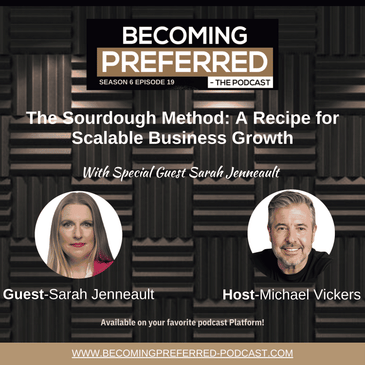
SEASON: 6 EPISODE: 19
Episode Overview:
Welcome back to Becoming Preferred, the podcast where we talk to the business professionals who are preferred in the markets they serve. Today, we are diving into the intersection of high-stakes strategy and operational discipline.
Our guest today is a literal 'Top 10' leader. Sarah Jeanneault is the VP of Marketing at ProcedureFlow and a veteran of the fintech and technology worlds. With over 20 years of experience—including leading multi-billion dollar asset growth and successfully exiting two fintech ventures—Sarah knows exactly what it takes to scale a business without losing the customer experience.
But here is why you need to listen closely today: Sarah is an expert at solving the 'knowledge gap.' In an era where everyone is chasing AI, Sarah advocates for a 'knowledge-first' strategy. She helps organizations in the most complex, regulated industries—like finance and healthcare—turn messy, unstructured data into visual, repeatable success.
Whether you’re an entrepreneur looking to build an exit-ready engine or a professional aiming to stay relevant in the age of AI, this episode is your blueprint. Join me for my conversation with Sarah Jenneault.
Guest Bio:
Sarah Jenneault is a seasoned executive leader with over two decades of experience driving scalable growth platforms and operating models within highly regulated industries, such as finance and healthcare. She has partnered closely with leadership to align go-to-market strategies, technology, and customer operations, directly supporting multi-billion-dollar AUM growth. A former educator with a Master’s in Education, Sarah uniquely applies teaching skills to change management, helping organizations navigate the "creative constraints" of regulation to move from being a commodity to a preferred brand.
Throughout her career, Sarah has overseen end-to-end commercial operations, building cross-functional teams and managing multi-million-dollar budgets to scale efficiently without sacrificing customer experience. Her approach centers on building "durable operating systems" and integrated growth engines that connect data, digital modernization, and customer insights. Having successfully exited two fintech ventures, she emphasizes that structured knowledge is an essential "operational layer" that significantly increases enterprise value during an acquisition.
Currently, Sarah focuses on helping organizations move toward a "knowledge-first" AI strategy to overcome the hurdles of unstructured data. At ProcedureFlow, she advocates for converting complex, text-heavy processes into easy-to-follow visual guides, which allows companies to onboard new hires in days rather than months. By treating internal knowledge management like the essential "backbone" of a company, Sarah helps businesses achieve optimal, repeatable outcomes and sustained revenue growth.
Resource Links:
- Website: https://procedureflow.com/
- Product Link: https://procedureflow.com/industries/contact-center
Insight Gold Timestamps:
04:08 It's our job as leaders to facilitate that conversation in a room
07:26 We want our B2B customers to be set up for success
08:25 Everybody thinks right now that AI is going to solve everything
10:23 I'm very pro AI, there's a lot of really great success stories out there
13:10 Think about, what do you really want AI to do for you
15:04 We naturally read in an F pattern
18:25 You have multiple generations of people working in organizations who all have organized their information in very different ways
22:43 Every entrepreneur should be working with the idea that you want to exit
25:39 I do love sourdough and also, I am a little obsessed with just making it better and better
31:00 Wherever you are in your journey, it's okay
33:54 It's not something I ever realized I really needed, but it is making such a critical difference
34:52 If we move too fast, too hard, AI starts hallucinating, it starts making things up
Connect Socially:
LinkedIn: https://www.linkedin.com/in/iam-sarah-potter/?originalSubdomain=ca
LinkedIn Business: https://www.linkedin.com/company/procedureflow/
Facebook: https://www.facebook.com/procedureflow
YouTube: https://www.youtube.com/channel/UCUXqqLeUImuk3jJ9tKc3nzw
Email: sarah.jeanneault@procedureflow.com
Sponsors:
Rainmaker LeadGen Platform Demo: https://calendar.summit-learning.com/widget/booking/JKItVP7WErmCBjU2cCIx
Rainmaker Digital Solutions: https://www.rainmakerdigitalsolutions.com/
In 3, 2, 1.
Speaker BWelcome back to Becoming Preferred, the podcast where we talk to the business professionals who are preferred in the markets they serve.
Speaker BToday we're diving into the intersection of high stakes strategy and operational discipline.
Speaker BOur guest today is a literal top 10 leader.
Speaker BSarah Genone is the VP of marketing at Procedure Flow and a veteran of the fintech and technology Worlds.
Speaker BWith over 20 years of experience including leading multi billion dollar ass growth and successfully exiting two fintech ventures, Sarah knows exactly what it takes to scale a business without losing the customer experience.
Speaker BBut here's why you need to listen closely.
Speaker BToday, Sarah is an expert at solving the knowledge gap.
Speaker BIn an era where everyone is chasing AI, Sarah advocates for a knowledge first strategy.
Speaker BShe helps organizations in the most complex regulated industries like finance and healthcare turn messy, unstructured data into visual, repeatable success.
Speaker BWhether you're an entrepreneur looking to build an exit ready engine or a professional aiming to stay relevant in the age of AI, this episode is your blueprint.
Speaker BJoin me now for my conversation with Sarah Genot.
Speaker BWell, hi Sarah, welcome to the program.
Speaker BWe're delighted to have you.
Speaker AThanks for having me.
Speaker BNow, where are we speaking to you from today?
Speaker AI am from Blue Mountains, which should be lovely and sunny, but it's a little on the rainy side today.
Speaker AI guess spring is coming way up
Speaker Bthere in Northern Ontario and get a chance to go there many times over the year.
Speaker BGreat conference area, but it's a beautiful part of town.
Speaker BGreat ski.
Speaker BYou must be a skier.
Speaker AI am a skier.
Speaker AI definitely live up here because I love the outdoors so much.
Speaker BWell, you're only 10 minutes from the slope, so if that.
Speaker BSo it's a beautiful place if you haven't found it.
Speaker BWell, Sarah, I'm really excited about our conversation today.
Speaker BYou've got lots of experience, you've got over two decades of working in corporate America, if you will.
Speaker BAnd we're going to talk about processes, we're going to talk about brand and product and positioning and how to grow and how to scale businesses and, and so I'm excited to dive into that.
Speaker BBefore we get there, our listeners always like to know, where did Sarah come from?
Speaker BSo you're back in high school.
Speaker BWhere are you growing up?
Speaker BWhat do you want to be when you grow up?
Speaker ANo, I have had quite a few different hats that I've worn as a career.
Speaker AAnd my biggest message to everyone, for those of you who are trying to figure out what you want to be when you grow up, I'm still figuring it out too.
Speaker ASo a long time ago, what feels like A long time ago I actually started in teaching.
Speaker ASo I was a teacher and very quickly realized, this really isn't for me.
Speaker AAnd then moved into working more with adults and spent more time in as a kind of an educational consultant helping educators.
Speaker ALoved that.
Speaker AAnd then I just had a moment of saying, you know what, I want to start my own business.
Speaker AAnd I thought I had a problem that I could solve.
Speaker AAnd I just decided I wanted to take finance a little differently and I wanted to make my own money.
Speaker AAnd much to my parents chagrin, I quit teaching.
Speaker AI walked away from all the stuff that your parent, or at least my parents said, this is what you should be aspiring to be in the world, is get the pension, get all that stuff.
Speaker AAnd I walked away from all of it, started my own business and never looked back.
Speaker BWell, that's interesting.
Speaker BWell, you walk away from the security of it.
Speaker BAnd you know, just an interesting note.
Speaker BIn my three decades of working in business, I find that teachers or those who have that education have the highest propensity of success, the highest odds of success in an entrepreneurial journey.
Speaker BSo any teachers out there?
Speaker BAnd why is because you know how to learn.
Speaker BYou know how to learn what you're missing and the process of learning, I believe, and I think that's part of it.
Speaker BPlus you know how to communicate.
Speaker BAnd so it's not unusual for you to be successful when you have an education background.
Speaker BI think you even went back and got a master's in education as well.
Speaker BSo you really amped it up, right?
Speaker AYeah, I do.
Speaker AI do love learning.
Speaker AAnd you know what?
Speaker AI think one of the biggest pieces that I can take a lot of times, if I'm sitting in a meeting room with a group of people and I'm trying to work through change management, we're trying to start something new.
Speaker AThere's risk there.
Speaker AI very much rely on my teaching skills because it's very similar.
Speaker AThere's someone in the room that is on board with you.
Speaker AThere's someone in the room that's going to have all the objections.
Speaker AThere's someone in the room that doesn't care and is thinking about something else.
Speaker AAnd it's our job as leaders to facilitate that conversation in a room to make sure we're bringing everybody forward when we need to to affect the biggest change we can in an organization.
Speaker BWell, it's interesting.
Speaker BWell, let's get into it.
Speaker BYou've spent a career in highly regulated industries like finance and healthcare.
Speaker BSo in these noisy and restrictive places, how does a brand transition from being, say, a commodity to becoming the preferred choice by their customers.
Speaker AAnd this can seem tricky on the outside because you are so heavily regulated, especially in Canada.
Speaker AI've worked in both Canada and the U.S. and there's different rules in different places, but in the financial space, there's a lot of people there that are really guarding what you can say when you can say.
Speaker ABecause at the end of the day they want to make sure that people are safe.
Speaker AWe work really hard for our money.
Speaker APeople are very emotionally connected to their money.
Speaker AAnd so it makes sense that there are regulations around that.
Speaker ASo to make sure that there's really key learnings and people are actually actively working on something that's going to benefit them.
Speaker ABut in that space there is still room for growth.
Speaker AWhere I find in organizations though, through my experience, is that it's not necessarily the regulators that are prohibiting change or prohibiting different messaging or content that you want to have in your business.
Speaker AIt's actually the organization itself that is fearful of upsetting the regulators.
Speaker ASo, so they don't ever actually push the envelope to see how far they can go.
Speaker AAnd that's really interesting.
Speaker AAnd I think that's an opportunity especially for mid level leaders when they're working within their organizations, trying to figure out how do I make a mark here, how do I really help this business grow?
Speaker AIf you're working in a regulated industry, really think about what's the line and what does the line represent for my customer?
Speaker AAnd if the line for my customer is over here, but my messaging is here and there's a little bit of a gap there, I what can I do to bring that forward?
Speaker AWhat would the risk be in order to take that?
Speaker AAnd the great way to position your brand is an opportunity to kind of look at, hey, you know what, where we are today and where we could go.
Speaker AI think there's a bit of a gap.
Speaker ALet's test that and have an opportunity for a sandbox.
Speaker AWhether that's internally or whether you're actually trying with a small segment of your customer base, regulate.
Speaker ANow I don't want people quoting Sarah said, don't listen to the regulators.
Speaker AThat's not my message at all.
Speaker ABut I do think that when you work in a regulated industry, they are also very willing to push areas.
Speaker AIf you can explain what the risk is, why you're doing what you're doing, how that might affect your customer and they're actually more willing than you think to work with you.
Speaker AAs long as you're obviously not going out and saying hey everybody, you'll make a Billion dollars tomorrow.
Speaker AAs long as you're not lying.
Speaker AThere is a process of moving forward your messaging in regulated spaces.
Speaker BYeah, no, it's interesting you call it, and I thought it was a great term, creative constraints.
Speaker BAnd so the way you approach it.
Speaker BSo I read that in some of your writing material that you've produced and with it's really about consistency.
Speaker BBut how do you create a brand?
Speaker BBecause I work with a lot of financial companies and the products seem similar, the processes look similar, the compliance is similar, all of those headaches.
Speaker BHow do you effectively differentiate?
Speaker BAnd so it's really about building trust and maintaining that trust.
Speaker BBut you build what you would call, I think, durable operating systems.
Speaker BAll right.
Speaker BIn order to do that, how do you enhance that client journey experience inside of those constraints?
Speaker ASo at Procedure Flow, that's something we're really focused on because that's important.
Speaker AWe want our B2B customers to be set up for success.
Speaker ASo we want to make sure that internally there's some guardrails with that messaging so that other employees, when they're messaging that out to their customers or even employee to employee within an organization, have the knowledge they need to make sure that brand message is consistent, is building trust, and isn't breaking any rules.
Speaker AThere's actually accurate data that's making sure that you're improving whatever it is that project that you're working on.
Speaker AAnd that could be brand related, that could actually just be internal knowledge related.
Speaker AWe think about risk departments as well, making sure that the dotted lines are all there for everybody.
Speaker AThat needs to be too.
Speaker AThat's also a critical piece.
Speaker BWell, with your role at Procedure Flow, you see a lot of entrepreneurial companies that are trying to scale, trying to grow.
Speaker BIs there a common denominator, is there a common error mistake that you see entrepreneurs making or going down a road that, hey, if they went this direction, it would get.
Speaker BThey'd get there a lot faster and things to avoid.
Speaker AOkay, so I got to use the big two letters here that everyone's talking about, which is AI.
Speaker AEverybody thinks right now that AI is going to solve everything, and it might, but it also might create opportunities for more errors to actually be brought to the surface.
Speaker ASo it's a scary thing, right?
Speaker AAnd AI actually represents a lot within an organization.
Speaker AIt is a means for efficiency, but it also is very scary.
Speaker AAnd so I put my teacher hat back on and that change management back on because a lot of people are very fearful, fearful of losing their jobs, of things actually just being replaced.
Speaker AAnd that might be so down the road but when we're edging in AI into our organizations, into our structure, we can look at it and say, what are areas of efficiencies that I can link into?
Speaker AMaybe small, but can actually make a really big impact.
Speaker AAnd what's interesting is that many different companies right now are on very different AI journeys.
Speaker AAnd that's okay.
Speaker AAnd I think it's really important that procedure flow.
Speaker AWe don't want to make anyone feel bad for where they're at, because where you're at is very important, and where you're at is where your company will continue to move forward.
Speaker ADon't compare yourself to another company and say, well, I'm not there, so it's not good enough.
Speaker ANo, no, no.
Speaker AYour business is meeting the needs of your customers today.
Speaker AAnd our job is to make sure that we're meeting you where your technology vision is moving to.
Speaker AAnd then if we layer that lower and say, where is your organization?
Speaker AHow is it set up today in a way that AI can be used most efficiently?
Speaker AAnd that is really.
Speaker ASometimes it's a hard conversation because sometimes it' your standard sop, the experts that you always rely on, and all of that data, those policies, those pieces that have actually been kind of sitting tucked in a drawer, if you will, metaphorically, that really haven't been dealt with because there's been so much need for speed in terms of innovation to move forward.
Speaker AOrganizations haven't necessarily been able to stop, really sort and sift out how their internal processes work.
Speaker AThey've been just plowing ahead.
Speaker AAnd now we've got this answer.
Speaker AIt's okay.
Speaker AAI will solve it, which it can.
Speaker AI'm very pro AI.
Speaker AThere's a lot of really great success stories out there.
Speaker ABut when we're trying to move so fast in innovation, we do need to make sure that those internal structures are actually capable of training AI the correct answers in the first place so that you can be more efficient.
Speaker ANow, again, so many more layers there about people and working in a space, understanding the evolving evolution of what your brand message needs to be as you integrate technology and you build that into a customer service.
Speaker AThis is such a huge story.
Speaker AThere's so many layers here.
Speaker AAnd so I think I just want to close with this idea of making sure everybody walks away with.
Speaker AYou can take the little bit of innovation, as small or large chunk as you want to and apply that in your organization, and it'll still make a big impact.
Speaker ABut just make sure that the structure that you're training, whatever you're doing in terms of innovation the human beings there are ready for it.
Speaker AYour AI tech stack is ready for it.
Speaker AAnd you have realistic expectations of the output of what you're looking for can actually, actually be achievable.
Speaker BNo, it's well said.
Speaker BSo you have a gentic and you have generative.
Speaker BAnd we started as soon as we could and started learning it.
Speaker BAnd it doesn't take long to learn it and to become capable.
Speaker BAnd I agree with you.
Speaker BYou know, are you going to lose your job to someone or to AI?
Speaker BProbably not.
Speaker BBut you will lose to someone who knows how to employ AI.
Speaker AExactly.
Speaker BSo the secret, it's an accelerator.
Speaker BIn my mind, it's an ex multiplier.
Speaker BIt amplifies.
Speaker BAnd so the key is for us to elevate our game.
Speaker BYou know, I've got a new book coming out early in the spring, and the first chapter is called the Fourth Great Disruption.
Speaker BWhen we've had four major disruptions of technologies, Internet, electricity, all the way back.
Speaker BAnd people have always worried about losing their jobs.
Speaker BAnd those who did well adapted and worked on continuous learning and focused on learning.
Speaker BAnd you would appreciate that as a teacher, as a former educator, is it's building on your skill sets where today we see a lot of people using AI as, you know, a glorified search engine, all right, Instead of actually applying it.
Speaker BSo the process of learning and adoption, I think, are huge.
Speaker BAnd I can see your point.
Speaker BWhen customers or clients are just trying to put out fires, they're growing, they're expanding, they don't have time to work on that internal structure.
Speaker BWe can totally relate to that.
Speaker BSo.
Speaker BAnd you advocate for a, which, and I love this part, a knowledge first, AI strategy.
Speaker BSo for the entrepreneur who is overwhelmed by all the AI hype, what does that actually mean?
Speaker BAnd why is unstructured data the biggest hurdle they face?
Speaker AWell, it's because sometimes as entrepreneurs, we're so busy and we are just jumping at every opportunity that we can grab and just trying our best to bootstrap things.
Speaker ASometimes what we're doing is saying, smack AI on top of this and this will solve it.
Speaker AAnd what we're saying is, no, just stop for a minute.
Speaker AThink about what do you really want AI to do for you?
Speaker AAnd then the information that you're going to teach, teach it, which might be one or two times, eventually this is going to lead to time efficiency for you.
Speaker AWhat is it being taught and what do you want it to do for you?
Speaker AAnd when you have those clear, measurable pieces at the beginning, you have begun to create guardrails for AI.
Speaker AIt knows what it wants you to do.
Speaker AAI can help you do what that is.
Speaker AAnd also we talk about agentic, that extra layer of where it's beginning to actually do things for you, do things in that tech stack to actually build even more efficiencies.
Speaker ABut it's just important that we step it back for a minute, make sure that knowledge layer is in the tech stack so that information is structured.
Speaker AWe can even do it visually depending on how your tech stack and what you want and your output.
Speaker AAnd that's another learning piece, putting things out in very clear one liners.
Speaker ASo there's actual steps there that either a human can follow or an AI can follow will mean that again there's just going to be so much more time efficiencies down the road.
Speaker ASometimes you got to stop, pause for a minute so that you can go faster again later.
Speaker BYeah, two steps back to go three forward or whatever.
Speaker BYou know, I get that 100%.
Speaker BWell, AI is only as good as the knowledge you feed it.
Speaker BAnd most companies have their, you call it their secret sauce trapped in text, heavy PDFs, messy emails, the veteran employees.
Speaker BIt's all unstructured data.
Speaker BAnd basically if your humans can't follow a process, neither can AI.
Speaker BSo you've got to identify that first.
Speaker BAnd then what are the areas that you can scale?
Speaker BDo you see certain areas at all?
Speaker BSo in your work with procedure flow, you've got visual versus text heavy.
Speaker BYou guys turn complex text into visual guides.
Speaker BWhy is our brain wired as an educator, you know, and prefer visual flows over traditional manuals, Especially when we're trying to scale.
Speaker BWhy do we like imagery versus I gotta read all this?
Speaker AWell, I think that's a conversation too about our brain and how we process information.
Speaker ASo I think you can do some cool research.
Speaker AOne piece is that we naturally read in an F pattern.
Speaker AIf there's been a lot of research done with eye scans and when you look at a screen, where do your eyes actually flow?
Speaker AAnd we, we as humans try to move through it as fast as possible.
Speaker AAnd so what we generally do is we start up at the top, left, top corner, read all the way across one time, then scroll down, read across somewhere in the middle towards the top again and then kind of go to the bottom.
Speaker AAnd generally it's because we're all busy people and we're just trying to whip through as much content as we can to move to the next task, the next task.
Speaker AAnd so at procedure flow, what we've done is taken the saying how can we make this as easy as possible?
Speaker AHow can we take the big heavy text documents, those big heavy PDFs and put them in a way that only the essential pieces are there, the forward steps.
Speaker ASo I know exactly what to do and put in a visual way.
Speaker ASo I know when there's a question, when there's a decision to be made, when there's an action to be made, I know also based visually there's a pattern there that I can follow so that I can move through that so much faster to get to the answer that I need to so that I don't have to go and ask a friend.
Speaker AAnd same thing with AI, it just makes it easier for anybody to complete their tasks.
Speaker BWell, I think for scaling a business, it means you can actually onboard new hires in days and weeks versus months.
Speaker BYou can ensure your customers are getting the experience they need.
Speaker BWe have different modalities.
Speaker BLike when I was going through school, it was big textbooks, it was big, big books.
Speaker BYou had to read it.
Speaker BToday we've got, you can watch YouTube, you can take courses.
Speaker BIf you're neurodivergent, there's ways you can learn.
Speaker BThere's no excuse if you're autistic, dyslexic.
Speaker BI think we live in a great time, so there's no excuse for not learning.
Speaker BAre you seeing as far as that process in converting say, text heavy organizations into say, a visual format, does that transition take a long time?
Speaker BIs it a quick process?
Speaker BWhere do you start?
Speaker ASo we do have dedicated teams that help organizations through that process.
Speaker AWe definitely believe in holding our customers through the process of making sure they're set up correctly.
Speaker AThat's one thing I really admire about procedure flow.
Speaker AAs somebody who has worked in multiple organizations and helped scale lots of different companies, I do think it's quite unique here that they do make sure that they invest very much in the customer base and not just say, here you go, here's the tool.
Speaker ABut we actually help the process of building and implementing so that that actually is working.
Speaker AAnd then we can go back and do feedback loops to make sure that there's improvement.
Speaker ASo I am very impressed with their continuous improvement model.
Speaker ABut I just want to also tap on something you said and it's only because it just trip triggered my mind yesterday.
Speaker AI have two girls, they're 9 and 12, and we were watching a movie and all of a sudden on the movie screen was an address book, like an old address book with paper.
Speaker AAnd it was indexed by letters.
Speaker AAnd they're like, mommy, what is that?
Speaker AAnd it just was incredible to me because I thought, oh wow, you have never been exposed to alphabetizing in paper.
Speaker AAnd the idea of recording mailing addresses for them, it was something so fore for me.
Speaker AIt was something I completely just take for granted.
Speaker AAnd now, granted, I don't actually do that anymore, but I remember my mother doing it.
Speaker AI remember as a child doing it.
Speaker AAnd so if I take that lens just for a minute and I apply it back into business.
Speaker AWhat's interesting also is you have multiple generations of people working in organizations who all have organized their information in very different ways.
Speaker AThe ways my kids will come into the workplace or the younger generation today are going to organize their information very differently than the way I will or you will or people older than me doing the same things.
Speaker AAnd that's another key piece here that is kind of an undercurrent in an organization.
Speaker AIf we're all organizing our structure, our information differently, that's okay.
Speaker ABut we need a knowledge layer in there that is going to connect the dots from the address book to someone who's got some texts and a phone.
Speaker AAnd isn't that an incredible example of how we store knowledge in organization?
Speaker BYeah, it's a great example.
Speaker BYou know, I was an Evernote guy when the Evernote first came out, I used to dump everything into Evernote and then I learned about tagging so I could find it.
Speaker BSo I wouldn't just put an article in there, I would put what does this apply to?
Speaker BSo I always had a certain note.
Speaker BSo if I was picking a subject on say employee motivation, all of those will come up.
Speaker BAnd so it's still a big filing cabinet that I dump stuff into.
Speaker BI put it into different workbooks and categorize it.
Speaker BBut AI has been helpful in organizing, so that's going to Are you tired
Speaker Aof chasing leads and ready to start effortlessly attracting more high value clients?
Speaker AIntroducing Rainmaker Lead Gen the ultimate sales, engagement and client acquisition platform that takes the stress out of outreach.
Speaker AWith Rainmaker Lead Gen, you can easily identify, engage, educate and convert your ideal prospects into loyal clients.
Speaker AOur industry leading automation and email sequencing empowers you to reach more ideal clients, accelerate the sales cycle and close more business.
Speaker AImagine authentically engaging with your prospects while the platform handles the heavy lifting.
Speaker ASay goodbye to the endless hustle and embrace a more efficient, effective approach to business development.
Speaker AReady to witness the magic?
Speaker ABook a 20 minute demo today and see how Rainmaker Lead Gen can revolutionize and level up your client acquisition game.
Speaker AThere's nothing to lose and everything to gain.
Speaker ADon't miss out on this opportunity to supercharge your client acquisition process, visit rainmaker rainmakerdigitalsolutions.com or check out the link in the show Notes to book your demo Rainmaker Lead Gen Spend less time hunting for your ideal clients and more time having high value sales conversations with your ideal clients.
Speaker BAnd now back to my conversation with Sarah Genot.
Speaker BLet's talk about building a business to sell.
Speaker BWe have a lot of entrepreneurs and you've been through it twice.
Speaker BSo you've successfully exited two fintech ventures.
Speaker BWhat is one operational must have that entrepreneurs often overlook that actually increases enterprise value during an acquisition?
Speaker AIt's the structured knowledge and honestly it's the piece that when I did sell, I look back of what I know today and say, wow, that probably would have added to my valuation.
Speaker AThat probably would have made the transition better.
Speaker ABecause most of the information of how the organization was run was a lot of it was in my head.
Speaker AA lot of it was stuff that I was just so used to doing on the day to day or telling other people what to do.
Speaker AAnd again, that's my own probably insecurity or learning.
Speaker AWe all have things that we learn as leaders and I've grown definitely from when I exited that.
Speaker ABut when you go to sell and then you're like, oh wait, yeah, I always did that little bit or oh, that was always our Tuesday meeting when I met with the team.
Speaker AThat's what happened.
Speaker AAnd I never bothered to write a lot of this part down.
Speaker AThis is so essential.
Speaker AAnd I do think that when you go to exit your business, when you have the processes actually all laid out in an organized fashion, not only will whoever's purchasing you actually think there's value in all of that, it also does help with that transition as whether you're staying on or whether you're moving into a new space, depending on how something is sold.
Speaker AAnd that actually is just going to help you in the long run.
Speaker AAnd I know, I get it.
Speaker AEven I heard you before say I take all my documents, documents and I put it in folders.
Speaker AI do it too.
Speaker AAnd I never went back to organize sometimes and that process of just stopping for a minute and saying when I sell, because every entrepreneur should be working with the idea that you want to exit.
Speaker AWhen is your exit plan?
Speaker AWhen are you actually saying I am going to hit my target, this is my target and this is what I'm going for.
Speaker AYou're moving your business through that.
Speaker ASo in that evolution of whatever that long term goal is, making sure you have an operational layer in there internally to make sure that all of those processes, all the knowledge you have, is actually documented, that the rest of your team knows a lot of the information that you might take for granted.
Speaker AAnd sometimes going through the process of writing it down by step or using a tool like procedure flow, actually it can be really informative to realize how much information you maybe do have stuck up in your head that you didn't even realize you did, did you?
Speaker ATook for granted.
Speaker AWe take information for granted because we assume somebody will just pick it up or remember or know.
Speaker AAnd when we have structure and routine in our organizations, that can work when we're smaller.
Speaker ABut as it begins to scale, there can be real gaps there in the knowledge that gets transferred from one employee to another.
Speaker AAnd that also can mean AI, by the way, if you are educating AI, it also needs to have that structured knowledge.
Speaker ASo you need to have a. I think procedure flow is like a furnace in a house, if you will.
Speaker ALike, it's.
Speaker AIt's not glamorous when you upgrade the firmness in your house, but you need heat or you need air conditioning, and if you don't have those things, you're miserable.
Speaker ASo it's just one of those essential pieces that you don't always see.
Speaker ABut it is part of the backbone of what a successful company should be.
Speaker AAnd obviously, every successful company, I believe, is working towards an exit.
Speaker BWell, I like what you said about taking it for granted.
Speaker BIt's things we think that are simple, and it's taking that journey, I think, mapping out all those touch points and breaking it down to simple steps.
Speaker BAnd I think you've arrived when you can give it to a stranger and have them go and execute.
Speaker BAnd if you can and watch, if somebody can basically understand how that works, you know, let's talk baking, because I know you're a big sourdough aficionado and my wife is completely jumped on that bandwagon, taking it to a whole new level.
Speaker BSo we enjoy some wonderful baked goods.
Speaker BI want to talk about, because it's a great metaphor for, I think, what we're talking about and people will understand it.
Speaker BPlus the outcome.
Speaker BDelicious.
Speaker AIt's delicious.
Speaker BObviously, we can bring that to our business.
Speaker BWe end up with a delicious outcome for our businesses as well.
Speaker BSo my wife picked up on it, and boy did.
Speaker BShe's taken it to a whole new level.
Speaker BSo she makes things with discard, nothing gets wasted, and our fridge has got all the little.
Speaker BIt looks like a lab, a science lab with all our stuff.
Speaker BBut if you don't get it just right, your outcome becomes disastrous.
Speaker BSo even letting it rise and giving it that extra hour or two and spending that time, there's a lot of details.
Speaker BSo let's use that as a metaphor because a, it's great.
Speaker BAnd if people haven't got on sourdough yet, it's a process.
Speaker BAnd what you're talking about is process too.
Speaker BSo let's link those two.
Speaker BAnd how does making sourdough using that work with our organizations and how we can scale them and bring that process into our work?
Speaker AI do love sourdough also.
Speaker AI am a little obsessed with just making it better and better.
Speaker AFor sure, I want people to think about this in the layer of an organization, I'm going to keep bringing it back.
Speaker ABut if I said to you, hey, to make sourdough, all you need is bread, flour, some yeast and salt and a bit of time, then you're going to put it in an oven, you're good to go.
Speaker AThe result of what you would get from the information I just shared with you is a hard brick of nothing that you would never be able to eat.
Speaker AAnd it's the same with an organization.
Speaker AAnd as an organization also gets bigger and there's more and more people to channel through information, let's say a CEO says, hey, I want to create this new vision, this new product feature, because this is what's going to relate to.
Speaker AThey try to bring that knowledge down, say, this is what I need.
Speaker AIt gets interpreted through everybody else.
Speaker AAnd the end outcome of where it's actually getting potentially to the engineers or even the product marketers or the product managers in your organization might be very different from what the CEO says based on that description.
Speaker ASo now let's take a successful sourdough bread, which is beautifully crispy on the outside.
Speaker AThe inside is moist.
Speaker AThe texture of the bread is incredible.
Speaker AEvery human being eats it and says, wow, that is so good.
Speaker AIn order to get to that place, not only does it take time and multiple experiences and opportunities to make it a little bit better, there are specific rules, specific measurements that we need to follow.
Speaker ATime, we need to wait.
Speaker AHeat exchange, thinking about steam.
Speaker AThere's many nuances to make that bread great.
Speaker AAnd if you follow a very structured process, you get an absolutely incredible bread that everybody loves.
Speaker AAnd now let's layer that in to going back to that same example where a CEO wants to produce a new feature because they want to create a new business line, build more revenue.
Speaker ANow, if they're got a structured knowledge there and they've Got an outline to say, this is what I want, this is what it needs.
Speaker AThis is what I think the revenue can be.
Speaker AThis is what I think the cost can be.
Speaker AThese are some projections.
Speaker AEven though we've gone through some different people, we can take a vision and take that right back down into the engineer of an organization and link that right back up with strong knowledge so that the communication there is improved, so that the end of the road output is actually creating revenue for an organization.
Speaker AWe're not lost in not understanding or interpreting what one person is to the next person, to the next person, to the next person.
Speaker AWe're able to implement what we wanted to do and really enjoy that, you know, the goods at the end, that revenue growth that we're looking for in an organization.
Speaker ASo it really is the same thing.
Speaker AAnd I think for anyone who's ever tried making sourdough and it's been a complete disaster, you can relate to what I'm saying.
Speaker AAnd then for anyone who has enjoyed, whether you baked it or someone else baked it for you, has enjoyed an incredible loaf, you know, there's two distinct differences.
Speaker AAnd I want you to think about that example when you think about an organization.
Speaker AWhat we want to be doing is creating the most optimal output for a business.
Speaker AWe already have enough issues with competition and other things.
Speaker ALet's create an optimal output to create the revenue you're looking for.
Speaker AAnd the way to do that is very clean line of structured information that exists within your organization, that knowledge management.
Speaker ASo you get what you're looking for.
Speaker BYeah, it's a great metaphor because there's so many details like my wife's friends have, hey, can you teach me?
Speaker BAnd so she started documenting and then videotaping each step of the way, what the pulling looks like, let it rise, how temperature impacts it.
Speaker BYou know, if it's too cool, she'll put things in the microwave and she has fixes for it not to heat up but just to have a coat closed thing or in the oven with a light on.
Speaker AYeah.
Speaker BAnd all of a sudden her starters.
Speaker BRight.
Speaker BIt always looks like a science experiment going on here, but you can't miss one of those steps.
Speaker BAnd if you do, you get a different outcome.
Speaker BAnd I mean I've seen the, let's call them the mistakes where procedure wasn't followed.
Speaker BAnd they're simple ingredients.
Speaker BLike it's very, you've got, I think salt, flour and water, you know, because you're using the natural fermentation process that's found, found in our environment.
Speaker BBut if you Miss one of those steps, the outcome's not good.
Speaker BSo, and each new recipe has something.
Speaker BSo whether you're making pancakes, whether you're making bread, scones, whatever it is, and cookies using the discard pizza dough, you name it, each has its own process.
Speaker BAnd so the more you document, the mistakes don't get made.
Speaker BYou can give it to someone else and off you go.
Speaker BSo I think it's a terrific metaphor, might be a book in there for you somewhere along the way where you can link those two.
Speaker BLet's talk about modernization and digital modernization for small business.
Speaker BCause that's what this is all about.
Speaker BSo for a mid size business owner or an owner who feels behind on digital modernization, where's the highest ROI place to start?
Speaker BWhere should they start?
Speaker AWell, so that's what's interesting about procedure flow too, which I'm new to.
Speaker AIt can be used in many different industries.
Speaker AAnd what I've learned is I came from the financial space that was regulated and I helped a large organization there.
Speaker ATwo of them really grow in scale.
Speaker AAnd now looking at healthcare and retail utilities, we have customers in all different industries and every industry is actually at a very different place.
Speaker AAnd so what I want to make sure is I'm being inclusive in my advice to everybody and by first saying, wherever you are in your journey, me, it's okay.
Speaker AAnd what I had to learn in this job, as I was going out at trade shows and speaking to different organizations and helping them, what I originally want to do is say, oh yeah, agentic AI.
Speaker AThis is how you layer it in and this is going to create.
Speaker AAnd then I realized, oh, Sarah, stop for a minute.
Speaker AI have to understand a little bit more where the company is.
Speaker ABecause if generally I speak to someone in retail, they're much further away than where somebody is in, let's say, more utility space.
Speaker ASo that's one of my key learnings that I've had from joining.
Speaker AAnd I want to put that out there because I do want to acknowledge that.
Speaker AAnd that's part of anyone's learning and growth stage.
Speaker ARight?
Speaker AEveryone's in a different space.
Speaker ASo we layer back that into roi.
Speaker AThis is what the foundation of every organization is looking to do.
Speaker AAnd as somebody who has implemented change management in a really large regulated financial space, what I did there is we needed to look at what is actually the easiest win.
Speaker AI can implement this first because I'm going to get more people on board in my organization with the idea of implementing knowledge management and AI when I can show a small win.
Speaker ASo thinking about where am I lagging a little bit in, particularly in contact centers or particularly in responding to customer needs, like going right into the client.
Speaker AWhere am I failing there?
Speaker AWhere is it just not working and where can I make a small tweak at that point point?
Speaker AAnd that's where I would start.
Speaker ABecause once I can prove that there's a better improvement on my ROI based on that little bit of metric, I can then find larger points to scale.
Speaker AIf I go the other way and say, actually this is just an example, but I'm going to completely remove trade desks, I'm going to put agentic AI in all these spaces.
Speaker AIt's going to do all of the first level of trading advice back to people.
Speaker AAnd this is going to be the answer I'm going to.
Speaker AOne, not going to meet my customer where they're at.
Speaker ATwo, not going to meet a regular where they're at.
Speaker AAnd probably not the internal engineering that are going to need to code and set that all that up.
Speaker ASo I'm probably setting myself up to fail.
Speaker ABut if I take the smaller point and say where is just an easy win and then from an easy win, how can I take a medium risk win and then take a larger risk win?
Speaker AYou're going to get more people within your organization on board with the idea of this new innovation.
Speaker AAnd I think that's really a critical piece for people to really think about.
Speaker AWhere am I today?
Speaker AWhere is a small achievable opportunity?
Speaker AWhere is a large opportunity that I can work towards?
Speaker ABut I'm going to start with something small and then I'm going to prove that out and then I'm just going to continue to grow.
Speaker ABecause what we've seen with so many companies is when they start in one area and what happens a lot with us with procedure flow is we start in one department or in one area if it's a smaller business, and then it actually ends up building out and scaling out internally within the organization because people realize, wow, this is such a game changer for me and it's not something I ever realized I really needed, but it is making such a critical difference.
Speaker BWell, that is great insight and I think it's the only way that founders who start and they're wearing all the hats can actually remove themselves and move into that leadership role where they can then farm that out because develop the process, hand it off, and that's how you know you've actually come up with a process that works.
Speaker BSo great advice.
Speaker BWait.
Speaker BTime flies when we're having fun here.
Speaker BSo One last question for you.
Speaker BIf you could leave our listeners with one leadership lesson from the trail and I'm referencing your love for trail running about staying relevant in the age of AI, what would that be?
Speaker AI think that trail running in particular offers incredible opportunity for people to be very reflective of themselves.
Speaker AAnd even though we're moving far ahead with AI, it's also exposing an organization's strengths and weaknesses without realizing it.
Speaker AIf we've moved too fast, too hard, AI starts hallucinating, it starts making things up.
Speaker AWe've all had that experience where we've jumped on one and we've asked some things and you're like, wait a minute, this doesn't seem right.
Speaker AAnd so, so same with trail running.
Speaker AIt can be a hard grind and sometimes those hills are bigger than you think.
Speaker AIt feels great at the end if you've paced it well, but it can be bumpy and you can fall and you can hurt yourself.
Speaker ASo thinking about that in terms of our organization, it's okay to push yourself.
Speaker AWe want to continue to be innovative.
Speaker AYou want to push hard.
Speaker APushing hard feels good.
Speaker AThink about what are you pushing towards and how do you make sure that you've paced yourself correctly so that you're really getting the outcomes you're looking for?
Speaker BYeah, no, that's interesting.
Speaker BWell, I'm sure when you go running you've got your goal.
Speaker BWhere am I headed to?
Speaker BIf I'm headed to the peak, wherever that's, you know, where that's going, that's going to be my end result.
Speaker BSo let's call it the peak is the goal, but the path is your actual execution that you're focused on.
Speaker BSo you know, and I'm sure you would agree with this, AI is kind of is just a better pair of shoes.
Speaker BIt helps you go faster, but it doesn't choose your direction.
Speaker BSo it's a matter of that process and staying relevant in today's world.
Speaker BSomeone who understands that and the human problem that you're solving.
Speaker BLet the tools handle the speed so you can focus.
Speaker BHey Sarah, this was really, really interesting and I really appreciate your insights on what we can do in order to scale and grow our business because we're all growth minded how we can focus.
Speaker BWhat can professionals do who are maybe in smaller businesses?
Speaker BWhat's a good place for them to start?
Speaker BAre there some good AI tools, tools that you would recommend that and we'll send them over to Procedure Flow because it's reasonable, it's cost effective.
Speaker BWho's the typical client?
Speaker BWho's it for?
Speaker BThat if we said, hey, here's somebody who could look at this particular solution, who's your ideal client that can benefit from this?
Speaker AWe have everybody.
Speaker ATo be honest, we do really specialize in contact centers just because those can be more sophisticated in getting somebody else out.
Speaker ABut we also see incredible relevance in someone who's begun to scale.
Speaker ASo if you're moving into a larger team, teams, larger places where you no longer can be the one who has all the answers, and you need to be able to have a structured place where you can put that in place for whoever your customers are, then you need procedure flow.
Speaker BHey, well, thanks for being our guest today.
Speaker BIt was a joy having you.
Speaker AThanks for having me.
Speaker AYou got to come running with me and then we'll eat some sourdough.
Speaker AWe got this solved.
Speaker BIt's a perfect solution.
Speaker BAs you are listening to this episode, what is one idea that you've heard that's caught your attention?
Speaker BAttention?
Speaker BAnd why does it matter so much to you?
Speaker BAnd who is one person who you can share that with, either sharing this episode or just sharing that insight that occurred to you while you were listening?
Speaker BPerhaps it is the idea to focus on achieving small wins in digital modernization, to build internal, buy in, improve ROI before attempting to scale complex AI solutions across the entire organization.
Speaker BOr to remember that while AI is a powerful accelerator, it requires a foundation of clean, structured knowledge.
Speaker BBecause if your humans can't follow a process, neither can AI.
Speaker BThank you for listening, for learning, and for investing in yourself so that you can become the best version of you.
Speaker BIf you found value in this episode, please write a review on Apple Podcasts.
Speaker BIf you haven't subscribed yet, please do so to get a new episode and start your week off right every Monday.
Speaker BUntil next time.
Speaker BThis podcast is created and associated with Summit Media.
Speaker BMy executive producer is Beth Smith and director of Research Search Tori Smith.
Speaker BThe fee for the show is that you share it with friends when you find something useful or interesting.
Speaker BThis podcast is subject to copyright by Summit Media.
Speaker AGoodbye.