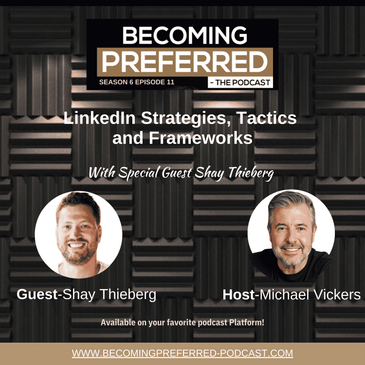
SEASON: 6 EPISODE: 11
Episode Overview:
Welcome back to Becoming Preferred, the podcast that arms you with the strategies to stop chasing and start attracting your ideal clients! I’m your host, Michael Vickers, and if you're a business professional or entrepreneur, you know the struggle: you have an incredible service, but cutting through the noise to establish yourself as the trusted authority feels impossible.
Today, we are tackling the single most powerful B2B platform: LinkedIn. It’s time to stop using your profile as a dusty online resume and start transforming it into a definitive lead generation engine. Our guest and his team have cracked the code on building genuine authority and measurable revenue through a high-conversion LinkedIn strategy. He's here to share the secrets to becoming the preferred provider in your niche.
We’re diving into everything: from the critical shift your profile must make, to the high-converting framework for direct messaging, and Shay's simple, actionable advice you can implement today.
Get ready to take notes, because this episode is how you master the art of B2B LinkedIn. Join me for my conversation with Shay Thieberg!
Guest Bio:
Shay is the Co-Founder of MAIA Digital - a LinkedIn Marketing Agency. Specializing in LinkedIn marketing, Shay holds a Masters degree in Social Psychology & Decision-Making. Shay is among 30 Global LinkedIn Certified Experts and Faculty members at Reichmann University where he teaches “B2B Marketing for Tech”.
Resource Links:
- Website: https://team-maia.com/
- Product Link: https://team-maia.com/b2b-linkedin-strategy/
Insight Gold Timestamps:
03:31 That was a lesson that I learned by myself that I can control my own life and path
05:21 My ADHD is my superpower
07:43 LinkedIn picked me
10:07 So, we're calling it the LinkedIn trifecta
11:33 The only thing that I did is post valuable insightful tips, hacks, and content for people to be able to use
17:16 I'm calling it T to B: Trust to Business
18:43 He wrote the post, I'm riding his wave, but I'm writing a thoughtful comment
23:00 I built a program that analyzes your entire LinkedIn analytics
24:37 And it's got to be authentic and you've got to be transparent with it
25:58 Stop thinking about posting content and start thinking about sharing your thoughts
28:58 I'm also a certified psychologist
34:36 People want to purchase, they don't want to be sold
38:10 The main two mistakes that people actually do...
39:21 Try to diversify your content because eventually people buy from people
41:17 I'm measuring my LinkedIn success, my ROL (Return On LinkedIn) by the amount of messages that I'm getting in my inbox
46:30 The website is team-maia.com
Connect Socially:
LinkedIn: https://www.linkedin.com/in/shay-thieberg/
Facebook: https://www.facebook.com/MAIA.DIGITAL.LINKEDIN
YouTube: https://www.youtube.com/@maia-digital
TikTok: @maiadigital_
Instagram: @team.maia.linkedin
LinkedIn Post Ideas & Examples: https://www.linkedin.com/pulse/30-linkedin-posts-ideas-examples-shay-thieberg/
Email: shay@team-maia.com
Sponsors:
Rainmaker LeadGen Platform Demo: https://calendar.summit-learning.com/widget/booking/JKItVP7WErmCBjU2cCIx
Rainmaker Digital Solutions: https://www.rainmakerdigitalsolutions.com/
In 3, 2, 1.
Speaker BWelcome back to Becoming Preferred, the podcast that arms you with the strategies to stop chasing and start attracting your ideal clients.
Speaker BI'm your host, Michael Vickers, and if you're a business professional or entrepreneur, you know the struggle.
Speaker BYou have an incredible service.
Speaker BBy cutting through the noise to establish yourself as the trusted authority to feels impossible.
Speaker BToday we are tackling the single most powerful B2B platform, LinkedIn.
Speaker BIt's time to stop using your profile as a dusty online resume and start transforming it into a definitive lead generation engine.
Speaker BOur guest and his team have cracked the code on building genuine authority and measurable revenue through a high conversion LinkedIn strategy.
Speaker BHe's here to share the secrets to becoming the preferred provider.
Speaker BAnd in your niche, we're diving into everything from the critical shift your profile must take to the high converting framework for direct messaging and Shay's simple, actionable advice you can implement today.
Speaker BGet ready to take notes because this episode is how you master The Art of B2B on LinkedIn.
Speaker BJoin me now for my conversation with Shay Thybert.
Speaker BWell, hey, Shay, welcome to the program.
Speaker BWe're delighted to have you.
Speaker AThank you, Michael.
Speaker AGood to be here.
Speaker BHey.
Speaker BHey.
Speaker BI'm really excited about this and you're speaking to us today.
Speaker BYou're in Tel Aviv.
Speaker ANext to Tel Aviv.
Speaker AYeah.
Speaker AReally close by.
Speaker BWell, very good.
Speaker BAnd just from a timely point of view, there's a lot going on in the world right now and so our hearts are with you and just in general, just some awful things going on in the world.
Speaker AThank you for this escapism.
Speaker AIt will be a nice one to have.
Speaker BThere you go.
Speaker BExactly.
Speaker BAnd peaceful.
Speaker BWell, I'm excited about this.
Speaker BYou're a specialist on LinkedIn and we love LinkedIn and we encourage our clients and our listeners to be on LinkedIn before we get there and how to develop a strategy maybe to make us prefer heard on LinkedIn and they can use the tool to its maximum benefit for us.
Speaker BHow did Shay get to be Shay?
Speaker BLet's go back.
Speaker BYou're in school.
Speaker BYou're deciding what you want to be when you grow up.
Speaker BAnd that wasn't too long ago because you're a young man.
Speaker AYeah, I'm about to be 33, so it was not that long ago, but should I go back to high school or.
Speaker BSure, you're in high school.
Speaker BYou're playing sport, you're playing soccer.
Speaker BFootball.
Speaker BYou're.
Speaker BWhat are you doing?
Speaker AI'm playing basketball.
Speaker ATill this day, I'm playing basketball.
Speaker ALakers fan over here.
Speaker AI need to wake up early.
Speaker AMornings in order to watch some games because of the different time zones.
Speaker ABut, Michael, the most fascinating thing about my high school days actually happened when I almost got kicked off school.
Speaker AI remember vividly when my teacher called me to meet the principal during the summer and she told me, hey, Shay, with those grades and the way that you interfere with your peers and teachers, I'm not sure I'm.
Speaker AI think you're going to be kicked out.
Speaker AAnd I took it personally because I was a really good friend and I wasn't that of a.
Speaker AOf a nuts one.
Speaker ALike, I was just a regular kid doing basketball thing, talking.
Speaker AI had adhd.
Speaker AI felt that no one got me.
Speaker ALike, I felt misunderstood.
Speaker AAnd I remember going home and the day after on my own terms and without consulting anyone.
Speaker AAnd I was a young person.
Speaker AI got back to school, to the principal, and it's a summertime, no one should be in school knocking on her door and begging for another chance.
Speaker AAnd she gave me that chance.
Speaker AAnd I took myself and I started to take personal tutors and working on myself.
Speaker AAnd I think that was a lesson that I learned by myself, that I can control my own life and path.
Speaker ABecause ever since this opportunity given to me, I took it with both of my hands.
Speaker AAnd later on to get accepted to my first degree, my second degree, I always had those obstacles.
Speaker AAnd every time I saw one, I took the challenge and made the efforts by myself.
Speaker ASo this hike.
Speaker AThank you for this question.
Speaker AIt's really nice to do this throwback and go back to this pivotal moment that actually changed and helped me build my character.
Speaker BYeah.
Speaker BWhat's interesting is the fact and what I'm interested in, because I can relate to you.
Speaker BI can relate to you on this.
Speaker BAnd, you know, I had a guest, and she's an expert on neurodivergent people who are neurodivergent who see the world a little differently.
Speaker BAnd as she's speaking, I'm going, you know what?
Speaker BI might be on this spectrum.
Speaker BAnd she goes, most people are on particular entrepreneurs because similar stories.
Speaker BYou know, I was disruptive.
Speaker BI felt it was boring.
Speaker BIt's like, why are we doing this?
Speaker BThis makes more sense.
Speaker BIt was challenging the norms.
Speaker BAnd so the fact that I'm more interested in that.
Speaker BWhen you're in school, what was it that was causing you to look at those things and go.
Speaker BBecause you were seeing the world differently and you've led that disruption, if you will.
Speaker BLet's call it a disruption.
Speaker BAnd maybe you didn't have the filters on that.
Speaker BYou do today, right?
Speaker BLike we not filters on.
Speaker BBut you've applied that to a business model as well.
Speaker BAnd go, how do we disrupt what's what?
Speaker BHow do we work within this complexity and make things simple?
Speaker BSo things probably didn't make sense.
Speaker BDoes that ring a bell?
Speaker BDoes that sound familiar?
Speaker AIt is because everyone told me that I have ADHD and they were trying to give me all those Ritalin pills and stuff and I never took even one, I never even tried it.
Speaker AAnd today looking back, I can tell you that my ADHD is my superpower.
Speaker BExactly.
Speaker ABeing able to navigate between tons of daily tasks and employees.
Speaker AI have 30 something clients, 12 employees, projects I'm lecturing, I'm doing so many things in one day without my adhd I don't think I would never be able to navigate between them.
Speaker BI agree.
Speaker BAnd the tools and the complexity.
Speaker BThis is why people who you see and this is what my guest said, the top influencers, the people who are really leading the way, they're all, they found their home.
Speaker BWe have tools in order to broadcast and to train.
Speaker BSo we just, just think differently.
Speaker BAnd people don't understand how you think but you just connections where people don't see connections.
Speaker BAnd even the top companies, Microsoft, they look for people who can do that because they see the world different.
Speaker BSo Bill Gates on the spectrum, you know, Michael Dow, you got all these people who same thought processes.
Speaker BAnd so we're going to bring that, we're going to unpack that and how it applies to business because you don't have to be neurodivergent or even on a spectrum.
Speaker BNo, but it's process and you're looking at different ways in new ways that most people don't look at things.
Speaker BAnd I think that's the story.
Speaker BReally.
Speaker AYeah.
Speaker AThank you for that.
Speaker ABy the way.
Speaker ADo you know what's the meaning of my name?
Speaker BNo.
Speaker BIt's a gift.
Speaker ASo I'm looking at life like I got this gift.
Speaker ASomeone else will look at ADHD as an obstacle, as something holding him back.
Speaker AI'm looking at stuff that happening in my life as a gift, like my name.
Speaker ASo this is how I'm operating and looking at the world.
Speaker BIt's perfect.
Speaker BIt's perfect.
Speaker BAnd we want people to understand that's a good thing.
Speaker BIt's a good thing.
Speaker BSo what we used to think was a handicap or this person's not advantage.
Speaker BIt's just a different way of learning, a different way of seeing the world.
Speaker BAnd we need that way to look at the world because who says the other way is the right way.
Speaker BAnd it obviously isn't because we exist, right?
Speaker BAnd so we see the world differently.
Speaker BAnd I know I see the world differently, I function differently, I'm the same way.
Speaker BI look at different things and I see the connections, I see how they're related to each other and I can see where there's opportunity.
Speaker BSo what you say there's gifts everywhere and it's just about, you know, people panic, they worry about things and it's.
Speaker AOpen up your eyes all opportunities.
Speaker BSo why LinkedIn?
Speaker BSo you're coming out of college, you're in business and you decided to choose LinkedIn as a path.
Speaker BWhat made you pick that first thing first?
Speaker ALinkedIn picked me and it's actually happened during college and not after college because as part of my studies I had to do practical stuff in order to practice.
Speaker AI studied interactive communication, ux, marketing, lots of stuff.
Speaker ASo the university took me to be their social media guy and it was in 2016 and in that year Microsoft just bought LinkedIn.
Speaker ASo I came to my boss, I told her we have to go on LinkedIn.
Speaker ASomething is going around here.
Speaker AIt's not super common for a company like Microsoft buying such a big company like LinkedIn like a social media platform.
Speaker AShe told me, Shea, Instagram just launched Instagram stories.
Speaker ALet's invest over there now.
Speaker AMichael Back in the days I used to do video editing, photography.
Speaker ASo I found it irritating that content that I'm about to produce to Instagram stories will be deleted after 24 hours.
Speaker ASo with my Israeli sassiness, I went and I opened up without telling anyone, the Reichman University, the biggest private University in Israel LinkedIn page.
Speaker AWithin a year this page was selected to be among the top five pages in Israel.
Speaker AThen I met my partner and we said let's do it, let's go on LinkedIn.
Speaker ANobody ever dealt with LinkedIn before.
Speaker AWe have something over here.
Speaker AWe felt like Adam and Eve, only HR people used to do let's take LinkedIn to the marketing realm.
Speaker AAnd we started by doing, we call it flm Founder led marketing Establish thought leadership for lots of startups in Israel.
Speaker ASo for founders, stakeholders, decision makers and then we evolved into company page management, employer branding on LinkedIn paid performance and fast forward for today, already 12 people established company and working globally.
Speaker BNo, it's interesting and you know I've always been aware of LinkedIn but we've only in the last four or five years really been active in using employing it is it.
Speaker BDo you still see it as a to your point, HR used it from A resume perspective.
Speaker BIt was kind of like that's where you would recruit from.
Speaker BThey had the recruiting model, but now we have sales navigator and for sales teams and a lot of our audience are sales professionals and stuff.
Speaker BSo what's one of the first things, if I'm a professional, an entrepreneur or a sales professional, what's one of the first things I should be looking at to make sure LinkedIn's working for me?
Speaker ASure.
Speaker ASo we're calling it the LinkedIn trifecta.
Speaker ALinkedIn can trifect three main departments, HR, which you mentioned, sales and also marketing.
Speaker ANow, in order to serve them all on the best way that you can ever possibly think, we call it, we call it ROL.
Speaker ASo you have ROI, we call it ROL return on LinkedIn how we can actually measure our investment in LinkedIn and making sure that we're not only following KPI's amount of followers and stuff, but actual tangible stuff like for salespeople, MQLs, for example, or inbound leads.
Speaker ASo for salespeople, my go to tip is to stay constant with their posting game.
Speaker ABut not only super mercuterial and salesy posting.
Speaker ASometimes when I'm lecturing to salespeople and I'm doing it quite a bit, the first thing that they think that you should do on LinkedIn is to start bombarding people with messages.
Speaker ABut if nobody encountered you before, nobody ever saw you before, and you suddenly sliding to their DMs, they don't trust you, they don't trust you, they don't need you.
Speaker ASo I'll give you a quick example.
Speaker ASince this September I got almost 90 leads organically to my business and I didn't do anything for that.
Speaker AThe stuff that I priorly did for it was building trust, making people want to work with me.
Speaker AHow did I did it?
Speaker ANo campaigns, no messages.
Speaker AThe only thing that they did is posting valuable insightful tips, hacks and content for people to be able to use.
Speaker ALots of people really afraid that if they're going to post their thoughtful and perspectives or knowledge, people will steal it.
Speaker ABut if you believe in yourself enough, nobody can do the thing that you do the best, right?
Speaker BYou share the value.
Speaker AI always say you can go ahead and learn how to change your engine, but the day that it will actually happen, you don't have the tools and you don't have the experience to actually do it on yourself.
Speaker ASo you want to go ahead and work with the best person that can do it for you.
Speaker AAnd this is my belief, whenever it comes to LinkedIn, I want to educate people about when to post, how to post, what to post, about how to send messages.
Speaker AIf you're trying to score before you went on the pitch, you're already losing.
Speaker ABecause if you're bombarding people with tons of messages and hoping that something will stick, I always, as a media person, communication person, always say to my students, think about the 99% of the people who haven't answered you and might think you're a spammer at the moment.
Speaker ASo you want to be laser focused with the people that you're approaching.
Speaker AThe best scenario is to send them a message and they already heard about you.
Speaker BYeah, no, that makes sense.
Speaker CAre you tired of chasing leads and ready to start effortlessly attracting more high value clients?
Speaker CIntroducing Rainmaker Lead Gen, the ultimate sales engagement and client acquisition platform that takes the stress out of outreach.
Speaker CWith Rainmaker Lead Gen you can easily identify, engage, educate and convert your ideas prospects into loyal clients.
Speaker COur industry leading automation and email sequencing empowers you to reach more ideal clients, accelerate the sales cycle and close more business.
Speaker CImagine authentically engaging with your prospects while the platform handles the heavy lifting.
Speaker CSay goodbye to the endless hustle and embrace a more efficient, effective approach to business development.
Speaker CReady to witness the magic?
Speaker CLook at the 20 minute demo today and see how Rainmaker Lead Gen can revolutionize and level up your client acquisition game.
Speaker CThere's nothing to lose and everything to gain.
Speaker CDon't miss out on this opportunity to supercharge your client acquisition process.
Speaker CVisit rainmaker digitalsolutions.com or check out the link in the show Notes to book your demo.
Speaker CRainmaker Lead Gen Spend less time hunting for your ideal clients and more time having high value sales conversations with your ideal clients.
Speaker BAnd now back to my conversation with Shay Thiberg.
Speaker BI think like I say, you get a lot of younger.
Speaker BI know in our sales training world we get a lot of young men in their mid early 20s.
Speaker BThey work for these SaaS companies and they're immediately pitching and so they're going in and they pitch the client and.
Speaker AThey'Re right away Belfort style.
Speaker BYeah, let me show you that.
Speaker BAnd people are gun shy with that versus on the other end with becoming preferred.
Speaker BWe believe in the relationship.
Speaker BThis is why I was delighted to have you as a guest.
Speaker BFor me it's relationship.
Speaker BSo we'll reach out to you and I'll go hey, came across your profile, you know where you have mutual friends.
Speaker BI'd love to connect with you professionally so the connection requests get high.
Speaker BFor me personally I'm up 50, 60% easily on my connection request.
Speaker BAnd then I know they're checking me out.
Speaker BSo when they go and check me out, they're looking for, I believe they're looking for relevance.
Speaker BIs this person going to be valuable to me or not?
Speaker BAnd what's the key?
Speaker BSo now they're checking you out.
Speaker BSo our headers, our profile, those things need to be optimized so that they fit the narrative that we're trying to tell the story.
Speaker BAnd I know you, you believe this and you offer this and you teach this.
Speaker BAnd then on our second request or let go up might be, hey, by the way, if there's someone in my network you'd love to meet and I can introduce for you, please don't hesitate to reach out.
Speaker BAnd so we give you a gift.
Speaker BWe call it the reciprocity.
Speaker BI'm not selling because most people, and salespeople particularly have solutions to problems.
Speaker BIf there's no problem raised, don't talk about your solution.
Speaker BValue, value, value what's valuable to that target market.
Speaker BDoes that fit within line?
Speaker AIt is.
Speaker ABut I'm doing an initial step before.
Speaker AI don't want to get into your personal life.
Speaker ASo this question will be about your professional life.
Speaker ASo the thing that I'm doing, if this one is my icp, my prospect, right, I want to reach out to him or her.
Speaker AI'm holding myself, I'm telling myself I'm going to reach out next week because in this week I'm going to like his posts, right?
Speaker AI'm going to comment on one of his posts.
Speaker AI want him to see that I view these posts.
Speaker AI will try to draw his or her attention.
Speaker AAnd only then I will post myself, obviously.
Speaker AAnd only then I will approach them.
Speaker AI'll give you another quick tip for your listeners.
Speaker APeople really like to ask me about the LinkedIn algo.
Speaker ASo a quick hack.
Speaker AWhenever you are commenting or connecting with people, they will be the next in line to see your next post.
Speaker ASo if I want to draw attention, I'm a sales rep in a SaaS company looking to book more demos.
Speaker AOkay, make your ICP list, go ahead, comment, like, connect with them and then start to post.
Speaker AThey will be the first in line to see your next vote.
Speaker AThey will perceive you as a more professional guy, they will see you more oftenly.
Speaker AAnd only then when you approach them, they were waiting for you to approach already because you cooked them for quite a bit.
Speaker ABy the way, I'm calling this entire strategy.
Speaker AYou heard about B2B.
Speaker AYou heard about B2C.
Speaker AI'm calling it T2B Trust to Business.
Speaker ABecause I saw one of your articles by the way about it in B2B marketing.
Speaker AIt's a long lasting cycle like build relationship in one day or one message.
Speaker AYou right, yeah.
Speaker BNo, that makes sense.
Speaker BAnd I think if you're coming from contribution it makes all the difference in the world.
Speaker BNow I heard on commenting and this is why we can bust the myths or not.
Speaker BIf you're going to go like somebody's post and you go like that and you're going to comment, comment at least two or three sentences so that it's not just I liked it actually.
Speaker AAmazing, right?
Speaker BAnd then maybe ask a question to create engagement because what we're doing, what you're saying is we're identifying our icp, here's our mark, here's our ideal client profile.
Speaker BThen what we want to do is connect.
Speaker BSo we want to form the connection, then we want to create engagement.
Speaker BAnd that comes before conversion into anything because until they tell us there's a problem, they're going to figure out what you do and they're going to check you out.
Speaker BI think most people probably go in and check you out and take care of it when it comes to liking or commenting.
Speaker BAny suggestions on there or hacks that in order to speed up that process?
Speaker ASure.
Speaker ALinkedIn few months ago launched impressions for comments.
Speaker AHave you seen this one?
Speaker BYes.
Speaker ASo a really nice story.
Speaker AA few weeks ago I commented on one of the biggest, most important influential VC Personas in Israel.
Speaker ARight.
Speaker ASo I'm commenting on his post.
Speaker AHe wrote the post, I'm writing his wave but I'm writing a thoughtful comment.
Speaker AMichael.
Speaker AI think I had two and a half paragraphs over there like really thoughtful comment and likes are stacking up and then I'm seeing that I have almost 3,000 impressions to my comment.
Speaker ADidn't wrote the post.
Speaker AI know everything about the answer that I was giving him from the top of my hand.
Speaker AIt's my expertise and I got 30 new connection requests from founders VCs Personas connecting with me.
Speaker ASo I'm telling people that having hard time to post, just comment on other people post thoughtfully and that will give you the most engaging.
Speaker AIt's a growth engine because you'll see who like your post your comment and then you can go ahead and connect with them.
Speaker APeople are seeing you more.
Speaker AIt's affecting your entire presence on LinkedIn.
Speaker BThat's interesting.
Speaker BSo you're saying connect with them, comment on them like their posts, warm them up, warm them up first in order to do that, that's interesting.
Speaker BGood insight.
Speaker BAnd a lot of people say they rush into the transaction.
Speaker BAnd LinkedIn is not about that, it's about building those relationships.
Speaker BSo it's finding the value.
Speaker BWhat about groups?
Speaker BWhat about groups on LinkedIn?
Speaker BAre they a good way to go?
Speaker BAnd then I want to move into, you know, some of the advertising, some of the things because there's pros and cons of that.
Speaker BBut what about joining groups and then what's the best behavior for when we belong to a group instead of soliciting people within the group, I know you'd be again delivering content, I'm assuming.
Speaker ASure.
Speaker ASo groups are not quite there yet, like on Facebook.
Speaker ALike I think LinkedIn still got some work to do on everything related to groups.
Speaker ABut I'll try to give our listeners one or two tips that can actually help them.
Speaker AIf you're looking for one of your prospects and you cannot reach him out, I don't know, you don't have LinkedIn Premium or you ran out of credits to send messages.
Speaker AMaybe happened to you, maybe this Persona is not reachable at the moment.
Speaker AHe blocked it.
Speaker AWhen you go to someone else's profile and you scroll down to the bottom, you will always see his interest within his interest.
Speaker AMichael, you can see the groups that this person is associated to if you will get accepted to one of those groups.
Speaker AAnd it's super easy to get accepted.
Speaker APeople don't know.
Speaker ABut you get five messages to people that are members with you at the same group.
Speaker BRight.
Speaker ASo you can go ahead, you can see in which groups someone is part of, go to his profile, ask to join the group and then you can message them.
Speaker AAnd LinkedIn is also giving you, and that's the best thing ever, a mutual common ground.
Speaker AIt's telling you, Michael, you and Shai are both part of leadership Think thank group.
Speaker AThis is one of the groups that I'm a part of and so it's giving you a common ground and then I can send you a message.
Speaker AHey, Michael, I saw that both of us are part of this amazing group.
Speaker ASaw your last post or whatever.
Speaker AI don't need to teach you this one.
Speaker BNo.
Speaker BAnd that's the key to it is like I say, delivering value and asking questions when it comes to responding to a post.
Speaker BSometimes, let's say you're working quite a few people in your icp.
Speaker BAre there AI tools like chat?
Speaker BCan I take the post?
Speaker BAnd from a hack point of view, because a lot of times you get brain dead.
Speaker BYou know, you got so many to do just to speed up that response and give something thoughtful.
Speaker BIn other words, have you developed any prompts that might be.
Speaker BTake this post, give me a human five sentence comment, whatever, anything there or tools that speed up that process a little bit?
Speaker ASure.
Speaker AIt's important to mention that I was selected by LinkedIn as a certified marketing expert.
Speaker AI'm one of 30 global experts.
Speaker ASo as a byproduct of that I'm not allowed to use any third party automations on LinkedIn.
Speaker ABut obviously I'm using side of LinkedIn, ChatGPT and whatever.
Speaker ASo I do take some posts that I really need some help to articulate my answers.
Speaker AI do use them, I always give them my personal perspective and go over everything.
Speaker ABut I will surprise you during the weekend.
Speaker AI build with Lovable.
Speaker AYou heard about lovable, the AI program?
Speaker AI built a program that analyzing your entire LinkedIn analytics and giving you really cool insights about your posts, your audiences, your best performing impressions and comments and everything.
Speaker ASo I launch it during the weekend and I already got 800 users using it.
Speaker APeople are sharing it online.
Speaker AWe can share it with your listeners as well.
Speaker ASo now I discovered that instead of just working hard to try to navigate what's working for me and using prohibited automations, I built an outside of LinkedIn program exporting my analytics, putting it out there and then I'm getting a full picture of everything that they do on LinkedIn that I'll share it with you.
Speaker AYou will love this one.
Speaker BYeah, that's good.
Speaker BWe'll put that in the show notes too and then people can take care of it.
Speaker BBecause the key is always, you know, what do I say?
Speaker BAnd I've even done it.
Speaker BI've gone in and taken a post, stuck it over into let's call it Chat, GBT or whatever, AI Gemini everybody and go hey, this is really good.
Speaker BI want something thoughtful, humanized to respond to it.
Speaker BThat I want to create a response from the writer and ask a question.
Speaker AAt the end of it from this point of view.
Speaker AYeah, yeah.
Speaker BAnd get a unique perspective or offer to it.
Speaker BBut I think the strategy is there.
Speaker BLet's talk about posting quantity versus quality and just content strategy.
Speaker BTypically like you said, if salespeople are just promoting their product like you see a lot of people putting posts on there and it's all about their product or the service, that's probably not a good thing.
Speaker BInstead we want to look at what's going to get my audience and take more of a broader approach.
Speaker BRight.
Speaker AAnd be authentic as well.
Speaker BAnd it's got to be authentic.
Speaker BAnd you Got to be transparent with it.
Speaker BWhat about, you know, photos, personal things?
Speaker BShould we always have a graphic that goes or a video?
Speaker BShould we.
Speaker BIf we're not posting about a product all the time, can we post about a product?
Speaker BSay we're doing, you know, post a week and what's the proper cadence?
Speaker BLike how many should I be doing without annoying everybody?
Speaker BAnd then what's the best time should I be posting?
Speaker BAnd if it's in a subject matter like for instance, I'm in sales and marketing, right.
Speaker BBecoming preferred.
Speaker BI focus on all things becoming preferred.
Speaker BSo my umbrella is big.
Speaker BMy topics are varied because I'm under a bigger umbrella.
Speaker BIf I got down and started talking about just say niche marketing or a software solution, I run out of content really quick instead, what's the outcome I'm looking for?
Speaker BSo if it's say productivity, I could do productivity hacks all year on all different Productivity hacks or LinkedIn hacks or things to.
Speaker AThere are always something going around.
Speaker BYeah, yeah, there's always something going around.
Speaker BIs there a strategy?
Speaker BQuality versus quantity.
Speaker BWhat do you recommend?
Speaker AFirst thing first, obviously quality.
Speaker AI think everyone will agree about it.
Speaker AThere is a certain cadence.
Speaker AIt's really depend on your goals.
Speaker ALet's say that if you want to grow your networking, I would say post at least once in a week.
Speaker AIf you can do twice a week, even better.
Speaker ABut my go to tip is stop thinking about posting content and start thinking about sharing your thoughts.
Speaker AThat's a huge difference.
Speaker AShare your thoughts rather than to try to post content.
Speaker AWhenever people are trying to write a post a piece of content, it's authentic.
Speaker AIt sounds very vogue sometimes too, too well done.
Speaker AI like to keep things low key, raw.
Speaker ASometimes I'm on my way to a lecture.
Speaker AOkay, what happened to me during the lecture on the go.
Speaker AIt doesn't have to be that perfect.
Speaker AThis is what people want to see.
Speaker AI'll give you a quick example.
Speaker AI'm working with Samsung globally and one of the employees, he's such a great guy but he Never posted on LinkedIn before and I was trying to teach him to write posts and it didn't work.
Speaker AAnd then he told me, but I don't mind to go on video.
Speaker AIt will be easier for me to speak about my expertise rather than to write about it.
Speaker ARight, There you go.
Speaker AHe went every week to the conference room, he opened up the camera, Open teams or Zoom and recorded himself talking about phrases and trends and best practices.
Speaker AFor his realm of expertise, it was software or hardware development.
Speaker AHe got so much engagement from the right people.
Speaker AAnd few weeks ago he told me, shea, you can't believe.
Speaker AEver since I started to post, I got to my company 648 CVS from people who want to work for us.
Speaker AMoreover, he got invites to lecture in several places.
Speaker AAnd this is the most introvert person you will ever meet.
Speaker AHe told me it helped me to build confidence.
Speaker ASo by posting in his form and the best way that suits him really worked for him.
Speaker ASo do whatever you feel comfortable with.
Speaker ADon't post because Michael or Shay told you to post.
Speaker AShare your thoughts if you have something to shake, to say.
Speaker AThat's a good one.
Speaker BThat's a good one.
Speaker BYeah, I just coined it.
Speaker BYeah, it's trending right now.
Speaker BHashtag something to shave now.
Speaker BAnd you raise an interesting point.
Speaker BSo what you're saying, and I am guilty of this myself, is we're teachers.
Speaker BLike, we're instructors.
Speaker BWe're teachers, we guide, we help people.
Speaker BSo let's say that I was going to be talking about target niche marketing, you know, and my subject is on niche.
Speaker BHere's how you identify.
Speaker BOr your icp.
Speaker BHere's how you identify.
Speaker BBlah, blah, blah.
Speaker BGreat.
Speaker AYou can do 1, 2, 3, or 4.
Speaker BYeah, yeah.
Speaker BBut what you're saying is maybe this month I'm going to talk about that, but then I'm going, here's been my experience in doing it.
Speaker BSo when I did this, here's what happened, but here's what I did to fix it.
Speaker BSo what you're saying is relate it from a personal point of view.
Speaker BThat's what the human aspect of it, not from an instructor point of view.
Speaker BIn other words, come from an adopting somebody who's on the journey with you.
Speaker BIn other words, take them with you on that.
Speaker BIs that what you're.
Speaker BI hear you saying, yeah, we haven't.
Speaker ADiscussed it yet, but I'm also a certified psychologist.
Speaker BThat's right.
Speaker BThat's where you went to school for.
Speaker BThat's right, yeah.
Speaker ASo I acquired my master's degree in social psychology.
Speaker ADecision making.
Speaker BYeah.
Speaker AMaking your approaches, your tactics, your strategies suit people, rather than try to suit people and implement them to your tactics and strategies.
Speaker AThat's my approach.
Speaker AThat's what I'm trying to do.
Speaker AAnd in order to do it, you have to be curious, you have to be patient, and you have to let people find their own way and path.
Speaker AAnd referring to my story, from the beginning of our recording, I found myself the strength to pull myself out of this situation.
Speaker AI got myself into.
Speaker AI got the opportunity, I took myself with Two hands.
Speaker ASo I really like give people, I'm really trying to give them the tools and not the actual solution.
Speaker AI'm doing it with my employees, I'm doing it with my students.
Speaker AI'm really trying to make them be better professionals and not just hands on employees who just follow stuff that they should do.
Speaker BYou want to move it more into an experience.
Speaker BAnd what's interesting on the decision making, because that's an area I focus on from sales, is we talk about emotion and logic and reason.
Speaker BSo the amygdala and the prefrontal cortex, right?
Speaker BSo what you're saying is when we're actually teaching, when we're actually teaching a principle that's going to go in, the amygdala sees it and goes, we don't know anything about this.
Speaker BThere's no emotional component to it sends it over to the prefrontal cortex or mainframe.
Speaker BAnd now the mainframe is processing it.
Speaker BBut it's not connecting necessarily on an emotional basis.
Speaker BWhere if we want to hit a trigger, and I call them triggers, an emotional trigger, it.
Speaker BIt's something of value, there's something they can relate to.
Speaker BA personal.
Speaker BIt's like, you know, my book, I've got a new book coming out and my editor comes back and goes, needs more you in here needs more personal stories.
Speaker BNeed more.
Speaker BWhere did you screw up?
Speaker BWhere did you fall out?
Speaker BWhere did you.
Speaker BInstead of it being a lecture, all right, because we want to teach.
Speaker BIt's here's what I did, here's how it lends way more credibility to the solution than just the solution.
Speaker BSo you're saying humanize it, personalize it.
Speaker ATreat it that way and also address it as.
Speaker AAlso as a business owner or a manager.
Speaker AAnd why is that?
Speaker ABecause as a business manager or an owner, a boss, someone who's managing people, okay, this person came to me, he needs help.
Speaker AOkay, solve the problem, we can go move forward.
Speaker ABut on the long run, he will keep coming to me.
Speaker AI want to build him to find his own answers.
Speaker AHolding back for a second, not telling him what he should or she do, but trying to actual get to his or her sense and making them in the future solve their own problems.
Speaker AThat's what's giving me a better business as well.
Speaker AA functional business that can actually sustainably grow itself.
Speaker ABecause if I will be the teacher and the problem solver and the person that you came to me with this scenario and you got my perspective.
Speaker ANo, I want you to develop your own perspective because then it will allow you to grow, to develop and for me, as someone who most of my employees are four or five years already with me, it's also helping me to, to take myself out of the day to day operations and even the stage to lead.
Speaker AAnd that's how you build a sustainable system.
Speaker BHow do you speaking of sustainability and systems.
Speaker BSo like I'm active and every day I get messages that come in and if we're using it as an outbound point of view, like I'm fairly reactive than I am proactive.
Speaker BJust because we have enough leads and things that pop in, is there a way to manage that?
Speaker BAre there some tools to manage those relationships?
Speaker BBecause within LinkedIn itself or Navigator, we can save them to lists, we can save our icp, we can have or we got premium, I get all that and then in they come, the inbox.
Speaker BBut as far as our sales process goes or an engagement process.
Speaker BSo I meet with you, I've connected with you, we're exchanging things back and forth and commenting.
Speaker BHow do I know where I'm at if I'm working hundreds of these?
Speaker BHow do I know where I'm at with you?
Speaker BHow do I know what should be my next step and when's my right time, where I should be going?
Speaker BAssuming you're qualified that I should make a request that hey, maybe we should have a conversation, maybe we should have a face to face.
Speaker BIs there a way you track all of those things like spreadsheet software, any.
Speaker ASpreadsheets, but asking questions, that's the obviously the first thing.
Speaker AThere is one thing that you do that I was preparing to the podcast that I really, really like and is sending in personal videos.
Speaker AI've been doing it for quite a bit.
Speaker AIf, let's say I spoke with one ICP few weeks ago and nothing really happened.
Speaker ASurprising him with a personal video.
Speaker AGoing over his LinkedIn profile, his marketing efforts, his latest post.
Speaker AHey Michael, saw your last video.
Speaker AI follow up our latest call.
Speaker AHere's a tip to increase your engagement in your next one.
Speaker AThat's so valuable.
Speaker AIt took me a minute to record myself doing it.
Speaker AIt's less time than writing an email.
Speaker AIt's less cocky or too pushy than to bombard his dm.
Speaker ALike there is someone, a salesperson that constantly chasing me at the emails right now and the more he's doing it day after day, it's antagonizing me.
Speaker AAnd we discussed psychology earlier.
Speaker APeople want to purchase, they don't want to be sold, make them.
Speaker AIt's like when you go to a shop, you go to.
Speaker AI don't know Zara, you go to, I don't know where you buy your clothes.
Speaker ASo the most annoying thing ever, you go to the store, the first thing happening to you, it's one of the nice ladies is jumping on you.
Speaker AHey, do you need any help?
Speaker ANo.
Speaker AWait a second.
Speaker ALet me fill the clothes.
Speaker ALet me see the price tags.
Speaker BLet me give me.
Speaker ALet's absorb the experience and make so the thing that I do.
Speaker AAnd that's a really cool tip.
Speaker AI'm retargeting with paid campaigns.
Speaker AI'm promoting content, not paid ads like supermarket or leave your details, sign up or think.
Speaker AI'm adding my icps to my remarketing lists.
Speaker ASo let's say you and I, we had a conversation.
Speaker AOkay, perfect.
Speaker AYou haven't bought anything from me yet because we said earlier B2B it's a long term cycle.
Speaker ARight now you'll be in my marketing list for always on paid compatible content.
Speaker AI want you to think and know but by yourself that I'm the best in the market because you're seeing me all over.
Speaker ASo some people call it omnichannel approach, some people call it always on approach to remarketing.
Speaker AI simply state it as being trustworthiness.
Speaker AYou want to be out there, you want to be top of mind and you want to be considered as the number one option the next time someone going back to the decision making position.
Speaker BLet's unpack that just a little bit for our listeners.
Speaker BSo what you're saying under said it right is I've got my followers, we're talking, we're engaging.
Speaker BI can actually create ads that retarget just specific people that are now my first connections or second connection.
Speaker AYou know, it's a little bit more complex than this.
Speaker AI'm taking, I'm seeing in which company they're a part of.
Speaker AI'm adding the company and their job title to my targeting list in LinkedIn Campaign Manager.
Speaker ASo that's one thing that I can do.
Speaker AAnd then I know that they will see my next post over and over again.
Speaker ANurturing my list.
Speaker BYeah, exactly.
Speaker AAll the time.
Speaker BAnd they call you when the opportunity's there and usually they'll call you if they know about you and they have awareness, they're going to ring out to you and that's why the keys ask the question and not be in too much of a hurry.
Speaker BI think on that.
Speaker BLet's talk about the ads part of it.
Speaker BWe're familiar with Facebook, Instagram, all the different ads.
Speaker BA lot of comments I hear from other entrepreneurs is LinkedIn's very expensive.
Speaker BThe ROI wasn't there and they're obviously not doing it right because this is all that you focus on.
Speaker BAddress that a little bit.
Speaker BWhat do they typically typically do wrong and what's the right approach?
Speaker AOkay, that's a misconception.
Speaker ALet's talk facts.
Speaker AThe average of all averages is 208 USD for leads for one lead.
Speaker AThat's the average of all of it.
Speaker AObviously it's very to do different.
Speaker B200 for a lead.
Speaker AYeah.
Speaker ANow if you compare it to Facebook or Google, obviously it's much more, but it's all you need to compare it to your products.
Speaker BHow much are you selling?
Speaker BIf you had a $30,000 solution, 200 bucks is nothing.
Speaker BYeah.
Speaker AEven if you need 10 leads, which is already 2,000 and something USD for one campaign, if you got one clients from it, it's nice for you.
Speaker AAnd then I ask my client how long usually a client sticking with you.
Speaker AWe are B2B in B2B clients sticking with their providers for years.
Speaker ASo it's worked, it's long lasting.
Speaker ABut the main two mistakes that people actually do, they rush to leads too early and they're not diversifying the creatives that they're using.
Speaker ASo my approach is to use thought leadership ads promoting people from your company posts that you can do only on LinkedIn, by the way, the thought leadership ads promoting videos, promoting articles, promoting single image content that you already posted in your page, then remarket it to your most interested Personas and only after try to send them a message or a lead form.
Speaker AWhenever you're working step after step, you're seeing up to six times more conversions and up to 30% more less in ad spend.
Speaker AAnd Michael, it's working phenomenally.
Speaker AI usually with most of our clients, I'm not even reaching to the third part of the funnel and the budgets are much lower.
Speaker ASo don't rush to leads too fast because I saw so many companies and startups getting burned out of it.
Speaker AAnd try to diversify your content because eventually people buying from people.
Speaker AAnd if you're not promoting content and you're only promoting those type of generic graphics, nobody, people are blind to it.
Speaker BYeah, no, that makes sense.
Speaker BLet's talk about navigating the algorithm.
Speaker BYou keep hearing different people talking about, okay, let's do a post or they join a pod of 20 other people.
Speaker BThey post on a Tuesday, Wednesday or Thursday and then all 20 people within two hours go and comment on it.
Speaker BAnd does that really do anything or is the algorithm figured that one out and Going okay.
Speaker BThey're just trying to.
Speaker AYeah.
Speaker ALinkedIn is tracking it.
Speaker AThey know that you're using it.
Speaker AThey will get to you eventually.
Speaker AI saw so many cases of really good people that LinkedIn is not playing around.
Speaker AThey will close your account pods.
Speaker AI wouldn't recommend to use it.
Speaker AI would use internal pod like not an automated one like open up a Slack channel or a WhatsApp group.
Speaker AAsk your teammates to comment on your post.
Speaker AIt will give you the enough boost to get things going.
Speaker AAlso I'm also letting my employees tracking their own metrics on LinkedIn.
Speaker AWe have a metric scorecard and they seeing their growth and it's really giving them the enough motivation to keep moving forward and eventually I'm always trying to measure my LinkedIn success.
Speaker ANot about the amount of likes, comments, shares or impressions that I get, about the amount of private messages that I get.
Speaker AAnd you'll see me, I have 10,000 something or more followers that don't even count.
Speaker AI got 5,000, 6,000 impressions per.
Speaker AI don't care about it.
Speaker AEventually I want money in the bank.
Speaker AAnd money in the bank is coming from communication from people who actually reached out because they found me enough valuable and insightful and they want to keep on the connection meet.
Speaker ASo I'm measuring my LinkedIn success, my ROL return on LinkedIn by the amount of messages that I'm getting in my inbox.
Speaker BYeah.
Speaker BAnd opportunities and sales.
Speaker BWe do the same thing in podcasts where you know, the listenings, the downloads, the whatever.
Speaker BGreat.
Speaker BBut at the end of the day, do we make good relationships?
Speaker BAre we finding this is expensive?
Speaker AYeah.
Speaker AYou want tangible results.
Speaker BYep.
Speaker BIt's how much is going into the bank account?
Speaker BIt's got to be a means to an end and to take care of it.
Speaker BLast question for you.
Speaker BIs there best times to post as far as.
Speaker BAnd there's a couple things and I think these are good little tips.
Speaker BLike I just know what we do.
Speaker BWe post for instance podcast every day.
Speaker BWe do snippets of the episode that go out and get taking it.
Speaker BBut when we schedule our posts so we use a scheduling system in order to do it.
Speaker BBut we also if there's an outside link, we don't put any outside of links inside of a LinkedIn post because LinkedIn doesn't like it when you take them off the platform.
Speaker AThey changed it.
Speaker BSo you can do that now.
Speaker ANot only that, you can they also recommend it because you can now see in your personal profile analytics how many people clicked on your third party link.
Speaker BYeah.
Speaker ADo want to use at the moment.
Speaker AThis is the latest update.
Speaker AYou do want to use links in your post.
Speaker AThat's the first thing.
Speaker AAnd back to the beginning of your question.
Speaker AThe best time to post is whenever you can be engaging back with the comments and the likes and the stuff that you're getting.
Speaker ASo always say it's 50% of writing, producing your content and 50% distributing it.
Speaker ABecause if you're posting something, scheduling, forget about it, it won't last.
Speaker ABut if you're posting something and within the first two golden hours you will.
Speaker AI got a comment from Michael.
Speaker AI'll comment back, I'll send it in a Slack channel, be active in distributing it, you'll see much better results.
Speaker ASo yeah, it will kind of growth hacking for the algorithm, but it's working.
Speaker AYou want to create discussions and conversations and as a last tip, try to open up your post for discussions.
Speaker AJust don't use statements or anything.
Speaker ADon't just try to be the most valuable and thoughtful person out there.
Speaker AUse the vast majority of people on LinkedIn to hear their thoughts, their perspectives.
Speaker ATwo weeks ago I posted the question a client asked me if I'm going to decrease my pricing due to the usage of AI.
Speaker AI posted about it, what my network think about it.
Speaker AI got so many comments, so many perspectives, I learned from it.
Speaker ASo it was a really nice trial to see how people are reacting to different types of questions.
Speaker BSo basically what I'm hearing you say is, and when we do our posts, write it as if it's going to that one particular person and ask them the question as if you were sitting right across from them and you were exchanging emails or dialogue instead of writing to a group of people, to that individual and hey, what's your take on that?
Speaker BI'd love to hear your take on that.
Speaker BHere's your feeling, but set time aside.
Speaker BSo when you do post, if you're posting at 11 o' clock on a Thursday, get the post out there, but then be ready to sit around and answer the and engage back because LinkedIn loves the engagement.
Speaker BAnd then what you're saying, like what we used to do to get around the link issue is we would put the link in the first comment and then just pin the first comment to do it.
Speaker BBut you're saying it doesn't matter anymore, we can just put that link in and take care of it there.
Speaker BNo, that's great advice.
Speaker BAny last suggestions?
Speaker BTime.
Speaker BBoy, we've really gone into our time.
Speaker AHere, but this is my, my one last thing.
Speaker AYou know the story about Alice In Wonderland, right?
Speaker BYeah.
Speaker ASo Alice is going around the woods.
Speaker AAll of a sudden she gets sucked to the core of the earth.
Speaker AShe's going through some psychedelic experiences.
Speaker AShe meeting this creepy cat and the Queen of hearts.
Speaker AThen she go out the second side of the woods.
Speaker AThe same goes with us.
Speaker AWe scroll through LinkedIn or any other platform and all of a sudden we get sucked into a hook.
Speaker ASomething that hooked us, lured us in and now we have 10 seconds, 20 seconds of someone else's attention.
Speaker AIn few moments we're going to get out to the.
Speaker AWe're going to keep scrolling.
Speaker AAlice in Wonderland is my way of checking if my post got any value.
Speaker AI'm asking myself, did I made someone laugh?
Speaker ADid I teach something new to someone?
Speaker AAlice in Wonderland is my way of thinking that after I drew someone in, I want to make sure that his experience by reading my post, he's getting something out of it value, a laugh, something emotional, something he didn't know before.
Speaker ASo this one is my go to way to measure and check if my content is worth a while.
Speaker ANot every post, but most of them I'm trying to measure them.
Speaker BNo, it's a good focus and go from there.
Speaker BThis was absolutely amazing.
Speaker BDid you go by Shay or Shy?
Speaker BI heard you say shy but I've been calling you Shay.
Speaker BDo you have a preference?
Speaker AThe actual one in Israel it's shy but the way that people are usually read it, it's Shay and I'm used to it.
Speaker AAnd also Shay, you're a Canadian.
Speaker ASo Shay Gilgis Alexander is giving me a really good way that the way he pronounced his name from the NBA.
Speaker ASo I'm sticking with Shay.
Speaker AIt's a really nice one when I'm stay with Shay.
Speaker BIt's a good way to do it.
Speaker BExcellent.
Speaker BHey, well, thanks for doing this.
Speaker BThe website is team maya.com Maia.com will have all their information in the show Notes.
Speaker BCompanies can reach out to you and I know you work with some great brands, whether it's LinkedIn, ads, company page management, personal training, resources, profile optimization, thought leadership, employer branding, you name it, you guys cover it all.
Speaker BAnd you're a great boutique and you got some great customers and clients and obviously you know what you're talking about.
Speaker BThanks so much for being our guest today.
Speaker AThank you.
Speaker BMichael, as you are listening to this episode, what is one idea that you've heard that has caught your attention and why does it matter so much to you and who is one person who you can share that with, either sharing this episode or just sharing that insight that occurred to you while you were listening.
Speaker BPerhaps it is learning to shift your LinkedIn profile from a traditional resume to a client focused lead generation tool.
Speaker BOr, when reaching out to new connections, avoid pitching immediately and start offering genuine value.
Speaker BThank you for listening, for learning, and for investing in yourself so that you can become the best version of you.
Speaker BIf you found value in this episode, please write a review on Apple Podcasts.
Speaker BIf you haven't subscribed yet, please do so so you can get a new episode and start your week off right every Monday.
Speaker BUntil next time.
Speaker BThis podcast is created and associated with Summit Media.
Speaker BMy Executive producer is Beth Smith and Director of Research, Tori Smith.
Speaker BThe fee for the show is that you share it with friends when you find something useful or interesting.
Speaker BThis podcast is subject to copyright by Summit Media.
Speaker AGoodbye.